

econintersect.com
  • 토토사이트
    • 카지노사이트
    • 도박사이트
    • 룰렛 사이트
    • 라이브카지노
    • 바카라사이트
    • 안전카지노
  • 경제
  • 파이낸스
  • 정치
  • 투자
No Result
View All Result
  • 토토사이트
    • 카지노사이트
    • 도박사이트
    • 룰렛 사이트
    • 라이브카지노
    • 바카라사이트
    • 안전카지노
  • 경제
  • 파이낸스
  • 정치
  • 투자
No Result
View All Result
econintersect.com
No Result
View All Result

Kansas City Fed: Manufacturing Activity Contracts for Sixth Month in March 2013

admin by admin
3월 28, 2013
in 미분류
0
0
SHARES
0
VIEWS

This is the first manufacturing survey in March which shows contraction.  Please see below.

TENTH DISTRICT MANUFACTURING SURVEY FELL AT A SLOWER RATE

The Federal Reserve Bank of Kansas City released the March Manufacturing Survey today. According to Chad Wilkerson, vice president and economist at the Federal Reserve Bank of Kansas City, the survey revealed that Tenth District manufacturing activity fell at a slower rate, but producers were considerably more optimistic about future months.

“Factory activity rebounded somewhat in March, although overall levels still remain sluggish. Contacts continued to cite uncertainty about healthcare costs and the overall economy as reasons for lower growth,” said Wilkerson. “However, the outlook for future activity was notably more positive than in previous months.”


Summary of all Federal Reserve Districts Manufacturing:

Richmond Fed (hyperlink to reports):

/images/z richmond_man.PNG

Kansas Fed (hyperlink to reports):

/images/z kansas_man.PNG

Dallas Fed (hyperlink to reports):

/images/z dallas_man.PNG

Philly Fed (hyperlink to reports):

/images/z philly fed1.PNG

New York Fed (hyperlink to reports):

/images/z empire1.PNG

Federal Reserve Industrial Production – Actual Data (hyperlink to report)
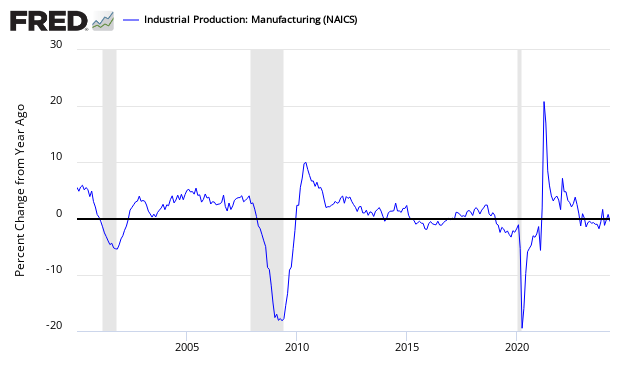
 

Holding this and other survey’s Econintersect follows accountable for their predictions, the following graph compares the hard data from Industrial Products manufacturing subindex (dark blue bar) and US Census manufacturing shipments (lighter blue bar) to the Kansas City Survey (pea-green bar).

Comparing Surveys to Hard Data

/images/z survey1.png

In the above graphic, hard data is the long bars, and surveys are the short bars. The arrows on the left side are the key to growth or contraction.


Steven Hansen

Previous Post

Markets Open Slightly Higher, Remain Flat And Mixed

Next Post

CoreLogic Reports Foreclosure Inventory Down 19% Year-over-Year in February 2013

Related Posts

Bitcoin Is Finally Trading Perfectly Like 'Digital Gold'
Economics

Bitcoin Is Finally Trading Perfectly Like ‘Digital Gold’

by admin
Namibia Will Regulate And Not Ban Crypto With New Law
Finance

Namibia Will Regulate And Not Ban Crypto With New Law

by admin
6,746 ETH Valued At $12M Was Just Burned
Economics

6,746 ETH Valued At $12M Was Just Burned

by admin
Bitcoin Is Steady Above $29,000 Awaiting US NFP Figures
Economics

Bitcoin: What Next After Consolidation Ends?

by admin
US Government Offloads Another 8,200 Bitcoin – On-chain Data
Economics

US Government Offloads Another 8,200 Bitcoin – On-chain Data

by admin
Next Post

CoreLogic Reports Foreclosure Inventory Down 19% Year-over-Year in February 2013

답글 남기기 응답 취소

이메일 주소는 공개되지 않습니다. 필수 필드는 *로 표시됩니다

Browse by Category

  • Business
  • Econ Intersect News
  • Economics
  • Finance
  • Politics
  • Uncategorized

Browse by Tags

adoption altcoins bank banking banks Binance Bitcoin Bitcoin market blockchain BTC BTC price business China crypto crypto adoption cryptocurrency crypto exchange crypto market crypto regulation decentralized finance DeFi Elon Musk ETH Ethereum Europe Federal Reserve finance FTX inflation investment market analysis Metaverse NFT nonfungible tokens oil market price analysis recession regulation Russia stock market technology Tesla the UK the US Twitter

Categories

  • Business
  • Econ Intersect News
  • Economics
  • Finance
  • Politics
  • Uncategorized

© Copyright 2024 EconIntersect

No Result
View All Result
  • 토토사이트
    • 카지노사이트
    • 도박사이트
    • 룰렛 사이트
    • 라이브카지노
    • 바카라사이트
    • 안전카지노
  • 경제
  • 파이낸스
  • 정치
  • 투자

© Copyright 2024 EconIntersect