


Written by Sig Silber
We published the NOAA Long-Term Forecast Part I on July 15, 2021. Tonight we compare the NOAA forecast for Alaska and CONUS with the JAMSTEC forecast. We show the maps side by side in a table with a summary. Obviously, the farther out you look, the less confidence you have in the forecasts and thus also the differences in the forecasts. Also provided are the JAMSTEC World Forecasts. JAMSTEC has sent us their forecast privately as their website is still not functional. What they have sent us includes a monthly forecast for each of the first three months so we are also able to compare the NOAA and JAMSTEC August forecasts this time. As usual, there are some significant differences but also a lot of agreement. What is a bit unusal is that they differ early and agree more in subsequent seasons.

Coping With Rapid Change.
Please share this article – Go to the very top of the page, right-hand side for social media buttons. Please feel free to send this article to anyone who you think might find it interesting and or useful.
An intriguing statement from the JAMSTEC Discussion.
Some parts of West Africa will also experience a wetter-than-normal condition due to the evolving Atlantic Niño.
I do not think they publish an index on that but unknown to many people the same process that we call ENSO in the Pacific also takes place in the Atlantic Ocean but it is more muted there. The dynamics are I would say almost identical. The timing does not fit real well with enhancing the hurricane season but this is something to pay attention to.
C. Comparison of the NOAA and JAMSTEC Forecasts
C1. The Comparison
Below is the comparison of the NOAA and JAMSTEC temperature and precipitation forecast maps for the month of August and then three season defined time-periods. In the Summary Table we show the NOAA forecast for Alaska and CONUS (the contiguous mid-latitude U.S) and right next to it the JAMSTEC forecast for North America (which includes Canada and part of Mexico). The NOAA forecast maps can be clicked on to enlarge. The JAMSTEC maps in the table are not set up to be clicked on to enlarge (because we do not have a larger version of them). We have concluded that these smaller images work fine for comparison purposes. Later in the article, we show the World Forecasts.
JAMSTEC normally works only with three-month seasons: Right now that is Fall: SON, Winter: DJF and Spring: MAM. Out of each three months, there is normally just one where the months in the two forecasts align perfectly for the first time period. But all of a sudden JAMSTEC has changed the process so I have forecast maps from JAMSTEC for August, September and October. I think this is an improvement. So I am now able to match up the NOAA and JAMSTEC maps exactly. It might look strange as we are comparing the NOAA SON forecast (not the ASO forecast) to the JAMSTEC SON forecast but we are also comparing the NOAA August forecast to the JAMSTEC August forecast.
| It is important to remember that the NOAA forecast is dated July 15 so it was probably prepared on July 13 or 14 and the JAMSTEC forecast is dated July 1. That is important when comparing assumptions when things are changing rapidly. |
In addition to the value of comparing the JAMSTEC and NOAA forecasts, the JAMSTEC forecast by showing North America provides more context for the Alaska and CONUS Forecasts as the temperature and precipitation patterns cover North America, not just Alaska and CONUS.
Map Comparisons and our Comments
Temperature*
| NOAA Alaska Plus CONUS | JAMSTEC North America | |
August 2021 |  |  |
Fall SON 2021 |  |  |
Winter DJF 2021-2022 |  |  |
Spring MAM 2022 |  |  |
Precipitation*
| NOAA Alaska Plus CONUS | JAMSTEC North America | |
August 2021 |  |  |
| Fall SON 2021
|  |  |
Winter DJF 2021-2022 |  |  |
Spring MAM 2022 |  |  |
* It is important to keep in mind that NOAA reports probabilities of being warmer or cooler than Climatology and JAMSTEC reports the degrees of temperature and millimeters of precipitation variation from Climatology (Normal). So they are not exactly comparable. Also please keep in mind that NOAA is now using a redefinition of Climatology which is the mean of the most recent three decades of weather namely 1991 to 2020. We do not believe that JAMSTEC has updated their definition of Climatology, They may have but there has been no announcement from JAMSTEC that they have updated their Climate Normals. This makes the comparisons a bit more difficult.
JAMSTEC World Forecasts
This month our comments for Summer and Fall (Northern Hemisphere Seasons) are taken directly from the JAMSTEC discussion. We do not have a JAMSTEC discussion for the July forecast.
Aug 2021
| Temperature |
 |
| Precipitation |
 |
Fall which is SON
| Temperature |
 |
| Precipitation |
 |
JAMSTEC says: “On a seasonal scale, the SINTEX-F predicts that most parts of the globe will experience a hotter-than-normal condition in boreal autumn (austral spring) except for northern parts of the South American Continent. ” “As regards to the seasonally averaged rainfall in boreal autumn (austral spring), a drier-than-normal condition is predicted for California, southern parts of the South American Continent, most parts of southern Africa, some parts of West Africa, some parts of Europe, some parts of Indochina, and most parts of China. In contrast, most parts of Alaska, the western coastal area of Canada, Central America, northern parts of the South American Continent, some parts of Central Africa, India, Philippines, and Indonesia will experience a wetter-than-normal condition. Some parts of West Africa will also experience a wetter-than-normal condition due to the evolving Atlantic Niño. Extremely wetter-than-normal conditions in Indonesia will be mostly due to the evolving negative Indian Ocean Dipole.” “The model predicts most parts of Japan will experience a warmer-than-normal condition in autumn as a seasonal average. As regards to the seasonally averaged rainfall, the model predicts almost neutral conditions over most parts of Japan in autumn.”
Winter which is DJF 2021-2022
 |
| Precipitation |
 “ “ |
Spring which is MAM 2022
 |
| Precipitation |
 “ “ |
I do not usually present this and I am doing it in a way that you have three large images but I think you can see some things.

Here is the JAMSTEC Discussion
We provided the full JAMSTEC Discussion in Part I. We repeat it here.
ENSO forecast:
Observation shows that the tropical Pacific is in a neutral state. The SINTEX-F predicts that a weak La Niña Modoki-like state will appear in boreal autumn.
Indian Ocean forecast:
As predicted earlier, observation shows occurrence of a negative Indian Ocean Dipole. The SINTEX-F ensemble mean predicts that the Indian Ocean will return to a neutral state in boreal autumn. However, there is a large uncertainty in the predictions, and the SINTEX-F2-3DVAR, which predicted most recent IOD events, predicts that a weakly negative Indian Ocean Dipole will persist in boreal autumn.
Regional forecast:
On a seasonal scale, the SINTEX-F predicts that most parts of the globe will experience a hotter-than-normal condition in boreal autumn (austral spring) except for northern parts of the South American Continent. In boreal winter (austral summer), the model still predicts most parts of the globe will experience a warmer-than-normal condition, except for northern parts of the South American Continent and some parts of Europe.
As regards to the seasonally averaged rainfall in boreal autumn (austral spring), a drier-than-normal condition is predicted for California, southern parts of the South American Continent, most parts of southern Africa, some parts of West Africa, some parts of Europe, some parts of Indochina, and most parts of China. In contrast, most parts of Alaska, the western coastal area of Canada, Central America, northern parts of the South American Continent, some parts of Central Africa, India, Philippines, and Indonesia will experience a wetter-than-normal condition. Some parts of West Africa will also experience a wetter-than-normal condition due to the evolving Atlantic Niño. Extremely wetter-than-normal conditions in Indonesia will be mostly due to the evolving negative Indian Ocean Dipole. In boreal winter (austral summer), a wetter-than-normal condition is predicted for Alaska, northern parts of the South American Continent, Philippines, and Indonesia. In contrast, most parts of Australia, some parts of southern Africa, and some parts of Europe will experience a drier-than-normal condition.
The model predicts most parts of Japan will experience a warmer-than-normal condition in autumn and winter as a seasonal average. As regards to the seasonally averaged rainfall, the model predicts almost neutral conditions over most parts of Japan in autumn. In winter, Okinawa and southern parts of Japan will experience a drier-than-normal condition
C2. ENSO Assumptions
Now let us look at the NOAA recent ENSO Update. This happens every month on the second Thursday. I show this because it is the information that NOAA works from in producing the Four-Season Forecast. We have covered some of this when we reported on the IRI/CPC analysis on July 8, 2021. I have added the JAMSTEC assumptions and also the Australian Bureau of Meteorology Assumptions.
ENSO UPDATE


This is a NOAA graphic but not part of the release of information on July 8, 2021. My interpretation of this graphic is that we are NOT in La Nina right now. It is a cross-section of the Equatorial Pacific. What counts is the surface temperature and this only shows the Equator and the actual calculation is based on the temperature anomaly from 170W to 120W but inducing 5 degrees north and south of the Equator. I have a different graphic that shows that but this one is probably more accurate for the area shown. The water is anomalously cold east of 100W. But west of 150W it is certainly not as cold as -0.5C. So we are definitely in ENSO Neutral the question being what is next and when will there be a change.
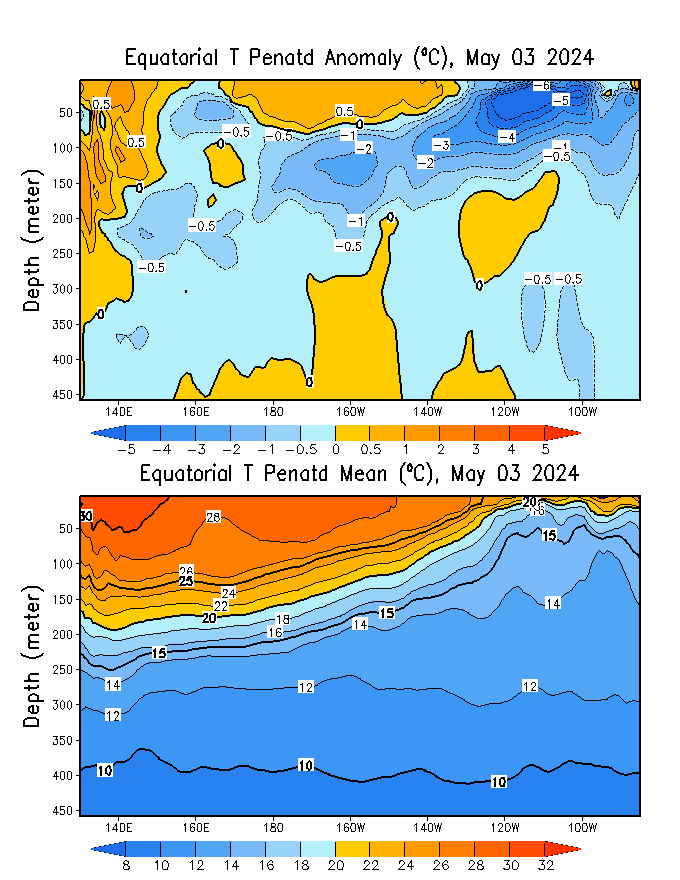
But now I freeze the graphic and focus on the top part which shows the temperature anomalies.

Below is the graphic above but also one issued five days later. (I believe these images are five-day averages centered on the date shown.)
| Prior Version | Updated Version | |
 |
|
|

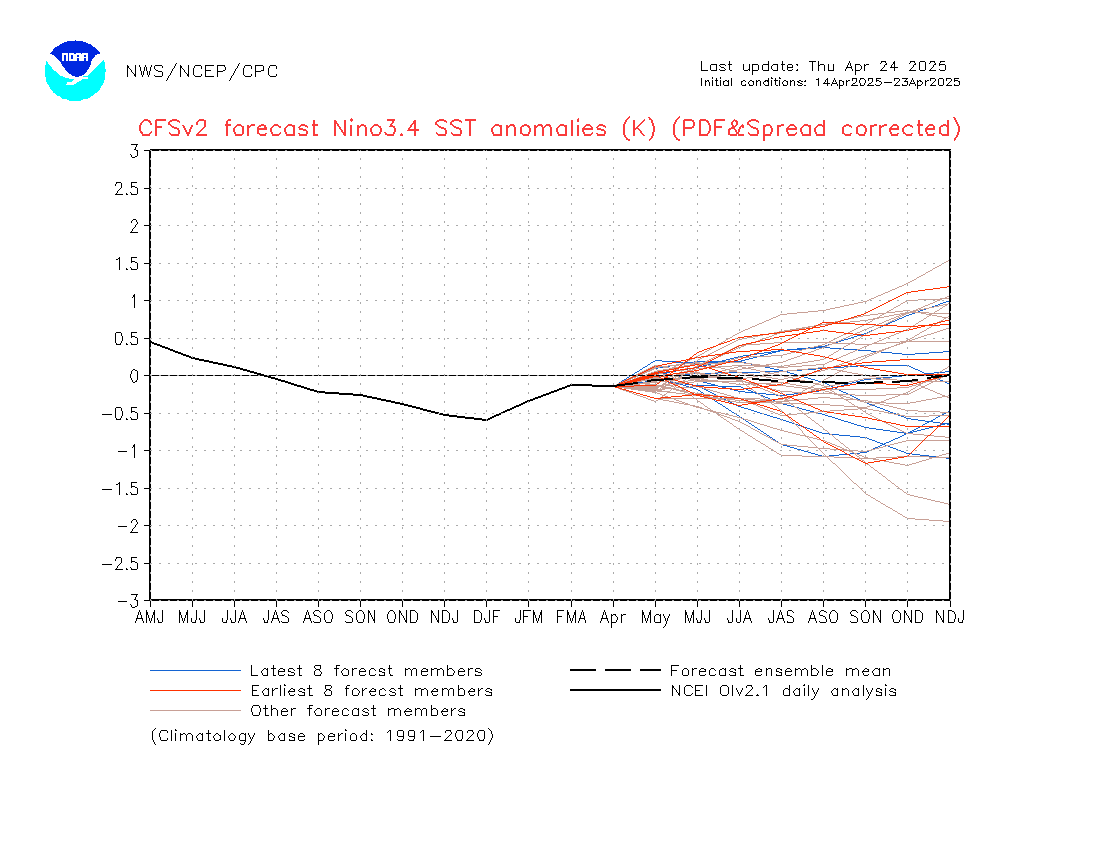


The Southern Oscillation Index or SOI being above 7 confirms that the Atmosphere is in tune with the Sea Surface Temperatures in the Pacific along the Equator. This is another graphic that we have not frozen.

Here is the BOM (Australia Bureau of Meteorology) Nino3.4 tracker.

Here is their current forecast.

Indian Ocean Dipole
Here is the JAMSTEC index forecast.

Here is the BOM version.

Here is the BOM Discussion of this event. It also mentions ENSO.
Negative IOD event likely in 2021 INACTIVE ENSO Outlook
Indian Ocean Dipole (IOD) index values continue to be negative. A negative IOD event is declared when there have been at least 8 weeks below the IOD index threshold of −0.4 °C. A negative IOD increases the chances of above average winter-spring rainfall for parts of southern Australia.
The most recent weekly IOD value is −0.27 °C, which is above the negative IOD threshold (−0.4 °C) but follows on from the IOD index being below the negative IOD threshold for the previous six weeks. Most climate models surveyed by the Bureau predict the IOD to return to below the negative IOD threshold, with a negative IOD event likely for the second half of the southern hemisphere winter and into spring.
The El Niño–Southern Oscillation (ENSO) remains neutral with most oceanic and atmospheric indicators within the neutral range. Cloudiness near the Date Line has been below average over the past fortnight, although this is weak and a localised pattern. Most climate model outlooks indicate a neutral ENSO state is likely to continue for the remainder of the southern hemisphere winter and spring despite tropical Pacific sea surface temperatures slowly cooling over the coming six months. This may be contributing to the wetter than average climate outlooks for parts of Australia.
The Southern Annular Mode (SAM) has been positive for the past four weeks. Forecasts suggest SAM will return to neutral levels over the coming week. Neutral SAM has little influence on Australian climate, while positive SAM typically means cold fronts and troughs are shifted further south than their usual winter path.
It is likely some of the wetter weather seen during June may have been a result of the developing negative IOD event, while the drier weather for parts of southern WA and western Tasmania may have been influenced by the positive SAM.
The Madden–Julian Oscillation (MJO) is currently over the Indian Ocean. Most climate models indicate the MJO will weaken approaching the Maritime Continent over the coming week. Should the MJO maintain its strength, an MJO near the Maritime Continent typically leads to stronger westerly winds over the Indian Ocean, which can reinforce the negative IOD.
Climate change continues to influence Australian and global climate. Australia’s climate has warmed by 1.44 ± 0.24 °C over 1910–2019, while southern Australia has seen a reduction of 10–20% in cool season (April–October) rainfall in recent decades.
I am not sure what to do with this.

D. Conclusion
As usual, there is a disagreement between NOAA and JAMSTEC. The differences are substantial especially with respect to precipitation.
It is difficult to relate the differences in the forecast to differences in assumptions on ENSO. But JAMSTEC tends to consider other factors that may not be considered by NOAA. On the other hand, the new versions of the JAMSTEC model are early in their usage and may not have been fully calibrated. I do not think I have gone into it in detail but when it comes to models we need to recognize that there are limitations and NOAA and JAMSTEC use very different approaches which I have summarized in the below table.
| Shorter Term | Intermediate-Term | |
| NOAA | Deterministic | Statistical |
| JAMSTEC | Deterministic | Deterministic (may also use statistical methods) |
| Assessment | Generally Considered to be reliable for 14 to 28 days | Errors build up in deterministic models and statistical models generally have insufficient historical data to be reliable |
So it is kind of a pick your poison choice. But both agencies have great skill at employing approaches that have inherent limitations.


