


Written by Steven Hansen
The U.S. new cases 7-day rolling average are 17.3 % LOWER than the 7-day rolling average one week ago. U.S. hospitalizations due to COVID-19 are now 8.6 % LOWER than the rolling average one week ago. U.S. deaths due to coronavirus are now 11.8 % HIGHER than the rolling average one week ago. Today’s posts include:
- U.S. Coronavirus New Cases are 146,640
- U.S. Coronavirus hospitalizations are at an elevated 108,957
- U.S. Coronavirus deaths are at an elevated 4,087
- U.S. Coronavirus immunizations have been administered to 7.1 % of the population
- The 7-day rolling average rate of growth of the pandemic shows new cases worsened, hospitalizations improved, and deaths worsened
- Current charts are showing a “holiday” peak is behind us – hopefully, this improving trend will remain in play even with the new strains
- Eyeglass Wearers Are 5x Less Likely To Get COVID, Study
- Risks of contracting Covid-19 are “much higher” than mild risks of vaccines
- Most Common U.K. COVID Variant Symptoms Revealed.
- Eli Lilly says monoclonal antibody cocktail cuts hospitalizations by 70% for high-risk COVID-19 patients
- PharmaMar Soars 21% After Mouse Data Confirm Drug’s Efficacy Against COVID
- Colchicine for Early COVID-19? Trial May Support Oral Therapy at Home
- 53 Dead in Gibraltar in 10 Days After Experimental Pfizer mRNA COVID Injections Started
- Former diplomat to China explains the ‘weaponization of COVID’
- Norway May Refine Vaccine Strategy After Elderly Deaths
- Serum Institute of India to produce an additional 100 million vaccine doses for India and other countries

The recent worsening of the trendlines for new cases is behind us which was attributed to going back to college/university, cooler weather causing more indoor activities, mutation of the virus, fatigue from wearing masks / social distancing, holiday activities, and some loosening of regulations designed to slow the coronavirus spread.
My continuing advice is to continue to wash your hands (especially after using the toilet as COVID first sheds in your stool), putting down the toilet seat (as flushing the toilet releases a plume), wear masks, avoid crowds, and maintain social distancing. No handwashing, mask, or social distancing will guarantee you do not get infected – but it sure as hell lowers the risk in all situations – and the evidence to-date shows a lower severity of COVID-19. In addition, certain activities are believed to carry a higher risk – like being inside in air conditioning and removing your mask (such as restaurants, around your children/grandchildren, bars, and gyms). It is all about viral load – and outdoor activities are generally safe if you can maintain social distance. Finally, studies show eating right (making sure you are supporting your immune system) and adequate sleep increase your ability to fight off COVID.
include($_SERVER[‘DOCUMENT_ROOT’].’/pages/coronavirus1.htm’); ?>
Hospitalizations (grey line) and Mortality (green line)
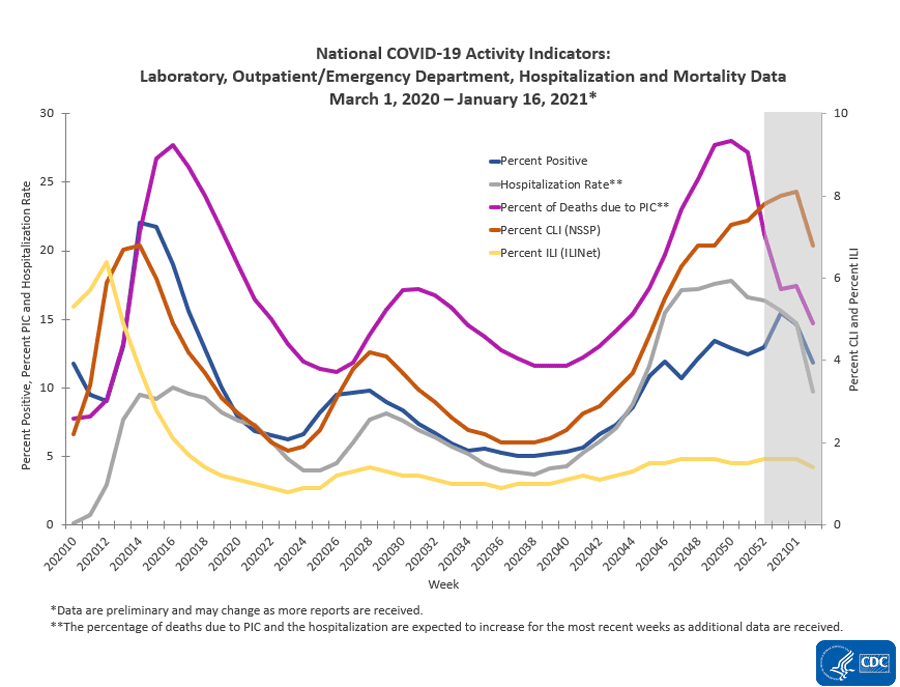
source: https://www.cdc.gov/coronavirus/2019-ncov/covid-data/covidview/index.html
Hospitalizations Are The Only Accurate Gauge As Reporting Is Not Affected By Holidays
The 4 day Thanksgiving holiday period put the first wobble in the trends. Over weekends and holidays, the number of new cases and deaths decline. Over weekends, this is not a problem for week-over-week rolling averages as weekends are compared against the previous weekend. But when a holiday falls within a working week, a non-working day is compared to a working day which causes havok in the trends.
However, hospitalizations historically appear to be little affected by weekends or holidays – the daily counts do not vary significantly from day-to-day.
The hospitalization growth rate trend is improving.

For the Thanksgiving and the end of the year holiday period – roughly, it seems each appears to have added around 5 % to the rate of growth of new cases, hospitalizations, and deaths.
Historically, hospitalization growth follows new case growth by one to two weeks.
As an analyst, I use the rate of growth to determine the trend. But, the size of the pandemic is growing in terms of real numbers – and if the rate of growth does not become negative – the pandemic will overwhelm all resources.
The graph below shows the rate of growth relative to the growth a week earlier updated through today [note that negative numbers mean the rolling averages are LOWER than the rolling averages one week ago]. As one can see, the rate of growth for new cases peaked in early December 2020 for Thanksgiving, and early January 2021 for end of year holidays – and the rate of growth is now contracting.

In the scheme of things, new cases decline first, followed by hospitalizations, and then deaths.
It is up to each of our readers to protect themselves and others by washing your hands, wearing a mask, avoiding crowds, and maintaining social distancing.
Will The New Variants Cause The Next Spike?
Maybe and maybe not. It all depends on vaccinations:
- the more people that are vaccinated reduces the pool of people that can be infected. Today we have removed over 7% of the population from being infected which theoretically should reduce the infection rate by 7% [it is unstudied whether the vaccines prevent a vaccinated person from being a carrier of the virus even though showing no signs]. If the vaccines are shown to stop transmission, then in theory it would reduce the infection rate by double the percent vaccinated [in this case you prevent your own infection and do not pass it along to another].
- it is also unknown what the effective rate of the current vaccines is against mutations that seem to appear almost daily. As an example, if the effective rate drops to 60%, it means the 7% reduction in the infection rate discussed above is almost cut in half. There continues to be worries that the South African and Brazilian variant is somewhat immune to the current vaccines.
- The pandemic should be over immediately if everyone could be vaccinated today. The problem is that every day brings a new mutation (which would not appear if the pandemic was stopped). The longer the immunization process takes – the more ineffective the vaccine will become.
- It is not clear whether the vaccine prevents those vaccinated from spreading the virus. It seems to be well documented that it normally stops the virus from taking hold and when it does not – the infection is mild.
Coronavirus News You May Have Missed
Risks of contracting Covid-19 are “much higher” than mild risks of vaccines, CDC director says – CNN
US Centers for Disease Control and Prevention Director Dr. Rochelle Walensky emphasized that the Covid-19 vaccines are safe and effective, saying the risk of getting sick with the virus is higher than having an anaphylaxis reaction.
“I want to take a moment here to emphasize that the Covid-19 vaccines are safe and they work. And this is backed up with data,” Walensky said at the White House Covid-19 Response Team’s first press briefing on Wednesday.
She said that based on recent data, there were 2.1 cases of anaphylaxis per million doses administered of the Moderna vaccine. For the Pfizer vaccine, data showed 6.2 cases of anaphylaxis per million doses.
“Let me be clear, these are rare, treatable outcomes and the Covid-19 vaccines are safe. It’s also important to put this into context. The risk with getting sick with Covid-19 are much higher than the risk of allergy or anaphylaxis from the vaccine,” she said.
“While anaphylaxis can be scary, there are effective treatments, and patients generally do quite well,” she added.
Walensky also said it is important to remember that there may be some side effects with the vaccine, including things like feeling feverish or having muscle aches.
“These are all normal and expected part of getting a vaccine, especially the second dose. These symptoms mean your immune system is revving up and the vaccine is actually working,” she said.
Norway May Refine Vaccine Strategy After Elderly Deaths, PM Says – Bloomberg
The Prime Minister of Norway, Erna Solberg, says her country may fine-tune the vaccination of its oldest, sickest citizens as it tries to make sense of a recent spate of deaths.
Having weathered the pandemic better than most, Norway suddenly made international headlines this month after revealing that more than 30 people — all over 70 and all already sick — died not long after being vaccinated against Covid-19. Solberg says the intense global interest in the news was “exaggerated” as she tries to ensure the development doesn’t put people off inoculation.
“We don’t believe there’s any problem with the safety of the vaccines,” Solberg said in an interview with Bloomberg Live that aired on Tuesday. “But we will maybe not give them to the most vulnerable of the elderly, because that might speed up a process where they were what we would say at the end of life phase anyway,” so, “that probably is not what we will continue to do.”
… Other countries, including Germany, have also recorded deaths in people who recently were vaccinated. Finland reported three such fatalities on Tuesday, but none of the countries identified causal links.
The Norwegian Medicines Agency says there’s no evidence so far that the elderly deaths reported were directly linked to the vaccine. “However, it cannot be ruled out that common vaccine side effects, such as fever and nausea, may have contributed to a serious course of underlying disease in frail patients,” the agency said in a written response to questions.
Norway is now working with Pfizer Inc. and BioNTech SE — the first producers to provide it with vaccines — to examine its data in more detail. The country’s medicines agency has told Pfizer it doesn’t see grounds for alarm. The first Europe-wide safety report on the Pfizer-BioNTech vaccine is due to be published at the end of January.
53 Dead in Gibraltar in 10 Days After Experimental Pfizer mRNA COVID Injections Started – Medical Kidnap
[editor’s note: I have partially fact-checked this post but cannot confirm it is 100% accurate. However, it is quite detailed, and deserves a full read]
Gibraltar is a British Colony at the southern tip of the Iberian Peninsula attached to the country of Spain. It’s population is just over 30,000 people, and it is best known for its huge “rock,” the “Rock of Gibraltar.”
I have been contacted by residents in Gibraltar stating that 53 people have died in 10 days immediately following the roll out of injections of the Pfizer mRNA COVID injections, and calling it a “massacre.”
Local media reports confirm the deaths, but blame them on COVID, and not the COVID injections.
However, prior to the roll out of the injections, it is reported that only 16 people in total died “from COVID” since the beginning of the “pandemic” about a year ago.
SERUM INSTITUTE OF INDIA TO PRODUCE UP TO AN ADDITIONAL 100 MILLION COVID-19 VACCINE DOSES FOR INDIA AND LOW-AND MIDDLE-INCOME COUNTRIES IN 2021 – Serum Institute
- The announcement takesforward the collaboration between the Serum Institute of India (SII), Gavi, the Vaccine Alliance and the Bill & Melinda Gates Foundation.
- The expansion follows August’s announcement of up to 100 million doses to be delivered by the collaboration, bringingthe total now to be delivered by the partnership to up to 200 million doses of COVID-19 vaccines•Itwill accelerate manufacturing and delivery of up to an additional 100 million doses of future safe and effective COVID-19 vaccines, priced at a maximum of US$ 3 per dose,for low-and middle-income countries in 2021.
- The Bill & Melinda Gates Foundation, via its Strategic Investment Fund, will provide at-risk funding of a further US$150 million to Gavi, bringing the total funding provided through this collaboration to US$300 million.
Former diplomat to China explains the ‘weaponization of COVID’ – 60 Minutes Australia
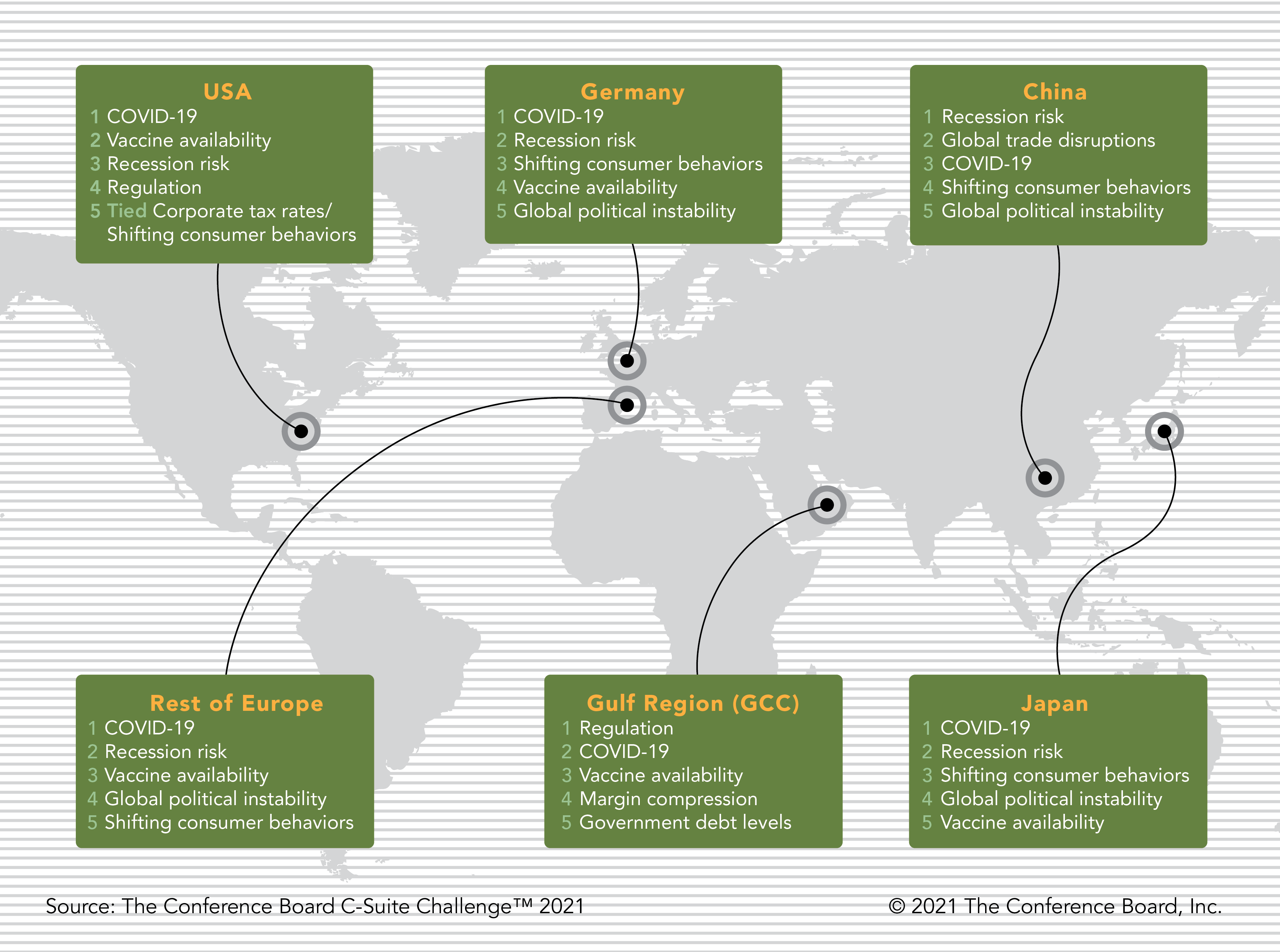
Top Five External Challenges – The Conference Board
According to the C-Suite Challenge™ 2021, a new report based on a recent survey of global CEOs and C-Suite executives conducted by The Conference Board, many of the top issues business leaders will face in 2021 transcend national borders. When asked which issues outside of management control will have the greatest impact on their business in the coming year, CEO survey participants cited the COVID-19 virus, vaccine availability, and changing consumer buying behaviors as the key potential game changers in 2021. However, despite modest growth expectations, both in the short and long term, business leaders seem unable to shake lingering concerns over recession.
COVID-19: The virus itself was the greatest CEO concern regardless of location, with a few exceptions. In the Gulf region,* COVID-19 ranked second as the most important external challenge, and in China it ranked third. Executives around the world remain acutely aware that the virus still has the ability to disrupt their businesses, especially if the pandemic is not brought under control.
Recession fears: CEOs remain concerned that the economic downturn seen in 2020 could resurface. While Chinese CEOs rate recession risk as their top external concern in 2021, their counterparts in most other parts of the world rank it second. The Conference Board forecasts that the global economy will rebound in 2021, but due to the fluid nature of the pandemic, we also maintain upside and downside scenarios.
Vaccine availability: CEOs believe the broad availability of COVID-19 vaccines would have a positive impact on their businesses in the coming year. As more people are inoculated against the virus, the pandemic risk declines and the business environment improves. US CEOs ranked the vaccine as the second most important external factor for 2021. European business leaders ranked it third, but Chinese CEOs ranked it ninth.
Shifting consumer buying behaviors: CEOs across almost all geographies rated this challenge in their top five concerns. While they recognize that consumer buying behaviors are changing, they also see new products and services and new customer segments as key levers of growth for their companies.
Eli Lilly says monoclonal antibody cocktail cuts hospitalizations by 70% for high-risk COVID-19 patients – USA Today
While vaccines may help slow the COVID-19 pandemic over the next months, drug company Eli Lilly announced Tuesday that its treatments can help save lives in the meantime.
The company’s drug bamlanivimab was authorized by the U.S. Food and Drug Administration late last year and has been used by 125,000 high-risk patients nationwide based on early-stage data suggesting it could be effective.
The drug is a monoclonal antibody, meaning it mimics one of the natural antibodies the immune system uses to fight off the virus.
Then-President Donald Trump as well as former New Jersey Gov. Chris Christie and former New York City Mayor Rudy Giuliani all received monoclonal antibodies shortly after they were diagnosed with COVID-19.
In a large, late-stage study the company unveiled Tuesday, bamlanivimab combined with another monoclonal antibody, etesevimab, was found to be extremely effective in high-risk patients diagnosed with COVID-19.
Among patients who received a placebo, 10% of those at high risk ended up in the hospital, compared with just 2% of those who received the drug cocktail – a 70% drop. Patients were diagnosed an average of four days before treatment.
Trump touted monoclonal antibodies: Why aren’t more people getting them?
None of the 518 patients who received the cocktail died, compared with eight deaths among an equal-size group with COVID-19 who received a placebo.
The single drug and the cocktail performed equally well, said Lilly’s chief scientific officer Dr. Daniel Skovronsky, but the company is going to switch to making the combination once it receives FDA authorization.
U.S. goal to squeeze more COVID shots from Pfizer vials hampered by syringe production – Reuters
The world’s largest syringe maker does not have the capacity to substantially increase U.S. supplies of specialty syringes needed to squeeze more doses from Pfizer Inc COVID-19 vaccine vials in the coming weeks, an executive said in an interview.
The vaccine made by Pfizer and its German partner BioNTech, one of two authorized for U.S. emergency use, is shipped in vials initially indicated to hold five doses. Six doses can be drawn with special syringes, call low dead space, which minimize the amount of vaccine left in the syringe after use.
If healthcare providers can reliably extract the sixth dose it would allow supplies to be stretched 20% further and could be a financial boost for Pfizer, which is paid per dose.
The U.S. government has begun giving healthcare providers new syringe kits to extract six shots from each vial. It said that three of the low dead space syringes in each six-needle kit would allow extraction, according to an email reviewed by Reuters. A CDC spokeswoman said the new kits would contain a “majority” of low dead space syringes.
Syringe maker Becton Dickinson has contracted with the U.S. government to provide 286 million syringes for use with COVID-19 vaccines, including around 40 million low dead space syringes, and is fully prepared to deliver on that agreement, said Troy Kirkpatrick, the company’s senior director of public relations.
… A new production line for syringes will be functional by July but was not designed to produce additional low dead space syringes, he said.
The federal government has contracts with other manufacturers, and it was not immediately clear whether they could supply more of the specialty syringes.
PharmaMar Soars 21% After Mouse Data Confirm Drug’s Efficacy Against COVID – Medscape
Shares in Spanish pharmaceutical company PharmaMar spiked over 20% on Tuesday after it cited a paper published in the journal Science that confirmed “potent preclinical efficacy” of its drug Aplidin against COVID-19.
A study carried out in vitro and in mice by a team of scientists in New York, San Francisco and Paris showed Aplidin (plitidepsin) leads to a reduction of viral replication, resulting in a 99% reduction of viral loads in the lungs of animals, the researchers reported (https://bit.ly/3cldxii).
The drug, approved in Australia for the treatment of multiple myeloma, blocks a host protein associated with the COVID-19 virus. Toxicity of the drug is well known and the doses used in COVID-19 trials are well tolerated in humans, the company said.
“When we infected animals and we treated them with the adequate dose of plitidepsin, an extraordinary reduction of the viral load is produced,” Pablo Aviles, head of nonclinical toxicology and pharmacology at PharmaMar, told Reuters TV.
The drug began early-stage clinical trials against COVID-19 last year. In April, plitidepsin was among several existing drugs flagged for their potential antiviral activity in a multidisciplinary study of host proteins that interact with the SARS-CoV-2 virus (https://reut.rs/39k5SPD; https://go.nature.com/2KQHg7J).
PharmaMar said it was in talks with various regulatory agencies – the most advanced ones being with the Spanish and British regulators – to start Phase III trials. They are deciding how many patients should be included in the trial.
“At first we are not targeting ICU patients, there will be hospitalized patients, but doctors are collaborating with us to identify the different phases a sick person goes through, and determine which would be ideal to focus on to produce the best results we can get from plitidepsin,” he said.
Most Common U.K. COVID Variant Symptoms Revealed in Survey – Newsweek
Symptoms such as cough, fatigue, muscle ache and sore throat appear to be more common in people who test positive for the B.1.1.7 COVID variant compared to other versions of the virus, a survey conducted in the U.K. has found.
The survey, which was published by the U.K. Office for National Statistics (ONS), also found that participants were slightly less likely to report a loss of taste or smell.
The B.1.1.7 variant was first detected in the U.K. toward the end of last year and has now been found in several countries around the world, as well as more than 20 U.S. states.
Scientists say the new variant is around 50 to 70 percent more infectious than the original. Some evidence has also emerged recently to suggest that the variant may be linked to higher mortality, although the data to support this hypothesis is not yet strong.
The survey involved responses from a random sample of 6,000 people in England between November 15, 2020, and January 16, 2021.
The researchers categorized the symptoms into the following groups:
- Any: all reported symptoms, including reporting symptoms compatible with COVID-19 whilst not naming specific symptoms
- Classic: cough, fever, shortness of breath, loss of taste or loss of smell
- Gastrointestinal: abdominal pain, nausea, vomiting or diarrhea
- Loss of taste or smell only
The survey found that the largest differences in reported symptoms with people who had tested positive with the new variant compared to others were seen in the frequency of cough, sore throat, fatigue and muscle pain.
“People testing positive compatible with the new U.K. variant were more likely to report any symptoms and the classic symptoms,” the authors of the study wrote.
However, they were slightly less likely to report loss of taste and smell, and there was no evidence of difference in the percentages reporting gastrointestinal symptoms, shortness of breath or headaches.
Among the people who tested for the new variant, 35 percent reported a cough, 32 percent said they had fatigue, 25 percent reported muscle aches and pains and 21.8 percent said they experienced a sore throat.
Among the people who tested positive for other variants, 28 percent reported a cough, 29 percent said they had fatigue, 21 percent reported muscle aches and pains and 19 percent said they experienced a sore throat.
Eyeglass Wearers Are 5x Less Likely To Get COVID, Study – Newsweek
Your favorite spectacles could also be one of your new defenses against contracting the novel coronavirus, according to a recent study conducted by researchers in China. This investigation looked at the proportion of glasses wearers with Covid-19 versus the general population of glasses wearers in the area, and the findings may surprise you.
The study, published in September 2020, consisted of all 276 inpatients with COVID-19 in Suizhou Zengdu Hospital, Suizhou, China, a designated hospital for COVID-19 treatment in the area, between January 27 and March 13, 2020. The median age of the study cohort was 51 years.
Of the patients, 30 were eyeglass wearers, consisting of 16 cases of nearsightedness and 14 cases of farsightedness. The 16 cases of nearsightedness were all classified as long-term wearers, indicating they wear their glasses for more than eight hours a day. These long-term glasses wearers account for 5.8 percent of the inpatient Covid cases in this study.
To get an estimate of the general population of glasses wearers, the researchers looked at a study from decades ago of students aged seven to 22 years in Hubei province, of which 31.5 percent wore glasses for nearsightedness. These people would now be between the ages of 42 to 57, close to the median age of 51 for the Covid patients in this study.
Thus, the general population is 5.4 times more likely to wear eyeglasses daily than those diagnosed with coronavirus.
Colchicine for Early COVID-19? Trial May Support Oral Therapy at Home – MedPage
Anti-inflammatory oral drug colchicine improved COVID-19 outcomes for patients with relatively mild cases, according to certain topline results from the COLCORONA trial announced in a brief press release.
Overall, the drug used for gout and rheumatic diseases reduced risk of death or hospitalizations by 21% versus placebo, which “approached statistical significance.”
However, there was a significant effect among the 4,159 of 4,488 patients who had their diagnosis of COVID-19 confirmed by a positive PCR test:
- 25% fewer hospitalizations
- 50% less need for mechanical ventilation
- 44% fewer deaths
If full data confirm the topline claims — the press release offered no other details, and did not mention plans for publication or conference presentation — colchicine would become the first oral drug proven to benefit non-hospitalized patients with COVID-19.
Coronavirus variants are impacting tests, FDA official says – CNN
Coronavirus variants popping up across the US are beginning to affect tests for the virus, the US Food and Drug Administration said Wednesday.
The agency said it is asking test developers to ensure their tests can detect the virus as it continues to mutate, an FDA official said.
“We are starting to see mutations to impact tests,” Dr. Timothy Stenzel, director of the FDA’s Office of In Vitro Diagnostics and Radiological Health, said during a briefing.
“There may be a performance difference going forward,” he added.
Stenzel said that Covid-19 tests are being developed that will consider new variants.
“We are going to start beginning to ask developers how they think they can monitor for variants of concern,” he said.
The following are foreign headlines with hyperlinks to the posts
“Realistic possibility” that UK variant ~30% more deadly
The United Kingdom has become the first country in Europe to pass 100,000 coronavirus-related deaths as infections around the globe topped 100 million. With more than 2.1 million dead worldwide, people the world over are mourning loved ones, but the U.K.’s toll weighs particularly heavily: It is the smallest nation to pass the painful milestone.
India’s first indigenous Covid-19 vaccine Covaxin effectively neutralises the deadly and infectious UK variants of SARS-CoV-2 virus, reducing the possibility of mutant virus escape, its developer Bharat Biotech said on Wednesday.
Chinese vaccine trial in Dhaka fell through. Its state media blames New Delhi
China has given more than 22 million doses of coronavirus vaccines
More than 1 million Beijing residents have been given anal swab tests for COVID-19, which scientists there say are more accurate than other types of tests.
Myanmar starts India-made COVID jabs, but China vaccine on hold
Some European Countries Move To Require Medical-Grade Masks In Public
Sanofi to help produce millions of rival Pfizer’s COVID-19 vaccines in Europe
Britain requires citizens flying home from 22 countries to quarantine at hotels.
In one fight over scarce vaccines, it’s Britain versus the European Union.
AstraZeneca CEO Pascal Soriot, in defense of the drugmaker’s delayed Covid vaccine rollout to the EU, said the 27-member bloc ordered three months later than the U.K., however, the company is “working 24/7” to fix production issues
Moscow mayor lifts restrictions, declaring the pandemic is ‘on the decline.’
Mexico’s richest man Carlos Slim hospitalized with COVID-19
The pandemic economically hit women and ethnic minorities the hardest, while the 1,000 richest people on the planet recouped their losses within nine months
Covid-19 variant first seen in UK has now been detected in at least 70 countries, WHO says
Madrid suspends vaccination program due to lack of supply
Two hospitals in German state of Bavaria self-quarantine after tests indicate UK variant
Nearly 300 Covid-19 cases in South Korea linked to unauthorized religious school
Peru locks down 10 regions due to “extreme” Covid-19 threat
WHO team in Wuhan to begin long-delayed coronavirus investigation after clearing quarantine
The following additional national and state headlines with hyperlinks to the posts
Biden administration orders 200 million more doses of Covid-19 vaccines
Biden vows to vaccinate 300m people in US by end of summer or early fall
Vaccine hesitancy is decreasing in the U.S.
The president is dispatching America’s top scientists and public health experts to regularly update the public about the pandemic. Beginning today, the experts will host briefings three times a week on the state of the outbreak and efforts to control it.
Moral Dilemma: Oregon teachers are eligible for COVID-19 shots before senior citizens after Democratic Gov. Kate Brown decided to prioritize reopening schools.
Parade-less Mardi Gras: You can’t keep a good city down, especially when Mardi Gras is coming. All around New Orleans, thousands of houses are being decorated as floats because the pandemic canceled the elaborate parades usually mobbed by crowds during the Carnival season and on Fat Tuesday.
FDA warns about hand sanitizers from Mexico
Risk of SARS-CoV-2 transmission among students attending in-person K-12 school was relatively low with masking and other precautions, according to a study of 17 rural Wisconsin schools published in MMWR; among 191 cases in students and staff, only 3.7% were linked to in-school transmission.
Putting moratoria on eviction and utility disconnection resulted in 8.2% lower rates of COVID infection, according to a study from National Bureau of Economic Research.
NIH has launched a database to collect reports of neurological symptoms associated with COVID-19
NIAID Director Anthony Fauci, MD, is the highest-paid employee in the federal government, with a reported salary of more than $434,000 in 2020 — higher than then-president Trump, who made $400,000.
Pfizer said it will be able to produce 200 million doses of its COVID vaccine for the U.S. by the end of May, 2 months earlier than expected, and rival Sanofi says it plans to help Pfizer with production for the EU.
Although there’s only a one in a billion chance that a COVID vaccination will cause a positive result on a drug test, some athletes will still refuse to get the vaccine, World Anti-Doping Agency scientists said.
Philadelphia’s Department of Public Health ended its partnership with the group that runs its largest COVID vaccination site after discovering the group had become for-profit and changed its policies to allow for the potential sale of patient data.
House panel investigating Trump administration purchases of ventilators
Oklahoma trying to return anti-malaria drug touted by Trump: report
Bill and Melinda Gates warn pandemic could unleash ‘immunity inequality’
US considering mandatory COVID-19 tests for domestic flyers, CDC official says
Costco COVID Vaccine Registration Latest As Stores Prepare for Appointments
Florida Super-Spreader Wrestling Tournaments Caused 79 COVID Infections
The United States is “43rd in the world” in its ability to track potentially dangerous new mutations of the coronavirus, according to President Biden’s coronavirus czar, who used the White House’s first public health briefing to issue a stark warning that the nation will remain vulnerable to the deadly pandemic unless Congress quickly passes a virus relief bill.
President Biden, under intense pressure to speed up the pace of coronavirus vaccination, said on Tuesday that his administration was nearing a deal with two manufacturers that would enable 300 million Americans to have their shots by the end of the summer.
Enrollment in N.Y.C. schools drops sharply, especially among preschool-age children.
Gov. Andrew Cuomo said New York will lift restrictions on gatherings and some nonessential businesses across most of the state — except in parts of the greater New York City-area, including Washington Heights, the Bronx and Queens, and the Newburgh area upstate.
NYC to receive 30% more doses of Moderna vaccine as a result of Biden plan
The percentage of Americans who want to be vaccinated as soon as possible or who have already received at least one dose of a two-dose regimen has jumped to 47 percent from 34 percent in Kaiser’s December survey.
The Wisconsin Senate voted to end a statewide mask mandate.
Federal Reserve Chair Jerome Powell said Wednesday nothing is more important for the economy than vaccinations — and that he’s gotten the first dose of a vaccine himself.
Two top U.S. health agencies will collaborate to study how effective Covid-19 vaccines are against mutated strains of the virus, White House health advisor Dr. Anthony Fauci said Wednesday.
Democrats are preparing to pass another coronavirus relief package without any Republican support.
Airport screenings in the U.S. are at their lowest since July as Covid-19 infections rise, CNBC’s Leslie Josephs.
The coronavirus pandemic has had an uneven financial impact on women and people of color, and it’s affected their ability to save for retirement.
Just over half of the adults with credit card debt, or roughly 51 million people, added to their balances since the start of the coronavirus crisis, according to a new report by CreditCards.com. Nearly half, or 44%, said the pandemic was to blame, the report also found.
U.S. reports record number of Covid deaths in January
CDC watching to see if new Covid-19 variants cause more cases of rare complication in children
Biden’s Covid task force says there is no vaccine stockpile
Walmart says it has thousands of stores ready to administer Covid vaccines
Today’s Posts On Econintersect Showing Impact Of The Pandemic With Hyperlinks
Worldwide Coronavirus Cases Surpass 100 Million
Headline Durable Goods New Orders Improved Again In December 2020
Infographic Of The Day: Global Income Support During COVID-19
Renters Are Still In A Recession
Intense Scrutiny Of Chinese-Born Researchers In The US Threatens Innovation
Environmental News For The Week Ending 23January 2019
Warning to Readers
The amount of politically biased articles on the internet continues to increase. And studies and opinions of the experts continue to contradict other studies and expert opinions. Honestly, it is difficult to believe anything anymore. A study usually cannot establish cause and effect – but only correlation. Be very careful what you believe about this pandemic.

I assemble this coronavirus update daily – sifting through the posts on the internet. I try to avoid politically slanted posts (mostly from CNN, New York Times, and the Washington Post) and can usually find unslanted posts on that subject from other sources on the internet. I wait to publish posts on subjects that I cannot validate across several sources. But after all this extra work, I do not know if I have conveyed the REAL facts. It is my job to provide information so that you have the facts necessary – and then it is up to readers to draw conclusions.
Analyst Opinion of Coronavirus Data
There are several takeaways that need to be understood when viewing coronavirus statistical data:
- The global counts are suspect for a variety of reasons including political. Even the U.S. count has issues as it is possible that as much as half the population has had coronavirus and was asymptomatic. It would be a far better metric using a random sampling of the population weekly. In short, we do not understand the size of the error in the tracking numbers.
- Just because some of the methodology used in aggregating the data in the U.S. is flawed – as long as the flaw is uniformly applied – you establish a baseline. This is why it is dangerous to compare two countries as they likely use different methodologies to determine who has (and who died) from coronavirus.
- COVID-19 and the flu are different but can have similar symptoms. For sure, COVID-19 so far is much more deadly than the flu. [click here to compare symptoms]
- From an industrial engineering point of view, one can argue that it is best to flatten the curve only to the point that the health care system is barely able to cope. This solution only works if-and-only-if one can catch this coronavirus once and develops immunity. In the case of COVID-19, herd immunity may need to be in the 80% to 85% range. WHO warns that few have developed antibodies to COVID-19 when recovering from COVID-19. Herd immunity does not look like an option without immunization although there is now a discussion of whether T-Cells play a part in immunity [which means one might have immunity without antibodies]
- Older population countries will have a significantly higher death rate as there is relatively few hospitalizations and deaths in younger age groups..
- There are at least 8 strains of the coronavirus. New York may have a deadlier strain imported from Europe, compared to less deadly viruses elsewhere in the United States.
- Each publication uses different cutoff times for its coronavirus statistics. Our data uses 11:00 am London time. Also, there is an unexplained variation in the total numbers both globally and in the U.S.
What we do or do not know about the coronavirus [actually there is little scientifically proven information]. Most of our knowledge is anecdotal, from studies with limited subjects, or from studies without peer review.
- How many people have been infected as many do not show symptoms?
- Masks do work. Unfortunately, early in the pandemic, many health experts — in the U.S. and around the world — decided that the public could not be trusted to hear the truth about masks. Instead, the experts spread a misleading message, discouraging the use of masks.
- Current thinking is that we develop 5 months of immunity from further COVID infection.
- The Moderna and Pfizer vaccines have an effectiveness rate of about 95 percent after two doses. That is on par with the vaccines for chickenpox and measles. The 95 percent number understates the effectivenessas it counts anyone who came down with a mild case of Covid-19 as a failure. But turning Covid into a typical flu — as the vaccines evidently did for most of the remaining 5 percent — is actually a success. Of the 32,000 people who received the Moderna or Pfizer vaccine in a research trial, only one contracted a severe Covid case.
- To what degree do people who never develop symptoms contribute to transmission? Research early in the pandemic suggested that the rate of asymptomatic infections could be as high as 81%. But a meta-analysis, which included 13 studies involving 21,708 people, calculated the rate of asymptomatic presentation to be 17%.
- The accuracy of rapid testing is questioned – and the more accurate test results are not being given in a timely manner.
- Can children widely spread coronavirus? [current thinking is that they are a minor source of the pandemic spread]
- Why have some places avoided big coronavirus outbreaks – and others hit hard?
- Air conditioning contributes to the pandemic spread.
- It appears that there is increased risk of infection and mortality for those living in larger occupancy households.
- Male patients have almost three times the odds of requiring intensive treatment unit (ITU) admission compared to females.
- Outdoor activities seem to be a lower risk than indoor activities.
- Will other medical treatments for Covid-19 ease symptoms and reduce deaths? So far only remdesivir, Bamlanivimab,
and Regeneron) are approved for treatment. What drugs work?
Arthritis drugs tocilizumab and sarilumab could cut relative risk of death of those in intensive care by 24%
- A current scientific understanding of the way the coronavirus works can be found [here].
There is now a vaccine available – the questions remain:
- how effective it will be in the general population,
- will there be any permanent side effects that will appear months from now,
- how long immunity will last [we can currently say we do not know if it will last more than 4 months],
- there is no evidence the vaccine will block transmission
Heavy breakouts of coronavirus have hit farmworkers. Farmworkers are essential to the food supply. They cannot shelter at home. Consider:
- they have high rates of respiratory disease [occupational hazard]
- they travel on crowded buses chartered by their employers
- few have health insurance
- they cannot social distance and live two to four to a room – and they eat together
- some reports say half are undocumented
- they are low paid and cannot afford not to work – so they will go to work sick
- they do not have access to sanitation when working
- a coronavirus outbreak among farmworkers can potentially shutter entire farm
The bottom line is that COVID-19 so far has been shown to be much more deadly than the data on the flu. Using CDC data, the flu has a mortality rate between 0.06 % and 0.11 % Vs. the coronavirus which to date has a mortality rate of 4 % [the 4% is the average of overall statistics – however in the last few months it has been hovering around 1.0%] – which makes it between 10 and 80 times more deadly. The reason for ranges:
Because influenza surveillance does not capture all cases of flu that occur in the U.S., CDC provides these estimated ranges to better reflect the larger burden of influenza.
There will be a commission set up after this pandemic ends to find fault [it is easy to find fault when a once-in-a-lifetime event occurs] and to produce recommendations for the next time a pandemic happens. Those that hate President Trump will conclude the virus is his fault.
Resources:
- Get the latest public health information from CDC: https://www.coronavirus.gov .
- Get the latest research from NIH: https://www.nih.gov/coronavirus.
- Find NCBI SARS-CoV-2 literature, sequence, and clinical content: https://www.ncbi.nlm.nih.gov/sars-cov-2/.
- List of studies: https://icite.od.nih.gov/covid19/search/#search:searchId=5ee124ed70bb967c49672dad
include(“/home/aleta/public_html/files/ad_openx.htm”); ?>


