


from The Conversation
— this post authored by H. Colleen Sinclair, Mississippi State University
As senators plan for an impeachment trial in which former President Donald Trump is accused of inciting his supporters to mount a deadly insurrection at the Capitol, global concern is growing about threats of violent unrest in multiple countries, including the U.S. The United Nations reports the proliferation of dangerous speech online represents a “new era” in conflict.

Please share this article – Go to very top of page, right hand side, for social media buttons.
Dangerous speech is defined as communication encouraging an audience to condone or inflict harm. Usually this harm is directed by an “ingroup” (us) against an “outgroup” (them) – though it can also provoke self-harm in suicide cults.
U.S. law reflects the assumption that dangerous speech must contain explicit calls to criminal action. But scholars who study speeches and propaganda that precede acts of violence find direct commands to violence are rare.

Dangerous speech is a toxic brew of emotion and age-old tropes. Mihajlo Maricic / iStock via Getty Images Plus
Other elements are more common. Here are some of the red flags.
Firing up emotions
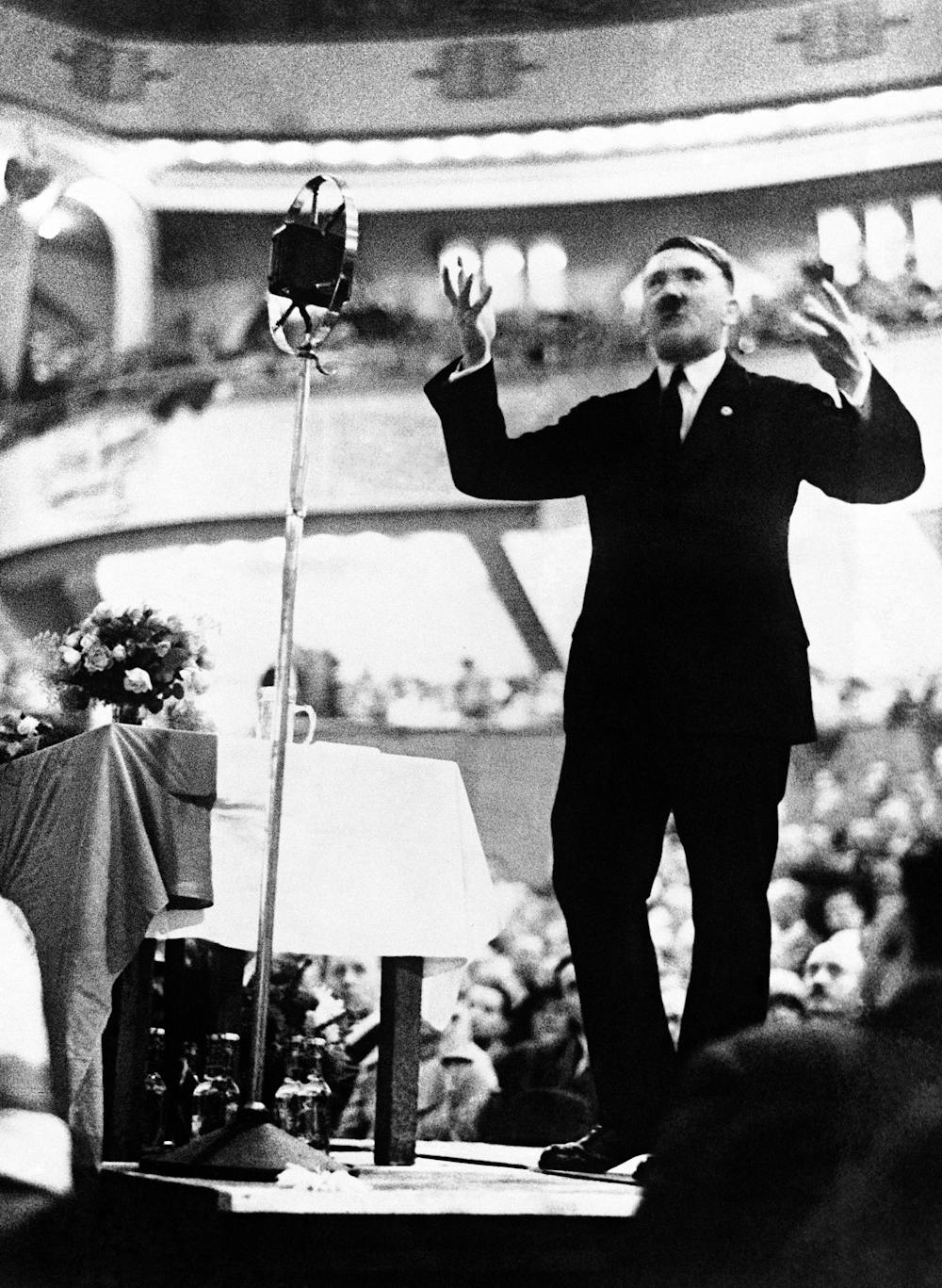
Adolf Hitler addresses the crowd, September 1930. ASSOCIATED PRESS
Psychologists have analyzed the speeches of rousing leaders like Hitler and Gandhi for their emotional content, assessing how much fear, joy, sadness and so on were present. They then tested whether the levels of emotion could predict whether a certain speech preceded violence or nonviolence.
They discovered the following emotions, particularly combined, could ignite violence:
Anger: The speaker gives the audience reasons to be angry, often pointing out who should be held responsible for that anger.
Contempt: The outgroup is deemed inferior to the ingroup, and thus unworthy of respect.
Disgust: The outgroup is described as so revolting they are undeserving of even basic humane treatment.
Constructing the threat
By studying political speeches and propaganda that have inspired violence, researchers have identified themes that can stir these powerful emotions.
Targets of dangerous speech are often dehumanized, depicted as fundamentally lacking qualities – empathy, intelligence, values, abilities, self-control – at the core of being human. Commonly, outgroups are depicted as evil, due to their alleged lack of morality. Alternatively, they may be portrayed as animalistic or worse. During the Rwandan genocide, Tutsis were referred to as cockroaches in Hutu propaganda.
To build a “story of hate,” a good guy is needed to counter the villain. So whatever dehumanizing quality is present in the outgroup, the opposite is present in the ingroup. If “they” are the Antichrist, “we” are the children of God.
Alleged past wrongdoings of the outgroup against the ingroup are used to position the outgroup as a threat. In cases of ongoing conflict between groups, such as between Israelis and Palestinians, there may well be examples of past wrongs on both sides. Effective dangerous speech omits, minimizes or justifies past wrongs by the ingroup members, while exacerbating past wrongs of the outgroup.
“Competitive victimhood” is used to portray the ingroup as the “real” victim – especially if ingroup “innocents” like women and children have been harmed by the outgroup. Sometimes past acts of the outgroups are fabricated and used as scapegoats for the ingroup’s past misfortunes. For instance, Hitler blamed the Jews for Germany losing World War I.

A survivor of the Rwandan genocide, 1994. Scott Peterson/Hulton Archive via Getty Images
A particularly dangerous fabrication is when outgroups are accused of plotting against the ingroup the very deeds the ingroup is planning, if not actually committing, against the outgroup. Researchers coined the term “accusations in a mirror” after this strategy was explicitly described in a Hutu propaganda handbook following the Rwandan genocide.
Disengaging one’s moral compass
Effective dangerous speech gets people to overcome internal resistance to inflicting harm.
This can be accomplished by making it seem like no other options remain to defend the ingroup from the threat presented by the outgroup. Less extreme options are dismissed as exhausted or ineffective. The outgroup can’t be “saved.”
Simultaneously, speakers deploy “euphemistic labeling” to provide more palatable terms for violence, like “cleansing” or “defense” instead of “murder.” Or they may use “virtue-talk” to play up honor in fighting – and dishonor in not. After directing his followers to kill their children and themselves, cult leader Jim Jones called it “an act of revolutionary suicide protesting the conditions of an inhumane world.”
Sometimes, the ingroup suffers from an illusion of invulnerability and does not even consider the possibility of negative consequences from their actions, because they are so confident in the righteousness of their group and cause. If thought is given to life post-violence, it is portrayed as only good for the ingroup.
By contrast, if the outgroup is allowed to remain, obtain control or enact their alleged devious plans, the future looks grim; it will mean the destruction of everything the ingroup holds dear, if not the end of the ingroup itself.
These are just some of the hallmarks of dangerous speech identified through decades of research by historians and social scientists studying genocide, cults, intergroup conflict and propaganda. It is not an exhaustive list. Nor do all these elements need to be present for a speech to promote harm. There is also no guarantee the presence of these factors definitely leads to harm – just as there is no guarantee that smoking leads to cancer, though it certainly increases the risk.
The persuasiveness of a speech also depends on other variables, like the charisma of the speaker, the receptivity of the audience, the medium by which the message is delivered and the context in which the message is being received.
However, the elements described above are warning signs a speech is intended to promote and justify inflicting harm. People can resist calls to violence by recognizing these themes. Prevention is possible.
[Get our most insightful politics and election stories. Sign up for The Conversation’s Politics Weekly.]
H. Colleen Sinclair, Associate Professor of Social Psychology, Mississippi State University
This article is republished from The Conversation under a Creative Commons license. Read the original article.


