


Written by Steven Hansen
The daily death count due to coronavirus today declined as well as new coronavirus cases. At the end of this post is a set of interactive graphs and tables for the world and individual states – as well as today’s headlines which include issues getting unemployment benefits; little hope for oil price recovery until 2021; and India surpasses China in coronavirus cases

Coronavirus News You May Have Missed
Study finds 44% of U.S. unemployment applicants have been denied or are still waiting – CNBC
Since early March, over 36 million Americans have filed for unemployment due to the coronavirus crisis, marking the biggest spike in unemployment in U.S. history.
In response to these claims, states have paid a record $48 billion in unemployment benefits to people out of work but several recent studies have found that this total could have been much higher.
According to an analysis by One Fair Wage, a nonprofit organization that advocates for restaurant workers, only 56% of those who have applied for unemployment insurance are receiving benefits, meaning about 44% have been denied or are still waiting.
To be sure, states are dealing with an unprecedented volume of unemployment applicants, causing delays. Additionally, it is possible that some people have filed incorrectly, but advocates and experts are increasingly calling attention to workers who are being left out.
“Using data from the Bureau of Labor Statistics, we estimate that more than half of states have processed and paid less than 60% of total submitted unemployment claims,” says Saru Jayaraman, president of One Fair Wage, in a statement. “And we know that the situation is even worse for low-wage and tipped service workers, who have earned a subminimum wage and in some cases cash tips. These workers are often being told they didn’t earn enough to qualify for unemployment, even when they’ve worked full-time, and are rejected at higher rates.”
As JC Penney files Chapter 11, bankruptcy not necessarily the end for some retailers – ABC News
J.C. Penney is the latest company to declare bankruptcy.
The retailer filed for Chapter 11 bankruptcy on Friday, just one day after it made an approximately $17 million interest payment. The payment, due on May 7, was paid within a one-week grace period and before entering default.
The company later said in a statement it had entered into a plan “expected to reduce several billion dollars of indebtedness, provide increased financial flexibility to help navigate through the Coronavirus (COVID-19) pandemic, and better position JCPenney for the long-term.”
Before filing for bankruptcy, J.C. Penney stated in documents filed Friday that it took the grace period to pay the interest payment in order to evaluate “certain strategic alternatives, none of which have been implemented and which continue to be considered.”
J.C. Penney joins the ranks of several other major retailers that have fallen victim to the novel coronavirus pandemic’s economic fallout, including Neiman Marcus and J. Crew, as it files for Chapter 11 bankruptcy.
The federal bank regulatory agencies today announced temporary changes to their supplementary leverage ratio rule. The temporary modifications will provide flexibility to certain depository institutions to expand their balance sheets in order to provide credit to households and businesses in light of the challenges arising from the coronavirus response.
Issued by the Federal Reserve Board, the Federal Deposit Insurance Corporation, and the Office of the Comptroller of the Currency, the interim final rule permits depository institutions to choose to exclude U.S. Treasury securities and deposits at Federal Reserve Banks from the calculation of the supplementary leverage ratio. If a depository institution does change its supplementary leverage ratio calculation, it will be required to request approval from its primary federal banking regulator before making capital distributions, such as paying dividends to its parent company, as long as the exclusion is in effect.
The agencies are providing this temporary exclusion to enable depository institutions to expand their balance sheets as appropriate to serve as financial intermediaries and serve their customers.
The supplementary leverage ratio generally includes subsidiaries of bank holding companies with more than $250 billion in total consolidated assets. The rule requires them to hold a minimum ratio of 3 percent, measured against their total leverage exposure, with more stringent requirements for the largest and most systemic financial institutions.
The change will be effective once the rule is published in the Federal Register and will be in effect through March 31, 2021. Comments will be accepted for 45 days after publication in the Federal Register.
Oil glut means there’s little hope for oil price recovery until 2021 – The Conference Board
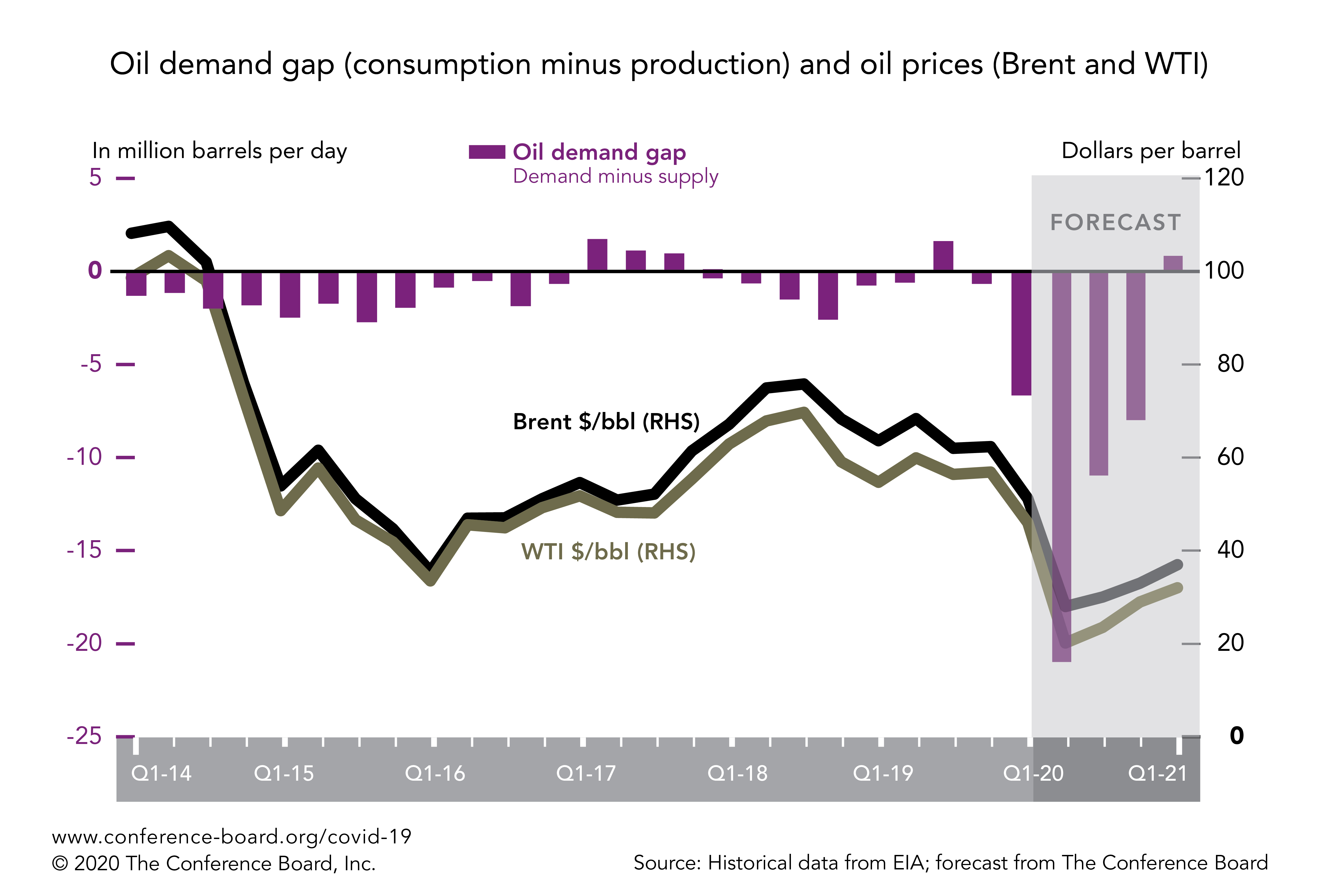
The COVID-19 pandemic has dramatically reduced oil demand, down to a level not seen since 1995. Supply cuts negotiated between OPEC and Russia have been insufficient so far to address the global glut. A dramatic gap between world demand and production is the net result. Because the economy will recover slowly (according to The Conference Board Global Economic Outlook), demand for oil will also recover slowly, and so the oil demand gap will remain large until the end of the year. Recently negotiated production cuts will help alleviate the pressure on oil prices and oil storage capacities as the year progresses but won’t be enough to lift prices, which will likely not exceed 40 dollars per barrel. This relatively low price will provide oil-consuming countries with some upside as they recover from the pandemic’s recession. At 40 dollars per barrel or below, some wells, especially in the Middle East, would remain profitable, and others may at least cover operating costs. However, low prices would prevent most producers from investing in new fields, which may pose a threat to the long-term viability of the industry.
Five Theodore Roosevelt sailors re-test positive for Covid-19 – Navy Times
Five sailors from the embattled aircraft carrier Theodore Roosevelt who had previously tested positive for Covid-19 retested positive this week, officials confirmed Friday.
The sailors had previously returned to the ship, which has been sidelined in Guam as leadership works to get the crew free of the novel coronavirus and back to work.
… Whether the five afflicted sailors were reinfected or still had the virus after multiple negative tests remains under investigation.
Navy officials point out that TR sailors have been tested more than any other sailors in the Navy.
House approves $3 trillion Covid aid bill and historic rules change to allow remote voting – CNN
The House of Representatives on Friday passed a sweeping bill to spend more than $3 trillion for Covid-19 relief and a rules change to allow lawmakers to vote remotely during the coronavirus pandemic.
The measure was approved by a vote of 208-199 despite opposition from Republicans as well as from some moderate and progressive Democrats. Fourteen Democrats crossed party lines to vote against it and one Republican voted in favor.
The legislation, which reflects Democratic priorities and was not a product of bipartisan negotiations, would stand as the largest relief package in US history and House Democratic leaders argued that the package, which allocates funding for state and local governments, coronavirus testing and a new round of direct payments to Americans, is urgently needed to address the crisis.
Republicans however have made clear that it is dead on arrival in the GOP-controlled Senate. Democrats also had to grapple with criticism and pushback from moderates upset that the bill did not have widespread bipartisan support and progressives who believe the bill did not go far enough to help Americans facing fallout from the pandemic.
Coronavirus: Italy set to throw open its borders in time for summer tourist season – sky news
Italy will reopen restaurants and coffee bars next week and allow travel in and out of the country next month as it continues to ease its coronavirus lockdown.
A decree signed by Prime Minister Giuseppe Conte on Saturday means that the foreign travel ban will be lifted on 3 June – and people can also start moving freely across the country’s regions on the same day.
Mr Conte said that anybody entering Italy from an EU country from then onwards would not have to undergo a quarantine period.
However he warned that while the Lombardy region could assess itself whether to reopen, the national government could intervene if the pandemic reemerged.
UK researchers hope dogs can be trained to detect coronavirus – The Guardian
Dogs are to be trained to try to sniff out the coronavirus before symptoms appear in humans, under trials launched with £500,000 of government funding.
Dogs have already been successfully trained to detect the odour of certain cancers, malaria and Parkinson’s disease, and a new study will look at whether labradors and cocker spaniels can be trained to detect Covid-19 in people.
Researchers at the London School of Hygiene and Tropical Medicine will carry out the first phase of a trial in collaboration with Durham University and the charity Medical Detection Dogs.
The initial stage of the research will see odour samples collected from coronavirus patients in London hospitals. Six specialist dogs will then undergo training to identify the virus from the samples.
Lord Bethell, the minister for innovation, said the government believed the dogs “might provide speedy results as part of our wider testing strategy”.
India surpasses China in coronavirus cases to become new Asia hot spot – Straits Times
India has now recorded more Covid-19 cases than China as it continues to lift some of its more stringent measures to contain the virus.
The world’s second most populous country has reported 86,508 infections and 2,760 deaths. China has recorded 84,038 cases and 4,637 deaths.
Most of India’s infection cases are registered in its top cities, which are hubs of economic activity, posing both public health and economic challenges.
Nearly a third of the country’s cases were recorded in capital city Delhi, which has a population of 19 million, and Mumbai, the country’s financial capital.
Mumbai, with its 22 million residents and 17512 Covid-19 cases, has seen its health infrastructure coming under pressure amid a growth in coronavirus infections.
Hospitals are overwhelmed, an estimated 487 police personnel have tested positive for Covid-19 and the virus has continued to spread through its slums, which remain a key worry for India’s policy makers.
Mar-a-Lago to partially reopen after coronavirus shutdown – The Hill
President Trump‘s Mar-a-Lago club will reopen its restaurant and pools this weekend, according to an email to members obtained by The Washington Post.
The email says the resort’s Beach Club restaurant, pool and whirlpool will reopen Saturday, the Post reported. Members will be required to practice social distancing.
The hotel and main dining room will remain closed.
Mar-a-Lago has been closed for two months under Florida’s stay-at-home order meant to slow the spread of the coronavirus. Trump has not visited Mar-a-Lago during the pandemic. Florida’s stay-at-home order expired April 30.
The resort in April furloughed more than 150 employees that had worked mainly in positions interacting with guests.
“There’s no income coming in,” Trump said at the time. “But you can’t have, you know, many hundreds of employees standing around doing nothing. There’s no customer. You’re not allowed to have a customer.”
Did a nursing home or assisted living facility take your stimulus check? – Federal Trade Commission
Do you or a loved one live in a nursing home or assisted living facility? Are you (or they) on Medicaid? If you said “yes” to both, please read on and prepare to get mad. We’ve been hearing that some facilities are trying to take the stimulus payments intended for their residents on Medicaid. Then they’re requiring those people to sign over those funds to the facility. Why? Well, they’re claiming that, because the person is on Medicaid, the facility gets to keep the stimulus payment.
But here’s the deal: those economic impact payments are, according to the CARES Act, a tax credit. And tax law says that tax credits don’t count as “resources” for federal benefits programs, like Medicaid. So: when Congress calls these payments “tax credits” in the CARES Act, that means the government can’t seize them. Which means nursing homes and assisted living facilities can’t take that money from their residents just because they’re on Medicaid. And, if they took it already, get in touch with your state attorney general and ask them to help you get it back.
This is not just a horror story making the rounds. These are actual reports that our friends in the Iowa Attorney General’s Office have been getting – and handling. Other states have seen the same.
If you’ve experienced this already, tell your state attorney general’s office first, and then tell the FTC: ftc.gov/complaint. If a loved one lives in a nursing facility and you’re not sure what happened to their payment, talk with them soon. And consider having a chat with the facility’s management to make sure they know which side of the law to be on.
Coronavirus Test Home Collection Kit Approved – coronavirus today
Late on May 15, 2020, the U.S. FDA issued authorization to Everlywell, Inc. for the Everlywell COVID-19 Test Home Collection Kit to be used by individuals at home who have been screened for COVID-19 disease using an online questionnaire that is reviewed by a healthcare provider.
This allows an individual to self-collect a nasal sample at home using Everlywell’s authorized kit.
Coronavirus Statistics For 16 May 2020 |
| U.S. Only | Global | U.S Percentage of Total | ||||
| Today | Cumulative | Today | Cumulative | Today | Cumulative | |
| New Cases | 25,508 | 1,440,000 | 97,519 | 4,500,000 | 26.2% | 32.0% |
| Deaths | 1,662 | 87,568 | 5,042 | 307,295 | 33.0% | 28.5% |
| Mortality Rate | 6.5% | 6.1% | 5.2% | 6.8% | ||
| total COVID-19 Tests per 1,000 people | 1.49 | 30.87 | ||||
Today’s Posts On Econintersect Showing Impact Of The Pandemic With Hyperlinks
Ready For The Pandemic? Household Debt Before The COVID-19 Shock
Tracking Trade During The COVID-19 Pandemic
The Commercial Paper Funding Facility
The Stock Market Ignores Small Business Pain
What The Pandemic Revealed: A Morally Bankrupt Culture
Brazil’s Spiralling COVID-19 Crisis
Coronavirus INTERACTIVE Charts
include($_SERVER[‘DOCUMENT_ROOT’].’/pages/coronavirus.htm’); ?>
Analyst Opinion of Coronavirus Data
There are several takeaways that need to be understood when viewing coronavirus statistical data:
- The global counts are suspect for a variety of reasons including political. Even the U.S. count has issues as it is possible that as much as half the population has had coronavirus and was asymptomatic. It would be a far better metric using a random sampling of the population weekly. In short, we do not understand the size of the error in the tracking numbers.
- Just because some of the methodology used in aggregating the data in the U.S. is flawed – as long as the flaw is uniformly applied – you establish a baseline. This is why it is dangerous to compare two countries as they likely use different methodologies to determine who has (and who died) from coronavirus.
- COVID-19 and the flu are different but can have similar symptoms. For sure, COVID-19 so far is much more deadly than the flu. [click here to compare symptoms]
- From an industrial engineering point of view, one can argue that it is best to flatten the curve only to the point that the health care system is barely able to cope. This solution only works if-and-only-if one can catch this coronavirus once and develops immunity. In the case of COVID-19, herd immunity may need to be in the 80% to 85% range. WHO warns that few have developed antibodies to COVID-19. At this point, herd immunity does not look like an option.
- Older population countries will have a higher death rate.
- There are at least 8 strains of the coronavirus. New York may have a deadlier strain imported from Europe, compared to less deadly viruses elsewhere in the United States.
- Each publication uses different cutoff times for its coronavirus statistics. Our data uses 11:00 am London time. Also, there is an unexplained variation in the total numbers both globally and in the U.S.
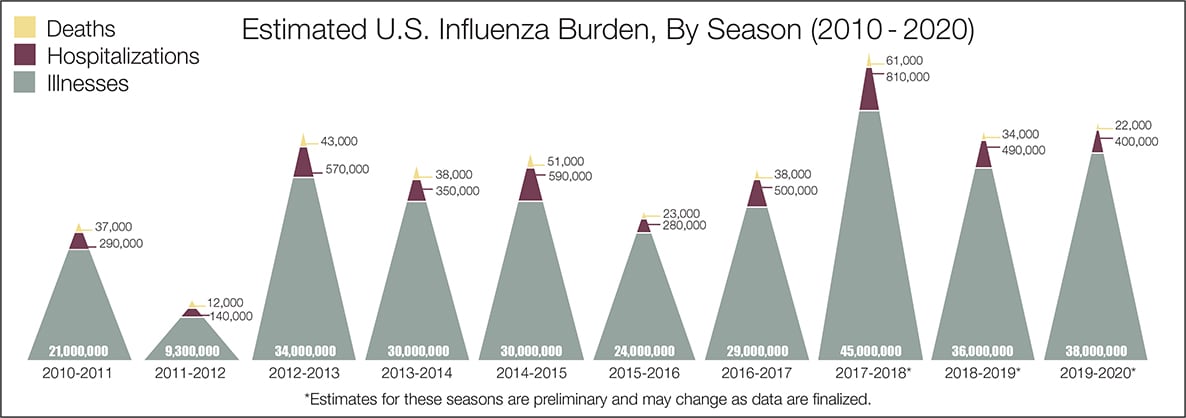
- The real question remains if the U.S. is over-reacting to this virus. The following graphic from the CDC puts the annual flu burden in perspective [click on image to enlarge].
What we do not know about the coronavirus [actually there is little scientifically proven information]. Most of our knowledge is anecdotal, from studies with limited subjects, or from studies without peer review.
- How many people have been infected?
- Can the US really scale up coronavirus testing and tracing?
- What forms of social distancing work best?
- Can children widely spread coronavirus?
- Why have some places avoided big coronavirus outbreaks?
- What effect will the weather have?
- Can we reopen parks and beaches?
- Do we develop lasting immunity to the coronavirus?
- Can the world really push out a vaccine in 12 to 18 months?
- Will we get other medical treatments for Covid-19?
- Do we need all these ventilators?
The bottom line is that COVID-19 so far has been shown to be much more deadly than the data on the flu. Using CDC data, the flu has a mortality rate between 0.06 % and 0.11 % Vs. the coronavirus which to date has a mortality rate of over 5 % – which makes it between 45 and 80 times more deadly. The reason for ranges:
Because influenza surveillance does not capture all cases of flu that occur in the U.S., CDC provides these estimated ranges to better reflect the larger burden of influenza.
There will be a commission set up after this pandemic ends to find fault [it is easy to find fault when a once-in-a-lifetime event occurs] and to produce recommendations for the next time a pandemic happens. Those that hate President Trump will conclude the virus is his fault. The most important issue will be an analysis of whether the federal government took a strong enough lead in dealing with the pandemic – and that includes every single politician!
include(“/home/aleta/public_html/files/ad_openx.htm”); ?>


