


Written by Steven Hansen
The non-seasonally adjusted Case-Shiller home price index (20 cities) year-over-year rate of home price growth was 5.1 %. The authors of the index say with “ core inflation was 1.9% …. One result is that a 5% price increase in the value of a house means more today than it did in 2005-2006“.

- 20 city unadjusted home price rate of growth accelerated 0.2 % month-over-month. [Econintersect uses the change in year-over-year growth from month-to-month to calculate the change in rate of growth]
- CoreLogic currently shows the highest year-over-year growth of 6.9 %.
- The market expected:
| Consensus Range | Consensus | Actual | |
| 20-city, SA – M/M | -0.1 % to 0.6 % | 0.1 % | 0.1 % |
| 20-city, NSA – M/M | 0.3 % to 0.9 % | 0.6 % | 0.4 % |
| 20-city, NSA – Y/Y | 4.9 % to 5.7 % | 5.1 % | +5.1 % |
S&P/Case-Shiller Home Price Indices Year-over-Year Change
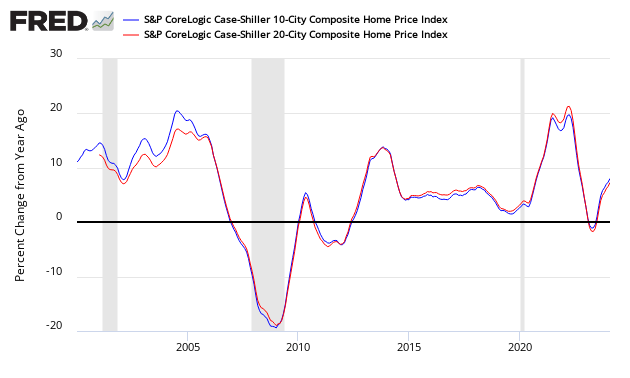
Comparing all the home price indices, it needs to be understood each of the indices uses a unique methodology in compiling their index – and no index is perfect. The National Association of Realtors normally shows exaggerated movements which likely is due to inclusion of more higher value homes.
Comparison of Home Price Indices – Case-Shiller 3 Month Average (blue line, left axis), CoreLogic (green line, left axis) and National Association of Realtors 3 Month Average (red line, right axis)

z existing3.PNG
The way to understand the dynamics of home prices is to watch the direction of the rate of change. Here home price growth generally appears to be stabilizing (rate of growth not rising or falling).
Year-over-Year Price Change Home Price Indices – Case-Shiller 3 Month Average (blue bar), CoreLogic (yellow bar) and National Association of Realtors 3 Month Average (red bar)

z existing5.PNG
There are some differences between the indices on the rate of “recovery” of home prices.
A synopsis of Authors of the Leading Indices:
Case Shiller’s David M. Blitzer, Chairman of the Index Committee at S&P Indices:
Home prices continue to climb at a 4% to 5% annual rate across the country. Most other recent housing indicators also show strength. Housing starts topped an annual rate of 1.2 million units in the latest report with continuing strength in both single family homes and apartments. The National Association of Home Builders sentiment survey, reflecting current strength, reached the highest level since 2005, before the housing collapse. Sales of existing homes are running about 5.5 million units annually with inventories of about five months of sales. However, September new home sales took an unexpected and sharp drop as low inventories were cited as a possible cause.
A notable part of today’s economy is the continuing low inflation rate; in the year to September, consumer prices were unchanged. Even excluding food and energy, the core inflation was 1.9%. One result is that a 5% price increase in the value of a house means more today than it did in 2005-2006, the peak of the housing boom when the inflation rate was higher. The rebound from the recent lows was faster than the 1997-2005 housing boom, and also much less driven by inflation.
CoreLogic believes low inventories are spurring rising home prices (August Data). Per Dr. Frank Nothaft, chief economist at CoreLogic and Anand Nallathambi, president and CEO of CoreLogic:
Economic forecasts generally project higher mortgage rates and more single-family housing starts for 2016. These forces should dampen demand and augment supply, leading to a moderation in home price growth. Over the next 12 months through August 2016, CoreLogic projects its national HPI to rise 4.3 percent, less than the 6.9 percent gain over the 12 months through August 2015.
Home price appreciation in cities like New York, Los Angeles, Dallas, Atlanta and San Francisco remain very strong reflecting higher demand and constrained supplies. Continued gains in employment, wage growth and historically low mortgage rates are bolstering home sales and home pricegains. In addition, an increasing number of major metropolitan areas are experiencing ever-more severe shortfalls in affordable housing due to supply constraints and higher rental costs. These factors will likely support continued home price appreciation in 2016 and possibly beyond.
The National Association of Realtors says home sales prices have moderated (September 2015 data):
Lawrence Yun, NAR chief economist, says a slight moderation in home prices in some markets and mortgage rates remaining below 4 percent gave more households the confidence to close on a home last month. “September home sales bounced back solidly after slowing in August and are now at their second highest pace since February 2007 (5.79 million),” he said. “While current price growth around 6 percent is still roughly double the pace of wages, affordability has slightly improved since the spring and is helping to keep demand at a strong and sustained pace.”
Black Knight Financial Services (formerly known as Lender Processing Services) August 2015 home price index up 0.3 % for the Month; Up 5.5% Year-over-Year.

Econintersect publishes knowledgeable views of the housing market.
Caveats on the Use of Home Price Indices
The housing price decline seen since 2005 varies by zip code – and seems to have ended somewhere around the beginning of the 2Q2012. Every area of the country has differing characteristics. Since January 2006, the housing declines in Charlotte and Denver are well less than 10%, while Las Vegas home prices had declined almost 60%.
Each home price index uses a different methodology – and this creates slightly different answers. There is some evidence in various home price indices that home prices are beginning to stabilize – the evidence is also in this post. Please see the post Economic Headwinds from Real Estate Moderate.
The most broadly based index is the US Federal Housing Finance Agency’s House Price Index (HPI) – a quarterly broad measure of the movement of single-family house prices. This index is a weighted, repeat-sales index on the same properties in 363 metro centers, compared to the 20 cities Case-Shiller.
The US Federal Housing Finance Agency also has an index (HPIPONM226S) based on 6,000,000 same home sales – a much broader index than Case-Shiller. Also, there is a big difference between home prices and owner’s equity (OEHRENWBSHNO) which has been included on the graph below.
Comparing Various Home Price Indices to Owner’s Equity (blue line)


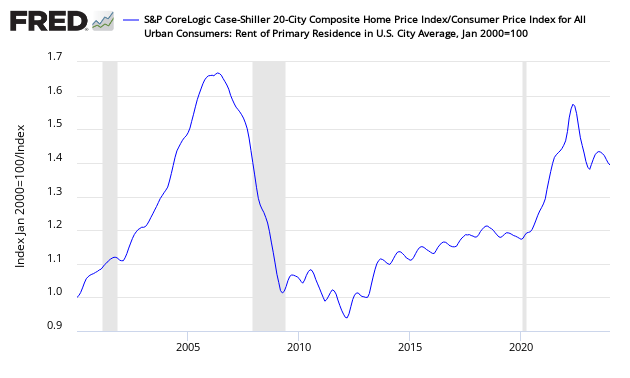
With rents increasing and home prices declining – the affordability factor favoring rental vs owning is reversing. Rising rents are shifting the balance.
Price to Rent Ratio – Indexed on January 2000 – Based on Case-Shiller 20 cities index ratio to CPI Rent Index
Related Articles
Old Analysis Blog | New Analysis Blog |
| Housing Sales and Prices | Housing Sales and Prices |
include(“/home/aleta/public_html/files/ad_openx.htm”); ?>


