


from The Conversation
— this post authored by Angie Chuang, University of Colorado Boulder
Since the Atlanta spa shootings, the U.S. media has been working harder than usual to describe and understand Asian Americans.

Please share this article – Go to very top of page, right hand side, for social media buttons.
Asian Americans represent a population of 21 million people, with astounding ethnic and socioeconomic diversity. Yet the same two stereotypes often emerge in news coverage about them.
One is that of Asian Americans as the “perpetual foreigner” – immigrants who constantly struggle, never assimilate. That’s how the six Chinese and Korean American women killed in the Atlanta area on March 16 came off in early stories about the massacre. The news media persisted in referring to victims as “women of Asian descent” – versus “Asian American women” – even after it became clear several were not recent immigrants.
These victims, six of the eight dead, don’t fit into the other Asian American stereotype of the upwardly mobile, educated and eager-to-fit-in immigrant – the “model minority.”
As a journalism researcher who has published studies on the news media’s tendency to render some groups in the U.S. as more American than others, I know both the “model minority” and “perpetual foreigner” myths well.
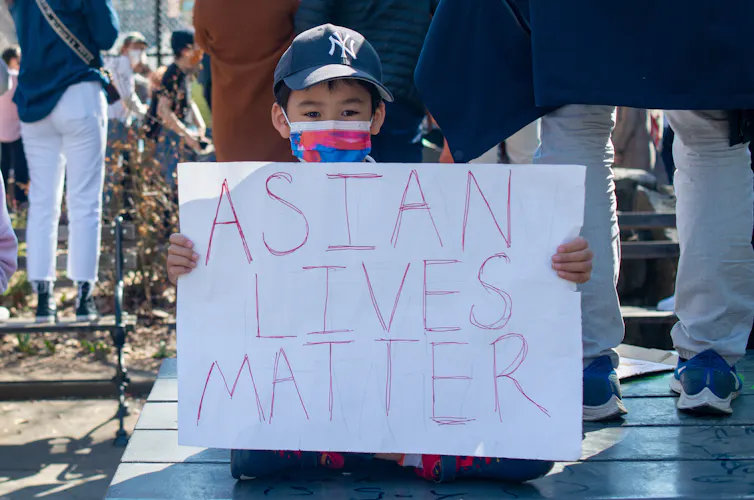
A rally against violence toward Asian Americans, after the March 16 attack in Atlanta, Georgia, that killed eight people, including six Chinese and Korean women. Alexi Rosenfeld/Getty Images
Both stereotypes have been levied in tandem against Asian immigrants to the U.S. for centuries.
Model minority
In the mid-1800s, Chinese laborers made up the first significant wave of Asian immigration to the United States. Recruited during the Gold Rush and to build the Transcontinental Railroad, the men were described by employers like industrialist Leland Stanford as “quiet, peaceable, patient, industrious and economical.”
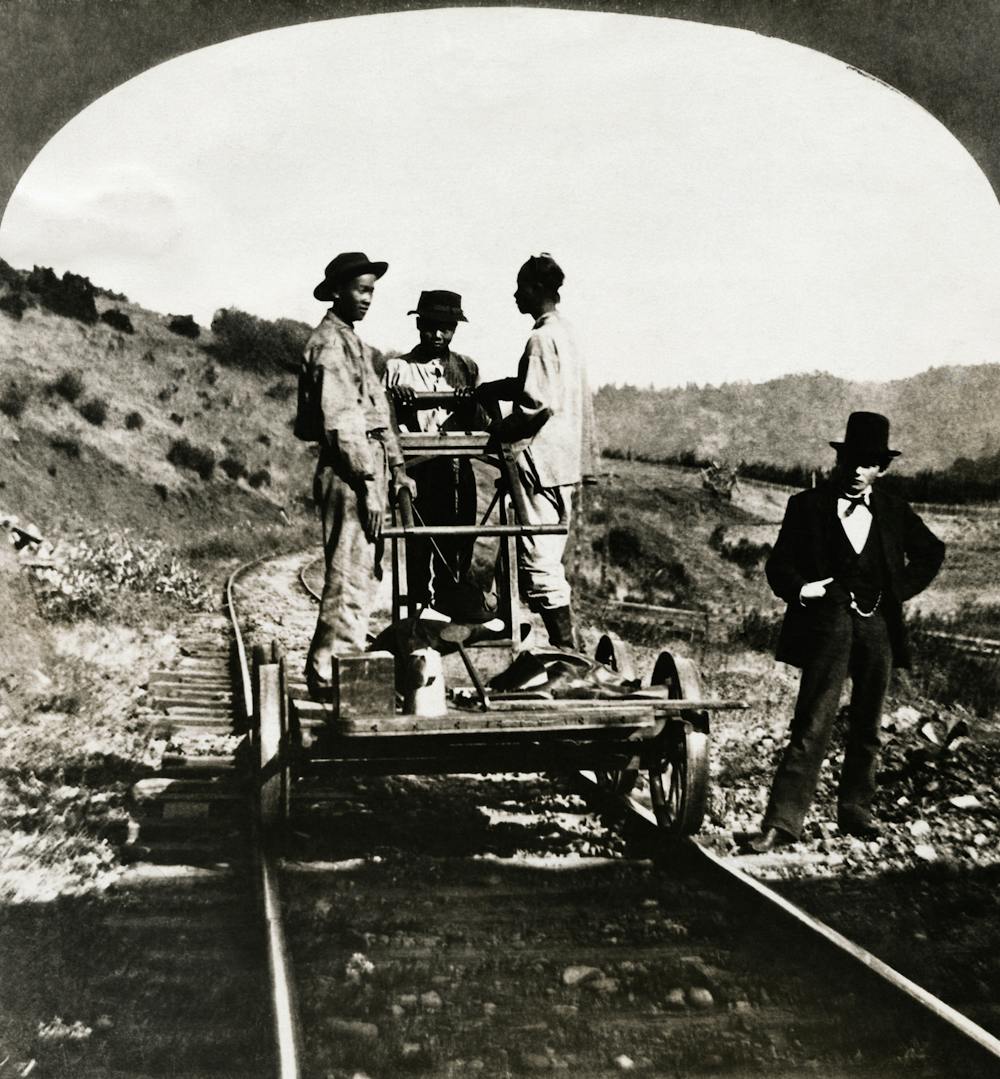
In California, Chinese immigrants were employed by the railroads to do the toughest work. George Rinhart/Corbis via Getty Images
As that initial population of 4,000 Chinese Americans in 1850 burgeoned, though, they were accused of taking white men’s jobs. Hostility and violence also grew against them. From the subsequent Chinese Exclusion Act of 1882, which prohibited the immigration of Chinese laborers, to the imprisonment of Japanese Americans during World War II, Asian Americans were still seen as hardworking and submissive – yet also dangerous and alien.
The model-minority myth emerged later. In 1965 the Hart-Celler Act opened immigration quotas that had previously favored Western Europeans. That spurred a major wave of immigration from across the globe, including Asia, to the United States.
Bolstered by university offers of international graduate scholarships, this policy favored highly skilled immigrants from Taiwan, South Korea, India, Japan and beyond.
My father, Tien-Yuh Chuang, who boarded a trans-Pacific flight from Taipei to San Francisco in 1965 with US$300, a suitcase and his letter of admission to an engineering doctoral program at University of California, Berkeley, was among them.
Many of the Hart-Celler immigrants were funneled into growing numbers of professional jobs in science and technology fields. They were part of the United States’s push to become a world leader in everything from the space race to transportation.
Out-earning all other racial groups, Asian Americans became the “model minority,” a term first coined by sociologist William Petersen in a 1966 New York Times article, “Success Story: Japanese American style.”
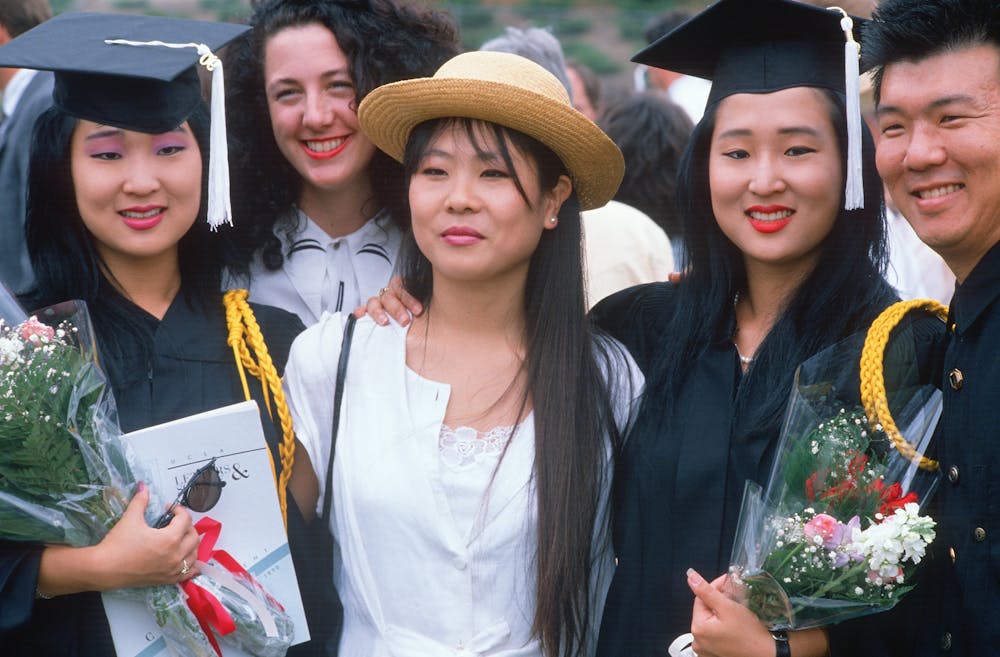
A family in Los Angeles celebrates college graduation. Joe Sohm/Visions of America/Universal Images Group via Getty Images
Perpetual foreigner
As U.S. immigration policy shifted to favor family reunification and diversity of origin, waves of Asians came to the U.S. from the mid-1970s to 1980s and onward.
Some were refugees resettled from places where the U.S. had gotten involved in wars, like Vietnam, Laos, Cambodia and South Korea. Other immigrants came from China, South Korea, Vietnam, Thailand, India, Bangladesh, the Philippines and more, attempting to lift their families out of poverty.
Without the same educational and professional sponsorships as my father had, many in these later waves founded mom-and-pop businesses and peer lending networks. They gravitated toward blue-collar industries and “pink-collar” jobs in salons, food service or child care.
Often serving affluent Americans who looked the other way at their struggle, or their very existence, members of this Asian America are perpetually foreign, and doubly invisible.
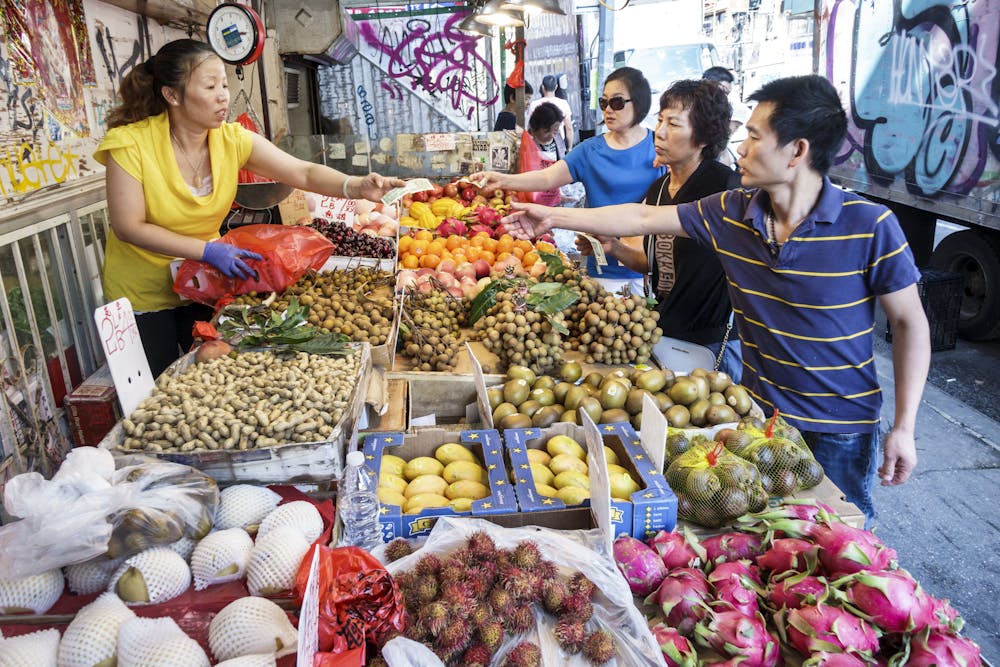
A mom-and-pop grocery store in Chinatown, New York City. Jeffrey Greenberg/Universal Images Group via Getty Images
The women who worked and died at Young’s Asian Massage, Gold Spa and Aromatherapy Spa lived in this Asian America – not my father’s or mine.
Between the ages of 33 and 74, more than half were over 50. They worked in a low-wage industry in which Asian immigrant ownership is linked to assumptions about sex work. This fits into the exotic Asian prostitute stereotype, as old as Suzie Wong or Miss Saigon.
However, immigrant-run massage and spa establishments perform legitimate business transactions every day. They massage feet and backs, do acupuncture, give facials. It’s also possible for both legal massage and sex work to occur at the same business, not involving every worker or every client.
[You’re smart and curious about the world. So are The Conversation’s authors and editors. You can read us daily by subscribing to our newsletter.]
Such workers make up the other side of the high-earning “model minority” statistic. That data masks the fact that Asian Americans have the highest income inequality of any racial group, with the top 10% of this population earning more than 10 times what the bottom 10% earns.
Dangerous stereotypes
This second Asian America is less likely to work from home or have access to power. That, combined with perceptions that they are not fully American, may make them more vulnerable to attacks like the 3,800 documented hate incidents against Asian Americans since the pandemic started.

A memorial at Gold Spa, in Atlanta, after the March 16 shootings. Megan Varner/Getty Images
When Asian Americans are so easily, and so often, stereotyped, they become categories, not people – not individuals who make lives, raise families and do the best they can in their adopted homeland.
In the case of the Atlanta killings, many early media portrayals obscured the victims’ dignity or distinctness as mothers and grandmothers, a business owner, a former school teacher, an avid line dancer and a lover of Korean soap operas who cooked a mean kimchi jjigae – in short, as Americans.
“My mother didn’t do anything wrong,” the son of 63-year-old Yong Ae Yue, the fan of Korean soap operas and cooking, told the Atlanta Journal-Constitution. “And she deserves the recognition that she is a human.”
Angie Chuang, Associate Professor of Journalism, University of Colorado Boulder
This article is republished from The Conversation under a Creative Commons license. Read the original article.


