


Written by John Lounsbury
The Federal Reserve and other major central banks around the world have set reference rates near zero, at zero or below zero for some time with the objective of increasing inflation. This, combined with central bank purchases of financial securities from the public (also with an increased inflation target), has failed to produce significant increases in inflation. How can this possibly be?

It has been a base tenet in economics that higher interest rates will “tamp down” inflation and lower rates will enable inflation to increase. The most notable example of the former was the early 1980s regime of Paul Volcker’s Federal Reserve which raised the effective Fed Funds rate to 19% to end an oil-crisis induced inflation spiral which peaked at 15% CPI in 1980.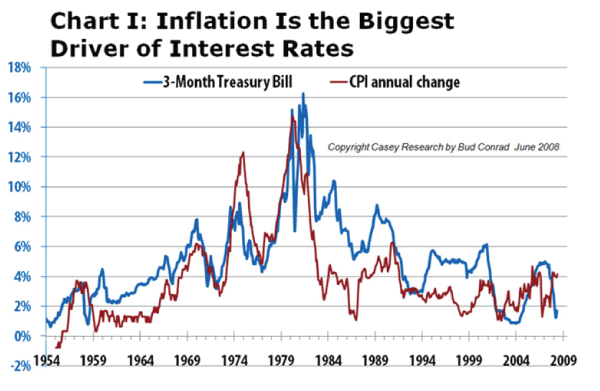
It is this relationship which has been the thinking behind the high liquidity and very low interest rate policies that have attempted to fend off deflation and promote a low rate of inflation during the years following the Great Financial Crisis of 2008. And immediately upon the initiation of the extraordinary monetary policy of the past 7 years, there were many respected financial and economic authorities who started warning that serious inflation would soon be the result from ZIRP and QE (quantitative easing – the creation of excess reserves in the banking system to pay for asset purchases by the Fed).
The inflation warnings came because it was feared that creating trillions of dollars of excess reserves would induce banks to increase lending in an imprudent manner. And the very low interest rates resulting from ZIRP (zero interest rate policy) would encourage unwise borrowing. The resulting increased liquidity would create a much larger surge of inflation than targeted, or so the critics thought.
But, inflation didn’t happen.
The reason why these warnings were wrong are many. A few:
Inflation is produced by increasing liquidity when an economy is operating near its output capacity – that has not been the case. There is far more capacity in the global economy than there is demand for goods and services.
With high levels of private debt there has not been an excessive demand for additional credit from creditworthy borrowers.
Many inaccurate predictions were based on an incorrect model of banking.
It is the third item above on which I will elaborate.
The incorrect model of banking is the so-called “loanable funds theory“. This is theory still found in many textbooks which states that the interest rate is determined by the demand for and supply of loanable funds. The term loanable funds includes all forms of credit, such as loans, bonds, or savings deposits. It is often referred to as the theory of endogenous money. This inaccurate characterization of banking has poisoned many a mind. The poison is the idea that deposits and reserves limit credit.
The actual operation of banks today uses what is called an exogenous money model: Credit is extended based on perceived ability of the borrower to repay interest and principle. The banker doesn’t look at deposits and/or reserves before making a loan – he extends credit based on evaluation of the return. It is said that bank credit “creates money out of thin air”.
An aside: Of course, it is temporary money because when the loan is repaid the money is removed from the economy. And the interest paid actually decreases money in the economy below what existed before the loan. That means as money grows in the financial sector is will decrease in the “real economy”. Thus if an increase in money is needed for increased output, that can only come from an expansion of credit.
So new temporary money is created through credit secured by the ability of the borrower to repay, not in any way by the amount of reserves or deposits in the banking system. Any imbalance created in reserve requirements across the entire banking system is corrected by the Fed, with increases in aggregate reserves when necessary.
So let’s go back to QE and ZIRP? That does create money but in an ineffectual way for a credit economy. The impact is on reserves which, as discussed above, has no significant relationship to issuance of new loans. And some think ZIRP may actually discourage new loans because low interest does not adequately compensate for risk involved in issuing new credit.
So, as Steven Hansen suggested this week (and he is not the first), raising interest rates may indeed increase credit issuance because banks will be able to be compensated for the risk assumed in making loans.
Another aside: if QE and ZIRP do not positively effect creation of new credit and therefore growth in the “real economy” what does it do? As many have pointed out it merely provides means of inflating the value of existing assets rather than supporting the creation of new assets.
I find the lack of recognition of these relationships by policy makers to be extremely distressful. ZIRP and QE have limited effect on the “real economy” of goods and services. A larger impact is seen in the inflation of financial asset values. And though people in the “real economy” got little benefit from the asset inflation, when the bubble bursts they will definitely feel the blast.


