


from The Conversation
— this post authored by Ivor Gaber, University of Sussex
It’s Boris Johnson’s word against that of his former alter ego, Dominic Cummings. And, depending where you have read or heard about the accusations and counter-accusations flying between the pair, one or both are being a trifle “economical with the truth”.

Please share this article – Go to very top of page, right hand side, for social media buttons.
The fact that most of what people see will have originated in either leaks from unnamed witnesses, or via the as yet unsubstantiated claims on Cummings’ blog, will have only further muddied the waters.
But the biggest problem the prime minister and his erstwhile chief adviser have is that a growing number of people, whether inside or outside the Westminster bubble, are finding it increasingly difficult to take either men at their word.
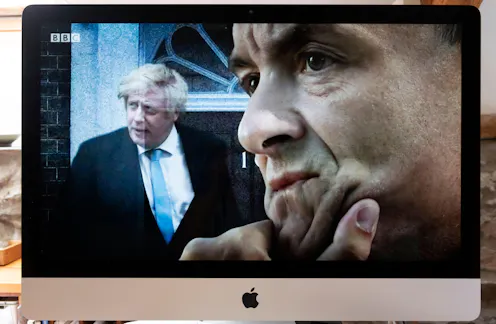
It’s their own fault, really. They have both long been devotees of what I and my colleague Caroline Fisher describe in a new journal article as “strategic lying”. This is a technique – honed by Cummings himself during the Brexit campaign and played masterfully during the 2019 election campaign – in which a politician tells a deliberate lie with the purpose of shifting the news agenda onto his or her preferred territory.
It doesn’t matter if the lie is easily rebutted. Indeed in one sense rebuttals are part of the plan because they result in the subject of the lie being amplified and kept on, or near, the top of the news agenda. The ultimate goal of strategic lying is to have an impact on the salience of issues.
As American media scholar Spiro Kiousis and colleagues explain in a 2010 study of US election coverage, this is a central objective for all political public relations messaging, particularly during an election.
Agenda-setting theory is useful for understanding this strategy, especially in the digital age. It is, if it ever was, not just a top-down activity but involves messages moving from politicians, to the media, to the public and back up again with the message being tailored at every point.
The related concepts of “priming” and “framing” come into play here – often seen as extensions of agenda-setting, they look at not at just what issues are being discussed in the media, but how they are discussed, the context and emphasis – in plain language, “spin”.
‘Brilliant’ Brexit ploy
The classic strategic lie was the slogan painted on the side of the Leave campaign’s bus during the Brexit referendum that claimed that the UK sent Pound Sterling350 million a week to the EU. It was a figure that was easily, and frequently, rebutted – not just by Remain campaigners but by all the reputable fact-checking organisations.
But that didn’t matter. Cummings, made no attempt to defend the figure in his blog about the campaign but instead described it as “a brilliant communications ploy” saying that it ” … worked much better than I thought it would”.
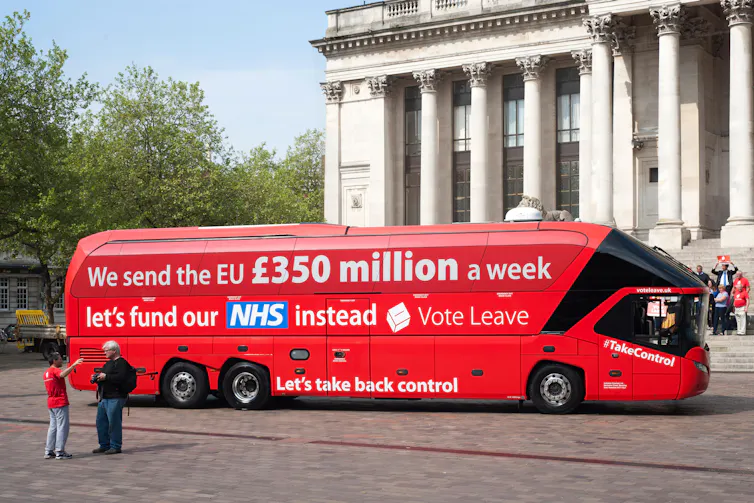
Brilliant? Or just another blatant lie? The Brexit battle bus in London, May 2016. Martyn Evans / Alamy Stock Photo
Cummings’ ploy could be seen up and running within days of the Leave campaign’s launch, when ITV’s News at Ten devoted a full eight minutes to an interview in which Johnson was repeatedly and robustly challenged over the truth of the Pound Sterling350 million claim. The more naive might have thought that the interview had effectively destroyed the Leave campaign’s key slogan. But far from it. The interview, and similar ones on other news bulletins, meant the issue of the UK’s payments to Europe was seen by millions of viewers as the most important issue of the campaign.
In addition, once a statement – or lie for that matter – has found a sympathetic ear, then no amount of rebuttal will convince people that it is not true. This is because the lie fits their worldview and to believe anything else would create a sense of cognitive dissonance, something we all seek to avoid. Furthermore, people’s memories of corrections fade rapidly, but the memory of the original lie remains.
Hence, Remain campaigners found that every time they sought to rebut statements such as the Pound Sterling350 million claim – or, for example, the notion that Turkey was about to join the EU (it wasn’t, but it kept the issue of immigration front and central) – they found themselves inadvertently rebroadcasting the lies. This has been described by media scholar Caroline Jack as “unintentional amplification”, which in turn leads to another phenomenon which she identifies as “inadvertent legitimisation” – the act of giving credibility to “strategic lies” simply by repeating them.
Mud sticks
Striking quick and hard is one of the key components of the strategic lie playbook, as the Brexit referendum demonstrated and could also be seen during the 2019 general election. In the first week of the campaign, the Conservatives posted a doctored video clip showing Labour’s then EU spokesperson, Keir Starmer, apparently stumbling over a question about the party’s Brexit stance. But in the original Starmer had not stumbled at all.
Challenged about the doctored clip, Conservative party chairman James Cleverly sought to laugh it off by telling BBC Breakfast that, “Everyone could see the video was ‘obviously edited’ because of the music underneath.”
Notwithstanding this, the doctored clip was viewed over a million times in the days immediately following and Labour’s subsequent disavowal posts were seen by many more – just one BBC report of the incident received 1.1 million hits on Twitter.
Clearly, strategic lying raises a number of major ethical issues, but there is also an important practical one. What do journalists, particularly those working for the regulated public service broadcasters, do when faced with the conflict between disseminating what they know to be a lie and their legal responsibilities to exercise “due impartiality”?
Do they challenge the lie on-air, quote an opponent, quote a fact-checking organisation or just not broadcast the lie? All are, or could be, problematic in the current regulatory environment. The quality of our democracy depends on the quality of the political debate within the public sphere. New campaigning techniques represent a real threat to both the debate and our democracy and something needs to be done urgently to address this problem.
Ivor Gaber, Professor of Journalism, University of Sussex
This article is republished from The Conversation under a Creative Commons license. Read the original article.
.
include(“/home/aleta/public_html/files/ad_openx.htm”); ?>


