


Written by rjs, MarketWatch 666
 Here are some selected news articles from the week ended 30 January 2021. Part 2 is available here.
This is a feature at Global Economic Intersection every Monday evening or Tuesday morning.
Please share this article – Go to very top of page, right hand side, for social media buttons.
Largest crude withdrawal since July leaves oil supplies lowest since March; distillates demand at a 47 week high
Oil prices finished fractionally lower for the third time in 13 weeks this week, as increasing coronavirus concerns outweighed a large drop in crude inventories…..after falling 15 cents or 0.3% to $52.27 a barrel last week on a surprise crude inventory increase, the contract price of US light sweet crude for March delivery opened lower on Monday as renewed Covid-19 lockdowns raised fresh concerns about global fuel demand, but recovered to close 50 cents higher at $52.77 a barrel as optimism around U.S. stimulus plans and supply concerns boosted prices…oil prices moved higher with European markets early Tuesday amid reports of a blast in Saudi Arabia, but faded to close 16 cents lower at $52.61 a barrel as rising coronavirus deaths fed worries about the global demand outlook…oil prices rose toward $53 a barrel in off-market trading late Tuesday after the American Petroleum institute reported inventories fell more than expected and opened higher on Wednesday, and then surged after the EIA reported the biggest draw from crude supplies since July, but could only hang on to part of its gain, as crude prices settled just 24 cents, or 0.5%, higher at $52.85 per barrel on persistent concerns that the pandemic would continue to hurt fuel demand…oil prices slid on Thursday as the impact of a weaker dollar and lower crude inventories couldn’t offset concerns that delays to vaccine rollouts and new travel curbs would depress demand, and settled 51 cents or 1% lower at $52.34 a barrel, as the South African mutant coronavirus was reported to have reached the U.S…oil prices edged lower on Friday alongside a broader market decline, as new data showed the recovery in consumption remained uncertain, and closed down 14 cents at $52.20 a barrel, thus posting a small 0.1% loss on the week, but still ending January’s trading more than 7% higher than where it started the year…
Meanwhile, natural gas prices finished modestly higher, as an outbreak of much colder temperatures reappeared in the weather forecasts….after falling 10.6% to $2.446 per mmBTU last week as expectations of a period of polar weather petered out, the contract price of natural gas for February delivery opened 4% higher on Monday on substantial increases in expected heating demand over the weekend and a new bout of winter weather moving into the Midwest and finished 15.6 cents, or 6.4% higher at $2.602 per mmBTU…February gas prices added 5.4 cents more on Tuesday, as traders absorbed news of weather forecasts shifting even colder, increasing the likelihood of robust heating demand into early February…natural gas rallied for a third day on Wednesday on intensifying winter weather and renewed momentum in LNG demand, and closed 10.4 cents or 4% higher at $2.760 per mmBTU as trading in the February gas contract expired…with reports now quoting the contract price of natural gas for March delivery, which had closed at 2.702 per mmBTU on Wednesday after rising 24.6 cents earlier in the week, natural gas prices fell 3.8 cents to $2.664 per mmBTU on Thursday, following a bearish storage report and a change in a key weather model pointing to lighter heating demand than was previously expected…with the cloud of the bearish storage report still hanging over markets, March gas fell another 10.0 cents on Friday to end the week at $2.564 per mmBTU, but still finished 4.4% above the prior week’s closing price..
The natural gas storage report from the EIA for the week ending January 22nd indicated that the amount of natural gas held in underground storage in the US fell by 128 billion cubic feet to 2,881 billion cubic feet by the end of the week, which left our gas supplies 78 billion cubic feet, or 2.8% higher than the 2,803 billion cubic feet that were in storage on January 22nd of last year, and 244 billion cubic feet, or 9.3% above the five-year average of 2,637 billion cubic feet of natural gas that have been in storage as of the 22nd of January in recent years….the 128 billion cubic feet that were drawn out of US natural gas storage this week was somewhat less than the average forecast of a 136 billion cubic foot withdrawal from an S&P Global Platts survey of analysts, and quite a bit less than both the 170 billion cubic foot withdrawal from natural gas storage seen during the corresponding week of a year earlier, as well as the average withdrawal of 176 billion cubic feet of natural gas that have typically been pulled out of natural gas storage during the same week over the past 5 years…
The Latest US Oil Supply and Disposition Data from the EIA
US oil data from the US Energy Information Administration for the week ending January 22nd showed that because of a large drop in our oil imports and a big jump in our oil exports, we had to withdraw a correspondingly large quantiity of oil from our stored commercial crude supplies for the 8th time in the past ten weeks and for the 19th time in the past twenty-seven weeks…. our imports of crude oil fell by an average of 981,000 barrels per day to an average of 5,064,000 barrels per day, after falling by an average of 194,000 barrels per day during the prior week, while our exports of crude oil rose by an average of 1,104,000 barrels per day to 3,355,000 barrels per day during the week, which meant that our effective trade in oil worked out to a net import average of 1,709,000 barrels of per day during the week ending January 22nd, 2,085,000 fewer barrels per day than the net of our imports minus our exports during the prior week…over the same period, the production of crude oil from US wells was reportedly 100,000 barrels per day lower at 10,900,000 barrels per day, and hence our daily supply of oil from the net of our trade in oil and from well production totaled an average of 12,609,000 barrels per day during this reporting week…
US oil refineries reported they were processing 14,721,000 barrels of crude per day during the week ending January 22nd, 39,000 fewer barrels per day than the amount of oil they used during the prior week, while over the same period the EIA’s surveys indicated that a net of 1,416,000 barrels of oil per day were being pulled out of the supplies of oil stored in the US….so based on that reported & estimated data, this week’s crude oil figures from the EIA appear to indicate that our total working supply of oil from net imports, from storage, and from oilfield production was 43,000 barrels per day more than what our oil refineries reported they used during the week….to account for that disparity between the apparent supply of oil and the apparent disposition of it, the EIA just inserted a (+696,000) barrel per day figure onto line 13 of the weekly U.S. Petroleum Balance Sheet to make the reported data for the average daily supply of oil and the data for the average daily consumption of it balance out, essentially a balance sheet fudge factor that they label in their footnotes as “unaccounted for crude oil”, thus suggesting that there must have been an error or errors of that magnitude in the oil supply & demand figures that we have just transcribed….however, since most everyone treats these weekly EIA figures as gospel and since these figures often drive oil pricing and hence decisions to drill or complete wells, we’ll continue to report them as published, just as they’re watched & believed to be accurate by most everyone in the industry…..(for more on how this weekly oil data is gathered, and the possible reasons for that “unaccounted for” oil, see this EIA explainer)….
Further details from the weekly Petroleum Status Report (pdf) indicate that the 4 week average of our oil imports fell to an average of 5,679,000 barrels per day last week, which was 13.9% less than the 6,594,000 barrel per day average that we were importing over the same four-week period last year…..the 1,416,000 barrel per day net withdrawal from our crude inventories was due to a 1,416,000 barrels per day withdrawal from our commercially available stocks of crude oil, while the oil supplies in our Strategic Petroleum Reserve remained unchanged….this week’s crude oil production was reported to be 100,000 barrels per day lower at 10,900,000 barrels per day because the rounded estimate of the output from wells in the lower 48 states was 100,000 barrels per day lower at 10,400,000 barrels per day, while a 3,000 barrel per day increase to 509,000 barrels per day in Alaska’s oil production had no impact on the rounded national total….last year’s US crude oil production for the week ending January 24th was rounded to 13,000,000 barrels per day, so this reporting week’s rounded oil production figure was 16.2% below that of a year ago, yet still 29.3% more than the interim low of 8,428,000 barrels per day that US oil production fell to during the last week of June of 2016…
Meanwhile, US oil refineries were operating at 81.7% of their capacity while using those 14,721,000 barrels of crude per day during the week ending January 22nd, down from 82.5% of capacity during the prior week… and since US refinery utilization had averaged the lowest on record through 2020 and has barely recovered, the 14,721,000 barrels per day of oil that were refined this week were still 9.2% fewer barrels than the 15,924,000 barrels of crude that were being processed daily during the week ending January 24th of last year, when US refineries were operating at an also low 87.2% of capacity…
With the decrease in the amount of oil being refined, the gasoline output from our refineries was lower for the 7th time in 10 weeks, decreasing by 212,000 barrels per day to 8,673,000 barrels per day during the week ending January 22nd, after our gasoline output had increased by a record 1,373,000 barrels per day over the prior week…but since our gasoline production was still recovering from a multi-year low in the wake of this Spring’s covid-related lockdowns, this week’s gasoline output was still 5.3% lower than the 9,158,000 barrels of gasoline that were being produced daily over the same week of last year….meanwhile, our refineries’ production of distillate fuels (diesel fuel and heat oil) decreased by 11,000 barrels per day to 4,518,000 barrels per day, after our distillates output had decreased by 132,000 barrels per day over the prior week….and since our distillates’ production was also just coming off a three year low, that output was 9.3% less than the 4,979,000 barrels of distillates that were being produced daily during the week ending January 24th, 2020…
Even with the decrease in our gasoline production, our supply of gasoline in storage at the end of the week increased for the 7th time in ten weeks, and for 12th time in 29 weeks, rising by 2,469,000 barrels to 247,686,000 barrels during the week ending January 22nd, after our gasoline inventories had decreased by a modest 259,000 barrels over the prior week…our gasoline supplies increased this week because the amount of gasoline supplied to US users decreased by 279,000 barrels per day to 7,833,000 barrels per day, while our exports of gasoline rose by 73,000 barrels per day to 804,000 barrels per day, and while our imports of gasoline fell by 39,000 barrels per day to 465,000 barrels per day….even after this week’s inventory increase, our gasoline supplies were 5.2% lower than last January 24th’s gasoline inventories of 261,235,000 barrels, and about 3% below the five year average of our gasoline supplies for this time of the year…
Meanwhile, with the decrease in our distillates production, our supplies of distillate fuels decreased for the 2nd time in 9 weeks and for the 29th time in the past year, falling by 815,000 barrels to 163,662,000 barrels during the week ending January 22nd, after our distillates supplies had increased by 457,000 barrels during the prior week….our distillates supplies fell this week because the amount of distillates supplied to US markets, an indicator of our domestic demand, rose by 479,000 barrels per day to a 47 week high of 4,300,000 barrels per day, even as our exports of distillates fell by 294,000 barrels per day to 808,000 barrels per day, while our imports of distillates rose by 14,000 barrels per day to 474,000 barrels per day….and even after this week’s inventory decrease, our distillate supplies at the end of the week were 12.5% above the 144,747,000 barrels of distillates that we had in storage on January 24th, 2020, and about 8% above the five year average of distillates stocks for this time of the year…
Finally, with the big decrease in our oil exports, our commercial supplies of crude oil in storage (not including the commercial oil being stored in the SPR) fell for the 21st time in the past thirty-three weeks, for the 23rd time in the past year, and by the most since July 24th, decreasing by 9,910,000 barrels, from 486,563,000 barrels on January 15th to 476,653,000 barrels on January 22nd, the lowest stores since March 27th…but even after that big decrease, our commercial crude oil inventories were about 5% above the five-year average of crude oil supplies for this time of year, and about 43% above the prior 5 year (2011 – 2015) average of our crude oil stocks as of the fourth weekend of January, with the disparity between those comparisons arising because it wasn’t until early 2015 that our oil inventories first topped 400 million barrels….since our crude oil inventories had generally been rising over the past two years, except for during the past 7 weeks and during the past two summers, after generally falling over the year and a half prior to September of 2018, our commercial crude oil supplies as of January 22nd were still 10.4% more than the 431,654,000 barrels of oil we had in commercial storage on January 24th of 2020, 6.9% above the 445,025,000 barrels of oil that we had in storage on January 25th of 2019, and also 13.9% more than the 418,359,000 barrels of oil we had in commercial storage on January 26th of 2018…
This Week’s Rig Count
The US rig count rose for the 19th time in the past twenty weeks during the week ending January 29th, but for just the 21st time in the past 46 weeks, and hence it is still down by 51.6% over that forty-four week period….Baker Hughes reported that the total count of rotary rigs running in the US rose by 6 to 384 rigs this past week, which was still down by 406 rigs from the 790 rigs that were in use as of the January 31st report of 2020, and was also still 20 fewer rigs than the all time low rig count prior to 2020, and 1,545 fewer rigs than the shale era high of 1,929 drilling rigs that were deployed on November 21st of 2014, the week before OPEC began to flood the global oil market in their first attempt to put US shale out of business….
The number of rigs drilling for oil increased by 6 rigs to 295 oil rigs this week, after rising by 2 oil rigs the prior week, still leaving us with 380 fewer oil rigs than were running a year ago, and still less than a fifth of the recent high of 1609 rigs that were drilling for oil on October 10th, 2014….at the same time, the number of drilling rigs targeting natural gas bearing formations was unchanged at 88 natural gas rigs, which was still down by 24 natural gas rigs from the 112 natural gas rigs that were drilling a year ago, and still just 5.5% of the modern era high of 1,606 rigs targeting natural gas that were deployed on September 7th, 2008…in addition to those rigs drilling for oil or gas, one rig classified as ‘miscellaneous’ continued to drill in Lake County, California this week, while a year ago there were three such “miscellaneous” rigs deployed…
The Gulf of Mexico rig count was unchanged at 16 rigs this week, with 15 of those rigs drilling for oil in Louisiana’s offshore waters and one drilling for oil offshore from Texas…that was 5 fewer Gulf of Mexico rigs than the 21 rigs drilling in the Gulf a year ago, when 19 Gulf rigs were drilling for oil offshore from Louisiana, one rig was drilling for natural gas in the Mississippi Canyon offshore from Louisiana, and one rig was drilling for oil offshore from Texas…since there are no rigs operating off of other US shores at this time, nor were there a year ago, this week’s national offshore rig figures are equal to the Gulf rig counts….however, in addition to those rigs drilling in the Gulf, 3 rigs continue to drill through inland bodies of water this week, one in Lafourche Parish, south of New Orleans, another in St Mary parish, farther west along the southern Louisiana coast, and another in Chambers County, Texas, just east of Houston, while a year ago there was just one rig drilling on US inland waters..
The count of active horizontal drilling rigs was up by 6 to 344 horizontal rigs this week, which was still 367 fewer horizontal rigs than the 711 horizontal rigs that were in use in the US on January 31st of last year, and less than a third of the record of 1372 horizontal rigs that were deployed on November 21st of 2014…at the same time, the vertical rig count was up by four rigs to 22 vertical rigs this week, and those were still down by 12 from the 34 vertical rigs that were operating during the same week a year ago….on the other hand, the directional rig count was down by four to 18 directional rigs this week, and those were still also by 27 from the 45 directional rigs that were in use on January 31st of 2020….
The details on this week’s changes in drilling activity by state and by major shale basin are shown in our screenshot below of that part of the rig count summary pdf from Baker Hughes that gives us those changes…the first table below shows weekly and year over year rig count changes for the major oil & gas producing states, and the table below that shows the weekly and year over year rig count changes for the major US geological oil and gas basins…in both tables, the first column shows the active rig count as of January 29th, the second column shows the change in the number of working rigs between last week’s count (January 22nd) and this week’s (January 29th) count, the third column shows last week’s January 22nd active rig count, the 4th column shows the change between the number of rigs running on Friday and the number running on the Friday before the same weekend of a year ago, and the 5th column shows the number of rigs that were drilling at the end of that reporting week a year ago, which in this week’s case was the 31st of January, 2020..
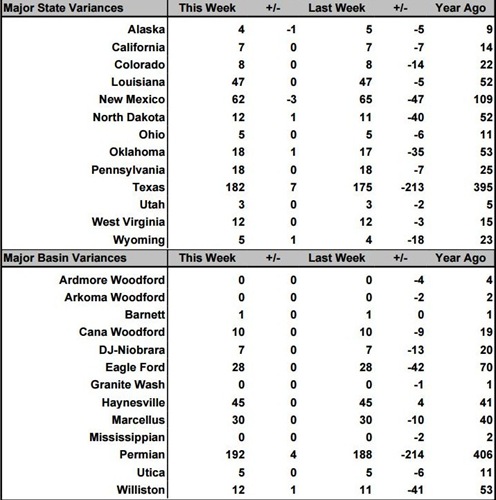
It looks like we just have a handful of fairly straightforward changes this week…checking first for the details on the Permian in Texas from the Rigs by State file at Baker Hughes, we find that there were 6 new rigs added in Texas Oil District 8, which corresponds to the core Permian Delaware, and another rig added in Texas Oil District 8A, which encompasses the northern counties of the Permian Midland basin, and hence the Permian basin in Texas saw a net increase of 7 rigs this week…since the national Permian rig count was up by 4, that means that all three of the rigs that were pulled out in New Mexico must have come from the far west reaches of the Permian Delaware, to account for the national net Permian basin rig increase…elsewhere in Texas, there was a rig added in Texas Oil District 2, while a rig was pulled out of Texas Oil District 1, which left the Eagle Ford rig count unchanged, and the total Texas rig count at 7…other rig activity this week included an oil rig that was added North Dakota’s Williston basin, and rigs that were added in Wyoming and Oklahoma in “other” basins that Baker Hughes doesn’t name, while a rig was pulled out from another such unnamed basin in Alaska at the same time..
Energy company sets sights on drilling near LaDue –An agreement could be in the works between the City of Akron and a private energy company that would result in drilling for gas and oil under 475 acres just south of the LaDue Reservoir in Auburn and Troy townships.In an Akron Planning and Economic Development Committee meeting on Jan. 11, Director of Public Service Chris Ludle explained that the energy company, DP Energy Auburn, LLC, is seeking to put gas and oil wells on adjacent private property to the city-owned land. He said this is located in the upper Cuyahoga River Watershed, and the proposal has been about a year in the making. The company is offering the city a one-time payment of $237,500, or $500 per acre, in a lease agreement for mineral rights of the 475 acres, according to the agreement. The city would also receive 15 percent of royalties on all oil and gas extracted from the wells.Geauga Commissioner Tim Lennon said neither the city nor the private company have approached the commission about the potential drilling in the county; however, he added the commissioners would not hold any authority over the situation anyway “I’d have to check with [our] legal counsel,” he said, “but I don’t think the commissioners can do anything officially to stop it. We don’t have the authority to impose restrictions on lands we don’t own.” He said any zoning concerns that may rise would fall under township purview. Mr. Lennon said he is not necessarily opposed to fracking, noting that there are oil wells all throughout the county, but he addressed environmental or drinking water concerns both area Geauga residents and Akron residents may have if City Council approves the deal. The city faced previous opposition from Geauga County residents to a logging proposal near LaDue in 2018, he added. He said he would have to wait for more information to unfold on the issue before taking any stance for or against the initiative.During the Jan. 11 meeting, Mr. Ludle explained that the agreement would not prevent the city from continuing any preservation efforts.”We can [still] do our invasive species program or wetlands management. We can do the normal things that we do to protect our land and protect the lake and the river up there,” he said, later adding, “We will still be able to do our best management practices with this land as we have in the past and we will be in the future.” He said if the agreement is approved, the energy company will have three years to find resources. “If they do not produce or if they do not hit anything, they cap the well and then all of the mineral rights do revert back to the city,” he said.
Risks too great from fracking at LaDue Reservoir, a key source of Akron drinking water – cleveland.com — Akron City Council must reject selling LaDue Reservoir’s mineral rights with the intent to use hydraulic fracturing under land that is near or under the reservoir. City officials defend the deal, saying fracking happens thousands of feet below surface water. Officials are ignoring thousands of documented cases of contamination, equipment failures, and intentional violations, expecting us to trust DP Energy Auburn, a recently incorporated company with no safety record. Although Akron Director of Public Service Chris Ludle pointed to regulation by the Ohio Department of Natural Resources when asked by council members about ensuring the integrity of the reservoir, Ohio had over 60,000 active oil and gas wells as of 2018, according to Spectrum News, but my analysis of ODNR data suggests that fewer than 17,000 wells were inspected in 2020. Violations could occur at any time, not only when inspectors are present. But ODNR does not, and likely will never, have the staff to provide constant oversight of every well. This is a matter of “when” not “if.” If fracking is permitted at LaDue, contamination could result in a Flintesque disaster. Akron’s officials are denying reality and the safety of residents. Theresa Gottl Brightman,
USA Shale Drilling Project Obtains $139.4M Investment Proposal from Capital Corp Merchant Banking –The shale development project will take place in lower-risk natural gas wells located in the Marcellus and Utica shale formations, which are some of the most prospective areas for natural gas production in the United States. The $139.4 million project will be developed by an oil & gas operator who has a full suite of in-house capabilities. The development of the targeted wells will include well drilling and the operator’s proprietary ability to process natural gas on-site and create refined components, including methane, ethane, propane, liquid natural gas, and other products for a value uplift.Shale is a substitute for conventional crude oil and is increasingly used, owing to its low cost of extraction. Additionally, oil shale serves in the production of specialty carbon fibers, carbon black, adsorbent carbons, resins, phenols, tanning agents, road bitumen, and soil-additives. The growing use of oil shale across various industries has been driving the oil shale market.Though shale may have had a rougher year in 2020 due to the Covid19 pandemic, oil prices appear ready to push higher in 2021 as demand recovers, according to Forbes. The funding structure of the project was engineered by Mr Gilles Herard. Mr Herard is a seasoned merchant banker and has been in the banking industry for over 40 years. As Managing Director of Capital Corp Merchant Banking, Mr Herard has become a leading figure in international middle-market project financing and engineers all funding structures for projects at Capital Corp.
EQT Launches Pilot to ‘Responsibly’ Produce Appalachian Natural Gas for Global Market – EQT Corp., the Lower 48’s largest natural gas producer, has launched a pilot program to demonstrate that the fossil fuel can be produced in an environmentally responsible way as buyers across the world continue demanding higher standards. EQT has partnered with environmental monitoring company Project Canary to continuously measure methane emissions and obtain certification that natural gas from two well pads in the Appalachian Basin is responsibly produced. The ultimate goal of the pilot, the company said, is to show that gas can be produced with both high environmental and social standards. EQT CEO Toby Rice said the pilot would help confirm “the emerging domestic and international markets for this differentiated commodity and the important role that United States liquefied natural gas (LNG) will play in the future energy mix.”Project Canary would provide an independent, third-party certification of responsibly sourced gas and provide methane monitoring. The terms of the project are confidential, but, EQT said a global energy company agreed to purchase a portion of the gas produced during the pilot. Costs associated with the pilot and the location of the wells were not disclosed.Devices are to be installed on the two well pads to measure methane concentrations at the site level “every second” and communicate results to a cloud database “every minute,” EQT said. Social impacts on the nearby community also would be evaluated. The TrustWell certification provides ratings for gas wells or entire asset bases. It measures several metrics to certify the conditions under which gas is produced to gauge impacts and risks, with a focus on water, air, land and community. The ultimate output is a rating similar to a Leadership in Energy and Environmental Design, aka LEED, rating for a building. Project Canary, which provides emissions monitoring for the oil and gas industry, merged with Independent Energy Standards, the developer of the TrustWell certification program, in August. They came together to provide a more comprehensive “responsibly sourced gas” solution for the industry as environmental, social and governance (ESG) issues have become a top priority. EQT produces gas in Ohio, Pennsylvania and West Virginia. It produced 366 Bcfe in the third quarter and has churned out more than 1 Tcf annually in recent years. The producer’s decision to launch the pilot comes as governments and private companies are aiming to curb the impacts of climate change.
Pain of natural gas price drop spreads to Pa. agencies, communities – The fallout from a year of low natural gas prices and little new drilling is reaching Pennsylvania state agencies and local governments that have come to depend on the shale gas industry for crucial funding. The state’s conservation and environmental protection departments are already warning of significantly less revenue from natural gas royalties and drilling permits in a year when the economic shock of the pandemic will make it harder to shift revenue from other state sources to fill in the holes. At the same time, low natural gas prices are projected to drive down total impact fees assessed on Pennsylvania’s shale gas wells by $56 million – to a record low of $145 million. That will leave less money to share among the counties, municipalities, state agencies and conservation initiatives that split the fees to offset the industry’s demands on the environment, public services and infrastructure. The impact fee rate is pegged to the average annual price of natural gas on the New York Mercantile Exchange. It fell to $2.08 per million British thermal units in 2020, the lowest level since the impact fee was established by Act 13 in 2012, according to the Independent Fiscal Office, which released the new projections. Impact fees are collected in April and distributed in July. The average natural gas price at major Pennsylvania trading hubs was even lower – $1.38 per MMBtu – according to the fiscal office’s weighted average of spot prices. Lower local gas prices means lower royalties for landowners who have leases with companies to extract gas from their properties – including the state. Natural gas revenue was down 23% – from $79 million in 2019 to $60.5 million in 2020 – on the 250,000 acres of state forest that are leased for shale gas development, the Department of Conservation and Natural Resources said.
Gov. Wolf outlines goals in 2021 – Gov. Tom Wolf is once again pushing for a higher minimum wage, a tax on natural gas drilling and the legalization of marijuana for recreational uses as top priorities in the coming year. The governor has met resistance from Republican lawmakers on those goals in the past. But he said he’d be pushing forward with them again as he outlined some of his top 2021 priorities in a news conference Thursday. Wolf has previously pushed a severance tax on natural gas production in each year in office and he’s now midway through his second term. Last year, he sought to use the tax to finance a host of economic development projects. Republicans have rejected proposals for a natural gas tax in the past. Pennsylvania is the second leading producer of natural gas in the nation. The governor said the severance tax would need to be “reasonable” but said it could be a source of revenue to finance economic development and workplace development programs that will help the state recover from the pandemic. The Marcellus Shale Coalition, which represents the natural gas industry, said a severance tax would hurt an industry already dealing with setbacks related to the pandemic. David Spigelmyer, the coalition’s president, said the industry’s numbers of active rigs and new well development are at their lowest since 2012. “We all feel the pandemic’s ongoing pain, yet Governor Wolf’s fixation with higher energy taxes will only compound these historically difficult challenges,” Spiglemyer said in a statement. “Increasing taxes on natural gas, one of the most essential products needed to keep us safe and defeat the pandemic, will put more Pennsylvanians out of work, increase energy bills for struggling families, small businesses as well as manufacturers, and further harm our economic recovery.”
De Blasio to ban gas hookups in new buildings by 2030 -The city will officially ban fossil fuel connections in new construction by 2030, a major step toward phasing out a reliance on gas and oil that other liberal cities have pursued across the nation.Mayor Bill de Blasio will announce the new policy, reviewed in advance by POLITICO, during his State of the City address on Thursday. The city will first establish intermediate goals for the policy in the short term and work to ensure the ban doesn’t negatively impact renters and low-income homeowners.De Blasio last year pledged to ban natural gas and other fossil fuels in large building systems by 2040 and to block any new fossil infrastructure, like pipelines, in the city. But it was unclear at the time how he would achieve those lofty goals as cities are mostly beholden to the state or federal government when it comes to new energy infrastructure – from siting new power plants to building offshore wind farms.But banning gas hookups in new or renovated buildings is one of the few ways cities can exert local authority to cut greenhouse gas emissions – and New York will now pursue the measure. The ban is among a list of policy items that environmental advocates are pushing Democratic mayoral candidates to commit to before the June primary. Some of those groups are likely to push the city for a ban ahead of 2030.
Biden administration to take ‘hard look’ at LNG-by-rail rule, Buttigieg says Pete Buttigieg, nominated to head the U.S. Transportation Department, signaled that the Biden administration would consider rescinding a recently completed rule allowing LNG transportation by rail. The final rule, issued June 19, laid out requirements for LNG transport by rail and allowed broad authorization for train shipments. The Transportation Department’s Pipeline and Hazardous Materials Safety Administration, or PHMSA, undertook the rulemaking to fulfill former President Donald Trump’s executive orders aimed at promoting energy infrastructure development. The LNG-by-rail rule is among a batch of Trump-era energy regulations the Biden administration is expected to review. Asked about his views on the rule during his Jan. 21 Senate confirmation hearing, Buttigieg said it was something he wanted to take a closer look at if confirmed. He said it would be important to take into account safety considerations. Pressed by Sen. Ted Cruz, R-Texas, on whether he would consider repealing the rule and halting transportation of LNG by rail, Buttigieg responded, “The best, honest answer I can give you now is that I’ll be taking a hard look at it.” Offering a view into his position on natural gas, Buttigieg noted that South Bend, Ind., converted some of the city’s municipal fleet to natural gas-powered vehicles during his tenure as mayor. Buttigieg elaborated on his views in response to Cruz’s comment that the transition from coal to gas for power generation has driven U.S. greenhouse gas emissions reductions. “I do recognize that natural gas, certainly for climate purposes, is not the same thing as coal,” he said. “It’s not the same as coal, but of course it’s not the same as hydroelectric power, and we need to be balancing all of these considerations as we go forward.” Buttigieg also committed to ensuring PHMSA is adequately staffed. The latest PHMSA reauthorization act requires the transportation secretary to present to Congress a comprehensive workforce plan for the administration.
Residents concerned about startup of compressor station – Residents opposed to a natural gas compressor station in the Fore River Basin are concerned that news that the facility will go back online came from the energy company and social media, rather than federal regulators. “It’s not professional and it’s not respectful of the citizens who live especially within that half-mile notification zone,” Alice Arena, of the Fore River Residents Against the Compressor Station, said during a virtual meeting Sunday night. “It’s all a little distressing.” The residents group called the meeting Sunday to discuss the news, as well as a vote by the Federal Energy Regulatory Commission to reject the denial of a rehearing request submitted by the group. The commissioners, several of whom suggested the commission should do more to address health and safety concerns, offered some hope that residents may succeed in keeping the compressor station turned off following two emergency shutdowns at the plant in September. But Max Bergeron, a spokesman for Enbridge, the Canadian company that built the compressor station, said in an email Friday, Jan. 22, that the federal Pipeline and Hazardous Materials Safety Administration has approved the station going back into service after two emergency shutdowns in September. Bergeron said the station would “methodically be placed in service” with oversight from the federal agency. “We expect to have the ability to start flowing gas through the compressor station for our customers in the coming days,” Bergeron said in the email. Robert Burrough, director of the Pipeline and Hazardous Materials Safety Administration Eastern Region, sent a letter to Enbridge on Jan. 22 confirming “the temporary operation of the compressor units.” Burrough said the agency’s corrective action still remains in effect. Arena called the news “a little sketchy,” and said the letter isn’t clear about whether Enbridge can operate the station at full capacity. A spokesperson for the Pipeline and Hazardous Materials Safety Administration confirmed Monday that the agency had temporarily removed pressure restrictions to allow for the station’s start up. A corrective action order remains in effect. The controversial compressor station is part of Enbridge’s Atlantic Bridge project, which expands the company’s natural gas pipelines from New Jersey into Canada. It has been a point of contention for years, and residents say it brings serious health and safety problems to the Fore River Basin.
$1.1 million Dominion gas upgrades continue in Bridgeport, West Virginia officials say – – Dominion is working on a $1.1 million project in Bridgeport that city officials say is a standard but substantial upgrade to gas lines. According to Bridgeport Interim Public Works Director Tiny Grimes, the gas company is working along parts of Johnson Avenue, Philadelphia Avenue, James Street, Water Street, Anderson Street, Wyatt Street and Faris Avenue. To Grimes’ knowledge, the old line was leaking in water and there were several leaks that could not be found, causing individuals to lose gas.
Regulatory route becomes more complicated for Mountain Valley Pipeline – The journey of the Mountain Valley Pipeline, up and down precarious mountainsides and under rocky streambeds, was never an easy one. Now, the natural gas pipeline is facing an increasingly difficult passage through legal and regulatory roadblocks. A sixth lawsuit challenging the project’s federal permits – which were recently restored after being set aside by an earlier round of litigation – was filed Wednesday. On the same day, the inauguration of President Joe Biden foreshadowed more uncertainty at agencies long perceived to be friends of the pipeline. Biden on Thursday named commissioner Richard Glick as chairman of the Federal Energy Regulatory Commission, putting a Mountain Valley critic in charge of the presidentially appointed panel that governs pipelines. And as the crossing of hundreds of streams and wetlands in the buried pipeline’s path grows more complicated, Mountain Valley has indicated it might abandon its initial plan and seek a new kind of permit that could further slow an already delayed construction schedule. No one obstacle alone is likely to kill the pipeline, according to Carolyn Elefant, a Washington, D.C., attorney who once worked for FERC and now represents landowners opposed to pipelines. But FERC could take a new look at Mountain Valley “through the prism of a new administration and new administrative policies,” she said. “I think it will certainly slow the process, and if the process is slowed enough, it could lead the developers to cancel or modify their plans.” The most recent slow-down came last Tuesday, when FERC considered an application by Mountain Valley to expedite construction on the first 77 miles of the pipeline in West Virginia. To the surprise of many, FERC deadlocked 2-2 on the company’s request to bore under streams along the segment, rather than use a trench-digging method that is currently stalled by a legal challenge from environmental groups. Boring would have allowed Mountain Valley to complete the segment and begin shipping gas up to the point where it connects with another pipeline, then on for distribution, while work continued on the rest of the 303-mile line. With the tie vote, the request was neither approved nor denied, putting it in a state of limbo. Mountain Valley spokeswoman Natalie Cox said the matter could be considered a second time. But the chair of FERC has the sole authority on whether to place items on the panel’s meeting agenda. The commission is now headed by a Democrat, Glick, who in the past has said Mountain Valley should not be allowed to resume construction on the $6 billion project until it has all of the required permits in hand. One approval has been stayed by a federal appeals court, and others are facing legal attacks.
NextEra Energy Posts Loss on $1.2 Billion Mountain Valley Pipeline Charge — NextEra Energy Inc., the world’s largest producer of wind and solar energy, swung to a loss in the fourth quarter, dented by an impairment charge of $1.2 billion on its investments in the Mountain Valley natural gas pipeline. Mountain Valley pipeline, which stretches from West Virginia to Virginia, is one of the several oil and gas pipelines delayed in recent years by regulatory and legal fights with states and environmental groups that found problems with permits issued by the Trump administration. Most recently, federal energy regulators did not approve a request to ramp up construction of a part of the pipeline, which is expected to transport 2 billion cubic feet per day of gas from the Marcellus/Utica shale formation in West Virginia, Pennsylvania and Ohio to Virginia. The natgas pipeline, owned by units of Equitrans Midstream Corp. and NextEra, among others, is currently estimated to be in service by late 2021. Analysts, however, expect the pipeline’s startup to be delayed after Virginia environmental regulators proposed changes to stream-crossing rules that would bar Mountain Valley from using the U.S. Army Corp’s proposed 2020 Nationwide Permits to cross streams. NextEra on Jan. 26 attributed its writedown to legal and regulatory challenges, saying the project is facing “substantial delays in reaching commercial operation and increased costs associated with those delays.” The company posted a net loss of $5 million in the three months ended Dec. 31, from an income of $975 million a year earlier. Excluding the charge and other items, the company’s profit of 40 cents per share beat analyst estimates of 37 cents, helped by a surge in demand for renewable power generation.
Editorial: Consistency needed in pipeline permitting process – The question of whether the United States needs more pipeline capacity to carry natural gas, natural gas liquids, crude oil and petroleum products over long distances returned last week when President Joe Biden, on his first day in office, issued an executive order canceling permits for the Keystone XL pipeline in the Great Plains. The immediate effect of Biden’s order was to cause a new strain in U.S.-Canadian relations, as the government of Canada was counting on the pipeline to move its crude oil to ports on the U.S. Gulf Coast. Closer to home, people who oppose pipelines won a victory last week when the Federal Energy Regulatory Commission, in a 2-2 vote with one abstention, declined to approve a request from the developers of the Mountain Valley Pipeline to bore under 69 waterbodies and wetlands along 77 miles of the pipeline at its northernmost end in West Virginia. Not all permits have been secured for pipeline work in West Virginia. Some have been tied up in court.The aim of the Mountain Valley Pipeline is to make natural gas from West Virginia’s Marcellus and Ohio’s Utica shale regions available to residential and industrial customers in Virginia and North Carolina. If built, the pipeline would run from Wetzel County to an existing compressor station in Virginia and then southward. As with any undertaking of this size and nature, there are questions of whether the pipeline is needed, whether construction would adversely impact the environment of sensitive areas and whether landowners whose land the pipeline would cross are being treated fairly. There are several ironies in all this. One is that Appalachians are willing to tear down a mountain to build a road or a shopping center, but they find drilling under a creek to install a pipeline to be unacceptable. Another is that propane (liquified natural gas) and compressed natural gas are being used as cleaner alternatives to diesel fuel in tractor-trailers and buses. That gas has to get from the well to the filling station somehow. Natural gas provides cleaner electricity than coal, but it needs to get from the well to a processing plant and then into a pipeline for delivery to a power plant. Renewables are the future, but we need a bridge to that future while technology and infrastructure are developed. Natural gas is our best bridge at this time. The gas industry needs to be responsible in its construction and maintenance of pipelines, and the federal government needs to honor its commitments in permitting instead of making permits subject to the whims of whatever new administration takes office.
Concerns over erosion impact of Mountain Valley Pipeline continue with project in limbo –West Virginia Rivers Coalition staff scientist Autumn Crowe has been closely following the Mountain Valley Pipeline since it was first proposed and says that pipeline construction through the steep slopes of West Virginia has taken a dangerous toll. “They’re trying to [work through] steep slopes with highly erosive soils, and we’re seeing that over and over again where slopes are failing, erosion is occurring,” Crowe said. “There’s just nothing they can really do to control the amount of soil they’ve exposed.” A volunteer group that has been monitoring and reporting environmental issues related to the construction of the 303-mile natural gas pipeline from Northwestern West Virginia to Southern Virginia filed evidence with federal regulators Thursday suggesting that the pipeline is eroding areas along the pipeline right-of-way in Braxton and Lewis counties. Mountain Valley Watch submitted three pages of aerial photos showing bare, unvegetated areas and slips long the pipeline route, reporting collapsing slopes and sediment in a stream crossing south of Copley Road in Lewis County. “The photos are conclusive evidence of unvegetated areas requiring corrective action for lack of ground cover,” Mountain Valley Watch wrote in the filing to the FERC. Mountain Valley Watch cofounder Kirk Bowers noted that exposed soil surfaces increase runoff into streams. “They need to go in and reseed the areas that are not under grass and don’t have adequate vegetative cover,” Bowers said. “It’s that simple.” Mountain Valley Watch has been on watch before. The group submitted aerial documentation of what it concluded were inadequate ground cover and stabilization measures in Doddridge, Lewis, Braxton, Webster, Summers and Monroe counties last summer to the West Virginia Department of Environmental Protection, which in 2019 fined Mountain Valley Pipeline, LLC $266,000 for more than two dozen notices of environmental violations, which included failing to operate and maintain erosion control devices, resulting in stream sedimentation. Natalie Cox, spokeswoman for Equitrans Midstream Corporation, said that “[Mountain Valley] has consistently stated that completing construction work and fully restoring the right-of-way is best for the environment, as well as for the affected landowners along the route,”.
Poll shows support for pipeline in Southwest Virginia – A majority of Southwest Virginians support the construction and operation of the Mountain Valley Pipeline, according to a recent poll commissioned by the company building the natural gas pipeline. Surveying by Mason-Dixon Polling & Strategy found that 66% of the respondents favored the pipeline, which has been under construction since 2018. The poll found 28% opposed and 6% undecided. However, the poll showed that backing for the project has declined since the start of construction led to widespread environmental problems with muddy runoff. In 2017, 74% of Southwest Virginia respondents supported the pipeline, compared to the more recent figure of 66%, according to Mason-Dixon. Although the pipeline has fierce opposition – from those who object to the project’s environmental impact in the Roanoke and New River valleys, contribution to climate change and use of eminent domain to take private land – supporters say its natural gas will fuel economic growth and sustainable energy. “Mountain Valley is important for our region’s future. As indicated by these latest survey results, most people agree,” Joyce Waugh, president and CEO of the Roanoke Regional Chamber, said in a news release issued by the company. Statewide, backing for the pipeline was by a closer margin, at 53%. The poll, conducted in December, relied on telephone responses from 625 registered voters selected at random. Based on population percentages, 70 respondents were from Southwest Virginia.
Mountain Valley Pipeline changes strategy on permits– Mountain Valley Pipeline says it will abandon its plan to use a blanket permit to cross nearly 500 streams and wetlands. The Roanoke Times reported Tuesday that the pipeline project will instead apply for individual approvals for each open-cut crossing. That will make for a more costly and time-consuming process for a project that is already swamped by legal and regulatory delays. But Mountain Valley attorney Todd Normane said in a letter Tuesday to the Federal Energy Regulatory Commission that switching to individual permits is “the most efficient and effective path to project completion.” The federal 4th Circuit Court of Appeals has twice set aside the blanket permit. Critics have said that it fails to adequately assess the environmental impacts of a massive pipeline fording pristine mountain streams. The project has faced various legal challenges from environmental groups because construction has led to violations of regulations meant to control erosion and sedimentation. Despite its change in strategy, Mountain Valley said it still expects to complete the project by year’s end at a projected cost of about $6 billion. That’s nearly twice the original estimate. The 303-mile pipeline will take natural gas drilled from the Marcellus and Utica shale formations and transport it through West Virginia and Virginia. Mountain Valley Pipeline LLC has received FERC permission to resume construction of its 303- mile, 2-bcfd natural gas pipeline through West Virginia and Virginia. FERC also granted a two-year extension for completion of the pipeline, through October 2022.With a vast supply of natural gas from Marcellus and Utica shale production, the Mountain Valley Pipeline is expected to provide up to 2 million dekatherms per day of firm transmission capacity to markets in the Mid- and South Atlantic regions of the U.S. The pipeline will be 42 inches in diameter and will require approximately 50 feet of permanent easement (with 125 feet of temporary easement during construction). In addition, the project will require three compressor stations, with identified locations in West Virginia’s Wetzel, Braxton and Fayette counties.
Frack check: Debunking natural gas pipeline claims made in a recent Energy Transfer commercial – On Jan. 24, oil-and-gas giant Energy Transfer shelled out some serious money to re-run one of their commercials during the NFL conference championship games. The commercial implies that oil and natural gas lines are necessary to keep tanker trucks off of roads and tanker train cars off of railways, “just to meet our energy needs.” The commercial posits underground pipelines as bucolic havens, and railroads and highways as dangerous.Highways are dangerous, and pipelines do have far fewer incidents compared to America’s roads. But any notion that pipelines are solely peaceful and perfectly safe comes tumbling down when confronted with reality. According to ProPublica, pipeline incidents have killed more than 500 people, injured over 4,000, and cost nearly $7 billion in property damages between 1986 and 2012. There are roughly 3 million miles of pipeline in the U.S. Between 2010 and 2019, there were 329 pipeline explosions and more than $5.3 billion in damages, according to the FracTracker Alliance.In 2018, less than two weeks after the initial airing of its commercial, an Energy Transfer pipeline exploded in Beaver County after only being in service for one week due to a landslide. It burned one house to the ground and several vehicles. No one was injured. (Natural gas drilling, aka fracking, is done all across Southwestern Pennsylvania, although fracking production has slowed as of late.)According to the Pennsylvania Public Utility Commission, the Energy Transfer pipeline was constructed in an area that has extremely high risks for landslides. Since the explosion, the state Department of Environmental protection haslevied more than 600 violations against the Revolution pipeline, as it is so called.Another claim made by the Energy Transfer commercial is that U.S. roads and railways would be clogged if pipelines were eliminated. Some politicians and environmentalists are more concerned with blocking new pipelines than ripping out ones currently in use. And many major pipeline proposals have recently either been abandoned by energy companies, or blocked by governments. Stephanie Wein of the statewide environmental group PennEnvironment says the Energy Transfer commercial is an attempt to boost the profile of fossil fuels when they are becoming increasingly less popular. She notes that pipelines do leak and cause pollution, like in Marsh Creek Lake in Chester County last year, but says that overall, Pennsylvanians should be wary of efforts by fossil-fuel companies to market pipelines since they could take the country in the wrong direction.
Vote Solar expert says Duke Energy customers could face $4.8 billion in stranded fossil fuel plant costs – Duke Energy Corp. customers could be on the hook for $4.8 billion by 2074 to pay for natural gas plants in the Carolinas that the company will build but will have stopped operating before they are fully paid for, says a new study by the Energy Transition Institute. At the heart of Carbon Stranding: Climate Risk and Stranded Assets in Duke’s Integrated Resource Plan is author Tyler Fitch’s analysis of the company’s latest Integrated Resource Plan judged against its carbon reduction plan to reach net-zero emissions by 2050. Fitch, Southeast regulatory manager for the pro-renewables group Vote Solar, produced the report while on a fellowship to ETI. His group intends to use the information to argue that regulators should account the possibility of stranded costs as they consider whether to approve Duke’s latest resource plans. Fitch notes that Duke Energy Carolinas and Duke Energy Progress plan to build from 6,100 to 9,600 megawatts worth of new natural gas plants by 2035. He argues that most of those will have to be closed down by 2050 to reach Duke’s carbon goals and conform with North Carolina’s Clean Energy Plan. Under regulatory practices in North Carolina and South Carolina, utilities are allowed to charge customers to amortize the costs of power plants over their “used and useful” life. But natural gas plants have are considered 40-year assets, and Duke (NYSE: DUK) projects the last of those plants being built in 2035. Fitch says that, absent some unusual amortization arrangements or intervention by regulators, customers could be paying the costs of that plant for more than 25 years after it stops producing power. He compares the situation to the way that Duke’s failure to account for long-range costs of coal ash left customers on the hook for some $7.5 billion now that those costs are coming due. If Duke’s Carolinas customers were required to pay that amount in a single lump sum, each of its 4.2 million customers would have to pay $900 in current dollars to cover those costs, the report says.
Colder Weather, Strength in Cash Prices Fuel Surge in February Natural Gas Futures– After a bruising run a week earlier, natural gas futures rebounded Monday on substantial increases in expected heating demand over the weekend and a fresh bout of winter weather settling in across parts of the Midwest on Monday. The February Nymex gas futures contract jumped 15.6 cents day/day and settled at $2.602. The prompt month had dropped 10% over the prior week. March rose 14.2 cents to $2.598 on Monday, also recovering from a slump a week earlier. Of last week’s activity, analysts at The Schork Report said, “the fact traders are unwilling to pay a premium to own gas for the final two delivery months of winter is as fundamentally bearish as it gets,” Observers said hints of a cold finish to winter, however, were enough for futures to reverse course on Monday. “The supply/demand balance remains tight for when weather cooperates,” NatGastWeather said. NGI’s Spot Gas National Avg. advanced 9.0 cents to $2.730. After a week of warming shifts in weather forecasts, model changes over the weekend turned back colder for the final week of January and into early next month, lifting expectations for a run of stronger heating demand. Bespoke Weather Services estimated an additional 15-20 gas-weighted degree days over the next couple weeks. “Some of these colder changes were for this week, not just far out in the more unreliable extended forecast,” the firm said. But the change marked “a decent step away from the big warmth we saw” in outlooks last week. U.S. liquefied natural gas (LNG) export volumes also recovered Monday, climbing to around 11 Bcf after dipping down near the 9 Bcf level late last week. Challenges created by several days of heavy fog near Cheniere’s Sabine Pass LNG facility temporarily minimized activity.
Natural Gas Futures Build Momentum as ‘Dead of Winter’ Arrives; Spot Prices Sail Higher – Natural gas futures extended gains on Tuesday, as traders absorbed news of weather forecasts shifting even colder after a similar change in models over the weekend. The weather outlooks increased the likelihood of robust heating demand the rest of January and into early February, fueling futures. The February Nymex gas futures contract settled at $2.656 on Tuesday, up 5.4 cents day/day. Both the domestic and European weather models produced forecasts that, if they hold up, could make the coming two weeks colder than the five-year average. On Monday, the prompt month surged 15.6 cents. March also advanced on Tuesday, rising 3.8 cents to $2.636. March takes over as the prompt month with Thursday’s trading. Futures caught “a dead of winter skew to the upside,” as Mizuho Securities USA’s director of energy futures Robert Yawger put it. NGI’s Spot Gas National Avg. posted a third-consecutive gain amid the intensifying winter chill, advancing 12.0 cents on Tuesday to $2.850. A day earlier and last Friday, cash prices rose 9.0 cents each day. A deep winter freeze had already settled in across the northern Plains and Midwest by Tuesday. NatGasWeather expected the frigid conditions to expand and generate strong national demand Wednesday through Friday, “as cold air spreads across the northern and eastern U.S.” Temperatures are expected to warm by the end of the coming weekend, the firm said, but another blast of widespread cold is possible in the first week of February. “What’s now most important is if cold air arriving into the Rockies and Plains Feb. 3-4 can spread eastward Feb. 5-8,” the forecaster added. Should the cold snap extend into next month, it would mark the longest and most frigid winter freeze of an otherwise benign winter season
Natural Gas Futures and Cash Prices Rally Amid Freezing Temps, Cold Outlooks – Natural gas futures on Wednesday extended to three days a winning streak built on intensifying winter weather and renewed momentum in U.S. liquefied natural gas (LNG) demand. EIA storage Jan 22 Before rolling off the board on Wednesday, the February Nymex gas futures contract climbed 10.4 cents day/day and settled at $2.760. March, which takes over as the prompt month on Thursday, advanced 6.6 cents to $2.702. NGI’s Spot Gas National Avg. continued its own multi-day rally, surging 52.0 cents to $3.370 on Wednesday. In addition to a widespread blast of cold this week, mid-range weather outlooks have steadily pointed to freezing conditions in weeks ahead. “Once again, the changes in the weather forecast are to the colder side, enough to now move the 15-day forecast as a whole a little colder even versus the long-term, 30-year normal,” Bespoke Weather Services said Wednesday. “Much of the colder change the last several days has been centered around more storm-induced variability than projected a week ago, as opposed to a true cold outbreak coming out of Canada,” Bespoke added. “But that narrative changes in the 11- to 15-day period, as a stronger cold air mass is expected to push southward out of Canada into the U.S. Its focus appears to be in the middle of the nation … as opposed to hitting the more populated East and South, though it still looks like enough for a few days of above-normal” demand.
US natural gas in storage falls less than expected but massive draw looms | S&P Global Platts – US working natural gas stocks dipped less than the market expected last week, leading to a dip in the Henry Hub prompt month, but a cold spell seizing most of the nation could lead to the largest draw of the heating season thus far for the week in progress. Storage inventories decreased by 128 Bcf to 2.881 Tcf for the week-ended Jan. 22 the US Energy Information Administration reported Jan. 28. It was a sharp departure from the massive 187 Bcf draw reported the week prior. US supply and demand balances were much looser than the week prior. The call on storage fields fell by 6.4 Bcf/d week over week, according to S&P Global Platts Analytics. Total demand saw a large decline due to milder temperatures, which pushed residential and commercial and industrial combined demand down nearly 2.9 Bcf/d. In addition, gas-fired power generation fell by 3.3 Bcf/d. This was due in part to higher wind and coal generation. Gas supply remained relatively stable as 300 MMcf/d of growth in US production was offset by an almost equal decline in net Canadian imports. Colder weather in Canada led to a spike in local demand resulting in less export to the Lower 48. The withdrawal was weaker than an S&P Global Platts’ survey of analysts calling for a 136 Bcf draw. The pull also trailed the 170 Bcf draw reported during the same week last year as well as the five-year average withdrawal of 174 Bcf, according to EIA data. Storage volumes now stand 78 Bcf, or 3%, more than the year-ago level of 2.803 Tcf and 244 Bcf, or 9%, more than the five-year average of 2.637 Tcf.
March Debuts with Thud; Natural Gas Futures Fall After Storage Withdrawal Fails to Impress – Natural gas futures faltered Thursday following a bearish storage report and a key weather model pointing to lighter heating demand than previously expected, ending a rally. EIA storage Jan 22 On its first day as the prompt month, the March Nymex gas futures contract shed 3.8 cents day/day and settled at $2.664. It ended a three-day run of solid gains for the prompt month. April lost 4.5 cents to $2.675. “The end of the winter curve is trading below the front of the summer curve, and has been since Dec. 8,” indicating that, despite the recent rally, cold weather has fallen short of expectations this winter, said Mizuho Securities USA’s Robert Yawger, director of energy futures. NGI’s Spot Gas National Avg. kept a five-day win streak alive Thursday, rising 5.0 cents to $3.420, after surging 52.0 cents on Wednesday. NatGasWeather noted the European weather model tilted warmer overnight. It showed a decline from earlier forecasts in the level of cold air reaching eastern portions of the country for the first 10 days of February. Over the course of the three prior trading days, weather models shifted colder at multiple stages, fueling a rally. After falling 10 cents lower in morning trading, futures regained some ground after the latest American Global Forecast System (GFS) model “upped the cold factor yet again for Feb. 6-10 by favoring frosty Arctic air over Western Canada releasing across the U.S. Rockies, Plains and Midwest for strong national demand,” NatGasWeather said in a midday note. EIA reported a withdrawal of 128 Bcf rom storage for the week ended Jan. 22, well below both the midpoint of analysts’ estimates and the week-earlier print. Analysts noted that it was warmer than normal during the covered week and liquefied natural gas (LNG) volumes were also lower because of heavy fog along the Gulf Coast that limited access to export facilities. LNG volumes have since recovered this week, holding above 11 Bcf/d on Thursday after dipping below 9 Bcf at one point last week, according to NGI data.
March Natural Gas Futures Lose More Ground Amid Mixed Demand Outlooks; Cash Prices Fall – – Natural gas futures flip-flopped between gains and losses early on Friday, as traders weighed fluctuating weather forecasts against renewed strength in U.S. liquefied natural gas (LNG) volumes. Still, futures ultimately finished in the red as the cloud of a bearish storage report from a day earlier – and the light winter heating demand it reflected – hung over markets. The March Nymex gas futures contract settled at $2.564 on Friday, down 10.0 cents day/day. A day earlier, in its debut as the prompt month, March shed 3.8 cents. The April contract, meanwhile, fell 8.3 cents to $2.592 on Friday. Analysts at The Schork Report noted that March traded at a discount to April, as it has since December. They said this “is a clear bearish fundamental telltale,” given that trading for March still represents the winter season, when demand for natural gas is typically at its peak. NGI’s Spot Gas National Avg., meanwhile, dropped 56.0 cents to $2.860, snapping a five-day win streak. Bespoke Weather Services noted early Friday that both the American and European weather models were colder versus 24 hours earlier, yet the overnight data from the European came in warmer versus Thursday’s afternoon run. Both models tilted slightly warmer at midday Friday. “Storm-induced variability is still the theme over the next week or so, followed by a more substantial push of cold into the central/western U.S. next weekend into the following week,” Bespoke said. The anticipated spell of freezing conditions over the next two weeks could drive above-normal gas-weighted degree days nationally, the firm said, even though the coldest temperatures were not expected to reach the East.
U.S. charges two offshore workers over Gulf of Mexico oil spills(Reuters) – Two Fieldwood Energy LLC oil workers face federal criminal charges for allegedly separately allowing crude oil spills from offshore U.S. Gulf of Mexico platforms to avoid required shut downs. The two were indicted Tuesday for spills in 2015 and 2018, according to complaints by the U.S. attorney for the Eastern District of Louisiana. Workers in one platform joked that their motto was “safe and sound until production’s down,” the indictment said. Fieldwood’s “top priority is to operate our facilities in a safe manner that protects” workers and the environment, the Houston-based company said in a statement. Fieldwood was not identified by name in the indictments or charged. It referred questions to attorneys for the two men. Fieldwood area foreman Brandon Wall, 42, of Louisiana, was charged with negligent discharge and bypassing monitoring and safety systems to keep oil flowing at one of the company’s most prosperous platforms, according to the indictment. “Shutting-in the platform for repairs or maintenance would have resulted in Company A making substantially less money,” the indictment said. The actions released a “harmful quantity of oil and other hazardous substances.” Wall alerted regulators a month after an oil sheen was first sighted off the Grand Isle 43AA platform, the indictment said. Patrick Huse, 40, of Mississippi, a person-in-charge of other Fieldwood platforms, faces eight charges including knowingly releasing oil, misrepresenting to regulators and making false entries to inspection logs.
Anti-fracking groups to appeal challenge to Michigan petition law to Supreme Court The Michigan Supreme Court is likely to be the last stop for a group that’s trying to put a fracking ban on the ballot. Hydraulic fracturing, commonly known as fracking, is a controversial process involving pumping large amounts of water, sand and chemicals into deep into the ground to break up shale deposits releasing oil or natural gas. Fracking has boosted oil and natural gas production. But critics say it damages the environment. The Committee to Ban Fracking in Michigan collected more than 270,000 signatures to put a ban on the ballot. But the signatures were not collected within the 180 day window required by law. The group has been fighting the limit in court for years. Last week, the Court of Appeals rejected the group’s request to strike down the statute. Attorney Matthew Erard represents the Committee to Ban Fracking in Michigan. He says meeting the 180-day limit is easier for well-funded campaigns with paid circulators. But Erard says for grassroots groups pursuing a petition drive entirely on the basis of volunteer effort it’s extremely daunting, if not impossible. “There is no purpose for this statute,” says Erard. “Other than to frustrate the citizens’ initiative process.” Erard says if appealing to the Supreme Court fails, the anti-fracking group will have to consider starting their petition drive over.
John Walsh: Whitmer’s Line 5 fight a ‘backslide for carbon control progress’(president and CEO of the Michigan Manufacturers Association) Rounding the corner to 2021, the pandemic that many believed would end months ago continues to take its toll on people’s lives and our economy. While Michigan can be immensely proud that Pfizer, one of our state’s most prominent manufacturers, is leading the way in speeding a life-saving vaccine to market, Michigan’s economic recovery is years away. One thing is for certain, the pandemic has altered the way we work, go to school and shop, among other things. In other words, the way we consume things. For Michigan, where good manufacturing jobs are highly desired and where we work hard to ensure our companies can compete around the world, basic economic principles of supply, demand and workforce remain challenged and uncertain. But the demand for goods, especially food, medical supplies, clothing, safety products and many others, continues despite, and because of the coronavirus. Michigan manufacturers have risen to the challenge, changing auto assembly lines to hand sanitizer, ventilator and mask-making production lines to meet the safety needs of front-line workers and citizens everywhere. Once the Arsenal of Democracy, Michigan is flexing its manufacturing muscle again as the Arsenal of Health. Michigan manufacturers are gearing up to power up Michigan’s economy as we emerge from COVID’s grip. But manufacturing takes a lot of energy, and Gov. Gretchen Whitmer’s recent actions to shutter Line 5 – Michigan’s energy lifeline – in early 2021 just three years before a planned tunnel solution can be completed, threatens the speed and strength of recovery. Her actions risk manufacturing jobs and the mere survivability of some manufacturers. They threaten to raise the price of nearly every product made in Michigan – from pickles to potato chips and automobiles to appliances – and sold here and around the world.
Canadian pressure mounts on Michigan governor to back off Enbridge pipeline – – Canadian government and business interests are mounting a full-court-press on Michigan Gov. Gretchen Whitmer, hoping to badger the Midwest Democrat into reversing an order that shuts down a controversial Enbridge oil pipeline under Lake Michigan later this year. Whitmer administration officials say formal calls are coming from nearly all corners of Canada to allow the Enbridge Line 5 oil line crossing under the Straits of Mackinac to continue operating after a May deadline, which the governor imposed several months ago when she announced revocation of the pipeline easement over past violations.Diplomats and business leaders across the border say the move imperils Canadian jobs and they’re threatening to escalate the matter with new U.S. President Joe Biden, who is juggling the desire of climate voters demanding a shift away from fossil fuels with efforts to improve an international relationship strained under Donald Trump.Local and provincials officials in Ontario, where the 645-mile pipeline crosses back into Canada at Sarnia, are pushing Prime Minister Justin Trudeau to take the matter directly to Biden.”At some point, there will be some discussions with the new administration, whether that be directly between our prime minister and the president, or at the cabinet-level on both sides. That’s still up in the air, ” said Joe Comartin, a former Parliment member and Canada’s consul-general in Detroit.”The position by Enbridge, generally, and we support it, is that the state does not have the jurisdiction and authority to close this (pipeline) down,” Comartin said. In November, Whitmer rewarded environmental groups and Enbridge critics by terminating a 68-year-old easement which enabled the company to run dual oil lines under the Great Lakes next to the Mackinac Bridge. The move was heralded by many concerned that the aging pipeline posed an oil spill risk, but has been criticized by pro-business and labor groups who say the pipeline is necessary to support energy jobs and supply home heating fuel in Michigan.Whitmer gave Enbridge until May to wind down operations, ostensibly a date chosen to allow time for alternative fuel supply issues to be figured out in the Upper Peninsula, where the line moves propane for residential heating.Enbridge has pushed back, saying it wont comply with the shutdown absent a court order. The company is seeking permits to build a huge $500 million tunnel under the straits to house a replacement for the pipeline. “We’re getting a lot of pressure from Canada,” said Hugh McDiarmid, spokesperson at the Michigan Department of Environment, Great Lakes and Energy (EGLE), which is reviewing several of Enbridge’s permit applications for the tunnel. “Every, or almost every, province has written a letter in support of keeping the pipeline open.” Canadian news sites have quoted a litany of local, provincial and federal officials as being concerned about a Line 5 shutdown and making efforts to lobby the Michigan governor. Canada’s ambassador to the U.S., Kirsten Hillman, is reported to have spoken to Whitmer and Ontario Prime Minister Doug Ford has also written the governor to urge that she reconsider.
SpaceX to Drill for Natural Gas Near Texas Starship Development Site – It’s a development that was unexpected even for the frequently surprising Elon Musk. As reported by Bloomberg, the Tesla Motors CEO’s SpaceX revealed in a regulatory hearing that it plans to drill for natural gas near its Boca Chica spacecraft development facility in the southeast corner of Texas, near Brownsville. In the hearing, conducted by the Railroad Commission of Texas and aimed at helping resolve a dispute, attorney Tim George said that SpaceX will utilize the methane extracted from its efforts “in connection with their rocket facility operations.” No further details were immediately available. George represents Lone Star Mineral Development, the SpaceX subsidiary formed last June that will be responsible for the drilling. Such activity has not yet begun because Lone Star Mineral Development is locked in a fight with rival energy company Dallas Petroleum Group. Lone Star purchased its 806-acre site from privately held Houston company Mesquite Energy; Dallas Petroleum claims it owns numerous inactive wells on the property. Another SpaceX subsidiary, land acquisition business Dogleg Park, claims that Dallas Petroleum blocked SpaceX’s access to the site in an attempt to effectively extort money from Musk’s company. Boca Chica is the site where SpaceX’s Starship spacecraft and Super Heavy rocket are currently being developed and tested. Last month, an unmanned Starship prototype was launched from Boca Chica. The flight saw Starship notch a new record for height (roughly 40,000 feet) and hit certain objectives, although it exploded on impact during landing.
US oil, gas rig count jumps 12 to 442; highest since April 2020: Enverus – The US oil and gas rig count jumped climbed 12 to 442 in the week ended Jan. 27, Enverus data showed, with the double-digit jump likely telegraphing a changing mindset stemming from higher oil prices.. Stay up to date with the latest commodity content. Sign up for our free daily Commodities Bulletin. Sign Up “Overall, another strong week for US rigs, as operators are likely starting to see a mid-$50/b price in 2021 as a possibility, which would allow for most of the drilled-but-uncompleted wells to be profitable in major crude plays and a large portion of new wells to be able to breakeven,” said Andrew Cooper, quantitative analyst with S&P Global Platts Analytics’ Global Supply Team. “However, a strong rig ramp of 20 rigs a week is unlikely without $60/b WTI,” Cooper said. For the week ended Jan. 27, oil prices were slightly lower. WTI prices averaged $52.71/b, down 33 cents, while WTI Midland averaged $53.63/b, down 28 cents, and the Bakken Composite price averaged $49.68/b, down 42 cents. Natural gas prices were also slightly weaker, with Henry Hub averaging $2.55/MMBtu and Dominion South averaging $2.25/MMBtu, both down 8 cents. The nationwide rig count, now it’s highest since April 2020, has grown by 36, or 8.9%, in the past three weeks. Oil rigs were up eight on week to 326, while gas rigs were up four to 116. In April-May 2020, rig totals plummeted from an oil price collapse as the pandemic hit oil demand. The rig count has since recovered 58% from the early July trough of 279 but it is still below the 838 domestic rigs active in early March 2020.The largest weekly change in rigs came in the Permian Basin of West Texas/New Mexico, where seven rigs were added to 201, marking the highest total the basin has seen since May 2020. Rigs in the Eagle Ford Shale of South Texas were up four week on week to 32. The DJ Basin (nine rigs) of Colorado; the SCOOP-STACK (16) play of Oklahoma; and the gas-prone Haynesville Shale (49) of East Texas and Northwest Louisiana all gained one rig apiece. The natural gas-prone Marcellus Shale (34), mostly in Pennsylvania, and the Utica Shale (eight), largely in Ohio, also kept their rig counts steady week on week. There were no weekly changes in rig count to the oily Bakken Shale, where totals have remained at 13 for three consecutive weeks.
Keppel Exits Offshore Rig Building Business – Keppel Corporation announced Thursday that its wholly owned subsidiary Keppel Offshore & Marine will exit the offshore rig building business. The development, which will occur after the company completes existing rigs under construction, is being undertaken amid the global energy transition and major disruptions facing the oil industry, Keppel Corporation noted. As part of the transformation, Keppel Offshore & Marine’s business will be restructured into three parts; a Rig Co, Development Co and Operating Co. The restructuring will commence immediately and is expected to be executed over the next two to three years. Keppel Offshore & Marine’s completed rigs will be placed under Rig Co, which will put the completed rigs to work, or sell them if there are suitable opportunities. Uncompleted rigs will come under Dev Co, which will focus on completing the rigs. Op Co, which comprises the rest of Keppel Offshore & Marine, will progressively transit to a developer and integrator role, focusing on design, engineering and procurement, Keppel Corporation noted. This business will be people and asset “light” and will seek opportunities in floating infrastructure and infrastructure-like projects, including renewables developments, Keppel Corporation outlined.
Oil companies could make millions if required to capture natural gas – Requiring oil and gas companies to capture 98 percent of natural gas produced in Texas could yield $440 million of additional revenue from increased gas production by 2025, according to a new report. If Texas were to adopt a 98 percent gas-capture policy, it would nearly eliminate routine flaring in the Permian Basin of West Texas, according to a Rystad Energy report commissioned by the Environmental Defense Fund and released Tuesday. The policy would sharply reduce greenhouse gas emissions, but also allow operators to capitalize on the increased natural gas production. “There’s significant value creation to be had with a 98 percent gas capture metric.” The oil industry has long battled the issue of flaring, the burning of excess natural gas that’s produced during crude production. Flaring releases greenhouse gases such as methane, which is 84 times more capable of trapping heat than carbon dioxide, according to the Environmental Defense Fund. A trillion cubic feet of natural gas in the Permian Basin of West Texas has been flared since 2013, according to the Energy Information Administration. Flaring has fallen to the lowest level in nearly a decade after the lockdowns during the coronavirus pandemic slashed crude demand and oil and gas production. Rystad estimates that 390 million cubic feet per day of natural gas – representing 1.6 percent of production – was flared in the fourth quarter of 2020, the lowest since 2012. For comparison, more than 4 percent of the natural gas produced in the Permian Basin was flared in 2018 and 2019. As oil production rebounds from the pandemic, however, flaring is expected to rise. “We haven’t seen an uptick in flaring yet.” Still, the Environmental Defense Fund is pushing ahead to keep flaring at historically low levels. The environmental advocacy group is proposing that Texas implement gas capture requirements similar to ones enacted recently in North Dakota and New Mexico. Some Democrat legislators in Texas are also calling for a tax on flaring. Complying with a 98 percent gas capture rule is estimated to cost oil and gas companies about $50 million by 2025. Less than a fifth of oil and gas companies would incur costs of about $100,000 a year to meet a prospective gas-capture rule, according to Rystad.
Regulator shelves rule meant to force banks to serve oil, gun companies – The Office of the Comptroller of the Currency (OCC) is shelving a controversial rule meant to prevent banks from rejecting corporate customers based solely on their industry. The OCC announced Thursday that it would wait to publish its “Fair Access” rule in the Federal Register until a full-time comptroller can review it, preventing it from taking effect until President Biden’s eventual nominee assumes office. The move comes roughly a week after the White House imposed a freeze on all rulemaking activity that began before Biden took office, though the OCC said the pause was the agency’s decision alone. Biden has not yet announced his pick for comptroller of the currency, The OCC on Jan. 14 finalized its Fair Access rule, which was proposed in November to protect oil, natural gas and firearms companies from being spurned by banks. A slew of major banks have backed away from financing oil and gas drilling projects and firearm manufacturers in recent years, citing climate change and several mass shootings. Republicans applauded the OCC for taking action to protect such companies, some comparing their woes to the centuries of financial discrimination faced by people of color in the U.S. Democrats and advocates for big banks – two groups rarely on the same page – condemned the proposal as unnecessary, intrusive and shortsighted.
Texas, New Mexico, Louisiana issue warnings against suspending oil and gas leasing on federal lands – In response to the Biden administration suspending new oil and gas leases on federal land for 60 days, oil and gas companies in the South and Southwest warned that doing so would impact hundreds of thousands of jobs and destroy the economy of some states. Under the new Biden Administration, the Acting Interior Secretary signed a 60-day Temporary Suspension of Delegated Authority, which among other directives suspends the issuance of federal onshore and offshore oil and natural gas leasing permits. “Should this action become permanent, it would be devastating to jobs, communities and economies nationwide and would set back tremendous environmental progress,” the Texas Oil & Gas Association (TXOGA) said. Power The Future-New Mexico called on New Mexican leaders to oppose the decision, arguing it was the first of many to ultimately implement a permanent ban. The TXOGA, the Louisiana Mid-Continent Oil and Gas Association (LMOGA) and the American Petroleum Institute (API) released an analysis last year warning that suspending leases would cost 200,000 jobs in the Gulf Coast region alone. The offshore Gulf of Mexico accounts for over 15 percent of U.S. oil production, and researchers found that local economies in the Gulf Coast region would be among the hardest hit areas with more than 200,000 job losses by 2022 and millions of dollars in reduced revenue. In New Mexico, roughly half of the state’s oil and gas production occurs on federal land. Banning it “would be nothing short of devastating to New Mexico’s energy workers and the state’s economy,” Power the Future says. “If New Mexico’s leaders care about our jobs and our economy, they will immediately begin the process of seeking relief including securing a waiver, from President Biden’s anti-energy agenda,” Larry Behrens, Western States Director for Power The Future, said. “This decision is going to destroy jobs and erode revenue needed for our schools, police and infrastructure. New Mexico’s leaders need to stand up for our working families and protect them from disastrous decisions coming out of Washington.” Last September, a spokeswoman for New Mexico Gov. Michelle Lujan Grisham said it was “premature” to discuss a waiver from a potential Biden federal ban. Now, Power the Future argues the state must seek a waiver.
After long fight to thwart climate rules, oil firms seek inroads with Biden – – Shortly after Donald Trump took office in 2017, the American Petroleum Institute reached out to members of Congress, urging them to repeal methane regulations put in place by the Obama administration. Since methane, better known as natural gas, has value as a commodity, the oil industry’s biggest lobbying group claimed drillers were unlikely to let it just escape from leaky pipes and drilling equipment. Emissions estimates by the Environmental Protection Agency, however, showed oil and gas companies were doing just that. Four years later, with President Joe Biden in the White House, the oil industry’s largest lobbying group has reversed course, pledging to work with the administration to restore federal methane regulations rolled back by Trump. The about-face comes as lobbyists representing oil and gas companies in Washington try to navigate a new administration that has put climate change near the top of its priority list, even as the government spends trillions of dollars on economic relief and COVID-19 continues to kill more than 4,000 Americans a day. “I think the American people and the industry I am in have evolved on this issue (of climate change),” Mike Sommers, president of the American Petroleum Institute, said in an interview. “I was really taken by President Biden’s tone (during the inauguration) and the importance on working together to solve the big problems. If he’s serious about working across industries, he’ll find a partner in the oil and gas industry.” How long the detente will last is anyone’s guess. Oil lobbyists made similar attempts to win points in the early days of the Obama administration, only to spend most of the next eight years fighting it in court. M
Oil Groups Talk Federal Lease Freeze – Restricting development on federal lands and waters is nothing more than an import more oil policy. That’s according to American Petroleum Institute (API) President and Chief Executive Officer Mike Sommers, who noted that energy demand will continue to rise, especially as the economy recovers. “We can choose to produce that energy here in the United States or rely on foreign countries hostile to American interests,” Sommers said in an API statement. “With this move, the administration is leading us toward more reliance on foreign energy from countries with lower environmental standards and risks to hundreds of thousands of jobs and billions in government revenue for education and conservation programs,” he added. “We stand ready to engage with the Biden administration on ways to address America’s energy challenges but impeding American energy will only serve to hurt local communities and hamper America’s economic recovery,” Sommers continued. According to a recent API analysis, without access to energy development on federal lands and waters, U.S. energy supply would shift to foreign sources, cost nearly one million American jobs, increase CO2 emissions and reduce revenue that funds education and key conservation programs. Commenting on the potential new energy policy, Todd Staples, the president of the Texas Oil and Gas Association (TXOGA), said, “banning energy development on federal lands and in offshore waters not only threatens thousands of the best paying jobs but needlessly erases much needed revenue that helps pay for schools and other essential services”. “American oil and natural gas is safe, clean and abundant, and misguided policies will only stifle our nation’s energy and environmental progress,” he added. The Louisiana Oil and Gas Association (LOGA) noted that moratoriums intended to regulate American oil and gas companies out of business backfire by burdening main street and households everywhere. The organization also highlighted that restricting offshore development will jeopardize hundreds of thousands of jobs and billions in revenue. “Now more than ever people cannot afford heightened energy costs,” LOGA Interim President Mike Moncla said in an organization statement. “A better approach would be to support the recovery with sustainable policies that benefit struggling Americans with affordable, reliable, American energy,” he added. “A large portion of drilling activity in Louisiana is from offshore federal waters … Biden should focus on responsible offshore energy development that will aid in nation’s economic recovery,” Moncla continued. On January 22, Bloomberg reported that U.S. President Joe Biden was poised to suspend the sale of oil and gas leases on federal land, according to four people familiar with the matter. Some of the people said the move could also block offshore oil and gas leasing, Bloomberg highlighted.
Biden Sets in Motion Plan to Ban New Oil and Gas Leases on Federal Land – NY Times – The president will announce a suite of executive actions on Wednesday to combat climate change, two people familiar with his plans said, and will ask federal agencies to determine the extent of a drilling ban. – President Biden on Wednesday will direct federal agencies to determine how expansive a ban on new oil and gas leasing on federal land should be, part of a suite of executive orders that will effectively launch his agenda to combat climate change, two people with knowledge of the president’s plans said Monday. An eventual ban on new drilling leases would fulfill a campaign promise that infuriated the oil industry and became a central theme in the fight for the critical battleground state of Pennsylvania, where the natural gas extraction method known as hydraulic fracturing, or fracking, has become big business. The move is the most prominent of several that Mr. Biden will announce Wednesday, the two people said. The president also will direct the government to conserve 30 percent of all federal land and water by 2030, create a task force to assemble a governmentwide action plan for reducing greenhouse gas emissions, issue a memorandum elevating climate change to a national security priority. Mr. Biden will also create several new commissions and positions within the government focused on environmental justice and environmentally friendly job creation, including one to help displaced coal communities. The programs and proclamations are supposed to signal that climate change is back on the government agenda, bigger than ever. What they will not deliver, at least yet, is a steep and rapid reduction in greenhouse gas emissions. “Can this administration do a lot on its own? Yes,” said Jonathan H. Adler, a law professor at Case Western Reserve University. “But,” he added, “if the standard, though, is atmospheric stabilization, I’m skeptical the administration can do anything near enough administratively.” That will require legislation, Mr. Adler said, “especially if a premium is put on getting emissions reductions as soon as possible.” A spokesman for the White House declined to comment on the orders, and two people close to the administration noted that final decisions on them were still being refined. ImageThe Kayenta Solar Plant on the Navajo Reservation in Kayenta, Ariz.
Biden Ban on Oil, Gas Leasing on U.S. Lands Challenged in Court – The Biden administration’s moratorium of oil and gas leasing on federal public land faced an immediate legal attack from an energy industry group. Western Energy Alliance, which says it represents 200 oil and natural gas companies, said the administration’s suspension of leases is “unsupported and unnecessary,” and an overreach by the U.S. Bureau of Land Management, according to a petition filed Wednesday in Wyoming federal court. “Presidents don’t have authority to ban leasing on public lands,” Western Energy Alliance President Kathleen Sgamma said in a statement. “Drying up new leasing puts future development as well as existing projects at risk,” she said, adding that the move will cost tens of thousands and perhaps millions of jobs. The administration moratorium issued Wednesday buys time for a broad review of whether fossil fuels should be extracted from lands under the U.S. government’s control. Environmentalists want President Joe Biden to make the suspension of leasing permanent. But even if he doesn’t, future leasing could encompass far less terrain and come with higher costs and environmental limits. Although Biden has directed the Interior Department to pause new leases for oil and natural gas from public land and coastal waters, it will not affect ongoing operations on existing leases. And drilling permits for existing leases will keep flowing; more than two dozen have been issued already since Biden took office. Beyond its two-page court petition, Western Energy Alliance said in its statement that the president’s order is a violation of the Mineral Leasing Act, the National Environmental Policy Act and the Federal Lands Policy and Management Act. The group successfully challenged former President Barack Obama’s rule governing gas venting and flaring on federal land and also tangled with the Obama administration over fracking restrictions on public lands. The case is Western Energy Alliance v. Biden, 21-cv-00013, U.S. District Court, District of Wyoming.
EMISSIONS: Analysis: How Biden’s freeze on drilling leases affects CO2 — Wednesday, January 27, 2021 — A freeze on new federal oil and gas leases could earn goodwill for President Biden among environmentalists, but analysts said such a move likely would have a limited effect on U.S. greenhouse gas emissions. Several news outlets, including Reuters and The Wall Street Journal, reported yesterday that Biden plans to suspend new oil and gas leases on federal land as part of a broader climate package of executive orders to be issued today. But experts said it’s difficult to determine how much of an impact this step would have on U.S. emissions. For one, oil and gas companies have stockpiled leases in recent months, meaning major producers could continue drilling new wells irrespective of the new order. A moratorium on new leases also would have no impact on existing oil and gas wells. An even bigger question is whether Biden could implement a long-term ban without a legislative change to the Mineral Leasing Act, a 100-year-old statute requiring that federal minerals be leased for auction. “I suspect there will be litigation if they try to cancel all future oil and gas sales,” A 2018 study by the U.S. Geological Survey estimated that more than 23% of American greenhouse gas emissions between 2005 and 2014 came from fossil fuels produced on federal land. About 36% of that total came from oil and gas production on federal lands and waters. The remainder came from coal production, largely in Wyoming. Issuing a moratorium on new coal leases would have little practical effect, since mining companies have stopped purchasing new tracts of federal land with the contraction of the coal market. Oil production on federal land, meanwhile, is booming. Output on federal land increased from 723 million barrels in fiscal 2014 to more than 1 billion barrels in 2019, according to the most recent Interior Department data. The increase has been driven in large part by a drilling boom in New Mexico’s Permian Basin, where output more than doubled over that time. Federal lands accounted for 23% of total U.S. oil production in 2019. Many of the major producers on federal land have been stockpiling leases. EOG Resources reported early last year that it had more than 2,500 wells permitted on federal lands, representing about five years of drilling, according to a research note published by Goldman Sachs. Devon Energy has 600 permits, or enough for about four years of drilling. Cimarex Energy Co. had a relatively modest 50 permits, but that was still enough for a three-year drilling program, the bank said. “Everyone saw this coming,” She called a moratorium a missed opportunity for the Biden administration, saying the president could have used the threat of a leasing ban to push for more stringent methane and flaring regulations while working on long-term measures to reduce oil demand.
Biden’s Pause of New Federal Oil and Gas Leases May Not Reduce Production, but It Signals a Reckoning With Fossil Fuels – It’s hard to overstate the symbolic importance of the executive order President Biden signed Wednesday that paused new leasing of oil and gas development on federal lands, among other actions on climate change. The United States is the world’s top oil and gas producer, and the directive, which orders a wholesale review of the federal leasing and permitting program, signals a reckoning with how that production will need to fall. Advocates hope the halt to leasing will be the first step toward developing a comprehensive path to phase out fossil fuel production in a way that also supports workers, communities and states that depend on the resources for their livelihoods. But the order-which pauses leasing until the review is completed-will do little in itself to reduce the nation’s oil and gas production, and will not affect the number of wells being drilled for years.Oil and gas companies are sitting on a huge cache of undeveloped federal leases: Nearly 14 million out of more than 26 million acres leased to oil companies onshore are not in use, and more than 9 million out of a total 12 million offshore acres leased are not producing, according to the Interior Department. Biden’s order will allow companies to continue to receive permits to drill on land they have already leased.The research firm Rystad Energy estimates that in New Mexico’s Delaware Basin, one of the most active drilling areas in the country, most companies can continue their current level of drilling for more than a decade, even without acquiring new federal leases.Wells on federal lands also account for only about 20 percent of the nation’s oil production, and even less of its gas output. The pause in new leasing will have no impact on the state and private lands that account for the rest. Still, fossil fuel production on federal lands is responsible for nearly a quarter of the nation’s carbon dioxide emissions, according to one government study, and those lands are the only place where the federal government can take a direct role in managing production.
Biden Administration Sued For Halting Oil, Gas Leasing On Federal Lands – The Biden administration was sued on Jan. 27 over its executive order to halt oil and gas leasing on federal lands and waters. The lawsuit (pdf) was filed in the U.S. District Court in Wyoming by the Western Energy Alliance, a group representing fossil fuel producers on federal lands. They say President Joe Biden exceeded his authority with the recent order.”The law is clear. Presidents don’t have authority to ban leasing on public lands. All Americans own the oil and natural gas beneath public lands, and Congress has directed them to be responsibly developed on their behalf,” Alliance President Kathleen Sgamma said in a statement, according to The Washington Times. “Drying up new leasing puts future development as well as existing projects at risk. President Biden cannot simply ignore laws in effect for over half a century.” The executive order, Sgamma said, violates the Mineral Leasing Act, the National Environmental Policy Act, and the Federal Lands Policy and Management Act. The lawsuit argues that the administration’s suspension of the federal oil and gas leasing program is “an unsupported and unnecessary action that is inconsistent with the Secretary’s statutory obligations” and is “both arbitrary and capricious.” The Biden executive order sets up a “pause on entering into new oil and natural gas leases on public lands or offshore waters to the extent possible” and will launch a “rigorous review of all existing leasing and permitting practices related to fossil fuel development on public lands and waters,” according to the White House. The White House said the move is an attempt to “tackle the climate crisis.” Republicans and industry leaders said the order would harm the U.S. economy and result in thousands of job losses.
Biden’s energy plan will cause Americans to ‘struggle’ for years, former Shell Oil president warns — Former Shell Oil President John Hofmeister argued on Monday that President Biden’s “Keystone cancelation makes no sense for the future good of the American people,” warning that “we will pay a price for that.” Hofmeister made the comments on “Mornings with Maria” on Monday, stressing that Biden’s energy actions create “uncertainty.” “Oil is not going away,” he said. “Anyone that thinks it is, certainly doesn’t understand how the economy works and how science works and so it’s just going to be a struggle.” “We’re in for a number of years of struggle while we also work on the next set of alternatives,” he continued. Biden signed a total of 17 executive orders within minutes of entering the Oval Office for the first time on Wednesday. The orders reversed a number of Trump administration policies and covered areas Biden identified as his priorities on the campaign trail, including climate change. In addition to halting the Keystone XL oil pipeline project, Biden renewed the U.S. commitment to the Paris climate agreement, just three years after President Trump withdrew support.”We’re not going to get rid of fossil fuels in a four-year term or an eight-year term of an administration. It’s just not going to happen,” Hofmeister stressed. “What will happen is that the price of oil will go up and the production of U.S. oil will go down.” “So we help Russia, we help the Middle East, OPEC countries, but the American people cannot shift quickly enough to electric vehicles, there aren’t enough of them,” he continued. “We don’t have the supply chain built yet for lithium, for example, for batteries so this is a long, long process.”
Texas governor vows to fight U.S. curbs on oil and gas activity (Reuters) – The top elected official of the largest U.S. oil and gas producing state on Thursday pledged to fight President Joe Biden’s executive orders that he claimed would undercut Texas energy production. In a case of dueling executive orders, Texas Governor Greg Abbott authorized state agencies to bring legal challenges Biden’s policies. Biden on Wednesday unveiled a series of actions to combat climate change, including pausing new oil and gas leases on federal land and cutting fossil fuel subsidies. “When it comes to threats to your jobs, you have a governor who has your back,” he told workers at an oilfield service firm where he signed his order. “Texas will protect the oil and gas industry from any type of hostile attack from Washington,” he said. State agencies should identify opportunities to sue the federal government where they find federal overreach, said Abbott who as the state’s attorney general sued the federal government 31 times. Cities in Texas also would be prohibited from banning natural gas appliances under state bill he plans to file, Abbott added. Texas produced 41% of U.S. crude oil and 25% of natural gas, according to the Energy Information Administration. The state lost about 60,000 energy jobs between February and August 2020, according to an energy lobby group.
Texas Gov. Abbott fights back against Biden order suspending oil, gas drilling on federal lands and waters – KAKE– In Odessa Thursday, Texas Governor Greg Abbott fired back at President Joe Biden’s executive order armed with an executive order of his own. The governor directed all state agencies to sue the federal government over its new policy to place on hold new oil and natural gas leases on federal lands and waters. During a news conference he said, “Texas is going to protect the oil and gas industry from any type of hostile attack launched from Washington, D.C. Texas is not going to stand idly by and watch the Biden administration kill jobs.”The governor held a roundtable discussion at Cudd Energy Services.An employee there, Daniel Posada, told reporters that he and his co-workers feel threatened by the Biden administration’s policy. “This industry is important to not just Texas, but the United States. We made a big part and we are here to stay.”President Biden’s executive order says, “The United States and the world face a profound climate crisis. We have a narrow moment to pursue action at home and abroad in order to avoid the most catastrophic impacts of that crisis and to seize the opportunity that tackling climate change presents.”While there is little to no oil and natural gas drilling on federal lands in Texas, off-shore drilling in federal waters is significant.The Texas Oil and Gas Association warns under the Biden policy, Texas could lose 120,000 jobs and $65 million in revenues by next year.
.
include(“/home/aleta/public_html/files/ad_openx.htm”); ?>


