


from Challenger Gray and Christmas
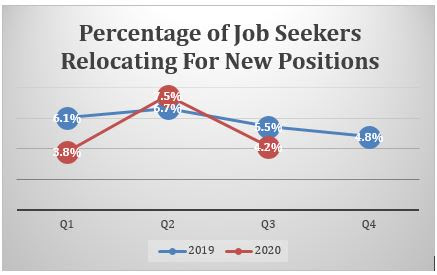
After spiking to 7.5% in the second quarter due to the shutdown orders precipitated by the COVID-19 pandemic, the relocation rate of job seekers fell to 4.2% in the third quarter.

The data comes from a quarterly survey of over 3,000 job seekers across the country conducted by Challenger.
“The events of March and April – the shutdowns, demand downturn, and ultimate recession – changed the way job seekers sought and accepted positions in the second quarter. Many more were willing to move to take a role that might not be there if they waited and was unlikely to be created in their current location,” said Andrew Challenger, Senior Vice President of Challenger, Gray & Christmas, Inc.
“The fact that many local officials decided to reopen early or not shut down at all may have contributed to the movement, as job seekers took positions in places that remained open. As the country reopened almost completely in the third quarter, fewer job seekers sought positions in other locations,” he added.
Indeed, the relocation rate for job seekers fell below the 5.5% recorded in the third quarter of 2019, but rose slightly from the first quarter of this year, when 3.8% of job seekers relocated for new jobs.
Source: Challenger, Gray & Christmas, Inc. ©
Besides reopening economies, the work-from-home (WFH) trend is keeping job seekers from relocating for new positions. According to a recent Challenger survey conducted online in October amid companies of various sizes and industries nationwide, of the 189 respondents, 55% said most of their workforce is still working from home. Another 15% said while they have reopened, they are giving workers a choice to return.
The survey also found that while the largest share (41%) of employers were unsure when they would have workers return to the office, 21% planned on early 2021, 9% said mid-2021, 7% said workers are home indefinitely, and 3% had converted many positions to permanent WFH.
“Companies continue to pledge to keep their workforces at home until the spring or summer months of next year, depending on distribution of a vaccine. Job seekers who were able to land remote work have no need to move to a new city or town for employment,” said Challenger.
While job seekers have not relocated for new work, many people are moving to new homes. According to Genworth Financial, Inc., first-time home buying hit a 20-year high and the repeat buying market grew 17% year over year.
“People are taking advantage of historically low interest rates, and as the home is now serving as a workplace, day care, gym, and school, many people who are able want to live somewhere that can comfortably be used for all these new purposes,” said Challenger.
“Another reason people may be moving to new houses but not new locations is that many companies, particularly in the tech sector and Silicon Valley, have said that while workers can work from home, if they move to destinations with lower costs of living, they may take pay cuts,” added Challenger.
In fact, Facebook, Microsoft, Stripe, and Redfin have announced that they would adjust pay for employees who relocate, according to a Bloomberg article published December 17th. The article also cites research from the Federal Reserve Bank of Dallas that found just 8% of workers worked from home in February, but spiked to 35% in May.
Find the report online: https://www.challengergray.com/blog/q3-job-seeker-relocation-report-after-covid-spike-relocation-falls-to-4-2/


