


Written by rjs, MarketWatch 666
 Here are some selected news articles from the week ended 14 July 2019.
This article is a feature every Monday evening on GEI.
Please share this article – Go to very top of page, right hand side, for social media buttons.
OPEC report shows summer demand exceeding supply by 2 million barrels per day; US rig count falls to 17 month low.
Oil prices jumped to a six week high midweek as tropical storm Barry meandered thru the Gulf and forced the shut in of over half of US offshore production….after falling 1.6% to $57.51 a barrel after the OPEC output cut extension disappointed oil traders last week, prices for US crude for August delivery initially jumped nearly 2% on Monday on confirmation that Iran had breached the limit on enriched uranium set by the 2015 accord that had been abrogated by the US, but later pulled back to end with an increase of only 15 cents at 57.66 a barrel, as gains were limited by renewed concerns about a slowing global economy…prices again rose to as high as $59.10 a barrel on Iran tensions early Tuesday, but again fell back to end with a gain of just 17 cents at $57.83 a barrel as concerns over a slowdown in energy demand again kept prices in check…oil prices again opened more than 1% higher on Wednesday after the API had reported that U.S. crude supplies had fallen for a fourth week in a row, but then extended those gains after the EIA confirmed an even larger oil inventory drop and as major producers cut nearly a third of offshore Gulf production, with oil prices finishing $2.60, or 4.5% higher at $60.43 a barrel…the Gulf of Mexico storm and Iran tensions pushed prices to another six-week high at $60.94 a barrel on Thursday before prices fell back to close 23 cents lower at $60.20 a barrel, as OPEC forecast lower demand for its crude oil next year as the U.S. & others lifted production…oil prices rose back to near six-week highs on Friday morning, as Gulf of Mexico oil producers cut more than half their output in the face of tropical storm Barry, but faded again in the afternoon to end just a penny higher at $60.21 a barrel, as concerns over a global crude surplus in the months ahead again limited gains…nonetheless, oil prices still ended nearly 5% higher for the week, as falling inventories, the tropical storm and geopolitical tensions all worked to push prices higher..
Natural gas prices also ended higher, as weather forecasts shifted to show widespread heat dominating the Midwest and East over the next couple of weeks, and expectations that hurricane Barry would impact production also pushed prices higher…after finishing the prior week nearly 5% higher at $2.418 per mmBTU, natural gas for August delivery first slipped 1.5 cents on Monday, then rose 2.2 cents on Tuesday and 1.9 cents on Wednesday as the 8 to 14 day forecasts heated up, before falling 2.8 cents on Thursday after the EIA’s natural gas storage report showed no surprises….prices then rose 3.7 cents on Friday with Barry bearing down to end the week at $2.453 per mmBTU, 1.4% higher than the prior week’s close…
The natural gas storage report for the week ending July 5th from the EIA indicated that the quantity of natural gas held in storage in the US increased by 81 billion cubic feet to 2,471 billion cubic feet by the end of the week, which meant our gas supplies were 275 billion cubic feet, or 12.5% more than the 2,196 billion cubic feet that were in storage on July 6th of last year, while still 142 billion cubic feet, or 5.4% below the five-year average of 2,613 billion cubic feet of natural gas that have been in storage as of the 5th of July in recent years….this week’s 81 billion cubic feet injection into US natural gas storage was in line with expectations of an 80 billion cubic feet injection into storage, but was still higher than the average 71 billion cubic feet of natural gas that have been added to gas storage during the first week of July in recent years, the 17th consecutive such above average storage change….the 1,283 billion cubic feet of natural gas that have been added to storage over the past 15 weeks has been the largest injection of gas into storage on record for any similar period of the injection season, as the 1,128 billion cubic feet that were added during the same 15 weeks of 2014 (when June was also unusually cool) is the only year that’s even close…
The Latest US Oil Supply and Disposition Data from the EIA
This week’s US oil data from the US Energy Information Administration, reporting on changes over the week ending July 5th, indicated that a larger than expected withdrawal of oil from our stored crude supplies, the 7th withdrawal in 15 weeks, resulted in a major shift in unaccounted for crude from the supply side of the balance sheet to the demand side…our imports of crude oil fell by an average of 284,000 barrels per day to an average of 7,302,000 barrels per day, after rising by an average of 920,000 barrels per day over the prior week, while our exports of crude oil rose by an average of 58,000 barrels per day to 3,048,000 barrels per day during the week, which meant that our effective trade in oil worked out to a net import average of 4,254,000 barrels of per day during the week ending July 5th, 342,000 fewer barrels per day than the net of our imports minus exports during the prior week…over the same period, field production of crude oil from US wells was reported to be 100,000 barrels per day higher at 12,300,000 barrels per day, so our daily supply of oil from the net of our trade in oil and from well production totaled an average of 16,554,000 barrels per day during this reporting week..
Meanwhile, US oil refineries were reportedly using 17,438,000 barrels of crude per day during the week ending July 5th, 148,000 more barrels per day than the amount of oil they used during the prior week, while over the same period the EIA reported that an average of 1,357,000 barrels of oil per day was being withdrawn from the supplies of oil stored in the US….hence, this week’s crude oil figures from the EIA appear to indicate that our total working supply of oil from net imports, from oilfield production, and from storage was 472,000 barrels per day more than what our oil refineries reported they used during the week…to account for that disparity between the supply of oil and the disposition of it, the EIA inserted a (-472,000) barrel per day figure onto line 13 of the weekly U.S. Petroleum Balance Sheet to make the reported data for the daily supply of oil and the consumption of it balance out, essentially a fudge factor that they label in their footnotes as “unaccounted for crude oil”…since the prior week’s unaccounted for crude was at +350,000 barrels per day, indicating unaccounted for supply, the week over week metrics we’ve just reported are undependable to the tune of 812,000 barrels per day..(for more on how this weekly oil data is gathered, and the possible reasons for that “unaccounted for” oil, see this EIA explainer)….
Further details from the weekly Petroleum Status Report (pdf) indicated that the 4 week average of our oil imports fell to an average of 7,253,000 barrels per day last week, 12.3% less than the 8,271,000 barrel per day average that we were importing over the same four-week period last year…the 1,357,000 barrel per day decrease in our total crude inventories was all pulled out of our commercially available stocks of crude oil, while the amount of oil stored in our Strategic Petroleum Reserve remained unchanged…this week’s crude oil production was reported to be 100,000 barrels per day higher at 12,200,000 barrels per day because the rounded estimate of the output from wells in the lower 48 states was 100,000 barrels per day higher at 11,900,000 barrels per day, while Alaska’s oil production was statistically unchanged at 426,000 barrels per day….last year’s US crude oil production for the week ending July 6th was rounded to 10,900,000 barrels per day, so this reporting week’s rounded oil production figure was roughly 12.8% above that of a year ago, and 45.9% more than the interim low of 8,428,000 barrels per day that US oil production fell to during the last week of June of 2016…
Meanwhile, US oil refineries were operating at 94.7% of their capacity in using 17,438,000 barrels of crude per day during the week ending July 5th, up from 94.2% of capacity the prior week, and a fairly normal refinery utilization rate for this time of year….however, the 17,438,000 barrels per day of oil that were refined this week were still 1.2% below the 17,652,000 barrels of crude per day that were being processed during the week ending July 6th, 2018, when US refineries were operating at 96.7% of capacity….
With the increase in the amount of oil being refined, gasoline output from our refineries was much higher, increasing by 470,000 barrels per day to 10,418,000 barrels per day during the week ending July 5th, after our refineries’ gasoline output had inexplicably decreased by 564,000 barrels per day the prior week….but even with that large jump in gasoline output, this week’s gasoline production was still 2.6% less than the record 10,699,000 barrels of gasoline that were being produced daily during the same week last year….meanwhile, our refineries’ production of distillate fuels (diesel fuel and heat oil) rose by 22,000 barrels per day to 5,358,000 barrels per day, after our distillates output had increased by 31,000 barrels per day the prior week….and even with this week’s increase, the week’s distillates production was still 1.5% less than the 5,442,000 barrels of distillates per day that were being produced during the week ending July 6th, 2018….
Even with the big increase in gasoline production, our supply of gasoline in storage at the end of the week fell for the 4th week in a row and for the 16th time in twenty weeks, decreasing by 1,455,000 barrels to 229,187,000 barrels over the week to July 5th, after our gasoline supplies had decreased by 1,583,000 barrels over the prior week….our gasoline supplies continued to fall because the amount of gasoline supplied to US markets increased by 262,000 barrels per day to 9,754,000 barrels per day, and because our exports of gasoline rose by 137,000 barrels per day to 700,000 barrels per day, even while our imports of gasoline rose by 335,000 barrels per day to 871,000 barrels per day…after our gasoline supplies had reached an all time record high twenty-two weeks ago, they then fell by nearly 13% over the next 10 weeks while US Gulf Coast refineries were crippled by the Venezuelan sanctions, and hence they are still 4.1% lower than last July 6th’s inventory level of 238,997,000 barrels, while slumping back to near the five year average of our gasoline supplies at this time of the year…
With the increase in our distillates production, our supplies of distillate fuels rose for the 6th time in the past 17 weeks, increasing by 3,729,000 barrels to 130,517,000 barrels during the week ending July 5th, after our distillates supplies had increased by 1,408,000 barrels over the prior week…our distillates supplies jumped this week because the amount of distillates supplied to US markets, a proxy for our domestic demand, fell by 277,000 barrels per day to 3,551,000 barrels per day, and because our imports of distillates rose by 83,000 barrels per day to 181,000 barrels per day, while our exports of distillates rose by 50,000 barrels per day to 1,455,000 barrels per day…after this week’s inventory increase, our distillate supplies were 7.3% higher than the 121,682,000 barrels of distillate that we had stored on July 6th, 2018, even as they remained 5% below the five year average of distillates stocks for this time of the year…
Finally, with lower oil imports and greater refinery throughput, our commercial supplies of crude oil in storage fell for a fourth week in a row and for the tenth time in 25 weeks, decreasing by 9,499,000 barrels, from 468,491,000 barrels on June 28th to 458,992,000 barrels on July 5th…but even with that decrease, our crude oil inventories remained roughly 4% above the recent five-year average of crude oil supplies for this time of year, and roughly 35% higher than the prior 5 year (2009 – 2013) average of crude oil stocks for the end of June, with the disparity between those comparisons arising because it wasn’t until early 2015 that our oil inventories first rose above 400 million barrels…since our crude oil inventories have generally been rising this year, & since this past Fall, after generally falling until then through most of the prior year and a half, our oil supplies as of July 5th were still 13.2% above the 405,248,000 barrels of oil we had stored on July 6th of 2018, but at the same time were 7.3% below the 495,350,000 barrels of oil that we had in storage on July 7th of 2017, and 7.0% below the 493,718,000 barrels of oil we had stored on July 8th of 2016…
OPEC’s Monthly Oil Market Report
Next we’re going to review OPEC’s July Oil Market Report (covering June OPEC & global oil data), which was released on Thursday of this past week and is available as a free download, and hence it’s the report we check for monthly global oil supply and demand data…the first table from this monthly report that we’ll look at is from the page numbered 63 of that report (pdf page 73), and it shows oil production in thousands of barrels per day for each of the current OPEC members over the recent years, quarters and months, as the column headings indicate…for all their official production measurements, OPEC uses an average of estimates from six “secondary sources”, namely the International Energy Agency (IEA), the oil-pricing agencies Platts and Argus, the U.S. Energy Information Administration (EIA), the oil consultancy Cambridge Energy Research Associates (CERA) and the industry newsletter Petroleum Intelligence Weekly, as a means of impartially adjudicating whether their output quotas and production cuts are being met, to thus avert any potential disputes that could arise if each member reported their own figures…
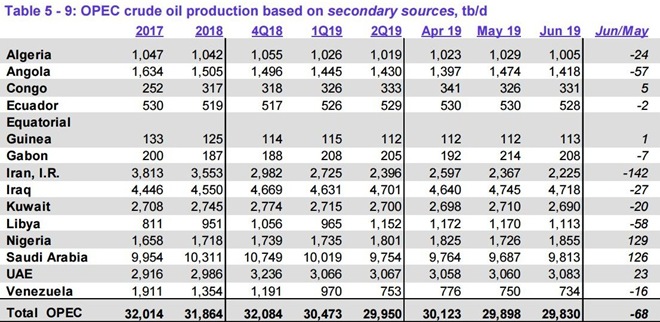
So, as we can see from this table of oil production data, OPEC’s oil output fell by 68,000 barrels per day to 29,830,000 barrels per day in June, from their revised May production total of 29,898,000 barrels per day…however that May figure was originally reported as 29,876,000 barrels per day, so that means their production for June was really a 46,000 barrel per day decrease from the previously reported figures (for your reference, here is the table of the official May OPEC output figures as reported a month ago, before this month’s revisions)…
The largely involuntary Iranian output reduction of 142,000 barrels per day due to US sanctions on their exports was the primary reason for the cartel’s output cut in June, as relatively smaller production cuts by Angola, by Iraq, by Kuwait, by Algeria and by Libya were more than offset by increases in output from Nigeria and the Saudis…however, that 129,000 barrels per day increase in the output from Nigeria that you see above now puts them well over the output allocations originally determined for each member after their December 7th, 2018 meeting, when OPEC agreed to cut 800,000 barrels per day as part of a 1.2 million barrel per day cut agreed to with Russia and other oil producers, and which were extended at their July 1st meeting a few weeks back…in addition, despite the small June decrease in output from Iraq, their output also remains well above quota, as can be seen in the table of OPEC production allocations we’ve included below:
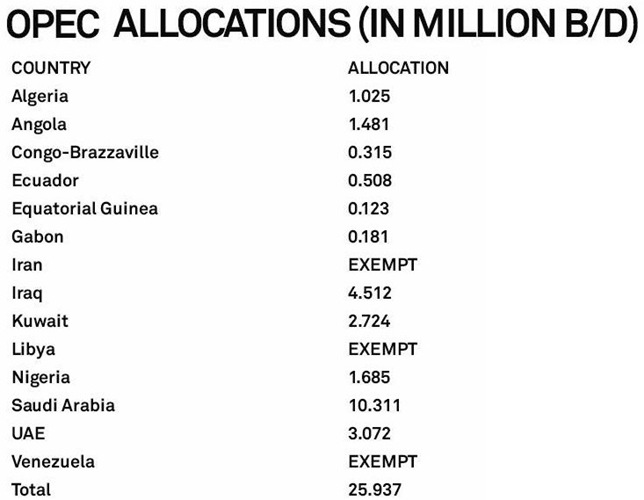
The table above came from a February 6th post on Saudi cuts and OPEC allocations at S&P Global Platts, and it shows average daily production quota in millions of barrels of oil per day for each of the OPEC members as was agreed to at their December 2018 meeting and has now been extended through March 2020…note that Venezuela and Iran, whose oil exports are being sanctioned by the Trump administration, and Libya, which has been beset by a civil war, are exempt from any production quotas, and that only Libya has been producing more than they did in the 4th quarter of 2018, as you can see in the third column of the OPEC production table above…
The next graphic from the report that we’ll include shows us both OPEC and world oil production monthly on the same graph, over the period from July 2017 to June 2019, and it comes from page 64 (pdf page 74) of the July OPEC Monthly Oil Market Report….on this graph, the cerulean blue bars represent OPEC oil production in millions of barrels per day as shown on the left scale, while the purple graph represents global oil production in millions of barrels per day, with the metrics for global output shown on the right scale…

Despite the decrease in OPEC’s production from what they reported a month ago, their preliminary estimate indicates that total global oil production still rose by 0.47 million barrels per day to 98.56 million barrels per day in June, an increase that came after May’s total global output figure was revised down by 170,000 barrels per day from the 98.26 million barrels per day global oil output that was reported a month ago, as non-OPEC oil production rose by a rounded 540,000 barrels per day in June after that revision, with higher oil output from the US, Brazil, Kazakhstan, Russia and China the major reasons for the non-OPEC production increase…. the 98.56 million barrels per day produced globally in June was still 0.71 million barrels per day, or 0.7% higher than the revised 97.85 million barrels of oil per day that were being produced globally in June a year ago (see the July 2018 OPEC report (online pdf) for the originally reported June 2018 details)…with the decrease in OPEC’s output, their June oil production of 29,830,000 barrels per day slipped to 30.3% of what was produced globally during the month, down from the revised 30.5% share they contributed in May….OPEC’s June 2018 production was reported at 32,327,000 barrels per day, which means that the 13 OPEC members who were part of OPEC last year, excluding Qatar from last year’s total and new member Congo from this year’s, are now producing 2,225,000 fewer barrels per day of oil than they were producing a year ago, when they accounted for 33.0% of global output, with a 1,575,000 barrel per day drop in output from Iran, a 607,000 barrel per day decrease in the output from Saudi Arabia, and a 606,000 barrel per day decrease in the output from Venezuela from that time more than offsetting the year over year production increases of 405,000 barrels per day from Libya, 185,000 barrels per day from Iraq, and 186,000 barrels per day from the Emirates…
Despite the 470,000 barrels per day increase in global oil output that was seen during June, there was still a large shortfall in the amount of oil being produced globally during the month, as this next table from the OPEC report will show us…

The table above came from page 33 of the July OPEC Monthly Oil Market Report (pdf page 43), and it shows regional and total oil demand in millions of barrels per day for 2018 in the first column, and OPEC’s estimate of oil demand by region and globally quarterly over 2019 over the rest of the table…on the “Total world” line in the third column, we’ve circled in blue the figure that’s relevant for June, which is their revised estimate of global oil demand during the second quarter of 2019…
OPEC has estimated that during the 2nd quarter of this year, all oil consuming regions of the globe have been using 99.24 million barrels of oil per day, which was unrevised from their estimate for the 2nd quarter a month ago….meanwhile, as OPEC showed us in the oil supply section of this report and the summary supply graph above, OPEC and the rest of the world’s oil producers were still only producing 98.56 million barrels per day during June, which means that there was a shortfall of around 680,000 barrels per day in global oil production when compared to the demand estimated for the month…
In addition, the downward revision of 170,000 barrels per day to May’s global output that’s implied in this report means that the 980,000 barrels per day shortfall that we had originally figured for May based on last month’s figures would now have to be revised to a deficit of 1,150,000 barrels per day during May….combined with the deficit of 1,020,000 barrels per day that we had previously figured for April, that means that for the 2nd quarter of 2019, global oil production has been running around 950,000 barrels per day short of what’s need to cover demand….while those deficits follow a first quarter that saw surpluses of 550,000 barrels per day for January, 640,000 barrels per day in February, and 190,000 barrels per day for March, note that in the 4th column above, global demand during the 3rd quarter, or summertime in the northern hemisphere, is expected to increase by 1,370,000 barrels per day to 100.61 million barrels of oil per day…that means that unless there is an unexpected pickup in oil production from the non-OPEC countries, the third quarter will be seeing oil output deficits near or above 2 million barrels of oil per day, or roughly 2% of total demand….
This Week’s Rig Count
The US rig count fell for the 18th time in 21 weeks during the week ending July 12th, and is now down by 11.5% for the year….Baker Hughes reported that the total count of rotary rigs running in the US fell by 5 rigs to a 17 month low of 958 rigs this past week, which was also down by 96 rigs from the 1054 rigs that were in use as of the July 13th report of 2018, and quite a bit below the shale era high of 1929 drilling rigs that were deployed on November 21st of 2014, the week before OPEC announced their attempt to flood the global oil market…
The count of rigs drilling for oil fell by 4 rigs to 784 rigs this week, which was also 79 fewer oil rigs than were running a year ago, and less than half of the recent high of 1609 rigs that were drilling for oil on October 10th, 2014…at the same time, the number of drilling rigs targeting natural gas bearing formations decreased by 2 rigs to 172 natural gas rigs, which was also down by 17 rigs from the 189 natural gas rigs that were drilling a year ago, and way down from the modern era high of 1,606 rigs targeting natural gas that were deployed on August 29th, 2008…however, another rig classified as miscellaneous was began drilling this week and hence there are now two such active, matching the “miscellaneous rig” count of a year ago…
The rig count in the Gulf of Mexico increased by 2 to 26 rigs this week, as two more rigs began drilling off the coast of Louisiana…that means there are now 24 rigs drilling offshore from Louisiana and 2 rigs deployed offshore from Texas, an increase of 7 offshore rigs from the 19 rigs that were deployed in the Gulf in the same week a year ago, when 17 rigs were drilling in Louisiana waters and two were deployed offshore from Texas…on the other hand, one of the 3 platforms that had been drilling through inland waters in southern Louisiana was shut down this week, leaving two still active, down from the 5 “inland waters” rigs that were drilling in Louisiana on July 13th 2018…
The count of active horizontal drilling rigs was down by 8 to 831 horizontal rigs this week, which was the least horizontal rigs deployed since February 9th, 2018 and hence a new 17 month low for horizontal drilling…it was also 99 fewer horizontal rigs than the 930 horizontal rigs that were in use in the US on July 13th of last year, and also well down from the record of 1372 horizontal rigs that were deployed on November 21st of 2014…at the same time, the vertical rig count was down by 1 rig to 57 vertical rigs this week, but those were still up by 1 from the 56 vertical rigs that were operating during the same week of last year….on the other hand, the directional rig count was up by 4 rigs to 70 directional rigs this week, and those were also up from the 68 directional rigs that were in use on July 13th of 2018…
The details on this week’s changes in drilling activity by state and by shale basin are included in our screenshot below of that part of the rig count summary pdf from Baker Hughes that shows those changes…the first table below shows weekly and year over year rig count changes for the major oil & gas producing states, and the second table shows the weekly and year over year rig count changes for the major US geological oil and gas basins…in both tables, the first column shows the active rig count as of July 12th, the second column shows the change in the number of working rigs between last week’s count (July 5th) and this week’s (July 12th) count, the third column shows last week’s July 5th active rig count, the 4th column shows the change between the number of rigs running on Friday and the number running before the equivalent weekend of a year ago, and the 5th column shows the number of rigs that were drilling at the end of that reporting week a year ago, which in this week’s case was the 6th of July, 2018…

As you can see, this week’s rig reductions were concentrated in Texas, in both the Eagle Ford and the Permian basins within Texas…in the Permian, 3 horizontal rigs were pulled out of Texas Oil District 8, which would be the core Permian Delaware, and 3 more were pulled out of Texas Oil District 7C, or the southern Permian Midland…meanwhile, 4 oil rigs and one targeting natural gas were pulled out of the Eagle Ford of southeast Texas, which left 60 oil rigs and 6 natural gas rigs still active in that basin…at the same time, oil targeting rigs were added in the Cana Woodford of central Oklahoma and the DJ Niobrara chalk of the Rockies front range, while a natural gas rig was added in the Haynesville on the Texas side of the border, as the northern Louisiana rig count was unchanged while Texas Oil District 6 saw a one rig increase…meanwhile, two more natural gas rigs were shut down in “other” basins not tracked separately by Baker Hughes…
Ohio reports quarterly increases in oil, natgas production – – First-quarter 2019 was very productive in Ohio in terms of crude oil and natural gas production, Kallanish Energy reports. Crude oil production jumped 28.7%, to more than 5.07 million barrels (Mmbbl). That’s up from 3.94 Mmbbl in the first quarter of 2018, according to production data released last Friday by the Ohio Department of Natural Resources. Natural gas production in Ohio also increased in Q1 2019, growing from 531.95 billion cubic feet (Bcf), to 609.45 Bcf, a 14.57% increase from Q1 2018. The data covers production from 2,277 horizontal shale wells in three Ohio rock formations. Of those wells, 2,228 reported production of oil and/or natural gas, the state said. The typical well produced 2,277 barrels (Bbls) of oil and 273.54 million cubic feet (Mmcf) of natural gas in Q1 2019. Ohio law does not require the separate reporting of condensate and natural gas liquids. They are included in the oil/natural gas totals. The results are available at https://oilandgas.ohiodnr.gov/production.
Utica Shale well activity as of July 6:
- DRILLED: 249 (240 as of last week)
- DRILLING: 165 (173)
- PERMITTED: 481 (481)
- PRODUCING: 2,225 (2,223)
- TOTAL: 3,120 (3,117)
- Three horizontal permits were issued during the week that ended July 6, and 17 rigs were operating in the Utica Shale.
Dominion Energy Pulls the Plug on Gas Pipeline Project in Ohio – Dominion Energy has decided not to push forward with its $48 million pipeline project bringing Marcellus Shale natural gas from Pennsylvania to market in Eastern Ohio. Dubbed “The Sweden Valley Project,” the company cited a protracted approval process at the Federal Energy Regulatory Commission (FERC) as its reason for pulling the plug.In a letter to FERC, Dominion said that the environmental assessment issued last August concluded “if Dominion constructs and operates the proposed facilities in accordance with its application and supplements, and the staff’s recommended mitigation measures below, approval of the Project would not constitute a major federal action significantly affecting the quality of the human environment.”Nonetheless the positive assessment did not add any wind to Dominion sails, leading to a situation where the company will not be able to meet contractual demands for its gas.Don Santa, a former FERC commissioner, said in an email that “in many cases, pipeline applicants request decision dates in order to be able to meet construction schedules and fulfill contractual obligations to the shippers who will transport natural gas using the newly constructed pipeline capacity.” Neil Chatterjee, FERC Chairman, reacted to the news on Twitter on Friday afternoon, saying he was “deeply disappointed that the unique circumstances of this case prevented the Commission from approving the project as quickly as the applicant had hoped, and that, as a result they are withdrawing the application.”
Ask the Doctors: Study links fracking to low birth weight – Dear Doctor: Fracking just started near my Ohio hometown, and I remember reading about a connection to the risk of having a baby with low birth weight. I want to get pregnant, but now I’m worried. How close do you have to be to a site to be affected? Dear Reader: “Fracking” is the common term for hydraulic fracturing, a drilling process that pumps fluid at ultra-high pressure deep into the earth. There has been no end of controversy regarding the process in recent years, with vigorous debate over whether or not fracking causes air pollution, contaminates surface and groundwater, leads to earthquakes and plays a role in a range of health problems. Among the health questions that have been raised is whether the process affects birth weight among pregnant women who live near fracking sites.Your question refers to a study published a few years ago in the journal Science Advances. The researchers, including one from UCLA, analyzed the outcomes of 1.1 million live births in Pennsylvania between 2004 and 2013. They compared the birth weights of infants born to mothers living at varying distances from active fracking sites, both before the extraction operations had begun, and after the wells became active. They found that women who lived very close to an active fracking operation — within one-half mile — had a 25 percent higher risk of delivering a baby of low birth weight than did women who lived at a distance of 2 miles or more. The study found that babies born to women who lived more than one-half mile from a fracking site, but less than 2 miles away, were also adversely affected, but to a lesser degree. When researchers looked at women who lived at least 2 miles from a fracking operation, they found no signs of adverse health effects to newborns. Low birth weight occurs most often in premature births, when the infant doesn’t have the full 37 weeks of gestation to grow and gain weight. Low birth weight is sometimes seen in full-term babies who failed to grow well during gestation due to issues with the mother’s health, the placenta or the baby’s condition.
Analysts say Philadelphia refinery, shut down after fire, unlikely to find a willing buyer — More than 1,000 people will be out of work once Philadelphia Energy Solutions’ refinery closes its doors this month. The closure comes in the wake of an explosion and fire that destroyed a crucial part of the plant. But despite pleas from the union, and comments from former Congressman Bob Brady, who told Plan Philly he thought the plant was “too big to fail,” industry analysts say finding a buyer who will keep it as a refinery will be next to impossible.“This facility was significantly less sophisticated than the other East Coast refineries,” said Phil Verleger, an economist and industry consultant. “It could barely hang on in a strong market. Once the export ban was gone, it couldn’t survive.”When the shuttered Sunoco refinery was revived in 2012 with the help of Brady, the Obama Administration and state grants, its new owner The Carlyle Group took advantage of cheap North Dakota crude oil traveling to Philadelphia by rail. One reason the Bakken crude was so cheap, Verleger said, is because an export ban meant producers couldn’t fetch a better price overseas. When that was lifted, he said, the PES refinery’s days were numbered.PES filed for bankruptcy in early 2018, citing the rising costs of the Renewable Fuel Standard, a program that forces refiners that don’t blend ethanol to buy credits on the open market.Verleger calls that claim a “fraud.” Nevertheless, the bankruptcy judge allowed the company to retire 138 million outstanding RFS credits.This February, six months after exiting bankruptcy, Reuters reported the plant was again in bad financial shape. In just three months, its cash balance had fallen from $148 million to $87.7 million by the end of 2018. In May, Reuters reportedthe company had deferred payments into employee retirement accounts.Verleger said it doesn’t help that investors aren’t eager to buy refineries these days, let alone one that had already fallen on hard times before the fire and explosion. “Nobody’s going to find the money any place,” Verleger said. “The energy sector right now represents 5 percent of the S&P 500. In 1980 it was at its peak at 20 percent of the S&P 500. Essentially the energy sector is being shunned by investors.”
Philadelphia Explosion One in String of ‘Near Miss’ Accidents at Refineries Using Deadly Chemical – Next Friday, July 12, the Philadelphia Energy Solutions (PES) refinery in south Philadelphia is slated to close its doors, marking the end of an era that began in 1866, one year after the Civil War ended, when 50,000 barrels of kerosene and chemicals were first stored on site.The plant – which continued to struggle financially after emerging from bankruptcy in August 2018 – experienced a major industrial accident on June 21. That morning, a massive fireball lit up the pre-dawn sky over Philadelphia after leaking hydrocarbon gas had ignited. Five workers were injured, all treated on site. Three explosions shook walls in Philadelphia and the blast was reportedly felt as far away as South Jersey. Emerging evidence suggests that the disaster could have been far more severe – in large part due to a deadly chemical used at the PES refinery and roughly 50 others nationwide.Hydrogen fluoride (HF) is one of the most dangerous chemicals used by industry. When released, it forms rolling clouds that cling low to the ground and can spread rapidly over long distances. On the skin, HF burns and causes ulcers. Mixed with water, it forms hydrofluoric acid. Inhaled into the lungs, it can cause a range of harms, from cough to lung collapse to the deadly destruction of organs and bones. Breathing the gas for as little as five minutes can cause death within “a couple of hours,” according to the University of North Carolina at Chapel Hill. Symptoms can be immediate or delayed for days.“Aging refineries are playing Russian roulette with American population centers,” said Tim Whitehouse, a former enforcement attorney with the U.S. Environmental Protection Agency (EPA), in a statement, noting that more than 22 million people in the U.S. live near sites usingHF. “Counting Philadelphia, three refineries using HF have had major explosions just since 2015, hardly cause for continued complacency.”
Report: Pennsylvania had record year for natural gas production – Pennsylvania had a record year for natural gas production in 2018, the state Department of Environmental Protection said on Wednesday.Unconventional well operators produced 6.1 trillion cubic feet of natural gas in 2018 – an increase of .8 trillion cubic feet over 2017 and the largest volume of natural gas produced in Pennsylvania in a single year, according to DEP’s 2018 Oil & Gas Annual Report.Pennsylvania is the second-largest natural gas producer in the United States, after Texas.Unconventional wells are those that access large reservoirs of underground natural gas through hydraulic fracturing, or fracking. The first unconventional natural gas well was drilled in Pennsylvania in 2004, according to DEP.Since then, production levels have steadily risen, requiring more permitting and inspection activities from DEP.DEP Secretary Patrick McDonnell said Wednesday that the agency’s internal restructuring and continued expansion of electronic tools has increased permitting and inspection efficiency, shortened waiting periods and improved oversight of natural gas producers. “Gov. (Tom) Wolf and DEP have made permitting and inspection efficiency a priority – reducing overall permit backlog by more than 90% since 2016 and improving inspection efficiency while ensuring compliance with our environmental regulations,”
The “Beast” is back, baby! — Rig counts have doubled in Pennsylvania – up from about 30 at the beginning of the year to 61 in June. Gas production in the basin has jumped from hundreds of millions of units per well a few years ago to billions of units of gas per well this year. With gas production rising to over 18 Bcf/d, Pennsylvania now produces over 20% of the natural gas in the U.S., second only to Texas, which tops out at 22 Bcf/d. In the 10 years since a shale boom skyrocketed in the Marcellus shale play, Pennsylvania’s natural gas production has increased by a monstrous 32-fold. Part of the “uproar” in gas production can be attributed to cost-saving innovations and greater efficiencies in drilling and in the technology being deployed down hole, which helps operators improve their margins and pull a lot more gas out of the well bores with each individual rig. Some of these advancements include: more wells per pad; drilling longer laterals – up to three miles long; sensors that determine how far hydrofracturing is penetrating the shale for more accurate well spacing; sensors that track temperatures, pressure and vibration on equipment down hole; and advanced software that can predict when equipment needs servicing before it breaks down. Another important factor driving the production of natural gas is its increasing use for power generation – the chief use of natural gas in the U.S. In 2018, natural gas-fired power plants surpassed coal-fired plants across the country. The Energy Information Administration forecast the share of U.S. total utility-scale electricity generation from natural gas-fired power plants to rise from 35% in 2018 to 38% in 2020. Nearly 30 new power plants, each with a capacity of 475-megawatts or more, are now in operation, under construction or in the permitting process in Ohio, Pennsylvania and West Virginia.
Trespass Charges Dropped Against Atlantic Sunrise Pipeline Protesters | WSKG – A Lancaster County judge on Monday dismissed trespassing charges against seven protesters who blocked construction of the Atlantic Sunrise natural gas pipeline almost two years ago. Judge Howard Knisely of the Lancaster County Court of Common Pleas released the defendants without charge after the district attorney dropped the misdemeanors in exchange for community service. Marie Cusick/StateImpact Pennsylvania The judge welcomed the agreement and said peaceful, nonviolent protest is protected, albeit with limitations, by state and federal law. Legislatures, not the courts, are the proper place to protect the natural environment and public safety, he said. But he urged citizens to elect lawmakers who truly represent public interests rather than their own. “We must all be more vigilant to elect to those legislative positions persons who are highly concerned with their local constituents and local problems, and not those who merely look for personal advancement or who look to industry to fill their coffers for re-election,” he said in court Monday. The pipeline, which went into service in September 2018, carries natural gas south from the Marcellus Shale through 10 Pennsylvania counties. It has stirred significant opposition in Lancaster County.
Should We Be Afraid of the Mariner East Pipeline? — Neighbors described it like this: a loud hissing noise. A massive ball of fire. A jet, or a meteor, crashing into the earth. Night turning into day. On September 10, 2018, a section of the Revolution Pipeline – which had begun carrying natural gas just a week earlier – leaked and ignited in rural Beaver County, Pennsylvania, northwest of Pittsburgh. The rupture shot flames 150 feet into the air, destroying one house, collapsing several overhead power lines, and forcing the evacuation of nearly 50 residents.Fortunately, no one was injured; the couple who lost their home had fled in the nick of time.But for residents living along the thousands of miles of natural gas pipelines in Pennsylvania – second only to Texas as the nation’s largest producer of the fossil fuel and home to the newly booming, energy-rich Marcellus Shale region – the fire and the charred earth it left behind serve as a haunting reminder: Something like this could happen in our backyards. That dread is perhaps nowhere more evident than 300 miles southeast of Beaver County, in the dense suburban neighborhoods west of Philadelphia, a city that energy industry leaders have, in the past decade, eyed as a global processing and trading hub. Here, tensions surrounding the cross-state Mariner East pipelines – a project much larger than Revolution and owned by the same parent company, Dallas-based Energy Transfer – are only intensifying. The pipelines (Mariner East 1 and 2 and the not-yet-completed 2x) carry highly compressed natural gas liquids. Once they are fully operational along a 350-mile route from their Marcellus Shale source to a revitalized former oil refinery in Marcus Hook, they promise to be vastly lucrative for Energy Transfer – and for the state, which, the company boasts, could see an economic impact of more than $9 billion from the project. But since work began in February 2017, Mariner East has been plagued by nearly 100 state Department of Environmental Protection violations, multiple sinkholes, service shutdowns and construction chaos. Glaring gaps in state regulatory oversight have been exposed, and opposition has grown into significant pushback from neighbors and a bipartisan group of lawmakers who say Pennsylvania communities are at risk of – and unprepared for – a potential pipeline disaster. In the meantime, those at the heart of the Mariner East conflict zone live in fear of an incident like Beaver County’s – or worse.’
Manchin asks DOE officials for update on Appalachian Storage Hub – U.S. Senator Joe Manchin questioned officials from the U.S. Department of Energy for an update on theAppalachian Storage Hub on Tuesday.Manchin, a Ranking Member of the Senate Energy and Natural Resources Committee, heard testimony on eleven bipartisan bills before the Committee including one that would require a study by the DOE on the benefits of the hub. Manchin is the sponsor of the proposedAppalachian Energy for National Security Act, S. 1064, which would require the study and report on the national security benefits of the proposed natural gas liquids storage hub in Appalachia. During questioning, Manchin said he has been in talks with U.S. Secretary of Energy Rick Perry about his bill and the hub. “I’ve talked with Secretary Perry and he’s seen the model of a class 5 hurricane coming up the Houston Channel and what it can do to cripple the energy of our country and the dependency we have,” he said.“So we are looking for a backup. West Virginia, Pennsylvania, Ohio, with all of the energy we have stored there and the protection of the mountains among everything else – it’s a natural hub.” Shawn Bennett, Deputy Assistant Secretary for Oil and Gas, Office of Fossil Energy at the U.S. Department of Energy, answered Manchin’s question about President Trump’s Executive Order to examine the Appalachian region as a candidate for economic development in the nation’s petrochemical sector.“Secretary Perry has been very fond of talking about creating a petrochemical complex storage hub in the region because he recognizes the importance from an economic security standpoint,” Bennett said. Manchin also stressed to the entire room just how large of a role that West Virginia plays in the energy industry. “We are heavily coal industry. We have an ocean of natural gas under us with properties in propane, ethane, and butane. We have been blessed but also we have a lot of wind which we are taking advantage of and solar is coming in,” Manchin said.
Standing Their Ground in the Path of the MVP – Construction continues on the Mountain Valley Pipeline in southwest Virginia, but several challenges to it remain unresolved. One that is still up in the air– tree sitting protestors in Elliston. They’ve managed to hold their ground in an encampment along its route for almost a year, preventing construction, at least for now, in one small mountain hollow. There’s been a loud silence since last winter when the Mountain Valley Pipeline company asked federal Judge Elizbeth Dillon to remove protestors camping out on a steep ravine in the path of the pipeline. Tammy Belinski is an environmental lawyer who has been following the legal challenges. “The absence of a ruling so far, in my view, means that she doesn’t have a way to rule in Mountain Valley Pipelines’ favor.” Belinksy points out Judge Dillon has consistently ruled in favor of the pipeline companies on eminent domain cases, that’s when the government can legally take people’s private land for public use and must compensate landowners when they do. Belinksy believes the laws have long been written to favor pipeline companies. “I have incredible respect for the young people who are taking this matter into their own hands because they see the regulatory system isn’t working,” Belinsky says. “They see that no one is protecting their future, no one is protecting their water, no one is protecting their air, so, they’re doing it.” Higher up on the mountain, tree sitters have been taking turns at the site known as ‘Yellow Finch,’ standing, sitting and sleeping in the trees. “It’s one thing to walk in a protest line,” says Crystal Mello. She spent a weekend in the tree to give the long-haul sitter a break. She enjoyed it. The experience gave Mello a perspective on what the long-time sitters go through. “It was hot the day I went up but, (over the past year) there’s been snowstorms and floods and a lot of wild weather. These tree sitters are very resilient.” Mello lives nearby and helps support the sitters, as do a couple dozen or more people from the region. They say they’ve had visitors from all over the country, and beyond. But the hardcore live-ins, the ones who have given up their ‘other lives’ to live on-site, are a dedicated, determined, and quiet crowd. Most don’t want to call attention to themselves, only their cause.
Powerless: The high cost of cheap gas – CBS News (documentary from ProPublica) When the U.S. declared the discovery of natural gas reserves large enough to propel the country to energy independence, property owners in West Virginia could never have imagined how that discovery might affect them. CBSN Originals and ProPublica traveled to West Virginia’s “gas patch” to meet landowners Beth Crowder and David Wentz, a once-married couple who found themselves in the crosshairs of Big Gas and joined forces to fight back.
A resolution condemning pipeline challengers passed easily in the WV House. A pipeline lobbyist wrote it. – It was getting late on March 7 in the West Virginia House of Delegates chamber.There were only two days left in the 60-day legislative session, and lawmakers had been voting for hours. By 8:30 p.m., delegates had moved past bills and onto resolutions – measures that don’t become law but express the legislative body’s sentiment. But one resolution seemed different from the others, Delegate Evan Hansen, D-Monongalia, said. He asked that House Resolution 11, titled “Recognizing the importance of the Atlantic Coast Pipeline,” be read and voted on separately. House Resolution 11, sponsored by nearly half the delegates, praised the Atlantic Coast Pipeline, a major natural gas project. Then, the resolution sharply condemned the citizens’ groups that challenged the project in court, calling their legal challenge an “all-out assault” with the goal of “forcing its cancelation.”The resolution passed 80-17.What wasn’t mentioned on the House floor that night was that the resolution was drafted by the pipeline company itself. Bob Orndorff, a lobbyist for Dominion Energy, wrote the resolution and sent it to the House of Delegates, according to documents obtained through a public records request filed by the Charleston Gazette-Mail with the clerk of the House of Delegates. At the end of January, as the resolution was being drafted, Orndorff took five Republican delegates — Eric Nelson, R-Kanawha; Jason Harshbarger, R-Ritchie, who works for Dominion Energy; Scott Cadle, R-Mason; John Hott, R-Grant; and Chris Phillips, R-Barbour — out to dinner at Fazio’s, an old-style Italian restaurant in Charleston, according to a disclosure filed with the West Virginia Ethics Commission. The bill: $575. All of those delegates would sponsor House Resolution 11, which was introduced one week later. Then, the day before the resolution passed on the floor, Orndorff, the West Virginia Oil and Natural Gas Association, and Antero Resources, the state’s largest gas producer, hosted a luncheon that cost $830 for the House Energy Committee, in the office of Delegate Bill Anderson, R-Wood, the resolution’s lead sponsor and chairman of the committee, another disclosure filing shows. On the floor the night the resolution passed, Anderson called natural gas pipelines “absolutely necessary.” It’s not abnormal for a lobbyist to provide insight or help draft legislation. But Orndorff’s resolution was different from other pieces of legislation because it singled out a specific group. It sheds light on the close relationship between West Virginia’s growing natural gas industry and its legislative branch, as the Gazette-Mail and ProPublica chronicled last year.
Regulators ask Mountain Valley Pipeline developers about the safety about the safety of pipe’s coating – A federal agency is asking Mountain Valley Pipeline officials about the safety of a protective coating on the 42-inch diameter steel pipe being buried through West Virginia and Southwest Virginia. Delays in construction of the natural gas pipeline have led to some sections of pipe being stored above ground for more than a year, generating concerns that the coating could degrade over time and contaminate nearby air, soil and water. In a letter Wednesday to Mountain Valley’s corporate attorney, the Federal Energy Regulatory Commission requested “toxicological, environmental and health information” on a coating used to prevent corrosion of the pipe. Tina Smusz, a retired physician from Montgomery County, has been sounding the alarm on what she calls “serious unanswered questions” about the coating, 3M Scotchkote Fusion Bonded Epoxy 6233. “The health and lives of citizens in Virginia and West Virginia, and those yet to be born, depend on your conscientious oversight of energy projects,” Smusz wrote in a Jan. 23 letter to FERC. In March, State Health Commissioner Norman Oliver and Department of Environmental Quality director David Paylor wrote a joint letter to the commission, citing concerns from the public in requesting information about any hazards posed by the coating. That in turn led FERC, the lead agency overseeing construction of the 303-mile pipeline, to ask Mountain Valley for a report on “the toxicity of the FBE [fusion-bonded epoxy] from all potential exposure pathways.” Concerns about the coating are twofold: Exposure to the elements could cause the substance to break down in a process called “chalking,” releasing harmful toxins into the air. And once the pipe is buried, some say, the material could leach into nearby ground water and be spread to streams or private wells. Smusz has cited the product’s safety data sheet, which says the coating contains carcinogens. But according to its maker, 3M Manufacturing Co., the coating is safe if applied properly and allowed to fully cure.
A church is fighting back against the Atlantic Coast Pipeline – John Laury, Union Grove Missionary Baptist Church, and their neighbors in Union Hill, Virginia – which was settled by freed slaves 150 years ago – are on the front lines of the climate struggle. They’re vying to preserve the health of their community and the health of the planet. They’re aware that over the years communities of color have been disproportionately afflicted with the consequences of environmental degradation. A landmark report commissioned by the United Church of Christ in 1987 showed that 60 percent of African Americans and Latinos in the United States lived near a toxic waste site. The UCC report, titled Toxic Wastes and Race in the United States, is often credited with raising the issue of environmental justice to public consciousness. The term environmental racism, in fact, was coined by Ben Chavis, a protégé of Martin Luther King Jr. As a UCC pastor and field officer for the denomination’s Commission for Racial Justice, Chavis was among 500 arrested while protesting a chemical waste dump in Warren County, North Carolina, which is often cited as the birth of the environmental justice movement. From higher asthma rates in Philadelphia and Milwaukee, to dirty drinking water in San Joaquin Valley, California, and Flint, Michigan, to oil spills and deadly hurricanes along the Gulf shore, to urban landfills in Houston and Harlem, minority populations have been more likely to suffer the consequences of industrial pollution. The Atlantic Coast Pipeline would move up to 1.5 billion cubic feet of fuel per day along a 600-mile route from West Virginia to eastern North Carolina. With that kind of capacity, an $8 billion financial investment, and the potential to export liquefied natural gas from terminals in Maryland and Georgia, the ACP would cement its lead developers, Duke Energy and Dominion Energy, into a long-term commitment to shale gas just at the time when scientists and most world leaders recognize the urgent need to phase out fossil fuels and turn to clean energy. “We’re supposed to leave this earth in the shape we found it or better,” said Laury. “That’s why we’re fighting this monster.”
Brothers Lead Showdown With US Gas Giant — The nine-month battle for control of America’s largest natural gas producer has come down to a choice: The old guard, or the “shalennials.” Absent a settlement before EQT Corp.’s annual meeting in Pittsburgh on Wednesday, shareholders will decide between competing rosters of candidates for the board of directors. One slate was nominated by EQT, while the other is backed by Toby and Derek Rice, the thirtysomething brothers leading a group of dissident investors who want to overhaul the company. Less than two years after EQT took the top spot among U.S. gas producers with its $6 billion purchase of the Rices’ former company, Rice Energy Inc., the two sides are locked in a bitter dispute. The brothers, who say EQT has underperformed since the acquisition, want a board majority and aim to install Toby Rice as chief executive officer. Though activists rarely grab a board majority through a proxy battle, the Rices’ push may be an exception: They’ve already won the backing of several large investors and two shareholder advisory firms. The brothers, who have used the term “shalennial” to describe their management style, own about 3% of EQT. The conflict between the Rices and EQT hinges on a wider issue for the industry. While U.S. gas drillers have been remarkably successful at ramping up output and turning the country into a net exporter, their track record of doing so profitably has been mixed at best, causing many investors to sour on the sector. The Rices say they’ll implement better technology and revamp EQT’s organizational structure to drill wells more efficiently.
They’ve drilled a well on my property, but never finished it. Why? – There are lots of reasons why a well may be drilled, but not finished and producing: The operator could be waiting for a pipeline to be connected, a crew to complete the fracking, or the markets to improve, Or it could be a well drilled to hold a lease, or a test well, and never put into production. A drilled but uncompleted well (DUC) is a new well that has been drilled, but has not been fracked for the first time and put into production. There is also casing, cementing and other steps that need to be done before a well can start producing. When producers are under stress, or when the market prices drops, there’s a slowdown in drilling and completion activity. An uncompleted well could also be waiting for a missing piece of the infrastructure puzzle, like an adjoining pipeline. When prices improve or other market triggers change, operators turn to DUC wells to be able to put them more quickly into production. There will always be some DUCs, and the U.S. Energy Information Administration says one long-term benchmark is the ratio of DUCs to completions of 2:1 for oil regions and just over 4:1 for gas regions.The recent high in the Appalachian region was 1,256 drilled but uncompleted wells in February 2014, and the number remained above 1,000 wells nearly 2 1/2 years later. But since July 2016, operators have been chipping away at that total, completing 95 wells in the second half of 2016; 121 wells in 2017; 212 wells in 2018, and 63 wells in the first five months of 2019, according to the EIA.As of the end of May 2019, there are still 437 drilled, but uncompleted wells in the Appalachian basin of eastern Ohio, West Virginia and Pennsylvania. As of June 15, 2019, Ohio has permitted 3,113 horizontal wells in the Utica and Point Pleasant shale plays, of which 2,626 have been drilled and 2,222 are producing. That means there are 234 drilled wells that are not currently producing. Another 67 permits have been granted in the Marcellus Shale in Ohio, and 44 of those have been drilled, but only 21 are producing. Of the 44, 23 have been drilled but aren’t producing.
Study Finds Thousands Live Near Underground Natural Gas Storage Wells – Thousands of Ohio, Pennsylvania and West Virginia residents live within one city block of highly pressurized underground natural gas storage wells, according to a new research from Harvard University. The study, published this week in the journal Environmental Health, found more than 20,000 homes and an estimated 53,000 people across six states are living within 650 feet of an underground gas storage well. “Our results were somewhat surprising in that a lot of these wells are in residential suburban areas, which in terms of the entire natural gas supply chain is definitely a unique kind of land use conflict,” said Drew Michanowicz, a research associate at the Center for Climate, Health and Global Environment at the Harvard T.H. Chan School of Public Health and lead author of the study. To store natural gas, companies often inject natural gas into repurposed decades-old oil and gas wells. The practice gained national attention in 2015, when a well in Aliso Canyon, California failed, leaking natural gas for 118 days. Nearby residents were evacuated and reported suffering from headaches, nosebleeds and rashes. The leak released almost 100,000 metric tons of the potent greenhouse gas methane into the atmosphere, equivalent to the emissions created by 530,000 cars in a year. Following the Aliso Canyon disaster, the Harvard team in 2017 set out to map the location of natural gas storage wells. Researchers used a combination of census data, satellite data, land use data and addresses to pinpoint homes located near more than 9,000 underground gas storage wells in Ohio, Pennsylvania, West Virginia, New York, Michigan and California. Their mapping model estimates 10,000 more people live near underground natural gas storage wells than previous models found. Companies often use older wells built before setback laws were put in place to store natural gas. In West Virginia, the study found half of the state’s underground storage facilities have at least one well that is near at least one home within the state’s 200-foot setback zone. Overall, the researchers found across the six states that 41 percent of underground storage wells are located within one city block of at least one home. In Ohio, more than half of the state’s underground storage wells are located within one block of a residence affected an estimated 12,000 Ohio homes and over 30,000 residents.
50,000 People Live Within a Block of Natural Gas Storage, Harvard Says – About 65% of natural gas storage facilities like the one that sprung a massive leak outside Los Angeles four years ago are in suburban neighborhoods from New York to California, according to a Harvard University study. More than 50,000 people live within a city block of an active gas storage well, researchers at Harvard’s Center for Climate, Health and the Global Environment found. That’s in contrast to shale wells, which are mostly located in rural areas. A 2015 rupture at Sempra Energy’s Aliso Canyon storage facility near Los Angeles forced thousands of residents to evacuate for months and cost the company more than $1 billion. Most of the storage facilities — used by utilities to stock gas for heating and power generation — are more than 50 years old and weren’t in populated areas when they were built, according to Harvard. They may also carry safety risks because they weren’t designed for storage, Harvard said. Previous studies using U.S. census data underestimated the number of people living near gas storage wells, according to the study. The new research, published Monday in the Journal of Environmental Health, combines census records with land use and satellite data. The study examined the locations of more than 9,000 wells in Pennsylvania, Ohio, West Virginia, Michigan, New York and California.
The Toxic-Gas Catastrophe Hiding Beneath Your Home – In October 2015, a fragile well casing ruptured at the Aliso Canyon natural gas storage field in Los Angeles, California – and no one could figure out how to stop it. For 118 days, 100,000 metric tons of methane and other hazardous pollutants seeped into the atmosphere. The single worst natural gas leak in American history was not only a disaster for the climate; it displaced thousands of nearby residents for months. Even after returning home, many complained of headaches, rashes, nosebleeds, and other symptoms they blamed on the lingering airborne chemicals. And most of these people didn’t see it coming. The majority of residents near Aliso Canyon claimed they had no idea they lived near a natural gas storage field until the 2015 blowout happened. They didn’t know that if any of the wells ruptured, they were at risk of exposure to a host of toxic chemicals, which could cause serious neurological and respiratory problems and even certain kinds of cancer. They could also be at risk of death from a pipeline explosion, like the victims of the Colorado blast in 2017. The massive Aliso Canyon storage field, which contained more than 110 underground wells, is just a small part of America’s much larger natural gas infrastructure. Approximately 15,000 such wells are active across the United States, and nearly half of them are concentrated in six states: Pennsylvania, Ohio, West Virginia, Michigan, New York, and California. For the many thousands of Americans who live near these wells, as well as federal regulators who are tasked with keeping the public safe, these wells are out of sight, out of mind. And a new study shows their dangers to be far greater than previously believed. Published Monday in the journal Environmental Health, Drew Michanowicz’s study was directly inspired by Aliso Canyon. After surveying the surroundings of more than 9,000 active wells in those six states, they found 6,000 located in suburban areas. Some 53,000 people live within 650 feetof a well, about 10,000 more people than previously estimated. The researchers found that most of those people had no idea about the threat lurking sometimes directly under their homes. “Because of suburban encroachment, some of these homes are sitting literally on top of these storage fields, especially in Ohio and Pennsylvania,” Michanowicz said. (For context, the closest home to the Aliso Canyon disaster was a mile away.) “Tens of thousands of people don’t realize that they’re one corroded steel casing away from disaster.” This is especially worrying because most wells at underground storage facilities are more than 50 years old, and most were not even designed to store natural gas,Michanowicz said; his 2017 study estimated that one in five of these wells were built for gas production, not storage, and are thus likely to be missing subsurface safety valves and other equipment needed to store gas under high pressure. (Federal data released after that study also showed Michanowicz’s number was too conservative; two-thirds of these wells are being used in ways they were not intended decades ago.)
The Natural Gas Industry Has a Methane Problem – Natural Resources Defense Council – Just because something is better than something else doesn’t necessarily make it good. This seems like an obvious enough point, yet it often manages to get lost in discussions about natural gas. Ever since certain advances in drilling and extraction technology – especially the technique of hydraulic fracturing, or fracking – ushered in the domestic natural gas boom 15 years ago, much of the conversation regarding this hydrocarbon has been about how much better it is than other fossil fuels. According to the Union of Concerned Scientists, when burned under optimal conditions, natural gas typically emits between 50 and 60 percent less CO2 than coal does, and as an automobile fuel, between 15 and 20 percent less of the greenhouse gases than gasoline. Natural gas also generates far less in the way of harmful pollutants like mercury and nitrogen oxide than do coal, gasoline, and diesel. But the fact that natural gas burns cleaner than other combustible fuels doesn’t mean that it’s clean. The reason why can largely be summed up in one word: methane. Methane leaks go hand in hand with our processes for extracting, storing, and burning natural gas. They’re a big reason that methane accounts for nearly 15 percent of greenhouse gas emissions. Last summer, a study published in the journal Science found that U.S. oil and gas operations are leaking 60 percent more methane than the U.S. Environmental Protection Agency had previously calculated: about 13 million tons more each year. And just last week, thanks to a journalistic collaboration between E&E News, the Center for Public Integrity, and the Houston Chronicle, we learned that Cheniere Energy’s 1,000-acre Sabine Pass terminal in Louisiana has been plagued by dangerous leaks for the past decade. A leak last year resulted from “gashes up to six feet long” in the steel tanks that store super-chilled liquid natural gas (LNG), the stuff that the Trump administration recently and ridiculously rechristened “freedom gas.” The released LNG “quickly vaporized into a cloud of flammable gas” with the potential to ignite and set off “an uncontrollable fire.” One LNG expert proffered a worst-case scenario: a series of “cascading explosions that could destroy a plant and possibly extend damages to the public beyond the facility boundary.” Whether or not these leaks ever catch fire and explode, such methane emissions are still doing substantial harm in the atmosphere. Practically everyone recognizes this – including some of the country’s biggest oil and gas companies, which have called for a tightening of federal rules designed to plug methane leaks connected to fossil fuel production.
Why Natural Gas Prices Collapsed – U.S. natural gas prices have collapsed since the end of winter, even as inventory levels remain below average levels for this time of year. Henry Hub prices spiked in the fourth quarter of 2018 due to record levels of demand, cold weather, and historically low inventories. But prices remained elevated, over $4/MMBtu, for only a brief period of time. Production continued to soar, so traders were not overly concerned about market tightness.As peak winter demand season drew to a close in March, prices continued to ease, and prices have eroded steadily in the last few months. Prices dipped below $2.30/MMBtu recently, hovering in that range for the first time in roughly three years. As recently as December, prices were twice as high as they are now. What’s going on? The main driver of the bearish market is production, which continues to ratchet higher, even as shale gas drillers are suffering from financial strain. Production from the Marcellus shale alone was up about 15 percent in May from the same period a year earlier.Gas markets also go through seasonal swings, seeing a peak in demand in winter and to a lesser degree in summer, while consumption falls sharply in spring and fall. But swings in temperatures from year to year can lead to significant disruption. A cool start to the summer this year led to lower demand than otherwise would be the case, allowing inventories to build back up.In the last week in June, U.S. natural gas storage levels stood at 2,390 billion cubic feet (Bcf), up 89 Bcf from a week earlier. Storage was still 152 Bcf below the five-year average but 249 Bcf higher than last year, which helps explain why prices recently fell off a cliff. Stocks have replenished, at least relative to last year.The multi-year low for natural gas prices are likely to deal a further blow to the coal industry, already caught in a death spiral. At least three coal companies have filed for bankruptcy since May, potentially putting 2,000 mining jobs at risk. Coal has a hard time competing with natural gas prices this low. But low gas prices is also bad news for the gas industry itself. Recently, a former executive at EQT, one of the country’s largest shale gas producers, said that fracking has been an “unmitigated disaster” for the industry, depressing prices and leading to consistent losses. “And at $2 even the mighty Marcellus does not make economic sense,” Steve Schlotterbeck, the former EQT executive said at an industry conference last month. “There will be a reckoning and the only questions is whether it happens in a controlled manner or whether it comes as an unexpected shock to the system.”
Gas Storage Injection In-Line with Expectations, Hurricane Barry Ahead –Natural gas storage inventories increased 81 Bcf for the week ending July 5, according to the EIA’s weekly report. This is in line with the expected injection, which was 80 Bcf.Working gas storage inventories now sit at 2.471 Tcf, which is 275 Bcf above inventories at the same time last year and 142 Bcf below the five-year average.At the time of writing, the August 2019 contract was trading at $2.466 MMBtu, roughly $0.022 higher than yesterday’s close and $0.20 higher than last week. Natural gas prices have been gaining traction over the past couple of weeks as weather forecasts have started to show warming temperatures across the lower-48. Prices rallied during expiration of the July contract, as expiration typically does, but then took a downturn to start the month, dropping as low as $2.24/MMBtu. However, the above-average weather forecasts have garnered support for prices, and prices are now trading in the $2.45 to $2.50 range as power demand is expected to increase. Tropical Storm Barry is now expected to become Hurricane Barry by tomorrow and could have a bearish impact on prices during the next couple of days should LNG terminals are shut in, leaving an over-supplied market. The storm will also likely decrease power burn for southern states (Texas and Louisiana) adding additional bearish sentiment to the market in the very short term. See the chart below for projections of the end-of-season storage inventories as of November 1, the end of the injection season. Dry gas production saw a decrease of 0.7 Bcf/d. The South Central region saw the largest move, decreasing by 0.47 Bcf/d as production is being shut down ahead of the tropical storm in the Gulf.Canadian net imports also decline this week, down 0.1 Bcf/d. Domestic natural gas demand increased 1.1 Bcf/d week over week. Power demand accounted for nearly all the domestic demand increase again this week, gaining 1.4 Bcf/d as temperatures started heating up. Res/Com demand decreased slightly, losing 0.15 Bcf/d, and Industrial demand fell 0.1 Bcf/d. LNG exports were flat week on week, while Mexican exports gained 0.18 Bcf/d.
Rural Macomb County residents plead for better safety from proposed gas compressor – A group of northern Macomb residents are bracing for the construction of a new gas compressor station, saying it lacks a safety feature that could protect them in the event of an explosion. The community near the site on Omo Road in Ray Township is about a mile from the Consumers Energy gas compressor station that was shut down temporarily in January when a fire broke out. Advocates say that’s made residents even more fearful than they were before, and that the company that plans to build the new station, Bluewater Gas Storage, has a bad track record in the area. Valerie Brader of Rivenoak Consulting says there were explosions in 2011 and 2014 at Bluewater-operated compressor stations in the area. “These are folks whose homes shook in the Consumers explosion and whose homes shook in the 2014 explosion, so these are folks who have been personally affected,” says Brader. Brader says there’s a common-sense solution that would add very little to the $40 million dollar cost of the project. She says an earthen berm around the compressor station would protect residents from an explosion or fire that starts at the station – and also prevent drivers from accidentally piling into the station and causing an explosion.
He was calling the gas company when the mall exploded, ‘but by then it was too late’ – The roads were clear, the cleanup had begun and most nearby businesses had opened their doors Sunday. But the mystery behind the explosion that leveled a Plantation strip mall and injured 23 people remains. “The investigation is going to take awhile,” said Plantation Fire Rescue’s deputy chief, Joel Gordon. “There’s so many things that can cause an explosion.” Fire rescue officials have walked back from initial reports Saturday that it was a gas leak that caused a blast heard for miles around. The force blew out windows of shops and cars, ripped brick from buildings, caved in ceilings and left the dust-hazed scene looking like “a war zone,” as some witnesses called it.In a Saturday statement, TECO Peoples Gas said technicians “found no natural gas leaks” in their system, although firefighters did report a ruptured natural gas pipe. But tenants of nearby buildings distinctly remember smelling a strong odor of gas Saturday morning. Graig Foulks, the 36-year-old manager of the Total Nutrition store next door to the assumed ground zero of the blast – a vacant store that used to be a pizza place – said he checked with the restaurant next door, Pho Brothers, to find the source of the smell. Foulks warned Hiep Van, the Pho Brothers cook also known as “Chef Mo,” about the gas smell around 11 a.m. Van, 35, smelled the gas, too, and called his gas company right away. “I was on the phone with TECO when it happened,” he said of the gas company. “I’m pretty sure he heard that. I told them to hurry up and send a technician, but by then it was too late.”
Jay Inslee says Enbridge Line 5 is ‘clear and present threat’ to Great Lakes – Democratic presidential hopeful Jay Inslee called for the closure of an oil and gas pipeline running across the Great Lakes, calling the pipeline and a proposed replacement tunnel a “clear and present threat” to the environment. The Washington governor has made addressing climate change the central message of his campaign for the Democratic Party’s nomination for president. Inslee slammed the 66-year-old pipeline in a statement Wednesday. “They threaten the clean drinking water that millions depend upon,” Inslee said. “And they would lock in decades of climate pollution that we can’t afford. … This dangerous pipeline must be decommissioned, the proposed oil tunnel must not be built and clean alternatives must be explored immediately.” Inslee backed up his statements on Twitter, saying the “dangerous” pipeline must be decommissioned and the proposed tunnel should not be built. Inslee said the pipeline should be “a major topic” in the upcoming Democratic primary debate in Detroit. He called on his fellow presidential candidates to oppose the Enbridge plan. Inslee’s campaign struggled to gain traction in the crowded Democratic field, but has sought to stand out by presenting a comprehensive plan to reduce fossil fuel use and encourage clean building practices. Inslee’s ambitious “100% Clean Energy for America Plan” lays out clean energy standards for new vehicles, public infrastructure and the construction of new buildings. As president, Inslee said he would use executive action to push some policies through a divided Congress. Inslee said his plan would create 8 million jobs, particularly in manufacturing cities like Detroit.
Enbridge begins geological work for Line 5 tunnel, despite Nessel lawsuit – Enbridge Energy is forging ahead with preparations to build a tunnel in the Straits of Mackinac to protect its controversial Line 5 oil and gas pipeline, even as the state seeks to block the project. Meeting with reporters at the Detroit Wayne County Port Authority along the Detroit River on Wednesday, Enbridge officials outlined $40 million in engineering and geological preparations planned this year as part of a $500 million project to swap the dual pipelines and construct a tunnel around new pipe. Officials of the Calgary-based energy giant said that’s the best option for protecting the Great Lakes from an unlikely rupture without disrupting regional fuel supplies. The highlight of Enbridge’s presentation on Wednesday: a tour of the Highland Eagle, a drilling vessel brought from the Irish Sea for the project. The ship was scheduled to depart Detroit on Wednesday night for a 36-hour voyage to the deepest stretches of the Straits, which separate Michigan’s two peninsulas. Once in the Straits, rotating 38-member crews will drill holes deep into the bedrock and collect rock samples over a 72-day stretch. Meanwhile, a separate jack-up barge will drill six more boreholes – deep, narrow holes – along the lakebed nearer to shore. Geological sampling is a critical step for finalizing designs and determining how to best build the 4-mile, 12-foot in diameter tunnel, Enbridge officials said. Guy Jarvis, Enbridge’s executive vice president of liquids pipelines, called the vessel “tangible evidence” of the company’s commitment to move forward on the tunnel “in the face of the state’s attempts to invalidate prior agreements and shut down the pipeline.”
Tugboats carrying 4,850 gallons of diesel, oil sink into Illinois River – About 4,850 gallons of diesel fuel and oil spilled into the Illinois River near Hardin, Coast Guard officials said Sunday. Three tugboats and a deck barge that were tied together, holding the oil and fuel sank into the river on Sunday at mile marker 21. It was first reported to the Coast Guard that the boats might be sinking on Friday.Coast Guard officials have assessed roughly 11 miles of the river and are working with the tugboat company to contain, remove and prevent the fuel from moving downstream. Efforts to prevent serious environmental damage is also underway.Devices called “booms” have been implemented to contain as much as the oil and diesel as possible. The booms work to guide the substances into an area where it can be absorbed and removed. The booms were placed around the boats. An excavation crew is planned to arrive later this week to attempt to remove the tugboats from the river, Fox 2 News reported Sunday. As of Monday, the tugboat vents from which the fuel leaked are believed to have been shut off by a team of divers, the release stated.Coast Guard spokesman Ian Ross told Fox 2 the spill was contained to an isolated area as of Monday. He said the incident was “unfortunate,” but noted the Coast Guard was “extremely happy” no one was injured. The sinking of the three tugboats is expected to cause “major” marine casualties and is currently under investigation.Major marine casualties are declared when a non-public vessel results in the loss of six or more lives; the loss of mechanically propelled vessel of 100 or more gross tones, property damaged estimated a $2 million or more or a serious threat to life, property or the environment by hazardous materials.
Groups Oppose Illinois Commerce Commission Granting Dakota Access Pipeline an Increase in Oil Flow Capacity at Pretrial Hearing – Twenty people attended a short rally with speakers outside of the Illinois Commerce Commission offices Wednesday to oppose a request by Energy Transfer Partners to add three pumping stations along the Dakota Access and ETCO pipeline routes, doubling the capacity of oil flow. After the rally opponents sat in on a pretrial meeting at the Illinois Commerce Commission in which opponents announced their intention to intervene to stop the upgrade to the pipelines. Speakers at the rally included Rachel Elfant of Save Our Illinois Lands, Joe Phillips of Extinction Rebellion Chicago and Angie Viands of Rising Tide Chicago. All three speakers addressed the grave environmental and social impacts of burning even more fossil fuels as we are currently experiencing negative climate change impacts. The pumping stations would increase capacity of oil flow from 570,000 barrels to 1,100, 000 barrels. According to Oil Change International, this is the equivalent of 30 new coal plants. Dakota Access Pipeline construction sparked nationwide protests and a large encampment at Standing Rock Sioux Reservation in North Dakota in 2016 and 2017. According to the pretrial hearing, the pumping stations could be approved or denied by early October 2019.
Bluffton, other communities voice concerns about seismic testing – The South Carolina Department of Health and Environmental Conservation received a letter this week from 16 coastal communities, including Bluffton, opposing seismic testing for offshore oil and gas deposits. The letter was drafted on behalf of the communities by the nonprofit law firm S.C. Environmental Law Project. It was submitted as DHEC begins its review of a federal permit application for the company WesternGeco to perform seismic testing off the coasts of Virginia, North Carolina, South Carolina and Georgia. “The seismic surveys proposed by WesternGeco involve towing an array of airguns that blast acoustic pulses at the ocean floor approximately every ten seconds, twenty-four hours a day, for months at a time,” a news release from the law firm said. ″(It’s) an injurious and extensive process known to harm and injure whales, sea turtles, fish and other marine animals and thus foreseeably harm South Carolina’s $22.6 billion tourism industry and its vital commercial and recreational fishery industries.” Mayor Lisa Sulka said Wednesday the town signed off on the letter last spring after a series of meetings with the S.C. Small Business Chamber of Commerce in conjunction with the firm. The firm held onto the letter until an application like WesternGeco’s came to DHEC for review. The 16 communities, a group that also includes Beaufort and Hilton Head Island, agreed to enter a lawsuit should a federal permit be approved.
Claims still mounting 9 years after BP oil spill – As judges and high-powered attorneys gathered inside an ornate Camp Street federal courtroom in April, the defendant in the case they were set to argue was identified only by a long series of numbers: BP Exploration v. Claimant ID 100139132. It was a format well-known to followers of the cases resulting from the 2010 Gulf of Mexico oil spill, where settlements have mostly been paid out under a veil of secrecy. But seconds after the case was called, and with a gleeful tone in her voice, Judge Edith Jones unmasked the party receiving the $9.4 million settlement award that was under protest by BP. “I can’t do five-digit numbers, and in this case, the claimant is the well-known law firm Phelps Dunbar,” she said. “Now the world knows it.” Jones, who sits on the 5th U.S. Circuit Court of Appeals, went on to declare it “tacky” of the mega-firm to seek money under the 2012 oil settlement, since the firm had represented paying clients in the massive wave of oil spill litigation that has so far cost BP nearly $12 billion to make people and businesses whole for the massive damage caused. Phelps Dunbar partner Harry Rosenberg protested that its losses were genuine and that many other law firms had received settlements, too. In February, the appeals court ruled that from now on, BP settlement appeals will be unsealed by default, unless someone successfully objects. So even as the BP litigation crawls to an end, details about claims from some of the thousands of private parties who sought money under the 2012 settlement are coming to light. The names that have surfaced so far have little in common with the shrimpers and oystermen who became poster boys for the spill’s devastating effects. They include Phelps Dunbar, the Tampa Bay Buccaneers and former New Orleans Hornets player David West. As one judge put it, “various types of businesses with more attenuated connections to conditions in the Gulf have also received compensation.”
Storm could become first hurricane of season and is already shutting down energy operations – The U.S. energy industry has halted about a third of Gulf of Mexico oil production and expects more disruptions, as the industry braces for the first hurricane of the year.The approaching storm, which was still forming over the Gulf Wednesday, was expected to head into the Louisiana coast by Saturday, dumping a large amount of rain. Oil prices jumped Wednesday by 4.5% per barrel on concerns the storm would disrupt oil production and threaten flooding around refineries in the area. Gasoline futures were also higher by about 4%, reaching $2 per gallon. The U.S. Energy Information Administration said Wednesday that U.S. crude stocks fell by 9.5 million barrels last week, triple what was expected by the market. At the same time, the oil industry is shutting in production and major producers evacuated rigs in the Gulf of Mexico, ahead of the approaching storm.The National Hurricane Center is predicting that the storm will develop over the Gulf of Mexico and hit the coast of Louisiana by Saturday. The storm, to be named Barry, would be the first hurricane of the season.Reuters reported that production in the gulf was cut by 602,715 barrels a day, about a third of gulf output, according to the Bureau of Safety and Environmental Enforcement. Natural gas production was reduced by nearly 18%.The U.S. Coast Guard anticipates issuing potential waterway restrictions on the Mississippi River within the next two days. That could limit the movement of tankers to and from refining areas.A U.S. Coast Guard official said, so far “we have not issued any waterway restrictions. We are anticipating that in the next 24 to 48 hours.” The spokesperson said depending on the expectations for wind and rain, the coast guard could act to restrict tanker traffic on the Mississippi River. The Coast Guard could also limit speed and direction in the shipping channel. “The forecasts are showing a significant amount of rain and the potential for flooding along the Mississippi River is a concern in the refining and oil industry,” said Andrew Lipow, president of Lipow Oil Associates. “The market has been moving up on all the issues related to the storm. A number of producers have been evacuating their platforms in the Gulf of Mexico, and curbing production.” Chevron, Royal Dutch Shell, BP, Anadarko Petroleum and BHP Group were evacuating staff from 15 offshore platforms. “From the track, it looks like the landfall is in the Lake Charles area. The concern is on the dirty side, where we get a lot of rainfall, can occur in the New Orleans and Baton Rouge area. We could see a storm surge that backs water into the Mississippi, which is already very high,” said Lipow. Lipow said there are three major refineries in Lake Charles and about 10 in the New Orleans-Baton Rouge area.
U.S. oil companies slash Gulf of Mexico production as storm bears down – (Reuters) – U.S. oil producers on Wednesday cut nearly a third of Gulf of Mexico crude output as what could be one of the first major storms of the Atlantic hurricane season threatened offshore oil production and began soaking Louisiana with heavy rains. Fifteen production platforms and four rigs were evacuated in the north central Gulf of Mexico, according to a U.S. regulator as oil firms moved workers to safety ahead of a storm expected to become a hurricane by Friday. The withdrawals helped push U.S. oil futures up 4.5% to $60.43 a barrel on Wednesday, and lifted gasoline futures more than 4% to the highest price since late May. The U.S. Gulf of Mexico produces 17% of U.S. crude oil and 5% of natural gas. As the potential hurricane, to be named Barry, approached Louisiana, Governor John Bel Edwards on Wednesday declared a state of emergency, warning that up to 15 inches (38 cm) of rain could fall on parts of the Gulf Coast state. New Orleans was under a flash flood warning after receiving about 8 inches of rain early in the day. Vermilion Parish, a coastal community, called for residents of some low-lying areas to evacuate. A tropical depression is expected to form in the Gulf by Thursday, with the potential to strengthen to a hurricane by the weekend, according to the National Hurricane Center. The system could produce a storm surge and heavy rainfall from Louisiana to the upper Texas coast.
Storm Barry cuts half U.S. Gulf Coast oil output, flooding fears close coastal refinery – (Reuters) – An intensifying tropical storm in the U.S. Gulf of Mexico on Thursday cut more than half the region’s oil output, with energy companies evacuating staff from nearly 200 offshore facilities and a coastal refinery. Oil firms shut more than 1 million barrels per day of oil production, 53% of Gulf of Mexico’s output, and 1.2 billion cubic feet per day of natural gas production, according to a U.S. regulator. Tropical Storm Barry’s winds reached 50 miles per hour (85 km/h) late Thursday and are expected to intensify, possibly reaching at least 74 mph, a category one hurricane, as it nears the coast, the U.S. National Weather Service said. It expects as much as 25 inches (64 cm) of rain to fall, with flooding due to the rains and a storm surge. Despite the production cuts, U.S. crude, natural gas and gasoline futures slipped on Thursday after the Organization of the Petroleum Exporting Countries forecast weaker demand for its output next year. Dozens of oil and gas producers have removed staff from 191 production platforms, according to offshore drilling regulator U.S. Bureau of Safety and Environmental Enforcement. It said seven rigs and 11 drill ships were evacuated or moved out of Barry’s path. Phillips 66 (PSX.N) evacuated staff and halted operations at its 253,600-barrel-per-day (bpd) Alliance, Louisiana, refinery and pipeline operator Enbridge Inc (ENB.TO) also evacuated three offshore platforms and halted some deepwater Gulf of Mexico natural gas pipelines. The storm prompted Anadarko, Chevron, Royal Dutch Shell and others to move staff out of the path of the storm and many halted production, according to company reports.
Slow-Moving Barry Threatens Louisiana Ports, Refineries, LNG Facilities – Tropical Storm Barry is expected to make landfall over the central Louisiana Coast Saturday, bringing the potential for extreme flooding, National Hurricane Center information showed Friday. The NHC forecasts storm winds could reach hurricane strength when Barry reaches the Louisiana Coast. But the slow movement of Tropical Storm Barry will result in a long, heavy rainfall and flooding along the central Gulf Coast. The NHC has warned that extreme rain will flood the coastal regions south of Baton Rouge and New Orleans. This could impact operations at regional refineries.Phillips 66 Friday completed the “orderly shutdown” of its 294,700 b/d Alliance refinery in Belle Chasse, Louisiana, because of the mandatory evacuation of Plaquemines Parish. While crude and feedstock processing has ceased at the plant, Phillips 66 said utilities at the facility “remain active for restart facilities to begin as soon as it is safe to do so.” Other regional refiners remain watchful, but are unlikely to shut down plants because they are not in the direct path of Barry. Valero has two refineries in the New Orleans region — the 125,000 b/d Meraux plant and the 215,000 b/d Norco facility.Chevron, ExxonMobil, and Shell said their USGC refineries were operating normally.About 1.1 million b/d, or 59%, of oil production and 1.4 Bcf/d, or 49%, of natural gas output in the Gulf of Mexico remained shut-in as Tropical Storm Barry approached, the US Bureau of Safety and Environmental Enforcement said Friday. Shipping disruptions by US Gulf Coast port closures have supported European diesel and gasoline markets as market players there expect delays in getting product from the USGC, which pushed down refined product futures during morning US trading. In the spot market, USGC USGC RBOB at 7.8 RVP traded at NYMEX RBOB plus 3.50 cents/gal on Friday morning, up from plus 2.25 cents/gal Thursday, a level not seen since early May. Prices were being driven both by storm concerns as well as reports of work planned at Marathon’s Galveston, Texas, refinery. A spokeswoman for the Louisiana Department of Environmental Quality said the Stolthaven terminal in New Orleans had shut down. The facility has 85 tanks. There are six US Gulf Coast liquefaction trains with total capacity of about 3.6 Bcf/d in operation at two terminals within range of potential impact from Tropical Storm Barry, based on the current track.Based on feedgas flows, LNG production appeared to be continuing Friday at Cheniere Energy’s Sabine Pass terminal in Cameron Parish, Louisiana, and Sempra Energy’s Cameron LNG facility in Hackberry, Louisiana. The biggest impact to the terminals in operation could come from vessel traffic restrictions along the intracoastal waterways that serve the terminals. At Cameron LNG, however, the facility was not scheduled to receive any tankers to load for export for the duration of the storm, a spokeswoman said after Lake Charles pilots advised they would be temporarily suspending service along the intracoastal waterway that serves the Louisiana terminal.
Tellurian, Total finalize Louisiana Driftwood LNG export plant agreements – (Reuters) – U.S. liquefied natural gas (LNG) developer Tellurian Inc said on Wednesday that units of French oil major Total SA have agreed to buy LNG from the U.S. company’s proposed $30 billion Driftwood export project in Louisiana. Total will buy one million tonnes per annum (mtpa) of LNG from Driftwood and invest $500 million in Driftwood Holdings LP, it said in a statement. Total will also buy an additional 1.5 mtpa of LNG from Tellurian’s offtake volumes from Driftwood. The deal involves LNG free on board at a price based on the Platts Japan Korea Marker (JKM). Tellurian said it planned to make a final investment decision this year on whether to build Driftwood, which would enable the plant to enter service in 2023. “The agreements we have executed with Total confirm the business model for the Driftwood project, establishing it as an LNG joint venture partnership with an implied value of $13.8 billion,” Tellurian President and Chief Executive Meg Gentle said in the statement.
Booming LNG industry could be as bad for climate as coal, experts warn – The booming liquefied natural gas (LNG) industry will play at least as big a role as new coal investments in bringing on a climate crisis if all planned projects go ahead, US-based energy analysts and campaigners say.The report by the Global Energy Monitor appears at odds with comments by Australia’s emissions reduction minister, Angus Taylor, who has said the country could be proud that the rapidly expanding LNG export industry was displacing coal power overseas.Government analysis identified LNG as the main reason Australia’s greenhouse gas emissions have risen each year since 2015, but the minister and industrysay Australian gas deserves credit for lowering global emissions. The Global Energy Monitor, formerly known as CoalSwarm, is a US-based research and advocacy group that tracks fossil fuel development. It found there were US$1.3tn in planned LNG investments across the globe, including nearly $38bn in Australia, putting it fourth on a list behind the US, Canada and Russia. Ted Nace, the group’s executive director, said the proposed tripling of global LNG capacity risked introducing decades of emissions of methane, a potent and difficult-to-monitor greenhouse gas, at odds with the Paris climate agreement. The Intergovernmental Panel on Climate Change last year estimated methane emissions would need to be reduced by 35% between 2010 and 2050 to meet the Paris goals. A separate study in the journal Nature found existing fossil fuel infrastructure alone, including coal and gas-fired power stations, would almost certainly be enough to push the world beyond 1.5C global heating if not shut down earlier than planned. Australia’s LNG industry has already more than tripled since 2012 as developments have come online in Western Australia, Queensland and the Northern Territory. A recent government Resources and Energy Quarterlyreport forecast the value of Australian LNG exports will be nearly $50bn this year, second only to iron ore.
A Community In America’s ‘Cancer Alley’ Fights For Its Life Against A Plastics Plant – St. James is a rural community of just over 21,000 on the Mississippi River, better known for its plantations than its plastics. Some of its residents, as well as activists from around the state, had come to the hall to strategize how to stop the construction of a $9.4 billion chemical plant proposed by Taiwan-based Formosa Plastics. The facility, to cover 2,400 acres about 2 miles upriver from the meeting, would be the largest in the parish, which already hosts a fertilizer plant, a polystyrene plant and several oil and gas terminals and pipelines. It would also be one of the largest plastic producers in the nation. The sprawling complex is set to comprise 10 separate plants that would use ethane, propane and natural gas to produce the base materials for the plastic bottles being passed around, as well as grocery bags, drainage pipes, clothing, astroturf and antifreeze. In October, Sharon Lavigne, a lifelong resident of St. James and a school teacher, founded a nonprofit group called RISE St. James to fight the Formosa plant after hearing one too many times that it was “a done deal.” “I didn’t buy that,” she told HuffPost. One day on her porch last year, Lavigne says she prayed on what to do and she got a clear answer: Rise and act. So she did. She organized residents to protest the plant, starting at the parish council hearings last year. RISE St. James works to get churches and other residents involved in the fight against the region’s chemical plants. St. James lies in the middle of Louisiana’s petrochemical corridor, called “Cancer Alley” by many people in the state because of the emissions and pollutants released by the many industrial plants in the region. Anyone you speak to here has had cancer or knows multiple people who have died from cancer. One resident told HuffPost she personally knows 70 people in the area who have died from cancer. Parents say their children have trouble breathing and suffer from skin rashes and nose bleeds. Last month, Lavigne and her group participated in a three-day march through Cancer Alley to talk with residents and local and state representatives about stopping construction of new plants in the state and asking for stronger regulations on existing plants. .
$8B Petchems Project Slated for Gulf Coast – CP Chem and QP unveil plans for another world-scale facility, this time in the U.S. During a White House ceremony Tuesday, officials with Chevron Phillips Chemical Co. (CP Chem) and Qatar Petroleum (QP) signed an agreement to jointly develop a petrochemical complex on the U.S. Gulf Coast estimated to cost $8 billion.According to a written statement from CP Chem, the planned U.S. Gulf Coast II Petrochemical Project (USGC II) will comprise a 2,000-kiloton-per-annum (KTA) ethylene cracker and two 1,000-KTA high-density polyethylene units. The company did not specify the site’s Gulf Coast location but noted that it will enjoy direct access to natural gas liquids from the Permian Basin.CP Chem added that it would own a 51-percent interest in USGC II, with QP owning the remaining 49 percent. The project reportedly would create approximately 9,000 construction jobs and roughly 600 full-time positions during operations.Tuesday’s announcement marks the second recent major collaboration unveiled by CP Chem and QP. As Rigzone reported in late June, the companies are developing another world-scale project in Qatar’s Ras Laffan Industrial City. “Qatar Petroleum is already a terrific partner of Chevron Phillips Chemical on petrochemical plants in Qatar and we look forward to expanding our relationship in the United States as we jointly seek to develop a new petrochemical facility along the U.S. Gulf Coast,” commented CP Chem President and CEO Mark Lashier. “Qatar Petroleum’s financial strength, its commitment to safety as a core value and shared belief in our strategy to build facilities located close to competitive feedstocks make this an ideal relationship.”
Chevron Phillips, Qatar Petroleum sign $8 billion petrochemical deal – (Reuters) – Chevron Phillips Chemical and Qatar Petroleum signed an agreement on Tuesday to develop an $8 billion petrochemical plant along the U.S. Gulf Coast, the second pact between the companies to build such plants in the last few weeks. The U.S. Gulf Coast II Petrochemical Project will include a 2,000 kilotons per year (KTA) ethylene cracker and two 1,000 KTA polyethylene units. The plant will mostly make hard plastics for everything from pill bottles to coolers to kayaks. Chevron Phillips Chemical, a joint venture of Chevron and Phillips 66, will be the majority owner with a 51 percent share, with Qatar Petroleum owning 49 percent of the project. The companies expect a final investment decision no later than 2021 for the project, which has a target of starting in 2024. Mark Lashier, chief executive and president of Chevron Phillips Chemical, said the plants would help fill demand for plastics from an expanding global middle class, which is expected to grow by about 160 million people per year for at least the next decade. Last month the companies announced they would build a petrochemical plant north of Doha in Ras Laffan Industrial City that will come on line by 2025 and tap Qatar’s North Field for natural gas feedstock. Qatar, a tiny but wealthy country, is the world’s largest exporter of liquefied natural gas (LNG). Qatar is broadening its energy interests after Saudi Arabia, the United Arab Emirates, Bahrain and Egypt severed ties with it in 2017, in one of the worst diplomatic disputes in the region in years. The countries accused Doha of support for Islamist militants and Iran, charges it denies. In February, Qatar Petroleum and Exxon Mobil Corp said they are investing in a $10 billion project to expand an LNG export plant in Texas, as companies race to meet global demand for the fuel.
Why Build An Ethane Steam Cracker In A Time Of Low Ethylene Margins? — The margin for producing ethylene by steam-cracking ethane has been less than a dime per pound since mid-March 2018, and less than a nickel for nearly nine of the past 15-and-a-half months. In fact, for two weeks last September, the ethylene-from-ethane margin fell below zero. And yet, a joint venture of two of the world’s savviest companies – energy giant ExxonMobil and petchem behemoth Saudi Basic Industries Corp., or SABIC – recently committed to building what will be the world’s largest ethane steam cracker: a 4-billion-pounds/year facility to be constructed near Corpus Christi by 2022. Is this a case of blind optimism? No, not when you factor in the cracker’s location, the JV’s concurrent plan to construct two polyethylene plants and a monoethylene glycol plant right next door, and the co-developers’ global market reach. Today, we discuss the thinking behind ExxonMobil and SABIC’s big investment in Texas’s San Patricio County. Refinery retrofits to allow more light-sweet shale crude to be processed. Liquefaction plants and LNG export terminals – new crude and LPG export infrastructure too. A slew of new natural gas-fired power plants, accelerating the retirement of coal generators. And, as we’ve discussed at least a few times in the RBN blogosphere, a long list of new, mostly ethane-only steam crackers – almost all of them along the Gulf Coast – to take advantage of the humongous volumes of ethane and other NGLs emerging from wells in the Permian, Eagle Ford, SCOOP/STACK, Marcellus/Utica and other shale plays. We’ve discussed the planning and buildout of a new generation of steam-cracking capacity in a number of blogs, including in our Ethane Asylum Revisited series. There, we explained that the now more than 40 stream crackers in the U.S. (capacity totaling 76 billion pounds/year as of May 2019) “crack” a variety of feedstocks (ethane, propane, butane, naphtha, gas oil) to produce ethylene as well as smaller volumes of propylene and other useful products. More than half of the plants are designed to crack specific feedstocks (mostly ethane or ethane and propane), while the others can switch between feedstocks to maximize their profitability – a function of the prices of feedstocks (ethane, propane, normal butane, etc.) and products (ethylene, propylene etc.), and the volumes of ethylene and other products that various feedstocks produce (see You’re the One That I Want for more about petrochemical feedstock selection). All but a handful of these crackers are located along the Gulf Coast, in large part because of the region’s abundant and generally lower-cost sources of feedstocks and natural gas, its proximity to import and export terminals, and the fact that a number of key locations along the Gulf Coast sit above underground salt formations that could be – and in many cases have been – developed into huge storage tanks for both feedstocks and petchem products. In Good Margin Gone Bad, which we posted soon after the ethylene-from-ethane margin fell below 10 cents/lb in March 2018, we noted that steam crackers make up about 60% of total U.S. NGL demand and 100% of domestic demand for ethane that is not “rejected” into natural gas. Therefore, high petchem margins are always a good thing for petchem companies and NGL producers – when the petrochemical industry is making lots of money, it buys more feedstocks, supporting NGL prices (and, with that, NGL producers).
Enterprise expanding oil exports and more along Houston Ship Channel – Houston’s Enterprise Productions Partners said it will greatly expand its Houston Ship Channel terminals to export more crude oil, propane, butane and petrochemicals. Enterprise said it is concentrating the expansion at its Houston Ship Channel terminal south of Channelview, including the construction of an eighth dock to increase its crude oil-exporting capacity by nearly 45 percent from Houston. Enterprise also will greatly expand its liquefied petroleum gas export capacity – primarily butane and propane – and add new refrigeration storage capacity so it can ship out more propylene, which is the primary petrochemical building block of many plastics. This is all part of an ongoing build out of Enterprise’s pipeline, storage, processing and exporting network that has rapidly expanded since the advent of the Texas shale boom. Enterprise has recently built massive crude oil and natural gas liquids pipelines stretching more than 500 miles from West Texas’ Permian Basin to the Houston area. “Our integrated midstream system, including our Houston Ship Channel terminal, is providing Texas products with access to the highest value markets, including international markets,” said Enterprise Chief Executive Jim Teague. Teague also credited a new Texas law recently signed by Gov. Greg Abbott to cap the number of larger cargo container vessels in the ship channel to ensure better two-way traffic. Enterprise wouldn’t provide project cost estimates. The pipeline, processing and exporting firm is the second-largest company headquartered in Houston by Wall Street value, behind only ConocoPhillips. Enterprise also has rapidly expanded its storage and processing hub in Mont Belvieu, and now Enterprise is again adding to its export capacity along the ship channel. In a previously announced project, Enterprise is even planning to build an oil exporting hub offshore of the Texas Gulf Coast to accommodate the largest crude oil tankers from around the world. As for the new Houston Ship Channel expansion, Enterprise said it will add 840,000 barrels per day of crude-exporting capacity, increasing its total potential exports to 2.75 million barrels daily. The new dock will be able to accommodate Suezmax vessels, the largest ship class that can navigate the Houston Ship Channel, Enterprise added.
Permian Poised for Next Pipeline Wave -Thanks to growing production from the Permian Basin, another wave of new crude oil takeaway capacity will be needed by the end of the next decade, according to natural resources consultancy Wood Mackenzie. “As production growth expands well into the 2030s, U.S. Gulf Coast-bound pipeline capacity will tighten,” John Coleman, Wood Mackenzie principal analyst for North American crude markets, said in a written statement emailed Monday to Rigzone. “By the mid-2030s, Permian-to-Gulf Coast pipeline utilization will surpass 92 percent in the absence of further investment, necessitating pipeline expansions or greenfield capacity.” According to Wood Mackenzie, a “moderate overbuild of pipeline capacity” should occur early next decade as the current wave of pipeline projects conclude. By the end of 2022, midstream operators should add approximately 4 million barrels per day (bpd) of new capacity bound for the U.S. Gulf Coast, the firm stated. It assumes seven proposals for new Permian pipelines, with four reaching the final investment decision (FID) stage and 2 million bpd of the capacity flowing into Corpus Christi for export. Wood Mackenzie contends the new capacity should translate into “two to three years of overbuild.” Subsequently, it expects the need for additional pipeline infrastructure as “normal long-haul capacity supply and demand conditions” resurface. “We are in the midst of one of the largest crude infrastructure investment booms in U.S. history, with much of the investment focused on the Permian basin,” stated Coleman. “As massive as this current investment wave is, we don’t think the story is yet finished.”
Kyle adopts pipeline ordinance with new regulations for developers, Kinder Morgan – Kyle City Council approved an ordinance July 2 that will affect both pipeline companies hoping to route projects through Kyle – including the controversial Permian Highway Pipeline slated to be built through the city – and developers with projects near those future pipelines. Citing the city’s obligation “to protect the public health, safety, and welfare that can affect the risks associated with increased human activity in the vicinity of transmission pipelines,” the new rules require additional permits and fees in addition to prohibiting certain types of buildings near pipelines unless the City Council grants an exception. The ordinance first appeared at a special council meeting May 14, where the four council members present voted to approve it. But when it was brought in front of the council at the regular May 21 meeting, Mayor Travis Mitchell asked to postpone the item. “We’ve had some questions brought up from some of the different developers in the community,” Mitchell said at the time, adding that the issues were related to how the ordinance might affect construction around existing pipelines. The Permian Highway Pipeline is a planned 42-inch oil and gas conduit under development by Kinder Morgan that will run through the Kyle on its way from the Permian Basin to the Gulf Coast. Officials in both the city and Hays County have vocally opposed the development for months, including filing a lawsuitagainst the Texas Railroad Commission – the government agency charged with regulating pipelines – and Kinder Morgan, which was just dismissed by a Travis County judge.
Earthquakes caused by industrial activities: what are the risks and how can they be reduced? – On September 3, 2016, a magnitude 5.8 earthquake struck just northwest of Pawnee, Oklahoma, causing moderate to severe damages in buildings near the epicenter . It was the largest ever recorded in the state. The Pawnee earthquake followed the dramatic increase of seismic events in the central United States beginning in 2009, associated with the increase of underground wastewater disposal byoil and gas operators . This and other events in the area raised public concerns and led governmental agencies to shut down injection wells and establish new regulations regarding wastewater injections . While human-caused earthquakes have been documented for more than a century, their increasing number reported worldwide has drawn much scientific, social and political attention . Such earthquakes are related to industrial activities such as mining, construction of water dams, injection of liquids such as waste water and carbon dioxide, and extractions associated with oil and gas exploitation. With the ever-increasing demand for energy and mineral supplies worldwide, the number of human-caused earthquakes is expected torise in the upcoming years . Some of the largest and more destructive earthquakes of the past few years have been related to man-made activities, such as the 2008 magnitude 7.9 Wenchuan (China) earthquake and the 2015 magnitude 7.8 Nepal earthquake . In most of the cases industrial activities do not induce earthquakes. But this becomes problematic when such activities are close to active faults. In this case, even small stresses underground caused by man-made activities can destabilise faults, inducing earthquakes.Such stresses, such as fluid injections, are even capable of migrating long distances in the planetary crust, can induce earthquakes days, months or even years after the injection. In Europe, where the population density is higher than the United States, public concern over man-made earthquakes is greater. In thewell-known case of Basel, Switzerland , which took place in 2006, approximately 11,500 cubic metres of water were injected at high pressure into a 5-km deep well to make the extraction of geothermal energy possible. During the injection phase, more than 10,000 earthquakes were induced, including some strong events that were felt in Basel itself. These raised public concern and anger, leading to the termination of the project and to morethan $9 million on damage claims .
Is US Shale Cannibalizing Itself? – U.S. oil production continues to grow, but the shale industry is in the midst of a deceleration as low oil prices and a financial squeeze slow the pace of drilling. The U.S. added 246,000 bpd of fresh supply in April, the latest month for which data solid is available. That put to rest concerns that the industry was in the midst of contraction, after production fell in January and February (some of which was due to offshore maintenance). Even as the rig count continues to fall, production grinds higher. The EIA expects output to grow by another 70,000 bpd in July, with the Permian alone adding 55,000 bpd.But the rate of growth is slowing. In April, production was up 1.6 million barrels per day (mb/d) compared to the same month a year earlier. By any measure, that is a massive increase. But it is down sharply from the nearly 2.1 mb/d year-on-year increase seen in August 2018, which looks set to be the peak in terms of the pace of growth.U.S. oil production is not in danger of outright decline, not for the foreseeable future. But growth is clearly slowing. The U.S. could add 1.3 mb/d of new supply this year, according to an average of forecasts from multiple analysts, compiled by Reuters. That figure would be down from 1.5 mb/d of additional supply that came online in 2018.Financial stress is spreading, and top industry executives in Texas are arguably at their gloomiest in years. Consolidation and bankruptcies could pick up pace in the next few months, a bankruptcy attorney told Reuters. Investors have soured on shale drillers, closing the door on fresh capital injections. The “biggest impact has been the rapid and accelerating lack of investor interest in both conventional and unconventional oil and gas. The securities of oil and gas companies now sell at a fraction of what they once commanded. Huge losses in these shares hamper new exploration. It looks like another round of bankruptcies and mergers,” one oil executive said in a survey by the Dallas Federal Reserve in June. Most shale drillers are still not profitable. To the extent that energy executives could make a compelling case to investors, much of it came down to the notion that costs decline over time, drilling techniques continue to improve, and companies could steadily increase the volume of oil and gas that they recover from individual wells. All of that added up to lower breakeven costs, more production, and – hopefully – profits somewhere down the line. This mantra kept skeptical investors on board, greenlighting the next tranche of capital that was injected into the ground. However, the tweaking of drilling techniques is not registering progress in the same way that the industry experienced in years past. Nor is the progress consistent with what companies have promised.
State regulators to revisit Line 3 environmental review; won’t appeal court ruling – Minnesota regulators announced Wednesday that they will revisit their environmental review of the Line 3 pipeline project, rather than asking the state Supreme Court to take up the case. Last June, the state Public Utilities Commission approved Enbridge Energy’s $2.6 billion plan to replace its aging Line 3 oil pipeline across northern Minnesota.But early last month, the Minnesota Court of Appeals reversed the PUC’s approval of the project’s environmental impact statement – a review of potential impacts the pipeline might have on the surrounding environment – saying it didn’t adequately address the potential impact of a spill in the Lake Superior watershed.In its ruling, the appeals court determined the environmental impact statement needed to be fixed, and sent it back to the PUC to address the issue.At the same time, the court upheld the majority of the more than 3,000-page environmental impact statement, and rejected most of the arguments made by pipeline opponents, including their contention that the study didn’t sufficiently assess the pipeline’s impacts on climate change, and didn’t adequately analyze possible harm to tribal and cultural resources. Opponents and supporters of the Enbridge Line 3 oil pipeline wait outside of the Minnesota Senate Building before a hearing in St. Paul, Minn. on Nov. 19, 2018. Evan Frost | MPR News 2018The PUC, Enbridge Energy and opponents of Line 3 involved in the appeals court case had until Wednesday to petition the state Supreme Court to review the ruling.PUC chair Katie Sieben said in a statement that the commission had decided to revisit the environmental review, instead of appealing the ruling to the state Supreme Court.
Keystone pipeline opponents again seek to block construction (AP) – Opponents of the Keystone XL oil pipeline asked a judge to again block construction of the $8 billion project after President Donald Trump issued it a new permit. Attorneys for environmental groups made the request Wednesday in a lawsuit before U.S. District Judge Brian Morris in Montana. They say Trump’s permit was illegal. The 1,184-mile (1,900-kilometer) pipeline proposed by TC Energy would carry crude oil from Canada to Nebraska. Opponents contend it would make climate change worse by increasing fossil fuel consumption. Morris temporarily blocked construction last year, saying officials had not fully considered oil spills and other impacts. That ruling was upheld on appeal, only to have Trump issue a new permit in March. Government attorneys say that permit is not subject to environmental laws. They want the lawsuit dismissed.
‘Protesters as terrorists’: growing number of states turn anti-pipeline activism into a crime – From the Standing Rock camps in North Dakota to tree-sits in Texas, activists have attempted to stop pipeline construction with massive shows of civil disobedience. Now they could be forced to change those tactics, or face heavy penalties under a wave of new anti-protest laws that civil liberties advocates say violate the first amendment.Conservative lawmakers have put forward laws criminalizing protests that disrupt the construction and operation of pipelines in at least 18 states since 2017.
- Seven states have passed laws that ratchet up the penalties for activists protesting or even planning protests of oil and gas pipelines and other “critical infrastructure”
- At least six more states are considering such laws
- In each case, misdemeanors are elevated to felonies, and criminal and civil punishments are escalated drastically
- The ACLU and the Center for Constitutional Rights have mounted challenges against such laws in Louisiana and South Dakota.
“This is a trend that shows no sign of slowing, let alone stopping,” said Elly Page, who has been tracking anti-protest legislation for more than two years as a legal adviser for the International Center for Non-Profit Law. The laws purport to only criminalize violence and property damage in service of pipeline safety, but critics say their greater intent appears to be to deter nonviolent civil disobedience by framing it as potentially violent in itself. The bills have mostly found fertile legislative ground in places where gas and oil companies already wield significant political and economic power and where anti-fossil fuel protests have been especially successful. But watchdogs say there’s every reason to believe more of these types of laws will be passed, and that they will chill activism otherwise protected by the first amendment. “This is a miscasting of protesters as economic terrorists and saboteurs when in fact they’re going out and having their voices heard about why these pipelines are problematic for their communities and the environment,” said Vera Eidelman, a staff attorney with the American Civil Liberties Union. “Even if folks haven’t been charged, the fact that these laws are on the books can seriously chill people and make them fearful of getting their voices out,” she added.
Trump plan to jail protesters: Justice or ‘un-American’? — Anti-pipeline activists knew they might go to prison when they broke into valve stations in 2016 and shut down five pipelines in a coordinated protest against climate change. But the activists, commonly called the “valve turners,” netted a total of about six months in lockup. To the oil and gas industry and the Trump administration, that wasn’t enough punishment. They think 20 years each would be a better fit. In a proposal to Congress last month, the administration recommended expanding criminal laws protecting pipelines to punish some civil disobedience, even if the act doesn’t cause physical damage (Greenwire, June 3). The oil and gas industry has cheered the proposal, warning that “direct action” – like turning valves – risks spills, ruptures, explosions and other problems. “We need more of a deterrent effect,” said John Stoody, an executive with the Association of Oil Pipe Lines. Federal law already authorizes prison terms of up to 20 years for damaging or destroying pipelines, but shutting them down in protest doesn’t qualify if there’s no damage. Existing law also doesn’t cover lines under construction. To critics, the administration’s wording is too broad and could criminalize peaceful, legitimate protest. The proposal would expand the definition of criminal activity to include “impeding, disrupting or inhibiting” operations. Pipeline opponents say a zealous prosecutor could decide that less-extreme protest techniques, like blocking construction trucks, fits that felony definition. “The Trump administration’s PHMSA language and all these state bills are about one thing, and one thing only: chilling speech, stopping protest, and protecting oil and pipeline companies from the costs of project delays,” Josh Axelrod of the Natural Resources Defense Council wrote in a recent blog post. “This is un-American.” In calling for harsher penalties, the Trump administration is joining lawmakers in industry-friendly states who are trying to crack down on protesters who try to block pipelines. Some state-level efforts have gone beyond imposing consequences for individuals by also targeting organizations that promote and coordinate demonstrations (Energywire, April 24).
Oil well vandalized near Lake Texoma – The Army Corps of Engineers said an unknown amount of oil spilled into Lake Texoma 3,000 feet north of the Roosevelt Bridge. Environmental specialist with the Army Corps of Engineers, James Vincent, said the investigation is still ongoing and it’s suspected the oil well was vandalized. The well released oil and produced water, a term used to describe water as a byproduct along with oil and gas. “We believe that it’s still small to a moderate size release, and we also know that the release has been stopped by the oil and gas producer,” Vincent said. The Oklahoma Corporation Commission said Godfrey Oil Properties owns the well and was quick to respond to the spill around 11 a.m. and are involved with the cleanup. Sarah Terry-Cobo with the Corporation Commission said the cleanup includes the usage of containment booms with white absorbent material to soak in the oil and hazardous material. “All of those things are removed, and sometimes are replaced several times to make sure they get as much crude oil as possible,” Terry-Cobo said. Vincent said the environmental impact to Lake Texoma is minimal, but will ensure to the public a total recovery of the resources. “It has been reported to the National Response Center that’s operated by the U.S. Coast Guard. That’s one of our steps to show that we are doing a whole recovery,” said Vincent. Parts of Lake Texoma are safe to swim, but it’s encouraged to avoid any oil sheens on the water and to report any sightings to the Army Corps of Engineers. The Marshall County Sheriffs will be investigating the damage done to the well.
US oil, gas rig count falls by 17 to 1,040 after holiday weekend: S&P Global Platts Analytics – The US oil and natural gas rig count dropped by 17 week on week to 1,040, S&P Global Platts Analytics said Thursday, as activity continued its seesaw trajectory following a national holiday. Rigs directed to oil saw an even bigger drop — 20 to 828 — while the number of gas rigs rose by four to 209. A one rig decrease was posted for rigs not classified as either oil or gas. Despite the overall drop in the rig count, the tally of private operators rose, according to Platts Analytics. That indicates that the privates are going ahead with the mid-year drilling budgets, helped by the recent uptick in crude prices that finally topped $60/b in recent days – although the rig increase was more likely due to the comfort zone that locked-in hedging levels provide. Click here for full-size image Widespread flooding in Oklahoma and Texas may also have kept some rigs from taking to the field. But in general, the rig count may have found at least a bottom range, Platts Analytics said. Although the rig count has seen a zigzag pattern for the better part of a year that has gradually seen its numbers sift down from a mid-November 2018 high of 1,233, the count has been rangebound between a low of 1,040 — a figure also seen three weeks ago — and the mid-1,060s for nearly two months. Within the large domestic plays, the biggest weekly rig count movement came from the Permian Basin, which dropped six to 440.With about 4.2 million b/d of oil production, the Permian is the largest single crude provider in the US, and the second-biggest natural gas basin after the Marcellus Shale.Otherwise, most basins moved up or down a rig or two, or remained the same.Down two rigs apiece were the SCOOP-STACK plays of Oklahoma, at 83, and the Utica Shale of mostly in Ohio, at 17.Also down one rig each this week were the Denver-Julesburg Basin in Colorado, the Dry Marcellus, the Wet Marcellus, and the Williston Basin of North Dakota and Montana. The decreases left the Denver-Julesburg with 32 rigs, the Dry Marcellus at 28, the Wet Marcellus at 24 and the Williston at 60 rigs.The Eagle Ford Shale of South Texas added a rig this week to reach 82 rigs, while the Haynesville Shale of East Texas and Northwest Louisiana remained the same at 55 rigs. The “Other Basins” category also fell by four rigs, leaving a total of 219. Rigs working outside the eight large named basins are classified in that category.
Fracking on the move in California; Did not cause quake, CalTech seismologist states – Dr. Egill Hauksson, a seismologist at CalTech, said unequivocally that fracking had nothing to do with the magnitude 7.1 earthquake that struck on July 5. During a press conference on July 6, a reporter asked Hauksson, “Could fracking in Kern County have anything to do with these earthquakes?” Hauksson replied: “I think that’s – no. I think I can answer that – no. I don’t have to put a qualifier on that.” The seismologist said “There is a geothermal area at the very north end….That’s the coastal geothermal area where there’s a – very large energy production going on where they pump water into the ground to harness heat from the rock. But if they had had something to do with this, we would have expected the activity to maybe start much closer to the geothermal area and then emanate from there.” Hauksson went to say: “But again, the reason we have a geothermal field there is in part due to the active tectonics. It’s due to the ongoing geological deformation. So in that particular area the crust is being thinned and pulled apart so heat can easily rise from the interior of the earth, and we are able to harness that for electricity production.” The Trump administration moved forward in May with a plan to open up federal land in California’s Central Valley and Central Coast to more oil and gas drilling, including fracking. The Bureau of Land Management (BLM) Central Coast Office’s boundaries stretch across 11 California counties: Alameda, Contra Costa, Fresno, Merced, Monterey, San Benito, San Joaquin, San Mateo, Santa Clara, Santa Cruz and Stanislaus. The agency said in a press release that the plan could result in up to 37 new oil and gas wells drilling on new land leases over the next 20 years, primarily in Fresno, Monterey and San Benito counties. BLM estimates that the oil and gas industry directly supports 3,000 jobs and $623 million in tax revenue within those counties. Fracking is currently primarily used in California to enhance oil production in the San Joaquin Valley, home to some of the largest producing oil fields in the United States. The Western States Petroleum Association, an industry lobbying group, said environmental reviews prove that fracking is safe. Laws In Oil & Gas-Producing States Can Force Homeowners To Lease Underground Mineral Rights – 90.5 WESA
Chevron spills 800,000 gallons of oil, water in Kern County – California authorities said Friday that crews are beginning to clean up a massive oil spill that dumped nearly 800,000 gallons of oil and water into a Kern County canyon, making it larger – if less devastating – than the state’s last two major oil spills. The seep, which has been flowing off and on since May, has again stopped, said Chevron spokeswoman Veronica Flores-Paniagua. The last flow was Tuesday.She and California officials said the spill is not near any waterway and has not significantly affected wildlife. Chevron reported that 794,000 gallons of oil and water have leaked out of the ground where it uses steam injection to extract oil in the large Cymric Oil Field about 35 miles west of Bakersfield. The steam softens the thick crude so it can flow more readily and is a different process from fracking, which breaks up underground layers of rock. About 70% of the fluid is water, Chevron said, meaning about 240,000 gallons of the mixture is oil. Earlier this year, a judge fined Plains All American Pipeline nearly $3.35 million for causing what had been the worst California coastal spill in 25 years. A corroded pipeline spilled 140,000 gallons of crude oil in 2015 onto Refugio State Beach in Santa Barbara County, northwest of Los Angeles, tarring popular beaches for miles, killing wildlife and harming tourism and fishing. In 2007, the container ship Cosco Busan leaked nearly 54,000 gallons of heavy fuel oil into San Francisco Bay after the ship hit the San Francisco-Oakland Bay Bridge in thick fog. The state’s worst spill was the 1969 Santa Barbara oil spill that leaked at least 80,000 barrels of crude oil into the Santa Barbara Channel. Each barrel is 42 gallons.
US zeros Venezuela, Kuwait and Nigeria crude imports as Canada flows surge: EIA – Crude oil flows between the US and Canada continued at or near record levels this month, as US importers zeroed out all imports from Venezuela, Kuwait and Nigeria for the first time since the US Energy Information Administration began tracking import data. Overall, the US imported about 7.3 million b/d of crude oil for the week ended July 5, down from an average of 7.8 million b/d in 2018, but above the weekly import average of 7.08 million b/d so far in 2019, according to the EIA. Going by monthly data, the US has imported an average of 6.91 million b/d of crude this year, which, if holds, would mark the lowest annual import average since 1993. The US’ annual import average peaked at 10.13 million b/d in 2005. The US imported no crude from Venezuela, Kuwait, and Nigeria last week, due to sanctions, the rise of domestic production and an increase in Canadian imports. US refiners have imported no Venezuelan crude for seven straight weeks and for 12 out of the last 17 weeks, according to the EIA. Imports of Venezuelan crude averaged 713,000 for the week ending September 28, 2018, the highest weekly average over the past year. The US imposed sanctions on PDVSA, Venezuela’s state oil company, in January, effectively creating a de facto ban on US imports of Venezuelan crude. The US has not imported a Kuwaiti barrel for four straight weeks and has not imported Nigerian crude eight separate weeks over the past year, data shows. CANADIAN CLIMB While imports are in decline, US crude exports and imports to and from Canada have risen to historic highs. US imports of Canadian crude averaged 3.95 million b/d for week ending July 5, the second-highest weekly average ever and more than half the crude imported into the US last week, according to the EIA. US imports of Canadian crude hit a record earlier this year of over 4.06 million b/d for the week ending January 18. US exports of crude oil averaged 3.05 million b/d last week, down from a record 3.77 million b/d set two weeks earlier, according to EIA. US crude exports are on track to average nearly 2.9 million b/d this year, a nearly 1 million b/d jump from 2018. The US is shipping about 20% of its crude to Canadian refiners.
Plains proposes Canadian pipeline expansions to ultimately connect to Texas – Houston’s Plains All American is proposing pipeline expansions in Canada, Montana and Wyoming that would ultimately connect to new pipeline systems to deliver more Canadian crude to Houston and the Texas Gulf Coast. The series of projects would offer more alternatives to deliver lighter-grade Canadian crude to Gulf Coast markets while other controversial projects such as the Keystone XL pipeline system continue to fight legal hurdles. Plains said Tuesday it wants to essentially double the capacity of its Rangeland Pipeline from Edmonton to the U.S. border and then also expand ts connecting Western Corridor pipeline system in Montana and Wyoming. The idea is that these more affordable expansions could ultimately connect to the $2.5 billion Red Oak Pipeline system that Plains and Houston’s Phillips 66 announced in June that they would build from Oklahoma to Houston, Beaumont and Corpus Christi. “We remain focused on leveraging our existing systems in creative ways to meet the growing needs of our customers,” said Tyler Rimbey, executive vice president for Plains in Canada.
Canadian oil companies see output cuts easing as rail capacity grows – (Reuters) – Major Canadian oil companies, who publicly disagreed over the Alberta government’s forced curtailments this year, are in lock step over how to end the production limits, saying they should be eased as more rail capacity comes online. Senior executives from Suncor Energy, Canadian Natural Resources, Imperial Oil Ltd and Cenovus Energy said at a TD Securities investor conference in Calgary that they are in talks with Premier Jason Kenney’s Alberta government about how quickly to end the mandatory cuts.
Oil Sands Firms May Ship by Rail for Production Limit Increase –Canada’s oil-sands producers are offering to commit to shipping a certain amount of their crude by rail in return for the Alberta government raising their production limits. When Alberta introduced its curtailment policy last year as a glut weighed on Canadian oil prices, the government was counting on Enbridge Inc.’s expanded Line 3 pipeline coming into service late this year and providing enough space for producers to ship all of their output. That project was delayed amid permitting setbacks in Minnesota, leaving explorers increasingly dependent on shipping crude by rail. But the curtailment program boosted the price for their crude so much that it wasn’t economical for refiners to take deliveries of it by more-expensive rail. That has caused a large portion of Alberta’s rail-shipping capacity to be shut in. Though they didn’t provide details, the deal explorers outlined at the TD Securities Calgary Energy Conference on Tuesday would allow them to produce at full capacity and send all of their output to refineries even without new pipelines coming into service. “The problem right now has been that crude-by-rail has been relatively slow to ramp up,” Cenovus Energy Inc. Chief Executive Officer Alex Pourbaix told reporters on the sidelines of the conference. “What we’ve suggested is that government should consider modifications to the curtailment rules that would allow companies to overproduce their monthly commitments as long as they can demonstrate that that product is moving by incremental rail.” Alberta now has about 260,000 barrels of daily rail shipping capacity that’s sitting idle, Suncor Energy Inc. Chief Executive Officer Mark Little said during a panel discussion at the event, citing industry estimates and Genscape Inc. data. That’s more than the roughly 175,000 barrels of daily volume that has been held back as part of the province’s curtailment program, he said. “We’re within rounding distance of being able to literally get all of the production to market with the excess rail that’s available and get a fair price for it,” Little said. “That’s actually the objective the companies working together with the government are really focused on.”
Tankers Change Names to Ship Venezuelan Oil to Cuba — Stopping the flow of Venezuelan oil to its ally Cuba might prove harder than the U.S. expected. Tankers are being renamed and vessels are switching off their transponders to sail under the radar of the U.S. government. The vessel Ocean Elegance, an oil tanker that has been delivering Venezuelan crude to Cuba for the past three years, was renamed Oceano after being sanctioned in May. The ship S-Trotter, another one that’s on the sanctions list, is now known as Tropic Sea, according to data compiled by Bloomberg. The oil tanker Nedas, after being sanctioned in April, made a delivery to Cuba incognito because it turned off its satellite tracking system. It went unaccounted for 42 days, but shipping reports show that it delivered oil to Cuba. After the ghost delivery, it discreetly changed its name to Esperanza. The Nedas/Esperanza has delivered 2 million barrels of crude to Cuba this year, according to shipping reports. Halting the flow between the two countries may prove difficult. There are over 4,500 crude oil tankers in operation globally, and state oil giant Petroleos de Venezuela SA also uses oil products vessels, adding to the complexity of the task. Nevertheless, the U.S. continues to target shipments between the two countries and aims to close loopholes in sanctions, according to a senior U.S. administration official. The goal is to surgically and methodically cut off funds to the regime of President Nicolas Maduro. “The United States will continue to target entities involved in shipping oil between the two countries (Venezuela and Cuba) and aims to further cut off Maduro and his cronies’ access to funds derived from oil sales to Cuba,” National Security Council spokesman Garrett Marquis said by email. “Those who circumvent sanctions do so at their own risk.”
Power outage hits Venezuela’s largest refinery complex, says lawmaker – Venezuela’s largest refinery complex has been hit by a power outage, at a time of acute fuel shortages in parts of the crisis-torn oil producer, an opposition lawmaker said Sunday. Luis Stefanelli, a deputy in the National Assembly, told AFP there was a “general blackout” at the Amuay and Cardon refinery complex Saturday night. “Access to both refineries has been closed and they have been taken over by the National Guard and officials of the SEBIN intelligence service,” he said. “Some workers have been detained,” Stefanelli added. Despite having the world’s largest oil reserves, Venezuela has experienced growing fuel shortages as corruption, mismanagement and, more recently, U.S. sanctions take their toll on the oil industry. Power failures are common in Venezuela and have grown in frequency since March, especially in the interior of the country, which has also seen long lines at gasoline stations. State oil company PDVSA has made no comment on the situation, which Stefanelli said had left most of the Paraguana peninsula where the refineries are located without power. A Paraguana resident told AFP that telephone lines were down and surrounding areas “continue to be without light.”
Cuadrilla to restart fracking at site in Lancashire – The first company to drill for shale gas in the UK plans to restart fracking at its Preston New Road site in Lancashire in a last-ditch effort to convince policymakers to relax safety rules.Cuadrilla will drill a second well near Blackpool after it was forced to abandon the first, which caused multiple earth tremors.It plans to remobilise its drilling and fracking equipment within the coming months to test gas flows from the site before its permission expires in November.Francis Egan, the company’s chief executive, plans to use the data to convince the government and regulators to loosen the safety rules that have slowed the progress of the UK shale industry. He said the work could help to make a case for the UK’s controversial shale ambitions by proving that the Bowland Shale region offers a “hugely exciting opportunity for the UK”. Cuadrilla has struggled to convince the public among growing opposition to shale gas exploration and protests by environmental campaigners. Fracking involves pumping high-pressure water, sand and various chemicals into tightly packed shale rock formations. The process fractures the rocks and releases the gas contained within the shale layers.Egan said it was no secret that Cuadrilla had asked for the “exceedingly low” tolerance for earth tremors to be lifted.“It remains the case that we are the only UK operator currently able to move forward and provide more data to support an expert review of this threshold – and we intend to do so,” he saidIneos, the chemicals giant owned by the billionaire Sir Jim Ratcliffe, has an extensive portfolio of shale sites across North and South Yorkshire, the East Midlands and Cheshire. However, Britain’s richest man has been unable to move ahead with plans for Ineos to become the UK’s largest fracking firm because of opposition from local councils.
Fracking ban in Republic ‘null and void’ if there is drilling in Fermanagh – A fracking ban in the Republic introduced two years ago will effectively be rendered “null and void” if Northern Ireland authorities grant permission for drilling in Co Fermanagh, campaigners claim. “It might as well be happening in Sligo and Leitrim, ” according to Jamie Murphy of the Love Leitrim campaign group. “Rossinver in Leitrim is a few minutes away from Garrison in Fermanagh.” In September 2016, Tamboran Resources UK applied to Northern Ireland’s department of the economy’s minerals and petroleum branch for permission to begin fracking across 608sq km in southwest Fermanagh. Love Leitrim, Leitrim County Council and hundreds of other campaigners in the Republic have made submissions opposing the licence ahead of the deadline for submissions on Friday. In its submission Leitrim County Council voiced “fundamental opposition” to the plan, saying it will have “lasting adverse consequences” for the county’s environment and the health of people living there. Shale gas extraction “risks contaminating ground water”, the local authority said. Tamboran’s proposed drilling site is close to both Lough Macnean and Lough Melvin. In its submission Love Leitrim said Tamboran’s application should not even be considered by the North’s department of the economy because the application claimed to cover exploratory drilling only but would in fact clear the way for full-scale production. Mr Murphy said the fact the North remained without a functioning Stormont assembly and Northern executive made matters more difficult “because we are dealing with faceless civil servants”.
U.S. oil makes it to Ukraine in another blow to Moscow – (Reuters) – U.S. crude exports are gaining traction in Europe as even Ukraine turns into a significant consumer of American barrels at the expense of Russian supplies amid heightened U.S. political pressure on Moscow and problems over contaminated Russian oil. Ukraine this month received its first ever barrels from the United States, according to Refinitiv Eikon flows data, as the tanker Wisdom Venture unloaded 80,000 tonnes of Bakken crude in Odessa on July 6 for the Kremenchug refinery, the port said. The oil was sold by BP (BP.L) to Ukrtatnafta, sources said, adding Ukrtatnafta will receive a further similar amount of U.S. crude around July 24, and more purchases were likely in August. “The Ukrainian oil industry is set to rise from the ashes with its new president (Volodymyr) Zelenskiy, so it’s an obvious new market for the United States, though the price matters,” a trader in a European oil major said. Ukraine’s oil sector, formerly mostly operated by Russian companies, has struggled since geopolitical tensions between the countries escalated in 2013-2014. Since then most of the country’s refineries have remained closed and the only oil supplied to Odessa is Azeri Light, sourced by Azerbaijan’s SOCAR. Since January 2019 it has supplied 320,000 tonnes, Refinitiv Eikon flows data shows. U.S. oil has yet to become a common feedstock for European buyers, who complain about volumes and varying quality, but recent market changes have shown American barrels can be a reliable alternative, traders said. The crisis that erupted at the end of April over contaminated Russian oil delivered through the Druzhba pipeline caused buyers to look for alternatives. “Refiners who were solely reliant on Druzhba supplies have been forced to test alternatives and could easily make these their new baseload barrels given the contamination issue has taken so long to sort out,” said Matthew Holland at Energy Aspects. As a result, U.S. supplies to Europe have risen steadily since May and have remained above 2.5 million tonnes a month.
Here’s Putin’s Answer To The U.S. Shale Boom – Last week saw Japan’s Mitsui and Japan Oil, Gas and Metals National Corporation agree to buy a 10% stake in Novatek’s Arctic LNG (liquefied natural gas) 2 project for an officially undisclosed price, although Russia’s President Vladimir Putin independently stated that the investment would be around US$3 billion. The fact that Putin himself commented on the deal underlines how important the exploration and development of the Arctic region is for the Russian state as a source of potentially vast new oil and gas resources and the accretion of further geopolitical influence, akin to the game-changing shale industry for the U.S.. Russia’s current development of the Arctic region is centered around the Yamal Peninsula and led principally Novatek but further developments are in the offing from Gazprom and Gazprom Neft, even in the face of current and future U.S. sanctions. Novatek’s main Arctic project, the Yamal LNG (unofficially referred to as ‘Arctic 1’) last week announced that it produced 9.0 million tons of LNG and 0.6 million tons of stable gas condensate in the first half of this year, with all three LNG trains running above the 5.5 million tons per annum (mtpa) nameplate capacity over that period. This resulted in 126 LNG tanker shipments being dispatched in the six month period via trans-shipment from the ice-class LNG carriers to conventional vessels in Norway and delivered onto the global markets, mostly to Russia’s key target markets in Asia. Overall, the Yamal LNG project consists of a 17.4 mtpa natural gas liquefaction plant comprised of three LNG trains of 5.5 mtpa each and one LNG train of 900 thousand tons per annum, utilising the hydrocarbon resources of the South-Tambeyskoye field in the Russian Arctic. “Additionally supportive of success for further developments is that the Arctic is an absolute priority for the government, aimed at bringing Russia’s LNG standing in the world market into line with its status as a global gas superpower, as its LNG capability has always been way behind what its gas production power would warrant,” he said. In this context, U.S. sanctions imposed after Russia took over Crimea in 2014 only made Putin more determined that the Arctic LNG program would not fail. Moscow not only initially bankrolled Yamal LNG from the beginning with money directly from the state budget but also later in 2014 supported it again by selling bonds in Yamal LNG (the program began on 24 November 2015, with a RUB75 billion 15-year issue). It further provided RUB150 billion of additional backstop funding from the National Welfare Fund.
Russia’s Dirty Oil Crisis Leaves Pipe Giant Scarred— As the biggest disruption to Russian oil flows in decades draws to a close the country’s European market looks remarkably unscathed, but its pipeline operator bears a few scars. For Transneft PJSC — the giant company that runs enough pipes to wrap five times round the Earth — the worst didn’t happen. There’s little sign that buyers are turning away from Russian crude, despite the crucial Druzhba supply network being shut down for weeks by chemical contamination. Yet the relief of retaining customers will be tempered by large compensation claims yet to be resolved, and potentially costly changes happening in Transneft’s domestic operations. The Druzhba incident “exposed weak links in the Russian oil transportation system,” said Vitaly Yermakov, senior research fellow at the Oxford Institute for Energy Studies. The way Transneft responds “will become a litmus test” for the company and Russian energy regulators, he said. The Druzhba crisis started small, with warnings in April about high levels of organic chlorides in Belarus’s portion of the pipeline. But it rapidly morphed into an international incident. It emerged that Russia, which has always prided itself on being a reliable energy exporter to Europe, had pumped millions of barrels of tainted oil to customers. The mistake brought the country “very serious damage” economically, financially and in terms of public image, according to President Vladimir Putin. “It’s the first time we are facing such a situation,” Transneft spokesman Igor Dyomin told Bloomberg. “It’s still too early to make any wrap-up analysis but we’ll definitely do it.”
Growth in Argentina’s Vaca Muerta shale and tight gas production leads to LNG exports — Argentina’s domestic natural gas production has been rising steadily in the past three years, largely because of increasing production from the Neuquén Basin’s Vaca Muerta shale and tight gas play. Production from Vaca Muerta surpassed 1.0 billion cubic feet per day (Bcf/d) in December 2018. As production has grown, Argentina has resumed exporting natural gas by pipeline to neighboring Chile and Brazil and has started exporting liquefied natural gas (LNG). Argentina’s first LNG export cargo was shipped on June 6 from the offshore Tango floating liquefaction unit (FLNG). The growth in Argentina’s shale and tight gas production has partially offset declines in its natural gas production from mature fields. Production from Vaca Muerta accounts for about 23% of Argentina’s total gross natural gas production. The Vaca Muerta shale formation has technically recoverable resources of 308 trillion cubic feet of natural gas and 16 billion barrels of oil and condensate within 8.6 million acres, and it is geologically comparable to the Eagle Ford shale play in southern Texas. Only 4% of Vaca Muerta’s acreage has entered the development phase so far. Argentina’s domestic natural gas production exceeds consumption during warmer months (October through April), but production is insufficient to meet demand during colder months (May through September), which requires Argentina to import natural gas by both pipeline and as LNG. Because Argentina doesn’t have geologically suitable formations to serve as large-scale natural gas storage facilities, natural gas producers have to shut in surplus production to accommodate seasonal consumption patterns. Argentina is conducting feasibility studies to identify potential natural gas storage sites. From 1990 through 2007, Argentina was a net exporter of natural gas. Since then, Argentina has been importing more natural gas both by pipeline (mainly from Bolivia) and as LNG. Argentina imports LNG using a floating storage and regasification vessel (FSRU) moored at the Escobar port near Buenos Aires.
.


