


Written by Econintersect
Early Bird Headlines 15 Oct 2018
Econintersect: Here are some of the headlines we found to help you start your day. For more headlines see our afternoon feature for GEI members, What We Read Today, published Monday, Wednesday and Friday, which has many more headlines and a number of article discussions to keep you abreast of what we have found interesting.

Please share this article – Go to very top of page, right hand side for social media buttons.
​Global
- Asia stocks fall following recent sell-off; Shanghai composite hits new low since Nov 2014 (CNBC) Stocks in Asia slipped on Monday afternoon as investors remained cautious, following global losses in the previous week. xxxxx Brent crude futures contract advanced by 0.56% to $80.88 per barrel, while the U.S. crude futures contract rose 0.36% to $71.60 per barrel. The U.S. dollar index traded lower at 95.220 as of 3:41 p.m. HK/SIN, following a slide from highs above 96.0 last week. Spot gold was up 0.4% at $1,222.0 an ounce at 0417 GMT, and not far off last week’s two-month high of $1,226.70.

U.S.
- Three reasons Mueller may not charge Trump with obstruction (The Hill) Washington is in another frenzy over the disclosure that President Trump’s lawyers are preparing answers to written questions from special counsel Robert Mueller. Observers are speculating on the meaning of this move, as anticipation grows for the investigation’s culmination. If the suspense is killing you, a bigger surprise may await.
The most significant aspect of this story may be what it did not contain: questions about obstruction. Mueller is asking about Russian collusion, rather than the driving force behind his appointment after the firing of former FBI Director James Comey. Indeed, ample reasons exist to question whether there is a serious obstruction charge in the making – the focus of so much media attention since Comey was ignobly dispatched on May 10, 2017.
- While the economy’s more confident consumer base is helping the bottom line, the labor market is tightening, making finding workers a challenge for small businesses looking to capitalize.
- Many are increasing pay for the workers they already have to keep them on board – and getting more creative with incentives.
- “Small firms are definitely squeezed by current labor conditions. Many cannot find the skilled employees they need,” says Karen Kerrigan, president and CEO of the Small Business & Entrepreneurship Council, and there is a limit to what they can pay.
- Vulnerable Republicans throw ‘Hail Mary’ on pre-existing conditions (The Hill) Dozens of vulnerable House Republicans have recently signed on to bills or resolutions in support of pre-existing conditions protections, part of an eleventh-hour attempt to demonstrate their affinity for one of ObamaCare’s most popular provisions. Thirty-two of the 49 GOP incumbents in races deemed competitive by the nonpartisan Cook Political Report have backed congressional measures on pre-existing conditions in the past six weeks, according to an analysis by The Hill.
- Many Native IDs Won’t Be Accepted At North Dakota Polling Places (NPR) Native American groups in North Dakota are scrambling to help members acquire new addresses, and new IDs, in the few weeks remaining before Election Day – the only way that some residents will be able to vote. This week, the Supreme Court declined to overturn North Dakota’s controversial voter ID law, which requires residents to show identification with a current street address. A P.O. box does not qualify.
Many Native American reservations, however, do not use physical street addresses. Native Americans are also overrepresented in the homeless population, according to the Urban Institute. As a result, Native residents often use P.O. boxes for their mailing addresses and may rely on tribal identification that doesn’t list an address.
- Disasters become big chunk of U.S. deficit (The Hill) As Congress moves to prepare another emergency funding bill to help people hit by Hurricane Michael, budget watchers are crying foul. The level of funding needed to cover disasters each year, they say, is largely predictable, but Congress only includes a fraction of that funding in its annual appropriations.
The rest of the money provided nearly every year to pay for the nation’s natural disasters just adds to the deficit, regardless of what promises or commitments the government has made to keep its spending down.
- Scientist: EPA changes are an effort to ‘gut rules’ that protect public (CNN) Acting EPA Administrator Andrew Wheeler has appointed five new members of an independent committee that provides advice to the EPA on national air quality standards, replacing the current members, while reducing the amount of support it gets from other scientists, according to an agency statement and emails obtained by CNN.
Wheeler’s appointments mean that the Clean Air Scientific Advisory Committee’s (CASAC) entire membership has been replaced over the course of the year.
The changes have left some scientists concerned that the committee will not be able to properly advise the EPA on its policies and procedures regarding national air quality standards.
- Santa Barbara County Avocado Farmer Struggles to Find Workers Amid Immigration Crackdown (KTLA 5 News) According to the Department of Labor, nearly half of the farm workers in the United States are undocumented immigrants. But decades of inconsistent immigration policies have helped to create a labor shortage – and recent crackdowns at the border are further depleting the already short supply of workers.
Farmers can participate in the H-2A guest farm worker visa program, which provides temporary visas to workers for up to 10 months, then requires them to return home after the season. But the application system is often difficult to navigate. According to a study by the American Farm Bureau Federation, the H-2A process is so grueling, farmers have had to hire lawyers to help. Of those who made it through, 72% of growers said administrative delays caused workers to arrive weeks after the needed date.
- U.S. Interest Expense Will Soar (Twitter)

- First Snow of the Season (Twitter)

UK
- Brexit deal fails after dispute over Northern Ireland derails talks (CNN) Negotiations between the UK and the European Union (EU) concluded Sunday without a Brexit deal, after disputes over Northern Ireland continued to hamper talks. The “backstop” refers to an agreement to protect an open border between Ireland and Northern Ireland. Michel Barnier, the EU’s Chief Brexit negotiator, said that “despite intense efforts, some key issues are still open, including the backstop.” According to a statement from the UK’s Department for Exiting the European Union.
“In the last few days UK and EU negotiators have made real progress in a number of key areas. However, there remain a number of unresolved issues relating to the backstop.”
- Into the Brexit Labyrinth (Project Syndicate) After a year and a half of negotiations with the European Union, the British government is no closer to a divorce agreement than it was when it invoked Article 50 of the Lisbon Treaty in March 2017. Sooner or later, Britons will have to choose between self-destruction and no Brexit at all. The author calls the situation the “Brexit Impossibility Maze“.
Germany​
- Bavaria Final Math: Look for a CSU Plus Free Voters Coalition (Mish Talk) The CSU will hold 85 seats (compared to 101 seats won in the 2013 vote), the Greens 38 seats (compared to 18), Free Voters 27 (compared to 19), the SPD 22 (compared to 42), the AfD 22 and the FDP 11. CSU has excluded AfD and the Greens want more immigration. SPD was humiliated in the election so one coalition choice stands out: CSU plus the Free Voters. (Note: There appears to be some uncertainty over how many seats will be in the new parliament.)

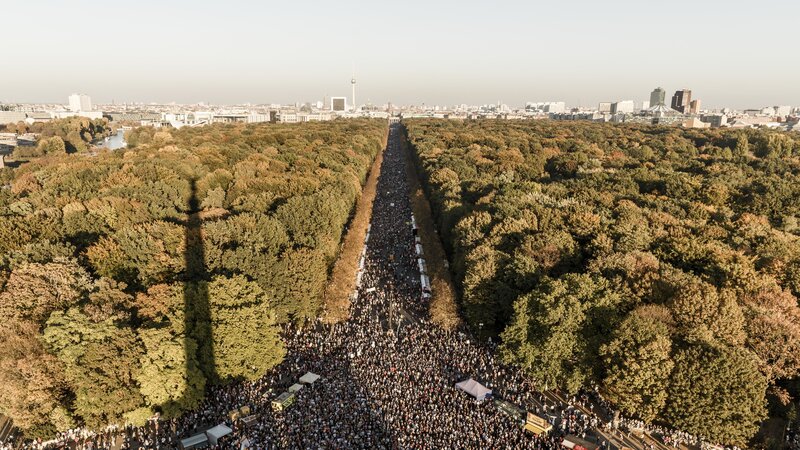
Protesters Throng Berlin In Massive Rally To Support ‘Open And Free Society’ (NPR) A massivce rally was held in Berlin on Sunday against “racism and discrimination” and in support of “humanity and human rights, religious freedom, and the rule of law“. Organizers had expected 40,000 – a quarter of a million or more showed up.
Turkey
- ‘Thankful To Be Safely Home’: Pastor Brunson, Freed From Detention, Arrives In U.S. (NPR) Andrew Brunson is back on U.S. soil. After two years of detention in Turkey, during which the American pastor’s fate drove a wedge between two longtime allies, a newly-freed Brunson touched down Saturday at Joint Base Andrews just outside Washington, D.C. From there, Brunson stopped by the White House for a visit with President Trump.
Saudi Araabia
- International pressure mounts on Saudi over journalist disappearance (CNN) The UK, Germany and France have demanded a credible investigation into the fate of missing Saudi journalist Jamal Khashoggi as international pressure mounts on Riyadh to explain his disappearance. Khashoggi, a columnist for The Washington Post and Saudi royal insider-turned-critic, went missing after entering the Saudi consulate in Istanbul on October 2 to obtain paperwork that would allow him to marry his Turkish fiancée.
His disappearance has drawn international condemnation and prompted Washington and Riyadh to trade threats, with US President Donald Trump warning of serious retribution if the Saudis are found to be behind his possible death.
India
- Of the 15.5 million who visited India in 2017, less than 10 percent were willing to spend upwards of $700 a day, said industry experts, who expect that market will double every three years.
- For those willing to spend big, however, India offers a host of luxuries.
- From palace hotels to glamorous camps, luxury trains to rare ingredients, vacation options for the super rich are growing in India.
China
- Are Trump and Xi on the brink of a new Cold War? (CNN) There is growing realization — and fear — among Chinese officials in Beijing that US President Donald Trump could be serious in his promise to upend the types of bilateral relations they have become accustomed to in the past few decades. It is a shock for Beijing to realize that reports about an administration-wide policy initiative countering China are more than mere Washington hearsay. Since June, United States and China’s diplomatic ties have deteriorated rapidly across a range of fronts, not just trade but also military and politics. It may not be the start of the next Cold War, at least not yet, but relations between the two sides have been plunged into an unprecedented deep chill.
Now Chinese President Xi Jinping may meet with Trump at the annual G20 leaders summit in Buenos Aires in November in an effort to broker a solution. Policy experts on both sides worry it may already be too late to find a way back.
- China’s central bank still has plenty of tools to counter detrimental trade war effect: Governor (CNBC)
- China’s central bank still has plenty of tools that it can use to counter the detrimental effects of a trade war, its governor, Yi Gang, said on Sunday.
- China and the U.S. have imposed tit-for-tat tariffs on each other’s products, which have made investors nervous and is seen as a major risk in derailing the global economy.
- “We still have plenty of monetary instruments in terms of interest rate policy, in terms of required reserve ratio. We have plenty of room for adjustment, in case we need it,” Yi said.
.


