


from The Conversation
— this post authored by Luke Rendell, University of St Andrews
History will record that in the second decade of the third millennium, a killer whale uttered the word “hello” to a human. After eons of existential wandering in the forest of cosmic loneliness, has humanity finally made contact with another consciousness, not from another world but, astonishingly, the oceans of our own?

Please share this article – Go to very top of page, right hand side, for social media buttons.
Although scientists have reported an Orcinus orca at a marine park in Antibes, France, making noises that sound like human speech, the whale was not talking, any more than Hoover the seal or Koshik the elephant or uncountable parrots were when they produced recognisable copies of human words.
Nevertheless the study, from researchers led by José Abramson at the Complutense University of Madrid and including my St Andrews colleague Josep Call, is still important. Not because it means whales can speak English, but that they are capable of one of the core building blocks of language development in humans: vocal learning, the ability to copy novel sounds.
The astonishing thing about a whale saying “hello” is not what it means to us, but what it means to them – absolutely nothing. It was specifically chosen, along with some other words, phrases and nonsense sounds, as being something completely outside the normal sound repertoire of the whales. So when the whale produced reasonable copies of the sounds when instructed to, often on the very first attempt, it was pretty conclusive evidence that these animals have the capability to learn new sounds by copying.
Abramson and his colleagues did more than this, as they tested multiple sounds in three situations. In one, the whale was instructed using gestures to produce a sound to copy. In another, the target sound was played back through a loudspeaker. And in a third, a human produced the target sound. Each time, the whale’s responses were subjected to forensic acoustic analysis to measure just how good the copies were. The answer? Pretty darn good.
The evidence that killer whales can show vocal learning provides us with a missing piece of understanding about their lives in the wild. We’ve long known that killer whales have group specific dialects, collections of distinctive calls that are unique to single pods, or sets of pods. For decades scientists have suggested that these dialects are the result of learning, and many clues have supported this view.
We have tracked parallel changes in the calls of wild pods over time, we know that captive killer whales moved to different locations have changed their calls to fit in with the other whales at their new home. The genetic data is also consistent with this idea. And we have circumstantial evidence of an individual copying the sound of another species (a sea-lion). But now we have gold-standard controlled experimental evidence. Now, any explanation of these vocal dialects that doesn’t involve learning looks pretty outlandish.
Killer whales live in a society organised around females. The vocal traditions that these animals learn as they grow up are crucial components of their behaviour. But they are only part of a suite of knowledge and behaviour that they acquire, largely from their mothers, aunts, and grandmothers
My colleague Hal Whitehead and I have argued that this cultural inheritance is vital to whales’ lives. Without it, they are incomplete. So it is somewhat ironic that this study, performed on captive animals, adds to a growing picture of the importance of cultural inheritance in their lives and to the case that these animals should never be kept captive. It is impossible for the whales in captivity to develop and express their cultures in anything like the richness we see in the wild.
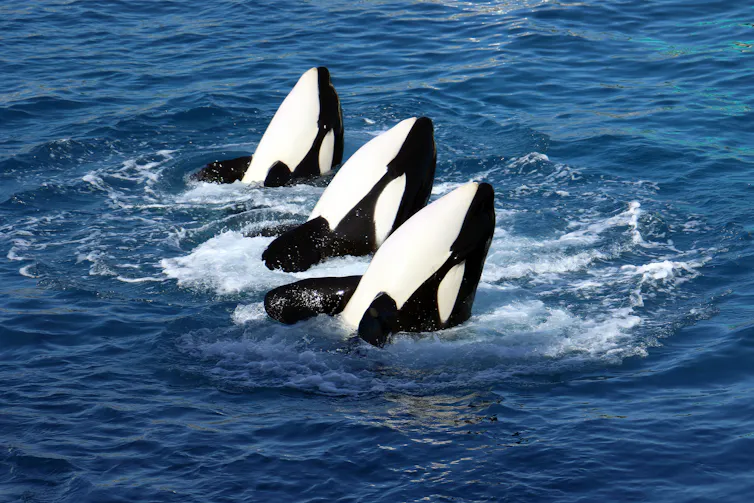
Whales learn in families. Shutterstock
Of course, killer whales are not alone in their ability to mimic human speech. We’ve known for centuries that some birds can do it, as can a select other few species of mammal including bats, seals, elephants, and other cetaceans such as bottlenose dolphins. Notably absent on this list are our closest living relatives, the chimpanzees and bonobos. True, chimps can subtly modify an existing call to match their group mates, but they have never been shown to be able to copy a completely novel sound.
While vocal learning underpins something only humans do – communicate via spoken language – it is intriguing that our closest primate relatives can’t do it. It tells us something crucial happened in human evolution after our ancestors separated from the other apes some 5m years ago.
We don’t know why this is, but studying the surprising distribution of vocal learning across the animal kingdom is one way to look for clues. Was it, for example, a result of a more mobile lifestyle? Birds, bats, and cetaceans are all highly mobile, but elephants less so. No current answer completely explains all the data, but then our picture is still far from complete.
 What’s next for the science of “talking” whales? It is clear that there is a lot of complex communication going on in whale and dolphin societies, much of which we still don’t understand. We are facing a vast ocean of ignorance. To rectify this, in my view, we need to drop our stifling and frankly navel-gazing, human-centric focus on asking “can whales talk?”. Instead, we should learn more about how each cetacean species has ways of communicating that are specific to their environment and how they have evolved. Only then will we be able to appreciate their true wonder.
Luke Rendell, MASTS Lecturer in Biology, University of St Andrews
This article was originally published on The Conversation. Read the original article.


