


from the Atlanta Fed
A recent paper by the Economic Policy Institute (EPI) argues that increased unionization would have broad economic benefits and, in particular, could help improve the wage stagnation facing many lower-skilled workers. Yet union membership has been declining, down by about 3 million between 1983 and 2015, and membership is down 4.5 million in the private sector.

(Union membership in the United States is discussed in this U.S. Bureau of Labor Statistics report and in this database, maintained by Barry Hirsch at Georgia State University.)
The overall membership decline in private-sector unions reflects a combination of lower employment in some traditionally unionized industries such as the steel and auto industries and lower unionization rates within industries. For example, the rate of unionization for goods-producing industries (largely manufacturing and construction) is down from 28 percent to 10 percent, and the rate in service-producing industries has declined from 11 percent to 6 percent. In contrast, union membership in the public sector has increased, mostly as a result of broad unionization among public safety, utility, and education occupations coupled with the fact that employment in these occupations has tended to grow over time.
For goods-producing industries in particular, unionized employment is down by about 4.2 million since 1983, and nonunionized employment is up by around 2.5 million. Many factors may have contributed to this shift away from union membership. A possibility I explore here is the role of wage rigidity. In particular, if union wage contracts prevent employers from adjusting wages in the face of an unexpected decline in output demand, then employers may adjust along the employment margin instead. The monopoly power of unions leads to higher wages for continuously employed union workers but also makes layoffs more frequent.
It is the case that unionized workers tend to earn more than their nonunion counterparts. For 1983 to 2015, I estimate that prime-age union workers in goods-producing industries earn an average of about 25 percent more (on a median hourly basis) than comparable nonunion workers (about 50 percent more in construction and about 10 percent more in manufacturing). In addition, the median wage growth of union workers is less cyclically sensitive. The following chart uses the Atlanta Fed’s Wage Growth Tracker data, and it shows the annual median wage growth of continuously employed prime-age workers in goods-producing industries, by union status.

Not only is wage growth among union workers less variable over time as the chart shows, research has noted that union wages are less dispersed – even controlling for differences in worker characteristics. Joining a union leads to wages that tend to be higher, wages that vary less across workers, and wage growth that responds less to changes in economic conditions.
But what about unemployment risk? Do union workers get laid off at a greater rate than nonunion workers? Using matched data from the Current Population Survey, the following chart shows an estimate of the probability that a prime-age worker in a goods producing industry is unemployed 12 months later, by union status.

The probability of unemployment rises during economic downturns for both union and nonunion workers, but is higher for union workers. The union worker displacement rate reached 13 percent in 2009 versus 8 percent for nonunion workers.
However, recall provisions are often built into collective bargaining agreements, so perhaps looking at the total unemployment flow overstates the permanent job loss risk. To investigate, the following chart shows the likelihood of being on temporary layoff (expected to be recalled within six months) versus indefinite (permanent) layoff.
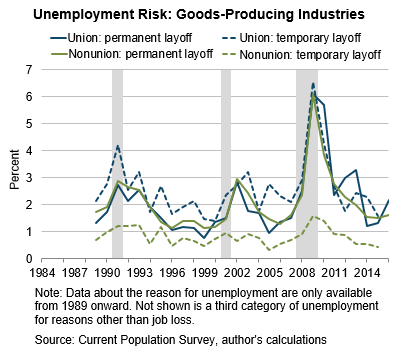
The likelihood of being recalled by your previous employer is much higher for union than nonunion workers, whereas the incidence of permanent layoff is about the same for both types of worker.
Admittedly, I’m not controlling for all the things about workers and employers that could influence employment and wage outcomes. But taken at face value, it appears that the likelihood of permanent job loss is no greater for union workers in goods-producing industries than for nonunion workers. At the same time, union workers are more likely to experience a spell of temporary unemployment. I view this as some evidence in support of my wage rigidity story, which holds that unionized firms use layoffs more intensively because wages are less flexible (I find that this same result holds if I look at the manufacturing and construction industries separately). However, this mechanism itself isn’t able to account for much of the secular decline in union participation. The decline seems to be more about where the jobs are created than where they are lost.
About the Author
 John Robertson, a senior policy adviser in the Atlanta Fed’s research department


