



This is the only regional survey showing contraction. All the other 4 regional surveys released to date show manufacturing expanding in June 2013.
Tenth District manufacturing activity fell modestly after last month’s rebound, although producers’ expectations for future activity continued to increase. Some firms commented on production delays due to power outages, flooding, and shipment interruptions from recent regional storms. Most price indexes posted minimal changes in June.
The month-over-month composite index was -5 in June, down from 2 in May but equal to -5 in April and March (Tables 1 & 2, Chart). The composite index is an average of the production, new orders, employment, supplier delivery time, and raw materials inventory indexes. Production fell at both durable and non-durable goods-producing plants, with food and machinery manufacturing particularly weak. Other month-over-month indexes showed mixed results. The production index dropped from 5 to -17, its lowest level since March 2009, and the shipments and new orders indexes also fell markedly. The order backlog and employment indexes increased somewhat but still remain slightly below zero. Both inventory indexes edged higher after falling in May.
The majority of year-over-year factory indexes improved over last month. The composite year-over-year index increased from 0 to 3, and the production, shipments, and new orders indexes also rose. The order backlog index edged up from -15 to -10, and the employment index posted a positive reading for the first time in two months. The new orders for exports index increased from -7 to -1, and the capital expenditures index improved for the second straight month. The raw materials inventory index inched higher from -7 to -6, and the finished goods inventory index also recorded a slight gain.
Most future factory indexes increased further in June. The future composite index edged higher from 11 to 12, and the future production, shipments, and new orders indexes also improved. The future order backlog index climbed from 9 to 14, and the future new orders for exports index posted its highest level in two years. In contrast, the future employment index was relatively unchanged, and the future capital expenditures index moderated somewhat. The raw materials inventory index fell from 1 to -2, while the finished goods inventory index increased slightly.
Most price indexes recorded minimal changes from the previous month. The month-over-month raw materials price index rose from -3 to 3, and the finished goods price index increased marginally. The year-over-year raw materials price index was unchanged, while the finished goods price index posted a slight gain. The future raw materials price index inched higher from 43 to 46, but the future finished goods price index eased somewhat, indicating fewer firms plan to pass recent cost increases through to customers.
Summary of all Federal Reserve Districts Manufacturing:
Richmond Fed (hyperlink to reports):

/images/z richmond_man.PNG
Kansas Fed (hyperlink to reports):
/images/z kansas_man.PNG
Dallas Fed (hyperlink to reports):

/images/z dallas_man.PNG
Philly Fed (hyperlink to reports):

/images/z philly fed1.PNG
New York Fed (hyperlink to reports):

/images/z empire1.PNG
Federal Reserve Industrial Production – Actual Data (hyperlink to report)
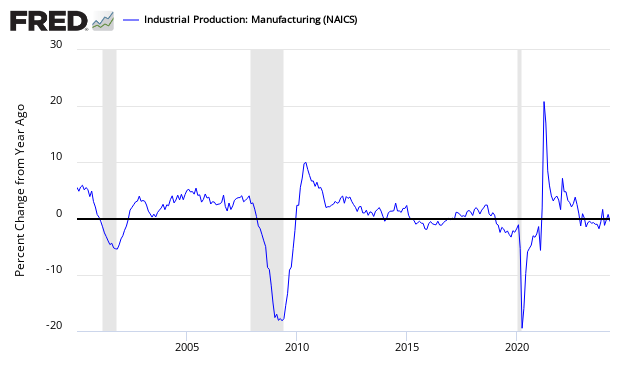
Holding this and other survey’s Econintersect follows accountable for their predictions, the following graph compares the hard data from Industrial Products manufacturing subindex (dark blue bar) and US Census manufacturing shipments (lighter blue bar) to the Kansas City Survey (pea-green bar).
Comparing Surveys to Hard Data


/images/z survey1.png
In the above graphic, hard data is the long bars, and surveys are the short bars. The arrows on the left side are the key to growth or contraction.


