


from The Conversation
— this post authored by Nadia Hilliard, UCL
Even as millions of votes in key battlegrounds were being counted, Donald Trump incorrectly declared victory in the US presidential race. The US will sit in limbo until the results from swing states are in. The Trump campaign has committed to pushing this political battle into the courts should he lose, and the Biden campaign has promised to meet the challenge.

Please share this article – Go to very top of page, right hand side, for social media buttons.
Throughout the 2020 campaign, polls suggested that whatever the outcome, significant parts of the US would see their new leader as illegitimate. Regardless of whether Trump or Joe Biden is ultimately inaugurated as their 46th president, millions of Americans will see the outcome as “the end of democracy“.
The apocalyptic tenor of the election reflects deeper, foundational challenges to the legitimacy of American democracy of which Trump is a symptom more than a cause.
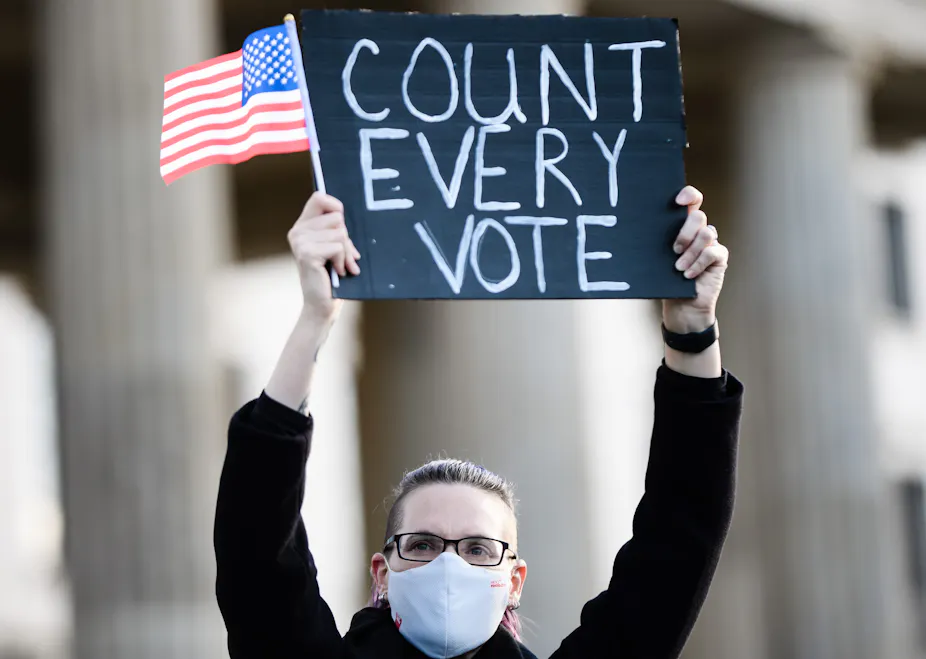
The US is facing a crisis of democratic legitimacy. Clemens Bilan/EPA
This crisis finds its roots in twin challenges. The first stems from accumulated procedural violations in all branches and levels of government. The second is grounded in the type of authority that Trump commands.
Flouting norms
The procedural challenges to democratic legitimacy include norms being flouted by both parties in Congress, the norms of public behaviour destroyed by the Trump presidency, and most recently, the electoral upheaval exacerbated by COVID-19.
The Republican Party’s recent insistence on a rapid confirmation process for conservative supreme court nominee Amy Coney Barrett especially after its refusal to do the same for Democratic nominee Merrick Garland in 2016, has made Barrett’s confirmation deeply divisive. Democrats do not have a clean track record in this arena, either: most recently, senate majority leader Chuck Schumer reportedly threatened that nothing was off the table if the Democrats take the senate.
Read more: Where the politicisation of the US Supreme Court could lead
Trump himself has also made lasting changes to the institutions of government. His catalogue of sins is lengthy and well-rehearsed, and his disregard for the rule of law has been patent. As worrisome as the violations themselves is the precedent that his behaviour sets for the standards of presidential probity.
A further threat to legitimacy comes not from the federal government or Trump himself, but from long-standing and intensifying attempts to derail citizens’ ability to participate in the democratic process. Observers have detailed the modes, extent, and history of voter suppression in the 2020 election cycle. These include convoluted registration laws that disadvantage specific (mostly Democrat-leaning) groups, intimidation or discouragement at the polls, and the disqualification of cast ballots.
Read more: Trump’s encouragement of GOP poll watchers echoes an old tactic of voter intimidation
Voters in Atlanta, Georgia in precincts with largely African American populations encountered waiting times of up to 12 hours during early voting. This has not been helped by a lack of effort by the Republican-led state legislature to increase the number of polling stations across the state. This kind of partisan electoral engineering has a history with deep racial overtones.
Both gerrymandering and the make-up of the electoral college currently give an advantage to Republican candidates, but have not always done so historically.
Sources of authority
Procedural integrity is certainly one prerequisite for democratic trust and legitimacy, but it is not the only one. While polarisation is hardly a novel feature of the American political landscape, the reluctance to accept one’s opponent as legitimate is new. This second challenge to a shared sense of legitimacy strikes at the very core of the country’s democratic framework. American citizens are divided not only culturally, but also with regard to the very sources of authority that underpin their political worldviews.
As the historian David Bell argues, modern democracy cannot do without charismatic leaders. Trump’s charisma and his social authority, derived from his celebrity status as a television personality and businessman, appeal to millions of Americans and make him a legitimate authority figure in their eyes.
Unlike previous charismatic presidents, such as Ronald Reagan or Barack Obama, Trump’s appeal in the eyes of his supporters does not lie in his competence or political vision – he appears to have little of either. For his base, the source of his authority – and thus, of his legitimacy as a leader – lies far from the attributes that Reagan and Obama displayed and that grounded their leadership: vision, persuasive skill, and respect for the political process.
But social and political authority are not synonymous. The Trump era has brought to the fore the distinct democratic challenge posed by self-aggrandising charisma without an accompanying foundation in procedural legitimacy.
A loyal opposition
What does this mean for the future basis of democratic legitimacy in America? The principle of loyal opposition is the idea that the losers of a political battle not only remain loyal to the fundamental political framework, but also make important contributions to political life, such as providing accountability and articulating an alternative political programme. It is fundamental for a healthy, diverse democracy – and it requires agreement on the basis of political legitimacy.
When the rules underlying the basic institutions upon which a democracy rests are flouted and rewritten, the basis for loyal opposition is undermined for both sides. And though the partisan jibes that eroded a sense of loyal opposition preceded Trump by decades, his presidency has forced a radical question for all: will I accept the outcome if my opponent wins?
These twin challenges will require multiple remedies. Restoring institutional integrity through processes of accountability and reform can and should be a point of agreement between conservatives and liberals, and reforms such as the National Popular Vote Interstate Compact might go some way to reversing institutional imbalances. Both parties should recognise that continued polarisation is in neither their interests, nor those of the country as a whole. Ultimately, a radically polarised nation is a broken nation.
Nadia Hilliard, Lecturer in US Politics, UCL
This article is republished from The Conversation under a Creative Commons license. Read the original article.


