


Written by Steven Hansen
The U.S. new cases 7-day rolling average is 23.2 % HIGHER than the 7-day rolling average one week ago. U.S. deaths due to coronavirus are now 11.2 % HIGHER than the rolling average one week ago. U.S. hospitalizations due to COVID-19 are now 1.2 % HIGHER than the rolling average one week ago. Today’s headlines include:
- U.S. Sets Coronavirus Record With Daily New Cases Pushing Past 122,000
- Why Germany’s virus strategy doesn’t appear to be working the second time around
- Researchers in Britain begin a trial of another possible Covid treatment: aspirin
- Clots, Strokes And Rashes. Is COVID-19 A Disease Of The Blood Vessels?
- Covid-19 may make people’s tinnitus worse
- COVID-Related Strokes Especially Severe, Result in Worse Outcomes
- New Case Suggestive of in Utero SARS-CoV-2 Transmission
- FBI Warns of ‘Imminent’ Cyberattacks on US Hospitals
- The hidden public health hazard of rapid Covid-19 tests
- The second wave of covid-19 has sent much of Europe back into lockdown
- Cough droplets can travel beyond six feet, new simulation study suggests

The recent worsening of the trendlines for new cases should be attributed to going back to college/university, cooler weather causing more indoor activities, possible mutation of the virus, fatigue from wearing masks / social distancing, holiday activities, and continued loosening of regulations designed to slow the coronavirus spread.
My continuing advice is to continue to wash your hands, wear masks, avoid crowds, and maintain social distancing. No handwashing, mask, or social distancing will guarantee you do not get infected – but it sure as hell lowers the risk in all situations – and the evidence to-date shows a lower severity of COVID-19. In addition, certain activities are believed to carry higher risk – like being inside in air conditioning and removing your mask (such as restaurants, around your children/grandchildren, bars, and gyms). It is all about viral load – and outdoor activities are generally safe if you can maintain social distance.
include($_SERVER[‘DOCUMENT_ROOT’].’/pages/coronavirus1.htm’); ?>
Hospitalizations (grey line) and Mortality (green line) For Week ending 24OCT2020
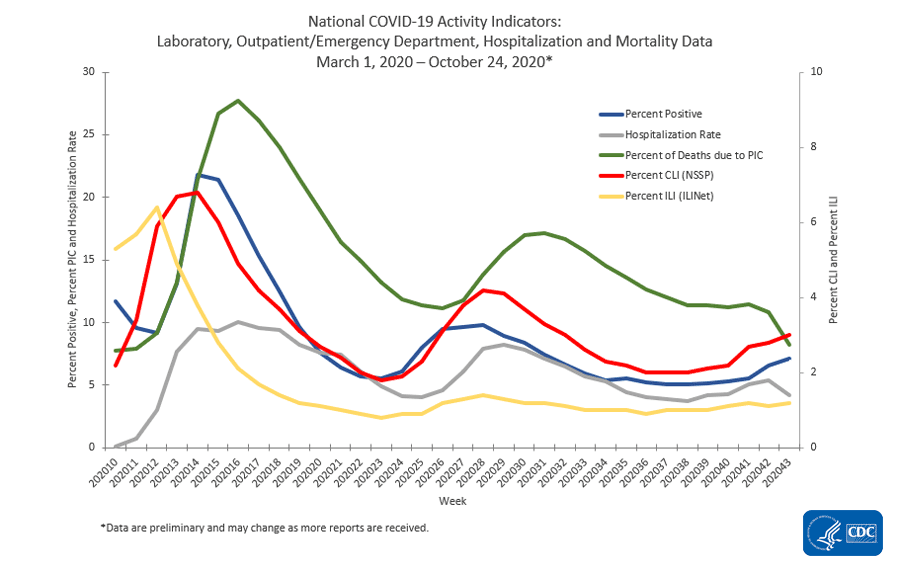
source: https://www.cdc.gov/coronavirus/2019-ncov/covid-data/covidview/index.html
Coronavirus News You May Have Missed
Why Germany’s virus strategy doesn’t appear to be working the second time around – CNBC
Germany was praised for its initial response to the coronavirus pandemic, but the country re-implemented strict public health measures on Monday, raising questions around the effectiveness of its strategy.
The country’s “light lockdown” came as cases of the coronavirus have continued to rise, with latest from the Robert Koch Institute showing nearly 127 infections per 100,000 people over a seven-day period. The German government is aiming to push this down to about 50 cases per 100,000 people.
Chancellor Angela Merkel warned that Germany “must get the situation under control to a point where the local public health offices can trace contacts again — otherwise the exponential growth will simply spiral further upwards.”
Dr. Hajo Zeeb, head of department for Germany’s Leibniz Institute for Prevention Research and Epidemiology, highlighted how people returning from vacation over the summer had resulted in a “major workload” for local public health offices, as they then also had to test these returning citizens.
FBI Warns of ‘Imminent’ Cyberattacks on US Hospitals
Amid recent reports of hackers targeting and blackmailing healthcare systems and even patients, the Federal Bureau of Investigation (FBI) and other agencies have issued warning of “imminent” cyberattacks on more US hospitals.
A new report released by the Cybersecurity and Infrastructure Security Agency (CISA), part of the Department of Homeland Security, notes that the FBI and the Department of Health and Human Services (HHS) have “credible information of an increased and imminent cybercrime threat to US hospitals and healthcare providers.”
The agencies are urging “timely and reasonable precautions” to protect healthcare networks from these threats.
As reported, hackers accessed patient records at Vastaamo, Finland’s largest private psychotherapy system, and emailed some patients last month demanding €200 in bitcoin or else personal health data would be released online.
In June, the University of California, San Francisco (UCSF), School of Medicine experienced an information technology (IT) “security incident” that led to the payout of $1.14 million to individuals responsible for a malware attack in exchange for the return of data.
In addition, last week, Sky Lakes Medical Center in Klamath Falls, Oregon, released a statement in which it said there had been a ransomware attack on its computer systems. Although “there is no evidence that patient information has been compromised,” some of its systems are still down.
The best COVID-19 warning system? Poop and pooled spit
“There are quite extensive numbers of poop jokes,” said Wilusz, a CSU molecular biologist.
Emerging research suggests infected people start shedding the coronavirus in their poop early in their infection, and possibly days before they begin shedding it from their mouths and noses.
In normal times, Wilusz studies stem cells and muscular dystrophy. Now, her team is on the front lines of defense against the massive COVID-19 outbreaks that, for a campus with more than 23,000 undergraduates alone, always seem to be lurking around the corner. The sewage review is part of a multipronged attack that includes the usual weapon of contact tracing plus a specialized “paired pooling” form of testing saliva samples. So far, the school has had about 500 cases since the semester started.
Amid fluctuating scientific recommendations and a virus that still holds uncertainties, colleges across the country are taking a choose-your-own-adventure approach to COVID-19. For those holding in-person classes, the adventure includes an extra puzzle: how to concentrate a lot of people into one place without an outbreak tearing through the student body and spilling into the community, all without safety precautions that would break the bank.
Testing is at the core of those plans.
The second wave of covid-19 has sent much of Europe back into lockdown – The Economist
… Asian nations, some democratic, some not, have proved it possible to force infection rates so low as to more or less eradicate the disease. But when they came out of their first lockdown European countries were unwilling to impose the strictures they thought would be necessary for true eradication. Many doubtless thought that their citizens would not put up with them. They chose instead a strategy in which various not-too-onerous modifications in everyday behaviour would keep the level of infection low enough for their health systems to be able to cope.
This strategy of containment has, unfortunately, proved fragile. But it remains the only one that most European nations see as viable. When the current lockdowns run their course, they need to follow it better. New tools may help them do so. Cheaper and quicker tests are already becoming available, and fairly soon there may be antibody and other treatments which, given early, reduce the risk of severe disease, and which might even offer some degree of prophylaxis. There could also be a significant boost to morale if, during the lockdowns, vaccine trials provide good news. Seeing a fairly near-term way out of the bind may make people more willing to submit to constraints in the meantime.
[editor’s note: this post is worth a full read.]

Covid-19 may make people’s tinnitus worse – NBC
Tinnitus — a condition characterized by whooshing, ringing, buzzing and hissing noises in the ear — can be triggered by a variety of factors, including exposure to loud noises, inner ear damage and stress. And while experts say the stress of the pandemic could be linked to worsening tinnitus symptoms, there’s growing evidence that the virus itself could also play a role.
A study published Thursday in the journal Frontiers in Public Health found that 40 percent of people who had symptoms of Covid-19 reported a worsening of their tinnitus. The research included more than 3,000 participants who self-reported whether they had experienced changes in their hearing since the pandemic started. Around 250 participants reported Covid-19 symptoms, although only 26 had tested positive for the virus.
In the roughly one-third of study participants who had tinnitus before the pandemic, “a combination of lifestyle, social and emotional factors during the pandemic” appears to have made it worse, said the study’s lead author, Eldre Beukes, a research fellow at Anglia Ruskin University in Cambridge, England.
Clots, Strokes And Rashes. Is COVID-19 A Disease Of The Blood Vessels? – NPR
Whether it’s strange rashes on the toes or blood clots in the brain, the widespread ravages of COVID-19 have increasingly led researchers to focus on how the novel coronavirus sabotages the body’s blood vessels.
As scientists have come to know the disease better, they have homed in on the vascular system — the body’s network of arteries, veins and capillaries, stretching more than 60,000 miles — to understand this wide-ranging disease and to find treatments that can stymie its most pernicious effects.
Some of the earliest insights into how COVID-19 can act like a vascular disease came from studying the aftermath of the most serious infections. Those reveal that the virus warps a critical piece of our vascular infrastructure: the single layer of cells lining the inside of every blood vessel, known as the endothelial cells or simply the endothelium.
Dr. William Li, a vascular biologist, compares this lining to a freshly resurfaced ice skating rink before a hockey game on which the players and pucks glide smoothly along.
“When the virus damages the inside of the blood vessel and shreds the lining, that’s like the ice after a hockey game,” says Li, a researcher and founder of the Angiogenesis Foundation. “You wind up with a situation that is really untenable for blood flow.”
… Could the lining of our blood vessels be a common denominator?
With a surface area larger than a football field, the endothelium helps maintain a delicate balance in the bloodstream. These cells are essentially the “gatekeeper” to the bloodstream.
“The endothelium has developed a distant early warning system to alert the body to get ready for an invasion if there’s trouble brewing,” says Peter Libby, a cardiologist at Brigham and Women’s Hospital and research scientist at Harvard Medical School.
When that happens, endothelial cells change the way they function, he says. But that process can also go too far.
“The very functions that help us maintain health and fight off invaders, when they run out of control, then it can actually make the disease worse,” Libby says.
In that case, the endothelial cells turn against their host and start to promote clotting and high blood pressure.
The hidden public health hazard of rapid Covid-19 tests – STAT
Rapid Covid-19 tests are being deployed by the millions across the nation. The federal government is sending these tests, which can provide results in minutes, to states for educators, students, nursing home patients, first responders, and other sites.
That’s a good thing. But in a rush to get individual test results, we’re making a dangerous public health mistake: We’re losing critical data about Covid-19.
For months, the U.S. has struggled to get accurate information about Covid-19 cases and testing about different demographic groups. As rapid tests surge — and are performed at sites that don’t follow specific Covid-19 data reporting processes — even more information will be lost.
Accurate data are essential for fighting public health crises like Covid-19. Policymakers need complete, timely information about who is getting the disease to track its spread, identify hot spots, and form effective, equitable solutions. Without data, public health strategies will be haphazard and ineffective.
[editor’s note: this post deserves a full read. Consider that it more important to the individual to know if they have COVID – reporting is secondary. Personally I believe the pandemic is growing to rapidly to be concentrating on reporting – we are in the “knocking down the peak” mode, not the elimination of the virus mode today.]
Denmark finds 214 people with mink-related coronavirus – Al Jazerra
Denmark’s State Serum Institute, which deals with infectious diseases, has found mink-related strands of the novel coronavirus in 214 people since June, according to a report on its website updated on November 5.
Meanwhile, one strain of the mutated coronavirus, which has prompted Denmark to cull its entire herd of mink, has been found in 12 people and on five mink farms so far.
“It is very, very serious,” Frederiksen said. “Thus, the mutated virus in minks can have devastating consequences worldwide.”
Health minister Magnus Heunicke said half the 783 human COVID-19 cases in northern Denmark “are related” to minks.
The development has prompted fresh measures to stem the spread of the virus; more than a quarter million Danes went into lockdown Friday in a northern region of the country where the mutated variation of the coronavirus has infected minks being farmed for their fur.
The coronavirus evolves constantly and, to date, there is no evidence that any of the mutations pose an increased danger to people. But Danish authorities were not taking any chances.
COVID-Related Strokes Especially Severe, Result in Worse Outcomes – MedPage
Ischemic strokes in COVID-19 patients tended to be more severe than those in other individuals, according to a case-control study from the U.K.
Among 86 stroke patients with COVID-19, stroke characteristics and outcomes differed from uninfected stroke patients treated during the same period. The COVID-19-associated strokes:
- Were more likely to involve multiple large vessel occlusions (17.9% vs 8.1%, P<0.03)
- Were more severe (median NIH Stroke Scale score 8 vs 5, P<0.002)
- Were associated with higher D-dimer levels (3.4 vs 3.0 ng/ml on the log10 scale, P<0.01)
- Resulted in more severe disability on discharge (median modified Rankin Scale score 4 vs 3, P<0.0001)
- Resulted in more deaths during index admission (19.8% vs 9.6%, P<0.0001)
“Our study provides the most compelling evidence yet that COVID-19-associated ischaemic strokes are more severe and more likely to result in severe disability or death, although the outlook is not quite as bleak as previous studies have suggested,” according to a group led by Richard Perry, BM, BCh, PhD, of UCL Queen Square Institute of Neurology and the National Hospital for Neurology & Neurosurgery, London. A full manuscript was published in the Journal of Neurology, Neurosurgery & Psychiatry.
New Case Suggestive of in Utero SARS-CoV-2 Transmission – Medscape
A new report of mother-to-fetus transmission of SARS-CoV-2 through umbilical cord blood adds to a small but growing body of evidence that the virus can be transmitted in utero.
Further, this case suggests such infections may not be easily detectable in neonates until days after birth.
In a report published in the Journal of the Pediatric Infectious Diseases Society, Isabelle Von Kohorn, MD, PhD, of Holy Cross Health in Silver Spring, Md., and colleagues, described a case of neonatal infection with SARS-CoV-2 in a boy delivered by C-section at 34 weeks to a mother diagnosed with COVID-19 some 14 hours before. The newborn was immediately removed to a neonatal ICU and reunited with his mother a week later, once the mother had recovered.
Von Kohorn and colleagues reported that, while the infant’s nasopharyngeal swab test for SARS-CoV-2 was negative at 24 hours after birth, repeat molecular tests (using different assays) from 49 hours on were positive and indicated an increasing viral burden, although the infant never developed symptoms of COVID-19. In addition to being found in the nasopharynx, viral RNA also was detected in cord blood and in urine. No viral RNA was found in the placenta.
The circumstances of the birth, and the care taken to keep mother and her infant at a safe distance along with masking of the mother, made it “extremely unlikely” that the infant acquired his infection by the respiratory route, Von Kohorn and colleagues wrote.
Researchers in Britain begin a trial of another possible Covid treatment: aspirin. – New York Times
Scientists in Britain have started a clinical trial of a cheap, commonly used drug — aspirin — to see whether the anti-inflammatory agent can improve the care of patients hospitalized with Covid-19 by reducing the formation of life-threatening blood clots.
The study of aspirin is part of the same large trial that in June discovered the life-saving benefits of the steroid dexamethasone, another inexpensive and widely available drug that was found to significantly reduce deaths in severely ill Covid patients who were on ventilators or supplemental oxygen.
Patients with Covid are at risk of developing blood clots that can block blood flow to organs and cause heart attacks, strokes and other complications. Over the course of the pandemic, doctors have learned to closely monitor hospitalized patients for signs of the clots, often putting them on blood thinners early on to reduce the risks.
The new study in Britain is part of the Randomized Evaluation of Covid-19 Therapy or Recovery trial, the world’s largest clinical trial of treatments for hospitalized Covid patients.
Cough droplets can travel beyond six feet, new simulation study suggests – Journal Physics of Fluids
A new simulation study suggests that a person coughing can disperse droplets well beyond six feet, and that anyone shorter than the person coughing — such as children — might be at a greater risk of encountering the downward trajectory of those cough droplets.
During the coronavirus pandemic, the dispersion of cough droplets has become of great interest among scientists. The new study, published on Tuesday in the journal Physics of Fluids, evaluates the risk of spreading the virus through cough droplets in the air under different tropical outdoor environments.
“Young children may be at greater risk compared to adults based on the typical downward cough trajectory. Teenagers and short adults are advised to maintain a social distance greater than 2 m from taller persons,” the researcher wrote in the study. “Surgical masks are known to be effective at trapping large droplets and therefore recommended for use as necessary.”
The researchers — from Singapore’s Agency of Science, Technology and Research — used numerical models to simulate the trajectory of droplets expelled by a person who suddenly coughs outdoors with someone listening nearby.
The following are foreign headlines with hyperlinks to the posts
Colombia’s lower legislative house abruptly adjourned and the lawmakers were told to quarantine after a member tested positive for coronavirus.
Greece orders nationwide lockdown to curb COVID surge
Famous Paris bookshop that published ‘Ulysses’ pleads for help
US asks WHO to invite Taiwan to health assembly next week
Ambulances Forced to Queue as Hospitals Scramble for COVID-19 Beds in Poland
China blocks more foreign residents from returning to the country.
Italy’s daily record nears 38,000 virus cases
Malaysia reports biggest daily jump in COVID-19 cases, with 1,755 new infections
Russia has over 20,000 daily cases for first time
The following are additional national and state headlines with hyperlinks to the posts
Tourism drop due to COVID-19 prompts some Las Vegas hotels to close midweek
Tightened Coronavirus Rules, Mask Order Effective in Massachusetts Friday
Idaho sees record COVID-19 cases, full hospitals and now flu
Missouri poll worker positive for Covid-19 still worked shift, died after Election Day
Navajo Nation sees 2nd wave, orders more curfews
NFL fines Raiders, takes draft picks over coronavirus violations
Movies postponed amid the coronavirus crisis
Regeneron officials expressed hope for a quick FDA authorization for emergency use of the company’s antibody cocktail.
The University of Maryland will transition almost all of its classes to online after Thanksgiving because of growing concern about the COVID-19 surge.
NBA Players Union Approves Plan To Tip Off 2020-21 Season Before Christmas
Connecticut limits gatherings to 10 people amid COVID-19 rise
Coronavirus cases at U.S. colleges have hit a quarter million.
New Orleans plans for a ‘different,’ Covid-safe Mardi Gras in 2021
Arthritis drug made by Novartis fails to help Covid-19 patients
Today’s Posts On Econintersect Showing Impact Of The Pandemic With Hyperlinks
September 2020 Consumer Credit Expands
September 2020 Headline Wholesale Sales and Inventories Improve
October 2020 BLS Jobs Situation – Employment Grew 638,000 But Still Down 8,394,000 Year-to-Date

Rail Week Ending 31 October 2020 – October Up 2.0%
Warning to Readers
The amount of politically biased articles on the internet continues to increase. And studies and opinions of the experts continue to contradict other studies and expert opinions. Honestly, it is difficult to believe anything anymore. A study usually cannot establish cause and effect – but only correlation. Be very careful what you believe about this pandemic.

I assemble this coronavirus update daily – sifting through the posts on the internet. I try to avoid politically slanted posts (mostly from CNN, New York Times, and the Washington Post) and can usually find unslanted posts on that subject from other sources on the internet. I wait to publish posts on subjects that I cannot validate across several sources. But after all this extra work, I do not know if I have conveyed the REAL facts. It is my job to provide information so that you have the facts necessary – and then it is up to readers to draw conclusions.
Analyst Opinion of Coronavirus Data
There are several takeaways that need to be understood when viewing coronavirus statistical data:
- The global counts are suspect for a variety of reasons including political. Even the U.S. count has issues as it is possible that as much as half the population has had coronavirus and was asymptomatic. It would be a far better metric using a random sampling of the population weekly. In short, we do not understand the size of the error in the tracking numbers.
- Just because some of the methodology used in aggregating the data in the U.S. is flawed – as long as the flaw is uniformly applied – you establish a baseline. This is why it is dangerous to compare two countries as they likely use different methodologies to determine who has (and who died) from coronavirus.
- COVID-19 and the flu are different but can have similar symptoms. For sure, COVID-19 so far is much more deadly than the flu. [click here to compare symptoms]
- From an industrial engineering point of view, one can argue that it is best to flatten the curve only to the point that the health care system is barely able to cope. This solution only works if-and-only-if one can catch this coronavirus once and develops immunity. In the case of COVID-19, herd immunity may need to be in the 80% to 85% range. WHO warns that few have developed antibodies to COVID-19. At this point, herd immunity does not look like an option although there is now a discussion of whether T-Cells play a part in immunity [which means one might have immunity without antibodies]
- Older population countries will have a higher death rate.
- There are at least 8 strains of the coronavirus. New York may have a deadlier strain imported from Europe, compared to less deadly viruses elsewhere in the United States.
- Each publication uses different cutoff times for its coronavirus statistics. Our data uses 11:00 am London time. Also, there is an unexplained variation in the total numbers both globally and in the U.S.
- The real question remains if the U.S. is over-reacting to this virus. The following graphic from the CDC puts the annual flu burden in perspective [click on image to enlarge]. Note that using this data is dangerous as the actual flu cases are estimated and not counted – nobody knows how accurate these guesses are.
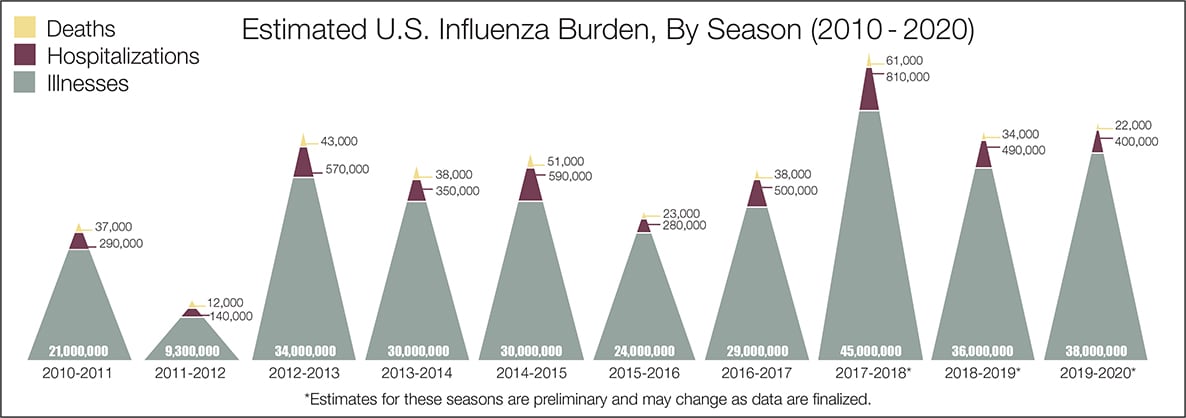
What we do not know about the coronavirus [actually there is little scientifically proven information]. Most of our knowledge is anecdotal, from studies with limited subjects, or from studies without peer review.
- How many people have been infected as many do not show symptoms?
- Masks do work.
- Do we develop lasting immunity to the coronavirus? Another coronavirus – the simple cold – does not develop long term immunity.
- To what degree do people who never develop symptoms contribute to transmission?
- The US has scaled up coronavirus testing – and the accuracy of the tests has been improving. However, if one loses immunity – the coronavirus testing value is reduced.
- Can children widely spread coronavirus? [current thinking is that they are becoming a major source of the pandemic spread]
- Why have some places avoided big coronavirus outbreaks – and others hit hard?
- What effect will the weather have? At this point, it does not seem hot weather slows this coronavirus down – and it seems air conditioning contributes to its spread.
- Outdoor activities seem to be a lower risk than indoor activities.
- Can the world really push out an effective vaccine in 12 to 18 months?
- Will other medical treatments for Covid-19 ease symptoms and reduce deaths? So far only one drug (remdesivir) is approved for treatment.
- A current scientific understanding of the way the coronavirus works can be found [here].
Heavy breakouts of coronavirus have hit farm workers. Farmworkers are essential to the food supply. They cannot shelter at home. Consider:
- they have high rates of the respiratory disease [occupational hazard]
- they travel on crowded buses chartered by their employers
- few have health insurance
- they cannot social distance and live two to four to a room – and they eat together
- some reports say half are undocumented
- they are low paid and cannot afford not to work – so they will go to work sick
- they do not have access to sanitation when working
- a coronavirus outbreak among farmworkers can potentially shutter entire farm
The bottom line is that COVID-19 so far has been shown to be much more deadly than the data on the flu. Using CDC data, the flu has a mortality rate between 0.06 % and 0.11 % Vs. the coronavirus which to date has a mortality rate of 4 % [the 4% is the average of overall statistics – however in the last few months it has been hovering around 1.0%] – which makes it between 10 and 80 times more deadly. The reason for ranges:
Because influenza surveillance does not capture all cases of flu that occur in the U.S., CDC provides these estimated ranges to better reflect the larger burden of influenza.
There will be a commission set up after this pandemic ends to find fault [it is easy to find fault when a once-in-a-lifetime event occurs] and to produce recommendations for the next time a pandemic happens. Those that hate President Trump will conclude the virus is his fault.
Resources:
- Get the latest public health information from CDC: https://www.coronavirus.gov .
- Get the latest research from NIH: https://www.nih.gov/coronavirus.
- Find NCBI SARS-CoV-2 literature, sequence, and clinical content: https://www.ncbi.nlm.nih.gov/sars-cov-2/.
- List of studies: https://icite.od.nih.gov/covid19/search/#search:searchId=5ee124ed70bb967c49672dad
include(“/home/aleta/public_html/files/ad_openx.htm”); ?>


