


from The Conversation
–this post authored by Richard Johnson, Lancaster University
As the US midterm elections approach, it’s important to understand how the US has undergone a profound intensification in racially polarised partisanship. Race and attitudes about race closely align with party identities more so than at any time in recent history.

Please share this article – Go to very top of page, right hand side, for social media buttons.
Democrat Barack Obama was elected in 2012 with the lowest support from white voters of any successfully elected presidential candidate; while 2016 Democrat hopeful, Hillary Clinton, did even worse among whites. At the same time, Democrats continue to attract exceptionally high support from racial minority groups.
In the US, access to the franchise has always been shaped in partisan terms. The politics of suffrage in the US has never been a simple, progressive expansion of the right to vote. Access to the ballot has been increased and diminished according to whoever manages to win power to write the rules. The Supreme Court’s recent ruling on supporting a Republican law in North Dakota, which will make it more difficult for Native Americans to vote, is no exception.
In the 19th century, many states allowed non-citizens to vote, giving the Democrats an advantage in urban areas as new arrivals tended to vote for the party and candidates that provided them with jobs and other social protections. In the same century, former slaves were also given the right to vote, and more than 2,000 African Americans were elected to public office in the 1860s and 1870s. Nearly all of these were Republican, the party of Abraham Lincoln and Emancipation.
As new, whiter western states, such as Kansas, Colorado, and Nebraska, joined the Union and began voting Republican, the partisan imperative to give blacks access to voting rights decreased. Eventually, Republicans abandoned their black electors for a newer, whiter crop of voters.
In the 21st century, when party and race closely align, rules written to advantage one party can inevitably skew an electoral race. Even rules with seemingly innocuous, race-neutral purposes, such as requiring voters to provide a state-issued photo ID to vote, can have racial and partisan implications. In Texas, for example, while 96.2% of white adult citizens have driver licences, only 86.9% of African Americans do. This ten percentage point gap can be politically consequential in close elections.
The Texas voter ID law was challenged by the Obama administration in the courts. But after Obama’s departure, the Trump administration reversed the federal government’s position and became a supporter of the legislation. This is no accident. The racist laws used to prevent blacks from voting before the mid-20th century – such as poll taxes, grandfather clauses, and literacy tests – were written in race-neutral terms. But while it meant that some poor whites were also affected, officials knew that the greater number of voters who were affected would be African Americans.
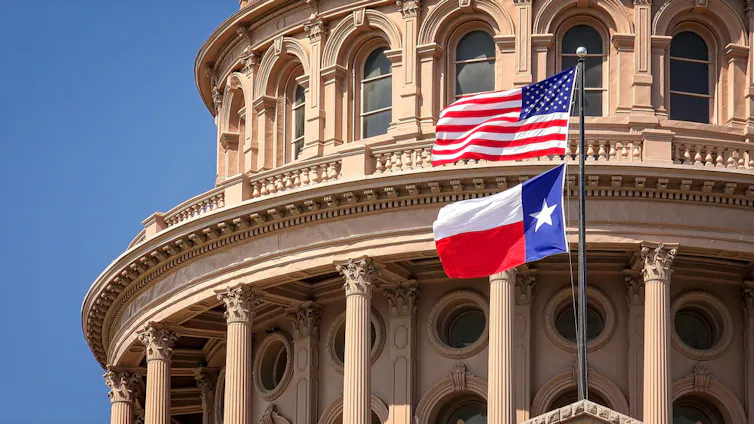
The Texas State Capitol building in Austin. Shutterstock
In 1945, the Alabama poll tax, which was explicitly race-neutral, was US$1.50 (US$20.20, adjusted for inflation in 2016), which is less expensive than it costs to buy a state-issued photo identification card ($36.25) in Alabama today. Supreme Court Justice Ruth Bader Ginsburg explicitly drew the connection between unconstitutional poll taxes and excessively burdensome voter ID laws.
The Dakota question
The latest North Dakota case shows how another racial minority group – in this case Native Americans – has been affected by the collusion of a Republican legislature, a Republican Justice Department, and a conservative federal court, with the effect of diminishing a racial group’s access to the ballot for partisan gain.
North Dakota is the only state in the US which does not have a voter registration requirement. Consequently, voters are required to show proof of residency in the state in order to vote. Until recently, voters without an ID could rely on another proof of residency, such as a sworn affidavit from a voter who did have ID.
State Republicans changed the law to require that all voters show IDs which list a residential address, not a PO Box. These personal post boxes, which are accessible at a local post office, are used by many Native Americans because the US Postal Service does not provide a daily, door-to-door service to some rural tribal communities. A 2015 survey showed that 23.5% of Native Americans lacked the required ID vote, compared to 12% of non-Native Americans.
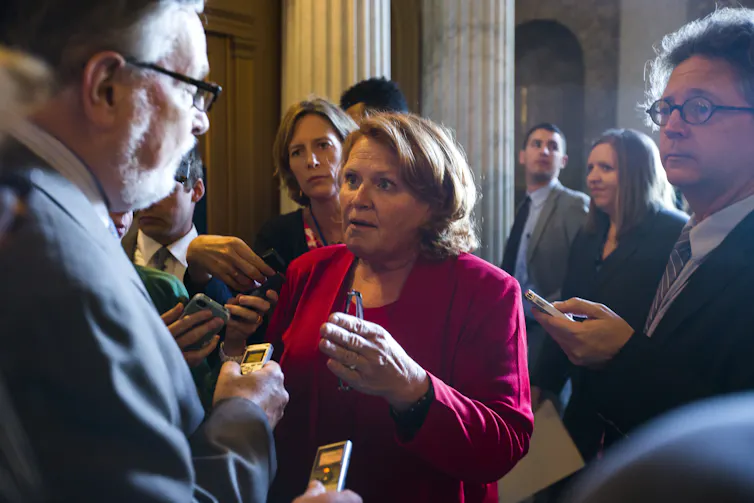
Democratic Senator Heidi Heitkamp (C) from North Dakota must now defend a tiny majority. EPA Images
The law was changed by the Republican state legislature for nakedly partisan purposes. In 2012, Democrat Heidi Heitkamp was elected to the US Senate over Republican Congressman Rick Berg by the narrowest of margins. Heitkamp won with a margin of just 2,936 votes over Berg, a majority of 0.92%.
Heitkamp’s victory was secured, in part, due to solid support from the state’s native populations. Native Americans form the largest racial minority group in the state. They also vote heavily Democratic. Sioux County, in the south of the state, is home to the Standing Rock Indian Reservation. The county is 84% Native American, and in 2012, it delivered 84% of the vote to Heitkamp. Rollette County, in the north, is home to the Turtle Rock Indian Reservation. The county is 77% Native American and delivered 80% of its vote to Heitkamp. And so, one year before the 2018 elections, the Republicans passed the new ID law.
In April 2018, Daniel Hovland, chief judge of the US District Court of North Dakota, ruled that the law disproportionately negatively impacted Native Americans. However, on October 9, the conservative-dominated US Supreme Court upheld the North Dakota voter ID law.
Desired outcomes
It is important to observe how partisan actors can coordinate at multiple levels to achieve desired outcomes. In the Dakota case, Republican-controlled state legislature faced no opposition from the Trump-era Justice Department – and a conservative-dominated Supreme Court protected the legislation from challenge. By comparison, the Obama-era Justice Department actively sued states on behalf of discriminated minority groups.
Dissenting in the North Dakota case, Supreme Court Justice Ruth Bader Ginsburg warned, “the risk of disfranchisement is large”. She observed that 18,000 North Dakotans lacked sufficient documentation to vote under the law.
Democrat Heitkamp won her Senate seat by less than 3,000 votes before the law went into effect – and the Democrats are two seats short of a Senate majority. Small, incremental adjustments to institutional rules can lead to consequential policy changes, as we may soon see again as the state goes back to the polls on November 6.
Richard Johnson, Lecturer in US Politics and International Relations, Lancaster University
This article is republished from The Conversation under a Creative Commons license. Read the original article.


