


Written by Steven Hansen
 The ISM Manufacturing survey was in contraction for the fourth month in a row. The key internals were mixed. The PMI manufacturing Index, also released today, is in expansion.
The ISM Manufacturing survey index (PMI) marginally declined from 48.0 to 48.2 (50 separates manufacturing contraction and expansion). This was at expectations which were 47.0 to 49.3 (consensus 48.3).
Earlier today, the PMI Manufacturing Index was released – from Bloomberg:
Released On 2/1/2016 9:45:00 AM For Jan, 2016
Prior Consensus Consensus Range Actual Level 51.2 52.6 51.5 to 52.7 52.4 Recent History Of This Indicator
The flash January manufacturing PMI improved by a solid 1-1/2 points to a 52.7 level that is, however, on the soft side for this report which typically runs hotter than the ISM. New orders firmed on strength in domestic demand, offsetting another month of weakness for exports. Backlogs also stabilized in the flash report. Other readings included a gain for production but slowing for job creation. A 1 tenth dip back to 52.6 is expected for the final January reading.
The regional Fed manufacturing surveys indicated little growth or contraction in January, and now the ISM indicates manufacturing shows contraction.

Relatively deep penetration of this index below 50 has normally resulted in a recession.
The noisy Backlog of Orders improved but remains in contraction. Backlog growth should be an indicator of improving conditions; a number below 50 indicates contraction. Backlog accuracy does not have a high correlation against actual data.
Excepts from the ISM release:
Economic activity in the manufacturing sector contracted in January for the fourth consecutive month, while the overall economy grew for the 80th consecutive month, say the nation’s supply executives in the latest Manufacturing ISM® Report On Business®.
The January PMI® registered 48.2 percent, an increase of 0.2 percentage point from the seasonally adjusted December reading of 48 percent. The New Orders Index registered 51.5 percent, an increase of 2.7 percentage points from the seasonally adjusted reading of 48.8 percent in December. The Production Index registered 50.2 percent, 0.3 percentage point higher than the seasonally adjusted December reading of 49.9 percent. The Employment Index registered 45.9 percent, 2.1 percentage points below the seasonally adjusted December reading of 48 percent. Inventories of raw materials registered 43.5 percent, the same reading as in December. The Prices Index registered 33.5 percent, the same reading as in December, indicating lower raw materials prices for the 15th consecutive month. Comments from the panel indicate a mix ranging from strong to soft orders, as eight of our 18 industries report an increase in orders, and seven industries report a decrease in orders.
Of the 18 manufacturing industries, eight are reporting growth in January in the following order: Textile Mills; Wood Products; Miscellaneous Manufacturing; Printing & Related Support Activities; Furniture & Related Products; Computer & Electronic Products; Machinery; and Electrical Equipment, Appliances & Components. The 10 industries reporting contraction in January — listed in order — are: Apparel, Leather & Allied Products; Nonmetallic Mineral Products; Petroleum & Coal Products; Paper Products; Transportation Equipment; Plastics & Rubber Products; Fabricated Metal Products; Food, Beverage & Tobacco Products; Primary Metals; and Chemical Products.

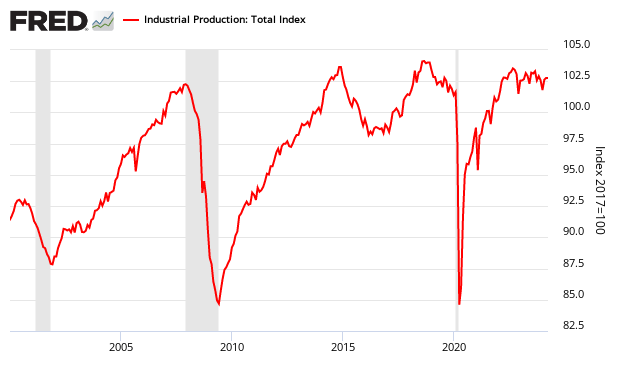
It is interesting to note that ISM Manufacturing represents less than 10% of USA employment, and approximately 20% of the business economy. Historically, it could be argued that the production portion of ISM Manufacturing leads the Fed’s Industrial Production index – however the correlation is not strong when looking at trends.
New orders have direct economic consequences. Expanding new orders is a relatively reliable sign a recession is NOT imminent. However, New Orders contraction have given false recession warnings twice since 2000. This month new orders moved slightly into expansion.

However, holding this and other survey’s Econintersect follows accountable for their predictions, the following graph compares the hard data from Industrial Products manufacturing subindex (blue bar) and US Census manufacturing shipments (red bar) to the ISM Manufacturing Survey (purple bar).
Comparing Surveys to Hard Data

z survey1.png
Caveats on the use of ISM Manufacturing Index:
This is a survey, a quantification of opinion – not facts and data. However, as pointed out above, certain elements of this survey have good to excellent correlation to the economy. Surveys lead hard data by weeks to months, and can provide early insight into changing conditions.
Many use ISM manufacturing for guidance in estimating manufacturing employment growth. Econintersect has run correlation coefficients for the ISM manufacturing employment and the BLS manufacturing employment data series above going back to 1988, using quarterly data. The coincident correlations are actually negative, but poor (r = -0.2 to -0.4 for various time periods examined). See here for definitions.
Before 2000 the ISM employment data had a weak positive correlation to the BLS data 4 to 7 quarters later (r values above 0.6). Since 2000 the correlations for ISM manufacturing employment as a leading indicator for the BLS manufacturing employment have been between 0 and 0.3 for r (correlation coefficient). These values define correlations as none to poor.
In other words, ISM employment index is not useful in understanding manufacturing jobsgrowth. The graph below shows BLS manufacturing employment month-over-month gains against the ISM Manufacturing employment index.
Indexed to Jan 2000 – Comparison of the ISM Manufacturing Employment Subindex (blue line) to BLS Manufacturing Employment (red line) – all data seasonally adjusted
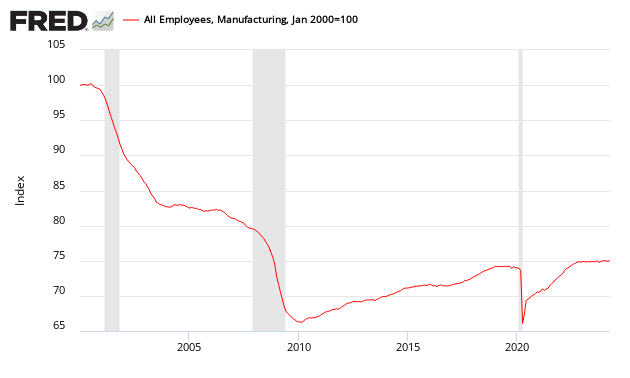
The ISM employment index appears useful in predicting turning points which can lead the BLS data up to one year.
include(“/home/aleta/public_html/files/ad_openx.htm”); ?>


