econintersect.com
  • 토토사이트
    • 카지노사이트
    • 도박사이트
    • 룰렛 사이트
    • 라이브카지노
    • 바카라사이트
    • 안전카지노
  • 경제
  • 파이낸스
  • 정치
  • 투자
No Result
View All Result
  • 토토사이트
    • 카지노사이트
    • 도박사이트
    • 룰렛 사이트
    • 라이브카지노
    • 바카라사이트
    • 안전카지노
  • 경제
  • 파이낸스
  • 정치
  • 투자
No Result
View All Result
econintersect.com
No Result
View All Result
Home Uncategorized

June 20, 2021 Seasonal Forecasts: Part II, NOAA Comparison with JAMSTEC

admin by admin
9월 6, 2021
in Uncategorized
0
0
SHARES
0
VIEWS

Written by Sig Silber

Edited at 4:40 pm EDT June 21, 2021 to correct one spelling error and add a little more explanation at the very end of the article.

We published the NOAA Long-Term Forecast Part I on June 17, 2021. Tonight we compare the NOAA forecast for Alaska and CONUS with the JAMSTEC forecast. For comparison we show the maps side by side in a table with a summary. Obviously, the farther out you look, the less confidence you have in the forecasts and thus also the differences in the forecasts. Also provided are the JAMSTEC World Forecasts. JAMSTEC has sent us their forecast privately as their website is still not functional.  What they have sent us includes a monthly forecast for each of the first three months so we are also able to compare the NOAA and JAMSTEC July forecasts this time. As usual, there are some significant differences between the two forecasts but also a lot of agreement.

NOAA v. JAMSTEC


Please share this article – Go to the very top of the page, right-hand side for social media buttons. Please feel free to send this article to anyone who you think might find it interesting and or useful.


C. Comparison of the NOAA and JAMSTEC Forecasts

C1. The Comparison

Below is the comparison of the NOAA and JAMSTEC temperature and precipitation forecast maps for the month of July and then three time-periods. In the Summary Table we show the NOAA forecast for Alaska and CONUS (the contiguous mid-latitude U.S) and right next to it the JAMSTEC forecast for North America (which includes Canada and part of Mexico). The NOAA forecast maps can be clicked on to enlarge. The JAMSTEC maps in the table are not set up to be clicked on to enlarge (because we do not have a larger version of them). We have concluded that these smaller images work fine for comparison purposes.  Later in the article, we show the World Forecasts.

JAMSTEC normally works only with three-month seasons: Summer JJA, Fall SON, and Winter DJF (and when.appropriate Spring MAM). Out of each three months, there is normally just one where the months in the two forecasts align perfectly for the first time period. But all of a sudden they have changed the process so I have forecast maps from JAMSTEC for JAS and SON in addition to Winter DJF. I think this is an improvement even though there is some overlap between the JAS and SON maps. But I am now able to match up the NOAA and JAMSTEC maps exactly. And we also have a separate July forecast from JAMSTEC. We have not usually had single-month JAMSTEC forecasts. I gather they make them but do not show them on their website. But they sent me a document with the seasonal forecasts and also three monthly forecasts: July, August and September. So in addition to comparing seasonal forecasts starting with JJA, we are tonight also able to compare the July forecasts.

In addition to the value of comparing the JAMSTEC and NOAA forecasts, the JAMSTEC forecast by showing North America provides more context for the Alaska and CONUS Forecasts as the temperature and precipitation patterns cover North America, not just Alaska and CONUS.

Map Comparisons and our Comments

Temperature*

 NOAA Alaska Plus CONUSJAMSTEC North America

July

2021

https://www.cpc.ncep.noaa.gov/products/predictions/long_range/lead14/off14_temp.gif

Late

Summer

JAS 2021

https://www.cpc.ncep.noaa.gov/products/predictions/long_range/lead01/off01_temp.gif

Fall

SON 2021

Winter

DJF 2021/2022


For July:  JAMSTEC is warmer for Alaska and does not show an EC area for CONUS.
For Late Summer:  JAMSTEC does not show an EC area within CONUS.
For Fall: JAMSTEC has Alaska cool while NOAA has it warm.
For Winter: JAMSTEC keeps CONUS warm while NOAA has a large EC area north of the warm anomaly but not extending to the East Coast.

Precipitation*

 NOAA Alaska Plus CONUSJAMSTEC North America

July

2021

https://www.cpc.ncep.noaa.gov/products/predictions/long_range/lead14/off14_prcp.gif
 

Late Summer

JAS 2021


Fall

SON 2021

Winter

DJF 2021/2022

https://www.cpc.ncep.noaa.gov/products/predictions/long_range/lead08/off08_prcp.gif


For July: JAMSTEC shows a failed Monsoon but a wet Southeast but this anomaly is much smaller than for NOAA. JAMSTEC does not show a dry Northwest but a dry rather then wet Alaska and a wet rather than dry Alaskan Panhandle.    
For Late Summer: JAMSTEC shows a failed Monsoon while NOAA has the dry anomaly in the Northwest.
For Fall: NOAA is much drier while JAMSTEC is more spotty. JAMSTEC has a wetter Alaska.
For Winter: Other than Alaska, there is a lot of agreement but the JAMSTEC dry anomaly covers a larger area.

* It is important to keep in mind that NOAA reports probabilities of being warmer or cooler than Climatology and JAMSTEC reports the degrees of temperature and millimeters of precipitation variation from Climatology (Normal). So they are not exactly comparable. Also please keep in mind that NOAA is now using a redefinition of Climatology which is the mean of the most recent three decades of weather namely 1991 to 2020. We do not believe that JAMSTEC has updated their definition of Climatology, They may have but there has been no announcement from JAMSTEC that they have updated their Climate Normals. This makes the comparisons a bit more difficult. 

JAMSTEC World Forecasts

This month our comments for Summer and Fall (Northern Hemisphere Seasons) are taken directly from the JAMSTEC discussion. We do not have a JAMSTEC discussion for the July forecast.

July 2021

Temperature
http://www.jamstec.go.jp/aplinfo/sintexf/2017/forecast/temp2.glob.SON2020.1jul2020.F23DVAR.gif
Precipitation
http://www.jamstec.go.jp/aplinfo/sintexf/2017/forecast/temp2.glob.SON2020.1jul2020.F23DVAR.gif


We do not have a JAMSTEC interpretation of their July forecast. But you can see the two maps just as well as I can. The Maratime Continent and India and Southern and Southeast Asia are complicated. 

Late Summer which is JAS 2021

Temperature
http://www.jamstec.go.jp/aplinfo/sintexf/2017/forecast/temp2.glob.SON2020.1jul2020.F23DVAR.gif
Precipitation
http://www.jamstec.go.jp/aplinfo/sintexf/2017/forecast/temp2.glob.SON2020.1jul2020.F23DVAR.gif


JAMSTEC says: “On a seasonal scale, the SINTEX-F predicts that most parts of the globe will experience a hotter-than-normal condition in boreal summer (austral winter) except for northern parts of the South American Continent, some parts of India, Indonesia, and northwestern Russia.”…”As regards to the seasonally averaged rainfall in boreal summer (austral winter), a drier-than-normal condition is predicted for central parts of the North American Continent, southern parts of the South American Continent, most parts of the Eurasian Continent, southern part of the Sahara Desert. In contrast, southern Alaska, the western coastal area of Canada, southeastern U.S.A., northern parts of the South American Continent, Philippines, Indonesia, some parts of West Africa, some parts of Central Africa, northern parts of the Eurasian Continent, India, some parts of the Indochina Peninsula, eastern China, and the Korean Peninsula will experience a wetter-than-normal condition.”…”The model predicts most parts of Japan will experience a hotter-than-normal condition in summer as a seasonal average. As regards to the seasonally averaged rainfall, Hokkaido will experience a slightly wetter-than-normal condition in summer. Monthly prediction suggests a wetter-than-normal condition in August.”

Fall which is SON 2021

http://www.jamstec.go.jp/aplinfo/sintexf/2017/forecast/temp2.glob.DJF2021.1jul2020.F23DVAR.gif
Precipitation
http://www.jamstec.go.jp/aplinfo/sintexf/2017/forecast/temp2.glob.DJF2021.1jul2020.F23DVAR.gif“


JAMSTEC says: “On a seasonal scale, the SINTEX-F predicts that  In boreal autumn (austral spring), the model still predicts most parts of the globe will experience a warmer-than-normal condition, except for Alaska, northern parts of the South American Continent, some parts of Indonesia, India, Indochina, eastern China, Saudi Arabia, and the Middle East.”…”As regards to the seasonally averaged rainfall in. In boreal autumn (austral spring), a wetter-than-normal condition is predicted for the western coastal area of Canada, most parts of the South American Continent, eastern Australia, eastern parts of southern Africa, northern parts of Europe, northern parts of the Eurasian Continent, India, Philippines, and Indonesia. In contrast, most parts of U.S.A., La Plata Basin, western parts of southern Africa, some parts of West Africa, southern parts of Europe, and eastern China will experience a drier-than-normal condition. Extremely wetter-than-normal conditions in Indonesia will be mostly due to the evolving negative Indian Ocean Dipole.”…”The model predicts most parts of Japan will experience a hotter-than-normal condition in autumn as a seasonal average.”

And Winter 2021/2022 which is DJF

Temperature
http://www.jamstec.go.jp/aplinfo/sintexf/2017/forecast/temp2.glob.MAM2021.1jul2020.F23DVAR.gif
Precipitation
http://www.jamstec.go.jp/aplinfo/sintexf/2017/forecast/temp2.glob.MAM2021.1jul2020.F23DVAR.gif


JAMSTEC  does not comment on the third period in their discussion. We assume this represents the lower level of confidence that far out. But you can see what it shows on the maps. For temperature you can see that Eastern Asia is warm. We have already discussed that North America is warm. With respect to precipitation, you can see that South Africa is dry and Australia is a bit wet and eastern China is dry.

Here is the JAMSTEC Discussion

We provided the full JAMSTEC Discussion in Part I. We repeat it here.

ENSO forecast:

As predicted earlier, observation shows that the tropical Pacific returned to a neutral state. The SINTEX-F predicts that a weak La Niña Modoki-like state will appear in boreal autumn. 

Indian Ocean forecast:

Observation shows that the central/eastern tropical Indian Ocean is warmer-than-normal. The SINTEX-F predicts that a negative Indian Ocean Dipole will occur in boreal summer and autumn.

Regional forecast:

On a seasonal scale, the SINTEX-F predicts that most parts of the globe will experience a hotter-than-normal condition in boreal summer (austral winter) except for northern parts of the South American Continent, some parts of India, Indonesia, and northwestern Russia. In boreal autumn (austral spring), the model still predicts most parts of the globe will experience a warmer-than-normal condition, except for Alaska, northern parts of the South American Continent, some parts of Indonesia, India, Indochina, eastern China, Saudi Arabia, and the Middle East.

As regards to the seasonally averaged rainfall in boreal summer (austral winter), a drier-than-normal condition is predicted for central parts of the North American Continent, southern parts of the South American Continent, most parts of the Eurasian Continent, southern part of the Sahara Desert. In contrast, southern Alaska, the western coastal area of Canada, southeastern U.S.A., northern parts of the South American Continent, Philippines, Indonesia, some parts of West Africa, some parts of Central Africa, northern parts of the Eurasian Continent, India, some parts of the Indochina Peninsula, eastern China, and the Korean Peninsula will experience a wetter-than-normal condition. In boreal autumn (austral spring), a wetter-than-normal condition is predicted for the western coastal area of Canada, most parts of the South American Continent, eastern Australia, eastern parts of southern Africa, northern parts of Europe, northern parts of the Eurasian Continent, India, Philippines, and Indonesia. In contrast, most parts of U.S.A., La Plata Basin, western parts of southern Africa, some parts of West Africa, southern parts of Europe, and eastern China will experience a drier-than-normal condition. Extremely wetter-than-normal conditions in Indonesia will be mostly due to the evolving negative Indian Ocean Dipole.

The model predicts most parts of Japan will experience a hotter-than-normal condition in summer and autumn as a seasonal average. As regards to the seasonally averaged rainfall, Hokkaido will experience a slightly wetter-than-normal condition in summer. Monthly prediction suggests a wetter-than-normal condition in August.

ENSO Assumptions

First I present what we reported on after the NOAA Update on June 10, 2019 plus the JAMSTEC assumptions and a couple of forecasts from the Australian Bureau of Meteorology (B0M). Then I report some recent information that as usual confuses the picture a bit.

C2. Assumptions that we believe impacted the NOAA and JAMSTEC forecasts.

We have covered some of this when we reported on the IRI/CPC analysis on June 10, 2021.  I show this because it is the information that NOAA works from in producing the Four-Season Forecast.

ENSO Update 

One can access the referenced figures here.

Notice OND through DJF in the forecast on the left which was the forecast used by NOAA. 

The methodology is not exactly the same but there is a very big difference between the Early June (June 10) analysis and the Mid May (May 19) Analysis.

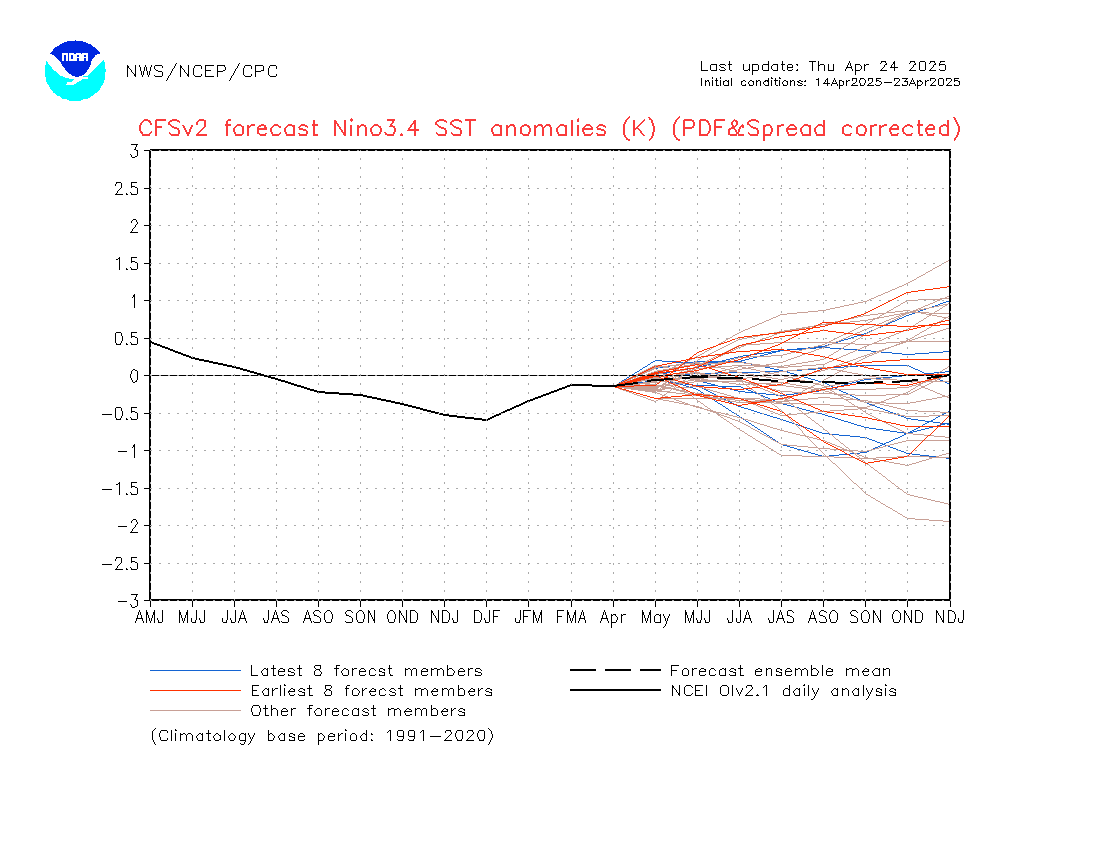
CFSv2 spread and bias correct ENSO forecast

NOAA may not rely on this much but I include it and allow it to update so readers can notice any changes if they consult this article more than once. There are two criteria for the Phase of ENSO. The Sea Surface Temperature anomaly is one and the most important and for most purposes it is measured in an area called Nino 3.4 and that measurement is shown here both the actual for overlapping three-month periods that have happened and the forecast for two individual months and from there overlapping three month periods.

Now we have the JAMSTEC models. 

First the standard Nino 3.4 model

It is a lot similar to the NOAA model. But it turns more neutral towards the end of the year and then slightly positive but actually always within plus or minus 0.5 C so it is always ENSO Neutral.

Then the Modoki Model

That also stays in the ENSO Neutral Range but it flirts with La Nina Modoki from October to February. I have the formula for calculating the El Nino Modoki Index. It may be the same formula for the La Nina Modoki Index. I am not sure. For ENSO a Modoki would mean the warm anomaly was shifted west. For La Nina Modoki I would assume the cool anomaly was shifted to the west
Lets take a look. I am going to look at Sea Surface Temperatures in the period where the forecast approaches the -0.5C line.


Here it is. We actually could have seen this on the surface temperature maps as JAMSTEC shows both land and sea temperatures on that map. But this is clearer. You can see the cool anomaly right along the Equator but west of the area where the NINO Indices are calculated. But what does it mean? I am not a meteorologist. I think it means a disruption of the Walker Circulation. I have presented many times the Canonical form of that circulation for El Nino, La Nina and Neutral. I assume the area of convection in the Pacific along the Equator is farther west than usual. That might mean subsidence is just to the east of that blue area. Looking to the north of that one finds the area that JAMSTEC says will be dry. I sure would not rely on my interpretation of this. Just as an aside, the warm water is just north of Hawaii. I am pretty sure the convection is farther west. But I am not sure how that impacts the subsidence or even more importantly the area where what went up comes down as precipitation. Usually a La Nina Modoki impacts the storm track as it applies to Eastern Asia.

http://www.bom.gov.au/climate/enso/monitoring/soi30.png

The Southern Oscillation Index or SOI being above 7 confirms that the Atmosphere is in tune with the Sea Surface Temperatures in the Pacific along the Equator. At least temporarily the SOI Index is in neutral territory. This is another graphic that we have not frozen.

This is the Australian Bureau of Meteorology SOI Index. Some believe this index is out of date since it was developed when it was convenient to measure things on land and the two measurement points in this index are on land and not directly on the Equator. NOAA has their own index that uses two points right on the Equator. Some studies show that the slope of the curve (first derivative) may be as important as the absolute value of the index.

Let’s take a closer look at the Equator in the Pacific Ocean

This is a NOAA graphic but not part of the release of information on June 10, 2021. My interpretation of this graphic is that we are NOT in La Nina right now. It is a cross-section of the Equatorial Pacific. What counts is the surface temperature and this only shows the Equator and the actual calculation of the Nino 3.4 Index is based on the temperature anomaly from 170W to 120W but including 5 degrees north and south of the Equator. I have a different graphic that shows that but this one is probably more accurate for the area shown. The water is anomalously cold east of 100W. But west of 150W it is certainly not as cold as -0.5C. So we are definitely in ENSO Neutral the question being what is next and when will there be a change.

Below is the graphic above but also one issued a month earlier. (I believe these images are five-day averages centered on the date shown.)

Prior VersionUpdated Version


You can see the change. There is now more cool (anomalywise) water at depth. That is probably why the ENSO forecast has changed a bit.

Here is the BOM (Australia Bureau of Meteorology) Nino3.4 tracker.

BOM Nino 3.4

It shows we are not in a La Nina. I have not frozen this graphic so it will update in the article. It is unclear how the recent change in Climate Norms impacts this graphic. This is a graphic of anomalies so the Norm is important. But I do not thing the Norm has been updated.

Here is the BOM current forecast.

NINO3.4 SST plume graphs from ACCESS-S forecasts, updated daily

Their criteria are stricter than what is used by NOAA. But even with the NOAA criteria, Australia would conclude that we were not in a La Nina right now. But it is suggesting a trend in that direction in the Boreal Fall (Spring down under). This graphic will be updated in a day or two. It will not auto-update in this article. If the change is drastic, which I doubt, I will either update this article or cover it in the weekly Weather Economics article as it would have economic impacts. I freeze most graphics so that if someone looks at an article six months from now they do not conclude that I was delusional.

Indian Ocean Dipole

JAMSTEC Forecast

It shows a brief period of a Negative IOD.

BOM Forecast

It is similar to the JAMSTEC forecast. The IOD impacts the Indian Ocean and these impacts should be reflected in the JAMSTEC forecast. It could mean a wetter Australia.

C.3 Some recent information from IRI/CPC which seems to delight in confusing the recently released NOAA Seasonal Outlook.

You have the early June forecast on the left and the newer forecast issued eight days later on the right. The methodologies are different. The first forecast in the month is based on a survey of meteorologists. The second is based on computer models. The computer models say no double dip La Nina. If that is correct, the NOAA and JAMSEC precipitation forecasts are not correct.

And they also released this graphic:

Here you want to pay attention to the Blue, Red and Green lines. Normally I would say the red line is most reliable and it agrees with the NOAA and JAMSTEC assumptions. The green line says lets just take an average of the forecasts including those we do not consider reliable. HUH? I am not sure what is included in the blue line. It indicates La Nina and was prepared by the same organization that says no La Nina. I just noticed that the JAMSTEC model is shown on this graph.

D. Conclusion

As usual, there is a disagreement between NOAA and JAMSTEC. The differences are substantial especially with respect to precipitation.

It is difficult to relate the differences in the forecast to differences in assumptions on ENSO. But JAMSTEC tends to consider other factors that may not be considered by NOAA. On the other hand, the new versions of the JAMSTEC model are early in their usage and may not have been fully calibrated. I do not think I have gone into it in detail but when it comes to models we need to recognize that there are limitations and NOAA and JAMSTEC use very different approaches which I have summarized in the below table.

 Shorter TermIntermediate-Term
NOAADeterministicStatistical
JAMSTECDeterministicDeterministic (may also use statistical methods)
AssessmentGenerally Considered to be reliable for 14 to 28 daysErrors build up in deterministic models and statistical models generally have insufficient historical data to be reliable


So it is kind of a pick your poison choice. But both agencies have great skill at employing approaches that have inherent limitations.  The following is an addition to what I published last night. Statistical methods may not handle Modokis very well. There are not that many ENSO events to begin with. If you subdivide them into more and more groups, the sample size gets smaller and thus the confidence interval gets wider. But JAMSTEC is not able to escape the same problem by usine deterministic methods since the problem will show up with attempts to calibrate the model.

Previous Post

Market Watch 666 For 20June 2021

Next Post

Market Fails At Highs

Related Posts

Scammers Steal $300K Using Fake Blur Airdrop Websites
Uncategorized

FBI Warns Investors Of Crypto-Stealing Play-to-Earn Games

by admin
Maersk Almost Completing Russia Exit After The Sale Of Logistics Sites
Uncategorized

Maersk Almost Completing Russia Exit After The Sale Of Logistics Sites

by admin
Why Is ‘Staking’ At The Center Of Crypto’s Latest Regulation Scuffle
Uncategorized

Why Is ‘Staking’ At The Center Of Crypto’s Latest Regulation Scuffle

by admin
Mexico's Pemex Dismantled Resources Worth $342M From Two Top Fields
Uncategorized

Mexico’s Pemex Dismantled Resources Worth $342M From Two Top Fields

by admin
Oil Giant Schlumberger Rebrands Itself As SLB For Low-Carbon Future
Uncategorized

Oil Giant Schlumberger Rebrands Itself As SLB For Low-Carbon Future

by admin
Next Post
Final August 2021 Michigan Consumer Sentiment Shows A Stunning Loss Of Confidence

Final August 2021 Michigan Consumer Sentiment Shows A Stunning Loss Of Confidence

답글 남기기 응답 취소

이메일 주소는 공개되지 않습니다. 필수 필드는 *로 표시됩니다

Browse by Category

  • Business
  • Econ Intersect News
  • Economics
  • Finance
  • Politics
  • Uncategorized

Browse by Tags

adoption altcoins bank banking banks Binance Bitcoin Bitcoin market blockchain BTC BTC price business China crypto crypto adoption cryptocurrency crypto exchange crypto market crypto regulation decentralized finance DeFi Elon Musk ETH Ethereum Europe Federal Reserve finance FTX inflation investment market analysis Metaverse NFT nonfungible tokens oil market price analysis recession regulation Russia stock market technology Tesla the UK the US Twitter

Categories

  • Business
  • Econ Intersect News
  • Economics
  • Finance
  • Politics
  • Uncategorized

© Copyright 2024 EconIntersect

No Result
View All Result
  • 토토사이트
    • 카지노사이트
    • 도박사이트
    • 룰렛 사이트
    • 라이브카지노
    • 바카라사이트
    • 안전카지노
  • 경제
  • 파이낸스
  • 정치
  • 투자

© Copyright 2024 EconIntersect