


by Salil Mehta, Statistical Ideas
So far in 2014, the Dow Jones Industrial average has dropped for 5 of the first 7 trading days. Conversely, this index has risen for 2 of the first 7 trading days, also equating to a simple 28% probability of an up-day. If markets are simply continuing last year’s upward march, how do these patterns fit in so far? Also how do these YTD market statistics match up versus prior years, and what do they imply about the Bayesian tilt with which 2014 has begun?

First we look at the theoretical distribution provided by a probability tree, where each successive day has an equal 50% chance of either branching up, or branching down. Then for a specific tree path over the first 7 days, a red value was given to indicate a down-day, while a green value was given otherwise. For more on combinatorics, one should see this first note and second note. As a reminder, we have a search bar on the blogsite so that one can independently retrieve statistics research under any term(s).
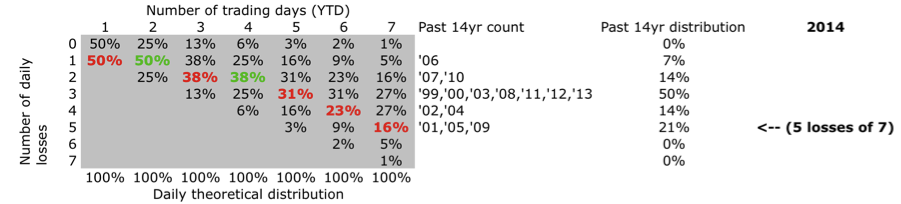
To read the tree above, for 2014, we see that the first trading day of 2014 was down. And this of course had a 50% theoretical chance of happening. Then the second trading day was up, and so we end that day with a score of one down-day out of two days. This score too has a 50% chance as shown (e.g., there is another 25% chance we’d instead have two up-days in a row, and lastly a 25% chance to instead have two down-days in a row). Through today, January 10, we’ve collected five down-days out of seven trading days. We see on the tree above, that this outcome has a 16% chance of occurring. We also see that the probability of having five or more down-days, out of seven trading days, is slightly larger at 23% (or ~16%+5%+1%).
A different interpretation of this 23% chance is that over the 14 years prior to this one, 3 of them (23%*14) should have also had at least 5 down-days out of the first 7 trading days. And empirically this is true: 2001, 2005, 2009. That’s some company.
But these probabilities were again derived assuming a fair 50% chance for either an up-day, or a down-day. Or a close to trendless market, which lacks general direction, even though we technically understand that over the long-run markets offer a slight upward trend. What would have been the probability of seeing five drops out of seven trading days, if we instead had assumed different up-day probabilities, ranging from 25%, to 75%? We see in the chart below, that as our assumption for the daily chance for an up-day increases, the probability of having five drops (out of seven trading days) falls well below our 16% baseline. Put differently, having five drops out of seven is less probable (from 16%, to 6%), if we switch from assuming a fair 50% up-day probabilities to a slight up-streak characterized by 60% up-day probabilities. Conversely, as the daily chance for an up-day decreases, the probability of having five drops (out of seven trading days) rises well above our 16% baseline.
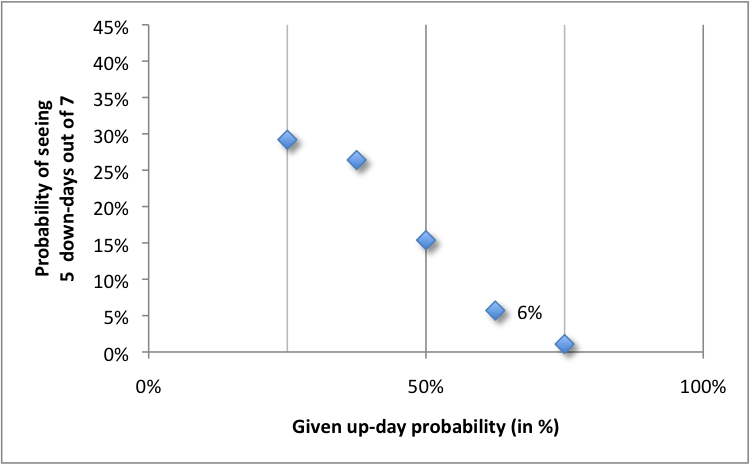
Let’s then use our assumed probability of an up-day to better explore our likelihood of outcome. We know the chance that we are in a general phase far from fair (i.e., normal 50% probability of an up-day) decreases the farther away the up-day probability is from 50%. Being in a strong up-streak (e.g., 75% up-day probability) or in a strong down-streak (e.g., 25% probability of an up-day) for extended periods is simply not as likely versus being in a phase closer to a 50% up-day probability. Technically the markets have a slight upward trend so their up-day probability is only slightly higher than 50%.
So we rearrange our likelihood distributions accordingly, and better understand our recent outcome taking this behavior (e.g., using the variance of a compounded Bernoulli distribution) into account. We initially stated that having 2 up-days out of the first 7 trading days is a 28% probability, but in the illustration below we can see how our new Bayesian likelihood levels look. It shows that we are instead closer to being in a slight down-streak period, characterized by up-day probabilities closer to 40% (less than a fair 50% chance of an up-day).
In other words we are more likely to be tilted in a slight down-streak (about 39% likelihood of being in a 40% up-day probability phase) versus being tilted in a slight up-streak (about 9% likelihood of being in a 60% up-day probability phase). Whether we consider the 6% fair chance to see our YTD results from about a 60% up-day probability (chart above), or a 9% chance to see it from with Bayesian conditions (chart below), both probabilities are too low to fit along any discussion that 2014’s YTD performance is just a continuation of last year’s upward fast ride.
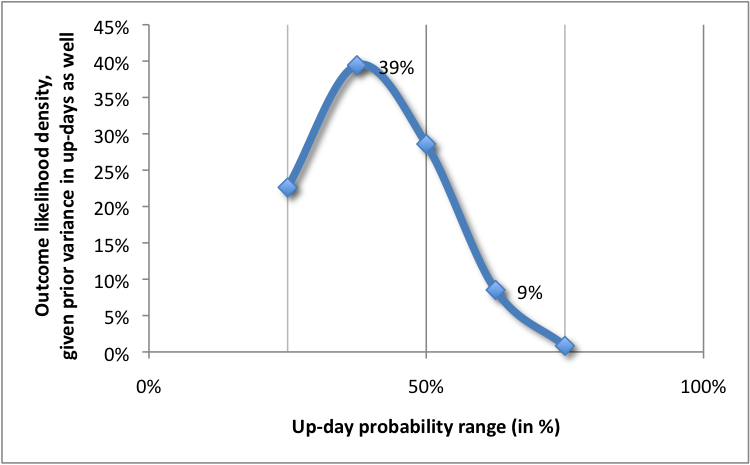
Recall that we said that was a 16% chance of seeing the Dow Jones Industrials drop on 5 out of 7 trading days, if we first assumed that each up-day probability was 50%. But per the chart above, if we see these 5 down-days (out of 7 trading days) we can instead better inform ourselves that we are more likely in a period that is not characterized with a daily 50/50 chance of going up/down. So instead of that 30% likelihood level afforded to a case where we have a 50% up-day probability, we instead suggest that 2014’s YTD performance has a higher 39% likelihood level of being from an underlying slight down-streak phase characterized with only about 40% probability of being up on any given day.


