


Written by Doug Short and Steven Hansen
The October 2014 Conference Board Consumer Confidence Index improved after rising for five out of the last six months. The market expected this index to come in at 80.0 to 90.0 (consensus 86.8) versus the 94.5 reported.

This index still remains in territory associated with past recessions. Note that this data is considered preliminary, and the cutoff for these results was 16 October 2014.
Here is an excerpt from The Conference Board:
The Conference Board Consumer Confidence Index®, which had decreased in September, rebounded in October. The Index now stands at 94.5 (1985=100), up from 89.0 in September. The Present Situation Index edged up from 93.0 to 93.7, while the Expectations Index increased sharply to 95.0 from 86.4 in September.
Says Lynn Franco, Director of Economic Indicators at The Conference Board: “Consumer confidence, which had declined in September, rebounded in October. A more favorable assessment of the current job market and business conditions contributed to the improvement in consumers’ view of the present situation. Looking ahead, consumers have regained confidence in the short-term outlook for the economy and labor market, and are more optimistic about their future earnings potential. With the holiday season around the corner, this boost in confidence should be a welcome sign for retailers.”
Consumers’ appraisal of current conditions was moderately more favorable in October than in September. Their view of business conditions was mixed; while the proportion saying conditions are “good” inched up from 24.2 percent to 24.5 percent, those claiming business conditions are “bad” also increased slightly, from 21.2 percent to 21.7 percent. Consumers’ assessment of the job market improved moderately, with the proportion stating jobs are “plentiful” increasing marginally from 16.3 percent to 16.5 percent, and those claiming jobs are “hard to get” declining slightly from 29.4 percent to 29.1 percent.
Consumers’ optimism, which had declined considerably in September, improved in October. The percentage of consumers expecting business conditions to improve over the next six months increased from 19.0 percent to 19.6 percent, while those expecting business conditions to worsen fell from 11.4 percent to 9.3 percent. Consumers’ outlook for the labor market also improved markedly. Those anticipating more jobs in the months ahead increased to 16.8 percent from 16.0 percent, while those anticipating fewer jobs fell from 16.9 percent to 13.9 percent. The proportion of consumers expecting growth in their incomes rose from 16.9 percent in September to 17.7 percent in October, while the proportion expecting a drop in income fell from 13.4 percent to 11.6 percent.
Putting the Latest Number in Context

Let’s take a step back and put Lynn Franco’s interpretation in a larger perspective. The table here shows the average consumer confidence levels for each of the five recessions during the history of this monthly data series, which dates from June 1977. The latest number is 20.3 points above the recession mindset and 0.3 points below the non-recession average.
The chart below is another attempt to evaluate the historical context for this index as a coincident indicator of the economy. Toward this end I have highlighted recessions and included GDP. The exponential regression through the index data shows the long-term trend and highlights the extreme volatility of this indicator. Statisticians may assign little significance to a regression through this sort of data. But the slope clearly resembles the regression trend for real GDP shown below, and it is a more revealing gauge of relative confidence than the 1985 level of 100 that the Conference Board cites as a point of reference. Today’s reading of 94.5 is well above the current regression point of 78.5.
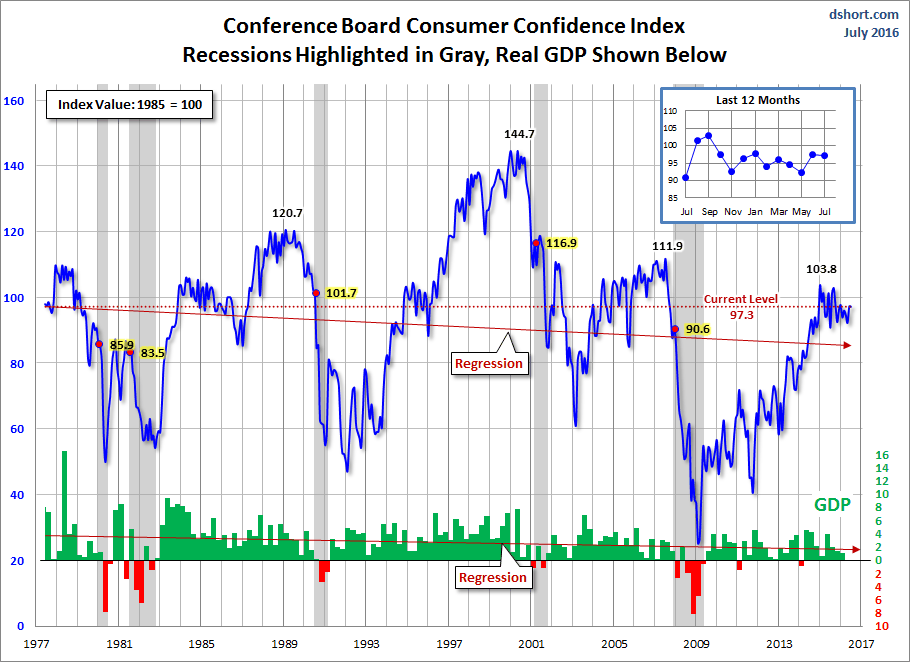
On a percentile basis, the latest reading is at the 49th percentile of all the monthly readings since the start of the monthly data series in June 1977 and at the 45th percentile of non-recessionary months.
For an additional perspective on consumer attitudes, see my post on the most recent Reuters/University of Michigan Consumer Sentiment Index. Here is the chart from that post.

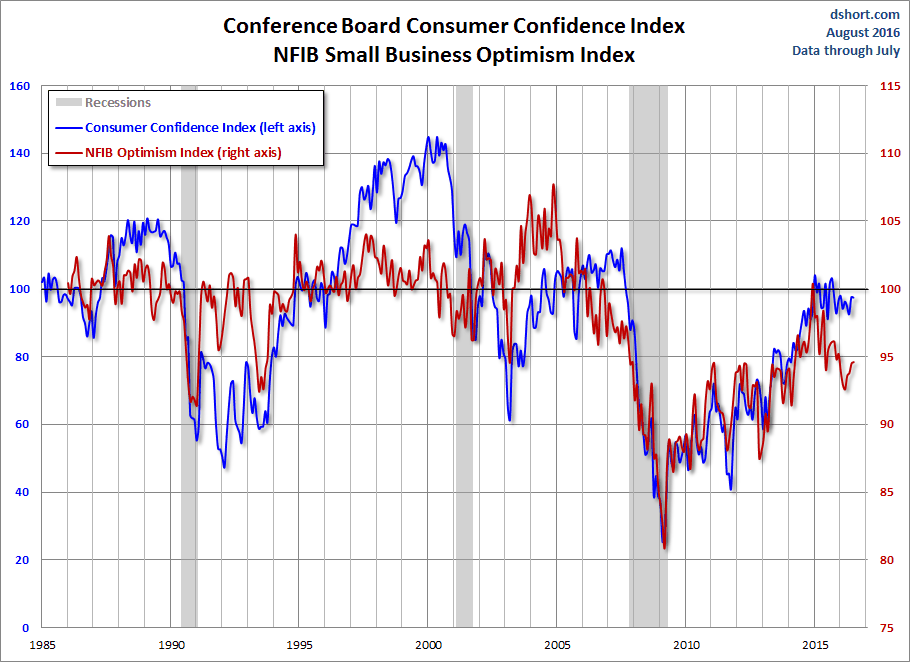
And finally, let’s take a look at the correlation between consumer confidence and small business sentiment, the latter by way of the National Federation of Independent Business (NFIB) Small Business Optimism Index. As the chart illustrates, the two have tracked one another fairly closely since the onset of the Financial Crisis.
Caveats in Using the Conference Board’s Consumer Confidence Index
According to Bloomberg, the following caveat is provided when reviewing this series:
The underlying series for ”planned purchases” (autos, homes, and major appliances) and ”vacation intentions” showed larger increases in November 2010 levels, primarily due to sample design differences. These level shifts will be treated as breaks, and there will be no historial revisions. Neither series is included in or has any impact on the Consumer Confidence Index.The switch to the Census X-12 seasonal adjustment program produced only minor differences for both levels and month-to-month changes. As a result, The Conference Board did not find it necessary to undertake a full historical revision of the CCI time series based on the seasonal adjustment method. The restated data for November 2010, December 2010 and January 2011 (preliminary data) are based on the prior seasonal adjustment method. This index is an average of responses to the following questions: 1. Respondents appraisal of current business conditions. 2. Respondents expectations regarding business conditions six months hence. 3. Respondents appraisal of the current employment conditions. 4. Respondents expectations regarding employment conditions six months hence. 5. Respondents expectations regarding their total family income six months hence. For each of the 5 questions, there are three response options: Postive, Negative and Neutral. The response proportions to each question are seasonally adjusted. For each of the five question (above), the POSITIVE figure is divided by the sum of the POSITIVE and NEGATIVE to yield a proportion, which we call the ‘RELATIVE’ value. For each question, the average RELATIVE for the calendar year 1985 is then used as a benchmark to yield the INDEX value for that question. From 1967 to mid 1977 the CCI was bi-monthly.
This is a survey based on a probability-design random sample – conducted for The Conference Board by Nielsen. Surveys are a quantification of opinion rather than facts and data.
Observers of consumer sentiment polls should be aware they are imperfect quantifications of opinion. The question arises whether they are a rear view window or a forward looking indicator – or possibly a little of each. There is little question, however, that poor consumer sentiment corresponds to poor economic performance. Econintersect believes that consumer sentiment is mostly a coincident or lagging economic indicator.
Related Posts:
Old Analysis Blog | New Analysis Blog |
| Consumer Confidence | Consumer Confidence |


