


Written by Sig Silber
It was hard to decide whether the Pacific Northwest Drought or the NASS Executive Briefing was the proper subtitle but the rotation of the drought into the Pacific Northwest was very extreme. Of course the new forecast that we may have a La Nina this winter is also very important. There is a long but very good video on crop sustainability that is well worth watching. The speakers deal with real issues not just theory. We cover all our regular topics including the intermediate-term weather forecast. There is also an EIA Energy Update.

Please share this article – Go to the very top of the page, right-hand side, for social media buttons. Please feel free to send this article to anyone who you think might benefit from reading it.
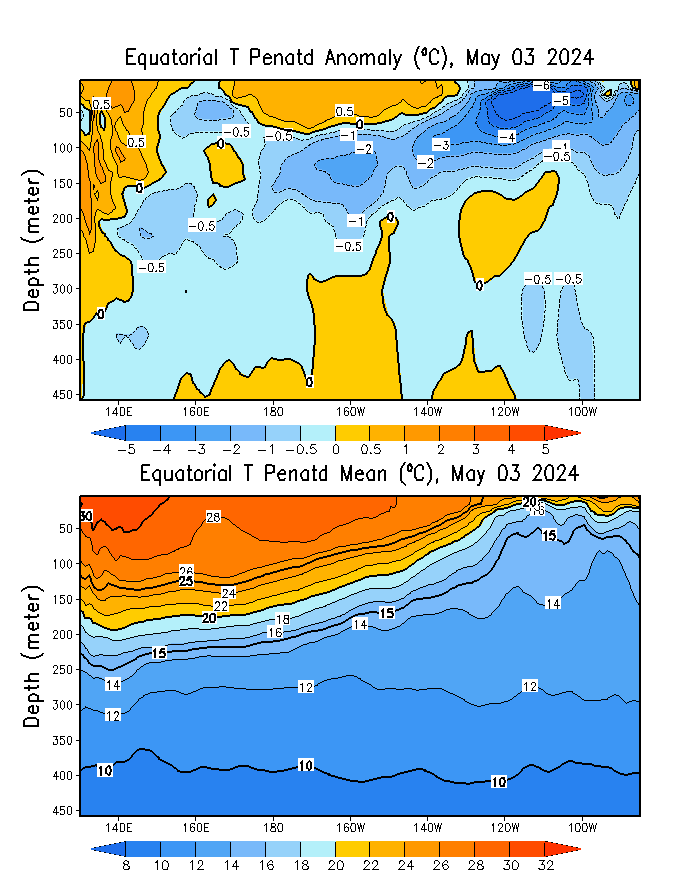
ENSO UPDATE


NASS Executive Briefing


Executive Briefings


Regional Conditions


Regional Reports.
We will focus on the PNW


There is more


Reservoir Conditions
We might as well show the situation for the California Reservoirs here.

Here is what the SNOTEL data is telling us about Spring/Summer runoff. I am just showing the basin view.

And it is always useful to look at the last seven days.

I think we have all gotten sick at looking at the water year to date which by now does not change unless there was a Noah’s Ark event. So I am not showing it.
Let’s look at the current drought situation.


Here we look at four time periods: one week, one month, six months, and a full year.

Drought Discussion (The Regional links are live and will take you to the drought map for that Region)
This Week’s Drought Summary
Another week of hot, dry weather in the Pacific Northwest, Northern Rockies, Northern Plains, and Upper Midwest led to the expansion of drought conditions. Meanwhile, monsoon thunderstorms brought wet weather to eastern New Mexico and West Texas resulted in large one-category improvements. Showers and thunderstorms associated with a slowly moving cold front helped improve conditions in the Great Lakes region and eastern U.S. Drought expanded in parts of the Mid-Atlantic that missed out on the heaviest rain.
Northeast
Another week of below normal rainfall in New York and Vermont led to the expansion of moderate drought. Year-to-date precipitation shows deficits of nearly 6 inches below what is normal for this time of year. The lack of rain has dried soils and lowered streamflows.
Southeast
Intense rainfall this week once again left much of the region virtually drought-free. In areas that missed out on the heaviest rainfall, such as Virginia and North Carolina, pockets of moderate drought (D1) remain and areas of abnormal dryness (D0) expanded. Persistent rainfall deficits have built over the past four months and agricultural reports continue to indicate very dry conditions.
South
Substantial rain fell across much of the South again this week, leading to large areas of one-category improvements to remaining drought areas in Texas and Oklahoma, where rainfall deficits, soil moisture, and streamflow improved. A two-category improvement was made in far West Texas near El Paso, where more rainfall has been recorded in the last nine days than in the prior 15 months.
Midwest
Wet weather continued this week over much of the lower Midwest, leaving that part of the region drought-free with pockets of abnormal dryness (D0). Across the northern tier, drought expanded in Minnesota and Iowa as high temperatures of 6 to 9 degrees above normal, combined with little or below normal rainfall, dried out soils and stressed vegetation. Rainfall deficits of 4 to 10 inches are present over the last 90 days.
High Plains
Another hot, dry week across the northern tier of the region, coupled with isolated showers, brought a mix of degradations and improvements. Drought expanded in parts of Wyoming, North Dakota, South Dakota, and Nebraska that missed out on the heaviest rainfall. Soils remain dry with USDA reporting that 92% of South Dakota and 76% of North Dakota’s topsoil moisture is short to very short, leading to limited hay production and stunted crop growth. Land enrolled in the Conservation Program has been opened to haying and grazing in some areas and producers are needing to monitor toxicity levels in hay and water supplies. Drought conditions improved in parts of Wyoming and eastern Nebraska, as showers over the last two weeks helped erase rainfall deficits, improve streamflow, and replenish soil moisture. In North Dakota, rainfall is finally helping to chip away at the long-term drought that has plagued the state since fall of 2020.
West
Another week of hot, dry weather once again led to worsening drought conditions across the Northwest. Temperatures as high as 17 degrees above normal set more high temperature records across the region. The excess heat continued to increase evaporative demand, dry out soils and vegetation, and strain water resources. Many areas in the Northwest saw degradations and pacts across the region continue to build. In Oregon, where drought intensified and expanded across severe drought (D2) to exceptional drought (D4) levels, soil moisture, streamflow, and the SPEI (a drought monitoring indicator that includes the effects of precipitation and temperature) show conditions are among the driest going back to 1895. Dryland agriculture is suffering and fire risk has escalated. In Washington, abnormal dryness (D0) and moderate drought (D1) expanded. With nearly all of the state experiencing dryness or drought, the U.S. Department of Agriculture’s National Agricultural Statistics Service (USDA NASS) reports as of July 4 that 84% of the state’s topsoil moisture is short to very short, significantly impacting forage production. The data show that the state’s rangeland and pasture conditions are far worse this year when compared to all other years this century. In Idaho, which saw expansions in D1-D3 drought categories, the state drought monitoring team noted that the Big Lost River is almost out of storage and priority water use is limited to early 1884 priorities. The team also reported significant agricultural impacts to the state, including crop loss, a lack of forage, and animal deaths. Montana, which saw D1-D4 expansion, recorded less than 25% of normal precipitation in June, which is historically the highest precipitation month. Impacts include diminished forage production and infestations of grasshoppers. Much of the Southwest remained unchanged this week. Where precipitation fell, such as in Arizona, it generally wasn’t enough to improve impacts. In places where it didn’t, conditions already are at D4 or don’t yet warrant additional degradations. The only exception was eastern New Mexico, where heavy rains (about 3 to 8 inches) over the past six to 10 days began to make a dent in the long-term drought, while also contributing to flash floods in the area. According to the Albuquerque National Weather Service, water levels at Santa Rosa Lake have risen over a foot since July 1.
Caribbean
No changes were made to the map in Puerto Rico this week.
Drought and dryness conditions this week in the U.S. Virgin Islands remained unchanged from last week. On St. Croix, precipitation deficits continued and groundwater remained low, so short- and long-term severe drought continued. On St. John, a combination of long-term precipitation deficits and mostly unchanged groundwater over the last week led to the continuation of long-term moderate drought there. Long-term abnormal dryness continued on St. Thomas this week, where precipitation was below normal and groundwater started to drop after a rebound last week. Despite the lowering groundwater, long-term precipitation deficits have mostly abated there.
Pacific
In Alaska, heavy rains this past week helped eliminate remaining abnormal dryness (D0) in Northwest Alaska and the inland North Slope. In contrast, D0 expanded from near Anchorage northeastward to the Canadian border where precipitation was below normal in May and June.
No changes were made to the map in Hawaii this week.
The Mariana Islands remained free of drought or abnormal dryness this week. Rainfall measurements on Saipan this week ranged from 0.79 to 1.56 inches. Given overall sufficient rainfall in June on Saipan, drought-free conditions remained. On Rota, 1.63 inches of rain fell this week. On Guam, 1.03 inches of rain fell this week.
The Federated States of Micronesia remained free of drought or abnormal dryness this week. On Yap, at least 1.67 inches of rain fell, which occurred after 10.35 inches of rain fell in June. On Woleai, 2.49 inches of rain fell this week, keeping short-term conditions wet after 1.38 inches fell last week. On Chuuk, at least 2.48 inches of rain fell this week, marking the third consecutive week with at least 2 inches of rain after two much drier weeks prior to that. On Lukunor, 4.88 of rain this week followed at least 12.27 inches in June. On Nukuoro, at least 3.59 inches of rain followed a very wet June when over 20 inches of rain fell. Kapingamarangi received 2.59 inches of rain last week, and 7.28 inches this week, snapping a two-week dry stretch that had occurred previously. Rain totaling 3.07 inches this week followed over 20 inches of rain in June on Pohnpei. Pingelap received at least 1.55 inches of rain this week after over 17 inches fell in June. On Kosrae, 5.38 inches of rain fell this week, after 27.74 fell in June. Data were missing this week on Fananu and Ulithi, so no drought depictions were made for either depiction this week.
On Palau this week, observing sites measured 2.76 and at least 3.44 inches of rain this week, and conditions remained free of drought for another week.
On Kwajalein, short-term abnormal dryness developed this week as 1.02 inches of rain fell, which followed only 4.61 inches in June. Short-term abnormal dryness also developed on Ailinglapalap this week, where only 0.16 inches of rain fell this week, following a relatively dry May and June, which saw 3.03 and 6.46 inches of rain, respectively. On Jaluit, 0.53 inches of rain fell this week, marking the fourth consecutive week with less than 2 inches of rain. While things are drying out on the very short term, June rainfall totalled 11.65 inches, so conditions remained free of drought or abnormal dryness. On Wotje, no rain was recorded this week, and short- and long-term abnormal dryness continued another week. On Majuro, 1.57 inches of rain fell this week, though this followed 10.26 inches in June, so conditions remained free of drought or abnormal dryness. Mili received 2.70 inches of rain this week, and drought-free conditions continued. No Drought Monitor depiction was made for Utirik, as data there were missing this week.
Drought-free conditions continued this week for American Samoa. Rainfall at Pago Pago totaled 1.92 inches on the low end, while Toa Ridge and Suifaga Ridge measured 6.13 and 8.37 inches of rain, respectively.
Looking Ahead
The National Weather Service Weather Prediction Center forecast for the remainder of the week (July 8 -13) shows tropical storm conditions and rainfall from Elsa will continue across parts of Florida and into the Southeast. Other areas expecting excessive rainfall include the Texas coast, Midwest, and Northeast. In the West, the hot weather will continue with daytime highs well into the 90s and lower 100s. Moving into next week, the Climate Prediction Center six-to-10 day outlook (valid July 13-17) favors above normal temperatures across much of Alaska, the West, northern Plains and Northeast. Below normal temperatures are most likely across the Southern Plains. Below normal precipitation is expected across Alaska, the Northwest, Northern Plains, and Florida while above normal precipitation is favored along a band stretching from the Southwest, across the Midwest, and into the Northeast.
Soil Conditions
The result of the drought is very dry soil conditions in some areas. There is also some very wet areas.

 |
 |
 |
 |
Drought Outlook
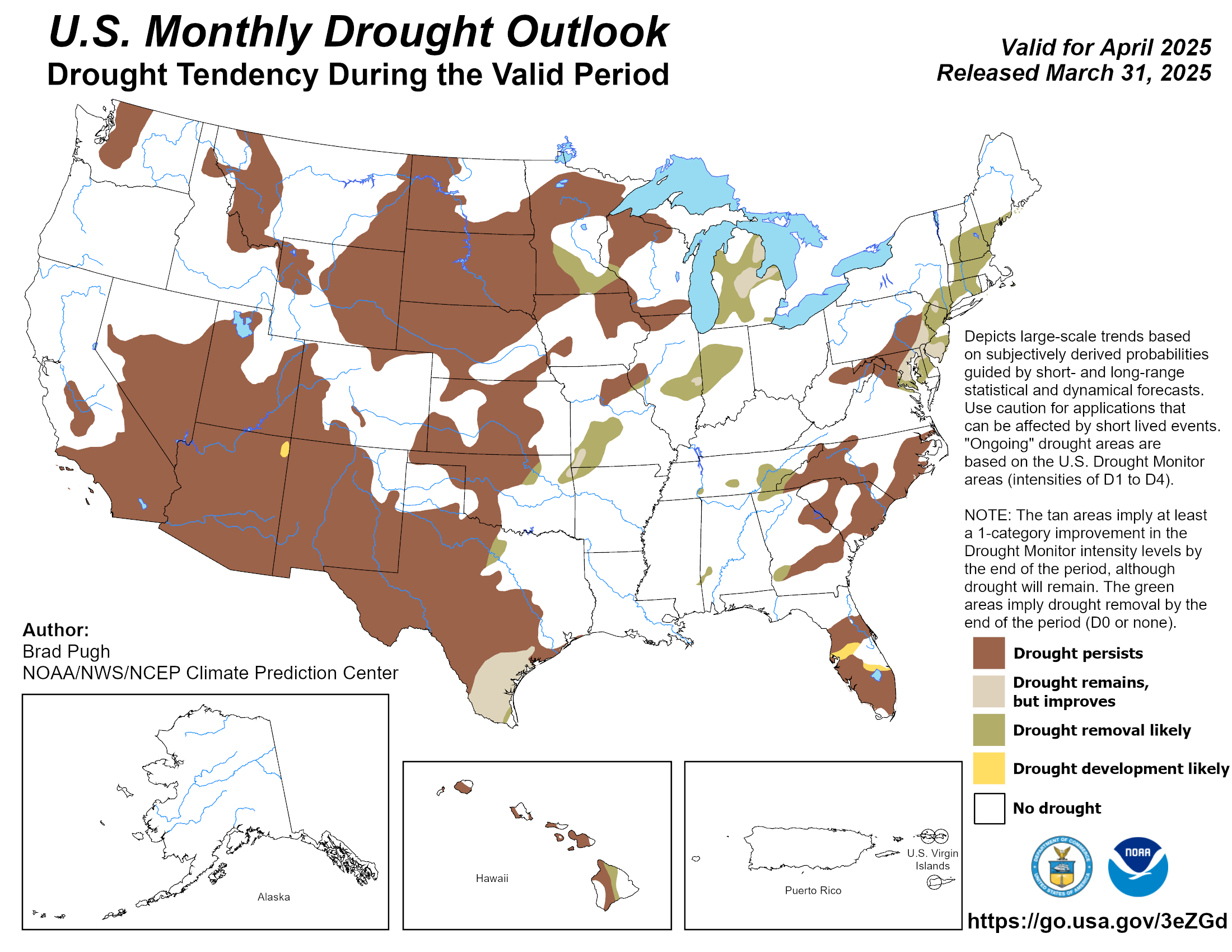
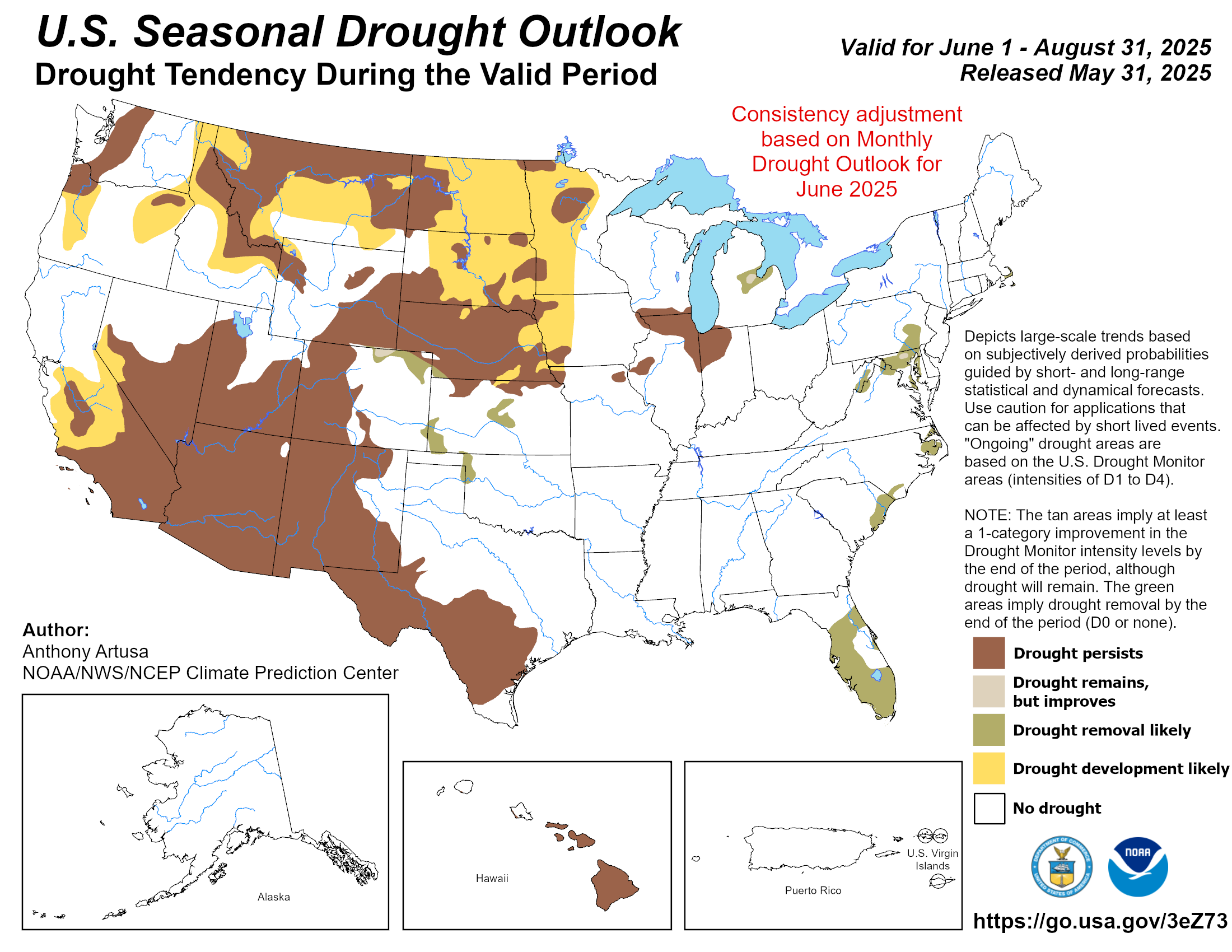

Since we are entering fire season it is time to be showing the wildland fire potential outlook. These will update automatically shortly after the month changes.


Crop Progress Reports
When we have a NASS Executive Briefing one way to look at this report is that it adds another more recent week of information. This report is issued every week and the Executive Briefings are every couple of months and provide a lot of historical information.
 |
 |
 |
 |
 |
| Crop | Crop Progress | Crop Condition |
| Corn | Percent Silking a bit slow | Better last year. Mostly due to the Dakotas. |
| Soybeans | Blooming and setting pods looking very good. | Not so great. Mostly due to the Dakotas and Minnesota.. |
| Cotton | Squaring and setting bolls a bit slow possibly due to Louisiana. But it is a bit early. | Good |
| Winter Wheat | Harvested slow | OK but varies by state |
| Spring Wheat | Headed very good | Very poor in the Dakotas and Washington State and Montana. |
| Sorghum | Headed and Coloring OK | Quite good |
| Rice | Headed Slow | OK |
| Oats | Headed Good | Poor compared to last year in the Dakotas, Texas and Minnesota. |
| Barley | Headed good | Very poor North Dakota, Washington State, and Montana. |
| Peanuts | Pegging OK | OK |
| Sugar Beets | NA | NA |
| Sunflowers | MA | NA |
| Pasture and Range | Poor |
Additional Information can be found here. Pretty much it is the same information as shown in the above tables but at the end there is some information on the methodology used.

NASS Reports
We focused on the Executive Briefing this week.
Agriculture Sustainability Videos
Introduction
More About Cover Crops (It is long)


Intermediate-Term Weather Forecast
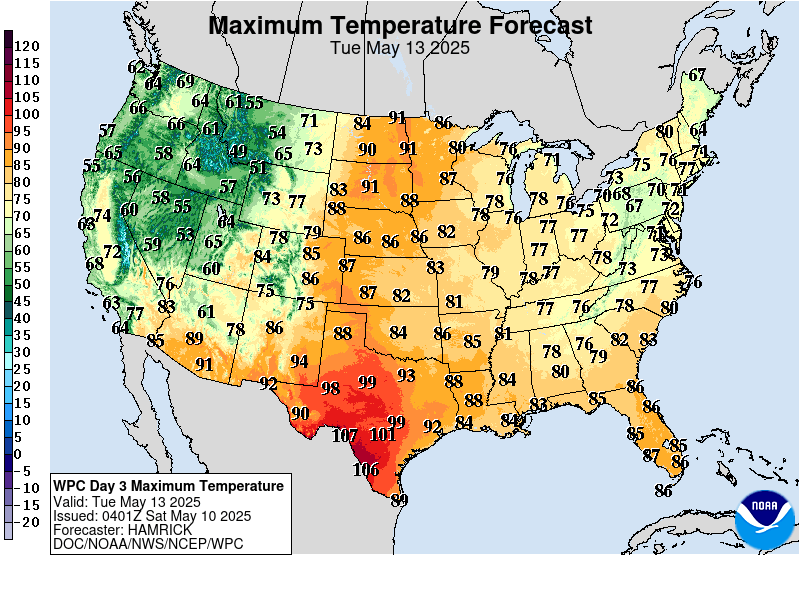
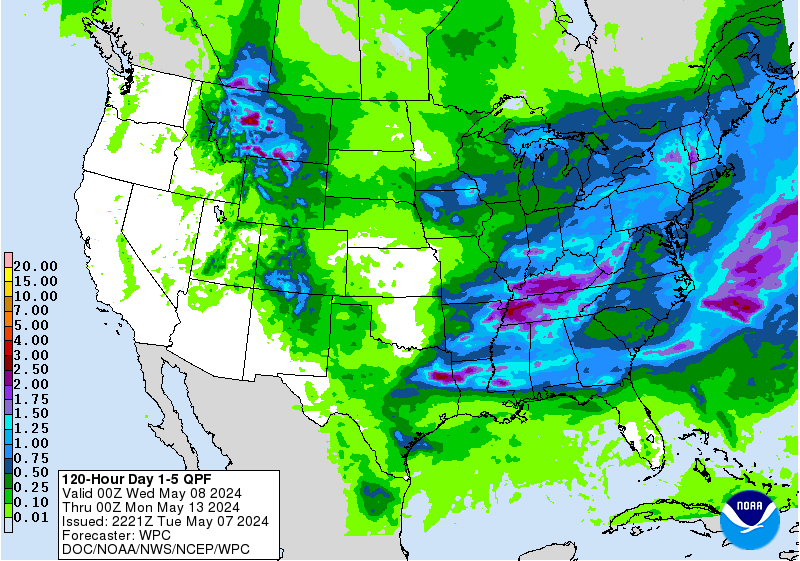
Showing from left to right, Days 1- 5, 6 – 10, 8 – 14, and Weeks 3 – 4 You can click on these maps to have them enlarge. Also, the discussions that go with these forecast maps can be found here (first two weeks) and here (Weeks 3 and 4).
First Temperature
|
|
|
|
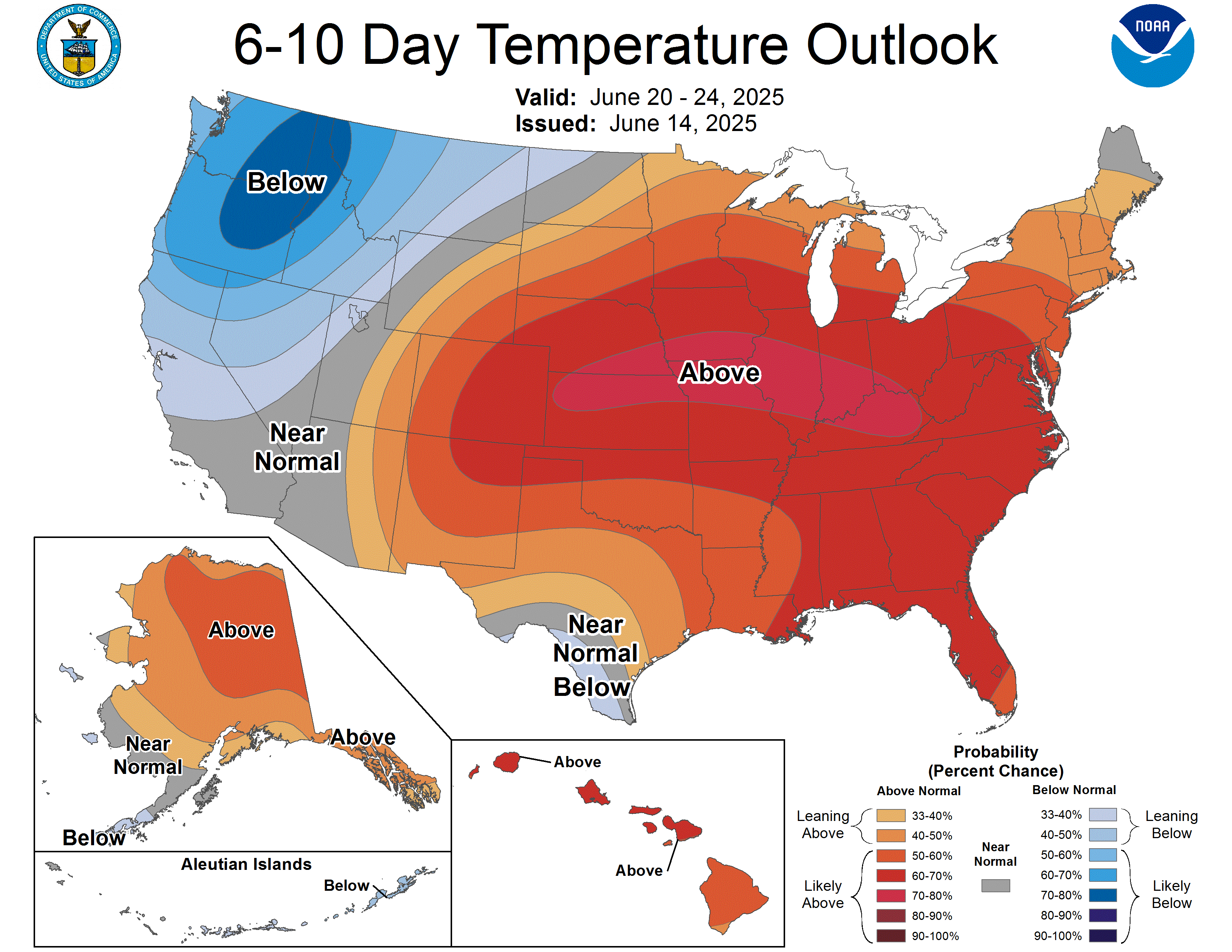
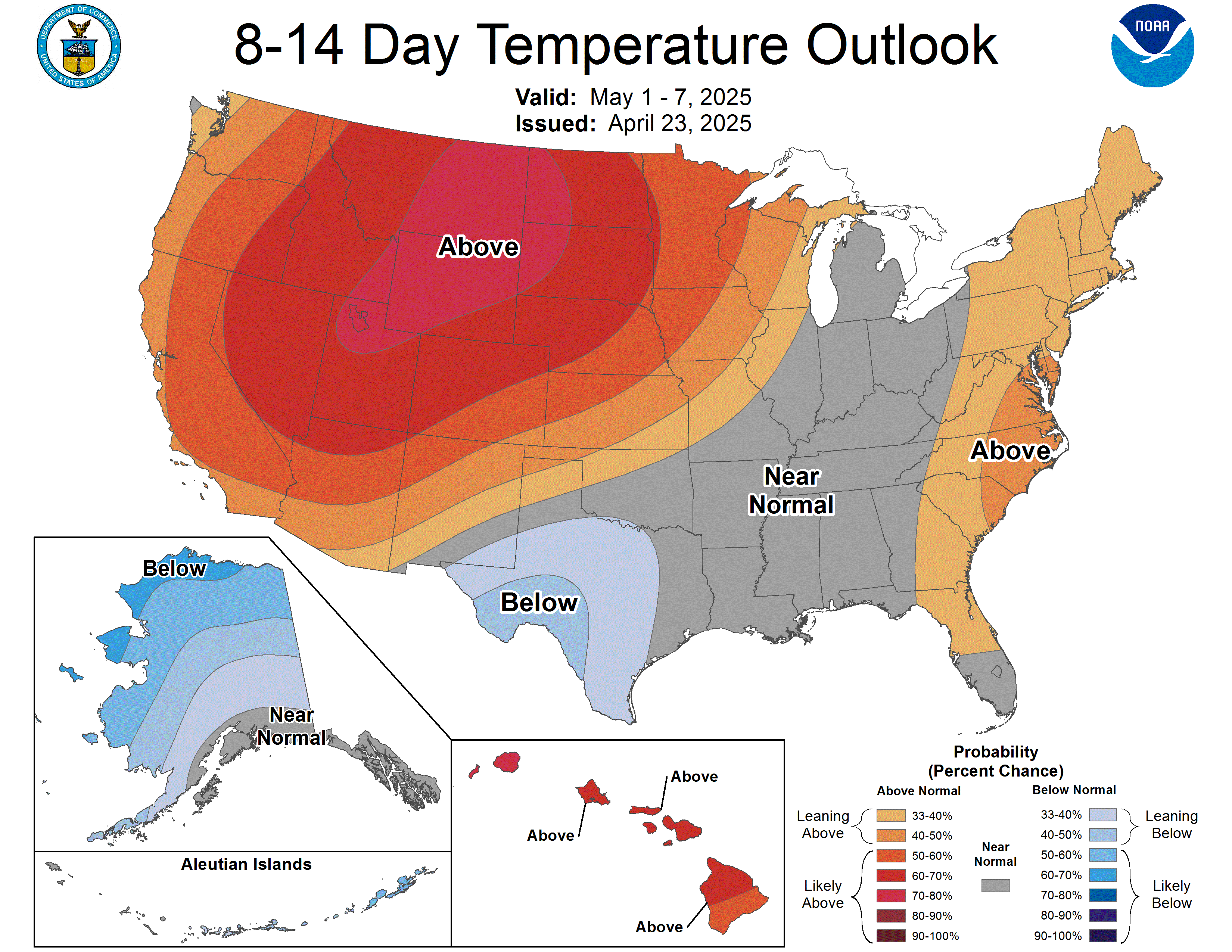
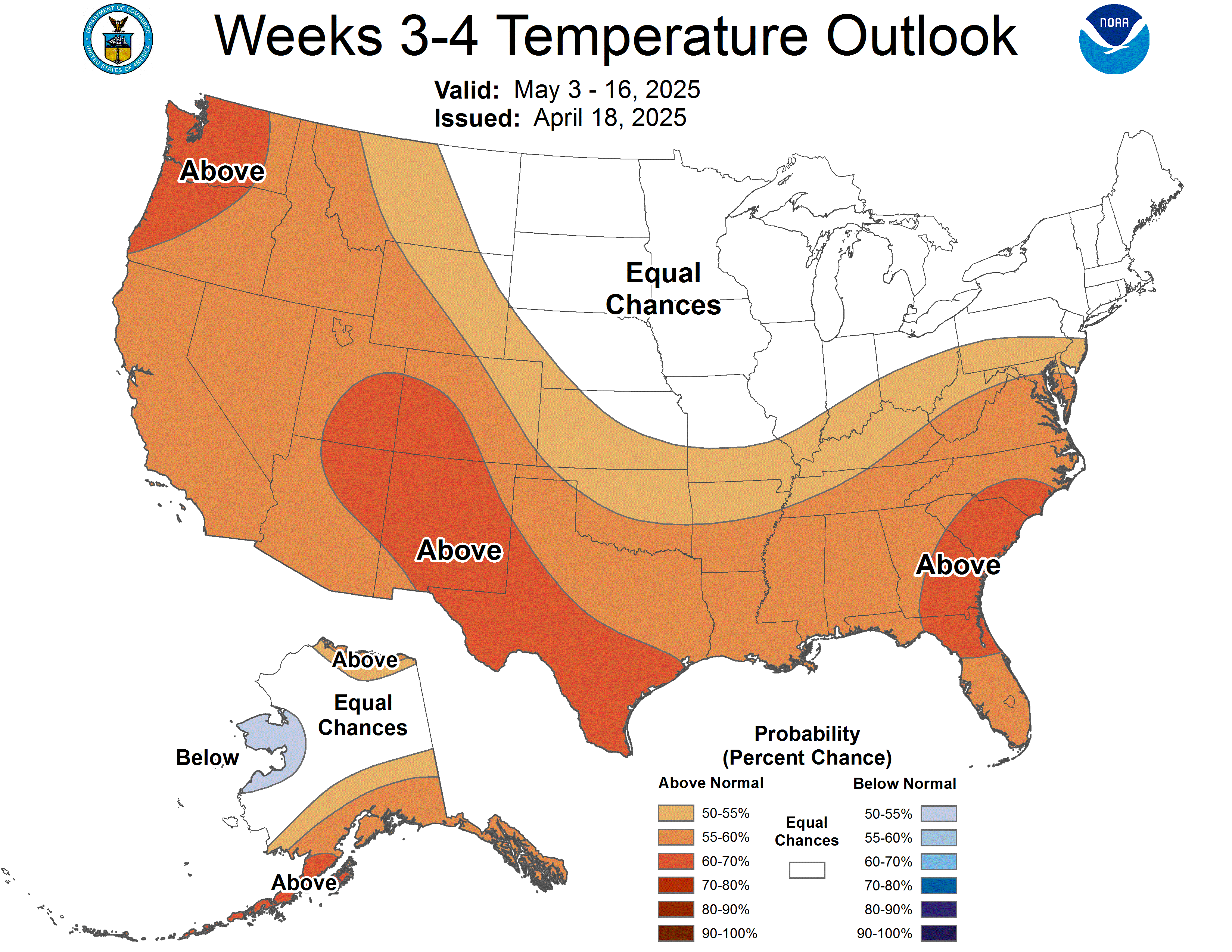
And then Precipitation
|
|
|
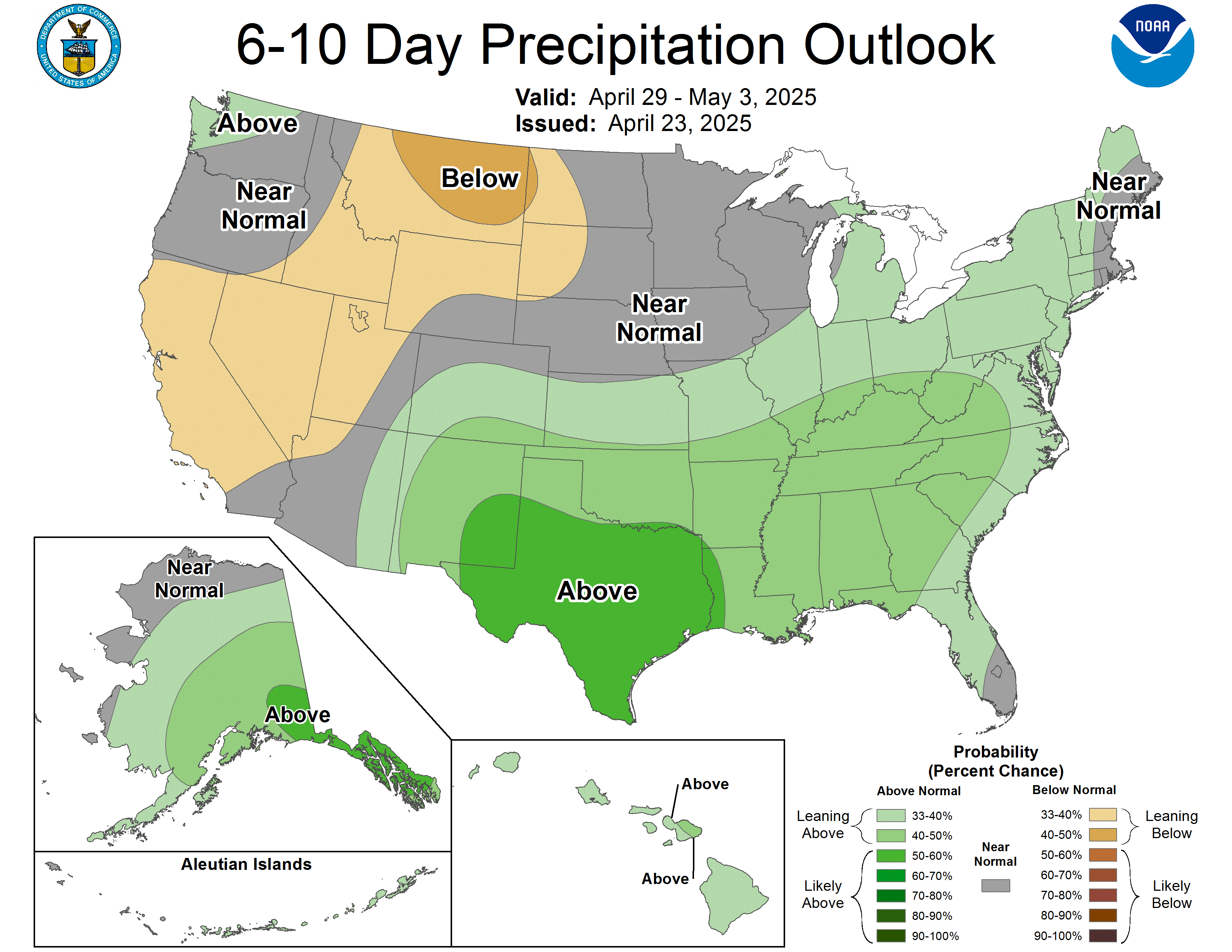
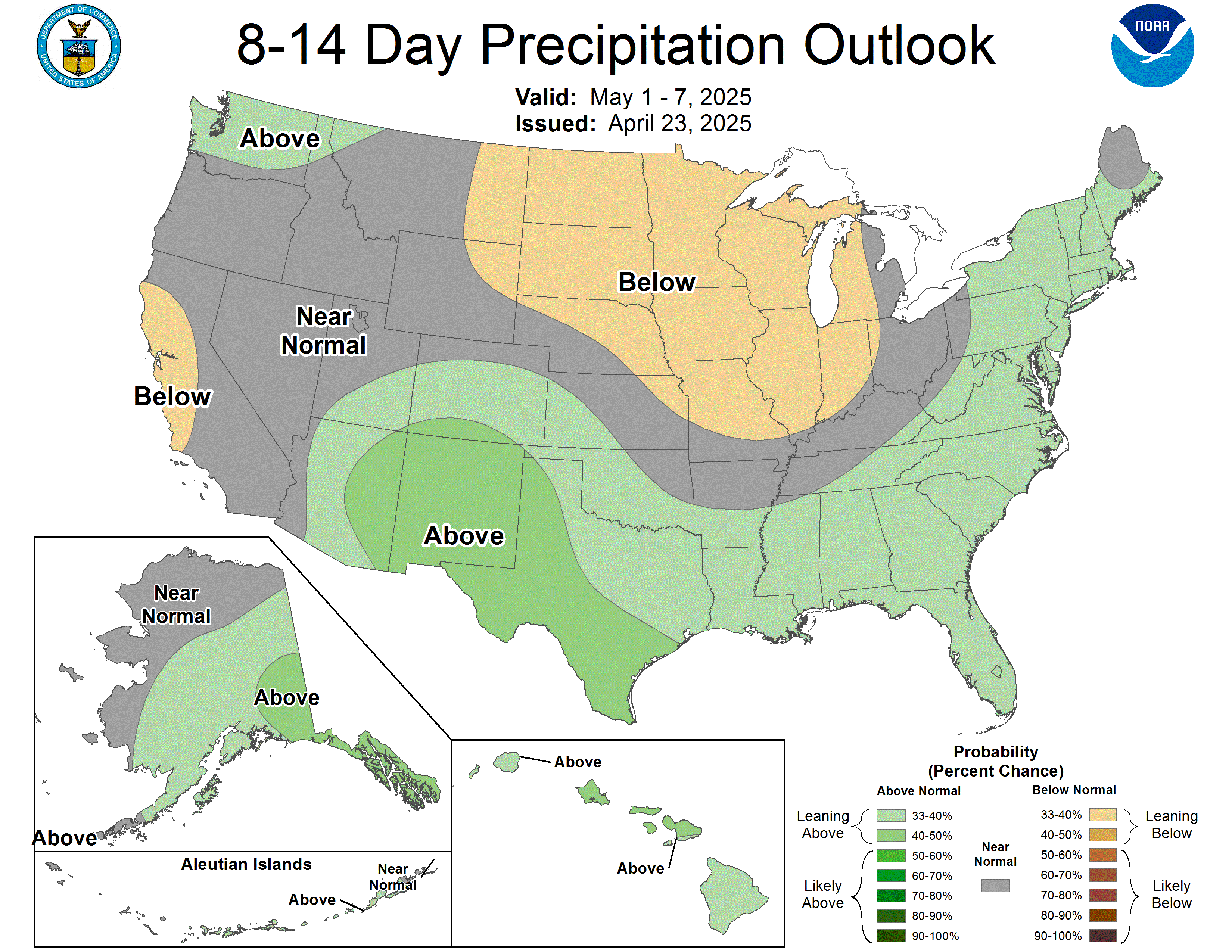
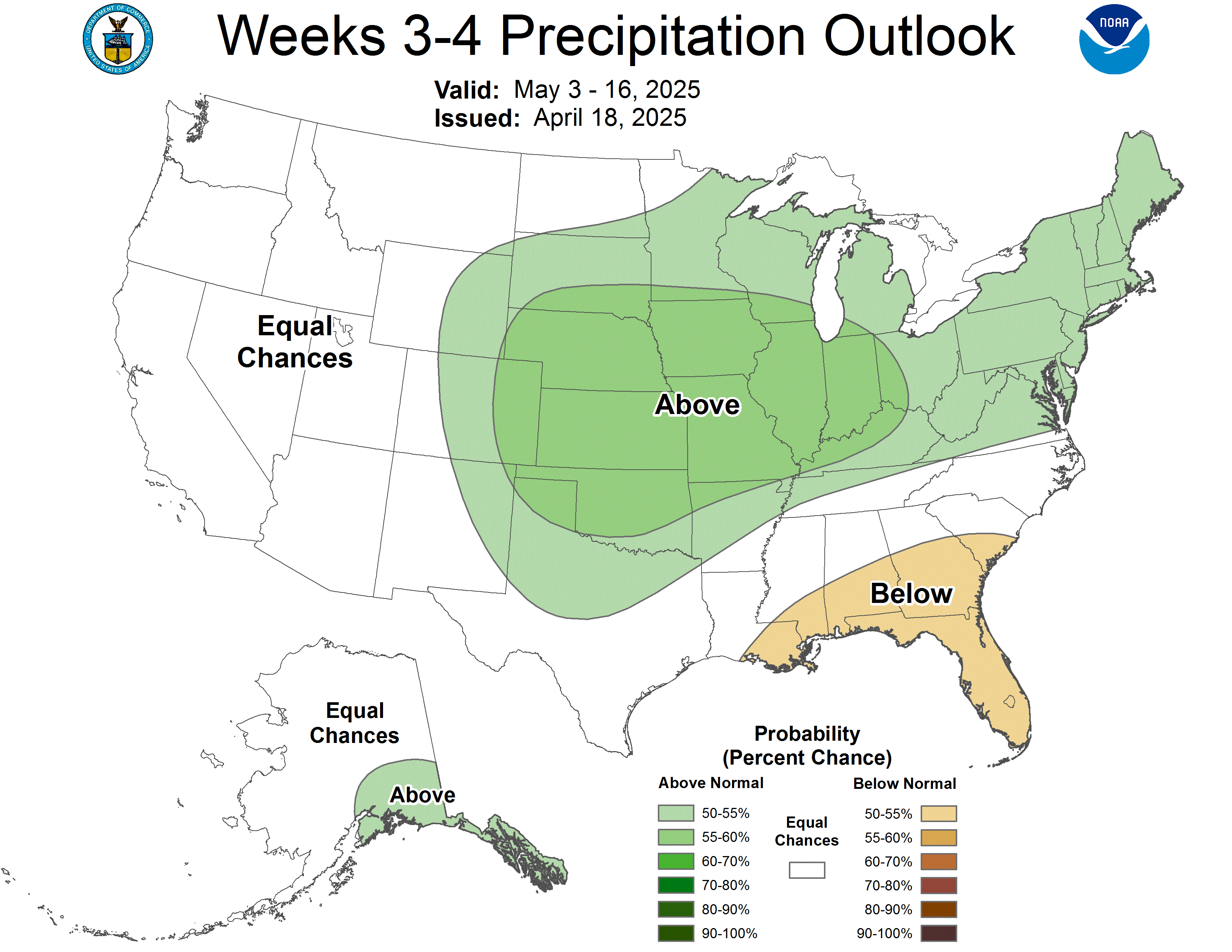

The Week 3-4 Discussion is always interesting so we include it in the article. Similar discussions for the 6 -10 Day and 8 – 14 Day Forecasts are available here.
Week 3-4 Forecast Discussion Valid Sat Jul 24 2021-Fri Aug 06 2021
The Madden-Julian Oscillation (MJO) became increasingly coherent over the past week, with the enhanced convective phase over the Indian Ocean. Model-based MJO forecasts generally depict eastward propagation of this signal over the next two weeks, with differences in the predicted amplitude. Despite the increase in the intraseasonal signal, the MJO does not teleconnect strongly onto the Northern Hemisphere midlatitude pattern during the Boreal summer months, yielding little potential for a substantial pattern change originating from tropical convection. ENSO-neutral conditions also remain in place, and therefore long term trends remain the dominant driver in the statistical guidance for Week 3-4. The primary contribution from the increased MJO activity may be reduced potential for Atlantic tropical cyclone activity during late July and early August.
The dynamical model 500-hPa height anomaly guidance is generally consistent and quite similar to last week’s forecast, demonstrating the persistence of the broad scale pattern over North America in the guidance. Above-average height anomalies are forecast across the Northern Tier, with some differences among the models on the placement of the mean ridge axis. This pattern favors a continuation of potential heatwave outbreaks across the Northwest and north-central CONUS, with dynamical model temperature outlooks all depicting fairly high probabilities for above-average temperatures, albeit slightly lower than what was depicted last week. The height field across the rest of the U.S is fairly weak, which is typical during the Boreal summer months, and surface conditions such as soil moisture may play a role in the placement and extent of the temperature anomalies.
Consistent with the height anomaly and dynamical model temperature forecasts, the Week 3-4 outlook favors above average temperatures extending from the Northwest through the Central Rockies, northern Plains, and the upper Midwest. The autoblend of dynamical and statistical model guidance also depicts enhanced chances for above-average temperatures across New England, which are included in this outlook. Lower confidence in the temperature outlook exists across the remainder of the eastern third of the CONUS. Most of the dynamical models favor below-average temperatures along parts of the southern tier, and the ECMWF extends the area of favored below-average temperatures across much of the East. This signal is likely due to feedback in the model from enhanced soil moisture, and may be overdone. Therefore, below-average temperatures are favored across Texas and the Southeast where there is dynamical model consensus, and equal chances for below- and above-average temperatures are maintained for the Midwest.
Consistent with the forecast ridging, below-average precipitation is favored for the Northwest and Northern Plains. Most of the dynamical model guidance also extends enhanced chances for below-average rainfall southward across the Plains into Texas. The exception is the ECMWF, which depicts enhanced chances for above-average rainfall across most of Texas. Therefore, the outlook maintains equal chances for below- and above-average precipitation for most of Texas, with below-average favored across northern Texas and above-average favored for the Big Bend in association with monsoonal moisture. Dynamical models continue to show enhanced monsoon precipitation across the Four Corners, with the highest probabilities across Arizona. Enhanced chances for above-average precipitation extend into the Great Basin and as far north as Wyoming, though climatological precipitation in these regions is fairly light. Below-average rainfall is favored for the Florida Peninsula, as most of the dynamical model guidance depicts a suppressed pattern across the Gulf of Mexico and western Atlantic.
Enhanced chances for above-average temperatures across Alaska extend across the western and northern parts of the state, consistent with dynamical model guidance. Equal chances for above- and below-average temperatures are maintained across central and southeastern Alaska due to weaker signals. Similar to last week, enhanced precipitation is favored for western Alaska and along the North Slope, while below-average precipitation is more likely for southeastern Alaska and the Panhandle.
A multi-model ensemble mean of the Subseasonal Experimental (SubX) guidance depicts high probabilities for above-normal temperatures across most of Hawaii. Model depicted precipitation anomalies are quite small across the islands, but the SubX MME slightly favors above-average precipitation for the Big Island.
Energy News


International

Science Feature
No Science Feature this week
Environmental News
Nothing to report this week but the Energy News is of course related.
Major Sources of Information Used in this Weekly Report. We will not be using them all each week but the reader is welcome to refer to these resources.
|


