


Written by Sig Silber
We published the NOAA Long-Term Forecast Part I on December 19, 2020. Here we compare the NOAA forecast for Alaska and CONUS with the JAMSTEC forecast. It is easier to see the disagreements by comparing the maps which we show side by side in a table with a summary of the comparison. Obviously, the further out you look, the less confidence you have in the forecasts and thus the differences in the forecasts. Also provided are the JAMSTEC World Forecasts. In Part I, we showed the differences in the assumptions with respect to ENSO and I have repeated them in this article. Again this month, it seems like JAMSTEC shows the Polar Branch of the Jet Stream farther north than NOAA has it.

Please share this article – Go to the very top of the page, right-hand side for social media buttons. Please feel free to send this article to anyone who you think might find it interesting and or useful.
C. Comparison of the NOAA and JAMSTEC Forecasts
Below is the comparison of the NOAA and JAMSTEC temperature and precipitation forecast maps for three time-periods and from left to right the NOAA forecast for Alaska and CONUS (the contiguous mid-latitude U.S) and then JAMSTEC for North America (which includes Canada and Mexico). The NOAA forecast maps can be clicked on to enlarge. The JAMSTEC maps in the table are not set up to be clicked on to enlarge (because we have no larger version of them). We have concluded that these smaller images work fine for comparison purposes. Later in the article, we show the World Forecasts.
JAMSTEC works with three-month seasons: Winter: DJF, Spring: MAM, and Summer JJA. Out of each three months, there is one where the months in the two forecasts align perfectly for the first time period. This is not one of those months so for the first period we are comparing DJF for JAMSTEC and JFM for NOAA. It is not perfect but probably ok.
In addition to the value of comparing the JAMSTEC and NOAA forecasts, the JAMSTEC forecast by showing North America provides more context for the Alaska and CONUS Forecasts as the temperature and precipitation patterns cover North America, not just Alaska and CONUS.
Map Comparisons and our Comments
Temperature
| NOAA Alaska Plus CONUS | JAMSTEC North America | |
WINTER JFM 2020 for NOAA DJF 2020-2021 for JAMSTEC |  |  |
SPRING MAM 2021 |  |  |
Summer JJA 2021 |  | |
Precipitation
| NOAA Alaska Plus CONUS | JAMSTEC North America | |
WINTER JFM 2020 for NOAA DJF 2020-2021 for JAMSTEC |  |  |
SPRING MAM 2021 |  |  |
Summer JJA 2021 |  |  |
JAMSTEC World Forecasts
This month our comments are taken directly from the JAMSTEC discussion. Now that JAMSTEC has a number of models, we are not exactly sure of the best one to display and the forecasts vary somewhat model to model. We are using their newest model and the version which does not average the result with the original model. We assume that the JAMSTEC discussion considers their various models and provides their assessment having considered their full suite of models. The wording in the JAMSTEC discussion is stilted possibly because it is a translation from the Japanese version. It reads pretty well this month.
Winter which is DJF 2020-2021
| Temperature |
 |
| Precipitation |
 |
Spring which is MAM 2001
 |
| Precipitation |
 “ “ |
And Summer which is JJA 2021
| Temperature |
 |
| Precipitation |
 |
D. Conclusion
As usual, there is some disagreement between NOAA and JAMSTEC. If we were looking at North America as a whole, the disagreement would be less than when we look at only CONUS as some of the features shown by NOAA to be in CONUS are shown by JAMSTEC to be a bit farther north.
It is difficult to relate the differences in the forecast to differences in assumptions on ENSO. But JAMSTEC tends to consider other factors that may not be considered by NOAA. On the other hand, the new versions of the JAMSTEC model are early in their usage and may not have been fully calibrated. I do not think I have gone into it in detail but when it comes to models we need to recognize that there are limitations and NOAA and JAMSTEC use very different approaches which I have summarized in the below table.
| Shorter Term | Intermediate-Term | |
| NOAA | Deterministic | Statistical |
| JAMSTEC | Deterministic | Deterministic (may also use statistical methods) |
| Assessment | Generally Considered to be reliable for 14 to 28 days | Errors build up in deterministic models and statistical models generally have insufficient historical data to be reliable |
So it is kind of a pick your poison choice. But both agencies have great skill at employing approaches that have inherent limitations.
E. Additional Information
JAMSTEC Discussion
We provided the full JAMSTEC Discussion in Part I. We repeat it here.
Dec. 17, 2020 Prediction from 1st Dec., 2020
ENSO forecast:
As predicted earlier, observation now shows a La Nina Modoki-like state. The SINTEX-F predicts that this La Nina Modoki-like state will persist in this boreal winter. Then, it will start to decay from the boreal spring of 2021. We need to be careful of its impact as it may be different from that of a canonical La Nina.
Indian Ocean forecast:
Observation shows that the tropical Indian Ocean is a neutral state. The ensemble mean prediction suggests that the present condition will persist in the first half of 2021.
Regional forecast:
On a seasonal scale, the SINTEX-F predicts that most part of the globe will experience a warmer-than-normal condition in boreal winter except for Alaska, northern Brazil, southwestern Australia, southern Saudi Arabia, Indochina Peninsula, and India. In boreal spring, the model predicts persistence of a similar condition.
As regards to the seasonally averaged rainfall in boreal winter, a drier-than-normal condition is predicted for southern U.S.A., eastern Brazil, La Plata Basin, southwestern Africa, southern Europe facing the Mediterranean Sea, some part of the Middle East, eastern China, and Indonesia. In contrast, Canada, most part of Brazil, western/eastern Australia, eastern part of South Africa, Philippines, and northern Europe will experience a wetter-than-normal condition. In boreal spring, a wetter-than-normal condition is predicted for most part of Canada, Mexico, northwestern Brazil, northern Australia, Indochina Peninsula, Philippines, West Africa, northern Europe, and eastern Russia. In contrast, most part of U.S.A (including California), southern Europe, southeastern China, and Indonesia will experience a drier-than-normal condition.
The model predicts most part of Japan will experience warmer-than-normal condition in winter and spring as a seasonal average. As regards to the seasonally averaged rainfall, most part of Japan (except for Hokkaido) will experience a drier-than-normal condition in winter. In spring, western part of Japan will experience slightly drier-than-normal conditions.
ENSO Phase
We showed some of this information in Part I am repeating it with some additions here.
ENSO Considerations
We have covered some of this when we reported on the IRI/CPC analysis on December 10, 2020.

This is the early December analysis which is based on a survey of meteorologists.


With NOAA it is sometimes hard to know what information they used. I could go back and reread the discussion. The following was issued on December 18, 2020 so they probably did not have it or use it. It is also different from the early forecast which is based on a survey of meteorologists as this is based on computer models.

Some version of the below was available to NOAA but only last month’s was available to me. It also was issued on December 18, 2020

NOAA has their own proprietary model which they rarely use. It is not exactly clear why they shun their own model.
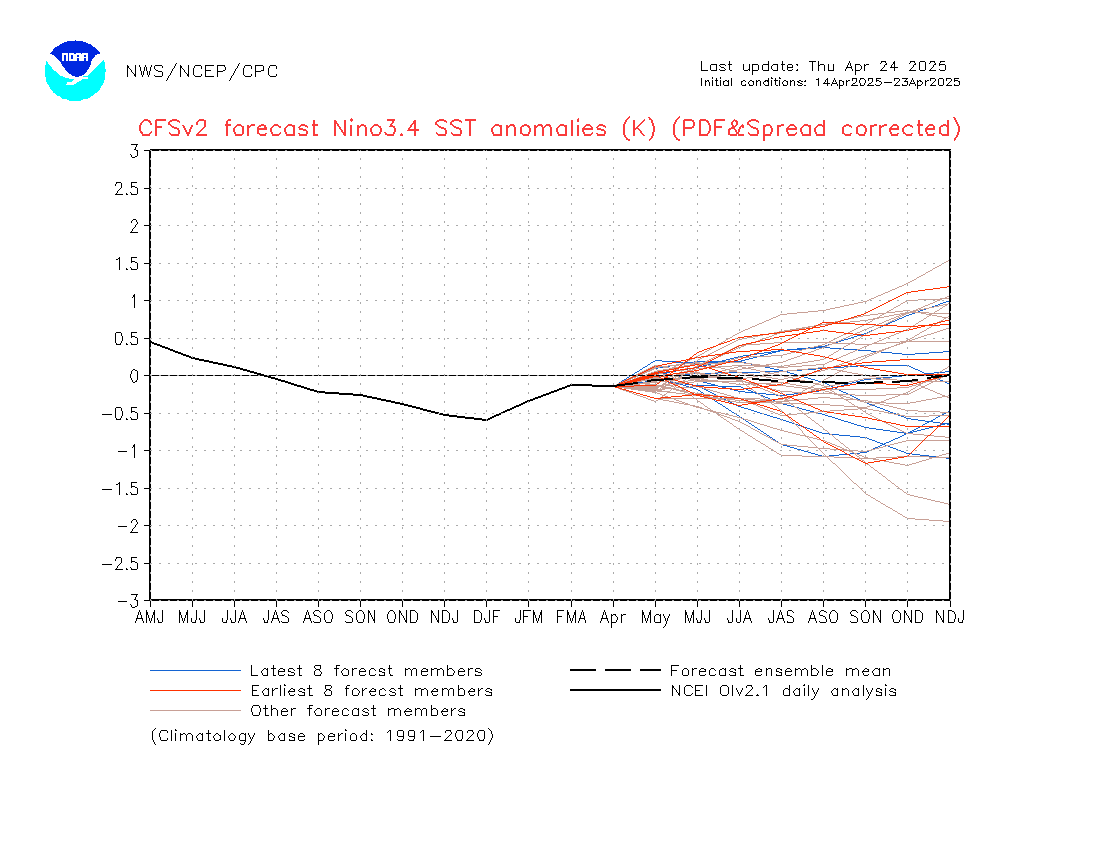
In most cases, I freeze the models as of the date of publication but for this one, I am going to just let the above model run so if you refer to the article in the future, the values in the above may not relate well to the discussion. But I am doing that so if you refer to this article in say two weeks, you will see if there has been any change in the forecast from this model.
Comparison models would include JAMSTEC

And the JAMSTEC Modoki Index

And the Australian BOM

I am going to introduce another graphic which is the current view of the subsurface along the Equator.
| Last Month | This Month |
 |
|

Here is an updated version which may or may not have been available to NOAA for their use in making the forecast that they issued on December 17, 2020

Now let us look at the SOI which is used to confirm the La Nina. I did not present this graphic in Part I.

From the BOM Glossary
The Southern Oscillation Index, or SOI, gives an indication of the development and intensity of El Nino or La Nina events in the Pacific Ocean. The SOI is calculated using the pressure differences between Tahiti and Darwin.
Sustained negative values of the SOI below 7 often indicate El Nino episodes. These negative values are usually accompanied by sustained warming of the central and eastern tropical Pacific Ocean, a decrease in the strength of the Pacific Trade Winds, and a reduction in winter and spring rainfall over much of eastern Australia and the Top End. You can read more about historical El Nino events and their effect on Australia in the Detailed analysis of past El Nino events.
Sustained positive values of the SOI above +7 are typical of a La Nina episode. They are associated with stronger Pacific trade winds and warmer sea temperatures to the north of Australia. Waters in the central and eastern tropical Pacific Ocean become cooler during this time. Together these give an increased probability that eastern and northern Australia will be wetter than normal. You can read more about historical La Nina events and their effect on Australia in the Detailed analysis of past La Nina events.
I have not frozen the SOI graphic so we will be able to track the SOI in this article. It is not indicating a very strong La Nina so far.

La Nina Modoki
There is not a lot of information on this. There appear to be impacts on China and Australia. But how about the U.S.? This is the closest I could find.
This abstract (link for full report) might be informative
Abstract
The present work identifies two types of La Nina based on the spatial distribution of sea surface temperature (SST) anomaly. In contrast to the eastern Pacific (EP) La Nina event, a new type of La Nina (central Pacific, or CP La Nina) is featured by the SST cooling center over the CP. These two types of La Nina exhibit a fundamental difference in SST anomaly evolution: the EP La Nina shows a westward propagation feature while the CP La Nina exhibits a standing feature over the CP. The two types of La Nina can give rise to a significantly different teleconnection around the globe. As a response to the EP La Nina, the North Atlantic (NA)-Western European (WE) region experiences the atmospheric anomaly resembling a negative North Atlantic Oscillation (NAO) pattern accompanied by a weakening Atlantic jet. It leads to a cooler and drier than normal winter over Western Europe. However, the CP La Nina has a roughly opposing impact on the NA-WE climate. A positive NAO-like climate anomaly is observed with a strengthening Atlantic jet, and there appears a warmer and wetter than normal winter over Western Europe. Modeling experiments indicate that the above contrasting atmospheric anomalies are mainly attributed to the different SST cooling patterns for the two types of La Nina. Mixing up their signals would lead to difficulty in seasonal prediction of regional climate. Since the La Nina-related SST anomaly is clearly observed during the developing autumn, the associated winter climate anomalies over Western Europe could be predicted a season in advance.
The key sentence from the above is: “And there appears a warmer and wetter than normal winter over Western Europe.” Is this reflected in the JAMSTEC maps? I do not see it in the JAMSTEC World Forecast. Perhaps a little bit. .


