


Written by Sig Silber
On September 10, 2020, NOAA updated their ENSO Alert System Status to La Nina Advisory. Here is the September 17, 2020, NOAA four-season forecast for CONUS and Alaska including the Early Outlook for October 2020. It covers a period that begins one month later than the forecast last month and extends one month longer. The prior forecast included the Early Outlook for September and this forecast has the Early Outlook for October. Also included is the three-month drought forecast.

Please share this article – Go to the very top of the page, right-hand side for social media buttons. Please feel free to share this report with anyone you feel will find it useful.
A. Focus on the NOAA Update
A note about terminology; the deviations from climatology/normal are color-coded but also labeled “A” for more than (above) normal and “B” for less than (below) normal. The area designated EC means Equal Chances of being more or less than normal. In my comments for the shorter-term maps, NOAA uses “N” instead of “EC” as they believe they can be more definitive for shorter time frames. So the words “warm”, “cool”, “wet”, “dry” should be generally interpreted as being relative to climatology/normal for that location and time of year.
First, we will take a look at the NOAA Early Outlook for October 2020. It is called the Early Outlook because it will be updated at the end of September. Only the October Outlook will be updated at that time.
Temperature

Precipitation

We have nothing to compare these maps with as NOAA does not provide in their Update a forecast for each of the subsequent two months separate from their three-month forecast. Thus I do not have forecast maps for October from the previous NOAA Report to compare against. And the current month is not over so we can not really compare the forecast for next month against the actual for this month. It is probably best to just try to understand what NOAA is trying to convey about October*. For Temperature, it is warm in Northern Alaska and all of CONUS except for the Northwest. For precipitation, Northwest Alaska, the Alaskan Panhandle, the Northwest and Florida plus coastal Georgia and South Carolina are wet. There is a large dry anomaly centered on Oklahoma, Northern Texas and Eastern New Mexico and impacting about twenty states. There is a small dry anomaly within Southern Alaska. There is a lot of area that is EC. Overall it is a somewhat dry forecast.
* compared to normal/climatology for the indicated time of the year.
Visual Consistency Testing.
It is useful to see how the month forecast fits with the set of shorter forecasts that we have. The first map covers only September and the second map as of today only covers two days in October .so only the third of the three maps is very useful for this purpose. The third map extends the coverage through the first 16 days of October. The Seasonal Outlook was issued fairly early this month since the third Thursday fell on September 17, 2020 close to the earliest possible issue of the forecast which would be September 15. Sixteen days of shorter forecasts is not a desirable basis for doing this visual consistency testing but it is what we have to work with and there are thirty-one days in October.
First Temperature
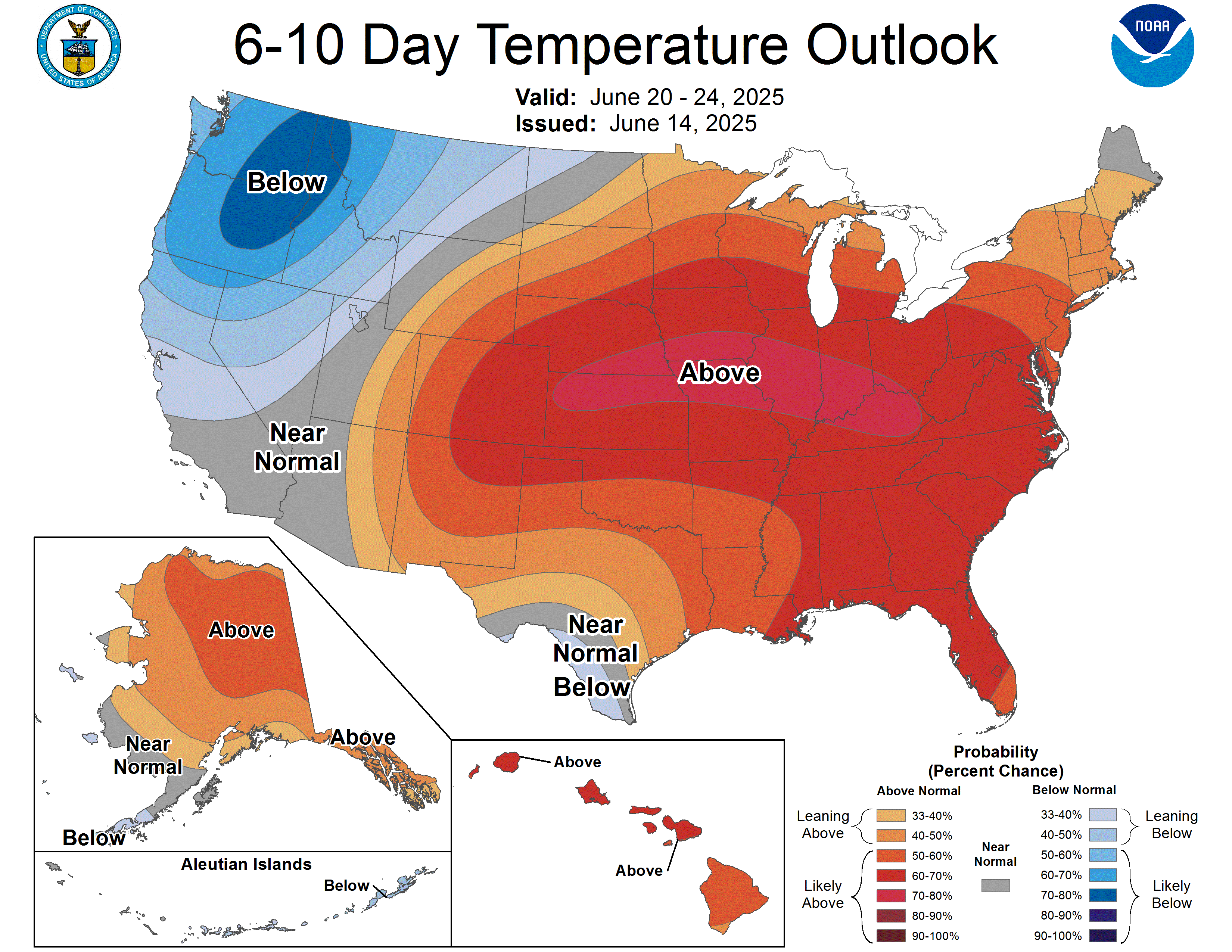 | 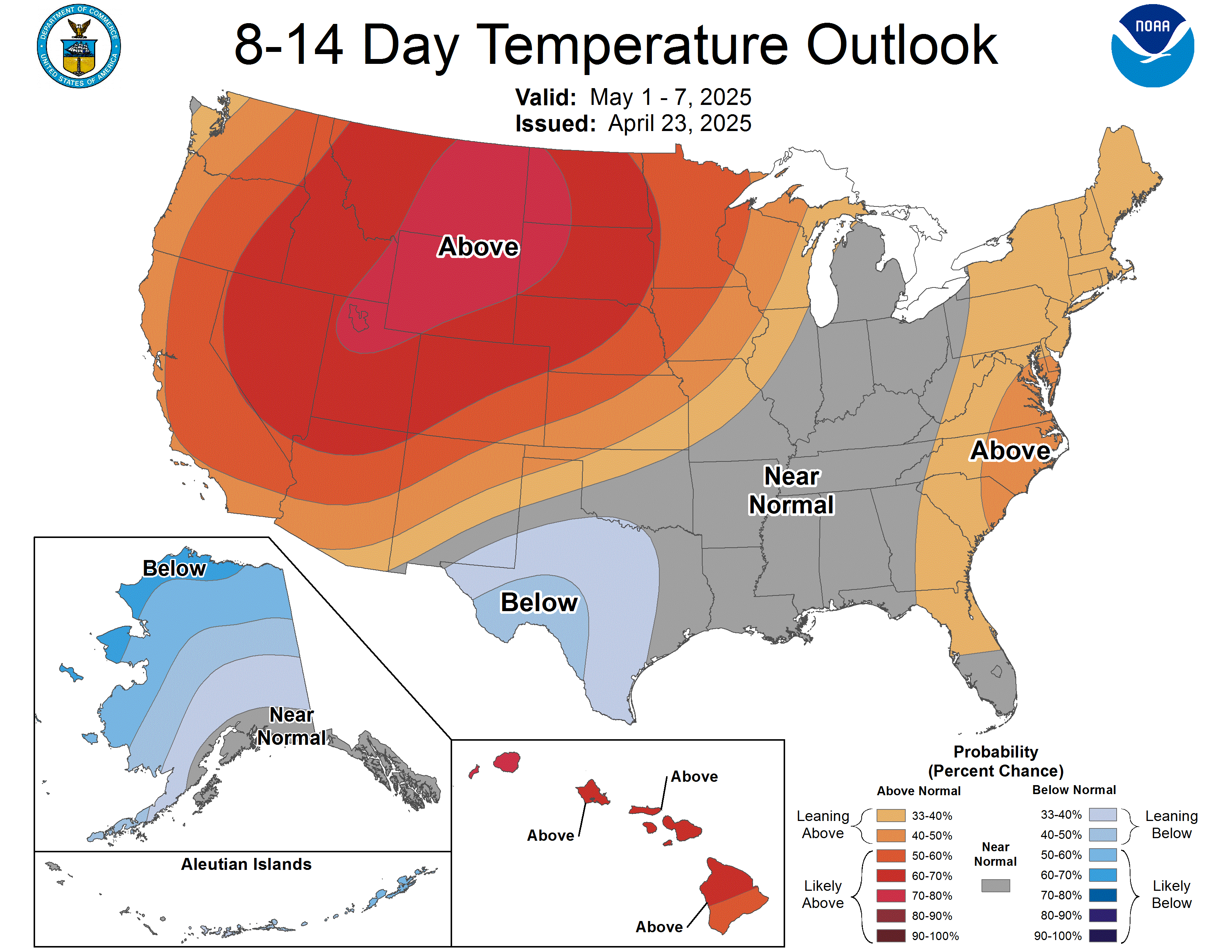 | 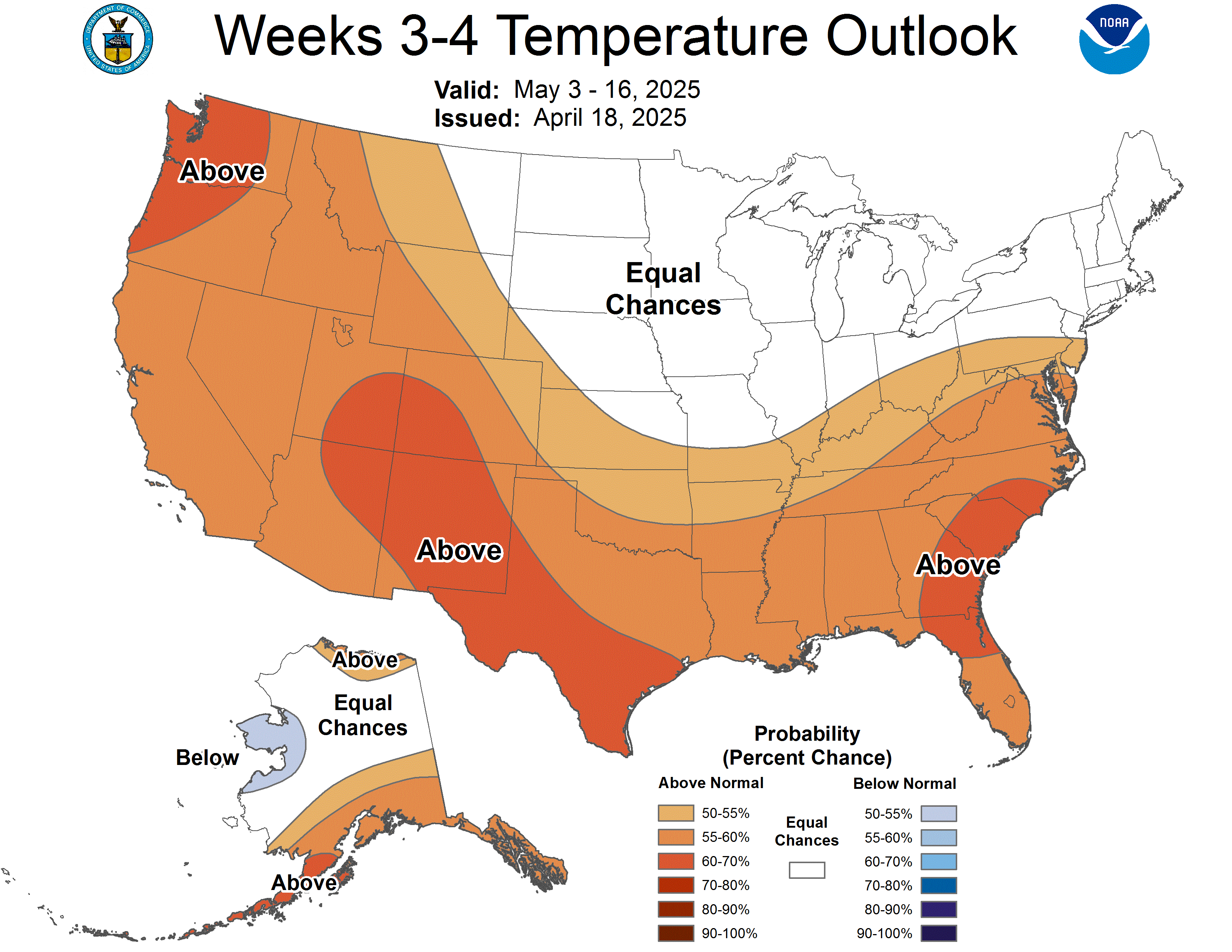 |
| The new monthly forecast is to the right. Does it appear to be reflective of the parts of the month for which we have forecasts? |
| It is probably too soon to do this analysis in a meaningful way. We may do an update on Friday, September 25 as we will have seven more days of the early month forecast to work with. At this point we have short-term forecasts for 16 of the 31 days in October. The information we have raises questions about the full month temperature forecast for the eastern half of CONUS. It may not be as warm as forecast. We will also revisit the forecast at the end of September when the October forecast is updated. |

And then Precipitation
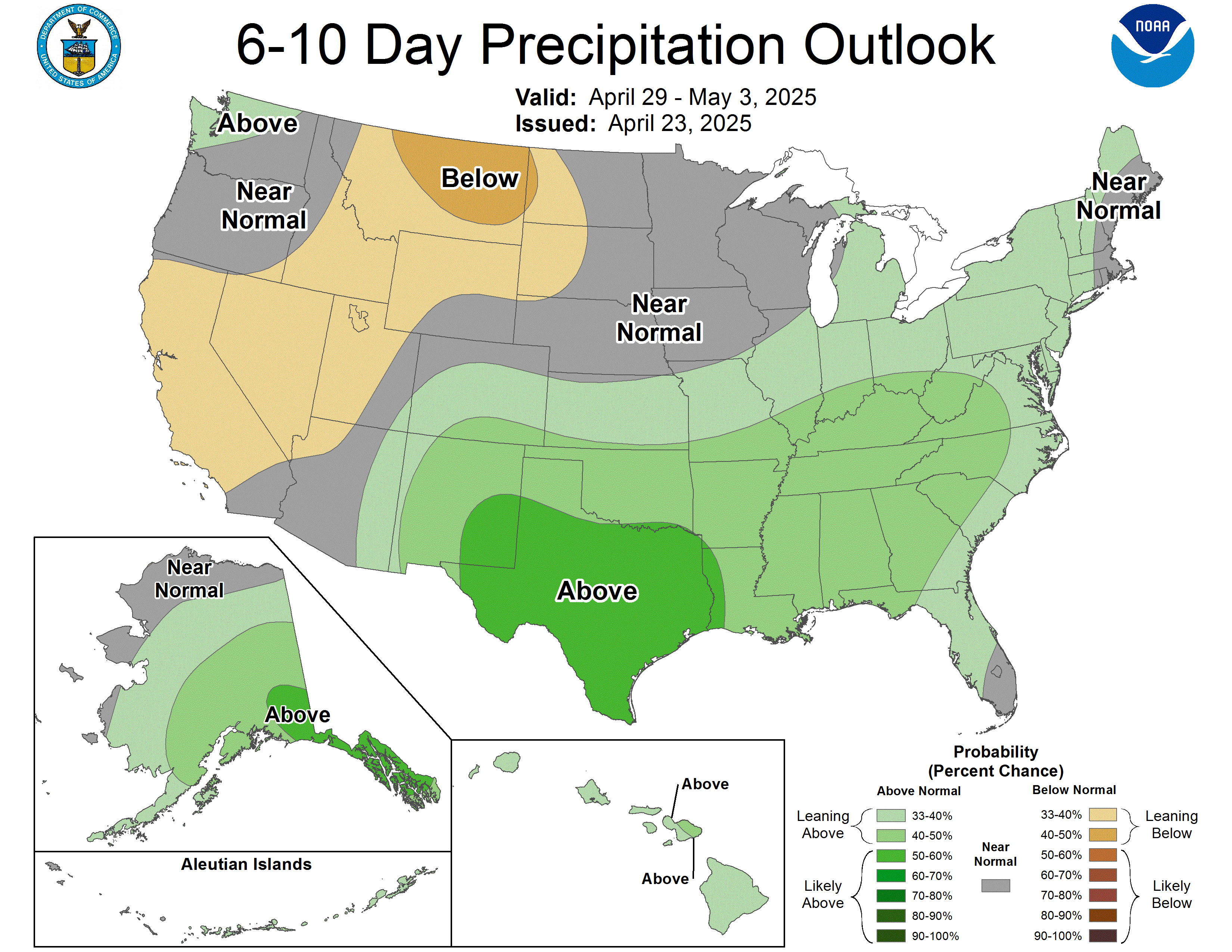 | 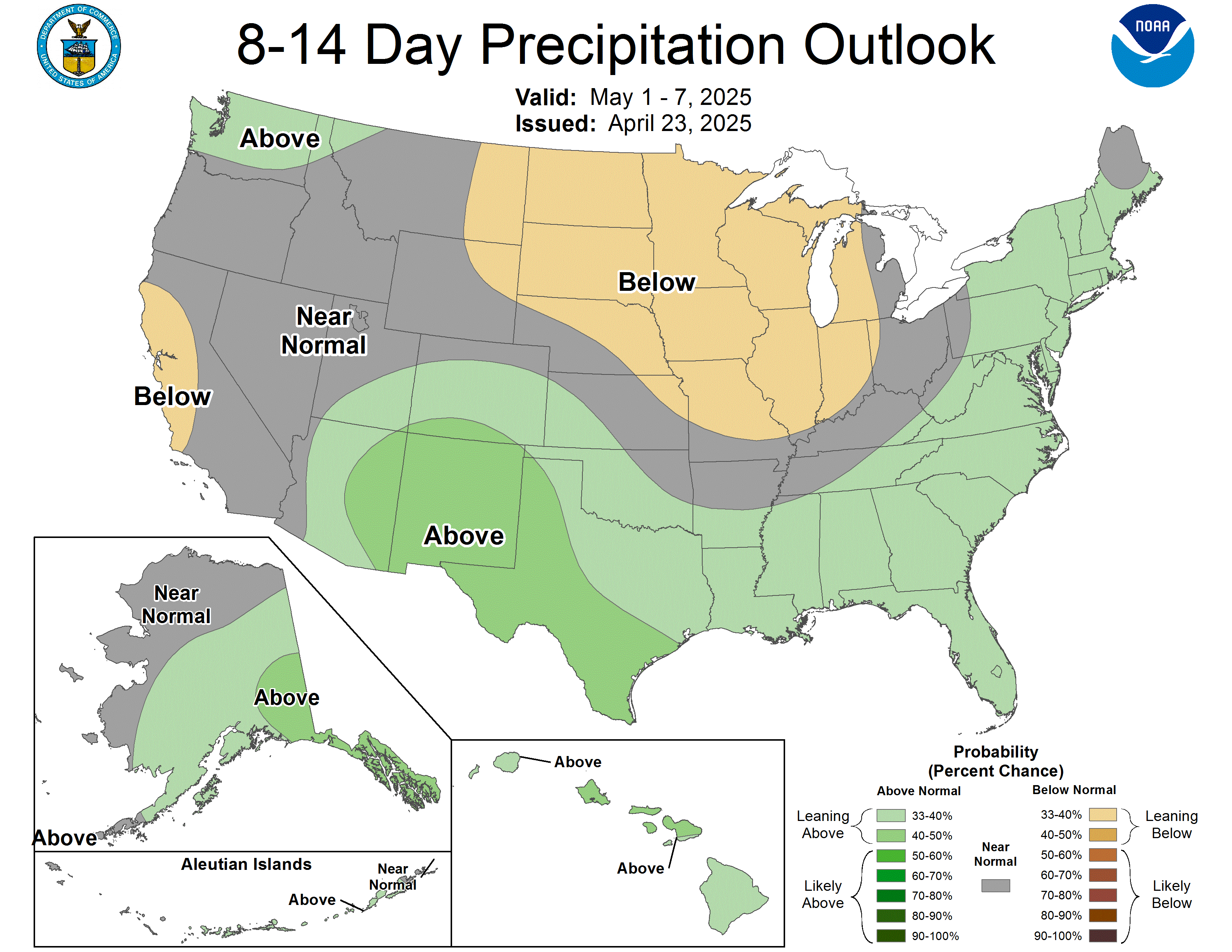 | 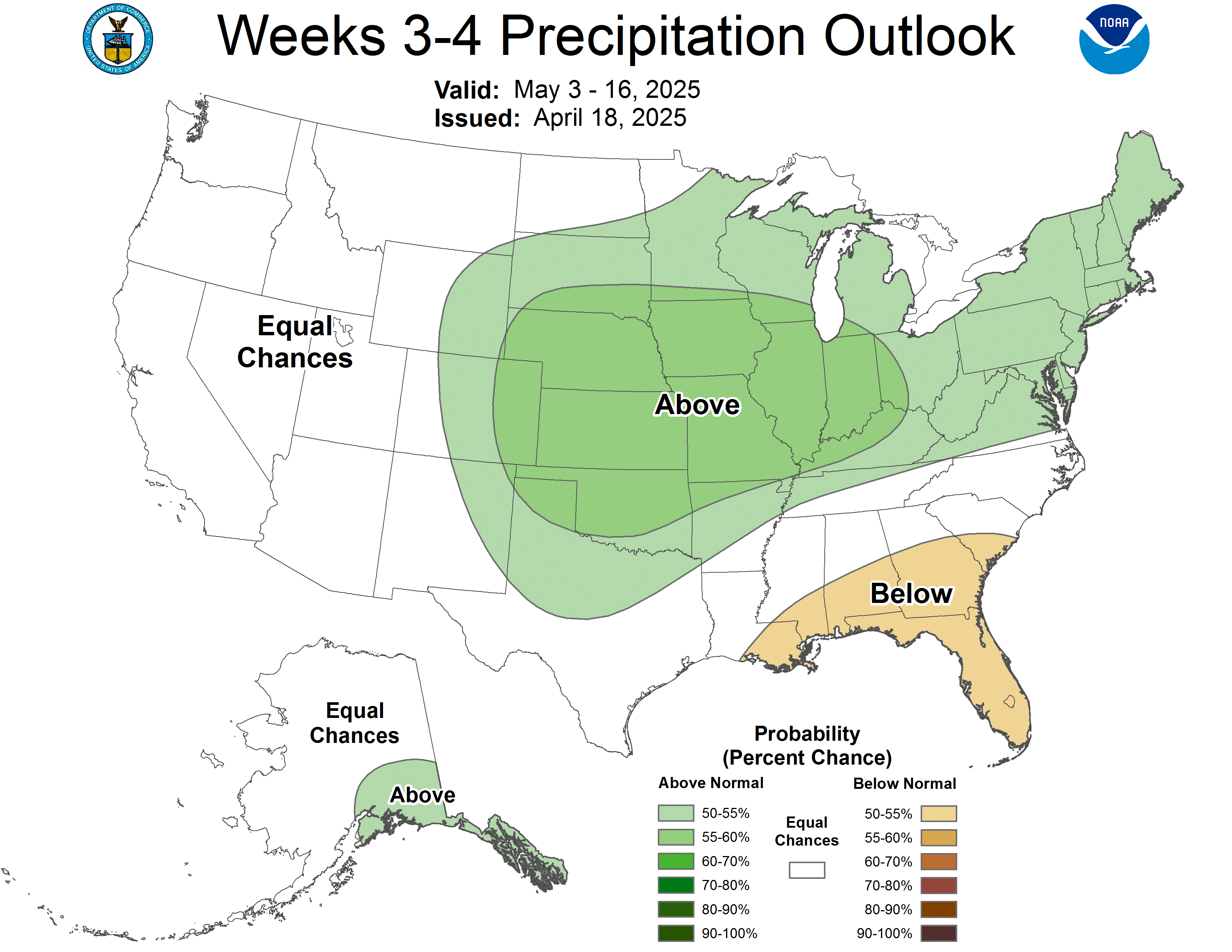 |
| The new monthly forecast is to the right. Does it appear to be reflective of the parts of the month for which we have forecasts? |
| It is probably too soon to do this analysis in a meaningful way. We may do an update on Friday, September 25 as we will have seven more days of the early month forecast to work with. At this point we have short-term forecasts for 16 of the 31 days in October. The information we have fits fairly well with the full month forecast but we wonder if the dry anomaly may extend even further north than shown. We will also revisit the forecast at the end of September when the October forecast is updated. |

Sometimes it is useful to look at the Week 3-4 Discussion.
La Nina conditions continue to persist in the Pacific, while an active Madden-Julian Oscillation (MJO) event is currently over the Maritime Continent. The MJO is forecast to push eastward over the course of the next two weeks, and may destructively interfere with the base state by the time it reaches the Pacific near the beginning of October. The present Weeks 3-4 outlook finds its basis in dynamical model guidance, coupled with secondary consideration given to long-term trends and typical La Nina conditions.
The forecast circulation from model guidance generally features broad anomalous ridging across much of North America, particularly from the JMA model. The model featuring the most impactful anomalous troughing for North America is the CFS which forecasts a trough over the Gulf of Alaska throughout the forecast period, in addition to slightly negative height anomalies over the Tennessee Valley. While lost in the Weeks 3-4 mean, the ECMWF does develop anomalous troughing over the Gulf of Alaska during Week-4. The CFS and JMA both forecast anomalous ridges over the West during Weeks 3-4. The ECMWF has this ridge as well, but instead it is part of the western edge of an elongated region of positive height anomalies that is instead anchored over Eastern Canada. The SubX multimodel mean closely aligns with the CFS perspective, which is unsurprising as this model makes up roughly a quarter of its members.
With broad anomalous ridging generally forecast in the models, coupled with positive decadal trends in temperatures, probabilities tilt toward above-normal temperatures across the CONUS. Weakest probabilities for anomalous warmth exist across the Southeast and southern Alaska tied to the potential for anomalous troughing as mentioned in the previous paragraph among some guidance. Highest probabilities for above-normal temperatures exist across Arizona where trends and anomalous ridging overlap, and to a lesser extent across much of the West and Great Plains as tied to forecast ridging over the West in the CFS, JMA, and Week-3 of the ECMWF. Long-term trends across Alaska also result in above-normal temperatures to increase poleward.
With a forecast of positive height anomalies across much of the country, a relatively dry forecast is the result for many areas. Exceptions for regions favoring below-median precipitation over the Lower 48 states include the West where forecast anomalous troughing over the Gulf of Alaska is likely to increase onshore flow to the Pacific Northwest and increase odds for above-median precipitation, with this also being consistent with typical La Nina conditions. Equal chances exist across much of California and into the Desert Southwest given the climatologically arid time of year favoring little to no precipitation. Equal chances also exist across portions of the East Coast tied to robust forecast wet signals over the Bahamas and the ECMWF model suggesting an active two week period for possible tropical cyclone activity recurving near the region. Highest probabilities for below-median precipitation exist over the Great Lakes in line with the forecast anomalous ridging from the ECMWF model which closely aligns with La Nina composites (although interestingly, not if also accounting for trends from the 1950s through recent). The Alaska Panhandle and portions of the southern coast see a slight tilt toward above-median precipitation tied to forecast troughing over the Gulf of Alaska. Below-median precipitation is favored with increasing confidence while heading northward across Alaska given topographic orientation and the lack of any source region for moisture with the forecast circulation.
Hawaii continues to be surrounded by above-normal sea surface temperatures, with the greatest positive anomalies surrounding western parts of the state. This supports high confidence for above-normal temperatures across the archipelago, with the largest chances for western points. SubX guidance consistently features dry signals for Hawaii, resulting in a tilt toward below-normal precipitation being favored.
Now we consider the three-month Outlook.
Notice that the three-month periods are abbreviated e.g. October/November/December is shown as OND. You will see such abbreviations often in this report.
Prior Temperature Outlook for OND 2020

New Temperature Outlook for OND 2020

Now Precipitation.
Prior forecast for OND 2020

New Precipitation Outlook for OND 2020

Now let us focus on the long-term situation.
First Temperature
Prior 14 Month Temperature Outlook: OND 2020 – SON 2021

New 14 Month Temperature Outlook: NDJ 2020 – OND 2021

To compare maps from one release to another, one needs to remember that the new release drops one three-month period and adds a later one. So to make the comparisons one has to shift the new maps to the right one position and that makes the map on the right drop-down to become the left-most map in the next level. I do not have a computer software tool for doing that for you so you have to do it mentally. When I do the comparison, I print the two sets of maps and put them side by side and number the same three-month maps 1, 2, 3,…..,11 in both sets of maps to make it easier for me to easily compare the same three-month period in the new with the previous forecast. One uses the same procedure to compare the precipitation maps. Based on this procedure, I conclude that:
Now Precipitation
Prior 14 Month Precipitation Outlook: 0ND 2020 – SON 2021

New 14 Month Precipitation Outlook: NDJ 2020/2021 – OND 2021

If you want larger versions of each map (temperature and precipitation) you can find them here. And then each of those maps can be clicked on to further enlarge them.
Sometimes it is useful to compare the three-month outlook to the forecast for the first of the three months. It shows how much the pattern changes over the three months.

One can mentally subtract the First-Month Outlook from the Three-month Outlook and create the Outlook for the last two months in the three months.
*The concept is that the probabilities of a deviation from climatology in the First Month and the combined Month Two and Three forecast that one derives must average out to the probabilities shown in the three-month maps.
Below is the NOAA Discussion (slightly reorganized) released by NOAA on September 17, 2020. Headings that are “Initial Cap” only rather than all caps were added by the Author of this Update Report for clarity. Also, we have organized the sequence of the sections of NOAA Discussion to first present the Atmospheric and Oceanic Conditions and then the Initial Month (October), the new NOAA Summary for OND, and finally the remainder of the 15-Month Forecast.
CURRENT ATMOSPHERIC AND OCEANIC CONDITIONS
The coupled oceanic and atmospheric observations reflect La Nina conditions. During the past four weeks (Aug 16 – Sep 12), sea surface temperature (SST) anomalies are below (above)- average across the equatorial east-central (west) Pacific. The negative SST anomalies have expanded since July and increased in magnitude from 120W to 90W. The latest Nino-3.4 index is -1.0 degree C. Negative subsurface temperature anomalies continue to persist at a depth of more than 150 meters from 160W to 120W. Integrated upper-ocean heat anomalies declined rapidly during July and early August with those anomalies remaining nearly steady since mid-August. Suppressed convection continues over the west-central Pacific.
PROGNOSTIC DISCUSSION OF SST FORECASTS
The CPC SST consolidation for the Nino-3.4 region depicts negative SST anomalies increasing in magnitude to more than -1.0 degree C by NDJ, followed by a gradual trend to near average by MAM 2021. The North American Multi-Model Ensemble (NMME) ensemble mean forecast for the Nino-3.4 SST anomaly has a similar evolution during the next six months. Based on the observational and model forecast indicators as of early September, the official CPC/IRI ENSO outlook favors La Nina conditions persisting through the Northern Hemisphere winter (~75% chance). La Nina conditions remain the most likely outcome through FMA 2021.
30-DAY OUTLOOK DISCUSSION FOR OCTOBER 2020
The October 2020 monthly temperature and precipitation outlooks are primarily based on consistent dynamical model forecast guidance within the context of ongoing and likely strengthening La Nina conditions as we progress into the autumn months. In addition, some areas of the forecast domain utilized current land surface states and nearby ocean surface temperatures as input.
The MJO is also considered, but played a lesser role in the outlook as the recent strong, coherent MJO activity has weakened some and is being disturbed by higher frequency coherent, subseasonal tropical variability (atmospheric Kelvin and equatorial Rossby wave activity) and evolving under strengthening La Nina conditions. Consequently, it is unclear how coherent and robust the MJO enhanced convective phase will emerge from the Maritime continent to the Pacific Ocean during the second half of September. Also, statistically significant impacts to higher latitudes from the MJO are often marginal during October.
Temperature
The October 2020 temperature outlook favors above-normal monthly mean temperatures for nearly all of the forecast domain except for areas in southeast Alaska and the Pacific Northwest where Equal Chances (EC) is forecast. Dynamical model forecast guidance and typical temperatures observed during October under La Nina conditions support this outlook. Long term positive temperature trends enhance odds for above-normal temperatures for parts of the western CONUS as does dry surface conditions. Strong negative trends in sea ice coverage and thickness and so warmer than normal ocean surface temperatures in waters surrounding Alaska also favors higher odds for above-normal temperatures for parts of western and northern Alaska. La Nina conditions tend to favor near to below-normal temperatures in parts of the Pacific Northwest, southeast Alaska and the Alaska Panhandle, but with positive long term trends in some of these areas counteracting this generally weak La Nina signal, EC is forecast for these areas. Long term positive temperature trends , dynamical model forecast guidance, and to a lesser extent near coast ocean surface temperatures and dry surface conditions support slightly higher odds for above-normal temperatures for the Northeast and mid-Atlantic.
Precipitation
For precipitation, consistent dynamical model forecast guidance and typical La Nina conditions favors a region of below-normal precipitation stretching from the Southwest and south-central Rockies eastward to include the central and southern Plains and Mississippi Valley to parts of the Tennessee and Ohio River Valley’s. Potential tropical systems developing in the Gulf of Mexico and northwestern Caribbean and their often northeast migration supports slightly elevated odds for above-normal rainfall for parts of the extreme Southeast and the state of Florida.
La Nina and consistent dynamical model forecast guidance favors above-normal monthly total precipitation amounts for parts of the Pacific Northwest and Alaska Panhandle. La Nina conditions typically support above-normal (below-normal) precipitation for the west coast of Alaska (south-central Alaska) respectively.
SUMMARY OF THE OUTLOOK FOR NON-TECHNICAL USERS (primarily OND 2020)
La Nina conditions are present across the equatorial Pacific Ocean, as represented in current oceanic and atmospheric observations. The official CPC ENSO forecast indicates that La Nina conditions are likely to persist through the Northern Hemisphere winter.
Temperature
The October-November-December (OND) 2020 temperature outlook favors above-normal temperatures for a majority of the CONUS, with the largest probabilities (greater than 70 percent) forecast across parts of the Southwest along with northern Alaska. The OND 2020 precipitation outlook indicates enhanced probabilities of below normal precipitation amounts from southern California, across the Southwest, southern Great Plains, and Lower Mississippi Valley, to the Southeast.
Precipitation
Above-normal precipitation is most likely across Washington, the northern Rockies, Dakotas, and Upper Mississippi Valley along with western and northern mainland Alaska. Equal chances (EC) are forecast for areas where probabilities for each category of seasonal mean temperatures and seasonal accumulated precipitation amounts are expected to be similar to climatological probabilities.
BASIS AND SUMMARY OF THE CURRENT LONG-LEAD OUTLOOKS
PROGNOSTIC TOOLS USED FOR U.S. TEMPERATURE AND PRECIPITATION OUTLOOKS
Given the likelihood of La Nina conditions persisting through the winter 2020-2021 and the most likely outcome into the early spring 2021, La Nina temperature and precipitation composites were a major factor through FMA 2021. Dynamical model guidance such as the North American Multi-Model Ensemble (NMME) and the Calibration, Bridging, and Merging (CBaM) version of the NMME were used. The consolidation tool, which includes NMME input and various statistical tools, was also used, especially at later leads. Also, based on the expectation of drought development during the next six months across the southern tier of the CONUS, low soil moisture conditions influenced the temperature outlooks during the spring and early summer 2021. At later leads, decadal trends in temperature and precipitation were the primary tool used in creating the seasonal outlooks.
PROGNOSTIC DISCUSSION OF OUTLOOKS – OND 2020 TO OND 2021
TEMPERATURE
During OND, above normal temperatures are favored throughout the forecast domain, except for southeastern Alaska where equal chances (EC) of below, near, or, above normal temperatures are forecast. This EC area is supported by La Nina composites and CBaM. Probabilities of above normal temperatures are lowest from the Pacific Northwest east to the Northern Great Plains and Upper Mississippi Valley based on the expectation of a more variable pattern during OND. Decadal trends support elevated probabilities (above 50 percent) of above normal temperatures across the Northeast. The largest probabilities (60 to 70 percent, or more) of above normal temperatures are forecast across the Southwest, based on La Nina composites, strong support from dynamical models , and decadal trends . Probabilities of the same magnitude are also forecast across northern Mainland Alaska due to decadal trends and the likely delayed onset of sea ice. As of mid-September, the Arctic Sea ice extent is well below its 1981-2010 median coverage.
The temperature outlooks during the winter 2020-2021 are consistent with La Nina composites, the latest dynamical model guidance, and a consideration of decadal trends . Beginning in DJF 2020-2021, slightly elevated probabilities of below normal temperatures are forecast for southeast Alaska, the Northern Great Plains, Northern Rockies, and parts of the Pacific Northwest. Probabilities of above normal temperatures increase below the 40th parallel. Later in the spring 2021, probabilities of above normal temperatures were increased across parts of the Southwest and southern Great Plains, compared to the previous seasonal release. This modification is related to the expectation of low soil moisture conditions and its warming influence on surface temperatures during the next warm season.
PRECIPITATION
The highest confidence in the OND precipitation outlook exists across the southern Great Plains and New Mexico, where more than a 50 percent chance of below normal precipitation is forecast. These relatively large probabilities are supported by multiple tools including La Nina composites. Although increased chances of below normal precipitation extend east across much of the Gulf Coast States during OND, probabilities are tempered due to the potential effect from a tropical cyclone during October and November. Based on La Nina composites and dynamical models , above normal precipitation is most likely across the Pacific Northwest, northern Rockies, and parts of Alaska during OND.
The most notable changes to the previous precipitation outlooks included an increase in coverage and probabilities of below normal precipitation throughout the southern tier of the CONUS and California, beginning in OND 2020 and continuing through FMA 2021. These necessary changes are consistent with La Nina condition, the latest dynamical model guidance, and the CPC consolidation tool. The dry signal for California indicated in many tools, is strongest during JFM and FMA 2021, then diminishes later in the spring, in part due to the waning of the wet season. Elevated probabilities of above normal precipitation expand to include the northern Great Plains, Upper Mississippi Valley, and Ohio Valley. This predicted dry-wet dipole from south to north is a typical response to La Nina conditions.
We will discuss this more when we compare the JAMSTEC to the NOAA forecast. But it is useful to look at the JAMSTEC discussion especially as it applies to Autumn since their assumption about ENSO in that season differs from the assumption made by NOAA. We will address this in more detail when we publish our NOAA v JAMSTEC comparison..
Sep. 16, 2020 Prediction from 1st Sep., 2020
ENSO forecast:
Observation shows that the La Nina continues to develop. The SINTEX-F predicts that the La Nina-like condition will persist in this year with weak anomaly in December-February.
Indian Ocean forecast:
Observation shows a weak negative IOD-like condition in the tropical Indian Ocean at present. The ensemble mean prediction suggests that the present condition will return to a neutral state from mid-autumn.
Regional forecast:
On a seasonal scale, the SINTEX-F predicts that most part of the globe will experience a warmer-than-normal condition in boreal autumn, except for southwestern Australia, India, Thailand, and northern Africa. In boreal winter, the model also predicts that most part of the globe will experience a warmer-than-normal condition, except for western Canada, northern Brazil, southern Australia, and India.
As regards to the seasonally averaged rainfall in boreal autumn, a drier-than-normal condition is predicted for a southern/central part of U.S.A., Mexico, Chile, La Plata Basin, West Africa, southern China, some parts of the Russian Far East, most part of Southeast Asia, and most part of Europe. In contrast, western Canada, most part of the South American Continent, India, some parts of southern Africa, Philippines, Indonesia, northern Europe, and northern Russia will experience a wetter-than-normal condition. In boreal winter, a wetter-than-normal condition is predicted for Alaska, most part of U.S.A., northern part of the South American Continent, Philippines, and some parts of Indonesia. In contrast, southeastern U.S.A., Mexico, La Plata Basin, most of Australia, some part of southern Africa, most part of Europe, and some part of Southeast Asia will experience a drier-than-normal condition.
The model predicts most part of Japan will experience warmer-than-normal condition in autumn and winter as a seasonal average. As regards to the seasonally averaged rainfall, most part of Japan will experience drier-than-normal condition in autumn. In winter, southern part of Japan will experience drier-than-normal condition.
And the Seasonal Drought Outlook

Latest Seasonal Assessment – La Nina conditions are present, and are likely to continue through the Northern Hemisphere winter (75% chance). The forecaster consensus favors a borderline moderate event during the peak November-January season. La Nina conditions typically indicate a warmer and drier pattern across much of the southern tier of the CONUS, cooler and wetter conditions in the Pacific Northwest, and increased chances for precipitation in Hawaii. A wild card for this outlook is the potential for a continuation of the active 2020 Atlantic hurricane season. Therefore, several synoptic-scale forcing mechanisms are considered in this forecast, in addition to the short-, medium-, and long-range model guidance and seasonal normals.
Drought continued to expand in the past 30 days over much of the western CONUS and in New England. The D3 category experienced a rapid increase, with extreme drought (D3) coverage rising from 3.83% to 11.55% on Sep. 8 as compared to Aug. 11. Overall drought (D1-D4) increased from 34.4% to 38.7% during the same time period, while D4 made a return on the Aug. 18 map and stood at 0.16% on Sep. 8.
In the Northeast, drought improvements are not expected to occur until later in the period (Nov-Dec), and may in fact worsen in the short-term (for the rest of September into early October) as the QPF, ERFs and Week 3-4 all favor below-normal precipitation. Although the 1- and 3-month precipitation outlooks have EC for the Northeast, autumn is a favorable time for soil moisture recharge as several factors lend themselves toward positive water balances, and in general, droughts rarely linger in New England due to these factors. In the Southeast, there was no drought, and with a few small areas of D0 in AL, GA, and SC which should be erased by Hurricane Sally rains, no development is expected through the end of the year. In the Midwest, drought existed in parts of the Corn Belt (IA, IL, IN, OH), in southwestern Missouri, and northeastern Minnesota. With short-term precipitation forecasts mostly trending drier than normal, October and OND climatologies somewhat dry, and the October and OND 2020 outlooks at EC, no clear signal emerged, thus persistence was left. A exception for improvement was made in southwestern lower Michigan where winter lake-effect snows should ease the very small area of D1. In the South, La Nina is expected to bring subnormal precipitation and above-normal temperatures during October and OND, thus development is expected into the south and south-central Great Plains and parts of the lower Mississippi Valley where D0 already exists. Areas along the Gulf Coast, parts of the lower Mississippi Valley, and central Texas were left blank due to previous tropical downpours (Hurricanes Hanna and Laura), heavy 30-day rainfall, or from future tropical systems as this has been a very active Atlantic hurricane season. The late fall and winter are climatologically dry for the High Plains, and with no indication of any real above-normal precipitation events out to 3-months, status-quo (persistence) was left. However, southern sections (KS) and northwestern areas (WY) were forecast for development and improvement, respectively, based upon the expected La Nina impacts in the 1- and 3-month LLFs. In the West, with anticipated above-normal precipitation odds across the Northwest and below-normal precipitation and warmth favored across the Southwest due to the La Nina, gradual improvement is likely across the Northwest (WA, OR, northern CA, ID, MT, WY) while persistence/intensification/developement is forecast for the southwestern quarter of the Nation.
In Alaska, even though subnormal October precipitation is favored in south-central sections (e.g. Kodiak Island), above-normal OND precipitation is expected along the western and southwestern coasts, and this should remove the two small D1 areas (Kodiak Island and near Kotzebue). In Hawaii, although drought conditions have somewhat worsened and expanded in coverage during the past month, drought removal and improvement are favored during OND as La Nina usually brings above-normal winter precipitation – just as Hawaii is transitioning into a wetter time of the year. Puerto Rico saw drought removal during August, largely aided by the close passage of Isaias in late July, and has remained drought-free ever since. With an active Atlantic tropical season continuing, no drought development is favored for Puerto Rico.
ENSO Considerations


NOAA has their own proprietary model which they rarely use. It is not exactly clear why they shun their own model.
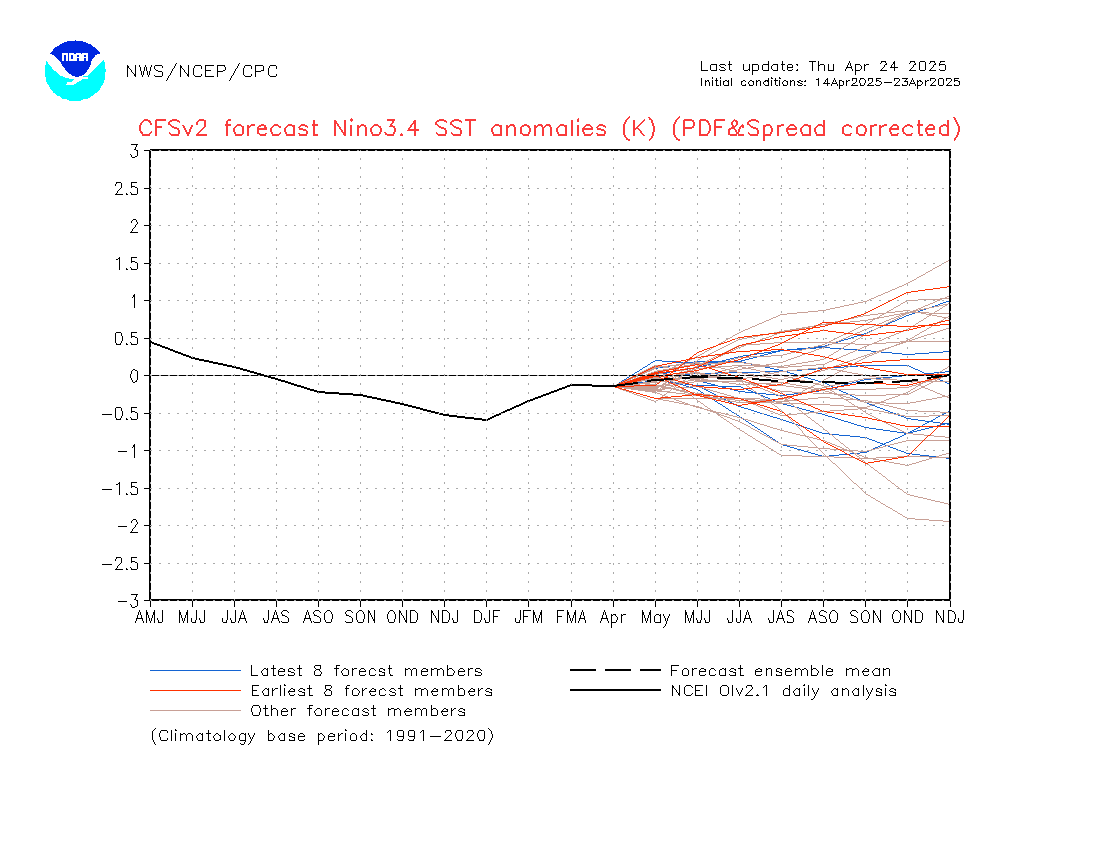
In most cases, I freeze the models as of the date of publication but for this one, I am going to just let the above model run so if you refer to the article in the future, the values in the above may not relate well to the discussion. But I am doing that so if you refer to this article in say two weeks, you will see if there has been any change in the forecast from this model.
Comparison models would include JAMSTEC

And the Australian BOM

I am going to introduce another graphic which is the current view of the subsurface along the Equator.

This is static but without showing the earlier views I can tell you that the warm anomaly is undercutting the cool anomaly. So the issue is when will it displace the cool anomaly. Not an easy question to answer.
B. Conclusion
We are now in a La Nina. There may be an issue as to how long this La Nina may last.


