


Written by Sig Silber
Here is the weekly USDA Crop Progress Report. Overall it continues to look very good. Tonight we also review the August state rankings for temperature and precipitation.

Please share this article – Go to the very top of the page, right-hand side, for social media buttons. Please feel free to send this article to anyone who you think might benefit from reading it.
Let’s look at the state rankings for August. The number shows where the state ranked in August with respect to the most recent and presumably most reliable 126 years of data. So a ranking of 126 would for temperature mean the highest in the 126 years of data and 1 would be the coolest. For precipitation, 126 would mean the wettest and 1 would mean the driest.
First, we look at average temperature.
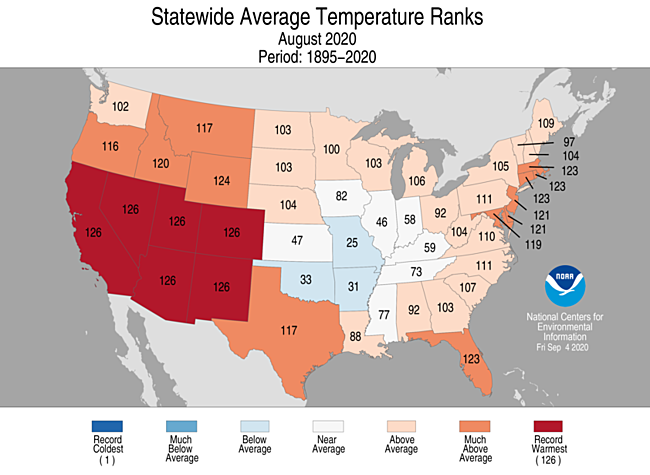
Six states had record temperatures. There are lots of states that were much above average. There were three states (powder blue) which were below average. You can kind of see the pattern with respect to the Mississippi River Valley.

If you look at the maximum temperature there are seven states setting records. There are lots of states that were much above average. There were also seven states that were below average.
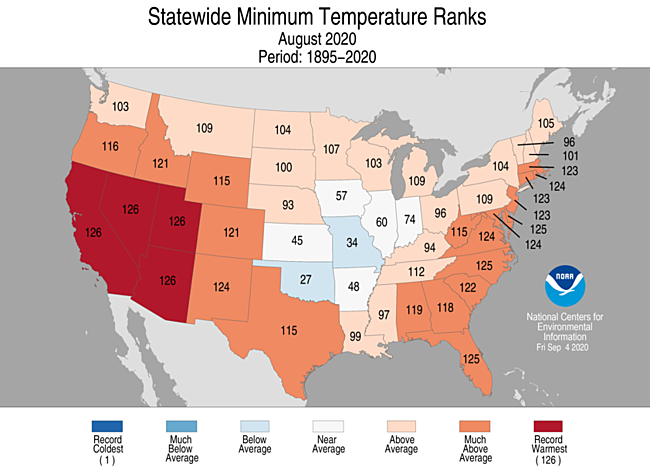
With respect to minimum temperature, there are four states with records. There are lots of states that were much above average. There were only two states with minimums below average. The reason for the differences in the three measures may have had to do with relative humidity. Where the relative humidity is low, temperatures drop at night. Where the relative humidity is high, they tend not to drop as much.
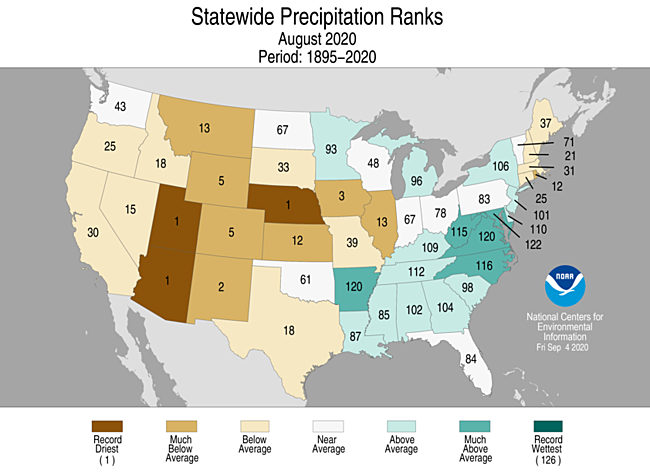
Three states had record dryness. No state had record wetness but five states were much above average.
Sometimes it is useful to look at climate divisions.

For both wet and dry you can see smaller areas that were very different than entire states. We see areas of record dryness. And I think we see one climate division that had record wetness.
 |
| The above is a very good summary of the situation. Below it is broken down in more detail state by state. |
 |
 |
 |
 |
Generally speaking, the weather cooperated with respect to fieldwork.

Only a small number of states had weather that negatively impacted fieldwork.


