


Written by Sig Silber
On July 9, 2020 NOAA Updated their ENSO Alert System Status to La Nina Watch. Here is July 16, 2020, NOAA 15-month forecast for CONUS and Alaska including the Early Outlook for August 2020 and forecasts out through October 2021. It covers a period that begins one month later than the forecast last month and extends one month longer. The prior forecast included the Early Outlook for July and this forecast has the Early Outlook for August. Also included is the three-month drought forecast. NOAA has chosen to issue a forecast that is essentially a forecast for a marginal La Nina. We expect that next month and even with the end of month update on July 31, 2020 it will be slightly more a forecast of a typical weak La Nina. That is not a huge difference but that is the direction we see the forecast trending.

Please share this article – Go to the very top of the page, right-hand side for social media buttons. Please feel free to share this report with anyone you feel will find it useful.
Special Note about the Author. The author has experienced a serious medical complication from a fairly minor medical procedure and is recovering slowly. That is why this article is a day or two later than usual. We expect to get back on schedule soon. In the meantime. John Lounsbury has been updating the LIVE: Current Weather and Forecasts article so many thanks to him: Sig Silber
A. Focus on the NOAA Update
A note about terminology; the deviations from climatology/normal are color-coded but also labeled “A” for more than (above) normal and “B” for less than (below) normal. The area designated EC means Equal Chances of being more or less than normal. In my comments For the shorter-term maps, NOAA uses “N” instead of “EC” as they believe they can be more definitive for shorter time frames. So the words “warm”, “cool”, “wet”, “dry” should be generally interpreted as being relative to climatology/normal for that location and time of year.
First, we will take a look at the NOAA Early Outlook for August 2020. It is called the Early Outlook because it will be updated at the end of July. Only the August Outlook will be updated at that time.
Temperature

Precipitation

We have nothing to compare these maps with as NOAA does not provide in their Update a forecast for each of the subsequent two months separate from their three-month forecast. Thus I do not have forecast maps for August from the previous NOAA Report to compare against. And the current month is not over so we can not really compare the forecast for next month against the actual for this month. It is probably best to just try to understand what NOAA is trying to convey about August *. For Temperature, it is warm everywhere except for the Western Northern Tier and Eastern Alaska. For precipitation, the Southeast and Mid-Atlantic are wet as are the Dakotas and surrounding areas and western and southern Alaska including the Panhandle.
* compared to normal/climatology for the indicated time of the year.
Visual Consistency Testing.
It is useful to see how the month forecast fits with the set of shorter forecasts that we have. The first two maps cover only July so only the third of the three maps is useful for this purpose. The third map extends the coverage through the first 14 days of August. The Seasonal Outlook was issued early this month since the third Thursday fell on July 16, 2020 close to the earliest possible issue of the forecast which would be July 15. Fourteen days of shorter forecasts is not an acceptable basis for doing this visual consistency testing but it is what we have to work with and there are thirty-one days in August.
First Temperature
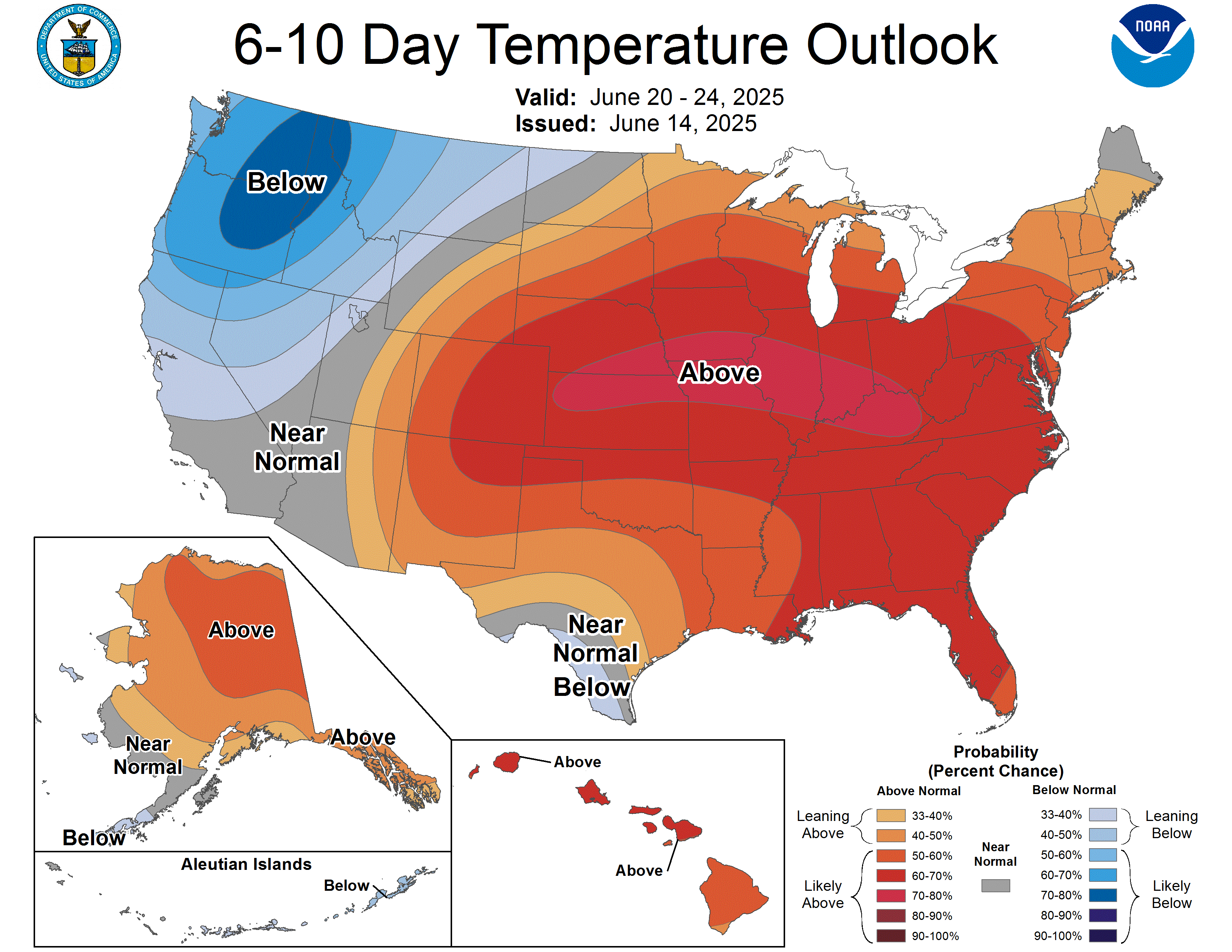 | 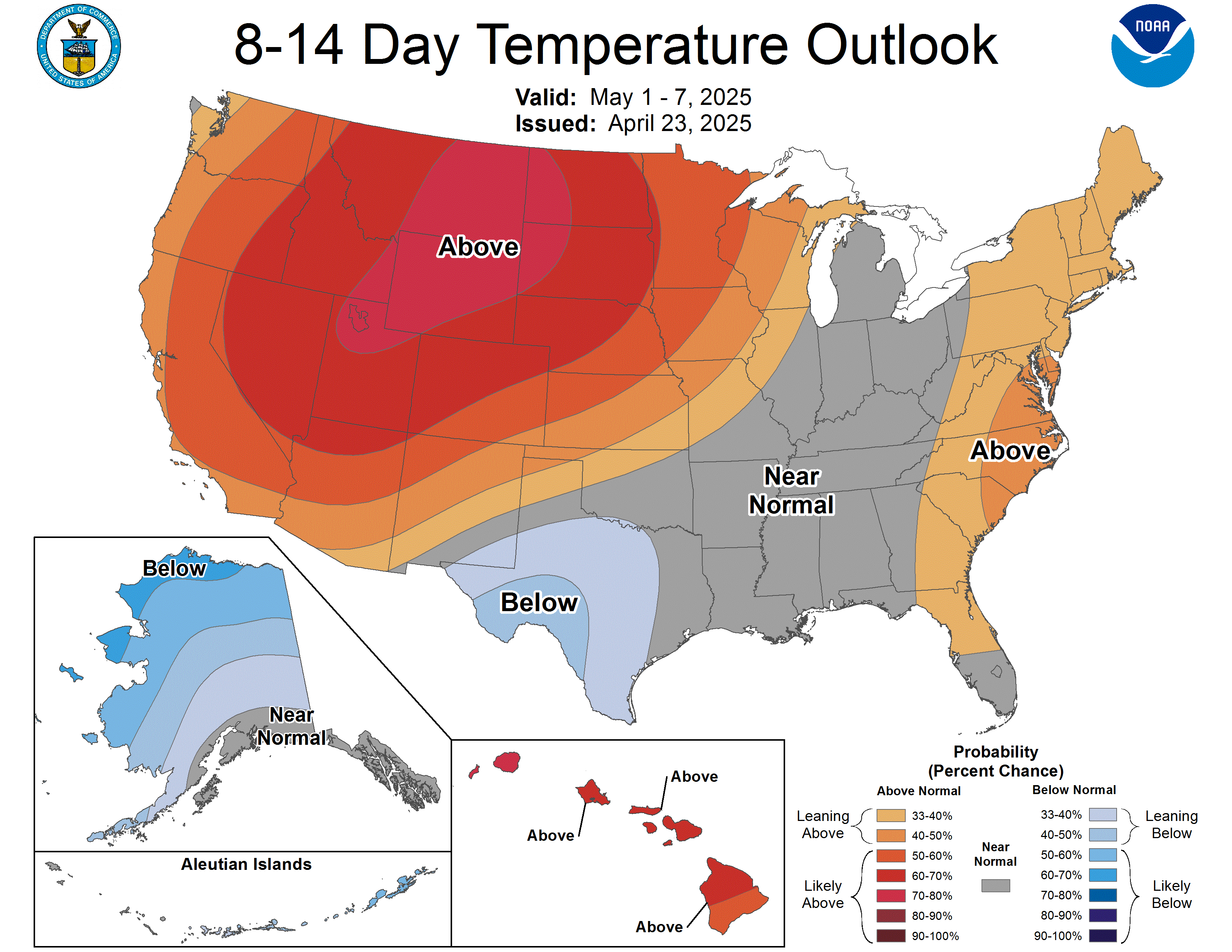 | 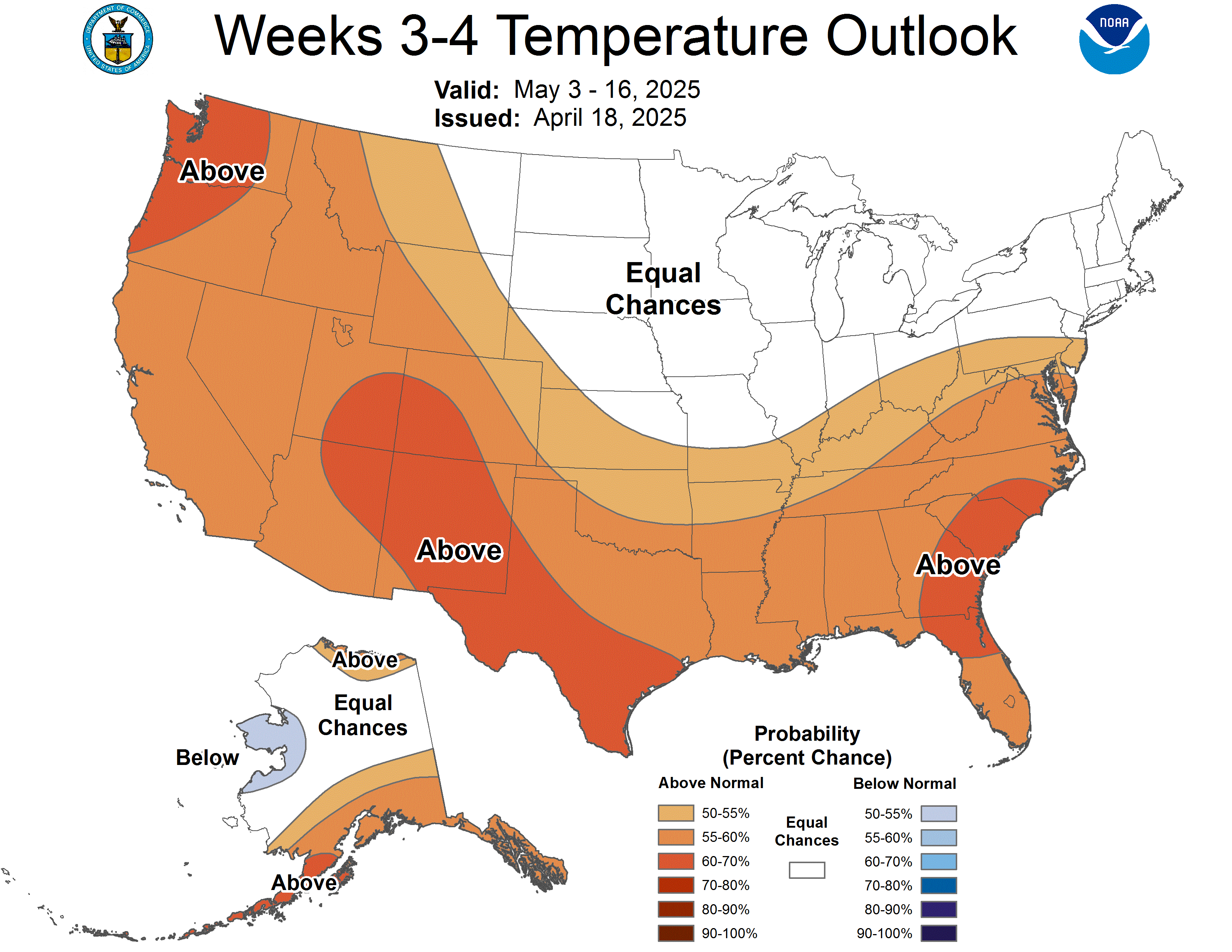 |
| The new monthly forecast is to the right. Does it appear to be reflective of the parts of the month for which we have forecasts? → |
| ↑ ← It is properly too soon to do this analysis. We may do an update on Friday, July 24 as we will have seven more days of the early month forecast to work with. We will also revisit the forecast at the end of July when the August forecast is updated. |

And then Precipitation
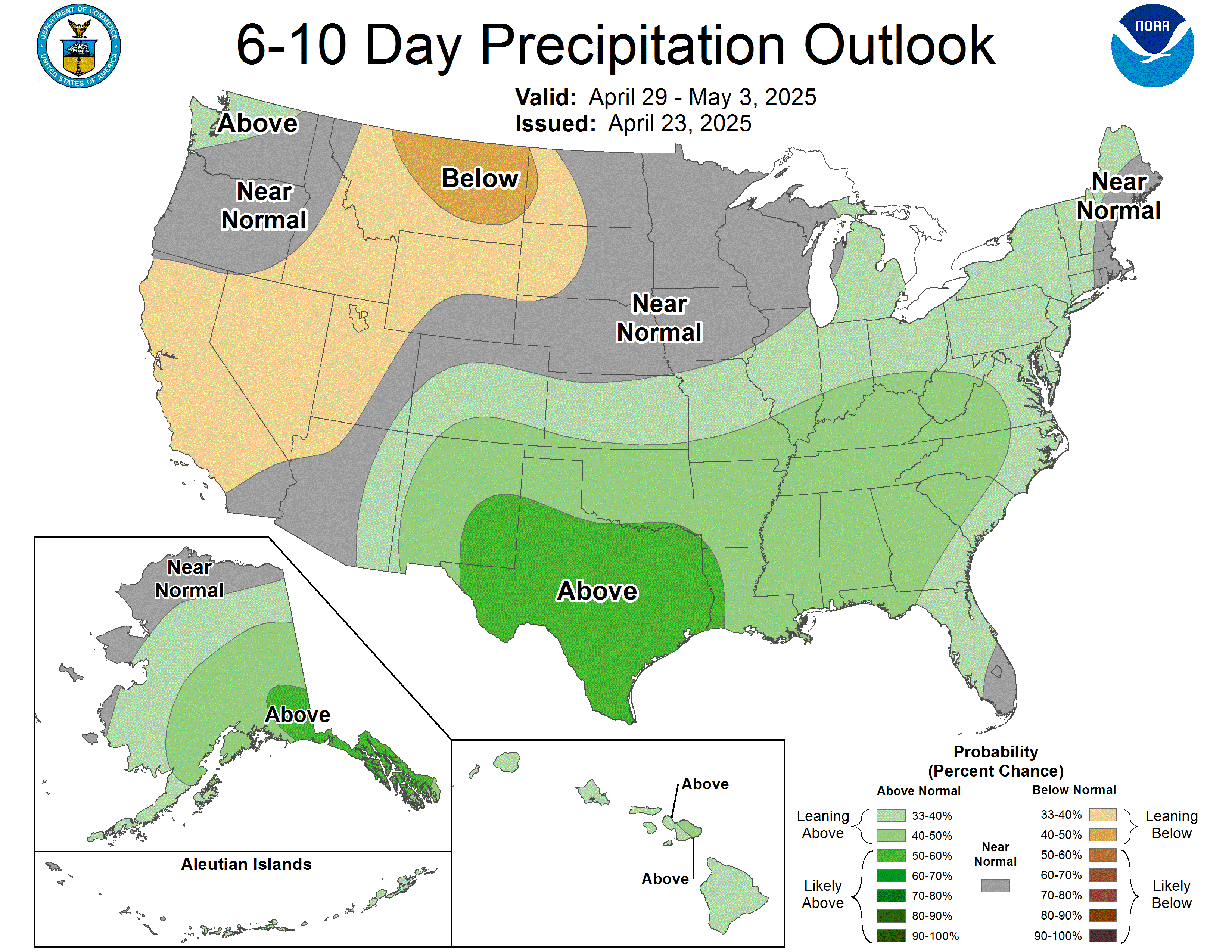 | 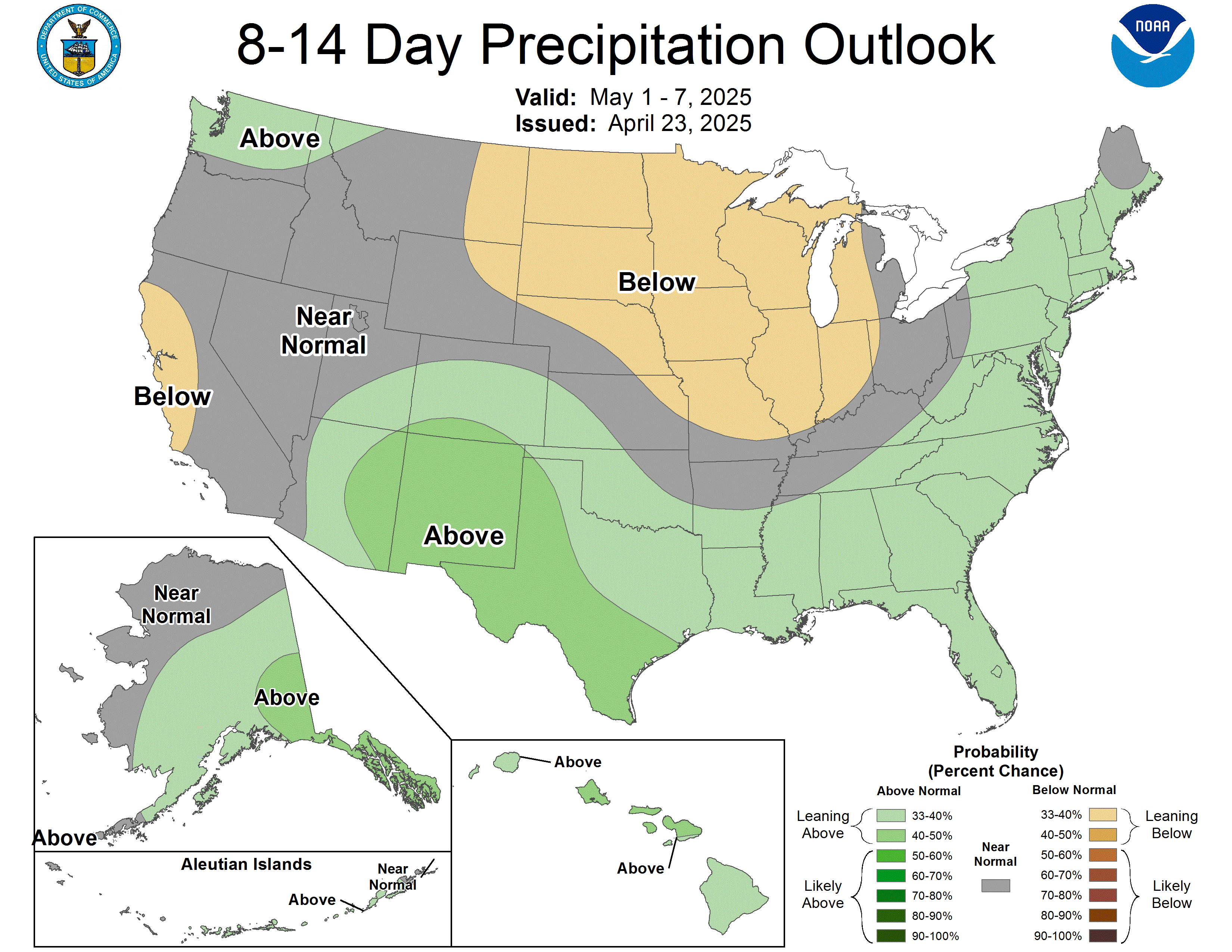 | 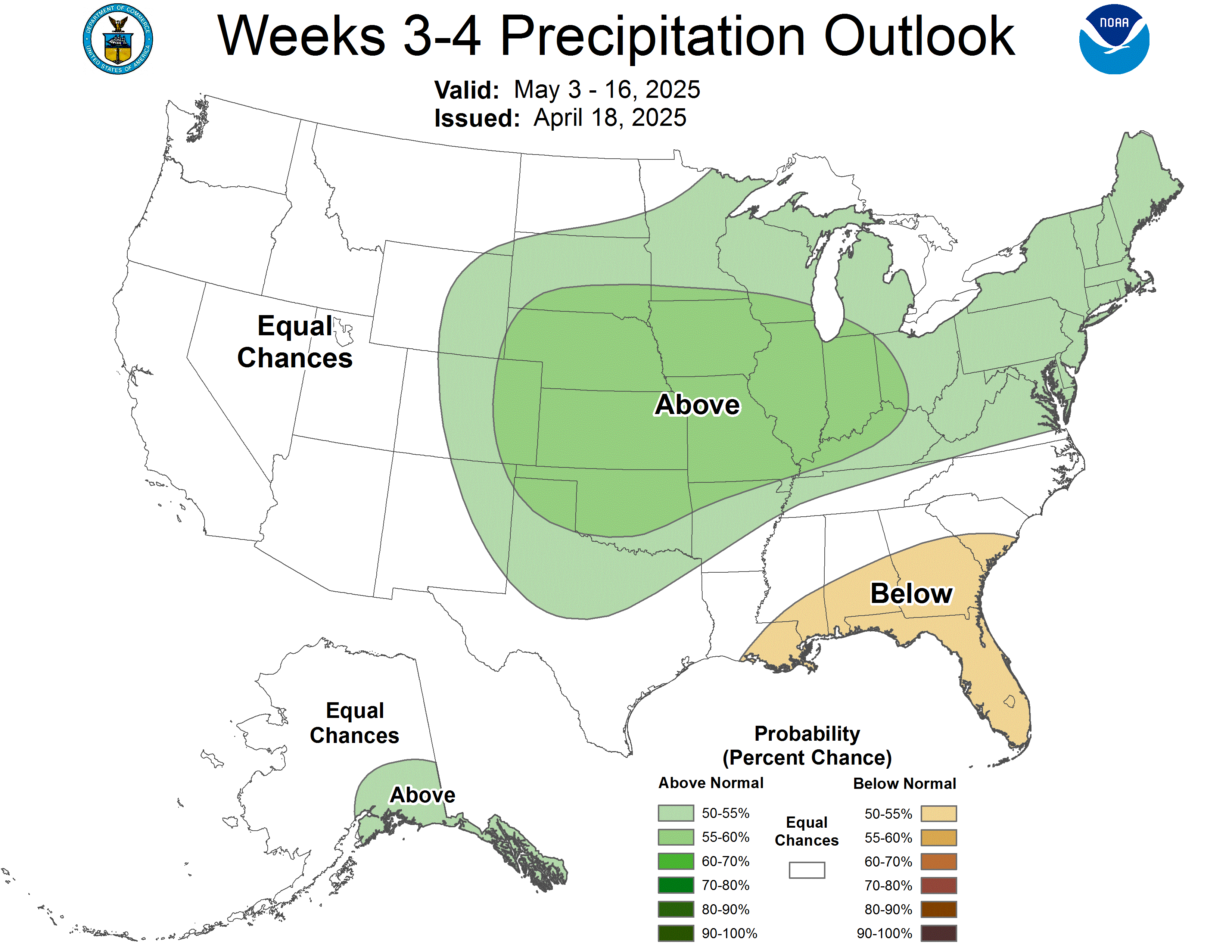 |
| The new monthly forecast is to the right. Does it appear to be reflective of the parts of the month for which we have forecasts? → |
| ↑ It is properly too soon to do this analysis. We may do an update on July 24 as we will have seven more days of the early month forecast to work with. We will also revisit the forecast at the end of July when the August forecast is updated. ← |

Sometimes it is useful to look at the Week 3-4 Discussion
Week 3-4 Forecast Discussion Valid Sat Aug 01 2020-Fri Aug 14 2020
ENSO-neutral conditions currently are present across the Pacific Ocean. Equatorial sea surface temperatures (SSTs) are near-to-below average across the central and eastern Pacific Ocean, and above average in the western Pacific. The RMM MJO index indicates a more organized eastward propagation of the intraseasonal signal during the past week. Most dynamical models forecast the MJO signal to rapidly weaken in the next two weeks. Dynamical and statistical forecasts indicate the MJO is unlikely to have a significant influence on the mid-latitude circulation pattern. The week 3-4 temperature and precipitation outlooks are based primarily on dynamical model forecasts from the NCEP CFS, ECMWF, and JMA, and the Sub-seasonal Experiment (SubX) multi-model ensemble (MME) of experimental and operational ensemble prediction systems. Anomalously warm SSTs, surrounding Florida and much of Alaska, were also a factor in the Week 3-4 temperature outlook, as well as the evolution of week 2 forecasts.
Dynamical model 500hPa height anomaly forecasts during week 3-4 show a fairly consistent evolution from the forecast state during Week-2. A broad subtropical ridge is forecast to persist over the central and southern CONUS and troughing is predicted near the West Coast. The CFS and ECMWF as well as the JMA models indicate positive 500-hPa height anomalies over the Aleutians, while negative 500-hPa height anomalies are forecast over most of mainland Alaska. Most models appear consistent in predicting above normal 500-hPa heights over Hawaii.
Enhanced probabilities of above normal temperatures are predicted across most of the CONUS, under a predicted ridge and positive 500-hPa height anomalies in dynamical model forecasts. The official week 3-4 temperature outlook indicates the greatest probabilities for above normal temperatures exceeding 60 percent over much of the southern CONUS (and probabilities exceeding 80 percent over Florida), where dynamical model forecasts are most consistent and decadal temperature trends are significant. Below normal 500-hPa heights over mainland Alaska enhance the likelihood of below normal temperatures, while above normal temperatures are favored over the Aleutians due to above normal 500-hPa heights and above normal SSTs in adjacent waters.
The dynamical model guidance is in reasonably good agreement on the spatial pattern of anomalous precipitation during the week 3-4 period. The week 3-4 outlook indicates enhanced probabilities of above median precipitation for Alaska, ahead of a predicted trough, persisting from the week 2 period. Mean ridging and above normal heights lead to enhanced probabilities of below normal precipitation across much of the Central and Southern Plains and the Middle and Lower Mississippi Valley. Below median precipitation is likely for much of the Pacific Northwest, the Northern and Central Great Basin, and much of the northeastern CONUS, while above normal precipitation is likely over parts of the Northern Plains, southeastern Arizona, southwestern New Mexico, and Southern Florida, consistent with the Autoblend, and CFS/ECMWF/JMA Correlation or Equal Weighted precipitation tools.
Positive SST anomalies support increased chances of above normal temperatures throughout the Hawaiian Islands. A consensus of the SubX dynamical models predicts likely above normal precipitation for Kahului, Honolulu, Lihue, and near normal precipitation for Hilo.
Now we consider the three-month Outlook.
Notice that the three-month periods are abbreviated e.g. August/September/October is shown as ASO. You will see such abbreviations often in this report.
Prior Temperature Outlook for ASO 2020

New Temperature Outlook for ASO 2020

Now Precipitation.
Prior forecast for ASO 2020

New Precipitation Outlook for ASO 2020

Now let us focus on the long-term situation.
First Temperature
Prior 14 Month Temperature Outlook: ASO 2020 – JAS 2021

New 14 Month Temperature Outlook: SON 2020 – ASO 2021

To compare maps from one release to another, one needs to remember that the new release drops one three-month period and adds a later one. So to make the comparisons one has to shift the new maps to the right one position and that makes the map on the right drop-down to become the left-most map in the next level. I do not have a computer software tool for doing that for you so you have to do it mentally. When I do the comparison, I print the two sets of maps and put them side by side and number the same three-month maps 1, 2, 3,…..,11 in both sets of maps to make it easier for me to easily compare the same three-month period in the new with the previous forecast. One uses the same procedure to compare the precipitation maps. Based on this procedure, I conclude that:
Now Precipitation
Prior 14 Month Precipitation Outlook: AS0 2020 – JAS 2021

New 14 Month Precipitation Outlook: SON 2020 – ASO 2021

If you want larger versions of each map (temperature and precipitation) you can find them here. And then each of those maps can be clicked on to further enlarge them.
Sometimes it is useful to compare the three-month outlook to the forecast for the first of the three months. It shows how much the pattern changes over the three months.

One can mentally subtract the First-Month Outlook from the Three-month Outlook and create the Outlook for the last two months in the three months.
*The concept is that the probabilities of a deviation from climatology in the First Month and the combined Month Two and Three forecast that one derives must average out to the probabilities shown in the three-month maps.
Below is the NOAA Discussion (slightly reorganized) released by NOAA on July 16, 2020. Headings that are “Initial Cap” only rather than all caps were added by the Author of this Update Report for clarity. Also, we have organized the sequence of the sections of NOAA Discussion to first present the Atmospheric and Oceanic Conditions and then the Initial Month (AugustJuly), the new NOAA Summary for ASO, and finally the remainder of the 15-Month Forecast.
CURRENT ATMOSPHERIC AND OCEANIC CONDITIONS
Oceanic and atmospheric observations across the equatorial Pacific indicate ENSO-neutral conditions persisted into July. Observed sea-surface temperatures (SSTs) for the previous 30 days showed positive anomalies west of 170W and negative anomalies anomalies from about 150 degrees W longitude eastward to near the coast of South America. Positive subsurface temperature anomalies continued to be confined to the western Pacific, with negative temperature anomalies to a depth of 150 meters in the eastern Pacific. Integrated upper-ocean heat anomalies declined rapidly since earlier this spring, though they have since recovered to a value that is now slightly negative. Easterly low-level wind anomalies were present over the western low-latitude Pacific during the previous 30 days, with westerly upper-level wind anomalies along the equator over the western equatorial Pacific Ocean. Positive outgoing longwave radiation (OLR) anomalies, during this same period show suppressed convection across the western and central equatorial Pacific. Negative OLR anomalies were noted over portions of the Maritime Continent.
PROGNOSTIC DISCUSSION OF SST FORECASTS
The CPC SST Consolidation for the Nino 3.4 region indicates an SST anomaly declining to near -1.0C (well within La Nina territory) during the autumn, being significantly skewed by the colder outlying CFS solution. In contrast, the other inputs to the CPC SST Consolidation (the canonical correlation analysis (CCA), constructed analog (CA), and Markov statistical models) remain well within the Neutral tercile (predicted SST anomaly range between -0.5C and +0.5C). The CPC/IRI consensus forecast favors ENSO-neutral conditions through the Northern Hemisphere summer, with a possible La Nina developing this autumn (50%-55% chance). There are comparable odds (50% chance) of a La Nina this winter. [Editor’s Note: See our ENSO considerations section later in this report]
30-DAY OUTLOOK DISCUSSION FOR AUGUST 2020
The main factors influencing the August 2020 outlooks for temperature and precipitation are trends , soil moisture, potential impacts from tropical cyclone activity, and dynamical model output (including post-processed data). A La Nina watch was issued in early July, so La Nina conditions are factored into the monthly outlook, though impacts are likely to be minimal for a single month rather than a full season in the heart of a La Nina event. Through the first half of the month, current information indicates that the Madden-Julian Oscillation is not likely to play a large role in determining the anomalous circulation pattern, nor the accompanying temperature or precipitation patterns.
Temperature
The highest odds for above normal temperatures during August stretch from the Southern Plains to the Mid-Atlantic and Northeast. Model forecast data have a consensus for above normal temperatures across much of the CONUS, with the exception of the Northwest to the Northern Plains and a relative weakness across the Southeast. Across the Southern Plains and Central High Plains, ongoing drought conditions also favor above normal temperatures, which aligns with the model output. Trends in the Northeast favor above normal temperatures in August, aligning with model data. Correlations of temperature with either Nino 3.4 or MEI support above normal temperatures in the eastern half of the CONUS, with a weakness in the Pacific Northwest and Northern Rockies, so no strong signals are indicated for the Pacific Northwest and Northern Rockies.
Precipitation
The potential for enhanced tropical cyclone activity and the reflection of the general circulation pattern associated with La Ninas in August result in a slight favoring of above normal precipitation across the Southeast. Below normal precipitation is favored for the southern Rockies, southern High Plains, and into the central Great Plains as La Nina is typically associated with reduced monsoonal activity into the central Rockies, Four Corners region, and central Great Plains region. Additionally, ongoing drought can have a negative feedback on precipitation in the plains. Model guidance is uncertain about the spatial extent of the below normal precipitation, so the area indicated in the outlook is where the C3S model suite mean and the NMME mean overlap. Correlations with La Nina and model guidance weakly favor above normal precipitation over the Northern Plains, which would be consistent with a relative weakness in odds for above normal temperatures for the same region.
Alaska
Temperature trends in August are weak for interior Alaska and many of the models showed a weak signal there, so equal chances are indicated. A slight favoring of above normal temperatures across western and southern Alaska, as well as the Alaska Panhandle is supported by model outlooks and trends , but mitigated by relationships with La Nina. A mean storm track across Southern Alaska, supported by model outlooks and correlations with La Nina conditions favors above normal precipitation across southern and western Alaska, from the Seward Peninsula to the Alaska Panhandle.
SUMMARY OF THE OUTLOOK FOR NON-TECHNICAL USERS (focus on ASO)
Temperature
The August-September-October (ASO) 2020 temperature outlook favors above normal temperatures across all of the contiguous U.S. and Alaska.
Precipitation
The ASO precipitation outlook favors above normal precipitation over southern portions of Alaska, including the Aleutian Islands and the Alaska Panhandle. Above normal precipitation is also favored for much of the Northern Great Plains and Upper Mississippi Valley, and all areas southeast of an approximate line that extends from southern New Jersey to southwestern Louisiana. There are elevated odds of below normal precipitation from southern Idaho and eastern Nevada across much of the Rockies to the south-central Great Plains region. Equal chances (EC) of below, near and above normal precipitation are indicated for northern Alaska, and for all remaining areas of the contiguous U.S.
BASIS AND SUMMARY OF THE CURRENT LONG-LEAD OUTLOOKS ( The Summary is actually shown right above. )
PROGNOSTIC TOOLS USED FOR U.S. TEMPERATURE AND PRECIPITATION OUTLOOKS
Tools used for the seasonal outlooks included dynamical model guidance such as the North American Multi-Model Ensemble (NMME) and the Calibration, Bridging, and Merging (CBaM) version of the NMME. Current soil moisture conditions played a role in the ASO temperature outlook, primarily across the southern Rockies and adjacent High Plains region. The seasonal consolidation tool, which includes dynamical model input from the NMME and various statistical tools such as regressions of observed temperature and precipitation on the CPC Nino 3.4 SST consolidation, was used. The likelihood of either a neutral or weak cold event this autumn played a role in both temperature and precipitation outlooks. During the 2021 warm season decadal trends were the primary source of climate signals.
PROGNOSTIC DISCUSSION OF OUTLOOKS – ASO 2020 TO ASO 2021
TEMPERATURE
Above normal temperatures are likely across the entire CONUS and Alaska during ASO with the largest probabilities (60% or greater) over western Alaska, the southwestern CONUS including California, the Northeast, and southern Florida, based on excellent agreement among dynamical and statistical forecast tools, including a strong decadal signal. The primary change made from the previous outlook (valid for ASO 2020) includes a reduction of probabilities for above normal temperatures over the northwestern quarter of the CONUS, due in part to the expected development of a weak La Nina. A secondary change made from the previous outlook involves a slight reduction in probabilities for above normal temperatures from the Northern Great Plains southeastward across much of the Middle Mississippi Valley, as supported by many of the dynamical and statistical tools. Soil moisture was also a consideration for the updated ASO temperature outlook, especially over the Southwest and Southern High Plains region. With the delay in the onset of the Southwest summer monsoon favoring increased chances of above normal temperatures, pre-existing drought across the region is expected to worsen, in part due to reduced evapotranspiration and its impact on local moisture recycling. In SON and OND, the continuing trend in delayed sea ice formation near Alaska’s North Slope supports odds of at least 70% for above normal temperatures in that area. Across the northwestern CONUS, probabilities for above normal temperatures continue to gradually decline from previous respective outlooks, as supported by various tools and aligned with the expected development of a weak La Nina this autumn. The bridging component of the CBaM tool (which uses statistical relationships between NMME Nino 3.4 forecasts and U.S. surface temperature and precipitation) also picks up on a cooler solution across the Northwest. In the Northeast, strong trends favoring above normal temperatures in ASO and SON begin to weaken in OND. By NDJ and DJF 2020, the weak tilt towards above normal temperatures over eastern and southern portions of Alaska, and the north-central CONUS, give way to Equal Chances (EC), in part due to increased temperature variability at this time of year, and increased odds of La Nina. The outlooks from JFM to MAM 2021 are based on a general consensus of statistical and dynamical models and tools, and to some degree on La Nina composites, even though the odds for a La Nina this winter stand at 50%. During these three seasons (JFM to MAM 2021), there are increased chances for below normal temperatures at various times across northern border states between the Upper Great Lakes region and the coast of Washington state. Probabilities for above normal temperatures are greatest (at least 50%) over the southern CONUS. For the remaining seasons, AMJ through ASO 2021, the temperature outlooks are based primarily on decadal timescale trends .
PRECIPITATION
During ASO, above normal precipitation amounts are favored across southern and much of western Alaska, and the Northern Plains and adjacent portions of the Upper Mississippi Valley, due to a general consensus of dynamical and statistical guidance, and expected influences from a possible weak La Nina. Above normal precipitation amounts are also indicated over the southeastern portion of the CONUS, about as far north as Delaware and as far west as western Louisiana. This is supported by the CFS and the Final CON tool (which uses the CCA, CA, ENSO-OCN tool, and dynamical NMME guidance). This broad signal for abnormal wetness is also consistent with long-track tropical cyclones that often develop over the deep tropics of the eastern Atlantic during August and September and eventually go on to influence the Southeast CONUS. Below normal precipitation amounts are favored from eastern Nevada and southern Idaho southeastward into the south-central Plains. This is based largely on the Stat CON tool (which uses the CCA, CA, and ENSO-OCN tools, but does not use dynamical NMME guidance) with some contribution from longer-term trends . In SON and OND, the continuing trend in delayed sea ice formation in the vicinity of the Beaufort Sea, resulting in a prolonged period of open water and available moisture, increases the odds for above normal precipitation across the North Slope region. Enhanced odds for wetter than usual conditions across southern Alaska and portions of the northwestern and north-central CONUS are consistent with the idea of a developing La Nina. The wet signal across the Southeast weakens rapidly from ASO to SON. The area of increased odds for below normal amounts of precipitation is predicted to expand east-southeastward with time, from ASO to OND. For NDJ and DJF 2020, a consensus of dynamical and statistical guidance indicates a broadening area of above normal precipitation across the northern CONUS, with elevated odds of below normal precipitation across most of the southern tier of states. This pattern is reminiscent of a typical cold season La Nina, given somewhat more information now than was available last month. This northern wetness/southern dryness pattern is expected to persist during JFM and FMA, with the dry signal gradually disappearing over the Southeast. At the longer leads, MAM through ASO 2021, the tilt in the odds towards above normal precipitation across parts of the central and eastern CONUS is consistent with decadal trends . The area of favored below normal precipitation for parts of the Southwest during MAM 2021 is consistent with decadal trends . Elsewhere, Equal Chances (EC) of below, near, and above normal seasonal accumulated precipitation amounts are favored.
We will discuss this more when we compare the JAMSTEC to the NOAA forecast. But it is useful to look at the JAMSTEC discussion especially as it applies to Autumn.
July 17, 2020
Prediction issued on July 1, 2020
ENSO forecast:
Observation shows that a weak La Niña is developing at present. The SINTEX-F predicts that the weak La Niña-like condition will persist in the latter half of this year.
Indian Ocean forecast:
Observation shows that the western tropical Indian Ocean is warmer-than-normal at present. The model predicts the evolution of a moderately positive Indian Ocean Dipole (IOD) from boreal summer. The predicted IOD will quickly decay in boreal autumn, in which a typical IOD usually matures. However, there is a large uncertainty in the prediction (15% of the ensemble members actually predict a negative IOD event).
The strong negative Indian Ocean Subtropical Dipole still persists. The model predicts that it will disappear from austral winter.
Regional forecast:
On a seasonal scale, the SINTEX-F predicts that most part of the globe will experience a warmer-than-normal condition in boreal summer and autumn.
As regards to the seasonally averaged rainfall in boreal summer, a drier-than-normal condition is predicted for most part of the South American Continent, South Africa, West Africa, central China, and western Indonesia. In contrast, most part of southern U.S.A., Mexico, India, Southeast Asia, Philippines, eastern Indonesia, eastern China, and the Korean Peninsula will experience a wetter-than-normal condition. In boreal autumn, a wetter-than-normal condition is predicted for northwestern coastal area of Canada, India, Southeast Asia, Philippines, and Indonesia. In contrast, eastern U.S.A., western part of the South American Continent, eastern part of South Africa, some part of West Africa, southeastern Europe facing the Mediterranean Sea will experience a drier-than-normal condition.
The model predicts most part of Japan will experience hotter-than-normal condition in summer as a seasonal average. In autumn, most part of Japan will experience hotter- and wetter-than-normal condition.
New Seasonal Drought Forecast (It is not set up to auto-update but you can always find the new Seasonal Drought forecast here) But it will not update until August 20, 2020.

Latest Seasonal Assessment – Since mid-June 2020, changes in drought severity were highly variable, with areas of improvement intertwined with areas of intensification. But overall, there was more deterioration than improvement. A few areas of rapid intensification (2 or more categories) were noted in New England (primarily Maine), much of the Plains, and part of the upper Midwest. Steep short-term rainfall deficits and persistently above-normal temperatures sparked drought in these areas, where no dryness was evident four weeks earlier.
But despite the rapid development in those areas, the most intense drought in the country (D3, extreme drought) covered about the same areas as in mid-June — the southern half of Colorado, adjacent areas in northern New Mexico and southwestern Kansas, several patches in the Texas and Oklahoma Panhandles, parts of eastern New Mexico and adjacent western Texas, and farther west in sections of Oregon and northern California.
Over the course of the next few months (through October 2020), the pattern of drought intensity changes should effectively split the contiguous states into two areas. Improvement is anticipated in drought areas from the Northeast and Appalachians westward across the northern Ohio Valley, upper Midwest, and northern Plains. To the south and west of this swath — across the rest of the contiguous United States — existing drought should persist or intensify. In addition, drought is forecast to expand into much of central and southwestern Texas, plus a few isolated areas in northwestern Texas, northeastern Colorado, and along the northern reaches of the New Mexico/Arizona border. Thus, broad areas of severe to extreme drought (D2 to D3) should continue affecting large areas from the Plains westward through California and the Northwest.
Drought in the central High Plains may push eastward into central Kansas early in the period, but any development is not expected to last through October 2020, so no development is depicted on the map.
Drought in Hawaii is expected to persist or worsen, expanding into central and southern sections of the Big Island, much of Lanai, and part of south-central Mauai by the end of the period. In contrast, increasing rainfall across Puerto Rico over the next few months should bring drought improvement (D2) and removal (D1) commonwealth-wide.�
ENSO Considerations
Here is what NOAA released last Thursday July 9, 2020 which is the official time (second Thursday) for them to make that release.
ENSO Update


It is useful to take a look at what the Equatorial Pacific looks like.
First we look at the situation a month ago.

Then we take a look at the current situation.

It is useful to see what some other agencies think. This is the JAMSTEC forecast

Here is is the JAMSTEC Modoki Forecast.

And here is what the Bureau of Meteorology BOM in Australia thinks as of July 4, 2020

NOAA has their own proprietary model which they rarely use.
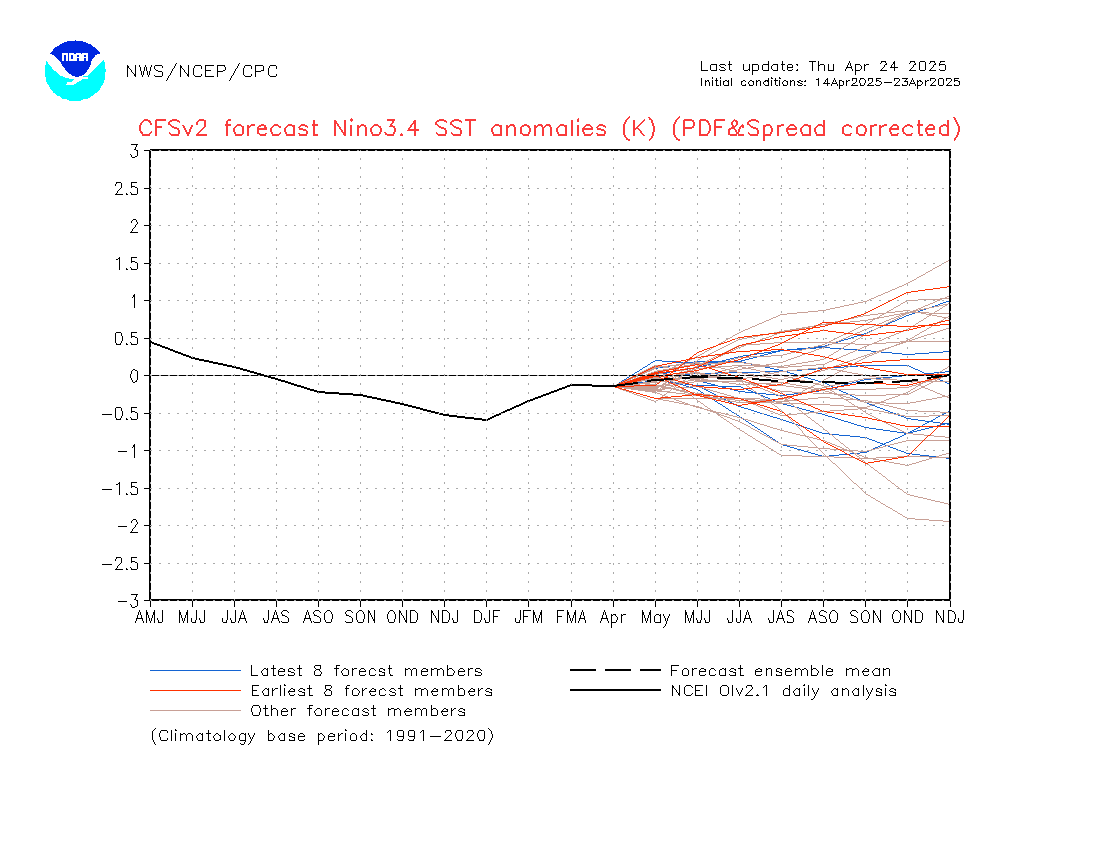
Right now it is clearly forecasting La Nina and looks a lot like the BOM forecast.
And the JAMSTEC IOD

And the BOM IOD

B. Conclusion
We seem to be headed into La Nina. We expect the August 13, 2000 NOAA ENSO Advisory will upgrade to La Nina and the August 20, NOAA Seasonal Outlook will be a more definitive La Nina Forecast.


