


Written by Sig Silber
We published the NOAA Long-Term Forecast Part I Thursday night. Here we compare the NOAA forecast for Alaska and CONUS with the JAMSTEC forecast. Also provided are the JAMSTEC World Forecasts. It is easier to see the disagreements by comparing the maps but we have attempted to create a summary table. With respect to Alaska and CONUS, the disagreements are more pronounced for precipitation than temperature. The precipitation disagreements apply to all three seasons: Summer, Fall, and Winter. Obviously the farther out you look, the less confidence you have in the forecasts and thus the differences in the forecasts.

Please share this article – Go to the very top of the page, right-hand side for social media buttons. Please feel free to send this article to anyone who you think might find it interesting and or useful.
C. Comparison of the NOAA and JAMSTEC Forecasts
Below (in what I call the “Summary”) is the comparison of the NOAA and JAMSTEC temperature and precipitation forecasts for three time-periods and from left to right the NOAA forecast for Alaska and CONUS (the contiguous mid-latitude U.S) and then JAMSTEC for North America (which includes Canada and Mexico). The NOAA forecasts can be clicked on to enlarge. The JAMSTEC graphics in the Summary Table are not set up to be clicked on to enlarge (because we have no larger version of them). We have concluded that these smaller images work fine for comparison purposes. Later in the article, we show the World Forecasts.
JAMSTEC works with three-month seasons: Summer JJA, Fall SON and Winter DJF. Out of each three months, there is one where the months in the two forecasts align perfectly for the first time period. This is not one of those months so for the first period we are comparing JJA for JAMSTEC against JAS for NOAA. It is not ideal but ok as long as you keep in mind that it is a slightly different period but pretty much summer in both cases.
In addition to the value of comparing the JAMSTEC and NOAA forecasts, the JAMSTEC forecast by showing North America provides more context for the Alaska and CONUS Forecasts as the temperature and precipitation patterns cover North America, not just Alaska and CONUS.
Here is the summary of our findings.
Temperature
| NOAA Alaska Plus CONUS | JAMSTEC North America | |
Summer JAS 2000 for NOAA and JJA for JAMSTEC 2020 |  |  |
Fall SON 2020 |  |  |
Winter DJF 2020- 2021 |  | |
Precipitation
| NOAA Alaska Plus CONUS | JAMSTEC North America | |
Summer JAS 2000 for NOAA JJA 2020 for JAMSTEC |  |  |
Fall SON 2020 |  |  |
Winter DJF 2020 – 2021 |  |  |
We provided the full NOAA Discussion in Part I. The much shorter JAMSTEC Discussion was published on June 10, 2020, and we included it in Part I but we are repeating it here also.
June 10, 2020 Prediction issued on June 1, 2020
ENSO forecast:
Observation shows that a weak La Niña is developing at present. The SINTEX-F predicts that the weak La Niña-like condition will persist in the latter half of this year.
Indian Ocean forecast:
Observation shows that the western tropical Indian Ocean is warmer-than-normal at present. The model predicts the evolution of a moderately positive Indian Ocean Dipole (IOD) from boreal summer. The predicted IOD will quickly decay in boreal autumn, in which a typical IOD usually matures. However, there is a large uncertainty in the prediction (15% of the ensemble members actually predict a negative IOD event).
The strong negative Indian Ocean Subtropical Dipole still persists. The model predicts that it will disappear from austral winter.
Regional forecast:
On a seasonal scale, the SINTEX-F predicts that most part of the globe will experience a warmer-than-normal condition in boreal summer and autumn.
As regards to the seasonally averaged rainfall in boreal summer, a drier-than-normal condition is predicted for most part of the South American Continent, South Africa, West Africa, central China, and western Indonesia. In contrast, most part of southern U.S.A., Mexico, India, Southeast Asia, Philippines, eastern Indonesia, eastern China, and the Korean Peninsula will experience a wetter-than-normal condition. In boreal autumn, a wetter-than-normal condition is predicted for northwestern coastal area of Canada, India, Southeast Asia, Philippines, and Indonesia. In contrast, eastern U.S.A., western part of the South American Continent, eastern part of South Africa, some part of West Africa, southeastern Europe facing the Mediterranean Sea will experience a drier-than-normal condition.
The model predicts most part of Japan will experience hotter-than-normal condition in summer as a seasonal average. In autumn, most part of Japan will experience hotter- and wetter-than-normal condition.
JAMSTEC World Forecasts
This month our comments are taken directly from the JAMSTEC discussion. Now that JAMSTEC has a number of models we are not exactly sure of the best one to display and they vary somewhat. We assume that the JAMSTEC discussion considers their various models and provides their assessment having considered their suite of models.
Summer which is JJA for JAMSTEC and JAS for NOAA.
| Temperature |
 |
| Precipitation |
 |
Fall which is SON
 |
| Precipitation |
 |
And Winter which is DJF
| Temperature |
 |
| Precipitation |
 |
D. Conclusion
As usual, there is substantial disagreement between NOAA and JAMSTEC especially with respect to precipitation. It is difficult to relate the differences in the forecast to differences in assumptions on ENSO. But JAMSTEC tends to consider other factors that may not be considered by NOAA. On the other hand, the new versions of the JAMSTEC model are early in their usage and may not have been fully calibrated. I do not think I have gone into it in detail but when it comes to models we need to recognize that there are limitations and NOAA and JAMSTEC use very different approaches which I have summarized in the below table.
| Shorter Term | Intermediate-Term | |
| NOAA | Deterministic | Statistical |
| JAMSTEC | Deterministic | Deterministic (may also use statistical methods) |
| Assessment | Generally Considered to be reliable for 14 to 28 days | Errors build up in deterministic models and statistical models generally have insufficient historical data to be reliable |
So it is kind of a pick your poison choice. But both agencies have great skill at employing approaches that have inherent limitations.
E. SINTEX Indices
I am showing these to illustrate how complex the SINTEX model is. They do not do a good job of labeling all of their indices. I am not sure I have the expertise and I am sure I do not have the time to relate the forecast of the indices to the weather forecast maps and there is no guarantee that the forecasts of the indices are correct. But it does provide some insight into why the JAMSTEC forecast is what it is.

NOAA usually does not express much faith in their proprietary model but instead relies on both an international panel of meteorologists and a selection of computer models.
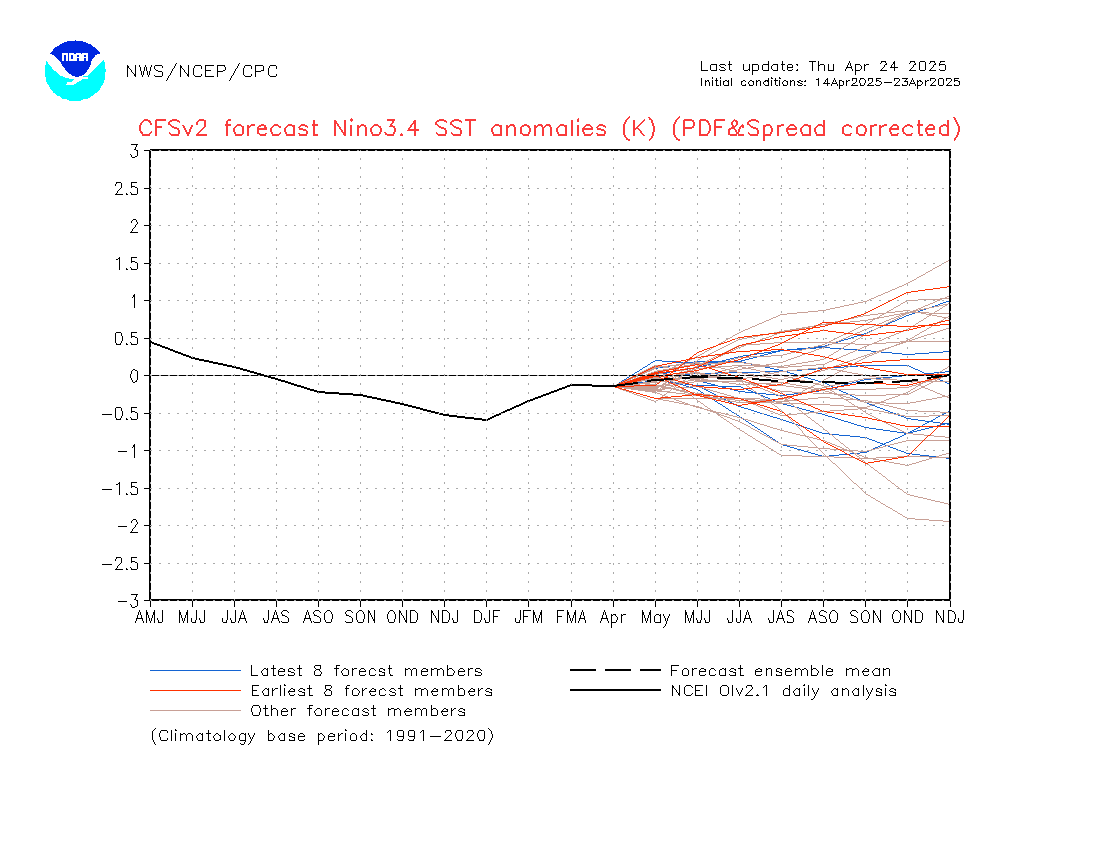
But for whatever it is worth this is the NOAA Model and unlike the others, I let this one update rather than freezing it
so if you come back in six months for sure it will look different. I leave it live for two reasons.
A. The actual NINO 3.4 readings update and they are official estimates from NOAA
B. Whether or not NOAA has confidence in their own model paid for by the taxpayer it should be showing changes. The Australian Bureau of Meteorology (BOM) has its own proprietary model and also pays attention to what other agencies are forecasting. So it is not that unusual. The information from the other agencies can be accessed I am sure daily but NOAA through its contractor provides updates twice a month or once a month and this model updates daily. So feel free to access this article and look at this forecast any time you want.
Right now it is in line with pretty much everyone’s forecast but may get to La Nina faster than NOAA wants…oops did I say that? I probably should have said they want to keep people in suspense to make their announcement on July 14, 2020, more newsworthy.


Here is the Australian Bureau of Meteorology (BPM) forecast for the IOD.

Here is what BOM says about it and remember their focus is Australia not all of the Indian Ocean as is the focus of JAMSTEC.
The IOD is currently neutral. Four of the six international climate models surveyed by the Bureau suggest the development of a negative IOD from the middle of the southern hemisphere winter, with other models remaining neutral. However, each model shows a broad spread of likely scenarios between the neutral and negative IOD range, and the most up to date model outlooks have shown a lower likelihood of negative IOD. A negative IOD typically brings above-average winter–spring rainfall to southern Australia.
JAMSTEC has three or four other indices which I showed last month but not tonight. They tend to impact the Pacific including possibly Southern California. But I concluded it was more information than most readers want.


