econintersect.com
  • 토토사이트
    • 카지노사이트
    • 도박사이트
    • 룰렛 사이트
    • 라이브카지노
    • 바카라사이트
    • 안전카지노
  • 경제
  • 파이낸스
  • 정치
  • 투자
No Result
View All Result
  • 토토사이트
    • 카지노사이트
    • 도박사이트
    • 룰렛 사이트
    • 라이브카지노
    • 바카라사이트
    • 안전카지노
  • 경제
  • 파이낸스
  • 정치
  • 투자
No Result
View All Result
econintersect.com
No Result
View All Result
Home Uncategorized

November, 2019 Seasonal Forecasts. Part II, NOAA Comparison with JAMSTEC

admin by admin
9월 6, 2021
in Uncategorized
0
0
SHARES
0
VIEWS

Written by Sig Silber

We published the NOAA Long-Term Forecast Thursday Night (here).  Now we compare the NOAA forecast for Alaska and CONUS with the JAMSTEC forecast. Similarly to last month, the temperature and precipitation forecasts are quite different even though the ENSO forecasts are very similar as measured by the NINO 3.4 Index. But JAMSTEC sees some Modoki characteristics in the Sea Surface Temperature pattern along the Equator in the Pacific. We also provide the JAMSTEC World Forecasts with special emphasis on Europe.

NOAA v. JAMSTEC


Please share this article – Go to the very top of the page, right-hand side for social media buttons. Please feel free to send this article to anyone who you think might find it interesting and or useful.


Because of the importance of the ENSO Phase to the weather forecast, we start by comparing the two NOAA forecasts for ENSO (specifically the Nino 3.4 Index) with the JAMSTEC forecast. The first image is the Mid-November IRI-CDC ENSO probabilities. The second image is the JAMSTEC proprietary forecast model for the Nino 3.4 Index. The third is the NOAA proprietary model CFSv2.

November 19, 2019 IRI-CPC ENSO Probabilities

JAMSTEC Nino 3.4 Forecast as of November 1, 2019

CFSv2 spread and bias corrected ENSO forecast

They are not lined up perfectly but one can easily compare them. The model results are very similar but the JAMSTEC NINO 3.4 forecast is slightly higher than NOAA. But both are in the ENSO Neutral Range. Two forecasts are shown for NOAA. It is not always clear which they use. More than likely, they at least place more weight on the IRI-CPC forecast. Now I will show the JAMSTEC Modoki Index which may play a large role in the differences in the forecasts for this Winter.
Mokoki Forecast November 1, 2019
You can see the difference, especially for November through December and into January.
The Bottom Line is that there are some minor differences when you look at the forecasts for the NINO 3.4 Index but JAMSTEC also looks at other parts of the Equatorial Pacific and there they see some Modoki aspects.  For those with more interest in this topic, you can find more information here.
This may explain the differences in the forecasts for Winter. It is more difficult to explain the differences for Spring and Summer. but those differences are not as extreme as for this coming Winter and forecasts are less reliable the farther out you go. I may want to backtrack on that statement just a bit as the precipitation for Summer 2020 is quite different from the two Agencies.

Looking beyond Alasaka and CONUS, another factor for this Winter (Summer in the Southern Hemisphere) is this very strong Indian Ocean Dipole (IOD) which is beginning to return to normal.

Here is the JAMSTEC forecast for the IOD.

  JAMSTEC IOD forecast as of November 1, 2019

We know it impacts weather for those nations that border the Indian Ocean but it may either have broader impacts or reflect broader impacts in other parts of the World. Further reading on that issue can be found here. As  you can see it is very complicated and many of the more recent papers are behind paywalls so I generally do not report on them.

Here is a little bit more explanation. 

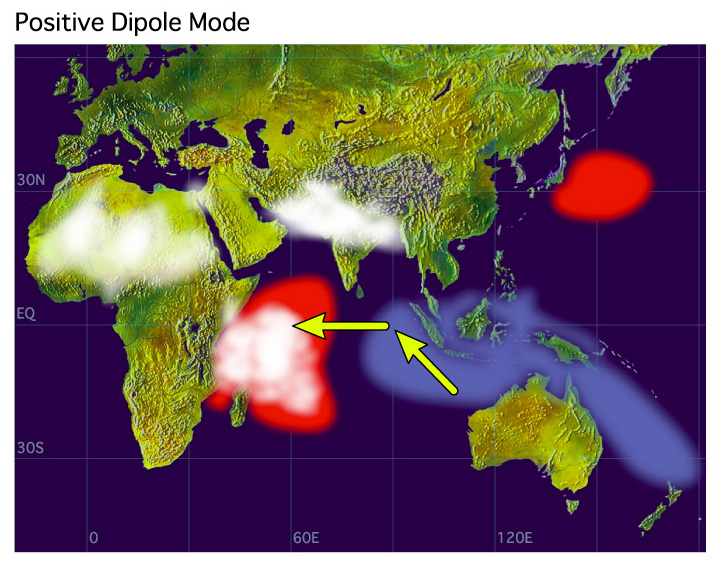
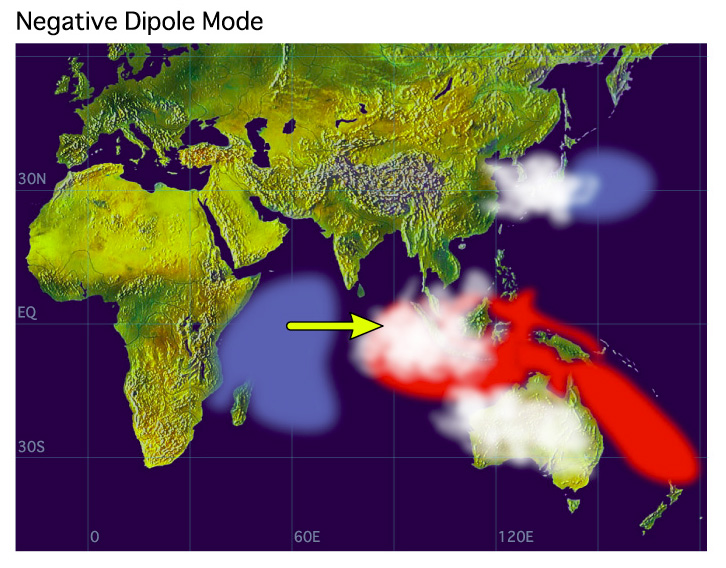
The Indian Ocean Dipole (IOD) is a coupled ocean-atmosphere phenomenon in the Indian Ocean. It is normally characterized by anomalous cooling of SST in the south eastern equatorial Indian Ocean and anomalous warming of SST in the western equatorial Indian Ocean. Associated with these changes the normal convection situated over the eastern Indian Ocean warm pool shifts to the west and brings heavy rainfall over the east Africa and severe droughts/forest fires over the Indonesian region.

Schematic of a positive IOD eventSchematic of a negative IOD event.

SST anomalies are shaded (red color is for warm anomalies and blue is for cold). White patches indicate increased convective activities and arrows indicate anomalous wind directions during IOD events.

The forecast maps do not extend beyond three seasons but for those with curiosity, here is the JAMSTEC two-year forecast for the NINO 3.4 Index.

Nino 3.4 two years as of November 1, 2019

Notice it starts just at the top of the ENSO NEUTRAL range and quickly declines and from there through the forecast period it stays within a range of +0.5C to -0.5C so it remains in the ENSO Neutral range the whole time. But above this graphic, we saw that the Modoki Index started above the +0.5C line and while declining still remained outside of the NEUTRAL RANGE into January and did not drop significantly below that line until March 2020.

C. Now to our full report. (Sections A and B were covered in Part I which can be accessed here)

This report is organized into a summary that has two tables of graphics that show the temperature and precipitation forecasts for the upcoming three seasons, a brief discussion of the ENSO assumptions by both NOAA and JAMSTEC and then the JAMSTEC Agency discussion and then a comparison of the two forecasts which is basically an expansion of the summary table.

Summary of the NOAA and JAMSTEC Forecasts

For those who want a quick synopsis of the two forecasts, below is a summary of the temperature and precipitation forecasts for three time-periods and from left to right the NOAA forecast for Alaska and CONUS (the contiguous mid-latitude U.S), then JAMSTEC for North America (which includes Canada and Mexico), and then JAMSTEC for Europe and surrounding areas. Larger graphics are provided later in the report. (the graphics in the Summary Table are not set up to be clicked on to enlarge). The Summary Table is kind of a tease to keep you reading but you can see the evolution of the weather pattern through Winter, Spring and then Summer. For some readers, these two sets of summary graphics may be all the information they wish to look at and that is fine.

In addition to the value of comparing the JAMSTEC and NOAA forecasts, the JAMSTEC forecast by showing North America provides more context for the Alaska and CONUS Forecasts as the temperature and precipitation patterns cover North America, not just Alaska and CONUS. Similarly, when I extract Europe from the JAMSTEC World Map, I include enough of North Africa and Eurasia to provide context.

Temperature

 NOAA Alaska Plus CONUSJAMSTEC North AmericaJAMSTEC Europe

Winter

DJF 2019-2020


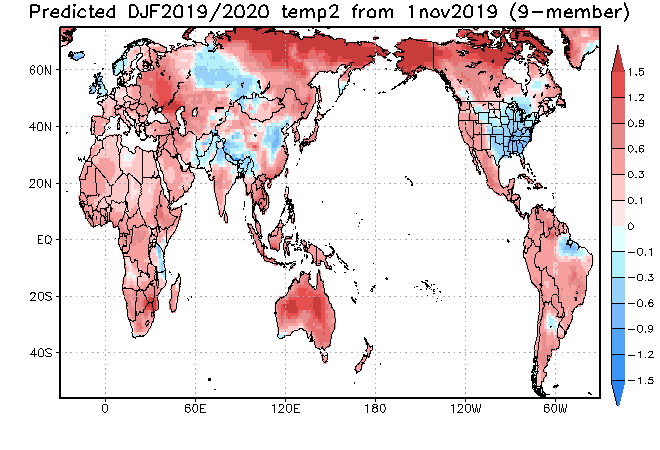
DJF 2019 - 2020 Temperature Outlook Issued November 21, 2019DJF- 2019 Temperature based on JAMSTEC November 1, 2019 ForecastDCF - 2019 Europe Temperature based on JAMSTEC November 1, 2019 Forecast

Spring

MAM 2020

MAM 2020 Temperature Issued on November 21, 2019MAM  2020 NA Temperature based on November 1, 2019 JAMSTEC ForecastMAM 2020 Europe Temperature Based on November 1, 2019 Jamstec Forecast

Summer

JJA

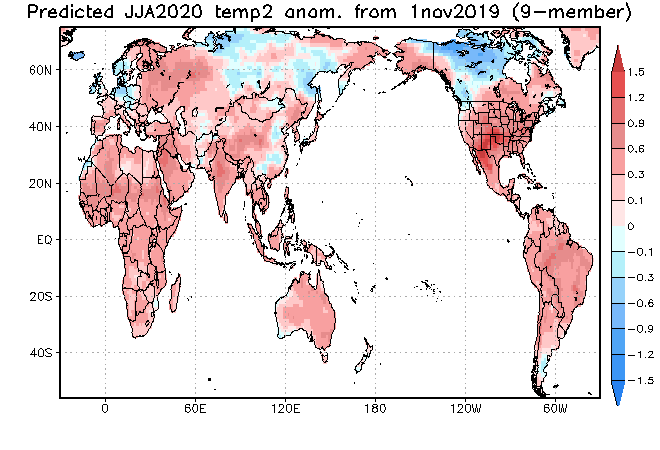
JJA 2020 Temperature Issued November 21,  2019JJA 2020 NA Temperature based on November 1, 2019JJA Temperature Europe 2010 based on November 1, 2019
I thought it would be useful to summarize my comments from the later detailed analysis. Here they are. For CONUS Temperature, Winter significant disagreement especially for the Eastern CONUS: Spring a lot of agreement except for the Northern Tier: Summer more agreement. NOAA has a very similar solution for all three seasons. JAMSTEC has similar solutions for Spring and Summer.
For Europe, it is fairly similar pattern season to season with the area surrounding the North Sea Sea and Central Siberia being a bit cool but everything else being warmer than climatology.

Precipitation

 NOAA Alaska Plus CONUSJAMSTEC North AmericaJAMSTEC Europe

Winter

DJF 2019-2020

DJF 2029 - 2020 Precipitation Issued on Novembe 21, 2019DJF 2019 - 2020 NA Precipitation based on JAMSTEC November 1, 2019 ForecastDJF 2019 - 2020 Europe Precipitation based on JAMSTEC November 1, 2019 Forecast

Spring

MAM 2020

MAM 2020 Precipitation Issued on November 21, 2019MAM 2020 NA Precipitation based on November 1, 2019 JAMSTECMAM Europe Precipitation based on November 1, 2019 JAMSTEC Forecast

Summer

JJA 2020

JJA 2020 precipitation Issued November 21, 2019JJA 2020 NA Precipitation based on November 1, 2019 JAMSTEC ForecastJJA 2010 Europe Precipitation based on November 1, 2019 JAMSTEC Forecast
I thought it would be useful to summarize my comments from the later detailed analysis. Here they are. For CONUS Precipitation: Winter agreement for California and the Northeast but disagreement for much of the Northern Tier and the location of the Mid-Continent dry anomaly which JAMSTEC shows in Mexico. Spring no longer agreement on a dry West Coast with JAMSTEC showing the dryness more in the Southeast. But there is agreement on a wet Great Lakes Region. Summer total disagreement, especially with regards to the North American Monsoon but NOAA often is reluctant to address the NA Monsoon this early. JAMSTEC correctly forecasted a failed Monsoon this year far in advance. Let’s hope they go one for two rather than two for two.
For Europe it is Sping being normal except to, the east with Winter being wetter than normal and Summer being drier than normal.

We provided the full NOAA Discussion in Part I. The much shorter JAMSTEC Discussion was published on November 15, 2019 so we have that for our Report tonight.

Nov. 15, 2019
Prediction from 1st Nov., 2019

ENSO forecast:
As predicted earlier, the El Niño Modoki-like state is observed now. The SINTEX-F predicts the El Niño Modoki-like state will persist at least until early winter. We need to be careful of its impact, as it may be different from that of the canonical El Niño. Then, the model predicts that the tropical Pacific will return to a neutral-state from late winter through year 2020.

Indian Ocean forecast:

The positive Indian Ocean Dipole is now fully established reaching a level similar to that of the extremely strong events of 1994 and 1997. The model predicts that the positive Indian Ocean Dipole will persist in late autumn, and then decay in winter. We may observe co-occurrence of a positive Indian Ocean Dipole and an El Niño Modoki-like state in autumn and winter; this is as we observed in 1994 and 2018.

Regional forecast:

On a seasonal scale, the SINTEX-F predicts that most part of the globe, particularly Australia, will experience a warmer-than-normal condition in boreal winter, except for most part of eastern U.S.A, northeastern Brazil, U.K., central Russia, northern part of the Indian subcontinent, and some parts of China. In boreal spring of year 2020, almost all part of the globe will still experience a warmer-than-normal condition, except for U.K. and some parts of western Europe.

As regards to the seasonally averaged rainfall in boreal winter, a wetter-than-normal condition is predicted for Alaska, northeastern Brazil, East Africa, and northern part of Europe, and eastern China. In contrast, some parts of western U.S.A., northern part of the South American continent, southeastern Brazil, Australia, southern Africa, southern part of Europe, some parts of Southeast Asia, Indonesia, Sri Lanka and Philippines will experience a drier-than-normal condition. In boreal spring of year 2020, a wetter-than-normal condition is predicted for northeastern U.S.A., northwestern part of the South American continent, South Africa, and eastern China. In contrast, most part of Brazil, Australia, western part of West Africa, some parts of Southeast Asia, Philippines, and southern China will experience a drier-than-normal condition.

The model predicts most part of Japan will experience warmer and slightly drier-than-normal condition in the coming winter and spring as a seasonal average.

Indices use a single number to convey information. Sometimes it is useful to look at the forecast Sea Surface Temperatures (SST) that correlate to the indices. I believe that the SST’s directly correlate with the JAMSTEC Nino 3.4 Index and their forecast but NOAA uses a variety of tools so it is not so easy to understand exactly how they do their forecast but there is a lot of information on that in their lengthy discussion which was presented in our Part I Report.

NOAAJAMSTEC
DJF 2019 - 2020 as of Novemer 23 19, 2019JAMSTEC DJF 2019 - 2020 aso of November 1, 2019

NOAA MAM 2019 as of November 23, 2019

MAM 2020 from November 1, 2019
MJJ 2020 SST as of November 23, 2019JJA 2020 from November 1, 2020
Do not be distracted by the choice of colors by the two agencies. The NOAA graphics are more brilliant but one needs to concentrate on the patterns, not the artistic appeal. For JAMSTEC, we have graphics here for each season but for NOAA we do not have a graphic for JJA 2020 to match the JAMSTEC map but we use the MJJ 2020 map instead.
These are fairly similar. You can see the warm area along the Equator near the Dateline in the JAMSTEC Winter and Spring Sea Surface Temperature (SST) forecasts. But you also see this in the NOAA forecasts. So the treatment of that situation in the weather forecast might be different with the forecast of the sea surface temperature anomaly being similar. Notice for NOAA, there is a fair amount of area in grey where their models have a low level of confidence. There is no sign of a traditional El Nino in any of the above SST forecasts.
Other differences which may not cover all differences include JAMSTEC showing the Davis Strait and waters south of Greenland to be cool. JAMSTEC also clearly shows PDO+ (a long cycle that behaves much like a weak El Nino). There are differences relative to the Indian Ocean.

Updates from JAMSTEC can be found here. Updates from NOAA can be found here. You have to look for the SST row and go to the right where it says “normalized with mask” and click on E3 which provides the latest model run.

All of these forecasts depend to a large extent on what is known about subsurface temperature anomalies. Here is the latest analysis. Updates can be obtained here.

I am showing three months: first two historical months shown side by side and then the current month.

Two Months agoOne Month ago
Subsurface Anomalies September 21, 2019Euatorial Pacific as of October 19, 2019

The Current Month. (Updates can be obtained here)

Equatorial Pacific as of November 23, 2019

This is a cross-section along the equator. In general, the Equatorial Current moves from west to east. So the warm anomaly moves east and then either “erupts” to the surface due to subsurface ridges that direct the current up or bumps into the coast of Ecuador and is forced to the surface and then drifts west due to the prevailing easterlies. Cool water can enter from the south namely the Humboldt Current/Peruvian current water coming up from Antarctica. So the models are really estimating the timing of the subsurface anomalies reaching the surface. The warm anomalies are not warmer than the water above them but simply warmer than normal for the current season.
Compared to last month, there has not been a lot of change in the location of the warm and cool anomalies but the warm anomaly in the Central Pacific persists but is a little less intense. Some of this has to do with the downwelling and upwelling phases of the remaining Oceanic Kelvin Wave that is still in play. As you can see there is now warm water at depth east of 120W where at the surface Nino 3.4 is measured. What should we make of that? I do not know and I think this is a vexing situation for both NOAA and JAMSTEC. JAMSTEC interprets the above pattern as resembling a Modoki.
I think the Nino 3.4 Index may not decline as quickly as either Agency is predicting.

Does the SOI confirm that ENSO Neutral Conditions apply? The SOI is one measure of the extent to what the atmosphere has been impacted by the Eastern Pacific surface pattern which is measured by the Nino 3.4 Index. After all, we are more interested in the impacts to weather in the atmosphere which impacts populated areas than we are about the temperature distribution of the ocean surface along the Equator in the Pacific Ocean.

I am showing the situation this month and last month.

Last MonthThis Month

30 Day SOI October 19, 2019

30 Day SOI November 23, 2019

The SOI is again close to signaling El Nino. This graphic is a 30-day average so it changes slowly. Updates to the above “frozen graphic” can be found here.

SOI = 10 X [ Pdiff – Pdiffav ]/ SD(Pdiff) where Pdiff = (average Tahiti MSLP for the month) – (average Darwin MSLP for the month), Pdiffav = long term average of Pdiff for the month in question, and SD(Pdiff) = long term standard deviation of Pdiff for the month in question. So really it is comparing the extent to which Tahiti is more cloudy than Darwin, Australia. During El Nino we expect Darwin Australia to have lower air pressure and more convection than Tahiti (Negative SOI especially lower than -7 correlates with El Nino Conditions). During La Nina we expect the Warm Pool to be further east resulting in Positive SOI values greater than +7).

D. Now we begin our comparison of the NOAA and JAMSTEC Forecasts (Focus on next nine months i.e. three seasons)

In this Update, we compare the JAMSTEC temperature and precipitation forecast maps, which are for the World, with the NOAA temperature and precipitation forecast maps that cover only CONUS and Alaska. We do this primarily for educational purposes.

JAMSTEC works in three-month intervals which correspond to seasons and does not change the selection of seasons each time they update but does so every three months. At that time they drop one season and add another season further in the future. So for one out of three months, the first season lines up perfectly and this is that month. So for JAMSTEC, we have Winter(DJF), Spring (MAM) and Summer (JJA) and for NOAA we have the same.

This is a good time to comment on the timing associated with the preparation of the forecasts. For JAMSTEC, it is clear that their forecasts are said to be based on a Nino 3.4 forecast dated November 1, 2019. And yet the discussion comes out much later this time on November 15, 2019, The forecast maps come out a few days earlier. So we do not know if everything is based on November 1 or if later information is utilized. We suspect that the JAMSTEC model takes a long time to run. For NOAA we have the opposite problem. The maps and discussion are always released on the Third Thursday of the month. But we do not know when they are prepared. It is our belief that the forecasts and discussion are prepared a few days prior to the release on the Third Thursday. We observed that the (Early Outlook) forecast for December seemed to be not consistent with the Week 3 – 4 forecast released the very next day. This is a common problem in meteorology and made more difficult the larger the agency. It should not normally impact the usefulness of the forecasts beyond the immediate next month. The December Early Outlook will be updated on November 30, 2019 which is only nine days later than the Early Outlook was released but we expect it to be quite different.

Presentation of the Forecast Maps.

I show the NOAA Maps first followed by the JAMSTEC maps. I extract North America from the Worldwide JAMSTEC map and use that to compare with the NOAA Maps. I also extract Europe including parts of North Africa and Western Asia from the Worldwide JAMSTEC maps and include those excerpted maps in the summary table at the beginning of this article.

Now we will compare the maps in that summary but with full-sized maps.

Winter DJF 2019 – 2020

Temperature

DJF 2019 - 2020 Temperature Outlook Issued October 17, 2019

And here is the DJF 2019 – 2020 temperature forecast for North America that I extracted from the JAMSTEC World Forecast.

DJF- 2019 Temperature based on JAMSTEC November 1, 2019 Forecast

One could make the case that there is some agreement here in that both NOAA and JAMSTEC see part of the Northern Tier not being warmer than climatology. But JAMSTEC is far more extreme in this and has the cooler anomaly farther east and extending to the south and being cooler than climatology not just EC. So we are calling this a lack of agreement.

And now the JAMSTEC WORLD FORECAST (I focus on areas other than Alaska and CONUS as that has already been covered)

http://www.jamstec.go.jp/aplinfo/sintexf/2007/forecast/temp2.glob.DJF2020.1nov2019.gif

For some reason, the North Sea seems to be a focus point for cool weather in all three seasons for JAMSTEC. For Winter one can see some cooler areas at about 80E to 90E in the Northern Hemisphere and also extended over to northeast China. The Southern Hemisphere is almost entirely warmer than climatology. 

Precipitation

NOAA

DJF 2029 - 2020 Precipitation Issued on Novembe 21, 2019

And here is the DJF 2019-2020 Precipitation Forecast for North America that I extracted from the JAMSTEC World Forecast.

DJF 2019 - 2020 NA Precipitation based on JAMSTEC November 1, 2019 Forecast

The only agreement is with respect to a dry California and the wet Great Lakes Region. JAMSTEC shows a dry anomaly in the Central Plains and in Mexico and NOAA shows one in Texas/Louisiana. Is it simply a difference of opinion on placement? JAMSTEC also shows the Great Lakes wet anomaly extending to the south. JAMSTEC and NOAA both show Alaska wet but NOAA has more confidence in that forecast than JAMSTEC.

And now the JAMSTEC WORLD FORECAST (My detailed comments on Alaska and CONUS appear with the larger graphics above)
http://www.jamstec.go.jp/aplinfo/sintexf/2007/forecast/tprep.glob.DJF2020.1nov2019.gif

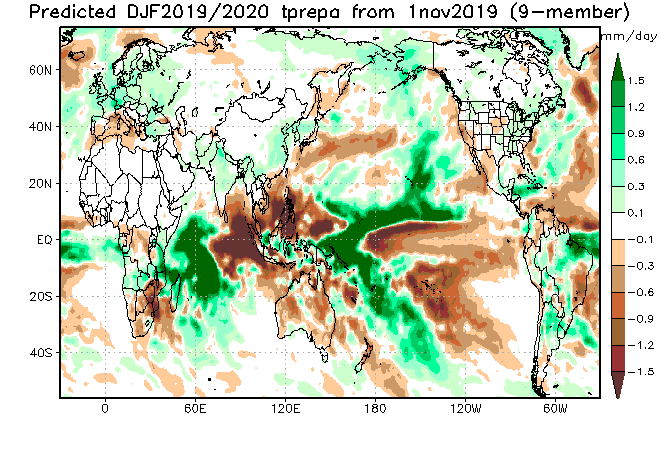
Australia is dry as is much of the Maritime Continent. South Africa is dry as is Japan. Much of South America is wet. There is a north/south divide in Europe.

Spring (MAM 2020)

Temperature

NOAA

MAM 2020 Temperature Issued on November 21, 2019

And here is the MAM 2020 Temperature Forecast for North America that I extracted from the JAMSTEC World Forecast.

MAM  2020 NA Temperature based on November 1, 2019 JAMSTEC Forecast

Recently JAMSTEC has been mostly cooler than NOAA for CONUS but here NOAA is showing both a North Central and Northeast EC area but to the extreme north a cool anomaly. JAMSTEC does show some limited cooler areas but further west and south of the NOAA area.

JAMSTEC WORLD FORECAST (My detailed comments on Alaska and CONUS appear with the larger graphics above)
http://www.jamstec.go.jp/aplinfo/sintexf/2007/forecast/temp2.glob.MAM2020.1nov2019.gif

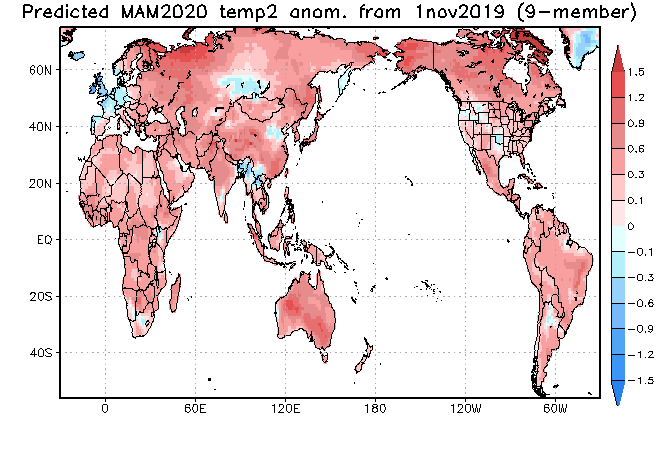
The North Sea cool anomaly is expanded in this season. And further east the north to south occasional cool anomalies are much reduced. Greenland is cool.

Precipitation

NOAA

MAM 2020 Precipitation Issued on November 21, 2019

And here is the MAM 2020 Precipitation Forecast for North America that I extracted from the JAMSTEC World Forecast.

MAM 2020 NA Precipitation based on November 1, 2019 JAMSTEC

There is agreement that Alaska will be wet but disagreement over where it will be wet. Both NOAA and JAMSTEC agree on a wet Great Lakes Region but NOAA has it extending much further to the west at least in terms of consistency. The major disagreement is that NOAA shows the extreme Southwest dry and JAMSTEC shows it EC and NOAA shows the Southeast EC and JAMSTEC shows it dry.

JAMSTEC WORLD FORECAST (My detailed comments on Alaska and CONUS appear with the larger graphics above)
http://www.jamstec.go.jp/aplinfo/sintexf/2007/forecast/tprep.glob.MAM2020.1nov2019.gif

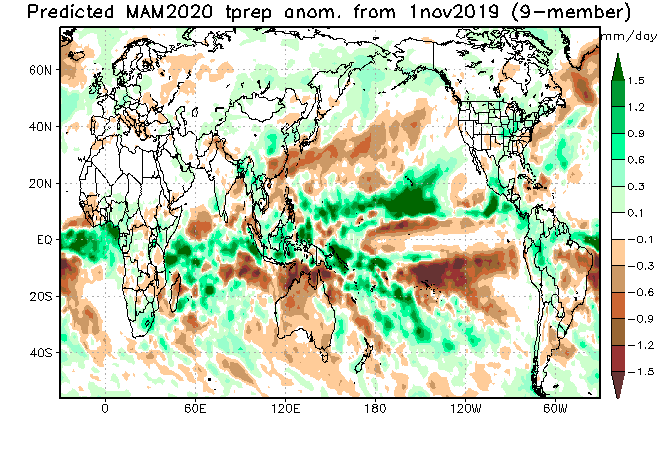
Australia is still dry but the Maritime Continent is wet. North Korea is wet but Japan is mostly dry. South America is more mixed as is Europe and Africa.

Summer JJA 2020

Temperature

NOAA

JJA 2020 Temperature Issued November 21,  2019

And here is the JJA 2020 Temperature Forecast for North America that I extracted from the JAMSTEC World Forecast.

JJA 2020 NA Temperature based on November 1, 2019

Again NOAA has the North Central being EC and JAMSTEC has most of CONUS warm except Washington State which is due to their view of the situation in Western Canada. This also creates some slight disagreement on Northeast Alaska.

JAMSTEC WORLD FORECAST

http://www.jamstec.go.jp/aplinfo/sintexf/2007/forecast/temp2.glob.JJA2020.1nov2019.gif

Again the area around the North Sea is cool. The cool area for Asia has shifted East. Much of Canada is cool but almost none of the Southern Hemisphere is cool.

Precipitation

NOAA

JJA 2020 precipitation Issued November 21, 2019

And here is the JJA 2020 NA precipitation I extracted from the JAMSTEC World Map

JJA 2020 NA Precipitation based on November 1, 2019 JAMSTEC Forecast

Other than Alaska, there is not much agreement. One might conclude that there is some agreement that the Northwest will tend to be dry but there is no agreement on the Southern Tier which JAMSTEC shows as dry and in particular shows a failed Monsoon. NOAA often does not express an opinion on the Monsoon this early in the water year.

JAMSTEC WORLD FORECAST

http://www.jamstec.go.jp/aplinfo/sintexf/2007/forecast/tprep.glob.JJA2020.1nov2019.gif

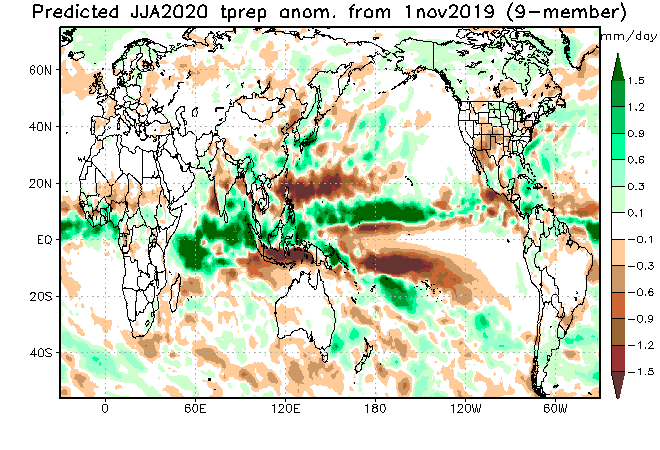
Australia is mostly EC. The Maritime Continent is wet. Canada is wet. Europe is again split north to south but overall is drier. Japan is now wet. Canada is wet. There is that frequent wet belt just north of the Equator in Africa. It is a fairly unremarkable forecast other than for CONUS.

D. Conclusion

Both NOAA and JAMSTEC have forecasts that in one way or another incorporate the value of Nino 3.4. Both forecast it to be positive but under +0.5C. JAMSTEC also sees Modoki characteristics in the pattern as measured by their Modoki Index which was created by Karumuri Ashoc EMI= [SSTA]A-0.5*[SSTA]B-0.5*[SSTA]C  The square  bracket  in this Equation represents  the area-averaged SSTA  over each  of  the regions A (165E-140W, 10S-10N), B (110W-70W, 15S-5N), and C (125E-145E, 10S-20N),  respectively.  The fact that this calculation yields a value greater than +0.5C probably means the warmer water along the Equator in the Pacific is a bit farther west than usual for a typical El Nino although we are not having an El Nino. But the warm anomaly is there. It also appears east of 120W so that combination is fairly unusual.

This shifts the Walker circulation west a bit. NOAA may take this into account but generally does not use Japanese terminology for the condition of the Equatorial Pacific Ocean which we share. I see that as a weakness in their forecasting approach. Also though it is possible to take Modoki into consideration using statistical methods, it is not easy to do so I suspect that NOAA does not do it. On the other hand, the dynamic methods of JAMSTEC build errors over time. So we have two less than perfect methodologies competing and thus comparing the results of the two flawed approaches is useful. 

Slight changes in the ENSO Phase are likely to change the actuals from what has been forecast. I do not have a lot of confidence in either of the forecasts but for different reasons. NOAA may not be properly taking into account the Modoki aspect of the situation and JAMSTEC may be overestimating or misinterpreting the impact of the Modoki-like conditions in their forecast. It is the same problem as last month and the prior month.

One of the reasons for doing this comparison is it provides the ability to create our own updated forecast as we see the assumptions made by each agency be confirmed or not. That is especially true when the actuals start coming within the range of the two sets of assumptions. Weather is not linear so it is more complex than scaling the solution to where the actuals are showing up relative to the two versions of the assumptions but with a little imagination one might be able to sort it out.

It is going to be difficult this time as the forecasts seem to be more different than what we might expect from the small differences in the ENSO assumptions. There is also the question of the impact of the Negative North Atlantic Oscillation and the Positive Indian Ocean Dipole.

Previous Post

Market Watch 666 For 24 November 2019

Next Post

LIVE ALL WEEK: Weather 25 November Through 1 December 2019

Related Posts

Scammers Steal $300K Using Fake Blur Airdrop Websites
Uncategorized

FBI Warns Investors Of Crypto-Stealing Play-to-Earn Games

by admin
Maersk Almost Completing Russia Exit After The Sale Of Logistics Sites
Uncategorized

Maersk Almost Completing Russia Exit After The Sale Of Logistics Sites

by admin
Why Is ‘Staking’ At The Center Of Crypto’s Latest Regulation Scuffle
Uncategorized

Why Is ‘Staking’ At The Center Of Crypto’s Latest Regulation Scuffle

by admin
Mexico's Pemex Dismantled Resources Worth $342M From Two Top Fields
Uncategorized

Mexico’s Pemex Dismantled Resources Worth $342M From Two Top Fields

by admin
Oil Giant Schlumberger Rebrands Itself As SLB For Low-Carbon Future
Uncategorized

Oil Giant Schlumberger Rebrands Itself As SLB For Low-Carbon Future

by admin
Next Post

Democratic Governors Are Quicker In Responding To The Coronavirus Than Republicans

답글 남기기 응답 취소

이메일 주소는 공개되지 않습니다. 필수 필드는 *로 표시됩니다

Browse by Category

  • Business
  • Econ Intersect News
  • Economics
  • Finance
  • Politics
  • Uncategorized

Browse by Tags

adoption altcoins bank banking banks Binance Bitcoin Bitcoin market blockchain BTC BTC price business China crypto crypto adoption cryptocurrency crypto exchange crypto market crypto regulation decentralized finance DeFi Elon Musk ETH Ethereum Europe Federal Reserve finance FTX inflation investment market analysis Metaverse NFT nonfungible tokens oil market price analysis recession regulation Russia stock market technology Tesla the UK the US Twitter

Categories

  • Business
  • Econ Intersect News
  • Economics
  • Finance
  • Politics
  • Uncategorized

© Copyright 2024 EconIntersect

No Result
View All Result
  • 토토사이트
    • 카지노사이트
    • 도박사이트
    • 룰렛 사이트
    • 라이브카지노
    • 바카라사이트
    • 안전카지노
  • 경제
  • 파이낸스
  • 정치
  • 투자

© Copyright 2024 EconIntersect