


Written by Sig Silber
We published the NOAA Long-Term Forecast Friday Night and it can be accessed here. In Part II (this post), we compare the NOAA forecast for Alaska and CONUS with the JAMSTEC forecast and also attempt to provide some explanation for the differences. The differences in the weather forecasts appear to be related to small differences in the El Nino forecast and how the western displacement of this El Nino was dealt with by the models and the forecasters. Our report provides the JAMSTEC forecasts for the whole World. In parts of the world, the interaction between the IOD and the EL Nino are important and JAMSTEC is experienced in that area. In our report, we also pay special attention to Europe.

Please share this article – Go to the very top of the page, right-hand side for social media buttons.
Prologue
Now we compare the two NOAA forecasts with the JAMSTEC forecast. We do it again later in the article but this comparison may be easier to see. The first image is the Mid-June IRI-CDC ENSO probabilities. The second image is the JAMSTEC proprietary forecast model for the Nino 3.4 Index. The third is the NOAA proprietary model CFSv2.
|
|
|


We will come back to this graphic later but it may be the key to the puzzle of why that which at first glance may appear to be similar Nino 3.4 profiles result in very different forecasts.

C. Now to our full report. (Sections A and B were covered in Part I)
This report is organized into a summary that has two tables of graphics that show the temperature and precipitation forecasts for the upcoming three seasons, a brief discussion of the ENSO assumptions by both NOAA and JAMSTEC and then the JAMSTEC Agency discussion and then a comparison of the two forecasts which is basically an expansion of the summary table.
Summary of the NOAA and JAMSTEC Forecasts
For those who want a quick synopsis of the two forecasts, below is a summary of the temperature and precipitation forecasts for three time-periods and from left to right the NOAA forecast for Alaska and CONUS (the contiguous mid-latitude U.S), then JAMSTEC for North America (which includes Canada and Mexico), and then JAMSTEC for Europe and surrounding areas. Larger graphics are provided later in the report. (the graphics in the Summary Table are not set up to be clicked on to enlarge). The Summary Table is kind of a tease to keep you reading but you can see the evolution of the weather pattern through Summer, Fall, and then into Winter. For some readers, these two sets of summary graphics may be all the information they wish to look at and that is fine.
Temperature
| NOAA Alaska Plus CONUS | JAMSTEC North America | JAMSTEC Europe | |
Summer 2019 JAS for NOAA JJA for JAMSTEC |  |  |  |
Fall SON 2019 |  |  |  |
Winter DJF 2019-2020 |  |  |  |
Precipitation
When thinking about the Southwest Monsoon, it is important to remember that the NOAA graphic covers JAS while the JAMSTEC graphic covers JJA. This matters when discussing the Monsoon.
| NOAA Alaska Plus CONUS | JAMSTEC North America | JAMSTEC Europe | |
Summer 2019 JAS for NOAA JJA for JAMSTEC |  |  |  |
Fall SON 2019 |  |  |  |
Winter DJF 2019-2020 |  |  |  |
We provided the full NOAA Discussion in Part I. Here is the much shorter JAMSTEC Discussion released on June 14, 2019
ENSO forecast:
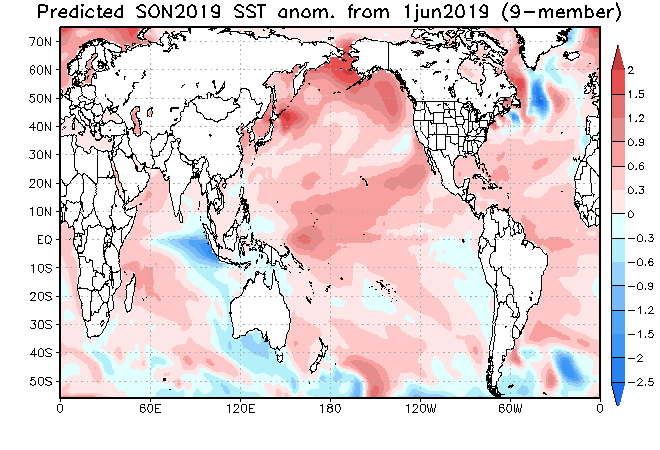
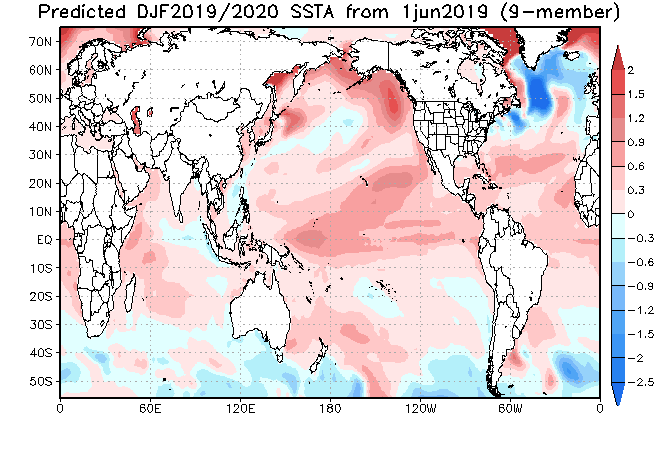
Warmer-than-normal sea surface temperature is observed now for the whole tropical Pacific. Since the warm anomaly is larger in the central Pacific, this is similar to the El Niño Modoki-like state. The SINTEX-F predicts a moderate El Niño event. This El Niño is more or less of Modoki-type with a peak in late summer. We need to be careful of its impact as it may be different from that of the canonical El Niño.
Indian Ocean forecast:
As predicted earlier, a positive Indian Ocean Dipole has quickly emerged in May. The model predicts that the positive Indian Ocean Dipole will have a peak in autumn, and then quickly decay in winter. We may observe co-occurrence of a positive Indian Ocean Dipole and an El Niño/El Niño Modoki-like state in the latter half of 2019; this is as we observed in 1994 and 2018.
Regional forecast:
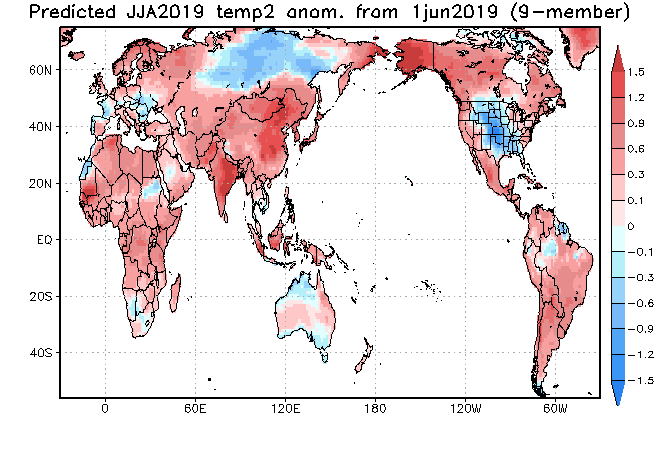
On a seasonal scale, SINTEX-F predicts that most part of the globe will experience a hotter-than-normal condition in boreal summer, while some part of central U.S.A, central Russia, and northern Australia will experience a cooler-than-normal condition. In boreal autumn, most part of the globe will still experience a warmer-than-normal condition, except for some parts of southeastern U.S.A., northwestern Brazil, East Africa, eastern Europe and central Russia.
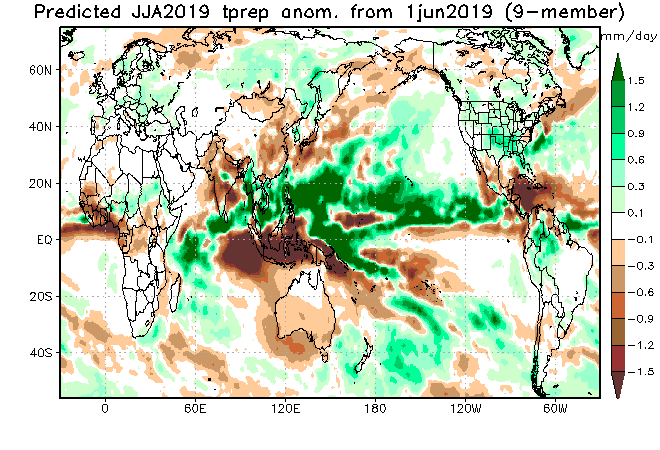
As regards to the seasonally averaged rainfall in boreal summer, a wetter-than-normal condition is predicted for U.S.A., northwestern part of the South American Continent, most part of Southeast Asia, and northern Philippines. In contrast, Mexico, India, West Africa, eastern China, Mongolia, Australia, and most part of Indonesia will experience a drier-than-normal condition. In boreal autumn, a wetter-than-normal condition is predicted for northern part of the South American Continent, East Africa, tropical West Africa, and northern India. In contrast, southern Brazil, eastern part of southern Africa, western Europe, Australia, most part of Southeast Asia, eastern China, Philippines, and Indonesia will experience a drier-than-normal condition. Some of them will be partly due to the expected positive Indian Ocean Dipole (see schematic of a positive Indian Ocean Dipole event: http://www.jamstec.go.jp/aplinfo/sintexf/e/iod/about_iod.html). In particular, we notice that Indonesia and Australia may experience extremely drier than normal condition, owing to the expected co-occurrence of a positive Indian Ocean Dipole and an El Niño/El Niño Modoki-like state.
The model predicts most part of Japan will experience hotter- and drier-than-normal condition in summer and autumn as a seasonal average.
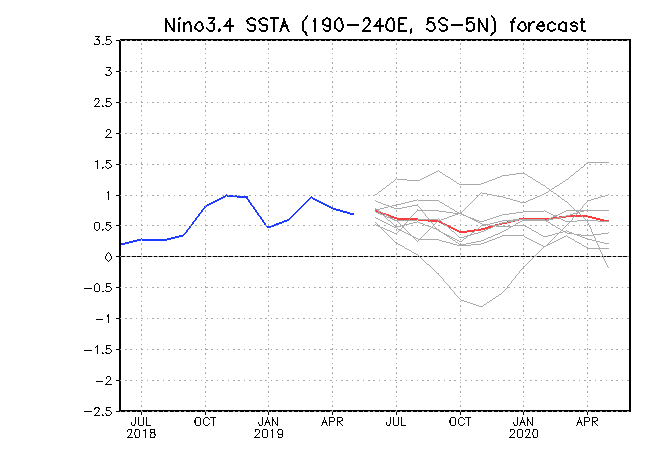
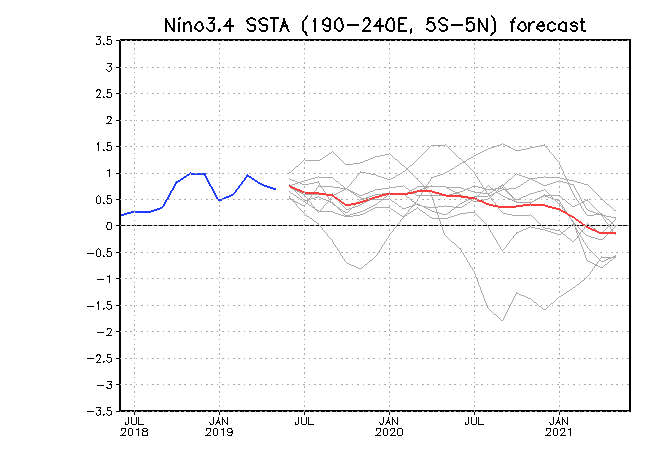
It is useful to look at the forecasts for the Nino 3.4 Index used to determine if the Sea Surface Temperatures meet the criteria for an El Nino(+0.5 C or higher). Here is a brief summary of the Indices of the two Agencies and how they compare. Three of these graphics were presented earlier. We use them again here and add two more to provide a more detailed analysis.
| One Year | JAMSTEC Two Years | |
| JAMSTEC |
|
|
| CFS.v2 | CPC-IRI Probabilities | |
| NOAA |
|
|
| Comparing the one-year JAMSTEC NINO 3.4 graphic above to a similar period for both the NOAA models, one sees a lot of similarity but subtle differences namely the dip and then gradual rise in the JAMSTEC forecast. | The IRI/CPC forecast uses different units namely probabilities rather than absolute levels of the NINO 3.4 Index | |
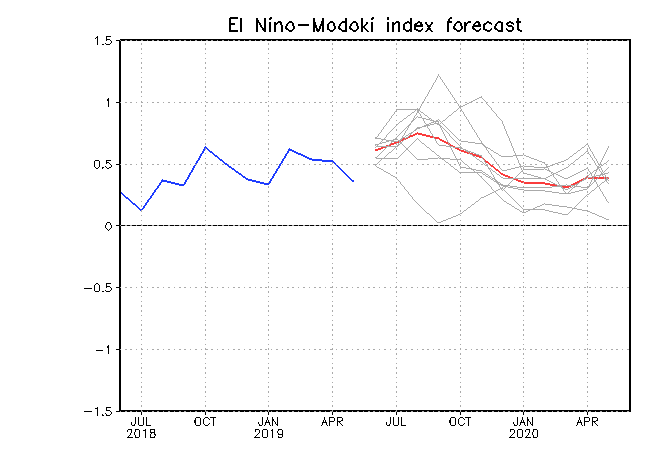
| The so-called Modoki index is interesting because it clearly indicates a Modoki for the Summer/Fall. This index was confusing last month but not this month. |
|
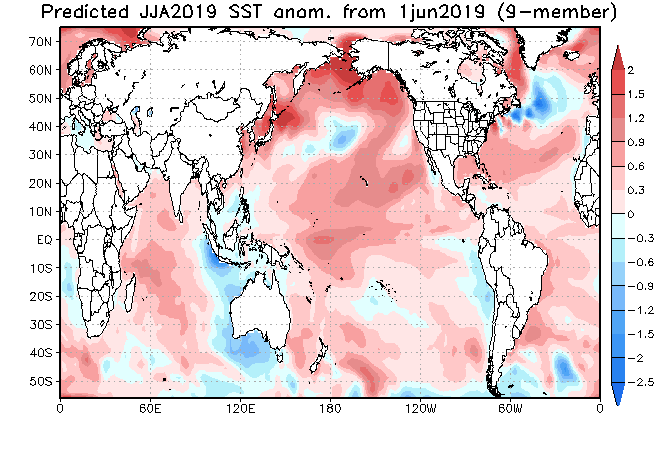
Indices use a single number to convey information. Sometimes it is useful to look at the forecast Sea Surface Temperatures that correlate to the indices. I believe that the SST’s directly correlate with the JAMSTEC Nino 3.4 Index but NOAA uses a variety of tools so it is not so easy to understand exactly how they do their forecast but there is a lot of information on that in their lengthy discussion which was presented in our Part I Report.
| NOAA | JAMSTEC |
 |  |
|  |
 |  |

Updates from JAMSTEC can be found here. Updates from NOAA can be found here. You have to look for the SST row and go to the right where it says “normalized with mask” and click on E3 which provides the latest model run.
All of these forecasts depend to a large extent on what is known about subsurface temperature anomalies. Here is the latest analysis. Updates can be obtained here.

Does the SOI confirm that El Nino Conditions apply? The SOI is one measure of the extent to what the atmosphere has been impacted by the Eastern Pacific surface pattern which is measured by the Nino 3.4 Index. After all, we are more interested in the impacts to weather in the atmosphere which impacts populated areas than we are about the temperature distribution of the ocean surface along the Equator in the Pacific Ocean.

D. Now we begin our comparison of the NOAA and JAMSTEC Forecasts (Focus on next nine months i.e. three seasons)
In this Update, we compare the JAMSTEC temperature and precipitation forecast maps, which are for the World, with the NOAA temperature and precipitation forecast maps that cover only CONUS and Alaska. We do this primarily for educational purposes.
JAMSTEC works in three-month intervals which correspond to seasons and does not change the selection of months each time they update but does so every three months. At that time they drop one season and add another season further in the future. So for JAMSTEC, we have Summer (JJA), Fall (SON), and Winter(DJF). NOAA provides maps for each three-month period and we start with JAS. JAMSTEC provides maps for three seasons and the choice of seasons changes every three months. So for one out of three months, the first season lines up perfectly but this is not that month. JAMSTEC is still working with JJA and June is almost over. Normally that is not a problem but with a projected late Monsoon, it is a bit of a problem so keep that in mind when looking at the graphics for Summer.
I show the NOAA Maps first followed by the JAMSTEC maps. I extract North America from the Worldwide JAMSTEC map and use that to compare with the NOAA Maps. I also extract Europe including parts of North Africa and Western Asia from the Worldwide JAMSTEC maps and include those excerpted maps in the summary table at the beginning of this article.
Now we will compare the maps in that summary but with full-sized maps.
Summer 2019.
Temperature JAS for NOAA
And here is the JJA 2019 temperature forecast for North America that I extracted from the JAMSTEC World Forecast.
And now the JAMSTEC WORLD FORECAST (for this graphic my comments are mostly related to areas other than Alaska and CONUS as those comments appear with the larger graphics above)
|
Precipitation
NOAA
And here is the JJA 2019 Precipitation Forecast for North America that I extracted from the JAMSTEC World Forecast.
And now the JAMSTEC WORLD FORECAST (for this graphic my comments are mostly related to areas other than Alaska and CONUS as those comments appear with the larger graphics above)
Fall (SON – 2019)
Temperature
NOAA
And here is the SON – 2019 Temperature Forecast for North America that I extracted from the JAMSTEC World Forecast.
JAMSTEC WORLD FORECAST
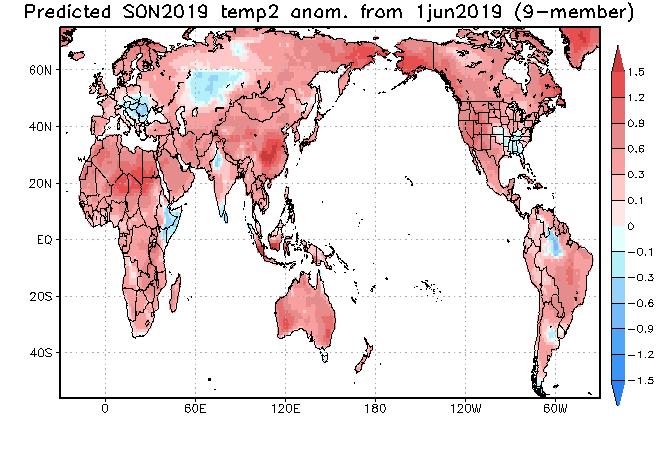
The Horn of Africa is cool, west of the Baltic Sea is cool, Southern Central Russia is cool and Northern Brazil is cool. Most of the World is warm.
Precipitation
NOAA
And here is the SON – 2019 Precipitation Forecast for North America that I extracted from the JAMSTEC World Forecast.
We may be seeing the impact of what we discussed in the Prologue namely:
JAMSTEC WORLD FORECAST
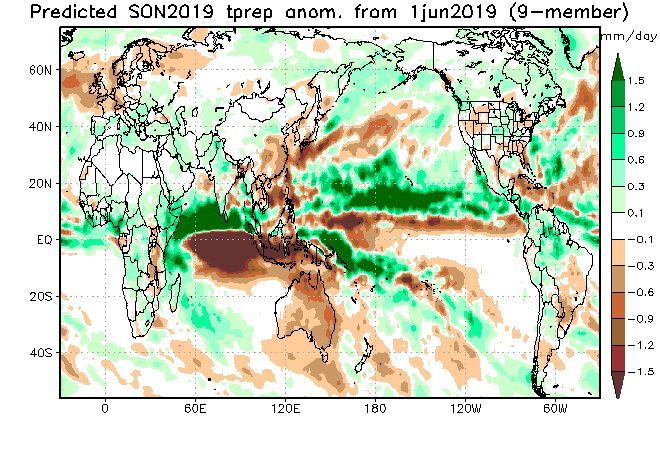
Winter (DJF 2019 – 2020)
Temperature
NOAA
And here is the DJF 2019-2020 Temperature Forecast for North America that I extracted from the JAMSTEC World Forecast.
Again the slight change in the JAMSTEC Nino 3.4 forecast might be responsible and another way of looking at that is the SST for the Eastern Equatorial Pacific.
JAMSTEC WORLD FORECAST
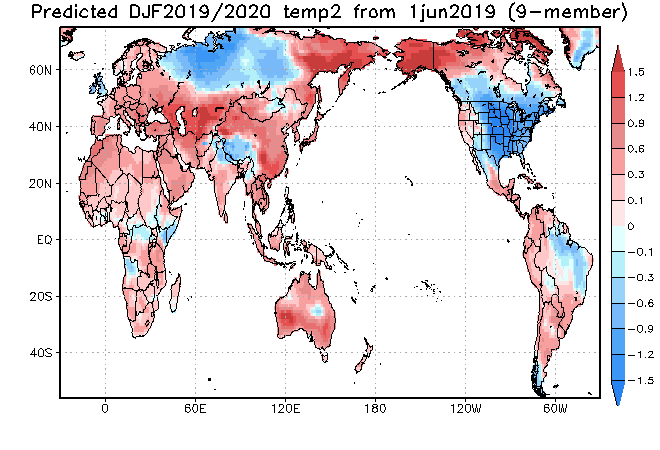
Precipitation
NOAA
And here is the NA precipitation I extracted from the JAMSTEC World Map
JAMSTEC WORLD FORECAST
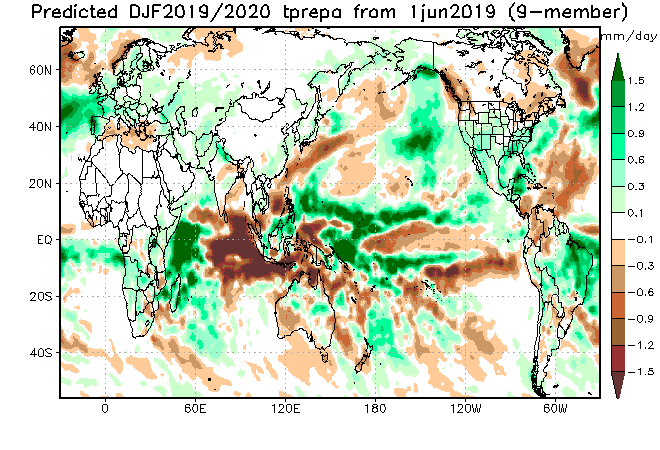
D. Conclusion
Similar to last month, both NOAA and JAMSTEC have forecasts that in one way or another incorporate an El Nino of some sort in their forecasts. But the type of El Nino varies a lot between the two agencies or perhaps it is that NOAA just does not like calling a westerly displaced El Nino a Modoki.
Slight changes in El Nino are likely to change the actuals from what has been forecast. I do not have a lot of confidence in the JAMSTEC Winter Temperature forecast.
.


