


Written by Sig Silber
Here is the April 18 NOAA 15-month forecast for CONUS and Alaska. Sunday night we will compare it to the JAMSTEC Three-Season forecast. NOAA sees very little change from their forecast last month. The May and May-June-July three-month forecasts are very similar. Both the temperature and precipitation patterns are quite interesting. There is a transition from a pattern dominated by the Gulf Coast moisture to a slightly delayed Southwest Monsoon. For next winter, there are questions about the duration of the El Nino.

Please share this article – Go to the very top of the page, right-hand side for social media buttons
Key Issue
The Precipitation Transition
| Three Months JJA (June/July/August | Three Months JAS (July/August/September |
 |  |
A. Focus on the NOAA Update
A note about terminology; the deviations from climatology/normal are color coded but also labeled “A” for more than (above) normal and “B” for less than (below) normal. The area designated EC means Equal Chances of being more or less than normal. In my comments For the shorter-term maps, NOAA uses “N” instead of “EC” as they believe they can be more definitive with respect to shorter timeframes. So the words “warm”, “cool”, “wet”, “dry” should be generally interpreted as being relative to climatology/normal for that location and time of year.
First, we will take a look at the NOAA Early Outlook for May, 2019. It is called the Early Outlook because it will be updated at the end of April. Only the May Outlook will be updated at that time.
Temperature

Precipitation

We have nothing to compare these maps with as NOAA does not in their Update provide a forecast for each of the subsequent two months separate from their three-month forecast. Thus I do not have previously forecast maps for May from the previous NOAA Report to compare against. And the current month is not over so we can not really compare the forecast for next month against the actual for this month. It is probably best to just try to understand what NOAA is trying to convey about May which for Temperature is a cool* anomaly centered on Western Texas with a warm* East Coast, Northern Tier and much of the West Coast. And for precipitation, there is a banana-shaped wet* anomaly running from Texas east and northwest.
* compared to normal/climatology for the indicated time of the year.
Visual Consistency Testing.
It is useful to see how the month forecast fits with the set of shorter forecasts that we have.
First Temperature
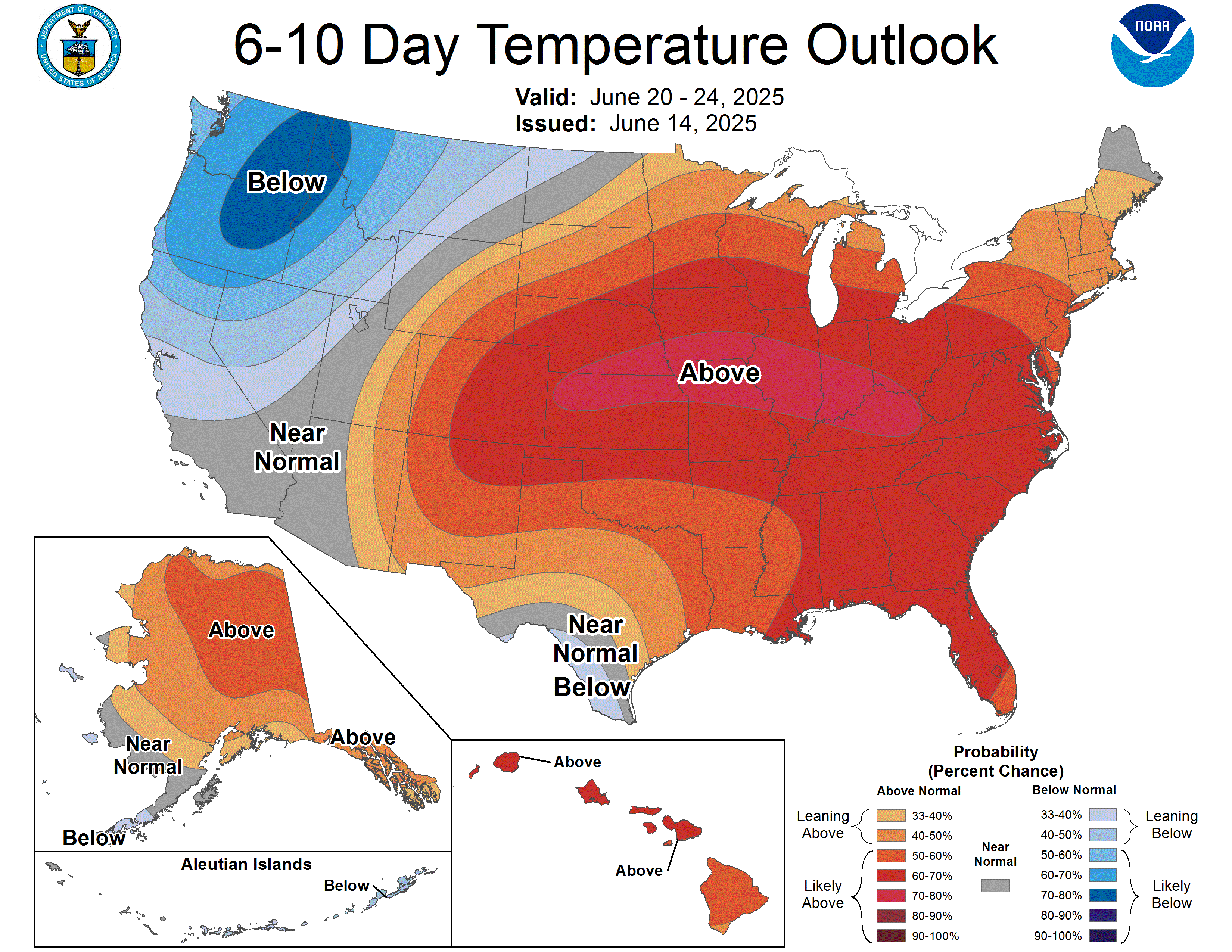 | 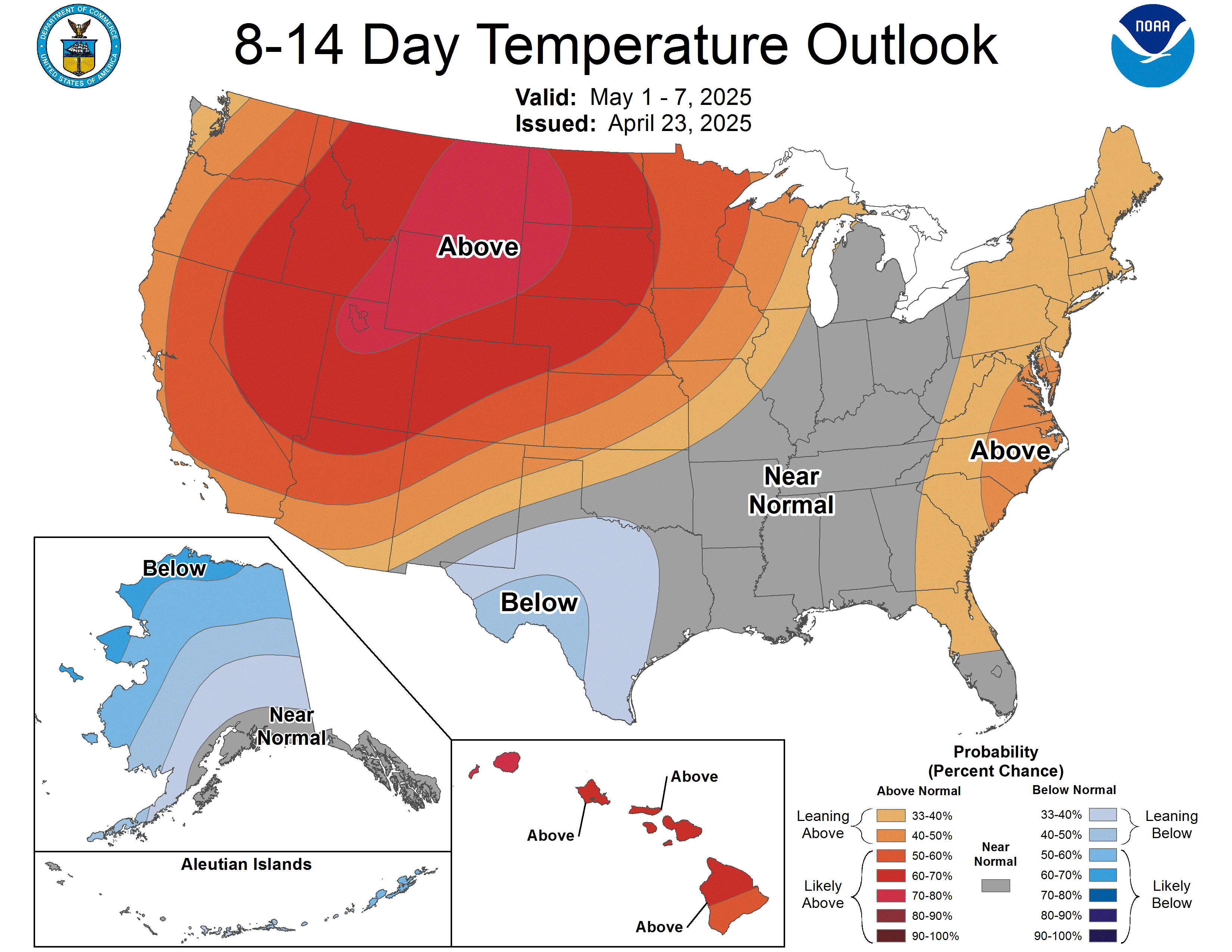 | 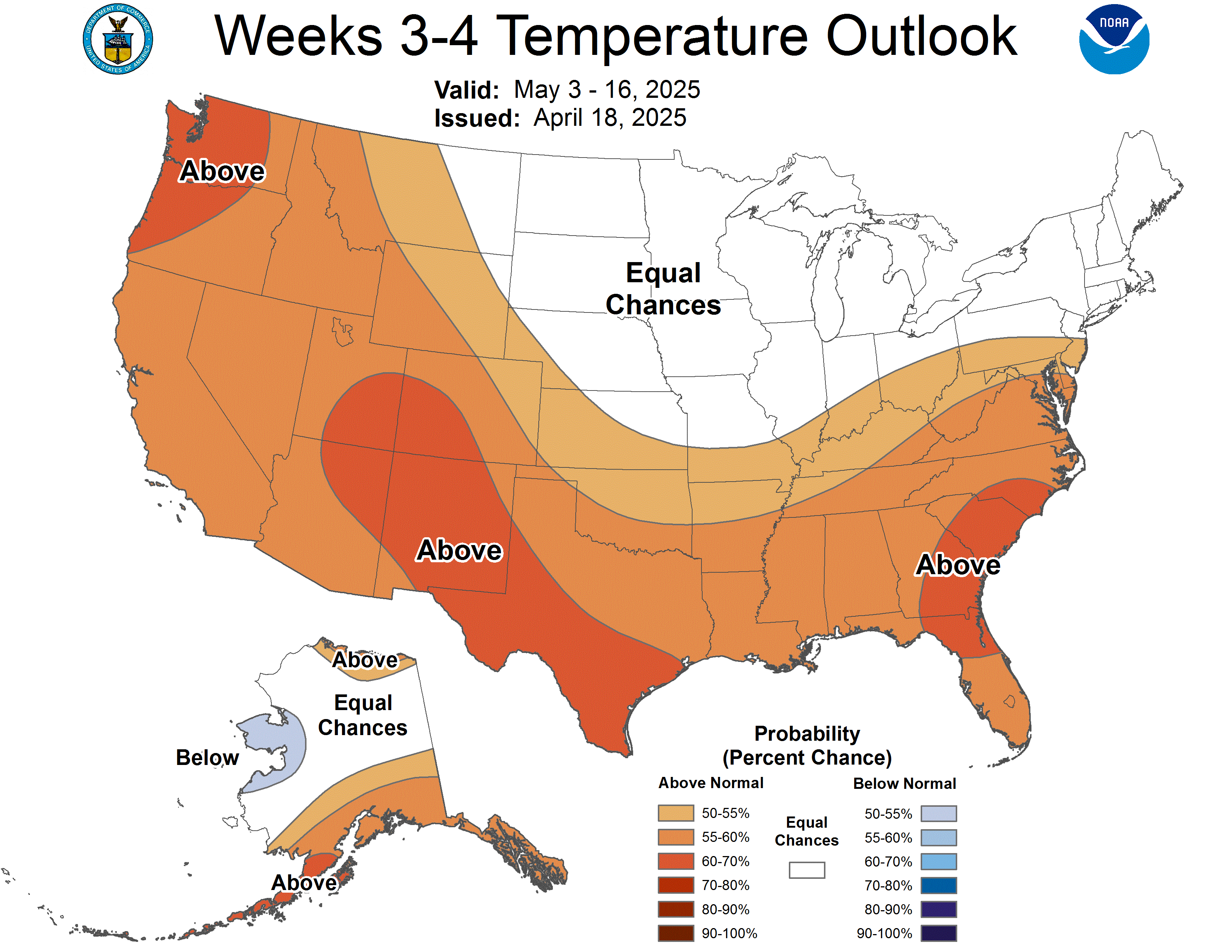 |
| The new monthly forecast is to the right. Does it appear to be reflective of the three parts of the month for which we have forecasts? → |
| ↑ ← The full month forecast seems to fit fairly well with the Week 3 – 4 forecast. We do not have the last eleven days of the month in the sequence of maps above. We will revisit this question at the end of April when the May forecast is updated. |
And then Precipitation
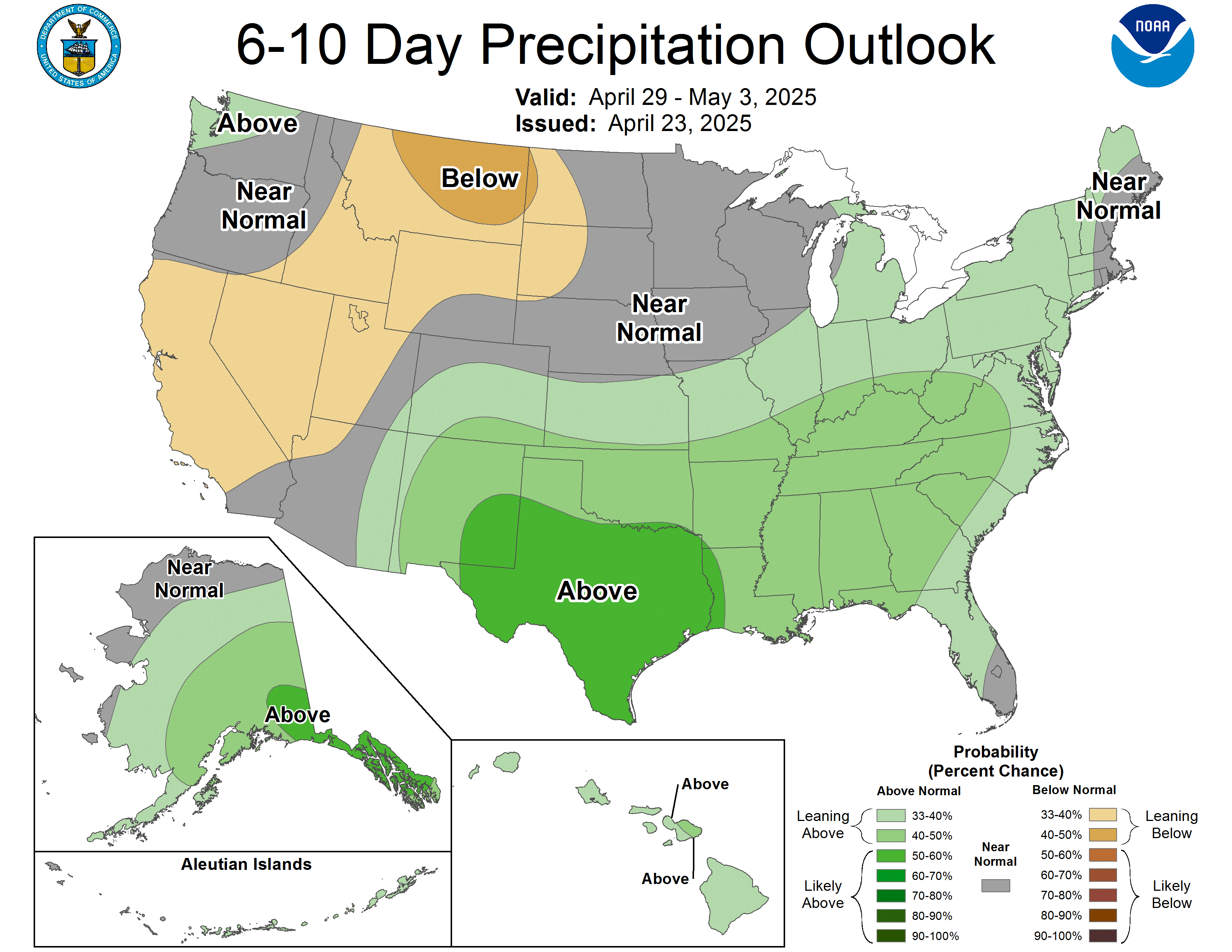 | 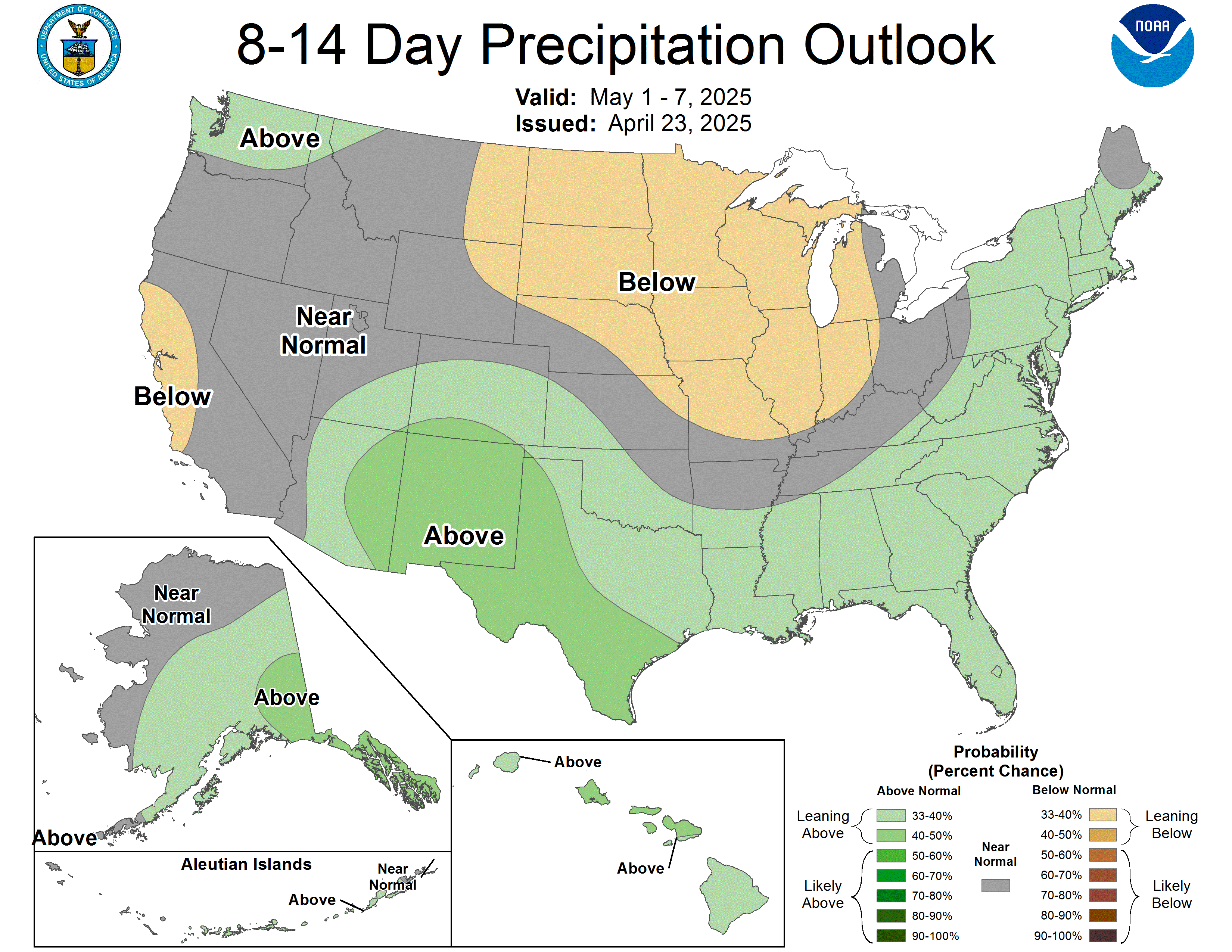 | 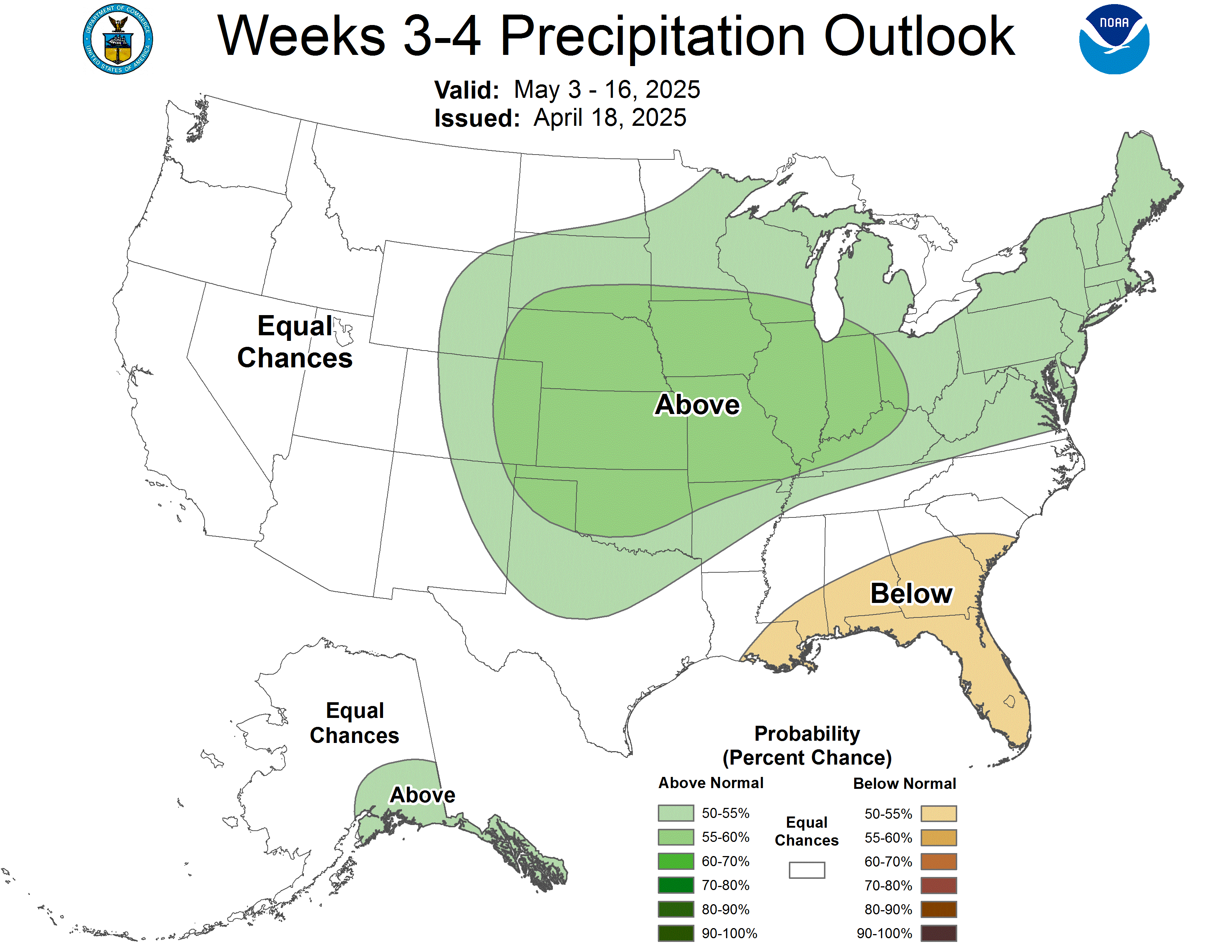 |
| The new monthly forecast is to the right. Does it appear to be reflective of the three parts of the month for which we have forecasts? → |
| ↑ ← The full month forecast does not seem to fit reasonably well with the Week 3-4 Map. It seems not to be sufficiently dry in the Northeast. But we do not have the last eleven days of the month in the sequence of maps above. We will revisit this question at the end of April when the May forecast is updated. |
Now we consider the three-month Outlook.
Notice that the three-month periods are abbreviated e.g. May/June/July is shown as MJJ. You will see such abbreviations often in this report.
Prior Temperature Outlook for MJJ 2019

New Temperature Outlook for MJJ 2019

Prior Precipitation Outlook for MJJ 2019

New Precipitation Outlook for MJJ 2019

And here is the new Seasonal Drought Forecast.

Now let us focus on the long-term situation.
Prior 14 Month Temperature Outlook: MJJ 2019 – AMJ 2020

New 14 Month Temperature Outlook: JJA 2019 – MJJ 2020

To compare maps from one release to another, one needs to remember that the new release drops one three-month period and adds a later one. So to make the comparisons one has to shift the new maps to the right one position and that makes the map on the right drop down to become the left-most map in the next level. I do not have a computer software tool for doing that for you so you have to do it mentally. When I do the comparison, I print the two sets of maps and put them side by side and number the same three-month maps 1, 2, 3,…..,11 in both sets of maps to make it easier for me to easily compare the same three-month period in the new with the previous forecast. One uses the same procedure to compare the precipitation maps. Based on this procedure, I conclude that:
Now Precipitation
Prior 14 Month Precipitation Outlook: MJJ 2019 – AMJ 2020

New 14 Month Precipitation Outlook: JJA 2019 – MJJ 2020

If you want larger versions of each map (temperature and precipitation) you can find them here. And then each of those maps can be clicked on to further enlarge them.
Sometimes it is useful to compare the three-month outlook to the forecast for the first of the three months. It shows how much the pattern changes over the three-month period.

One can mentally subtract the First-Month Outlook from the Three-month Outlook and create the Outlook for the last two months in the three-month period.
Below is the NOAA Discussion (slightly reorganized and with a bit of the redundancy and some discussion of methodology removed) released by NOAA on April 18, 2019. Headings that are “Initial Cap” only rather than all caps were added by the Author of this Update Report for clarity. Also, we have organized the sequence of the sections of NOAA Discussion to first present the Atmospheric and Oceanic Conditions and then the Initial Month (May), the new NOAA Summary for MJJ, and finally the remainder of the 15 Month Forecast.
CURRENT ATMOSPHERIC AND OCEANIC CONDITIONS
El Nino conditions continued in the Pacific Ocean through April 2019. Sea surface temperatures (SSTs) across much of the equatorial Pacific Ocean remain above climatological averages with areas above +1.0 degrees C from the central to the eastern Pacific for the most recent 4-week average. The latest weekly Nino 3.4 SST anomaly is slightly below +1 degree C. Oceanic heat content, determined from ocean temperature anomalies from the surface to a depth of 300 meters along the equatorial Pacific, has decreased in the last month after increasing over the prior two months. Atmospheric conditions continue to respond to the anomalous SST forcing with enhanced convection consistently along the equator near the Date Line during the last few months. Modest low-level westerly wind anomalies were observed along the equator over the western Pacific, and an upper-level anticyclonic circulation was observed north of the equator in the central Pacific along with easterly upper-level anomalies from the central to the western Pacific. Collectively, these oceanic and atmospheric conditions represent a continuation of weak El Nino conditions as of April 2019.
Other boundary conditions relevant to the seasonal outlook are soil moisture anomalies, current snow depth anomalies, and in some areas near-coastal SSTs. Widespread and persistent above normal precipitation for most of the CONUS during recent months and especially during February and March has resulted in positive soil moisture anomalies for parts of the Southwest and for many areas of the central and eastern CONUS. Sea ice coverage along much of the western Alaska coast is below normal, with SSTs above normal.
PROGNOSTIC DISCUSSION OF SST FORECASTS
The CPC SST Consolidation Nino 3.4 forecast indicates the continuation of an El Nino through 2019. There is considerable spread, however, among its constituent input models with the constructed analog (CA) indicating persistent ENSO neutral conditions, while the CCA and Markov statistical models predict an increase in positive Nino 3.4 anomalies from late summer 2019 through the winter of 2019-2020. The CFS dynamical model forecast ensemble mean predicts a slow decline in positive Nino 3.4 anomalies after an initial increase in the spring. The NMME suite of dynamical models also shows large spread with some ensemble members predicting a strong El Nino event by the beginning of winter, some maintaining a weak or moderate event through autumn, and some members predicting a return to ENSO neutral conditions by autumn. Little possibility of a La Nina event next winter is indicated by statistical and dynamical model forecasts. While La Nina events often emerge in the year following an El Nino in the climate record, at other times El Nino events extend beyond one year, as predicted by a significant number of the forecast tools. The probability of a continuation of the current El Nino into next winter is set at about 50% by the IRI/CPC consensus forecast.
30-DAY OUTLOOK DISCUSSION FOR MAY 2019
The May 2019 outlook is informed by various forecast tools, both dynamical and statistical, and is issued against a tropical background state that is largely dominated by ENSO. El Nino conditions remain in place across the equatorial Pacific, and are forecast to persist into boreal summer. Forecast tools that contribute to the 0.5-month lead May 2019 outlook also vary in terms of their characteristic time scales. Medium range dynamical models now extend into very early May, and the the latest Weeks 3-4 guidance covers nearly the first half of the month. These are in addition to guidance initialized during early April for the entire month of May, which will tend to emphasize interannual variability.
A good starting place for the May outlook is the calibrated NMME guidance. This guidance is augmented by uncalibrated (but non-biased) forecast guidance from the ECMWF and more recent runs of the CFS. Long-term trends play a role as well. Given the time of year, antecedent soil moisture conditions play a role by affecting the partitioning of incident solar radiation between sensible and latent heating.
Temperature
The temperature outlook consists of above-normal temperatures favored in an arc-like region from parts of the West Coast, across the northern tier, and over much of the eastern CONUS. Above-normal temperatures are strongly favored over much of Alaska. Inspection of the forecast circulation for the CFS, for example, reveals an ENSO-like wave dispersion featuring positive 200-hPa height anomalies centered near and southeast of Hawaii, a weakness in above-normal heights extending across parts of the eastern Pacific and southwestern North America, and an anomalous 200-hPa ridge over west-central Canada extending southeastward to the eastern CONUS. This general structure of the upper-level height field is apparent in the latest Weeks 3-4 guidance and is broadly consistent with ENSO regressions, but shifted 10-20 degrees longitude eastward over the Pacific-North America domain. While this circulation pattern is sufficient to explain the overall temperature pattern, there are some other factors at play. High-amplitude soil moisture anomalies over much of the central CONUS extending into the Midwest have a negative impact on temperature during the warm season, and lead to a reduction in above-normal probabilities relative to model guidance over parts of the Upper Midwest and Plains. Below-normal temperatures are more likely over parts of the Southern Plains, where forecast above-normal rainfall and wetter-than-normal soils support the model consensus. Equal chances is depicted over a large region encompassing much of the Southwest and parts of the Great Basin. Dynamical models are not in good agreement here as the long-term warming trends and a relatively cool interannual signal are destructively interfering.
Precipitation
The precipitation outlook is consistent with the aforementioned circulation pattern; above-normal rainfall is more likely near and east of the anomalous cyclonic upper-level circulation. This extends over much of the interior West, High Plains, and Southern/Central Plains. There is an eastward extension at very modest probabilities across the Gulf Coast and Deep South consistent with ENSO and the dynamical model consensus. There is a small region extending from the Pacific Northwest to the Alaska panhandle where below-normal precipitation is more likely. This is likewise based on the model consensus and consistent with long-term trends . There was some consideration of depicting below-normal rainfall over parts of the Northeast and Great Lakes in accordance with the latest Weeks 3-4 guidance and recent CFS runs. However, this is a low-skill region in the hindcast and contrary to long-term trends , so equal chances is depicted over the northeastern quarter of the CONUS.
SUMMARY OF THE OUTLOOK FOR NON-TECHNICAL USERS
The May-June-July (MJJ) 2019 temperature outlook indicates that above normal seasonal mean temperatures are most likely for the eastern and western thirds of the US, including Alaska. The greatest probabilities exceed 50% for the southern coast of Alaska, including the Alaska Panhandle, the Pacific Northwest, and for the Northeast region extending southward along the east coast to Florida. Below normal seasonal mean temperatures are more likely for parts of the Central and Southern Plains.
The MJJ 2019 precipitation outlook indicates that above normal seasonal total precipitation is most likely for much of the US, including the interior West across much of the Great Plains into the Central Mississippi and Ohio Valleys, the Southeast region, and along the Atlantic Coast from Florida to the Mid-Atlantic. The greatest probabilities for above normal seasonal total precipitation are for areas of the Central Rockies. Below normal precipitation is more likely for a small area of the Pacific Northwest near the coast. Above normal precipitation is more likely for most of Alaska, with below normal more likely for the Alaska Panhandle.
Equal Chances (EC; white areas) of below, near, and above normal seasonal mean temperatures or seasonal total precipitation amounts are where the likelihoods for these three categories are similar to their climatological probabilities. Review of subsequent seasonal outlooks and the scientific forecast basis for all outlooks are given below.
BASIS AND SUMMARY OF THE CURRENT LONG-LEAD OUTLOOKS
PROGNOSTIC TOOLS USED FOR U.S. TEMPERATURE AND PRECIPITATION OUTLOOKS
The temperature and precipitation outlooks were based primarily on dynamical model guidance from the NCEP CFS, as well as the NMME, along with statistical model guidance, including a statistical forecast of the impacts of ENSO combined with decadal climate trends based on the CPC SST Consolidation forecast for Nino 3.4. The potential impact from a possible continuation of El Nino conditions were considered for the seasonal outlook period through next winter 2019-2020. Soil moisture conditions were considered, as well as recent snowpack observations, and near-coastal SST anomalies. Several statistical and dynamical models, as well as hybrid statistical-dynamical models, along with a consolidation of several forecast tools, were also examined in preparation of the seasonal outlooks. Decadal timescale trends were considered for all leads but take a primary role in later outlooks, as uncertainty in interannual climate signals increases.
PROGNOSTIC DISCUSSION OF OUTLOOKS – MJJ 2019 TO MJJ 2020
TEMPERATURE
The MJJ 2019 through JFM 2020 seasonal mean temperature outlooks utilize the predictability of several climate phenomena, including the potential of an ongoing El Nino event and its potential impacts, anomalous land surface and sea surface temperature states, and decadal timescale climate variability or trends. Probability anomaly calibrated (PAC) forecasts derived from the NMME, a statistical-dynamical hybrid model combining calibrated NMME temperature forecasts with statistically bridged impacts from NMME Nino 3.4 forecasts (known as calibration, bridging and merging or CBaM), as well as a consolidation of statistical and dynamical tools predict that below normal temperatures are most likely for an area of the Central and Southern Plains during MJJ 2019. These models predict that above normal temperatures are likely for Alaska, as well as much of the western and eastern CONUS beginning in MJJ 2019 and continuing through all outlooks, where interannual climate signals and other shorter timescale climate forcings are either in phase with decadal warming trends or positive temperature trends are greater than shorter timescale climate signals . Greater probabilities exceeding 50% of above normal temperatures expand across the West through summer 2019, while probabilities of above normal temperatures decrease below 40% across southern tier states beginning in the Southwest region and continuing across the southern CONUS into the Southeast by early winter, due to the potential impact if El Nino persists through these seasons. Areas with enhanced probabilities of above normal temperatures expand into the Southern Plains in JJA and JAS 2019, as the signal due to positive soil moisture anomalies decreases. Areas with likely above normal temperatures further expand into the Central and Northern Plains in ASO and SON 2019, driven in part by decadal climate trends and supported by dynamical and statistical models and the consolidation forecast. Temperature outlooks for OND 2019 and later are largely based on the consolidation, deriving signals from statistical model forecasts, based largely on decadal trends and the possible states of ENSO. Above normal temperatures are most likely for all regions in the NDJ and DJF winter 2019-2020 outlooks, with an area of uncertainty and decreased probabilities of above normal appearing in the north-central CONUS in the JFM through MJJ 2020 outlooks.
PRECIPITATION
Beginning with the MJJ 2019 precipitation outlook, above normal precipitation is forecast for a large region of the CONUS from the interior West across the much of the Great Plains to the Gulf and Atlantic coasts. This general precipitation forecast pattern persists with some reduction in probabilities for the JJA 2019 season. For MJJ 2019, below normal precipitation is most likely for parts of the Alaska Panhandle and the Pacific Northwest. The region of enhanced probabilities for above normal precipitation over the CONUS steadily decreases in area from JAS through SON 2019, with decreasing signals for the Gulf and Atlantic coasts in JAS and ASO 2019. The area of enhanced probabilities of above normal precipitation expands into the Southwest from JAS through SON 2019, due to forecasts of continued above normal SSTs over the eastern Pacific Ocean, related to the potential persistence of El Nino, along with potential moisture surges into the Southwest monsoon region related to enhanced tropical storm activity. Probabilities of above normal precipitation are enhanced for much of Alaska outside the Alaska Panhandle in MJJ and JJA 2019, and for various regions of Alaska from JAS through all seasonal outlooks, driven by signals related to decadal climate trends and interannual climate signals, such as a persistence of El Nino. Decadal precipitation trends lead to enhanced probabilities of above normal precipitation for parts of the Northeast CONUS in AMJ and MJJ 2020. Precipitation outlooks are based primarily on dynamical model guidance from the NMME and CBaM through SON 2019, and the consolidation of statistical forecast tools and trends from OND 2019 through MJJ 2020.
ENSO Considerations
Recent IRI-CDC Analysis


What about the SOI?

B. Conclusion
There has hardly been any change in the forecast this last month. The duration of this El Nino is central to making a forecast but NOAA does not seem to be really highly confident in how this Warm Event will play out. You will see on Sunday that JAMSTEC supports one of the two outcomes and we will see how the impacts the comparison of the two forecasts.
The other issue relates to the Southwest Monsoon. NOAA is showing an interesting approach on this and JAMSTEC does not agree and we will also discuss that on Sunday night.


