


Written by Sig Silber
Agreement on El Nino. Disagreement on what kind of El Nino. NOAA issues their Outlook on the Third Thursday and JAMSTEC always seems to have theirs out by then so comparison is feasible. JAMSTEC covers the entire World in their forecast. This report contains the JAMSTEC World Forecast through May of 2019 and the NOAA Alaska and CONUS forecast through December of 2019. It is a must read for individuals, businesses and governments impacted by the weather. NOAA discusses the potential for the MJO to produce a stronger El Nino than currently forecast.

Please share this article – Go to very top of page, right hand side for social media buttons.
| NOAA | JAMSTEC One Year | JAMSTEC Two Years |
 |
|  |

We do not see much difference here. JAMSTEC provides a longer forecast of the Nino 3.4 Index so that provides information on their view of weather beyond the three seasons for which they make detailed forecasts. NOAA on the other hand does not provide their views on ENSO that far out but makes forecasts further out based on trends. It is one more reason that looking at how two different meteorological agencies make forecasts can provide useful information to planners.
| NOAA | JAMSTEC |
 |  |
But there is also the question of the Northwest Drought re the first season and also the second season precipitation.
| NOAA | JAMSTEC |
 |  |
Summary:
This report is organized into a summary that has two tables of graphics that show the temperature and precipitation forecasts for the upcoming three seasons, A brief discussion of the ENSO assumptions by both NOAA and JAMSTEC and then a lengthy analysis which is organized into three parts:
A. A full discussion of the recent NOAA Seasonal Outlook
B. A comparison between the NOAA and JAMSTEC Forecasts.
C. A more detailed analysis of the forecasts for ENSO by NOAA and JAMSTEC and others including the Australian Bureau of Meteorology and other factors influencing the forecasts.
For those who want a quick synopsis of the two forecasts, below is a summary of the temperature and precipitation forecasts for three time-periods and from left to right the NOAA forecast for Alaska and CONUS (the contiguous mid-latitude U.S), then JAMSTEC for North America (which includes Canada and Mexico), and then JAMSTEC for Europe and surrounding areas. Larger graphics are provided later in the report. It is kind of a tease to keep you reading but you can see the evolution of the weather pattern through Fall, Winter and into Spring. For some readers, these two sets of summary graphics may be all the information they wish to look at and that is fine.
Temperature
| NOAA Alaska Plus CONUS | JAMSTEC North America | JAMSTEC Europe | |
Fall Temp SON JAMSTEC OND NOAA |  |  |  |
Winter Temp DJF 2018 – 2119 |  |  |  |
Spring Temp MAM 2019 | | |  |
Precipitation
| NOAA Alaska Plus CONUS | JAMSTEC North America | JAMSTEC Europe | |
Fall Precip SON JAMSTEC OND NOAA | | |  |
Winter Precip DJF 2018-2019 |  |  |  |
Spring Precip MAM |  |  |  |
This is a summary of the ENSO forecasts of the two agencies. It is somewhat repetitive of the information we provided in the introduction.
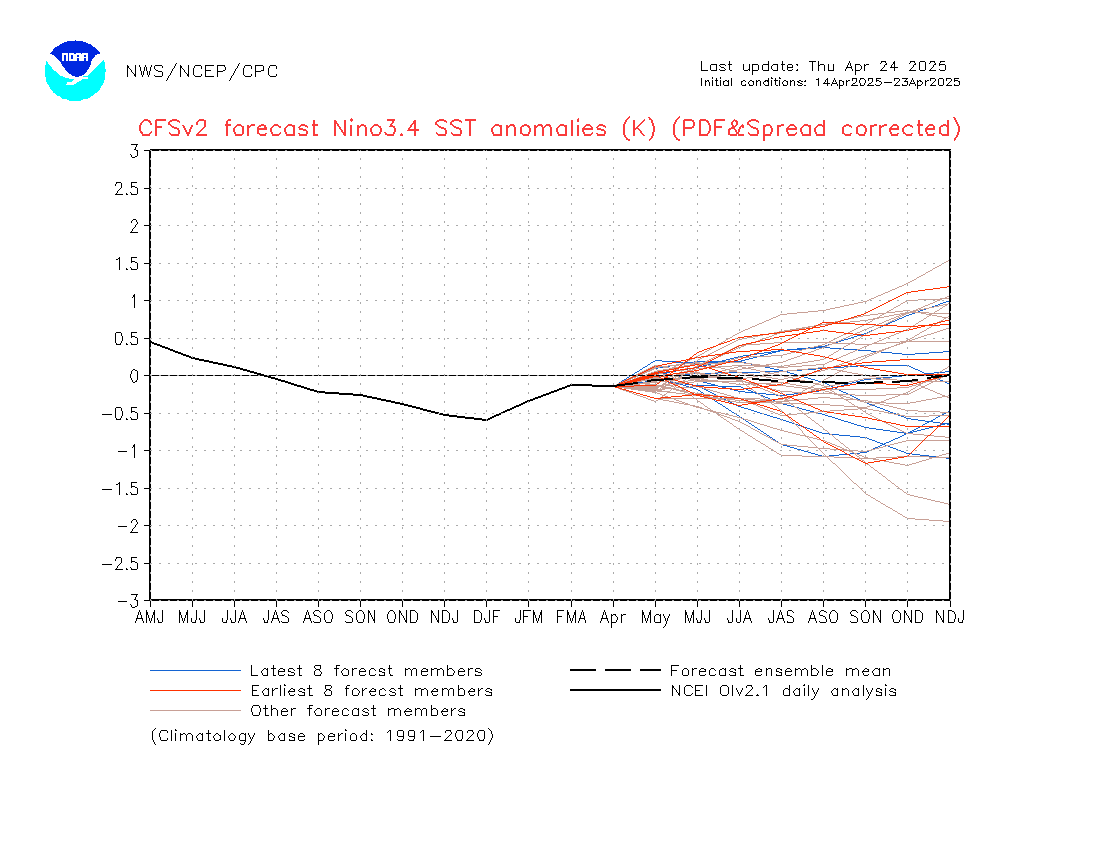 |  |
| This NOAA CFS.V2 Model keeps us in marginal to moderate El Nino through the forecast period. | The IRI/CPC Model moves into El Nino now and keeps the odds of being in El Nino high before they start to decline in AMJ 2019. The chart on the left forecasts intensity. The chart on the right forecasts probability and they are based on two different methodologies. . |
| This makes it very difficult to know what the basis of the NOAA forecast is. But this month there is not a lot of difference between these two views. So the NOAA forecast should be consistent with both of these tools. But the slight difference becomes important when you compare the MAM 2019 forecasts of NOAA and JAMSTEC. The JAMSTEC forecast seems to be more in line with the IRI/CPC forecast. | |
| JAMSTEC quickly goes to El Nino values and maintains them into the Spring of 2018/2019. But the intensity and duration of the El Nino is less than in the forecast last month. |
| El Nino as measured by the Nino 3.4 Index starts soon, peaks in February or March 2019 and then starts a steady decline |
|
I am not sure how to interpret this graphic. It is what JAMSTEC calls their Modoki Index. It is reading lower than their standard index but it is barely in El Nino Territory. It may well impact the Spring of 2019 forecast but the El Nino is just starting to be more westerly displaced at that time so it is not exactly clear to me what is happening here. You really need to compare the JAMSTEC Modoki Index with the JAMSTEC one year Nino 3.4 Index so I have not done the best job of organizing these graphics. |  |
To remedy that problem I have repeated the JAMSTEC one year Nino 3.4 forecast here. I do not know how to interpret this but the Modoki Index declines faster than the traditional Index which is consistent with what JAMSTEC has been saying namely that this El Nino will have some Modoki characteristics early. |
|
NOAA relies on a variety of forecasts including the CPC/IRI forecast. We did not include the CPC/IRI discussion as we believe it is well covered in the general NOAA discussion shown later.
A part of forecasting is the forecast of Sea Surface Temperatures (SST) as this is very important for many forecasting models.
 |  |
 |  |
 |  |
Updates from JAMSTEC can be found here. Updates from NOAA can be found here. You have to look for the SST row and go to the right where it says “normalized with mask” and click on E3 which provides the latest model run.
A. Focus on the NOAA Update
A note about terminology; the deviations from climatology/normal are color coded but also labeled “A” for more than (above) normal and “B” for less than (below) normal. The area designated EC means Equal Chances of being more or less than normal. JAMSTEC relies on their color coding. In my comments I have used EC to cover all the situations where a clear anomaly is not shown. So the words “warm”, “cool”, “wet”, “dry” should be generally interpreted as being relative to climatology/normal for that location and time of year.
First we will take a look at the NOAA Early Outlook for October 2018. It is called the Early Outlook because it will be updated at the end of September. Only the October Outlook will be updated at that time.
Temperature

Precipitation

We have nothing to compare these maps with as NOAA does not in their Update provide a forecast for each of the subsequent two months separate from their three-month forecast. Thus I do not have previously forecast maps for October from the previous NOAA Report to compare against. And the current month is not over so we can not really compare the forecast for next month against the actual for this month. It is probably best to just try to understand what NOAA is trying to convey about October which for Temperature will be warm in the West and the Southeast with a small cold anomaly within a larger EC area in the Central CONUS. Re precipitation, we see a wet East Coast, Southern Tier and Western Alaska and a dry Northwest CONUS.
Visual Consistency Testing.
It is useful to see how the month forecast fits with the set of shorter forecasts that we have. But since the Seasonal Outlook was issued on August 16 which is almost the earliest it is ever issued, some of our short term forecast maps fall in August but we include them as they show the trend.
First Temperature
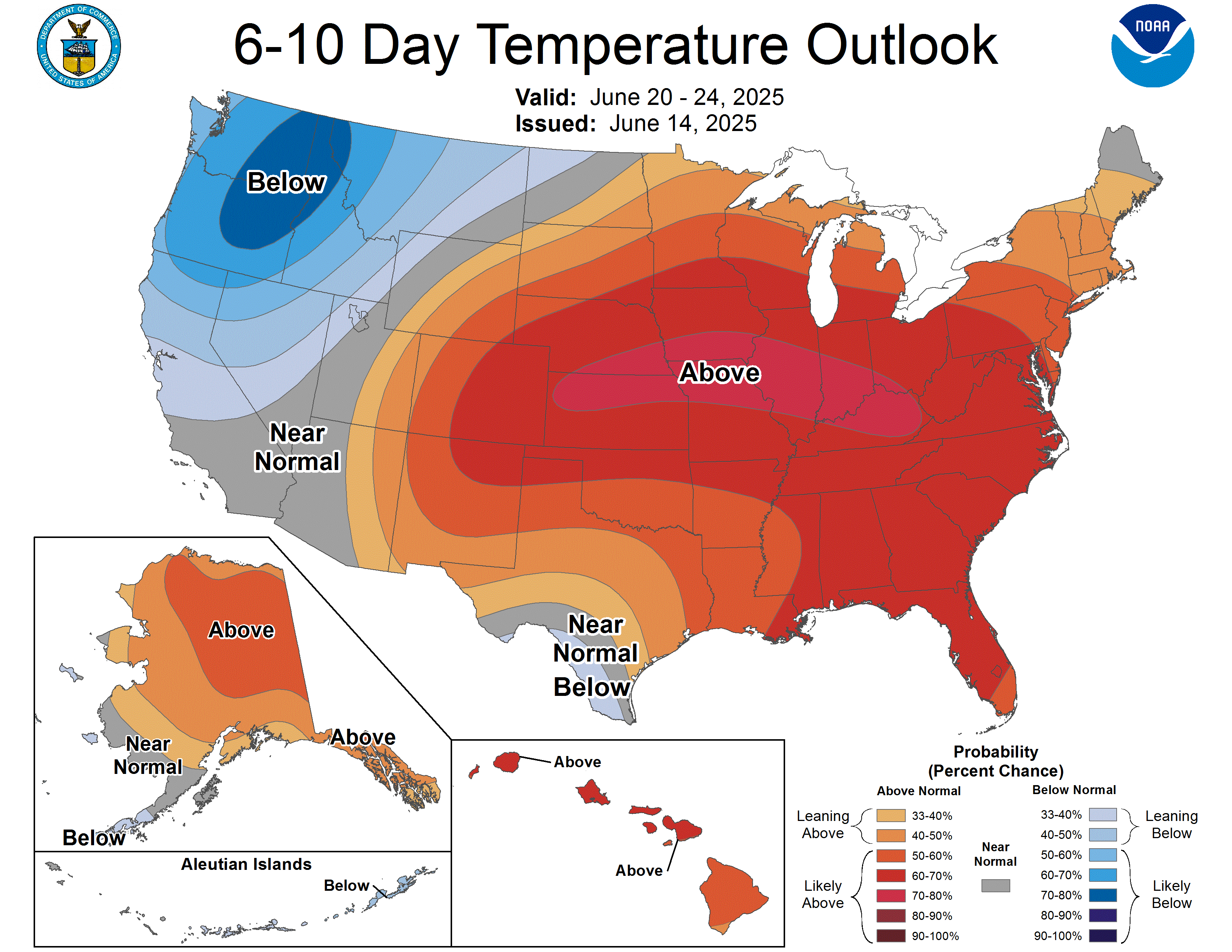 | 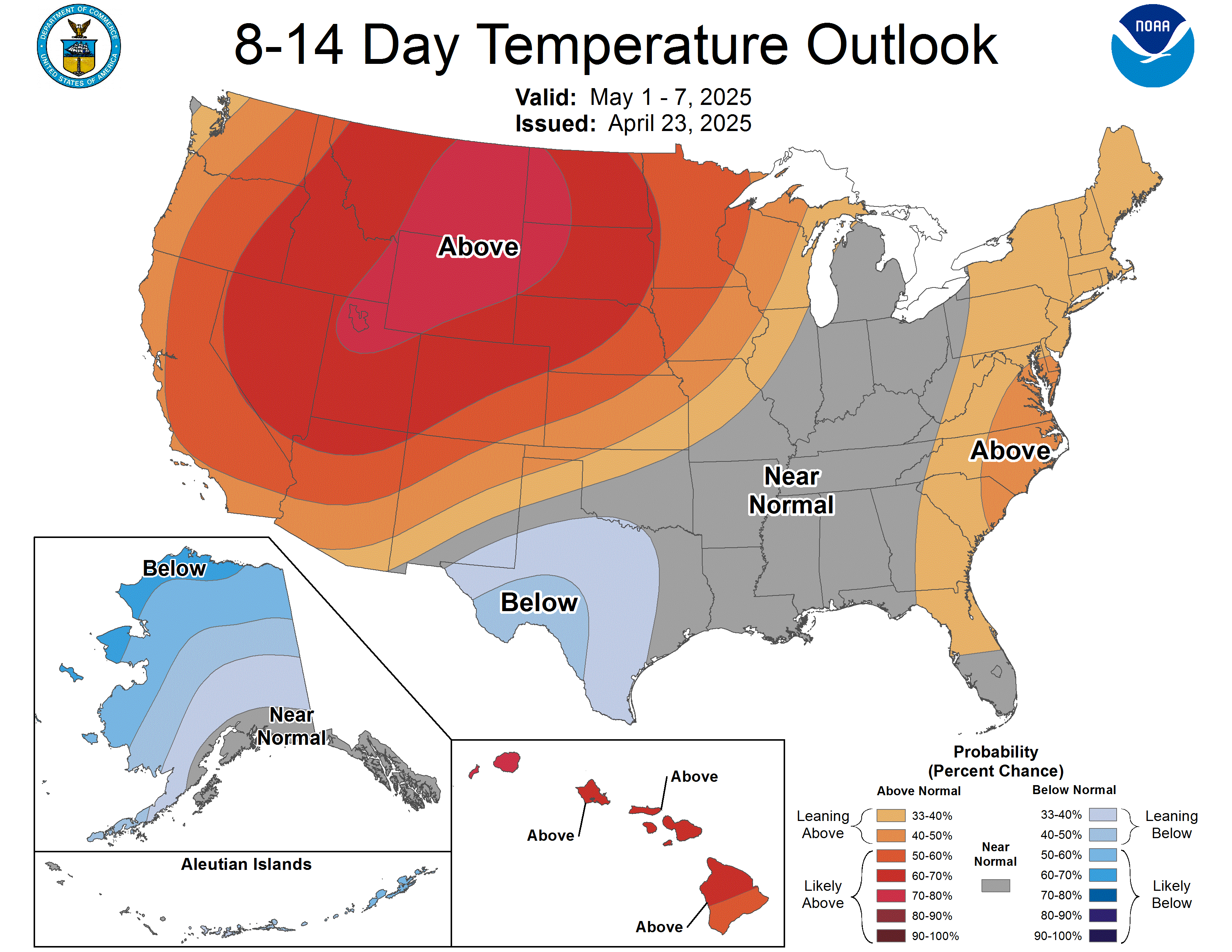 | 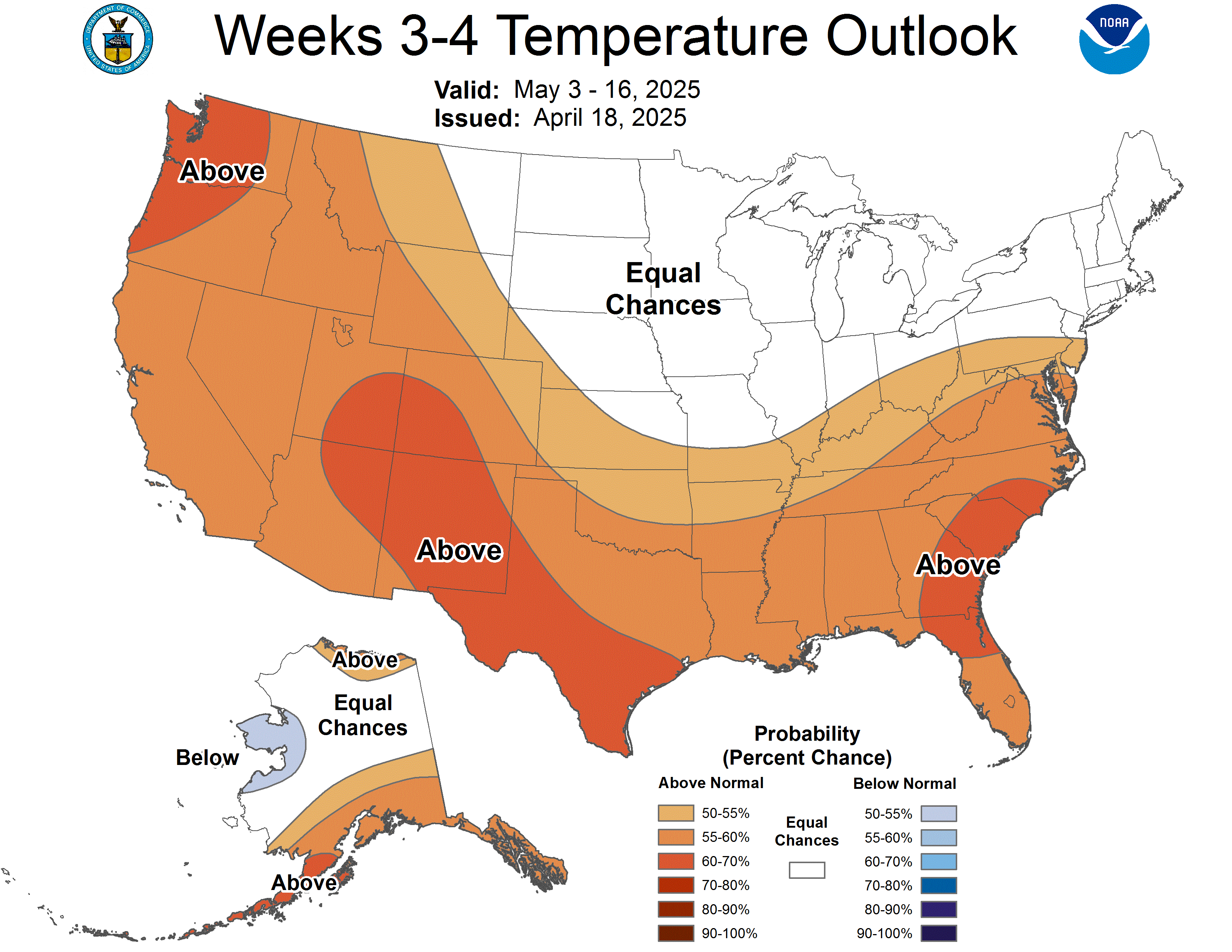 |
| The new monthly forecast is to the right. Does it appear to be reflective of the three parts of the month for which we have forecasts? → |
| ↑ ← The full month forecast seems to fit fairly well with the 8- 14 day and the Week 3/4 forecast. But, we do not have the last part of the month in the sequence of maps above. The Early Outlook for October was issued on September 20 so it may very well be changed on September 30 when it is updated. |
And then Precipitation
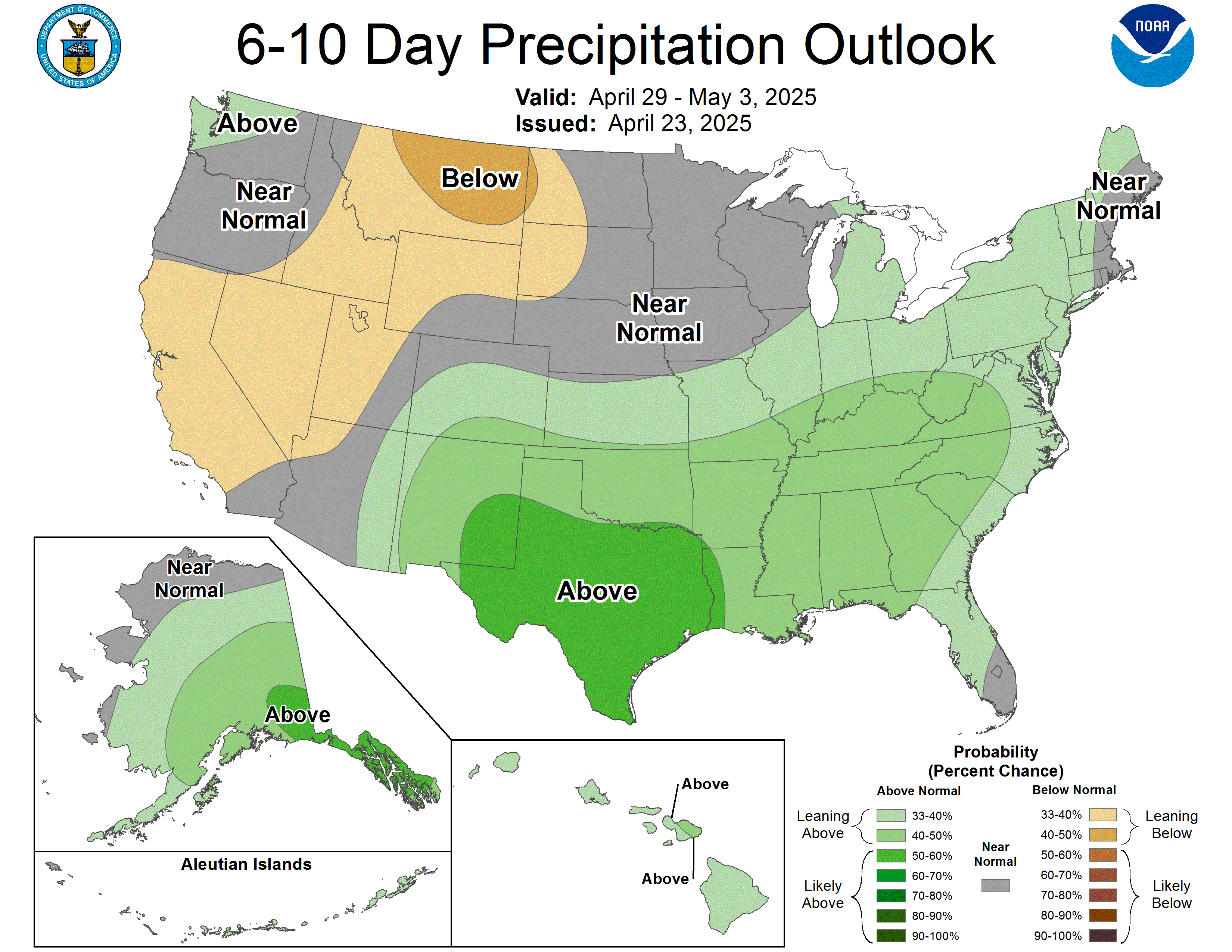 | 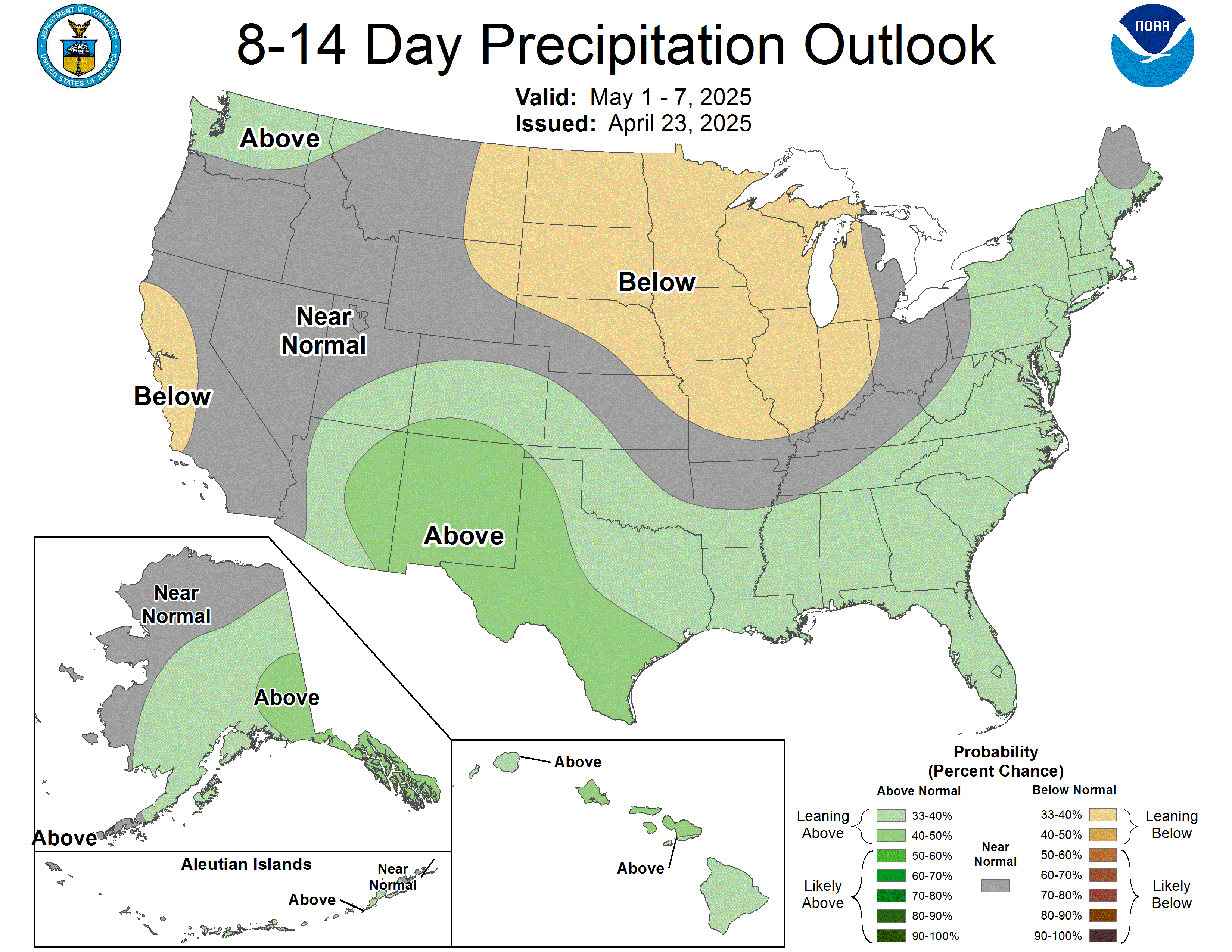 | 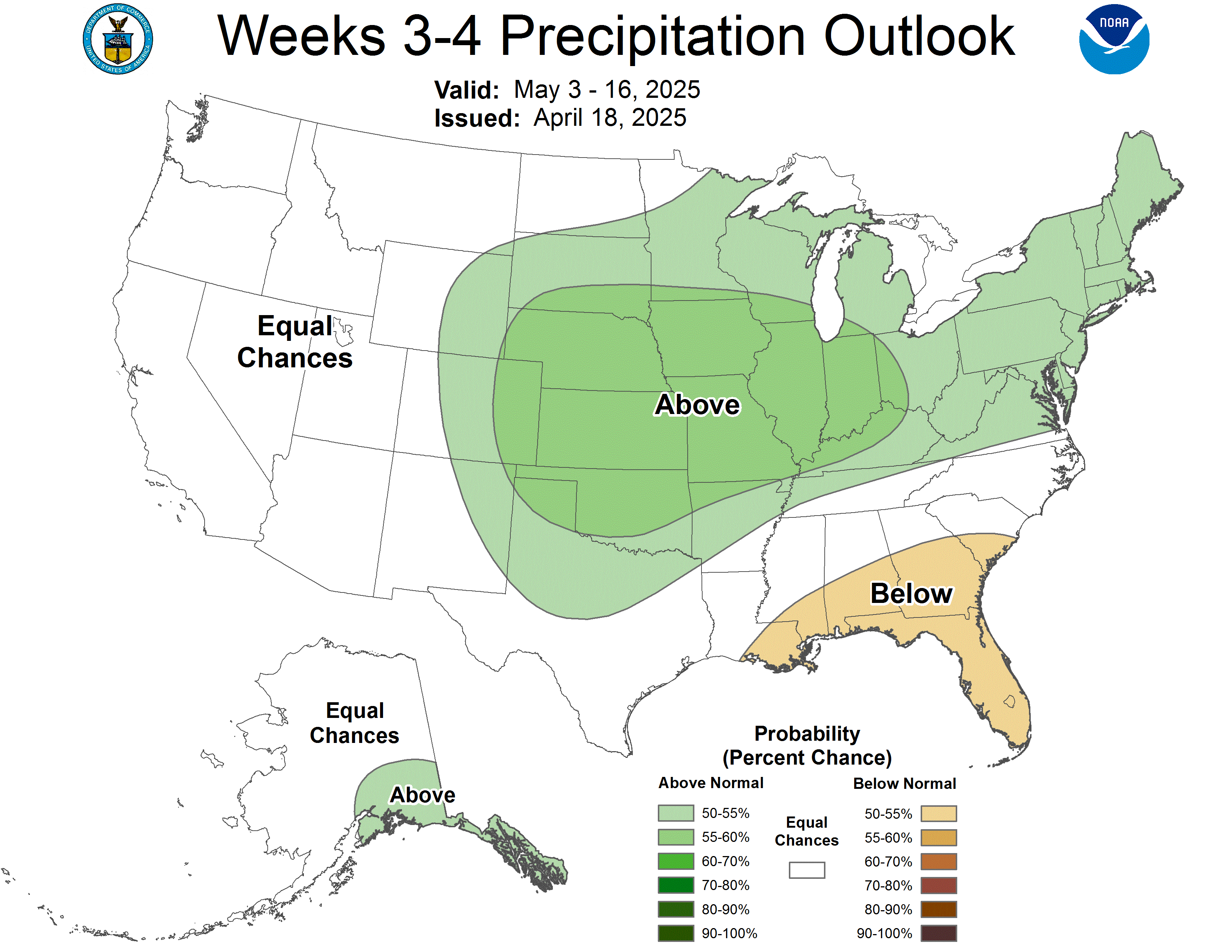 |
| The new monthly forecast is to the right. Does it appear to be reflective of the three parts of the month for which we have forecasts? → |
| ↑ ← The concatenation of the 8-14 Day and Week 3-4 Map seems to fit fairly well. But we do not have the last part of the month in the sequence of maps above. The Early Outlook for October was issued on September 20 so it may very well be changed on September 30 when updated. |
Now we consider the three-month Outlook.
Notice that the three-month periods are abbreviated e.g. October/November/December is shown as OND. You will see such abbreviations often in this report.
Prior Temperature Outlook for OND 2018

New Temperature Outlook for OND 2018
Prior Precipitation Outlook for OND 2018

New Precipitation Outlook for OND 2018
It seemed to make sense to have this Australian BOM forecast here.
.
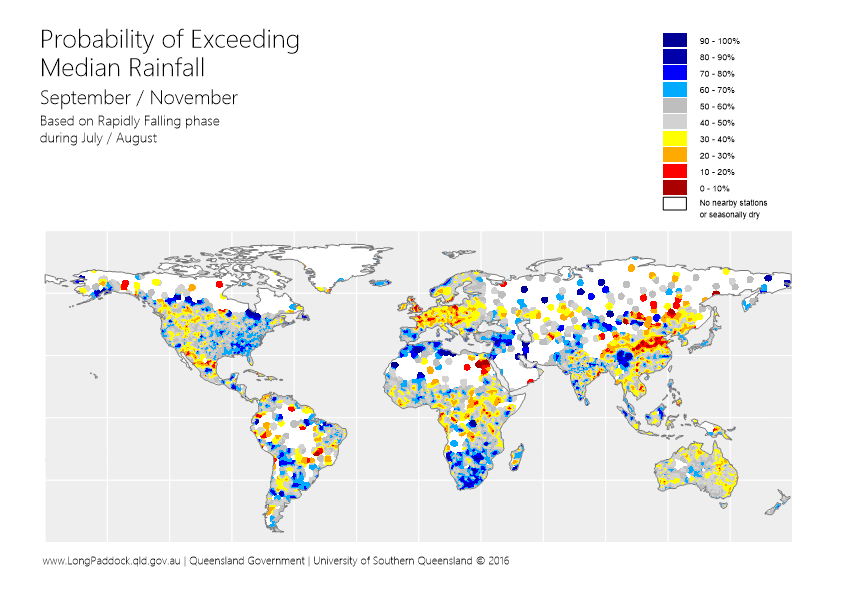
It is kind of amazing that you can make a worldwide forecast based on just one parameter the SOI and changes in the SOI. Basically it is an El Nino forecast as the SOI was falling most of July and August. For CONUS it shows a dry West and wet Southeast. I probably should have include it with the NOAA JAMSTEC comparison.
Now let us focus on the long-term situation and compare the new set of maps with the maps issued on July 19, 2018.
Prior 14 Month Temperature Outlook: OND 2018 – SON 2019

New 14 Month Temperature Outlook: NDJ 2018/2019 – OND 2019
To compare maps from one release to another, one needs to remember that the new release drops one three-month period and adds a later one. So to make the comparisons one has to shift the new maps to the right one position and that makes the map on the right drop down to become the left-most map in the next level. I do not have a computer software tool for doing that for you so you have to do it mentally. When I do the comparison, I print the two sets of maps and put them side by side and number the same three-month maps 1, 2, 3,…..,11 in both sets of maps to make it easier for me to easily compare the same three-month period in the new with the previous forecast. One uses the same procedure to compare the precipitation maps. Based on this procedure, I conclude that:
Now Precipitation
Prior 14 Month Precipitation Outlook: OND 2018 – SON 2019

New 14 Month Precipitation Outlook: NDJ 2018/2019 – OND 2019
If you want larger versions of each map (temperature and precipitation) you can find them here. And then each of those maps can be clicked on to further enlarge them.
Sometimes it is useful to compare the three-month outlook to the forecast for the first of the three months. It shows how much the pattern changes over the three-month period.

One can mentally subtract the First-Month Outlook from the Three-month Outlook and create the Outlook for the last two months in the three-month period.
Below are excerpts (significantly reorganized and with a lot of the redundancy and discussion of methodology removed) from the Discussion released by NOAA on September 20, 2018. Headings that are “Initial Cap” only rather than all caps were added by the Author of this Update Report for clarity. Also we have organized the sequence of the sections of NOAA Discussion to first present the Atmospheric and Oceanic Conditions and then the Initial Month, the Three-month period, and finally the remainder of the 15 Month Forecast. We think that sequence with the three- to four-month period broken out separately, makes the discussion more useful for more readers.
CURRENT ATMOSPHERIC AND OCEANIC CONDITIONS
OCEANIC AND ATMOSPHERIC OBSERVATIONS ACROSS THE EQUATORIAL PACIFIC INDICATE ENSO-NEUTRAL CONDITIONS HAVE PERSISTED INTO EARLY SEPTEMBER. OBSERVED WEEKLY SSTS HAVE BEEN NEAR TO ABOVE AVERAGE OVER MOST OF THE EQUATORIAL PACIFIC OCEAN FOR THE PAST 3 MONTHS. THE LATEST WEEKLY OBSERVATIONS DEPICT SSTS WITHIN ONE CELSIUS DEGREE OF NORMAL FOR MOST AREAS, WITH SEVERAL ISOLATED POCKETS OF +1.0C TO +2.0C. POSITIVE SUBSURFACE TEMPERATURE ANOMALIES HAVE PERSISTED FOR MOST AREAS INTO EARLY SEPTEMBER, FROM NEAR THE SURFACE TO A DEPTH OF 250 METERS. NEGATIVE SUBSURFACE TEMPERATURE ANOMALIES WERE CONFINED TO NEAR THE SOUTH AMERICAN COAST, TO A DEPTH OF ABOUT 125 METERS. PERSISTENT SUBSURFACE POSITIVE HEAT ANOMALIES CONTRIBUTE TO THE CONTINUED LIKELIHOOD OF THE DEVELOPMENT OF A WEAK EL NINO DURING AUTUMN 2018.
OUTGOING LONGWAVE RADIATION (OLR) ANOMALIES INDICATED SUPPRESSED CONVECTION OVER MALAYSIA AND WESTERN INDONESIA, AND ENHANCED CONVECTION OVER PAPUA NEW GUINEA. LOW-LEVEL (850-HPA) WINDS WERE NEAR AVERAGE OVER MOST OF THE EQUATORIAL PACIFIC, WITH A FEW SMALL POCKETS OF ENHANCED WESTERLY ANOMALIES. NEAR AVERAGE WINDS WERE ALSO OBSERVED AT UPPER-LEVELS (200-HPA), WITH THE EXCEPTION OF ENHANCED WESTERLY WIND ANOMALIES OVER THE EASTERN TROPICAL PACIFIC OCEAN. OVERALL, ATMOSPHERIC OBSERVATIONS INDICATE THE CONTINUATION OF ENSO-NEUTRAL CONDITIONS.
THERE ARE SEVERAL FACTORS TO CONSIDER FOR THE AUTUMN 2018 AND WINTER 2018-19 OUTLOOKS, GIVEN THE EXPECTED DEVELOPMENT OF A WEAK EL NINO. MUCH OF THE RECENT WARMING IN SSTS HAS BEEN OVER THE CENTRAL PACIFIC, A BIT WEST OF WHERE IT TYPICALLY OCCURS. HOWEVER, THE MORE IMPORTANT CONSIDERATION IS THAT THIS WARM EVENT IS FORECAST TO BE WEAK. ONE OF THE MAIN CHALLENGES ASSOCIATED WITH A PREDICTED WEAK EL NINO IS THE UNCERTAINTY CONCERNING THE EASTERNMOST EXTENT OF THE POSITIVE SST ANOMALIES IN THE PACIFIC, THE SUBTROPICAL RIDGES THAT STRADDLE THE EQUATOR AND RELATED DEEP CONVECTION, AND THE SUBTROPICAL JET STREAM. OF PRIMARY CONCERN HERE IS HOW FAR EAST THE SUBTROPICAL JET STREAM WILL EXTEND ACROSS THE SOUTHERN TIER OF THE CONTIGUOUS U.S. IN ADDITION, WHEN EL NINO IS WEAK, THERE IS A GREATER LIKELIHOOD THAT OTHER MODES OF VARIABILITY (SUCH AS THE ARCTIC OSCILLATION (AO)) WILL PLAY A MORE SIGNIFICANT ROLE IN THE NORTH AMERICAN CLIMATE. ANOTHER FACTOR TO CONSIDER WITH THIS EL NINO IS THE MADDEN JULIAN OSCILLATION (MJO). IF A SIGNIFICANT MJO EVENT WERE TO DEVELOP DURING THE WEEK-2 PERIOD AS SOME DYNAMICAL MODELS SUGGEST, IT COULD AID IN EL NINO DEVELOPMENT OVER THE NEXT MONTH OR TWO. IT IS CONCEIVABLE THAT A SIGNIFICANT MJO EVENT COULD HELP THE EL NINO STRENGTHEN TO MODERATE INTENSITY. FOR THIS SUITE OF SEASONAL OUTLOOKS, THERE IS ENOUGH UNCERTAINTY TO CONTINUE WITH THE PREDICTION OF A WEAK EL NINO DURING THE UPCOMING COLD SEASON IN THE NORTHERN HEMISPHERE. WHETHER OR NOT THIS PARTICULAR EL NINO FADES AWAY, OR GETS SOME HELP FROM THE MJO IN THE NEXT FEW WEEKS, REMAINS TO BE SEEN.
PROGNOSTIC DISCUSSION OF SST FORECASTS
THE OCEANIC NINO INDEX (ONI) FOR THE RECENTLY OBSERVED JJA SEASON WAS +0.1C, AND THE MOST RECENT WEEKLY VALUE IS +0.3C. THE CPC SST CONSOLIDATION (CON) FOR THE NINO 3.4 REGION PREDICTS THE LIKELIHOOD OF TEMPERATURE ANOMALIES GREATER THAN +0.5 DEGREES C TO BE GREATER THAN 50 PERCENT BY SON, WITH POSITIVE ANOMALIES PEAKING NEAR +1.0 DEGREES C DURING NDJ 2018-19. THE SST CONSTRUCTED ANALOG, MARKOV MODEL, AND CFS INDICATE PEAK ANOMALY VALUES AT OR ABOVE +1.0 DEGREES C THIS UPCOMING WINTER. THE CPC/IRI CONSENSUS FORECAST FAVORS THE ONSET OF EL NINO DURING THE NORTHERN HEMISPHERE AUTUMN WITH PROBABILITIES OF EL NINO OF 65-70 PERCENT DURING NDJ AND DJF 2018-19.
30-DAY OUTLOOK DISCUSSION FOR OCTOBER 2018
ON MOST OCCASIONS, PREDICTABILITY REACHES A GENERAL MINIMUM OVERALL DURING THE MONTH OF OCTOBER FOR THE U.S. FORECAST DOMAIN AS IT IS IN THE MIDDLE OF THE SHOULDER SEASON (SEP-OCT-NOV) THAT RESIDES BETWEEN THE TRANSITION FROM THE SUMMER MONTHS TO THE COLD SEASON. THE HALF-MONTH LEAD MONTHLY FORECAST SUCH AS THE OCTOBER TEMPERATURE AND PRECIPITATION OUTLOOK PRESENTED HERE INCLUDES INFORMATION ACROSS MULTIPLE TIME SCALES (THE EXTENDED RANGE, SUBSEASONAL, AND THE SEASONAL BACKGROUND STATE). THESE FACTORS INFLUENCE THE EVENTUAL OBSERVED MONTHLY MEAN TEMPERATURE AND TOTAL PRECIPITATION AMOUNTS. THE TYPICAL GREATER UNCERTAINTY RESULTS IN A RATHER SIZABLE FORECAST AREA DEPICTING EQUAL CHANCES (EC) FOR THE INITIAL OCTOBER OUTLOOK.
A REVIEW OF THE MJO CURRENTLY INDICATES THAT IT REMAINS GENERALLY POORLY DEFINED AND THE ANOMALOUS TROPICAL CONVECTION IN RECENT WEEKS HAS BEEN DOMINATED BY HIGHER FREQUENCY TROPICAL SUBSEASONAL VARIABILITY SUCH AS ATMOSPHERIC KELVIN WAVES AND BURSTS IN TROPICAL CYCLONE ACTIVITY. SOME MODELS DO INDICATE POTENTIAL IMPROVED MJO ORGANIZATION ACROSS THE WESTERN HEMISPHERE AS WE ENTER EARLY OCTOBER, BUT UNTIL THAT PROVES TO BE THE CASE, POTENTIAL MJO INFLUENCE WAS NOT LARGELY UTILIZED IN THE CURRENT OUTLOOK.
Temperature
THE OCTOBER TEMPERATURE OUTLOOK FAVORS ABOVE NORMAL TEMPERATURES FOR ALL OF ALASKA AND MOST OF THE WESTERN CONUS WITH HIGH PROBABILITIES FOR MUCH OF THE ALASKA REGION INCLUDING GREATER THAN 80% PROBABILITY FOR PORTIONS OF NORTHWEST MAINLAND ALASKA. THE TRENDS ASSOCIATED WITH LATE ARRIVAL OF SEA ICE, MUCH ABOVE NORMAL SEA SURFACE TEMPERATURES (SSTS) ALONG MUCH OF THE COASTAL AREAS OF THE STATE, AND STRONG RIDGING AND SOUTHERLY FLOW ANTICIPATED EARLY IN THE MONTH ARE THE BASIS FOR THIS FORECAST. FOR THE WESTERN CONUS, NEARLY UNANIMOUS DYNAMICAL MODEL FORECAST GUIDANCE, LARGE AREAS OF BELOW NORMAL SOIL MOISTURE CONDITIONS AND STRONG LONG TERM TEMPERATURE TRENDS SUPPORT THE FORECAST IN THIS REGION.
ABOVE NORMAL TEMPERATURES ARE ALSO MOST LIKELY FOR AREAS OF THE SOUTHEAST, TENNESSEE VALLEY, AND MID-ATLANTIC AS SUBTROPICAL RIDGING, ABOVE NORMAL 500-HPA HEIGHT DEPARTURES, AND SURFACE MEAN SOUTHERLY FLOW ARE STILL ANTICIPATED TO PLAY A ROLE DURING THE MONTH. THE PROBABILITIES ARE MORE MODEST, HOWEVER, AS DYNAMICAL MODEL FORECAST GUIDANCE IS LESS DEFINITIVE IN THIS REGION AND SOME AREAS HAVE SUBSTANTIAL POSITIVE SOIL MOISTURE DEPARTURES AND PERHAPS REMAINING STANDING WATER FROM AN OBSERVED VERY WET SUMMER AND, MOST RECENTLY, IMPACTS FROM HURRICANE FLORENCE.
THE MOST CHALLENGING ASPECT OF THE TEMPERATURE OUTLOOK RESIDES ACROSS THE NORTHERN AND CENTRAL PLAINS, GREAT LAKES AND OHIO VALLEY REGIONS. INDICATIONS IN LATE SEPTEMBER ARE THAT A ROBUST RIDGE WILL DEVELOP ACROSS ALASKA WHICH MAY FAVOR DOWNSTREAM TROUGHING ON AVERAGE DURING EARLY PORTIONS OF OCTOBER. THE LATEST WEEK 3-4 FORECAST GUIDANCE FROM THE CFS AND ECMWF FAVOR THIS TO PERSIST SIGNIFICANTLY INTO OCTOBER WITH ELEVATED ODDS FOR BELOW NORMAL TEMPERATURES. IN ADDITION TO THE GENERAL UNCERTAINTY FOR THE FINAL TWO WEEKS IN OCTOBER, THIS IS ALSO AT ODDS WITH NMME DYNAMICAL MODEL GUIDANCE AND LONG TERM TRENDS SO EC IS CURRENTLY FORECAST FOR MUCH OF THIS AREA, HOWEVER, A REGION IS HIGHLIGHTED FAVORING BELOW NORMAL TEMPERATURES IN THE CENTRAL PLAINS AT THIS TIME.
AREAS SHOWN IN WHITE LABELED EC DEPICT A FORECAST WHERE THE PROBABILITIES FOR EITHER OF THREE CATEGORIES, BELOW-, NEAR- OR ABOVE-NORMAL MONTHLY MEAN TEMPERATURE ARE NOT SIGNIFICANTLY DIFFERENT FROM CLIMATOLOGICAL PROBABILITIES.
Precipitation
THE OCTOBER PRECIPITATION OUTLOOK WAS PARTICULARLY DIFFICULT THIS MONTH AS SIGNALS IN FORECAST GUIDANCE PRODUCTS ARE WEAK AND OFTEN CONFLICTING IN NATURE. THE OUTLOOK DEPICTS AN ENHANCED LIKELIHOOD FOR ABOVE NORMAL PRECIPITATION FOR MOST OF WESTERN AND CENTRAL ALASKA. MORE OPEN WATERS AND ABOVE NORMAL SSTS AS WELL AS GENERALLY CONSISTENT DYNAMICAL MODEL GUIDANCE ARE THE RATIONALE FOR THE OUTLOOK IN THIS REGION. POTENTIAL TROUGHING AS NOTED ABOVE ACROSS THE INTERIOR OF NORTH AMERICA WITH SOME EXTENSION INTO THE CONUS FAVORS ABOVE NORMAL PRECIPITATION FOR SIGNIFICANT PORTIONS OF THE SOUTHERN TIER OF THE CONUS AND THE EASTERN SEABOARD. THIS IS CONSISTENT TO FIRST ORDER WITH THE LATEST WEEK 3-4 DYNAMICAL MODEL GUIDANCE FROM THE ECMWF AND CFS. LONG TERM POSITIVE PRECIPITATION TRENDS ALSO CONTRIBUTE TO THE OUTLOOK ALONG PARTS OF THE EASTERN SEABOARD. ANTICIPATED RIDGING ON AVERAGE DURING THE FIRST HALF OF THE MONTH FAVORS BELOW NORMAL PRECIPITATION IN AREAS OF THE PACIFIC NORTHWEST DOING THE MONTH OF OCTOBER.
AREAS SHOWN IN WHITE LABELED EC DEPICT A FORECAST WHERE THE PROBABILITIES FOR EITHER OF THREE CATEGORIES, BELOW-, NEAR- OR ABOVE-NORMAL MONTHLY TOTAL PRECIPITATION ARE NOT SIGNIFICANTLY DIFFERENT FROM CLIMATOLOGICAL PROBABILITIES. SUMMARY OF THE OUTLOOK FOR NON-TECHNICAL USERS
BASIS AND SUMMARY OF THE CURRENT LONG-LEAD OUTLOOKS
PROGNOSTIC TOOLS USED FOR U.S. TEMPERATURE AND PRECIPITATION OUTLOOKS
THE PREDICTION OF WEAK EL NINO DEVELOPMENT SUGGESTS ENSO-RELATED IMPACTS ACROSS THE UNITED STATES THIS AUTUMN AND WINTER WILL BE SOMEWHAT DIMINISHED, FROM WHAT WOULD BE EXPECTED WITH A MODERATE OR STRONG WARM EVENT. THIS SUITE OF SEASONAL TEMPERATURE AND PRECIPITATION OUTLOOKS ARE THEREFORE BASED PRIMARILY ON A WEAK EL NINO BETWEEN OND 2018 AND MAM 2019, AND DECADAL TRENDS FOR THE ENSUING LEADS (AMJ TO OND 2019). TOOLS USED FOR THE SEASONAL OUTLOOKS INCLUDED DYNAMICAL MODEL FORECAST GUIDANCE SUCH AS THE NORTH AMERICAN MULTI-MODEL ENSEMBLE (NMME), THE INTERNATIONAL MULTI-MODEL ENSEMBLE (IMME), THE SST-BASED CONSTRUCTED ANALOG, THE CANONICAL CORRELATION ANALYSIS (CCA), AND A HYBRID STATISTICAL/DYNAMICAL CONSOLIDATION OF THE CCA/CA/ENSO-OCN/NMME (FINAL-CON) OUT THROUGH LEAD 5 (FMA 2019). FOR LEADS 6-13 (MAM THROUGH OND 2019), DECADAL CLIMATE TRENDS WERE PRIMARILY USED, AND A STATISTICAL CON (STAT-CON) WHICH IS SIMILAR TO THE FINAL-CON, BUT DOES NOT INCLUDE THE NMME. A RELATIVELY NEW TOOL IN THE CPC SUITE IS THE CBAM, OR CALIBRATION, BRIDGING, AND MERGING FORECAST TOOL. THIS USES A BAYESIAN APPROACH TO THE NMME MODEL CALIBRATION AND CONSOLIDATION, AS WELL AS A HYBRID STATISTICAL-DYNAMICAL FORECAST, IN WHICH NMME CONSTITUENT-MODEL NINO 3.4 FORECASTS ARE STATISTICALLY BRIDGED TO PREDICTED TEMPERATURE AND PRECIPITATION USING A BAYESIAN MODEL.
Three Months October – November – December
Temperature
ABOVE NORMAL TEMPERATURES ARE FAVORED FOR MOST OF THE CONTIGUOUS U.S. AND ALASKA DURING OND 2018, WITH EC INDICATED OVER A SMALL PORTION OF THE SOUTHEAST REGION. THE HIGHEST PROBABILITIES FOR ABOVE NORMAL TEMPERATURES OVER THE CONUS EXCEED 60 PERCENT ACROSS THE FOUR CORNERS REGION. PROBABILITIES GREATER THAN 60 PERCENT FOR ABOVE NORMAL TEMPERATURES ARE ALSO INDICATED FOR NORTHWESTERN ALASKA. WIDESPREAD ABOVE NORMAL TEMPERATURES ARE SUPPORTED BY THE FINAL-CON, ESPECIALLY ITS NMME, OCN, AND ENSO CONSTITUENTS. CONSIDERABLE SUPPORT ALSO COMES FROM THE IMME, THE CFS, AND THE OLDER LEGACY CON TOOL. THE BROAD REGION OF LOW PROBABILITIES FOR ABOVE NORMAL TEMPERATURES (33%-40%) ACROSS THE CENTRAL PORTION OF THE CONUS IS DUE TO THE EXPECTATION OF A FAIRLY COOL OCTOBER. THE LATEST MODEL GUIDANCE INDICATES THE BUILDUP OF COLDER AIR ACROSS WESTERN CANADA, WHICH APPEARS POISED TO DRIVE SOUTHWARD ACROSS THIS REGION, AT LEAST DURING THE FIRST WEEK OR TWO OF OCTOBER. THE PRIMARY UNCERTAINTY LIES WITH THE PREDICTED DURATION OF AN AMPLIFIED UPSTREAM RIDGE; WHETHER IT REMAINS PERSISTENT, OR ENDS UP BEING A TRANSIENT FEATURE. IN ALASKA, THE HIGHEST PROBABILITIES FOR ABOVE NORMAL TEMPERATURES ARE SUPPORTED BY RELATIVELY WARM SSTS (WESTERN ALASKA), AND BY RECENT TEMPERATURE TRENDS RESULTING IN A SIGNIFICANT DELAY IN THE ONSET OF ICE COVER (NORTHERN ALASKA).
Precipitation
FOR OND 2018, THE PRECIPITATION OUTLOOK FAVORS ABOVE NORMAL PRECIPITATION FROM FAR SOUTHERN CALIFORNIA AND MUCH OF THE FOUR CORNERS REGION EASTWARD ACROSS THE SOUTHERN GREAT PLAINS, THE GULF COAST STATES, AND THE ATLANTIC COAST STATES FROM FLORIDA TO CENTRAL NEW ENGLAND. FAR SOUTHERN CALIFORNIA, EXTREME SOUTHERN NEVADA, AND WESTERN ARIZONA HAVE TWO OPPORTUNITIES TO REACH THE UPPER TERCILE FOR SEASONAL PRECIPITATION. THE FIRST OPPORTUNITY IS FAVORED TO BE IN OCTOBER, WITH ANOMALOUSLY WARM SSTS STILL OFF THE SOUTHERN CALIFORNIA AND MEXICAN COASTS, AND THE CONTINUING POTENTIAL FOR EASTERN PACIFIC TROPICAL CYCLONES AND ATTENDANT GULF SURGES TO FOCUS MOISTURE INTO THAT REGION OF THE FAR SOUTHWESTERN CONUS. THE SECOND OPPORTUNITY IS FAVORED LATE IN THE OND SEASON, WITH INCREASING ODDS OF EL NINO. THE FAVORED ABOVE NORMAL PRECIPITATION OVER THE REMAINDER OF THE SOUTHERN TIER OF STATES AND THE SOUTHEAST CONUS IS ATTRIBUTED TO THE POTENTIAL FOR AT LEAST A WEAK EL NINO THIS COLD SEASON. THE PREDICTED NORTHWARD EXTENSION ACROSS MUCH OF THE MID-ATLANTIC AND NORTHEAST IS LARGELY DUE TO HISTORICAL TRENDS. WETTER-THAN-NORMAL CONDITIONS ARE ALSO FAVORED IN ALASKA, WHICH ARE SUPPORTED BY THE SST-CA (CONSTRUCTED ANALOG ON SSTS) TOOL, THE CFS, THE EXPERIMENTAL CBAM, THE FINAL-CON, AND THE IMME (ESPECIALLY SOUTHERN AND WESTERN COASTS OF ALASKA). RELATIVELY WARM SSTS OFF THE SOUTHERN AND WESTERN COASTS ALSO INCREASE THE LIKELIHOOD OF WETTER-THAN-NORMAL CONDITIONS FOR THOSE AREAS. THE DELAYED ONSET OF ICE COVER OVER THE ARCTIC OCEAN/BEAUFORT SEA REGION IN THE PAST FEW DECADES ALSO LENDS SOME SUPPORT FOR FAVORED ABOVE NORMAL PRECIPITATION FOR THE NORTH SLOPE REGION. BELOW NORMAL PRECIPITATION IS FAVORED ACROSS MOST OF THE NORTHWEST, PERHAPS AS FAR EAST AS CENTRAL MONTANA AND AS FAR SOUTH AS NORTHERN NEVADA. THIS IS INDICATED BY SUCH TOOLS AS THE NMME, IMME, SST-CA, AND CBAM TO VARIOUS DEGREES. IN ADDITION, DRIER-THAN-NORMAL CONDITIONS USUALLY BEGIN TO SET UP ACROSS THE NORTHWESTERN CONUS IN CONCERT WITH A DEVELOPING EL NINO.
PROGNOSTIC DISCUSSION OF OUTLOOKS – OND 2018 TO OND 2019 (with a focus on months after OND)
TEMPERATURE
FOR LEADS 2-6 (NDJ 2018-19 THROUGH MAM 2019), THE TEMPERATURE OUTLOOKS ARE BASED ON THE PREMISE OF A WEAK EL NINO, AND CONSIDERATION OF A WIDE ARRAY OF STATISTICAL AND DYNAMICAL TOOLS (NOTED EARLIER). THE GENERAL IDEA IS TO DEPICT THE ANTICIPATED WAXING AND WANING OF EC COVERAGE ACROSS THE SOUTHEAST, WHICH REPRESENTS THE AREA OF GREATEST UNCERTAINTY DURING THESE SEASONAL LEADS. DURING THESE SAME SEASONS, THE PROBABILITIES FOR ABOVE NORMAL TEMPERATURES DECLINE ACROSS THE NORTHEAST AND GREAT LAKES REGION DURING NDJ AND DJF, BEFORE FAVORING EC IN JFM AND FMA 2019. THE PREDICTED SPATIAL EXTENT OF EC DIMINISHES ACROSS THIS AREA IN MAM 2019. THE CALIBRATED NMME, THE FINAL-CON, AND THE LEGACY CON, SUPPORT SIGNIFICANTLY ELEVATED CHANCES OF NON-ABOVE NORMAL TEMPERATURES FOR THE NORTHEAST AND GREAT LAKES, MEANING EITHER EC OR BELOW NORMAL TEMPERATURES. WITH SUBSTANTIAL UNCERTAINTY REGARDING EL NINO INTENSITY DURING THE AUTUMN AND WINTER, IT WAS DECIDED AT THIS TIME TO FAVOR EC OVER BELOW NORMAL TEMPERATURES. IT IS ALSO POSSIBLE THAT THIS PREDICTED WARM EVENT MAY NOT MATERIALIZE AS MOST NINO 3.4 SST ANOMALY PROJECTIONS INDICATE.
THE SEASONAL TEMPERATURE OUTLOOKS FOR LEADS 7-13 (AMJ THROUGH OND 2019) ARE BASED ALMOST EXCLUSIVELY ON DECADAL TEMPERATURE TRENDS, WHICH FAVOR ANOMALOUS WARMTH FOR MUCH OF THE CONUS, WITH THE EXCEPTION OF THE NORTH-CENTRAL STATES WHERE EC IS FAVORED FOR LEADS 8-11 (MJJ THROUGH ASO 2019), AND THE SOUTHEAST FOR LEADS 12-13 (SON AND OND 2019). MOST OF ALASKA IS ALSO FAVORED BY DECADAL TRENDS TO BE ABOVE NORMAL, WITH THE EXCEPTION OF LEADS 12 AND 13 (SON AND OND 2019) WHEN EC IS FAVORED OVER THE SOUTHEAST MAINLAND AND NORTHERN PANHANDLE.
PRECIPITATION
FOR LEADS 2 AND 3 (NDJ AND DJF 2018-19), THE SEASONAL PRECIPITATION OUTLOOKS FAVOR THE MEAN STORM TRACK AND SUBTROPICAL JET STREAM ACROSS THE SOUTHERN TIER OF THE CONUS, LARGELY IN RESPONSE TO THE PREDICTED DEVELOPMENT OF A WEAK EL NINO. DUE TO THE UNCERTAINTY ASSOCIATED WITH THE DEVELOPING EL NINO AT THIS TIME, THE 50%-60% PROBABILITY REGIONS FAVORING ABOVE NORMAL PRECIPITATION OVER THE SOUTHWEST AND SOUTHEAST REGIONS OF THE CONUS FROM THE PREVIOUS SET OF OUTLOOKS HAVE BEEN DROPPED. THE FAVORED AREA OF BELOW NORMAL PRECIPITATION ACROSS THE INTERIOR NORTHWEST IS EXPECTED TO SHIFT SLIGHTLY EASTWARD DURING THESE TWO SEASONS. THE ALASKA PRECIPITATION OUTLOOKS FOR NDJ AND DJF 2018-19 ARE BASED PRIMARILY BY DYNAMICAL MODEL GUIDANCE. FOR LEADS 4-6 (JFM THROUGH MAM 2019), THE PRECIPITATION OUTLOOKS CONTINUE TO WORK OFF THE PREMISE OF A WEAK EL NINO EVENT. THIS UNDERLYING PREMISE, ALONG WITH STATISTICAL AND DYNAMICAL MODEL GUIDANCE, FAVORS THE CONTINUATION OF A SOUTHERN STORM TRACK, A PERIOD OF FAVORED BELOW NORMAL PRECIPITATION CENTERED OVER THE OHIO VALLEY, AND THE REMOVAL OF THE DRIER-THAN-NORMAL CONDITIONS INDICATED OVER THE NORTHWEST CONUS. JFM AND FMA 2019 ALSO FAVOR THE INTRODUCTION OF FAVORED BELOW NORMAL PRECIPITATION ACROSS WESTERN ALASKA.
THE SEASONAL PRECIPITATION OUTLOOKS FOR SUBSEQUENT LEADS 7-13 (AMJ THROUGH OND 2019) ARE ALMOST EXCLUSIVELY BASED ON DECADAL PRECIPITATION TRENDS. THESE OUTLOOKS ARE MOSTLY UNCHANGED FROM THE CORRESPONDING PREVIOUS SET OF OUTLOOKS, WITH NO NEW INFORMATION AVAILABLE AS TO WHICH DIRECTION THESE OUTLOOKS CAN BE RELIABLY TILTED. THE ONLY EXCEPTION IS WESTERN ALASKA FOR LEADS 12 AND 13 (SON AND OND 2019) WHERE OPEN WATER LATER INTO THE AUTUMN SEASON IS LIKELY TO INCREASE THE ODDS FOR ABOVE NORMAL PRECIPITATION THERE.
It may not shed much light but the discussion issued with the Week 3 – 4 forecast is more current than the discussion with the Seasonal Update but only covers that particular two-week period. The comments on the MJO are interesting. It is something to monitor as some of the models are forecasting WWB for November. WWB are western wind bursts which can trigger another Kelvin Wave.
Week 3-4 Forecast Discussion Valid Sat Oct 06 2018-Fri Oct 19 2018
ENSO-neutral conditions currently are present across the equatorial Pacific Ocean. Equatorial sea surface temperatures (SSTs) are near to above average across most of the Pacific Ocean. The CPC velocity potential based and RMM MJO indices indicate an inactive MJO. The GEFS depicts the MJO to strengthen and emerge over the Western Hemisphere during the next two weeks. The Week 3-4 temperature and precipitation outlooks rely primarily on dynamical model forecasts from the NCEP CFS, the ECMWF, and the JMA operational ensemble prediction systems, as well as forecasts from the Subseasonal Experiment (SubX), a multi-model ensemble (MME) of experimental ensemble prediction systems. Consideration is also given to the possible evolution of the predicted circulation pattern for Week-2.
Dynamical model guidance from the CFS and ECMWF is broadly consistent, depicting a trough over the Aleutians, while a strong ridge is forecast over Mainland Alaska and along the Pacific Northwest of the CONUS. Downstream a trough is centered over parts of the Upper Midwest and Great Lakes region, and ridging is forecast to persist in parts of the Southeast. The CFS and ECMWF ensemble means favor near-normal 500-hPa heights over Hawaii, while JMA favors above-normal 500-hPa heights there.
Ridging and large positive 500-hPa heights over Alaska lead to enhanced probabilities of above-normal temperatures over the entire state. Dynamical model forecasts (CFS, ECMWF and JMA) are in general agreement on increased chances of above-normal temperatures for the western CONUS and parts of the Southeast. Below-normal temperatures are favored over the Southern Plains, the Lower Mississippi Valley, and the Tennessee Valley, extending northeastward across the Middle and Upper Mississippi Valley, the Ohio Valley, the Middle Atlantic, the Great Lakes region, and over the Northeast, consistent with dynamical model guidance from SubX.
The various model guidance is in fairly good agreement on the precipitation outlook for the Week 3-4 period. Forecast ridging across the Pacific Northwest supports increased chances of anomalously dry conditions for the northwestern CONUS. The greatest probabilities for above-normal precipitation are indicated over the Pacific Northwest. Above-normal precipitation is favored across the southeastern seaboard, consistent with dynamical model predicted Week 3-4 precipitation amounts. Above-normal precipitation is likely in southern Alaska and the Alaska Panhandle due to troughing over the Aleutians.
Persistent positive SST anomalies continue to surround Hawaii, supporting increased chances of above-normal temperatures and precipitation across the island chain. Dynamical model precipitation forecasts generally favor above-normal rainfall over Kahului and Honolulu.
B. Now we begin our comparison of the NOAA and JAMSTEC Forecasts (Focus on next nine months i.e. three seasons)
In this Update, we compare the JAMSTEC temperature and precipitation forecast maps, which are for the World, with the NOAA temperature and precipitation forecast maps that cover only CONUS and Alaska. We do this primarily for educational purposes.
JAMSTEC works in three-month intervals which correspond to seasons and does not change the selection of months each time they update but does so every three months. At that time they drop one season and add another season further in the future. So for JAMSTEC we now have Fall (SON), Winter (DJF) and Spring (MAM) to work with and we have the corresponding maps from NOAA. JAMSTEC only provides three sets of maps and they only change every three months.
I show the NOAA Maps first followed by the JAMSTEC maps. I extract North America from the Worldwide JAMSTEC map and use that to compare with the NOAA Maps. I also extract Europe including parts of North Africa and Western Asia from the Worldwide JAMSTEC maps and include those excerpted maps in the summary table at the beginning of this article.
Fall SON
Temperature
NOAA (which is showing an OND forecast which in many ways is more useful but overlaps with winter unlike the JAMSTEC forecast)
And here is the SON 2018 temperature forecast for North America that I extracted from the JAMSTEC World Forecast.
And now the JAMSTEC WORLD FORECAST (for this graphic my comments are mostly related to areas other than Alaska and CONUS as those comments appear with the larger graphics above)

Precipitation
NOAA (notice that NOAA is using OND which is more useful but JAMSTEC sticks with SON as their approach is to focus on seasons in this case meteorological Fall)
And here is the SON 2018 Precipitation Forecast for North America that I extracted from the JAMSTEC World Forecast.
JAMSTEC WORLD FORECAST

Winter (DJF 2018 – 2019)
Temperature
NOAA
And here is the DJF 2018 – 2019 Temperature Forecast for North America that I extracted from the JAMSTEC World Forecast.
JAMSTEC WORLD FORECAST

NOAA
And here is the DJF 2018 – 2019 Precipitation Forecast for North America that I extracted from the JAMSTEC World Forecast.
JAMSTEC WORLD FORECAST

Spring (MAM 2019)
Temperature
NOAA
And here is the MAM 2019 Temperature Forecast for North America that I extracted from the JAMSTEC World Forecast.
JAMSTEC WORLD FORECAST

NOAA
And here is the MAM 2019 Precipitation Forecast for North America that I extracted from the JAMSTEC World Forecast
JAMSTEC WORLD FORECAST

C. An analysis of the forecasts for ENSO by NOAA and JAMSTEC and others including the Australian Bureau of Meteorology.
This provides a bit more background to that which was provided by NOAA in their official release on August 16. This section is organized into four parts.
1. Current and Recent Sea Surface Temperatures (SST)
2. Current and Recent Equatorial Pacific Subsurface Temperatures
3. History of the Nino 3.4 Readings and forecasts from other Meteorological Agencies.
4. The Surface Air Pressure Pattern that confirms the state of ENSO.
1. Current and Recent Sea Surface Temperatures (SST)
A major driver of weather is Surface Ocean Temperatures. Evaporation only occurs from the Surface of Water. So we are very interested in the temperatures of water especially when these temperatures deviate from seasonal norms thus creating an anomaly. The geographical distribution of the anomalies is very important. To a substantial extent, the temperature anomalies along the Equator have disproportionate impact on weather so we study them intensely and that is what the ENSO (El Nino – Southern Oscillation) cycle is all about. Subsurface water can be thought of as the future surface temperatures. They may have only indirect impacts on current weather but they have major impacts on future weather by changing the temperature of the water surface. Winds and Convection (evaporation forming clouds) is weather and is a result of the Phases of ENSO and also a feedback loop that perpetuates the current Phase of ENSO or changes it. That is why we monitor winds and convection along or near the Equator especially the Equator in the Eastern Pacific.
It is the ocean surface that interacts with the atmosphere and causes convection and also the warming and cooling of the atmosphere. So we are interested in the actual ocean surface temperatures and the departure from seasonal normal temperatures which is called “departures” or “anomalies”. Since warm water facilitates evaporation which results in cloud convection, the pattern of SST anomalies suggests how the weather pattern east of the anomalies will be different than normal.

A major advantage of the Hovmoeller method of displaying information is that it shows the history so I do not need to show a sequence of snapshots of the conditions at different points in time. This Hovmoeller provides a good way to visually see the evolution of this ENSO event. I have decided to use the prettied-up version that comes out on Mondays rather that the version that auto-updates daily because the SST Departures on the Equator do not change rapidly and the prettied-up version is so much easier to read. The bottom of the Hovmoeller shows the current readings. Remember the +5, -5 degree strip around the Equator that is being reported in this graphic. So it is the surface but not just the Equator.
This next graphic is more focused on the Equator and looks down to 300 meters rather than just being the surface.

2. Current and Recent Equatorial Pacific Subsurface Temperatures Let us look in more detail at the Equatorial Water Temperatures.
This graphic provides both a summary perspective and a history (small images on the right).
.
Anomalies are strange. You can not really tell for sure if the blue area is colder or warmer than the water above or below. All you know is that it is cooler than usual for this time of the year. A later graphic will provide more information. Aside from buoyancy the currents tend to bring water from that depth up to the surface mostly farther east. These currents are very complicated and made even more so by the uneven nature of the ocean floor. So the exact pattern of where this warm water will erupt is beyond my level of understanding. But it will erupt to the surface in multiple different places.
Now for a more detailed look. Below is the pair of graphics that I regularly provide. The date shown is the midpoint of a five-day period with that date as the center of the five-day period. The bottom graphic shows the absolute values, the upper graphic shows anomalies compared to what one might expect at this time of the year in the various areas both 130E to 90W Longitude and from the surface down to 450 meters. At different times I have discussed the difference between the actual values and the deviation of the actual values from what is defined as current climatology (which adjusts every ten years except along the Equator where it is adjusted every five years) and how both measures are useful for other purposes.
We now have warm water extending to 110W. Most of this is at depth. One can see why the models predict an El Nino. |
 |
| The 28C Isotherm is now at 160W, the 27C Isotherm is at 150W, the 25C Isotherm is now at 130W. The 20C Isotherm no longer reaches the surface but the 21C Isotherm does so at 105W. |
Tracking the change.
 |  |
The next graphic basically averages out the anomalies by longitude.

The discussion in this slide says it better than I could. One might compare the current reading to Oct/Nov 2017. The anomaly had returned to zero then reversed for a month and then returned to zero and now has gone positive. It now seems to be increasing a bit.
3. History of the Nino 3.4 Readings and forecasts from other Meteorological Agencies.
TAO/TRITON GRAPHIC (a good way of viewing data related to the part of the Equator and the waters close to the Equator in the Eastern Pacific where we monitor to determining the current phase of ENSO. It is probably not necessary in order to follow the discussion below, but here is a link to TAO/TRITON terminology.
And here is the current version of the TAO/TRITON Graphic. The top part shows the actual temperatures, the bottom part shows the anomalies i.e. the deviation from normal.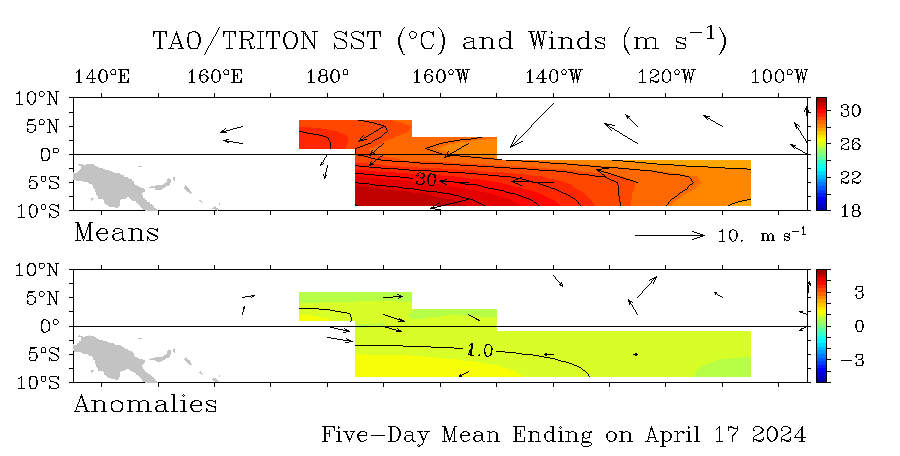
Location Bar for Nino 3.4 Area Above and Below
| ———————————————— | A | B | C | D | E | —————– |
The above is how I estimate the key Index that NOAA uses to forecast ENSO. The below graphic shows the current values and about a year of history. The same data in graphic form but going back a couple of more years can be found here. The full table of values can be found here.

As shown in the little insert in the graphic above, the Nino 3.4 area has been found to correlate best with CONUS weather. Other areas may correlate better with Asian weather. There are many models used to forecast these four indices and in particular the Nino 3.4 Index. This is a larger version of the model we showed earlier.
The CFS.v2 is not the only forecast tool used by NOAA. The CPC/IRI Analysis which is produced out of The International Research Institute (IRI) for Climate and Society at Columbia University is also very important to NOAA.
Here is the most recent update.

The discussion released with the forecast follows. It can also be found here.
IRI Technical ENSO Update
Published: September 19, 2018
Note: The SST anomalies cited below refer to the OISSTv2 SST data set, and not ERSSTv4. OISSTv2 is often used for real-time analysis and model initialization, while ERSSTv4 is used for retrospective official ENSO diagnosis because it is more homogeneous over time, allowing for more accurate comparisons among ENSO events that are years apart. During ENSO events, OISSTv2 often shows stronger anomalies than ERSSTv4, and during very strong events the two datasets may differ by as much as 0.5 C. Additionally, the ERSSTv4 may tend to be cooler than OISSTv2, because ERSSTv4 is expressed relative to a base period that is updated every 5 years, while the base period of OISSTv2 is updated every 10 years and so, half of the time, is based on a slightly older period and does not account as much for the slow warming trend in the tropical Pacific SST.
Recent and Current Conditions
In mid-September 2018, the NINO3.4 SST anomaly showed neutral ENSO conditions. For August the SST anomaly was 0.30 C, indicating neutral conditions, and for Jun-Aug it was 0.27 C, also neutral. The IRI’s definition of El Niño, like NOAA/Climate Prediction Center’s, requires that the SST anomaly in the Nino3.4 region (5S-5N; 170W-120W) exceed 0.5 C. Similarly, for La Niña, the anomaly must be -0.5 C or less. The climatological probabilities for La Niña, neutral, and El Niño conditions vary seasonally, and are shown in a table at the bottom of this page for each 3-month season. The most recent weekly anomaly in the Nino3.4 region was 0.3, showing neutral conditions. Additionally, most of the key atmospheric variables, including the upper level zonal wind anomalies, the outgoing longwave radiation pattern (convection), and the Southern Oscillation Index suggest neutral conditions over recent weeks. However, during the most recent month the low-level zonal wind anomalies have become weakly westerly, suggesting a tendency toward El Niño conditions. The subsurface temperature anomalies across the eastern equatorial Pacific remain at moderately above-average, and have recently shown a slight further increase. These warmed waters at depth have been impacting the surface, resulting in slightly above-average temperatures, and also presaging likely further warming of the SST in the coming months. Given the current and recent SST anomalies, the subsurface profile and the conditions of most key atmospheric variables, we see a likely warming to at least weak El Niño conditions beginning in the Sep-Nov period.
Expected Conditions
What is the outlook for the ENSO status going forward? The most recent official diagnosis and outlook was issued approximately one week ago in the NOAA/Climate Prediction Center ENSO Diagnostic Discussion, produced jointly by CPC and IRI; it gave a 50-55% chance for El Niño development during fall season, rising to 65-70% for winter 2018-19. An El Niño watch remains active. The latest set of model ENSO predictions, from mid-September, now available in the IRI/CPC ENSO prediction plume, is discussed below.
As of mid-September, about 60-65% of the dynamical or statistical models predict El Niño conditions for the initial Sep-Nov 2018 season, with about 35-40% showing neutral conditions. Following that first forecast season, probabilities for neutral drop to roughly the 15-30% range for Oct-Dec 2018 through May-Jul 2019. Meanwhile, the probability for El Niño rises to 80-85% for Oct-Dec through Dec-Feb, but remains at more than 70% through to the final forecast season of May-Jul 2019. This hints at the possibility of a 2-year El Niño period, given the late start to the predicted 2018-19 El Niño. La Niña probabilities are near zero throughout the forecast period. At lead times of 3 or more months into the future, statistical and dynamical models that incorporate information about the ocean’s observed subsurface thermal structure generally exhibit higher predictive skill than those that do not. For the Dec-Feb 2018-19 season, among models that do use subsurface temperature information, 23% of models predicts neutral conditions and 77% predict El Niño conditions.
Note – Only models that produce a new ENSO prediction every month are included in the above statement.
Caution is advised in interpreting the distribution of model predictions as the actual probabilities. At longer leads, the skill of the models degrades, and skill uncertainty must be convolved with the uncertainties from initial conditions and differing model physics, leading to more climatological probabilities in the long-lead ENSO Outlook than might be suggested by the suite of models. Furthermore, the expected skill of one model versus another has not been established using uniform validation procedures, which may cause a difference in the true probability distribution from that taken verbatim from the raw model predictions.
An alternative way to assess the probabilities of the three possible ENSO conditions is more quantitatively precise and less vulnerable to sampling errors than the categorical tallying method used above. This alternative method uses the mean of the predictions of all models on the plume, equally weighted, and constructs a standard error function centered on that mean. The standard error is Gaussian in shape, and has its width determined by an estimate of overall expected model skill for the season of the year and the lead time. Higher skill results in a relatively narrower error distribution, while low skill results in an error distribution with width approaching that of the historical observed distribution. This method shows probabilities for La Niña at 2% or less for the full range of seasons from Sep-Nov 2018 through to May-Jul 2019. Probabilities for neutral conditions begin at 45% for Sep-Nov, fall to about 25-30% for Nov-Jan through Apr-Jun, and are 36% for May-Jul. Probabilities for El Niño, which begin at 55% for Sep-Nov, rise to about the 70-75% range from Nov-Jan through Apr-Jun and drop to 62% for May-Jul. A plot of the probabilities generated from this most recent IRI/CPC ENSO prediction plume using the multi-model mean and the Gaussian standard error method summarizes the model consensus out to about 10 months into the future. The same cautions mentioned above for the distributional count of model predictions apply to this Gaussian standard error method of inferring probabilities, due to differing model biases and skills. In particular, this approach considers only the mean of the predictions, and not the total range across the models, nor the ensemble range within individual models.
In summary, the probabilities derived from the models on the IRI/CPC plume describe, on average, a a tilt of the odds toward El Niño conditions starting from Sep-Nov and continuing through May-Jul 2019, peaking around 70-75% from Nov-Jan through Apr-Jun. The predicted continuation of elevated chances for El Niño well into spring/early summer 2019 hints at the possibility of a two-year El Niño episode, likely related to the late predicted onset of El Niño in 2018. Probabilities for La Niña are less than 5% throughout the entire forecast period. A caution regarding this latest set of model-based ENSO plume predictions, is that factors such as known specific model biases and recent changes that the models may have missed will be taken into account in the next official outlook to be generated and issued early next month by CPC and IRI, which will include some human judgment in combination with the model guidance.
This graphic shows a collection of models used by various meteorological agencies to forecast the NINO 3.4 Index. We will have an update on this on Thursday and it will be in our Saturday Seasonal Outlook article.

Forecasts from Other Meteorological Agencies.
Here is the Nino 3.4 report from the Australian BOM (it updates every two weeks)

And the ENSO Outlook Discussion Issued on September 11, 2018
El Niño still possible in 2018
The El Niño–Southern Oscillation (ENSO) remains neutral. However model outlooks continue to indicate El Niño is possible from late spring 2018. When assessed with current observations, the Bureau’s ENSO Outlook stands at El Niño WATCH, meaning there is approximately a 50% chance of El Niño forming in the coming months—double the normal chance.
There were only small changes to most indicators of ENSO in the past fortnight. The central and eastern tropical Pacific Ocean are warmer than average, with greatest warmth in the central to western Pacific (NINO4; +0.6 °C), while water below the surface remains somewhat warmer than average. Atmospheric indicators generally remain neutral, although trade winds are slightly weaker over parts of the western Pacific. A weakening of the trade winds is one of the most important precursors at this point for any possible El Niño, and will be watched closely.
Seven of the eight surveyed models suggest SSTs are likely to reach or exceed El Niño thresholds by the end of spring, with the majority suggesting values will remain at or above the threshold into early 2019. El Niño during spring typically results in below-average rainfall in eastern and northern Australia. In summer, this drying influence retracts to tropical regions of Australia, although the possibility of high temperatures elsewhere remains high.
Regardless of El Niño or positive IOD developing, the climate outlook for spring is for a continuation of drier and warmer than average conditions across eastern and southwest Australia.
Indian Ocean IOD (It updates every two weeks)

Indian Ocean Dipole Outlook Discussion Issued September 11, 2018
Indian Ocean Dipole outlooks
The Indian Ocean Dipole (IOD) is currently neutral. The weekly index value to 9 September was +0.28 °C. However, two of six international climate models suggest a positive IOD event may develop before the end of spring. A positive IOD during spring typically reduces rainfall in central and southern Australia, and can exacerbate any El Niño-driven rainfall deficiencies.
It is useful to understand where and how the IOD is measured.

IOD Positive is the West Area being warmer than the East Area (with of course many adjustments/normalizations). IOD Negative is the East Area being warmer than the West Area. Notice that the Latitudinal extent of the western box is greater than that of the eastern box. This type of index is based on observing how these patterns impact weather and represent the best efforts of meteorological agencies to figure these things out. Global Warming may change the formulas probably slightly over time but it is costly and difficult to redo this sort of work because of long weather cycles.
4. The Surface Air Pressure Pattern that confirms the state of ENSO.
And Now the Air Pressure to Confirm that the Atmosphere is Reacting to the Sea Surface Temperature Pattern. The most Common way to do that is to use an Index called the SOI.
This index provides an easy way to assess the location of and the relative strength of the Convection (Low Pressure) and the Subsidence (High Pressure) near the Equator. Experience shows that the extent to which the Atmospheric Air Pressure at Tahiti exceeds the Atmospheric Pressure at Darwin Australia when normalized is substantially correlated with the Precipitation Pattern of the entire World. At this point there seems to be no need to show the daily preliminary values of the SOI but we can work with the 30 day and 90 day values.

SOI = 10 X [ Pdiff – Pdiffav ]/ SD(Pdiff) where Pdiff = (average Tahiti MSLP for the month) – (average Darwin MSLP for the month), Pdiffav = long term average of Pdiff for the month in question, and SD(Pdiff) = long term standard deviation of Pdiff for the month in question. So really it is comparing the extent to which Tahiti is more cloudy than Darwin, Australia. During El Nino we expect Darwin Australia to have lower air pressure and more convection than Tahiti (Negative SOI especially lower than -7 correlates with El Nino Conditions). During La Nina we expect the Warm Pool to be further east resulting in Positive SOI values greater than +7).
To some extent it is the change in the SOI that is of most importance. The MJO or Madden Julian Oscillation is an important factor in regulating the SOI and Ocean Equatorial Kelvin Waves and other tropical weather characteristics. More information on the MJO can be found here. Here is another good resource.


