


Written by Sig Silber
JAMSTEC has suggested that there may be a Climate Shift in the Pacific to PDO Positive. What does that mean for World weather the next twenty years? The key is to understand that 1947 to 1976 is considered a period where the PDO was generally in its Negative Phase. Similarly, the years 1977 to 1998 are considered to be a period of time when the Pacific was in the PDO Positive Phase. And the period 1999 to the present is considered to be a period of time when the PDO has been in its Negative Phase. JAMSTEC is suggesting that we may be returning to 1977 to 1998 conditions. Read on to find out more.

First some housekeeping information. For those who want the forecasts beyond three months, we reported previously on the December 15 NOAA 15-Month Forecast and compared the first nine months of the NOAA Outlook with that of JAMSTEC in a special Update that you can get to by clicking here. We will of course publish a new 15 Month Update Report shortly after January 19, 2017. Remember if you leave this page to visit links provided in this article, you can return by hitting your “Back Arrow”, usually top left corner of your screen just to the left of the URL box.
From the recent JAMSTEC discussion which we commented on last week:
Interestingly, majority of the ensemble members indicate recurrence of a moderate El Niño event in the latter half of 2017. It will be interesting if an El Niño event really evolves in 2017, which may suggest a decadal turnabout in the tropical Pacific climate condition to El Niño-like state after a long spell of La Niña-like state, which led to the global warming hiatus.
We will now attempt to explain.
A. What is meant by a Pacific Climate Shift
B. Why it is reasonable to believe it might happen soon.
C. How the Pacific and Atlantic are linked.
This is a long discussion and one can jump over it if they are more interested in current weather than what we might be dealing with during the next twenty years. It is to a large extent material that I have covered in the past.
First. What is the PDO? Surprisingly it is simply the pattern of warm and cool water in the Pacific. It is not necessarily the warming or cooling of the average temperature of the water in the Pacific. One reason the pattern is important is that clouds form over the warmer parts of the Pacific so the pattern of warm and cool water and the temperature gradients determine where convection (warm moist air rising) occurs and this impacts the storm patterns which generally move from West to East.
But for CONUS, the PDO also determines if the waters off the West Coast are warm or cool. For example with PDO Negative, the coastal waters are cool which may be good for marine life but reduces coastal precipitation. There may be other important impacts. With PDO Positive some believe the ratio of El Nino’s to La Nina’s may be higher. Also the location of the Equatorial sea surface temperature (SST) anomalies associated with El Nino and La Nina may be different. In my articles I discuss Modokis and perhaps there are fewer of them with PDO Positive. So the range of impacts may be quite broad.
If one is not Northern Hemisphere Centric, one talks about the IPO the Interdecadal Pacific Oscillation rather than the PDO. Fortunately the Northern Pacific and Southern Pacific are highly correlated so we can pretend that only the Northern Hemisphere exists and not go too far wrong. But scientists sometimes address the IPO so wherever in this report you see IPO you are free in your thinking to think PDO.
At this point, it might be useful to discuss the PDO. The below shows the different pattern of where the surface water is warm and where it is cool in the Pacific during the two most discussed phases of the PDO. The graphic on the left is PDO+. The scale is surface water anomalies in degrees Centigrade. Notice the Southern Hemisphere is shown and the pattern is slightly different. Also notice the Gulf of Mexico is correlated with the PDO. Elsewhere perhaps I will discuss the reality that all of our oceans are correlated with each other due to both ocean currents and wind patterns.
| PDO Positive (+) | ————————————————————— | PDO Negative (-) |

How does the PDO impact weather?
It is important to remember that the PDO and IPO are oscillations not regular cycles and most likely represent three or more separate phenomena. The Aleutian Low may have its own cycle. The Kuroshio-Oyashio Extension (KOE) may exhibit cyclical behavior. ENSO is a well known cycle. Some of these cycles may be impacted by the AMO. There is a South Atlantic version of the AMO also. So the PDO and IPO may be a combination of cycles with different wavelengths. So a change in the Pacific may take many different forms and occur in an irregular manner. The below graphic shows the differences over a multi-year period. One could view the analysis by year and see how it is impacted by the ebb and flow of the situation in the Pacific but it would be difficult to interpret that amount of data so this approach is easier to interpret but we should recognize that the conditions in the Pacific are not binary but vary and not in a totally regular way. The same goes for the Atlantic.
Impact of Pacific Climate Change
The key to understanding these graphics is to understand that 1947 to 1976 is considered a period where the PDO was generally in its Negative Phase. That does not mean that the PDO Index registered as Negative all the time during that approximately twenty year period. Similarly the years 1977 to 1998 are considered to be a period of time when the Pacific was in the PDO Positive (sometimes abbreviated as PDO +) Phase. And the period 1999 to the present is considered to be a period of time when the PDO has been in its Negative Phase.
This provides the basis for comparing weather in those three periods of time. And if the PDO indeed changes its Phase to PDO+ we might expect weather that is more like 1977 to 1998 than 1999 to present. The differences might include rates of precipitation, the land temperature, the types of ENSO events and their frequency and other factors. The below only deals with precipitation which is of most interest to most people.
There are three graphics below and they are explained in the legend but to use larger type, Graphic “a” compares the PDO Positive Period of 1977 to 1998 with the PDO Negative Period of 1999 to 2010 (since this paper was written shortly after that point in time); the “b” graphic does the same but compares the PDO Positive period 1977 to 1998 with the PDO Negative Period 1947 to 1976 and Graphic (c) combines “a” and “b” but screens out the values which are not statistically significant. Thus two PDO Negative Periods are compared to a PDO Positive Period namely 1977 to 1998. The precipitation in the PDO Positive Period is subtracted from the precipitation in the two PDO Negative Periods thus providing an assessment of the difference between PDO Negative and PDO Positive.

Thus we should expect THE OPPOSITE OF WHAT IS SHOWN HERE in Graphic “c” if the PDO shifts back to PDO Positive as JAMSTEC has suggested it might soon do.
To assist in viewing the Graphic “C” I have blown it up.

This set of maps has limitations since it covers the March – April – May period rather than the winter which is impacted the most but it is useful as it is directly related to Climate Shifts. I was not able to locate a comparable set of graphics for the winter but I am sure they exist but I do not have them so I am using this set. I suspect the Spring anomalies and the winter anomalies are fairly similar with the winter anomalies being more extreme but pretty much in the same places. That is conjecture on my part.
Here is the discussion from the paper where I obtained these graphics and remember the discussion relates to the impacts of PDO Negative so if we are going to be PDO Positive the opposite impacts are like to be the result. This information comes from this paper “Tropical Pacific Forcing of a 1998–1999 Climate Shift: Observational Analysis and Climate Model Results for the Boreal Spring Season Bradfield Lyon, Anthony G. Barnston, David G. DeWitt”.
The following is from the Summary and Conclusions Section of their paper:
“Observationally-based analyses and reanalysis products have been used to document a multidecadal shift in Pacific SSTs in 1998–1999 and associated atmospheric changes that are akin to the shift of 1976–1977. Emphasis is on the 3-month season of MAM, which has received only modest attention from previous investigators examining related multidecadal SST variations. The motivation for the study was to examine in greater detail the abrupt decline in MAM East African rainfall reported by LD [Editors Note: From the paper written by Bradfield Lyon and David G. DeWitt] that occurred in 1999 in order to view those results in a global domain and on multidecadal timescales. The associated PC time series shows a shift in 1999 indicative of, among other features, a change in the background state of Pacific SSTs towards cooler than average conditions in the east-central tropics. A composite difference of the full SST field in fact shows an average cooling of over 0.5 for the period 1999–2012 relative to 1977–1998 in that region. The PC time series of the residual SST EOF reveals earlier shifts in 1925, 1946 and 1976, which are all consistent with previously reported shifts in the PDO (e.g., Mantua et al. 1997)
As expected, the precipitation response to the 1999 shift in SST is large scale, with statistically significant changes in MAM season totals for the post-1998 period seen in multiple locations including drying over East Africa and central-southwest Asia, coastal regions of southeastern China, parts of northeastern Australia and the southwestern US. Drier conditions are also seen over the central Indian Ocean and the east-central Pacific Ocean. Wetter conditions include a zonally elongated band across the northern Indian Ocean extending from the eastern Arabian Sea eastward across southern India to the Philippines, the western tropical Pacific and northern South America.
Southwestward displacement of the SPCZ is also identified.
Aside from the issue of the season studied, another deficiency in the above analysis is that it does not consider variations in the Phase of the Atlantic or Indian Ocean Low-Frequency Cycles. So it actually underestimates the impact of the Pacific Climate Shift. Weather cycles come with a variety of frequencies. The high-frequency cyclies have period lengths of days to a couple of years. ENSO is a medium-frequency cycle. The three main low-frequency cycles have a period of approximately 60 years. So looking at the impact of only the PDO does not factor in the impacts of the similar length cycles in the Atlantic and Indian Oceans: such cycles not generally being in sync with the PDO.
I do not want to get into a long discussion tonight but here is a short discussion of the impact of the combinations of the Pacific and Atlantic Cycles on drought probabilities in CONUS.
The seminal work on the impact of the PDO and AMO on U.S. climate can be found here. And here is a later version but I do not have a link that shows it in color but I believe the maps have not changed from the earlier version.
The key maps are shown below:
–
Drought frequency (in percent of years with red being drought and blue not drought) for positive and negative regimes of the PDO and AMO. (A) Positive PDO, negative AMO. (B) Negative PDO, negative AMO. (C) Positive PDO, positive AMO. (D) Negative PDO, positive AMO.
There are other cycles also. Two important ones are the Arctic Oscillation and the North Atlantic Oscillation. These differ from the PDO and AMO as they are atmospheric cycles not ocean cycles. But of course they are related. Below is An Attempt to Extrapolate the Impact of Ocean Cycles Worldwide – a First Attempt at Putting it all Together.
| Geographical Area | PDO+ | PDO- | AMO+ | AMO- | Comments * |
| Western US | Wet. High ratio of El Ninos to La Ninas | Dry. High ratio of La Ninas to El Ninos | Amplifies PDO – | Amplifies PDO + | The Arctic Oscillation (AO) mediates the impact of the PDO on the Northern Tier and other parts of the U.S. |
| Eastern US | Dry | Wet | Cold Winter Dry and Warm Summer | Warm Winter Wet and Cold Summer | AMO Negative tends to correlate but lag by several years the North American Oscillation (NAO) which means a colder Europe and cold air intrusions into the Center of the U.S. and the North East. AMO Positive is the opposite but the correlation with the NAO is lower. |
| Europe | NA | NA | Cold Winter Wet and Warm Summer | Warm Winter Dry and Cold Summer | |
| South America | West Coast impacted more Often by El Nino | East Coast impacted more often by La Nina | Moisture further North | Wet Summer | Note when the North Atlantic is Warm the South Atlantic is Cool and the Intertropical Convergence Zone (ITCZ) shifts to the south. |
| West Africa | NA | NA | Wet Summer | Dry Summer | Wet West African summers tend to increase hurricane activity in the U.S. |
| Australia | Dry | Wet | NA | NA | PDO Impacts the Indian Ocean Dipole IOD so that impacts both Australia and India but probably in the opposite way as India and Australia are in different hemispheres. |
| India | Dry | Wet | NA | NA | |
| Comments | Arctic Oscillation (AO) very important mediator of PDO impacts in the US especially the Northern Tier. | North American Oscillation (NAO) very important mediator of AMO impacts especially for the Central and Norther Tier of the U.S. and Europe | |||
* Cycles are not like light switches where they are either on or off. They become increasingly more positive or negative but often in an irregular way. So what is in this table are average impacts.
So let’s now go back to why we believe that the JAMSTEC announcement is a reasonable forecast.
The paper I want to discuss can be found here.
Joint statistical-dynamical approach to decadal prediction
of East Asian surface air temperature
LUO FeiFei & LI ShuangLin
The following Graphic from the Luo and Li paper is very interesting. The dashed lines are the actual readings of the Index that measures the AMO, (IPO which is a proxy for the PDO) and the somewhat similar but not very well know oscillation in the Indian Ocean. The higher-frequency version of the IOBD is well know but the low-frequency component which has a period similar to the PDO and AMO is not well known. The solid lines are the best fit with models of the index readings which were then used to forecast the index readings out to 2040. This allows me to estimate what the combination of AMO and PDO using the IPO as the surrogate for the PDO will be at the end of each decade.

Now I have modified the above to line up some key dates in the graphics namely the beginning of decades starting from the one we are in and looking forward. The decades are numbered across the top as “1”, “2”, “3”, “4”.

So combining the work of McCabe et al with the work of Lou and Li , what can we say about these beginning years in the decade which started in 2014 and subsequent decades out into our future?
1. 2010
This was clearly AMO+/PDO-. This is McCabe Condition D and full explains the approximately twice a century severe drought in the Southwest and also in the Great Lakes area.
2. 2020
This might be PDO+/AMO+ to AMO Neutral. This might be somewhere between McCabe A and McCabe C but closer to McCabe C. McCabe C is associated with extreme drought in the Northern Tier west of the Great Lakes. McCabe C also is associated with a high probability of drought in the South Atlantic Coast states extending into the Mid-West.
3. 2030
PDO-/AMO Neutral. This might be somewhere between McCabe B and McCabe D. Note the IPO (which I am using as a surrogate for the PDO) is forecast by Lou and Li to be less negative at its low point presumably due to the combination of subcycles with different amplitudes within the IPO. Also notice the significant difference between McCabe B and McCabe D. This illustrates the importance of the Atlantic SST’s
4. 2040
PDO+/AMO Neutral. This might be somewhere between McCabe A and McCabe C. McCabe C seems to flip drought in the West from south to north. So McCabe A and McCabe B both spare the Southwest but the condition of the Atlantic may have a big impact on the Northern Tier west of the Great Lakes. McCabe C also is associated with a high probability of drought in the South Atlantic Coast states extending into the Mid-West.
5. And dare we project out to say 2050? This might be PDO?/AMO-. That might result in conditions intermediate to McCabe A and McCabe B. McCabe B would raise the risk for drought in the Southeast including moderate probability of drought in Florida and small areas of extreme drought in other places.
Caveats:
- There is no intention of suggesting that the drought probability for a particular year in a particular geographic area can be predicted accurately with this methodology. It is intended to provided a reasonable scenario of how these probabilities might vary over time. This can be very useful for water planning.
- The IPO is not the PDO but they are highly correlated.
- The authors show significant confidence intervals around their projections. i.e. the timing of the peaks and valleys of these cycles could fall in the shaded area of the graphic rather than exactly as shown.
- Other authors might project these cycles slightly differently
- I believe the authors have taken Global Warming into account. But RCP 4.5 (which was used in this analysis) may be considered by some as being too conservative.
- The McCabe et all maps are maps of drought frequency. I am assuming they are highly inversely correlated with amounts of precipitation.
I have not tried to interpret the implications for each state in the Lower 48. The McCabe et al analysis is a mathematical analysis based on historical data. Underlying the data are climate patterns determined by mountains and interactions with Canada and Mexico. If I better understood all of these patterns I would feel more confident in making predictions state by state. I am hoping that my experiment with combining the emerging information on ocean cycles with the work of McCabe et al and similar will inspire others to undertake more work in this area.
Is the Lou and Li analysis realistic? Is it an outlier or is it consistent with the work of other researchers in the field.
The Lou and Li methodology is described in their paper. I have studied at least three similar papers and what I have found is that all three authors believe the two (in the case of Lou and Li three) cycles are synchronized to each other. I have consolidate the information from the three papers and here is what I came up with. This table relates the AMO to the PDO. So “Lead” means the AMO reaches a peak or minimum and begins to trend in the other direction in advance of the PDO beginning to change its direction (if it is positive begin to become less positive and then become negative or vice versa).”Lag” means the AMO chances direction later than the PDO which could be expressed as the PDO leads the AMO. So yes this is a difficult concept to grasp when looking at a table of numbers. For me it is more understandable when I look at a graph of the time series of the amplitudes of the surface temperature anomalies of the AMO and PDO.
| AMO relationship to the PDO re Leads and Lags | Lead | Lag | Sum of Absolute Values of the Lead and Lag | Twice the number in the prior column |
| Orgeville and Peltier | -13 | +17 | 30 | 60 |
| Wu, Liu, Zhang and Delworth* | 12 to 14 | 12 to 13 | 26 | 52 |
| Li and Luo | -(16 to 18) | 19 to 21 | 37 | 74 |
* This paper decomposes the PDO into a high-frequency 20 year cycle and a low-frequency presumably 60 year cycle. The above data is for the low-frequency Cycle and in this paper the authors also report a high correlation for the PDO lagging the AMO by 1 – 3 years which represents an additional scenario. Although I show a positive correlation for this paper in the above table in regards to the AMO leading the PDO it may well be that I have not read the paper carefully enough and that the correct sign of that correlation is also negative. So I would not conclude that this paper is inconsistent with the other two.
Curiously the most common belief is that the AMO controls the PDO. This is counterintuitive since winds move from West to East but they do not in the lower latitudes where the Trade Winds blow from East to West. Also the Pacific and Atlantic are connected via the Arctic Ocean. What are called teleconnections are often quite complex. Also it is important to recognize that there really is no such thing as the PDO or AMO. They both and especially the PDO are a combination of many different cycles. We talk about the PDO and AMO because it is easier to talk about two cycles than six to ten cycles. And the goal is to be able to regress actual weather to these cycles and it is more difficult to do so with six to ten cycles then with two. So when one does what is called spectral analysis one finds many different cycle lengths (i.e. the spectral analysis is actually recognizing the subcycles within the PDO and AMO) and what I have reported above is the information on the lead and lags that have the highest correlation coefficient in the three studies. Highest correlation does not mean 100% correlated so what we are describing is tendencies not certainties.
And of course we do not know how Global Warming might change the length of these cycles or the lead and lag. It is also useful to recognize that information on the AMO and PDO has only been known in the last twenty years and the PDO was figured out before the AMO. This information is all less than twenty years old. It is so new that most meteorologists and climatologists are not conversant in it. Neither are most universities. People are more conversant with the PDO since it was figured out first. There is much more to be learned. But we now know enough to expect that our climate will be impacted somewhat along the lines of the time frame I have laid out above.
Conclusion
So we are early in the process. Probably many who have been studying this believe that a change to PDO Positive will happen soon. So really the question is how soon is soon?
Is it two years or perhaps it has occurred already.
Or do we need one more cycle of El Nino – La Nina – El Nino for this to occur.
JAMSTEC seems to be suggesting sooner rather than later.
A. Focus on Alaska and CONUS (all U.S. except Hawaii)
First Let us focus on the Current (Right Now to 5 Days Out) Weather Situation.
This graphic provides a good indication of where the moisture is. It is a bit different than just moisture imagery as it is quantitative.

Image credit: Center for Western Weather and Water Extremes, Scripps/UCSD. More explanation can be found at Atmospheric Rivers (Click to read full Weather Underground Dr. Bob Henson article)
To turn the above into a forecasting tool click here and you will have a dashboard for a short-term forecasting model.
Here is a national animation of weather fronts and precipitation forecasts with four 6-hour projections of the conditions that will apply covering the next 24 hours and a second day of two 12-hour projections the second of which is the forecast for 48 hours out and to the extent it applies for 12 hours, this animation is intended to provide coverage out to 60 hours. Beyond 60 hours, additional maps are available at links provided below.
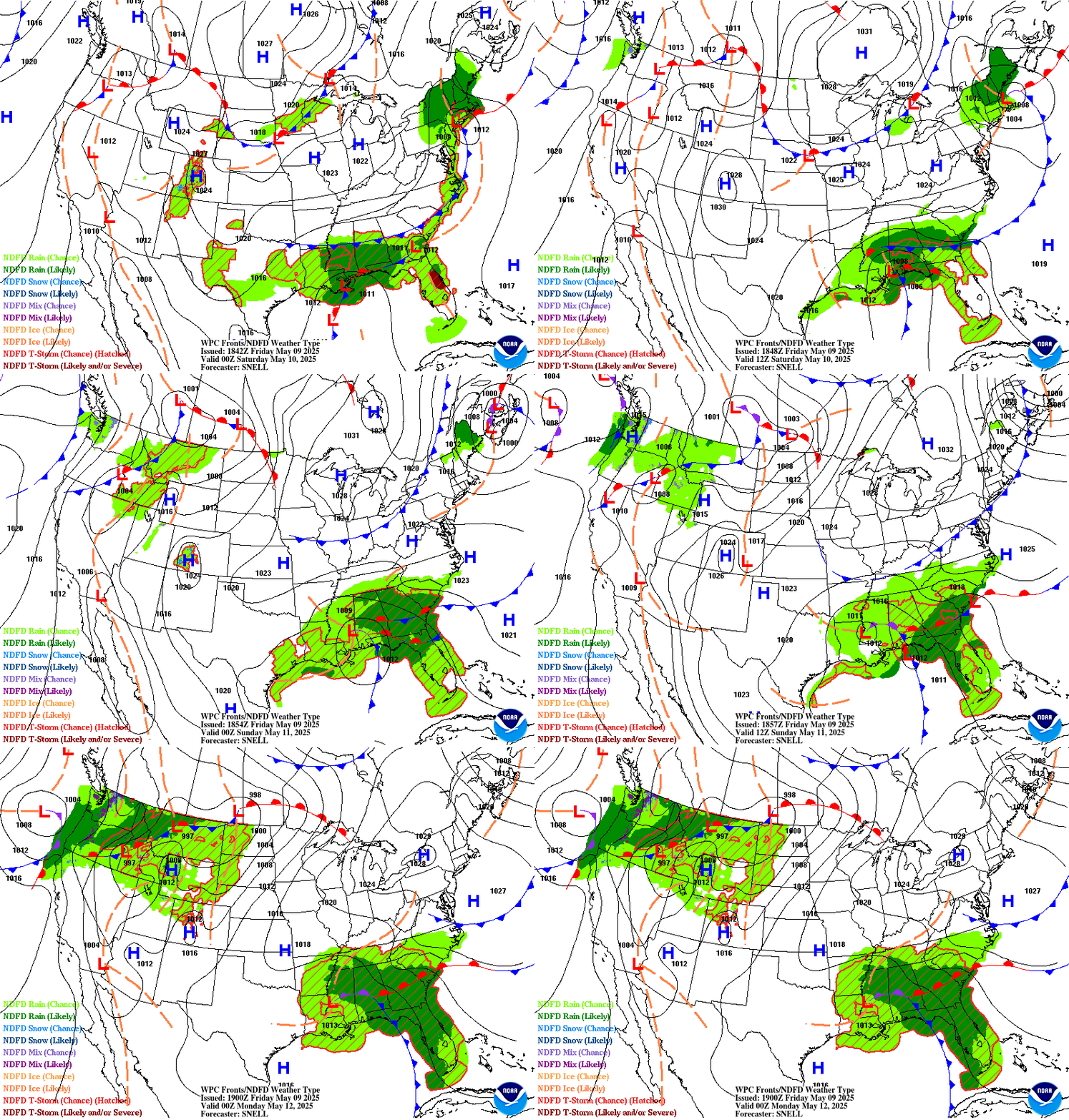
The explanation for the coding used in these maps, i.e. the full legend, can be found here although it includes some symbols that are no longer shown in the graphic because they are implemented by color coding.
U.S. 3 Day to 7 Day Forecasts
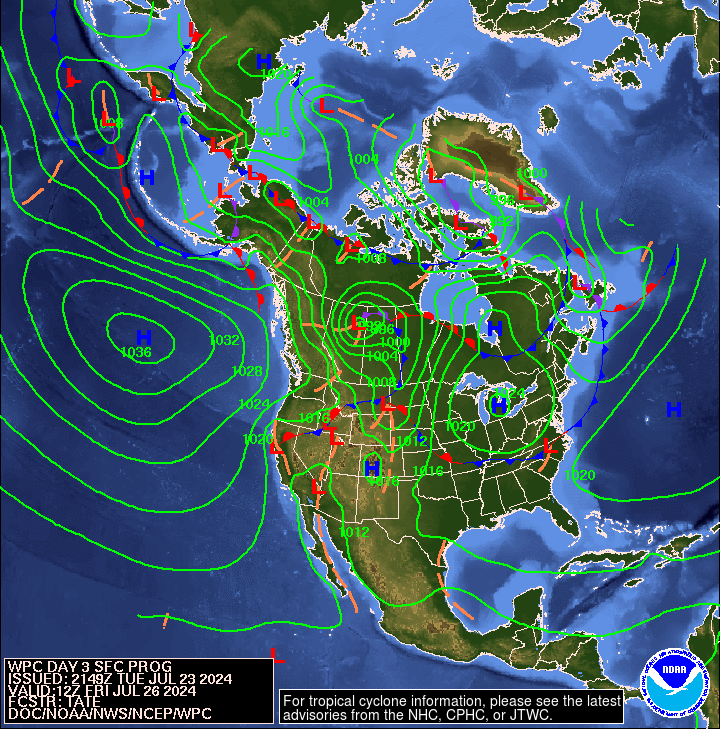
Below is a graphic which highlights the forecasted surface Highs and the Lows re air pressure on Day 3. The Day 6 forecast can be found here.
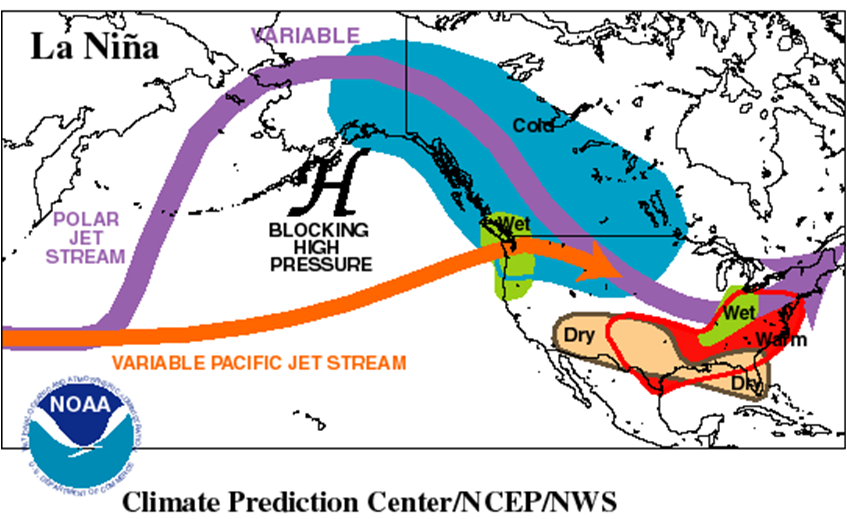
This is perhaps a good place to describe what a “Canonical” La Nina looks like. It is part of a very good write up covering many topics which can be found here.
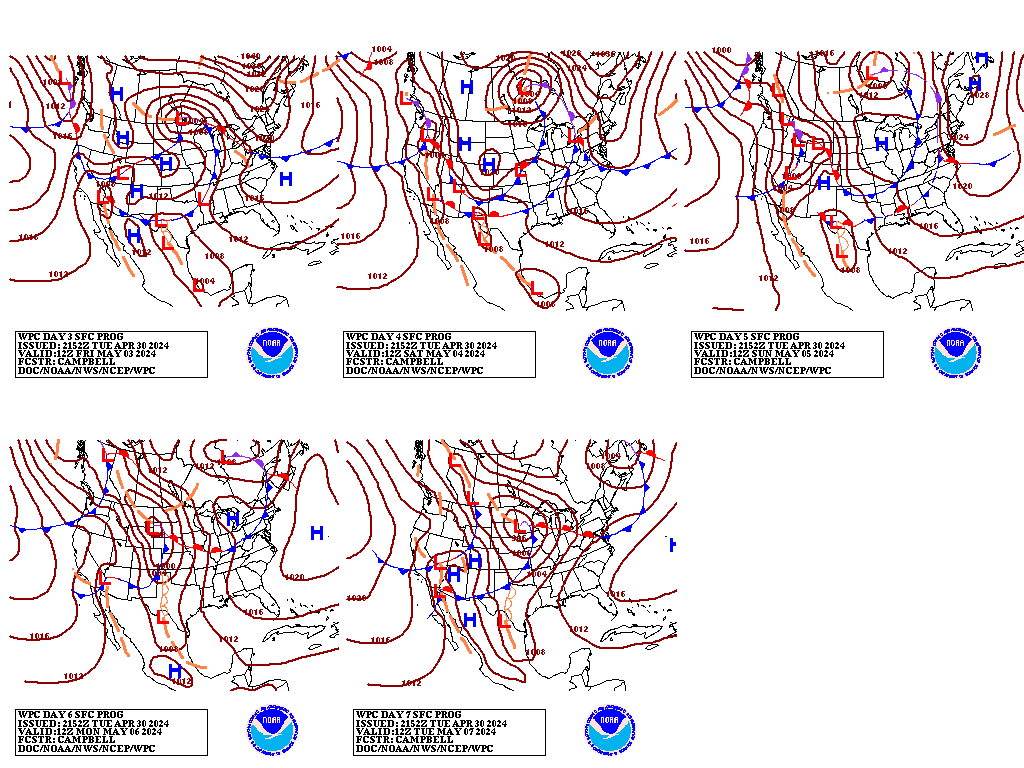
You can enlarge the below daily (days 3 – 7) weather maps for CONUS by clicking on Day 3 or Day 4 or Day 5 or Day 6 or Day 7. These maps auto-update so whenever you click on them they will be forecast maps for the number of days in the future shown.
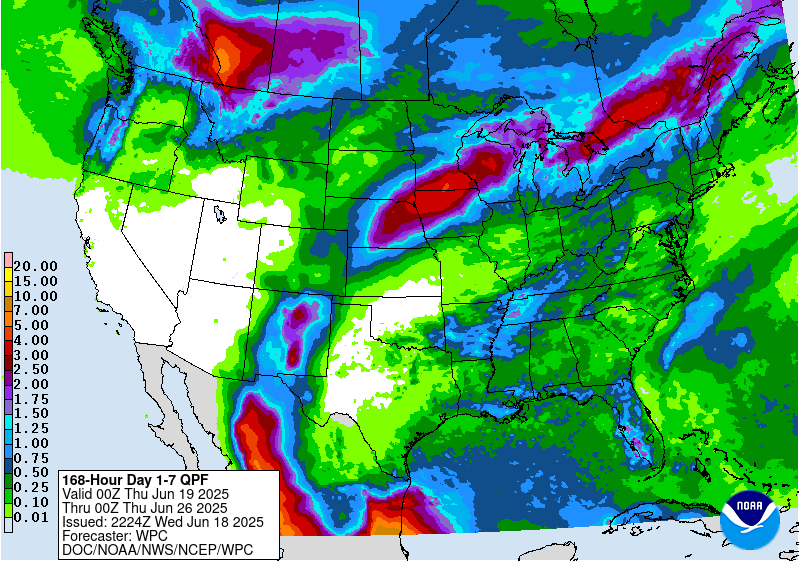
Here is the seven-day precipitation forecast. More information is available here.
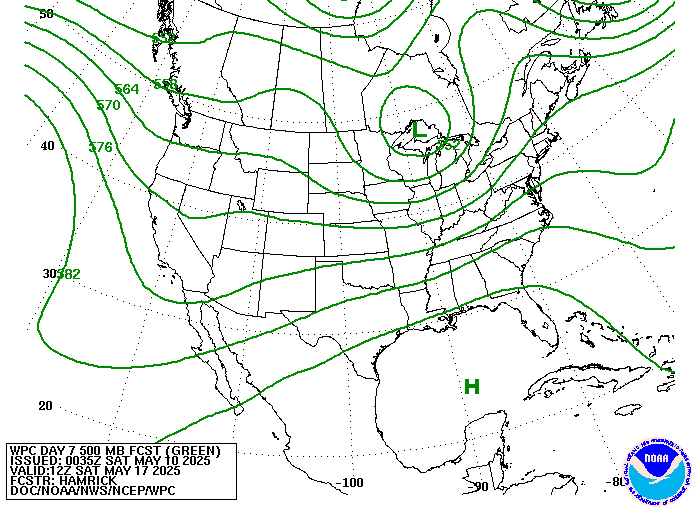
The map below is the mid-atmosphere 7-Day chart rather than the surface highs and lows and weather features. In some cases it provides a clearer less confusing picture as it shows only the major pressure gradients.This graphic auto-updates so when you look at it you will see NOAA’s latest thinking. The speed at which these troughs and ridges travel across the nation will determine the timing of weather impacts. This graphic auto-updates I think every six hours and it changes a lot. Because “Thickness Lines” are shown by those green lines on this graphic, it is a good place to define “Thickness” and its uses. The 540 Level general signifies equal chances for snow at sea level locations. Remember that 540 relates to sea level.
The graphic that I have been showing below was the Eastern Pacific a 24 hr loop of recent readings. When working, it does a good job of showing what is going on right now. When I published and for the past two weeks, that graphic was not being displayed but the NOAA website indicated that was a temporary outage. So for the time being I have substituted a static version of that image which works almost as well. However you can obtain somewhat similar imagery loop image by clicking here. It actually provides more functionality than the either the previously or currently displayed version but you have to click to get it as I have not figured out how to get it to display otherwise. It is really cool imagery and explains a lot. For now you have the static image without clicking but can click to view a more elaborate loop image. The loop image provides a better feel for the speed at which things are taking place.
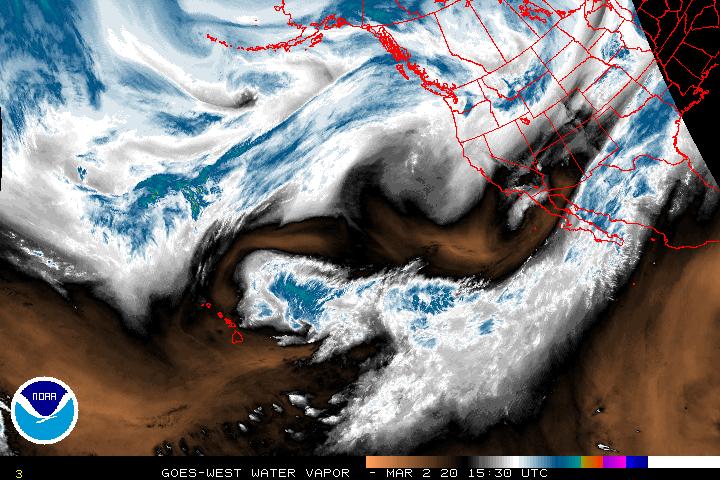
I have stopped showing the Tropical events graphic. We are still having tropical events even though it is late December but we can track them with the other graphics that I am presenting including the graphic above and below. They are both the same graphic which you can tell by looking at the date and time stamp but the above graphic covers a larger area and is centered on the Eastern Pacific and the graphic below is centered on North America. That provides more resolution that trying to work with a single graphic that covers a larger fraction of Planet Earth.
Below is the current water vapor Imagery for North America.

Looking at the current activity of the Jet Stream.
First the current situation. Not all weather is controlled by the Jet Stream (which is a high altitude phenomenon) but it does play a major role in steering storm systems. The sub-Jetstream level intensity winds shown by the vectors in this graphic are also very important in understanding the impacts north and south of the Jet Stream which is the higher-speed part of the wind circulation and is shown in gray on this map. In some cases however a Low-Pressure System becomes separated or “cut off” from the Jet Stream. In that case it’s movements may be more difficult to predict until that disturbance is again recaptured by the Jet Stream. This usually is more significant for the lower half of CONUS i.e. further south than the Jet Stream.

Now looking at the 5 Day Forecast
 .
.
Putting the Jet Stream into Motion and Looking Forward a Few Days Also
To see how the pattern is projected to evolve, please click here. In addition to the shaded areas which show an interpretation of the Jet Stream, one can also see the wind vectors (arrows) at the 300 Mb level.
This longer animation shows how the jet stream is crossing the Pacific and when it reaches the U.S. West Coast is going every which way.
When we discuss the jet stream and for other reasons, we often discuss different layers of the atmosphere. These are expressed in terms of the atmospheric pressure above that layer. It is kind of counter-intuitive to me. The below table may help the reader translate air pressure to the usual altitude and temperature one might expect at that level of air pressure. It is just an approximation but useful.

Click here to gain access to a very flexible computer graphic. You can adjust what is being displayed by clicking on “earth” adjusting the parameters and then clicking again on “earth” to remove the menu. Right now it is set up to show the 500 hPa wind patterns which is the main way of looking at synoptic weather patterns. This amazing graphic covers North and South America. It could be included in the Worldwide weather forecast section of this report but it is useful here re understanding the wind circulation patterns.
Four- Week Outlook
I am going to show the three-month JFM Outlook (for reference purposes although I do not have a lot of confidence in it), the Updated Outlook for the single month of January, the 6 – 10 Day and 8 – 14 Day Maps and the Week 3 – 4 Experimental Outlook. I use “EC” in my discussions although NOAA sometimes uses “EC” (Equal Chances) and sometimes uses “N” (Normal) to pretty much indicate the same thing although “N” may be more definitive.
First – Temperature
Here is the Three-Month JFM Temperature Outlook issued on December 15, 2016:

Here is the “Early” Temperature Outlook for January Issued on December 15, 2016

6 – 10 Day Temperature Outlook Issued Today (Note the NOAA Level of Confidence in the Forecast Released on December 26 was 5 out of 5)
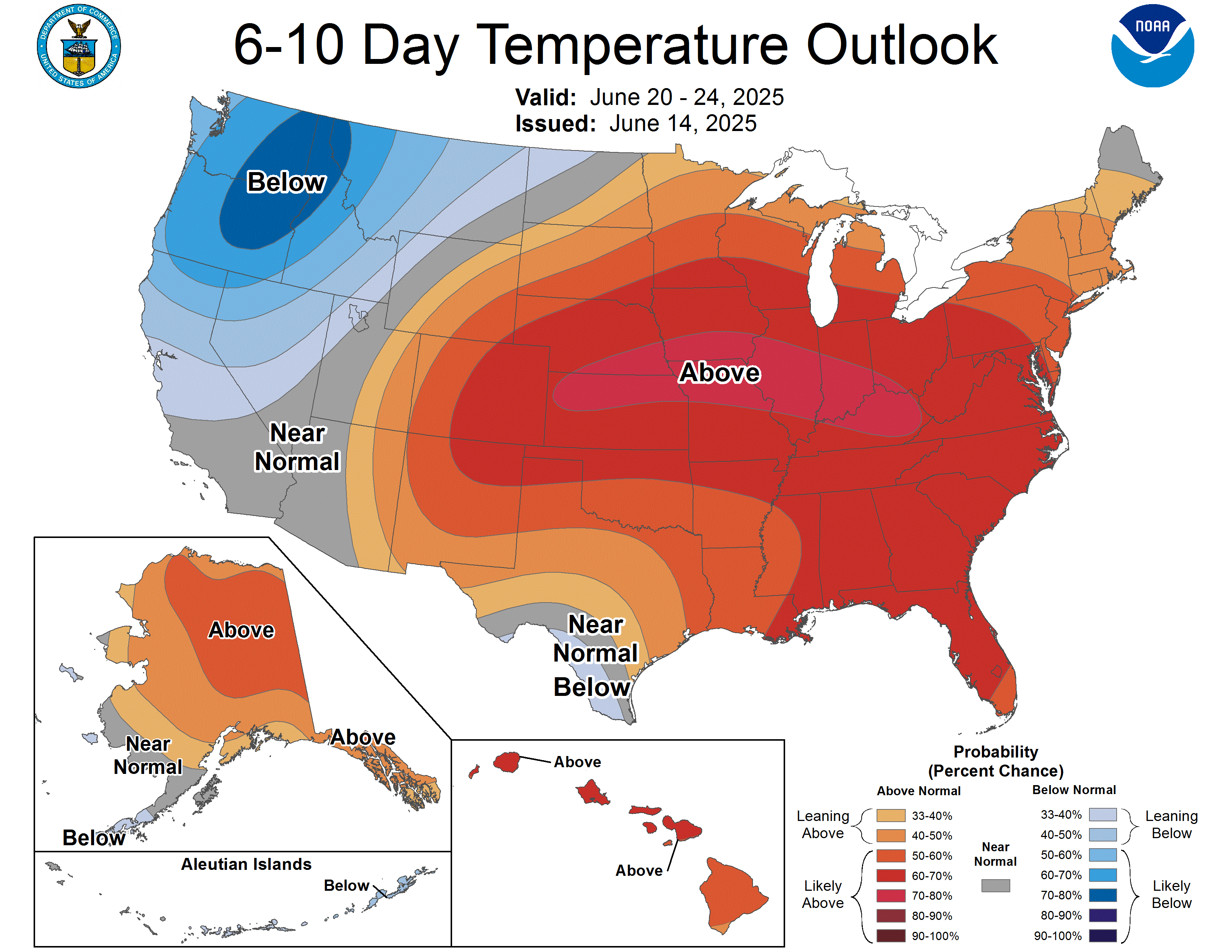
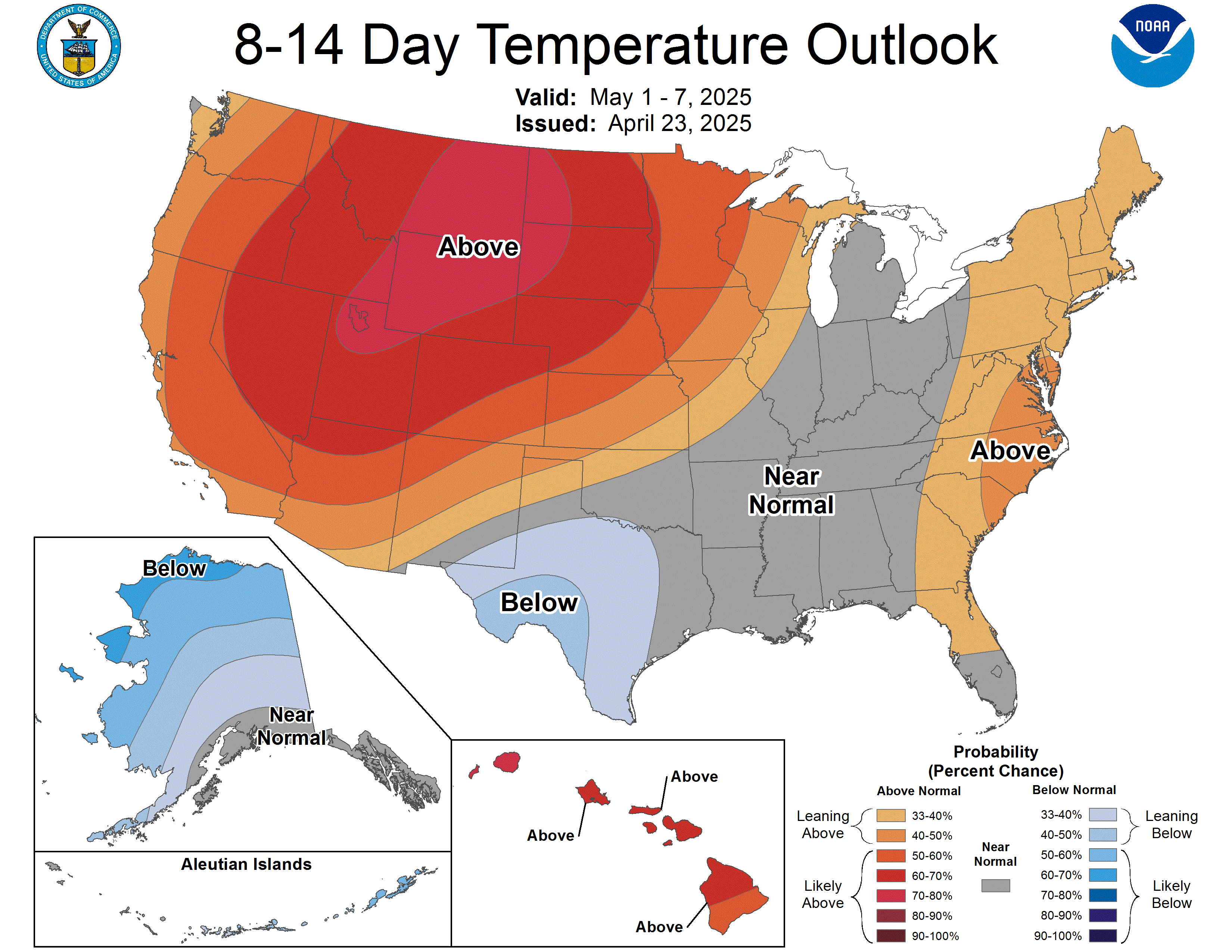
8 – 14 Day Temperature Outlook Issued Today (Note the NOAA Level of Confidence in the Forecast Released on December 26 was 5 out of 5)
Looking further out.
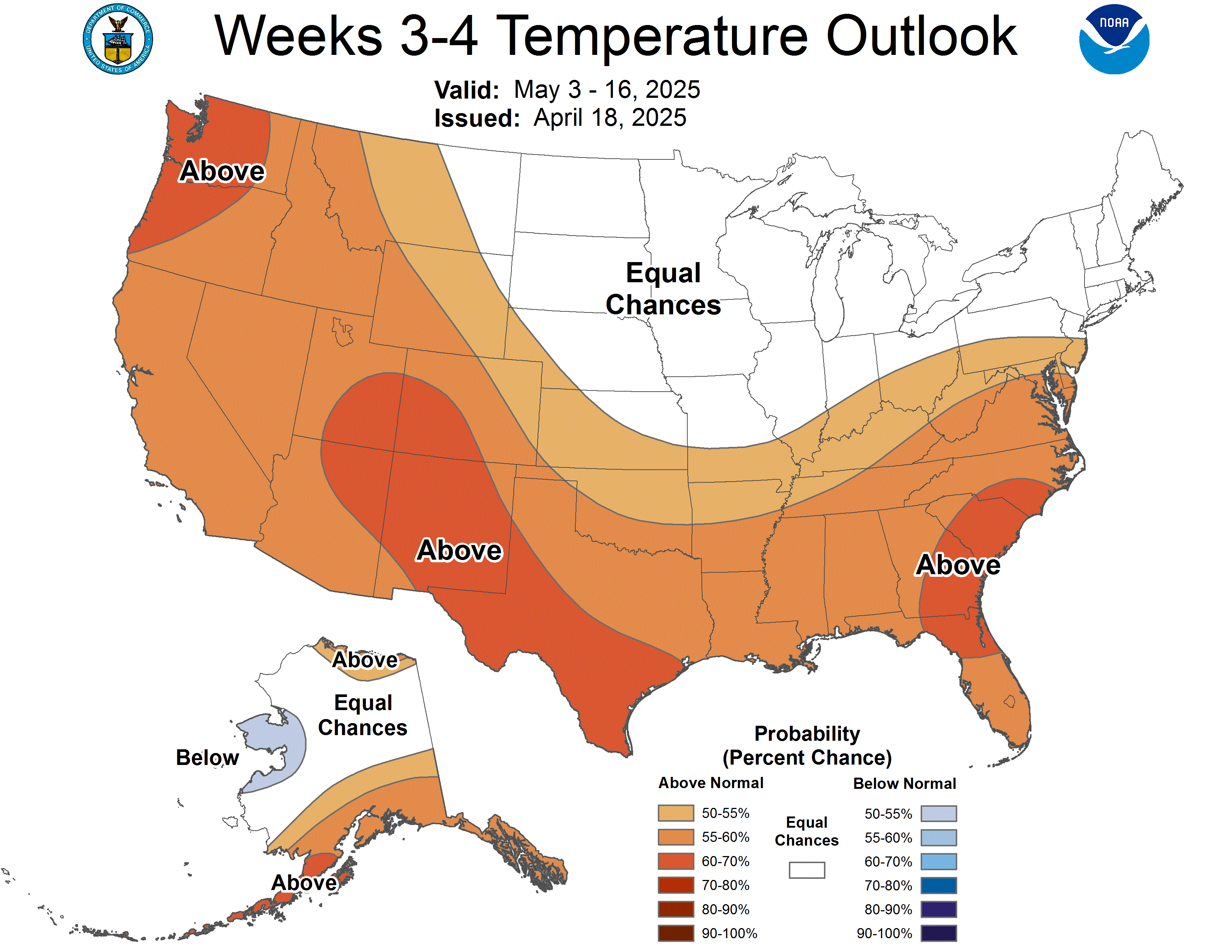
| January 1 to January 9 | January 7 to January 20 |
| Alaska will be warm, Northwest cool and the Southeast and Southwest warm with the Northwest cool anomaly expanding and the warm anomaly gradually moving south and east. | The transition to the patterns shown in the Week 3 – 4 Forecast seems to be a smooth transition. But the Northwest cool anomaly may overwhelm the Southeast cool anomaly. |
| Remember the Week 3-4 Experimental Outlook was issued last Friday and I am looking at the 6 – 10 and 8 – 14 day forecasts issued today i.e. Monday. So that explains the overlap of dates. Remember that the Week 3 – 4 Forecast covers two weeks so it can appear to not mesh perfectly but actually do so over that two-week period. At this point it meshes fairly well. | |
Now – Precipitation
Here is the three-month JFM Precipitation Outlook issued on December 15, 2016 that I do not have much confidence in.

And here is the “Early” Precipitation Outlook for January issued on December 15, 2016

6 – 10 Day Precipitation Outlook Issued Today (Note the NOAA Level of Confidence in the Forecast Released on December 26 was 5 out of 5)
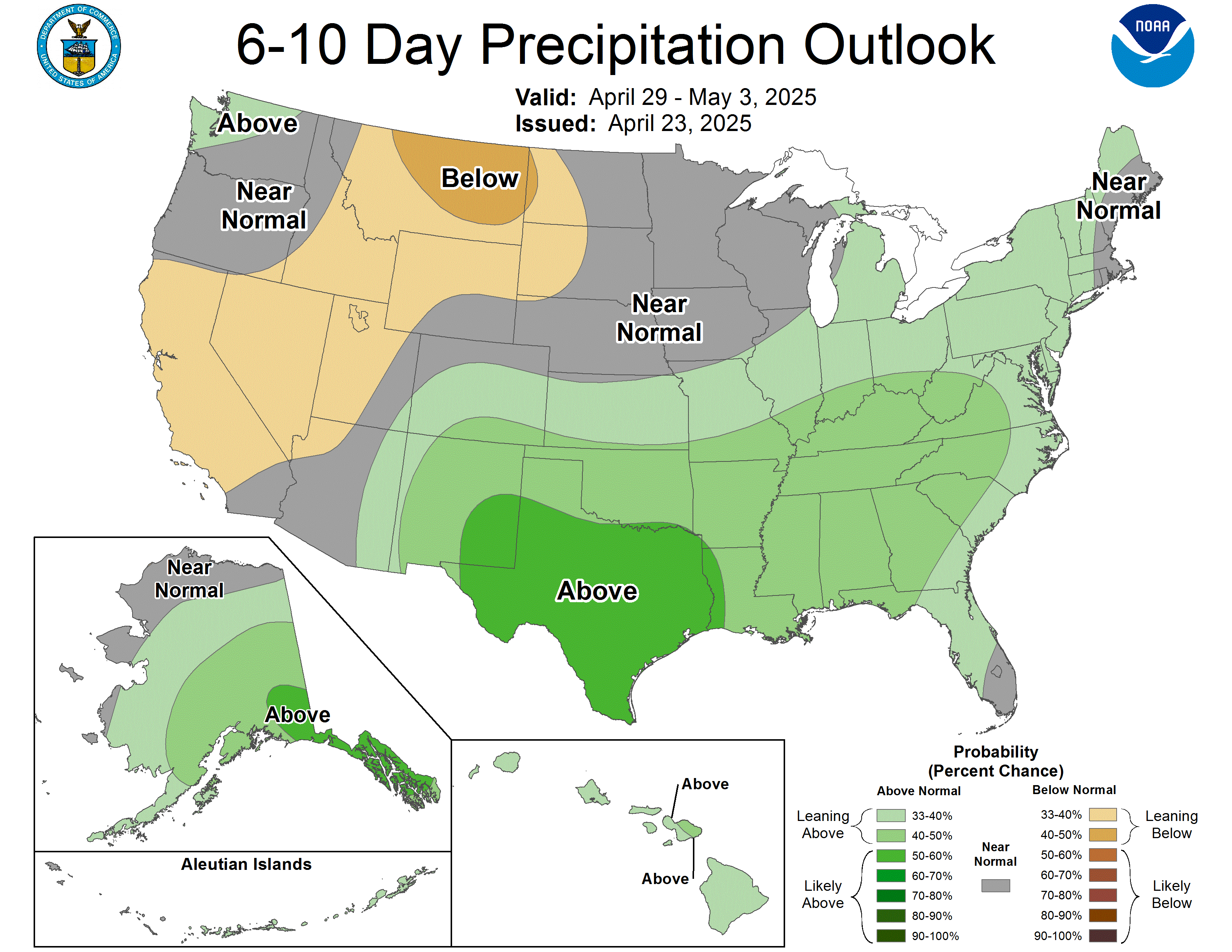 Unlink
8 – 14 Day Precipitation Outlook Issued Today (Note the NOAA Level of Confidence in the Forecast Released on December 26 was 5 out of 5)
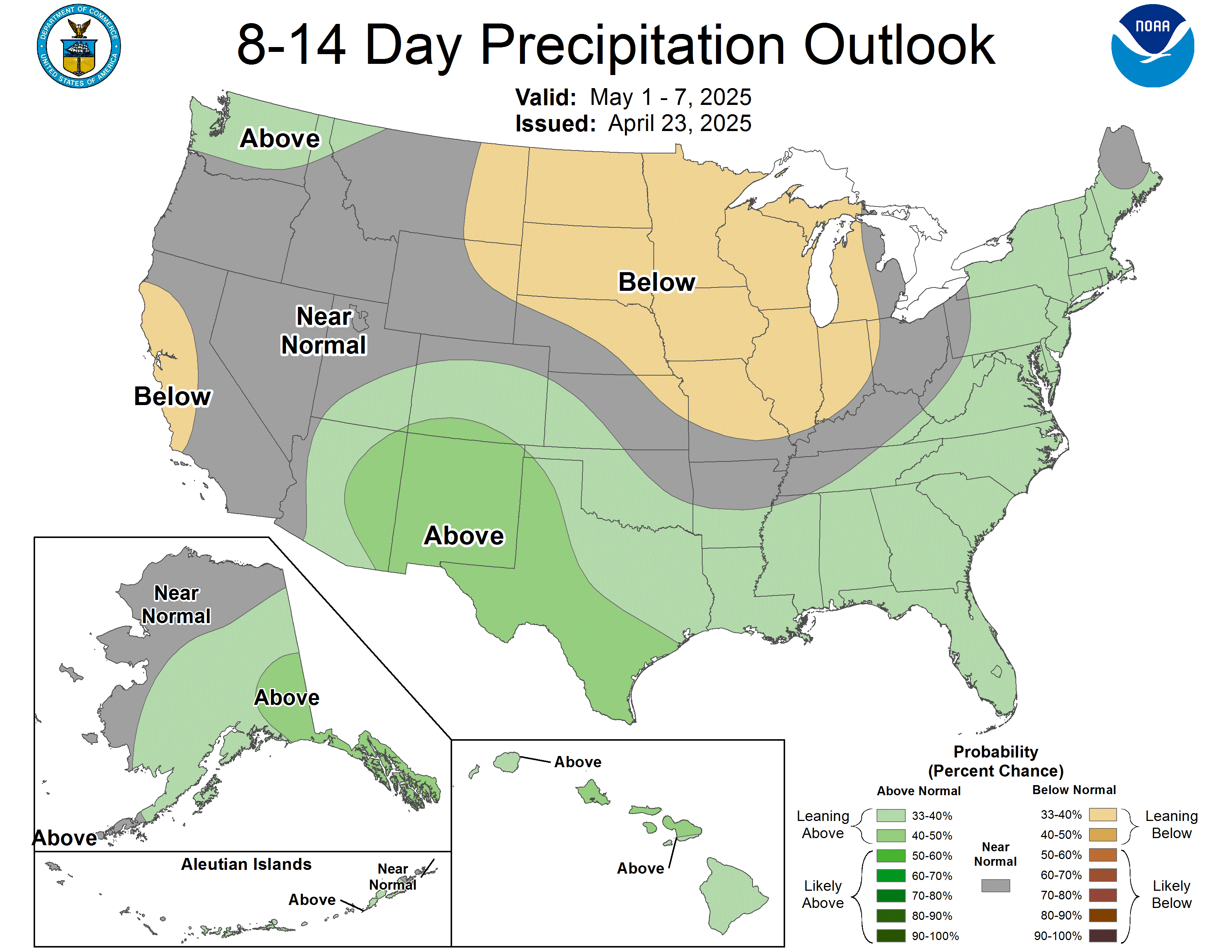
Looking further out.
 .
.
| January 1 to January 9 | January 7 to January 20, 2017 |
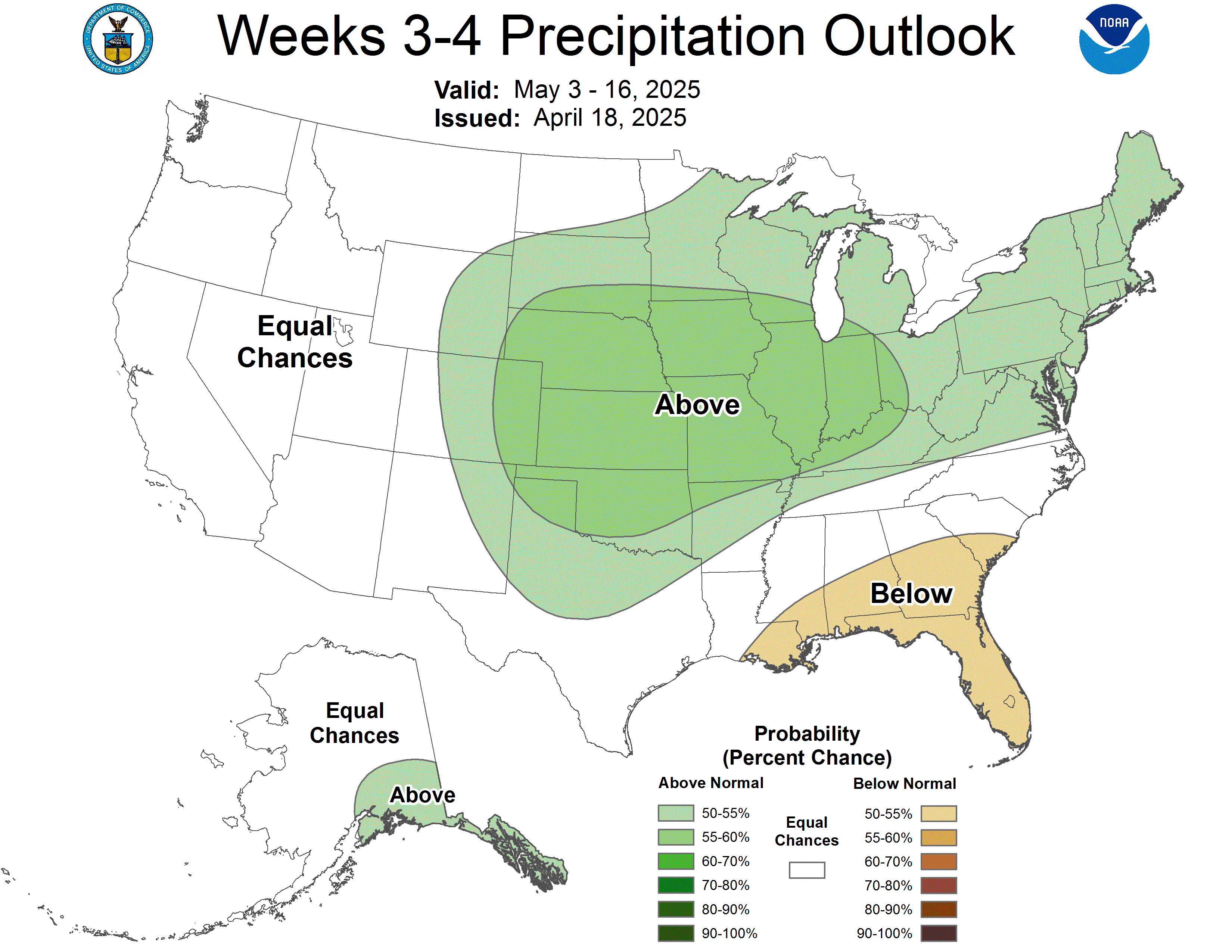
| Alaska is mostly wet except for the south coast and the Panhandle. CONUS starts mostly wet with only minor dry anomalies with only small parts of the Northwest and Southern Texas to be forecast dry. | There are three small dry anomalies shown: one for the Alaskan Panhandle, a second for South Texas and the other for Florida. There is a single Wet anomaly shown with two areas of highest probability one centered on Utah and the other on the Mid-Mississippi States. In between these wet and dry anomalies is EC. |
| Remember the Week 3 – 4 Experimental Outlook was issued last Friday and I am doing this analysis on Monday which explains the overlap in dates. | |
Here is the NOAA discussion released today December 26, 2016
6-10 DAY OUTLOOK FOR JAN 01 – 05 2017
TODAY’S NUMERICAL MODEL SOLUTIONS ARE IN FAIRLY GOOD AGREEMENT ON THE 500-HPA FLOW PATTERN PREDICTED OVER THE FORECAST DOMAIN. ALL OF TODAY’S MODELS PREDICT AN ANOMALOUSLY STRONG RIDGE IN THE GULF OF ALASKA, WHILE MOST OF TODAY’S MODELS PREDICT A DOWNSTREAM TROUGH OVER MOST OF THE CONUS. MODELS DIFFER IN HOW MUCH ATMOSPHERIC BLOCKING WILL OCCUR WITH THIS RIDGE. THE LATEST GFS-BASED MODELS AND THE CANADIAN ENSEMBLE PREDICT MORE BLOCKING, WHICH WOULD ALLOW THE DOWNSTREAM NEGATIVE HEIGHT ANOMALIES TO PUSH ALL THE WAY SOUTH INTO THE SOUTHERN PLAINS AND SOUTHWESTERN U.S. THE LATEST ECMWF-BASED MODELS PREDICT THE RIDGE TO BE MORE NARROW, LEADING TO LESS BLOCKING AND NEGATIVE HEIGHT ANOMALIES TO BE WEAKER OVER THE CONUS. TELECONNECTIONS OFF OF THE POSITIVE HEIGHT ANOMALY CENTER SUPPORT A PATTERN MUCH CLOSER TO THE GFS AND CANADIAN SOLUTIONS. DUE TO THIS, AND GOOD RUN-TO-RUN CONTINUITY FROM THE GEFS, TODAY’S MANUAL 500-HPA BLEND FAVORS THE 6Z GEFS AND GFS SOLUTIONS, AND INDICATES RIDGING OVER ALASKA AND TROUGHING OVER MOST OF THE REST OF THE COUNTRY.
WITH LARGE POSITIVE HEIGHT ANOMALIES FORECAST OVER ALASKA, ABOVE NORMAL TEMPERATURES ARE FAVORED ACROSS MOST OF THE STATE. LARGE NEGATIVE HEIGHT ANOMALIES FORECAST OVER THE WESTERN TWO-THIRDS OF THE CONUS AND COLD CANADIAN HIGH SURFACE PRESSURE SETTLING INTO MUCH OF THE WESTERN U.S. SIGNIFICANTLY INCREASES THE LIKELIHOOD OF BELOW NORMAL TEMPERATURES WEST OF THE MISSISSIPPI VALLEY, ESPECIALLY FOR MONTANA AND NORTHERN IDAHO WHERE NEGATIVE HEIGHT ANOMALIES ARE LARGEST AND SURFACE HIGH PRESSURE IS THE HIGHEST. THE EXCEPTION TO THE BELOW NORMAL TEMPERATURES IS OVER PARTS OF TEXAS AND THE FOUR CORNERS REGION, WHICH WILL LIKELY BE ON THE WARM SIDE OF THE SURFACE FRONT A LOT DURING THE 6-10 DAY PERIOD. POSITIVE HEIGHT ANOMALIES OVER THE EAST COAST LEAD TO INCREASED CHANCES FOR ABOVE NORMAL TEMPERATURES FOR THE SOUTHEAST AND MUCH OF THE EASTERN CONUS.
THE STRONG RIDGE EXPECTED OVER THE GULF OF ALASKA FAVORS A STORM TRACK FURTHER NORTH THAN USUAL, ENHANCING THE LIKELIHOOD FOR BELOW MEDIAN PRECIPITATION ALONG THE SOUTH COAST OF MAINLAND ALASKA AND THE ALASKA PANHANDLE, AND ABOVE MEDIAN PRECIPITATION ELSEWHERE. THE RIDGING IS ALSO EXPECTED TO SUPPRESS PRECIPITATION IN THE PACIFIC NORTHWEST, FAVORING NEAR TO BELOW MEDIAN PRECIPITATION THERE. TROUGH ENERGY DIGGING INTO THE SOUTHWEST U.S. FAVORS ABOVE MEDIAN PRECIPITATION FOR CALIFORNIA, THE GREAT BASIN, THE ROCKIES AND THE NORTHERN PLAINS, WHILE SEVERAL STORM SYSTEMS EXPECTED TO DEVELOP AHEAD OF THE LARGE-SCALE TROUGH EXPECTED OVER THE CENTRAL U.S. INCREASE THE CHANCES FOR ABOVE MEDIAN PRECIPITATION IN THE EASTERN U.S.
FORECAST CONFIDENCE FOR THE 6-10 DAY PERIOD: WELL ABOVE AVERAGE, 5 OUT OF 5, DUE TO GOOD AGREEMENT AMONG THE MODEL SOLUTIONS AND THE VARIOUS SURFACE TOOLS AND A RELATIVELY HIGH-AMPLITUDE PATTERN ACROSS THE U.S.
8-14 DAY OUTLOOK FOR JAN 03 – 09 2017
MODELS AGREE ON PERSISTING THE BLOCKING RIDGE IN THE GULF OF ALASKA DURING THE WEEK-2 PERIOD, INDICATING THAT THE TEMPERATURE AND PRECIPITATION PATTERNS EXPECTED IN THE 6-10 DAY PERIOD ARE LIKELY TO PERSIST IN THE WEEK-2 PERIOD. HEIGHT ANOMALIES DURING THE WEEK-2 PERIOD ARE SIMILAR TO THOSE IN THE 6-10 DAY PERIOD, AND FAIRLY LARGE, INDICATING BOTH A RELATIVELY HIGH-AMPLITUDE PATTERN IN THE WEEK-2 PERIOD, AS WELL AS HIGH CONFIDENCE IN THE MODELS.
THE TEMPERATURE PROBABILITY FORECAST DURING WEEK-2 IS SIMILAR TO THE 6-10 DAY PERIOD, EXCEPT THAT A STRONG COLD FRONT EXPECTED TOWARDS THE END OF THE 6-10 DAY PERIOD FAVORS COLD AIR SPREADING SOUTH AND EAST, EXPANDING THE INCREASED LIKELIHOOD OF BELOW NORMAL TEMPERATURES INTO THE SOUTHERN PLAINS AND MUCH OF THE EASTERN U.S. THE PRECIPITATION PROBABILITY FORECAST DURING WEEK-2 IS VERY SIMILAR TO THE 6-10 DAY PERIOD.
FORECAST CONFIDENCE FOR THE 8-14 DAY PERIOD IS: WELL ABOVE AVERAGE, 5 OUT OF 5, DUE TO GOOD AGREEMENT AMONG THE MODEL SOLUTIONS AND THE VARIOUS SURFACE TOOLS AND A RELATIVELY HIGH-AMPLITUDE PATTERN ACROSS THE U.S.
THE NEXT SET OF LONG-LEAD MONTHLY AND SEASONAL OUTLOOKS WILL BE RELEASED ON JANUARY 19
Some might find this analysis click to read interesting as the organization which prepares it focuses on the Pacific Ocean and looks at things from a very detailed perspective and their analysis provides a lot of information on the history and evolution of ENSO events.
Analogs to the Outlook.
Now let us take a detailed look at the “Analogs” which NOAA provides related to the 5 day period centered on 3 days ago and the 7 day period centered on 4 days ago. “Analog” means that the weather pattern then resembles the recent weather pattern and was used in some way to predict the 6 – 14 day Outlook.
Here are today’s analogs in chronological order although this information is also available with the analog dates listed by the level of correlation. I find the chronological order easier for me to work with. There is a second set of analogs associated with the Outlook but I have not been regularly analyzing this second set of information. The first set which is what I am using today applies to the 5 and 7 day observed pattern prior to today. The second set, which I am not using, relates to the correlation of the forecasted outlook 6 – 10 days out with similar patterns that have occurred in the past during the dates covered by the 6 – 10 Day Outlook. The second set of analogs may also be useful information but they put the first set of analogs in the discussion with the second set available by a link so I am assuming that the first set of analogs is the most meaningful and I find it so.
Day | ENSO Phase | PDO | AMO | Other Comments |
| Dec 20, 1988 | La Nina | – | – | Strong La Nina |
| Dec 23, 1988 | La Nina | – | – | Strong La Nina |
| Jan 1, 1989 | La Nina | – | – | Strong La Nina |
| Dec 12, 1994 | El Nino | – | – | Questionable re duration |
| Dec 13, 1994 | El Nino | – | – | Questionable re duration |
| Dec 6, 1998 | La Nina | – | + | Following 1997/1998 MegaNino |
| Dec 13, 2001 | La Nina | – | + | |
| Jan 9, 2006 | El Nino | + | + |
(t) = a month where the Ocean Cycle Index has just changed or does change the following month.
One thing that jumped out at me right away was the spread among the analogs from December 6 to January 9 which is 34 days which is a bit more than last week. I have not calculated the centroid of this distribution which would be the better way to look at things but the midpoint, which is a lot easier to calculate, is about December 23. These analogs are centered on 3 days and 4 days ago (December 21 or December 22). So the analogs could be considered in sync with the calendar meaning that we will be getting weather that normally would occur at about this time of year.
For more information on Analogs see discussion in the GEI Weather Page Glossary.
There are three El Nino Analogs (why are there any?, five La Nina Analogs and zero ENSO Neutral Analogs. Looks like the analogs are suggesting that both La Nina and El Nino Conditions prevail. The phase of the ocean cycles in the analogs points strongly towards McCabe Condition B which fits with the 6 – 14 Day Forecasts.
The seminal work on the impact of the PDO and AMO on U.S. climate can be found here. Water Planners might usefully pay attention to the low-frequency cycles such as the AMO and the PDO as the media tends to focus on the current and short-term forecasts to the exclusion of what we can reasonably anticipate over multi-decadal periods of time. One of the major reasons that I write this weather and climate column is to encourage a more long-term and World view of weather.

| McCabe Condition | Main Characteristics |
| A | Very Little Drought. Southern Tier and Northern Tier from Dakotas East Wet |
| B | More wet than dry but Great Plains Dry |
| C | Northern Tier and Mid-Atlantic Drought |
| D | Southwest Drought extending to the North and also the Great Lakes |
You may have to squint but the drought probabilities are shown on the map and also indicated by the color coding with shades of red indicating higher than 25% of the years are drought years (25% or less of average precipitation for that area) and shades of blue indicating less than 25% of the years are drought years. Thus drought is defined as the condition that occurs 25% of the time and this ties in nicely with each of the four pairs of two phases of the AMO and PDO.
Historical Anomaly Analysis
When I see the same dates showing up often I find it interesting to consult this list.
Recent CONUS Weather
This is provided mainly to see the pattern in the weather that has occurred recently.
Here is the 30 Days ending December 17, 2016

And the 30 Days ending December 24, 2016

B. Beyond Alaska and CONUS Let’s Look at the World which of Course also includes Alaska and CONUS
Near Term
World Weather Forecast produced by the Australian Bureau of Meteorology. Unfortunately I do not know how to extract the control panel and embed it into my report so that you could use the tool within my report. But if you visit it Click Here you will be able to use the tool to view temperature or many other things for THE WORLD. It can forecast out for a week. Pretty cool. Return to this report by using the “Back Arrow” usually found top left corner of your screen to the left of the URL Box. It may require hitting it a few times depending on how deep you are into the BOM tool.
Although I can not display the interactive control panel in my article, I can display any of the graphics it provides so below are the current worldwide precipitation and temperature forecasts for three days out. They will auto-update and be current for Day 3 whenever you view them. If you want the forecast for a different day Click Here
Precipitation

Temperature

Looking Out a Few Months
The new precipitation forecast from Queensland Australia was based on a rapidly rising SOI. That did not seem to be correct October and November. Below are the numbers as of December 19. I am not confident in the numbers released this week due to a very extreme value released for December 23 so I have not updated the data below since last week.

So I used the feature to create a forecast based on stable SOI and this is what was generated.

Here is the most recent JAMSTEC three-month Temperature Forecast.

And here is the most recent three month JAMSTEC Precipitation Forecast.

And then to get more focus, I extracted and enlarged an image for CONUS on the left and Europe on the right.
 |  |
There is a short but very important JAMSTEC discussion:
Dec. 19, 2016 Prediction from 1st Dec., 2016
ENSO forecast:
According to the SINTEX-F prediction, the current La Niña Modoki/La Niña state will continue until late winter. Interestingly, majority of the ensemble members indicate recurrence of a moderate El Niño event in the latter half of 2017. It will be interesting if an El Niño event really evolves in 2017, which may suggest a decadal turnabout in the tropical Pacific climate condition to El Niño-like state after a long spell of La Niña-like state, which led to the global warming hiatus.
Indian Ocean forecast:
The negative Indian Ocean Dipole has started decaying and will be terminated by the end of 2016. Then we expect a positive Indian Ocean Dipole in summer of 2017. We also expect the Ningaloo Niño off the west coast of Australia in late austral summer, which may persist until late austral fall. However, the prediction plumes are spreading and those expectations are still uncertain at the present stage.
Regional forecast:
On a seasonal scale, most part of the globe will experience a warmer-than-normal condition, while some parts of northern U.S., southern Canada, northern Brazil, and Australia will experience a colder-than-normal condition in the boreal winter.
According to the seasonally averaged rainfall prediction, most parts of southeastern China, Indonesia, eastern Africa, eastern half of Europe including Italy, and Caribbean countries including Florida will experience a drier condition during winter, whereas the Philippines, the eastern U.S., and the western part of Europe will experience a wetter-than-normal condition. Most parts of Brazil, Australia and South Africa will experience a wetter-than-normal condition during austral summer. Most parts of Japan will be warmer and quite drier than normal in winter. However, we note that highly fluctuating mid- and -high latitude climate in winter may not be captured well by the current model.
Additional forecasts from JAMSTEC including future time periods can be found at this link.
Sea Surface Temperature (SST) Departures from Normal for this Time of the Year i.e. Anomalies
And when we look at the current Sea Surface anomalies below, we see a lot of them not just along the Equator related to ENSO.
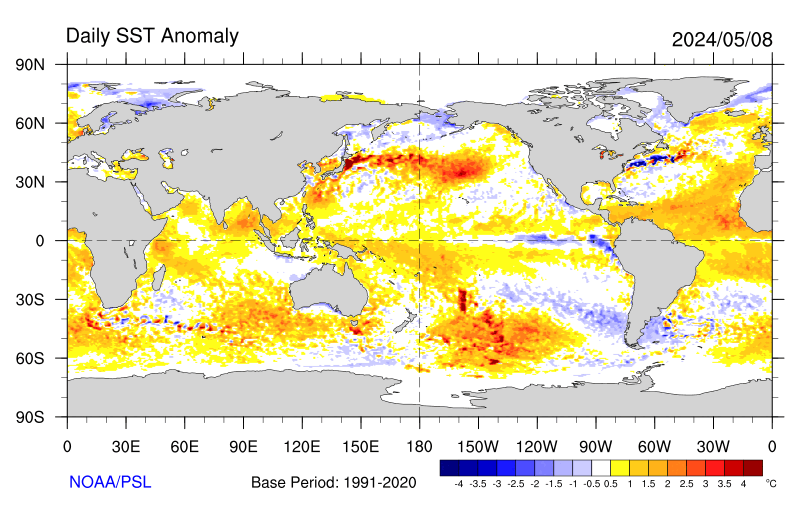
Just for fun I thought I would try to draw in the NINO 3.4 area into today’s graphic. It is frozen unlike the graphic above, it will not auto-update.

Below I show the changes over the last month in the Sea Surface Temperature (SST) anomalies.

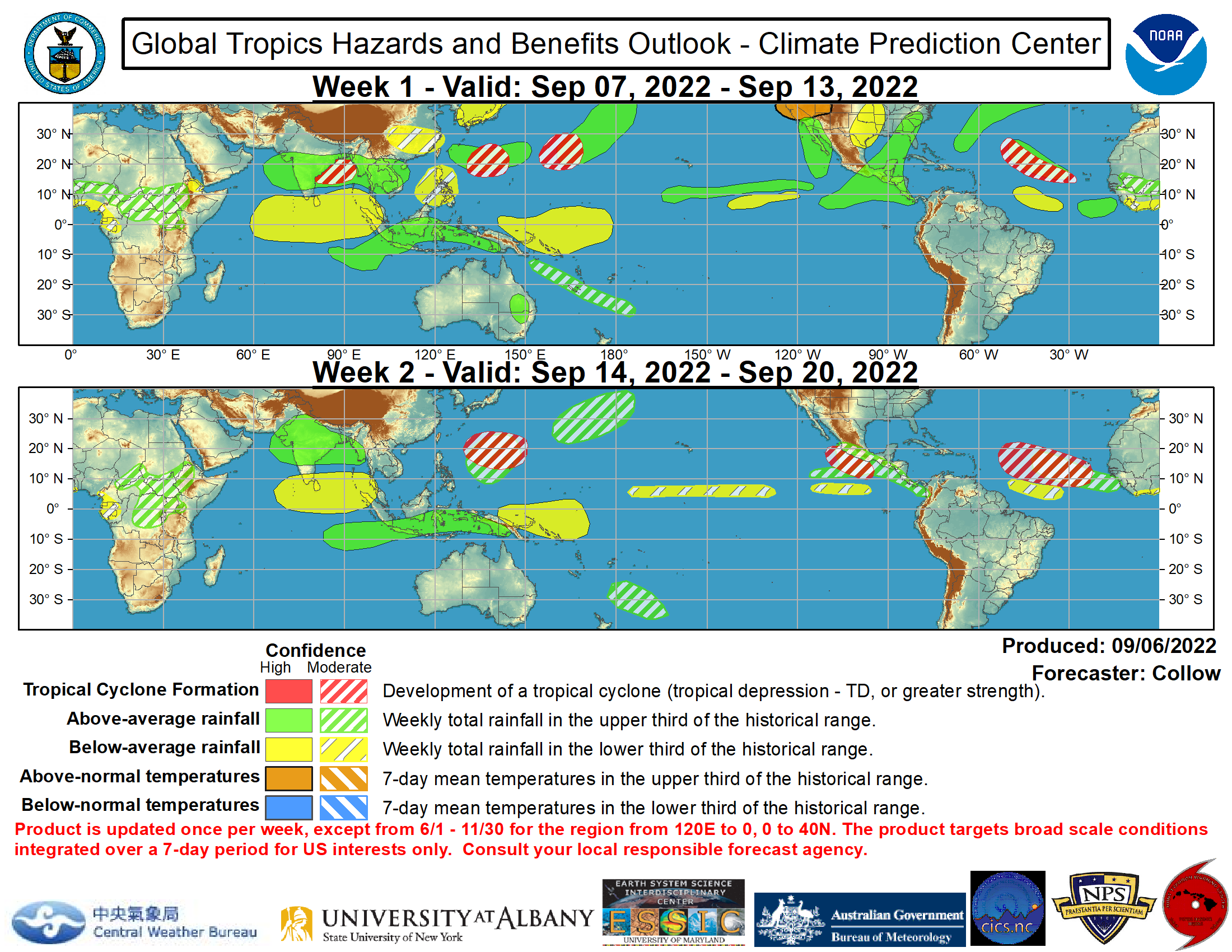
Below is an analysis of projected tropical hazards and benefits over an approximately two-week period. This graphic is scheduled to update on Tuesday and I am reading the December 20, 2016 Version and looking at Week 2 of that forecast.
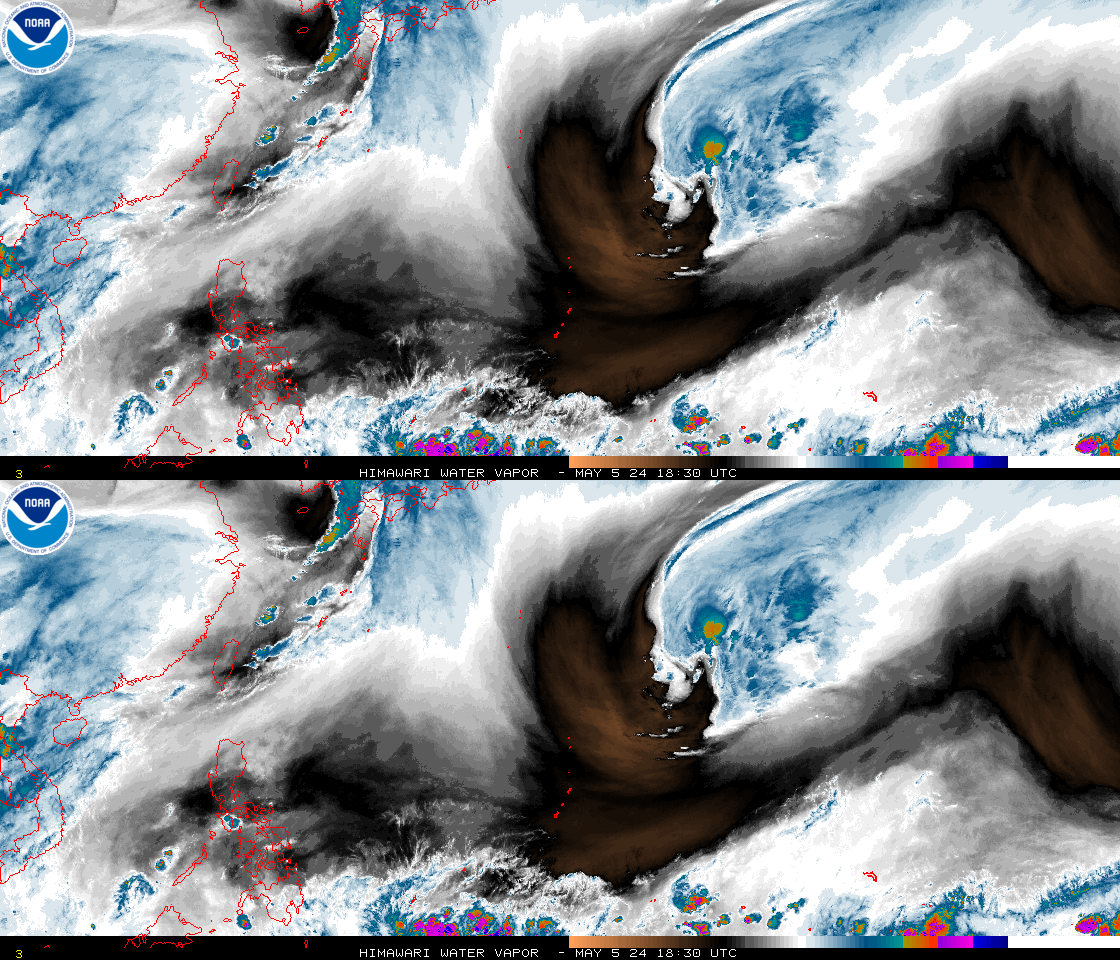
Look at the Western Pacific in Motion. NOAA is having problems with their web site so I have temporarily substituted a static image but you can find a somewhat similar loop version by clicking here. It actually provides more functionality than the displayed version but you have to click to get it as I have not figured out how to get it to display otherwise.
C. Progress of the Cool ENSO Event
Starting with Surface Conditions.
TAO/TRITON GRAPHIC (a good way of viewing data related to the part of the Equator and the waters close to the Equator in the Eastern Pacific where we monitor to determining the current phase of ENSO. It is probably not necessary to follow the discussion below, but here is a link to TAO/TRITON terminology.

And here is the current version of the TAO/TRITON Graphic.
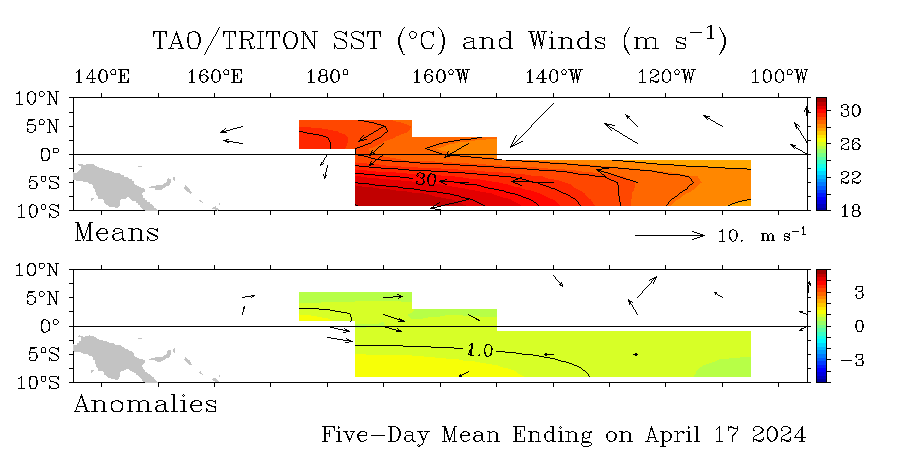
| ———————————————— | A | B | C | D | E | —————– |
The below table which only looks at the Equator shows the extent of anomalies along the Equator. I had split the table to show warm, neutral, and cool anomalies. The top rows showed El Nino anomalies. When there were no more El Nino anomalies along the Equator, I eliminated those rows. The two rows just below that break point contribute to ENSO Neutral and after another break, the rows are associated with La Nina conditions. I have changed the reference date to May 23, 1016.
Subareas of the Anomaly | Westward Extension | Eastward Extension | Degrees of Coverage | |||||
As of Today | May 23, 2016 | As of Today | May 23 2016 | As of Today | In Nino 3.4 | Dec 12, 2016 | May 23, 2016 | |
| These Rows Show the Extent of ENSO Neutral Impacts on the Equator | ||||||||
| 0.5C or cooler Anomaly | 170E | 155E | Land | 155W | 95 | 50 | 95 | 50 |
| 0C or cooler Anomaly | DATELINE | 155W | LAND | Land | 85 | 50 | 85 | 60 |
| These Rows Show the Extent of the La Nina Impacts on the Equator | ||||||||
| -0.5C or cooler | 170W120W | 145W | 145WLAND | Land | 50 | 25 | 65 | 50 |
| -1C or cooler Anomaly | LAND* | 140W | LAND | 105W | 0 | 0 | 40 | 35 |
| -1.5C or cooler Anomaly | LAND | 135W | LAND | 120W | 0 | 0 | 0 | 0 |
*There is a small cool anomaly of -1C+ north of the Equator.
I calculate the current value of the ONI index (really the value of NINO 3.4 as the ONI is not reported as a daily value) each week using a method that I have devised. To refine my calculation, I have divided the 170W to 120W Nino 3.4 measuring area into five subregions (which I have designated from west to east as A through E) with a location bar shown under the TAO/TRITON Graphic). I use a rough estimation approach to integrate what I see below and record that in the table I have constructed. Then I take the average of the anomalies I estimated for each of the five subregions.
So as of Monday December 26, in the afternoon working from the December 25 TAO/TRITON report, this is what I calculated. [Although the TAO/TRITON Graphic appears to update once a day, in reality it updates more frequently.]
| Anomaly Segment | Estimated Anomaly | |
| Last Week | This Week | |
| A. 170W to 160W | -0.5 | -0.4 |
| B. 160W to 150W | -0.5 | -0.7 |
| C. 150W to 140W | -0.3 | -0.2 |
| D. 140W to 130W | -0.2 | -0.0 |
| E. 130W to 120W | -0.3 | -0.3 |
| Total | -1.8 | -1.6 |
| Total divided by five subregions i.e. the ONI | (-1.8)5 = -0.4 | (-1.6)/5 = -0.3 |

From Tropical Tidbits.com
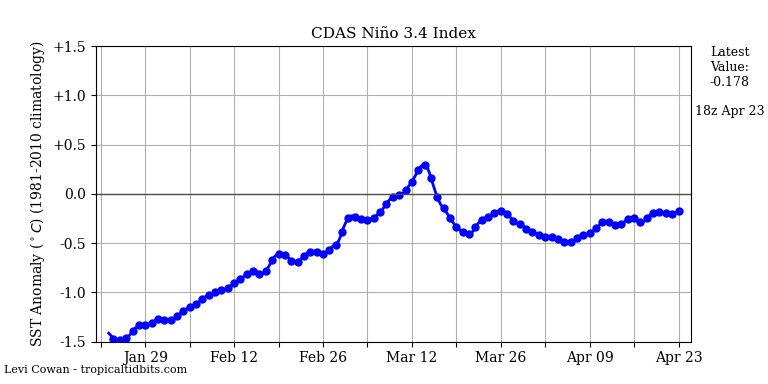

Sea Surface Temperature and Anomalies
It is the ocean surface that interacts with the atmosphere and causes convection and also the warming and cooling of the atmosphere. So we are interested in the actual ocean surface temperatures and the departure from seasonal normal temperatures which is called “departures” or “anomalies”. Since warm water facilitates evaporation which results in cloud convection, the pattern of SST anomalies suggests how the weather pattern east of the anomalies will be different than normal.

I had stopped showing the below graphic which is more focused on the Equator but looks down to 300 meters rather than just being the surface. But over the last month there has been sufficient change to warrant including this graphic.

Let us look in more detail at the Equatorial Water Temperatures.
We are now going to change the way we look at a three-dimensional view of the Equator and move from the surface view and an average of the subsurface heat content to a more detailed view from the surface down. Notice by the date of the graphic (dated December 19, 2016 but it has been updated but NOAA has not gotten around the correct the date) that the lag in getting this information posted so the current situation may be a bit different than shown although this graphic was updated today so it is more current than usual. The date shown is the midpoint of a five-day period with that date as the center of the five-day period.
And now the pair of graphics that I regularly provide. The bottom graphic shows the absolute values, the upper graphic shows anomalies compared to what one might expect at this time of the year in the various areas both 130E to 90W Longitude and from the surface down to 450 meters. At different times and today in particular, I have discussed the difference between the actual values and the deviation of the actual values from what is defined as current climatology (which adjusts every ten years except along the Equator where it is adjusted every five years) and how both measures are useful but for different purposes.
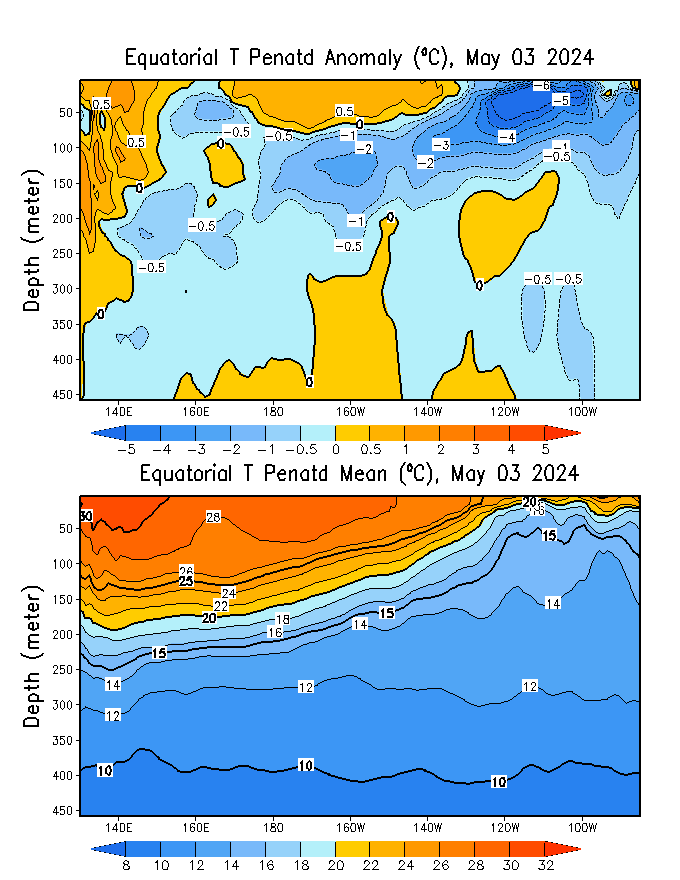
The bottom half of the graphic (Absolute Values which highlights the Thermocline) is now more useful as we track the progress of this new Cool Event.
Here are the above graphics as a time sequence animation. You may have to click on them to get the animation going.
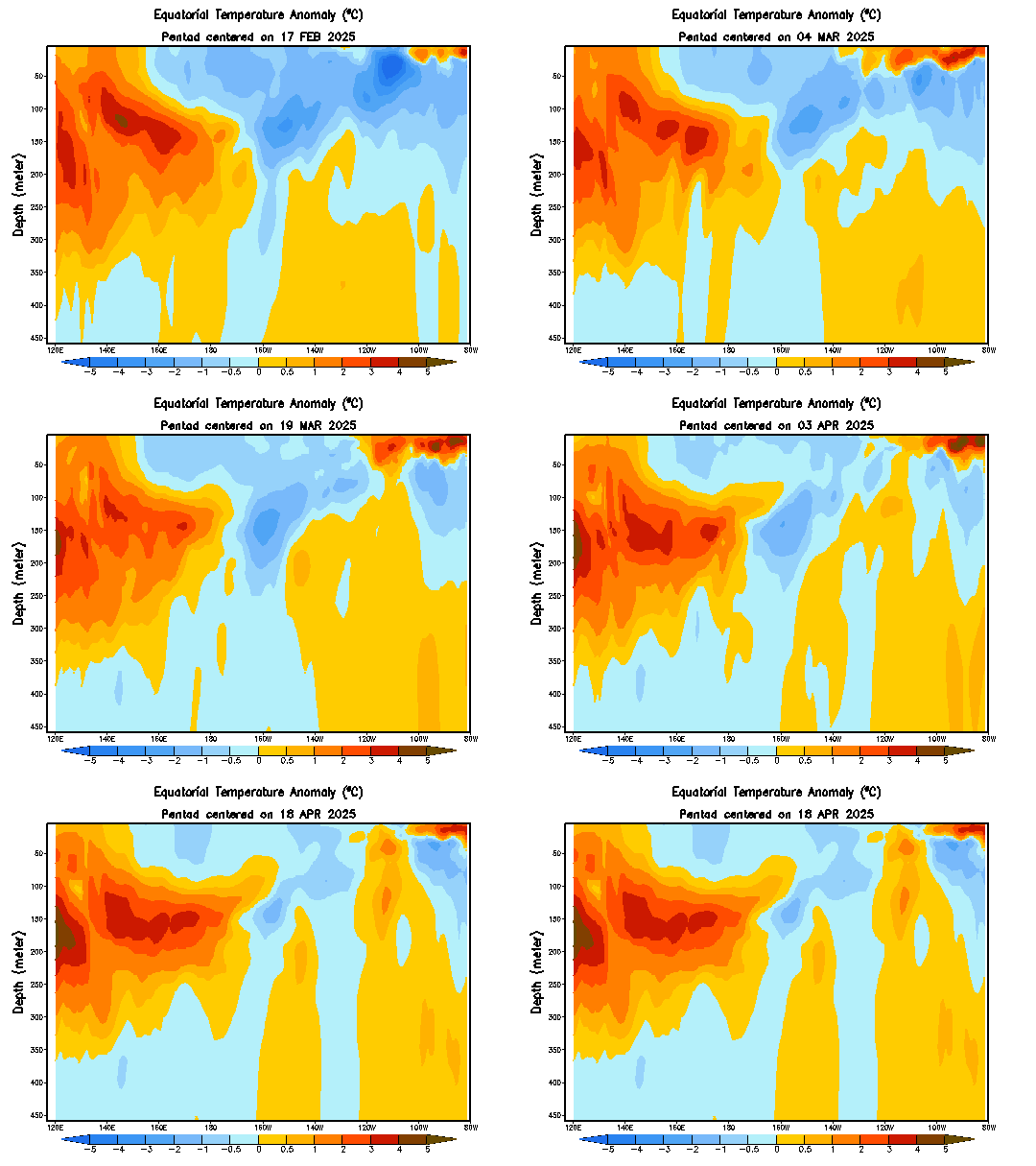
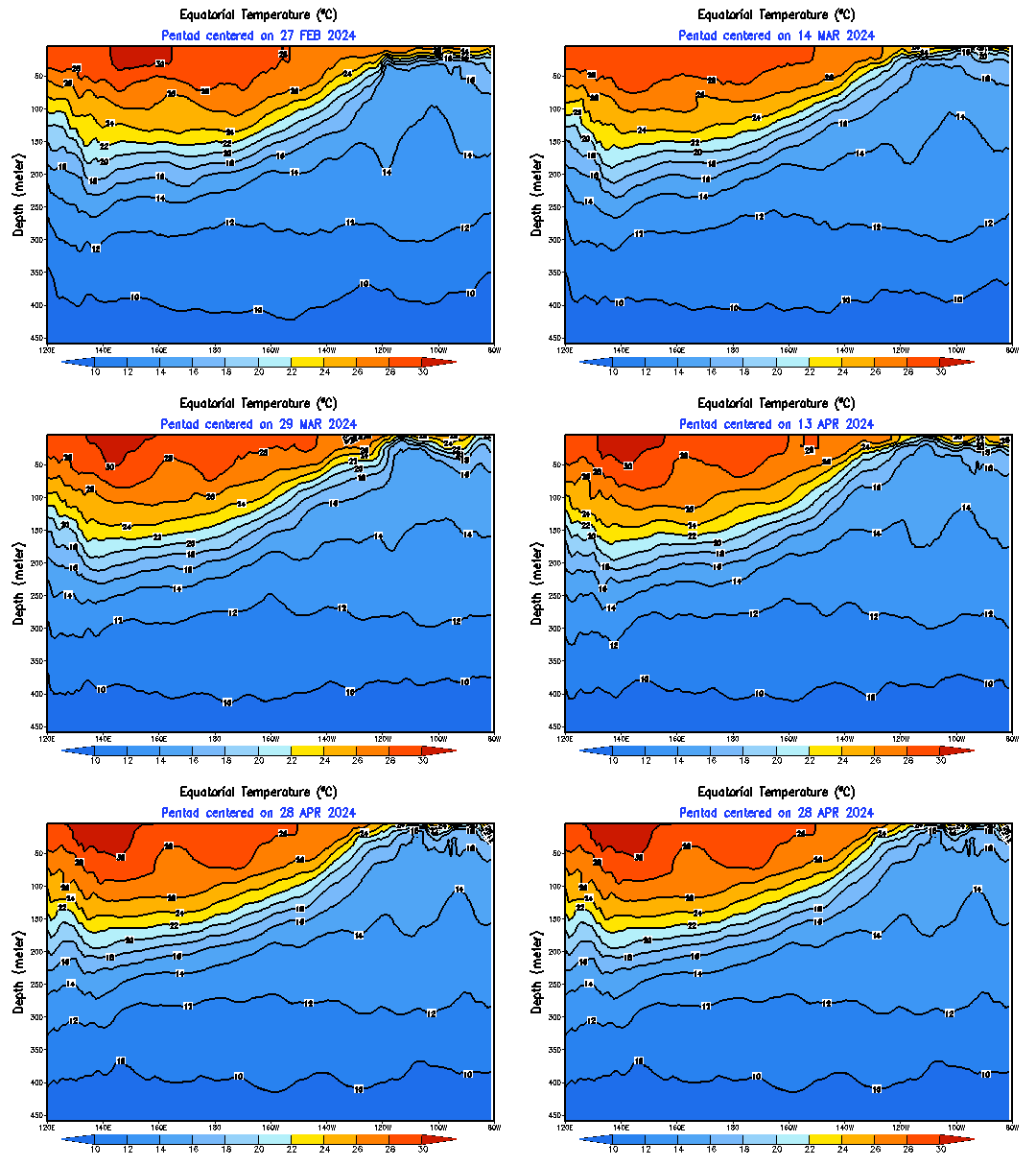
Although I did not fully discuss the Kelvin Waves earlier, now seems to be the best place to show the evolution of the subsurface temperatures which remains relevant. What we have is only the upwelling phase of the series of Kelvin waves last winter.

And now Let us look at the Atmosphere.
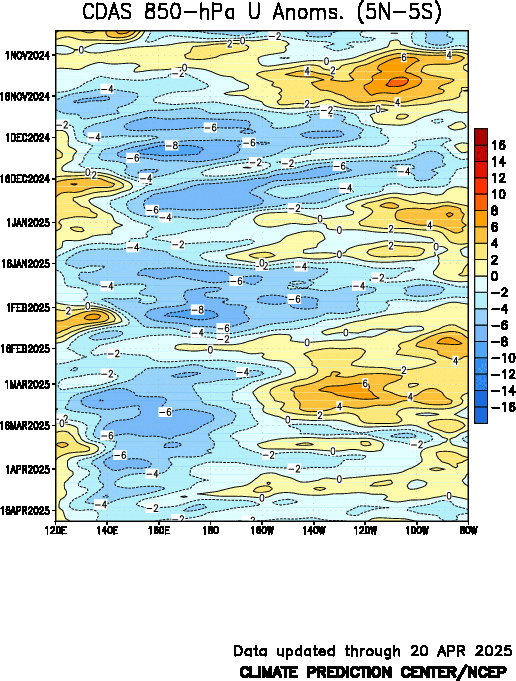
Low-Level Wind Anomalies near the Equator
Here are the low-level wind anomalies.
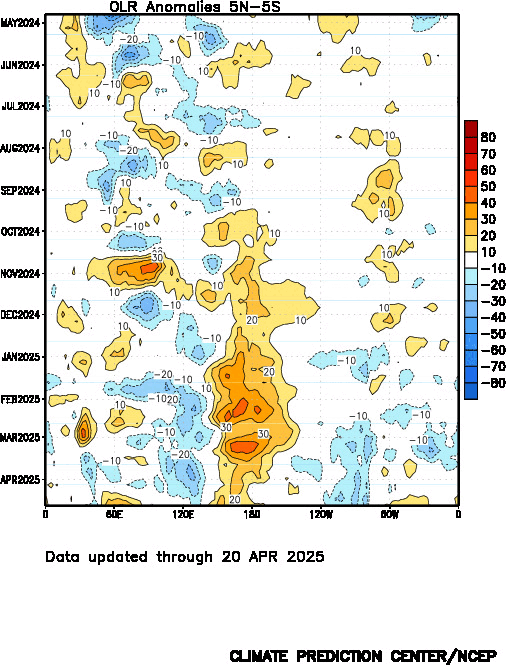
And now the Outgoing Longwave Radiation Anomalies which tells us where convection has been taking place.
And Now the Air Pressure which Shows up Mostly in an Index called the SOI.
This index provides an easy way to assess the location of and the relative strength of the Convection (Low Pressure) and the Subsidence (High Pressure) near the Equator. Experience shows that the extent to which the Atmospheric Air Pressure at Tahiti exceeds the Atmospheric Pressure at Darwin Australia when normalized is substantially correlated with the Precipitation Pattern of the entire World.
Below is the Southern Oscillation Index (SOI) reported by Queensland, Australia. The first column is the tentative daily reading, the second is the 30 day moving/running average and the third is the 90 day moving/running average.
| Date | Current Reading | 30-Day Average | 90 Day Average |
| Dec 20 | +23.66 | +2.51 | +0.43 |
| Dec 21 | +20.60 | +3.12 | +0.58 |
| Dec 22 | -0.36 | +2.95 | +0.49 |
| Dec 23 | * (-670.93)? | ||
| Dec 24 | -7.84 | ||
| Dec 25 | -6.12 | ||
| Dec 26 | -0.36 |
* The reported value for December 23 is questionable so I will wait to see if there is a correction to that reported value. The 30-day average, which is the most widely used measure, as of December 22 (to avoid having to deal with the question of the reasonableness of the value reported on December 23) was reported at +2.96 which is up a bit from last week but remains an ENSO Neutral Value. The 90-day average at +0.49 is similar to last week and again solidly Neutral. Usually but not always the 90 day average changes more slowly than the 30 day average but it depends on what values drop out. The disparity between the two is one reason why we look at both. (Sustained values over +7 are usually associated with La Nina and less than -7 are usually associated with El Nino). To some extent it is the change in the SOI that is of most importance. It had been increasing in September but now in October and November and through most of December has stabilized in the Neutral Range. That could change but for now the SOI is not signaling a La Nina but ENSO Neutral.
The MJO or Madden Julian Oscillation is an important factor in regulating the SOI and Kelvin Waves and other tropical weather characteristics. More information on the MJO can be found here. Here is another good resource. November was not particularly favorable for La Nina development and most likely neither will be December in terms of the MJO.The forecasts of the MJO are all over the place and not suggesting a strong Active or Inactive Phase of the MJO any time soon.The MJO being Inactive is more favorable for La Nina than the MJO being Active. But the MJO goes back and forth from being Active, Inactive, strong and weak so it has mostly a short-term impact. It is possible that a weak Inactive Phase of the MJO might be giving this dying La Nina a little reprieve but the forecast is that this will soon change to a weak Active Phase so it is not very significant other than on a weekly basis.
Lately, the impact has been fairly muted. But the change in the SOI recently and some other changes suggest that we are having an Active Phase of the MJO even if such is not being reported and what we have is not the MJO but something else that is impacting the cool pool in a similar way as an Active MJO would. The forecast for the MJO is updated weekly and can be found here. If the MJO is not in its Active Phase then perhaps some other pattern is impacting the SOI and also shifting the cool pool to the east. We are also having a non-split fairly strong Jet Stream which is also consistent with an Active MJO. So I am calling it a Stealth MJO.
The MJO tends to be more important when the situation is ENSO Neutral and the MJO can start the process of an El Nino getting started. It is less significant re the initiation of a La Nina but is a factor. It is surprising how weak the MJO has been for months. But it may account for what seems like a cycling of the estimate of Nino 3.4 as the cool water is blown first to the west and then to the east. This impacts the upwelling also.
Forecasting the Evolution of ENSO
We have the December early-month report from CPC/IRI which I call the reading of the tea leaves in that it is based on a combination of model results and a survey of the views of meteorologists.
Figure 1 is based on a consensus of CPC and IRI forecasters, in association with the official CPC/IRI ENSO Diagnostic Discussion

Now we have the December 15, 2016 fully model-based version .

And here is the discussion that was released with the graphic.
What is the outlook for the ENSO status going forward? The most recent official diagnosis and outlook was issued one week ago in the NOAA/Climate Prediction Center ENSO Diagnostic Discussion, produced jointly by CPC and IRI; it carries a La Niña advisory and called for weak La Niña to last through winter 2016-17 (i.e., for December-February), and for a transition to neutral to occur by late winter. The latest set of model ENSO predictions, from mid-December, now available in the IRI/CPC ENSO prediction plume, is discussed below. Those predictions suggest that the SST could remain in the weak La Niña category during the rest of 2016 and into the early part of 2017, or may return to neutral by the New Year.
As of mid-November, 17% of the dynamical or statistical models predicts La Niña conditions for the initial Dec-Feb 2016-17 season, while 83% predict neutral ENSO. At lead times of 3 or more months into the future, statistical and dynamical models that incorporate information about the ocean’s observed subsurface thermal structure generally exhibit higher predictive skill than those that do not. For the Mar-May 2017 season, among models that do use subsurface temperature information, no model predicts La Niña conditions, 89% predicts ENSO-neutral conditions, and 11% predicts El Niño conditions. For all model types, the probabilities for La Niña are 9% for Jan-Mar 2016-17, and less than 5% for all subsequent seasons out to Aug-Oct 2017. The probability for neutral conditions is at least 70% for all seasons through the final season of Aug-Oct 2017, and rise to greater than 90% from Jan-Mar through Apr-Jun 2017. Probabilities for El Niño are near zero initially, rise to 5-10% by Mar-May 2017, and to 25-30% from Jun-Aug through the final season of Aug-Oct.
Here is the daily PDF and Spread Corrected version of the NOAA CFSv2 Forecast Model.
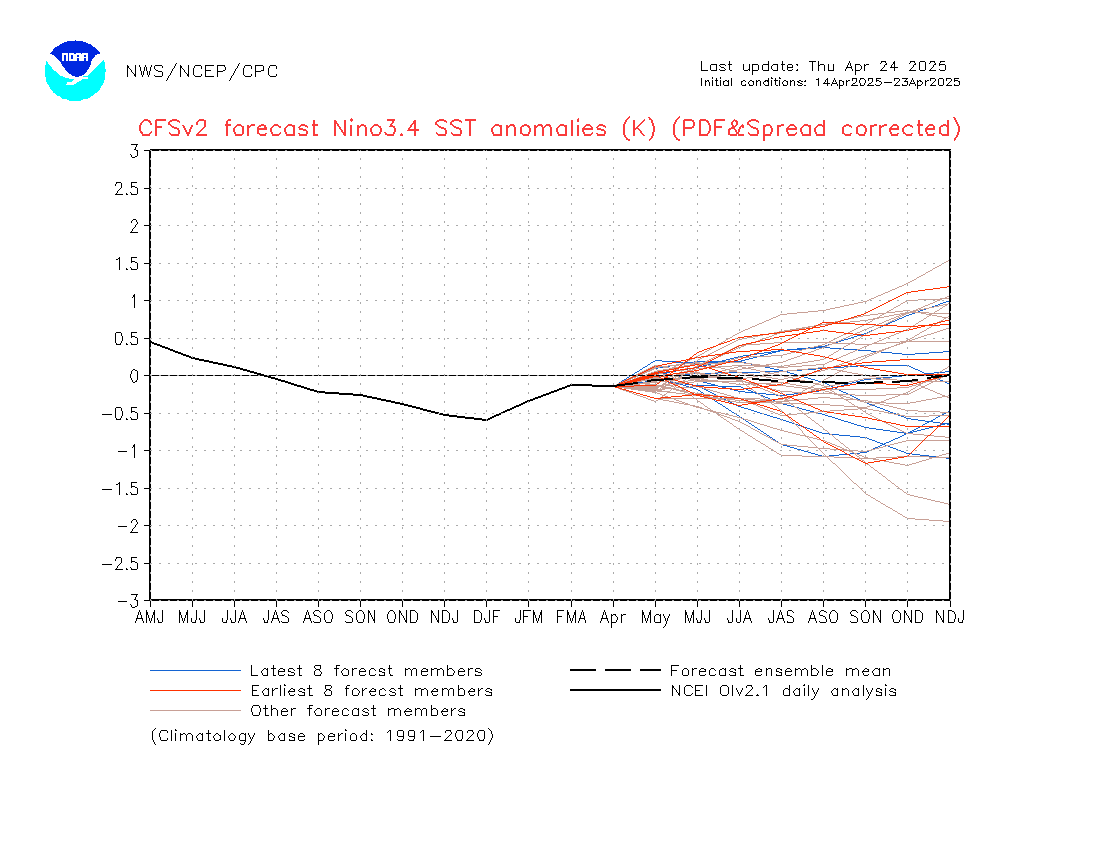
The full list of weekly values can be found here.
Forecasts from Other Meteorological Agencies.
Here is the Nino 3.4 report from the Australian BOM (it updates every two weeks)

Discussion (notice their threshold criteria are different from NOAA but also their actuals are higher than recorded by NOAA and yet Nino 3.4 is standard. So someone is incorrect OR WORSE.)
Here is the discussion.
ENSO outlooks
Outlooks from the eight international climate models surveyed by the Bureau indicate that neutral ENSO conditions are likely for the remainder of the southern hemisphere summer.
One model continues to indicate an increased likelihood of the central tropical Pacific Ocean briefly exceeding La Niña thresholds before warming. All models indicate warming of the central Pacific is likely over the coming months.
Most models maintain neutral outlooks through to May 2017; however one model suggests strong warming may be possible in autumn, reaching El Niño thresholds in May. It must be noted that this outlook straddles the autumn predictability barrier—typically the ENSO transition period—during which most models have their lowest forecast accuracy.
We also have the most recent JAMSTEC December 1, 2016 ENSO forecast.

The model continues to show ENSO Neutral or what they call a weak La Nina Modoki gradually ending. The potential for an El Nino had been taken out of the forecast last month but is back in the forecast again. The JAMSTEC Discussion is shown earlier in this report.
Indian Ocean IOD (It updates every two weeks)
The IOD Forecast is indirectly related to ENSO but in a complex way.

Discussion
Indian Ocean Dipole outlooks
The Indian Ocean Dipole (IOD) is neutral. The weekly index value to 18 December was −0.23 °C.
The influence of the IOD on Australian climate is weak during the months of December to April. This is because the monsoon trough shifts south over the tropical Indian Ocean changing wind patterns, which prevents an IOD pattern from being able to form.
However, the continued presence of much warmer than average water to the north and northwest of Australia may see continued influence on Australia, including enhanced rainfall
D. Putting it all Together.
Looks like this Cool Event is no longer even properly described as La Nina Conditions Apply.
Forecasting Beyond Five Years.
So in terms of long-term forecasting, none of this is very difficult to figure out actually if you are looking at say a five-year or longer forecast. The research on Ocean Cycles is fairly conclusive and widely available to those who seek it out. I have provided a lot of information on this in prior weeks and all of that information is preserved in Part II of my report in the Section on Low Frequency Cycles 3. Low Frequency Cycles such as PDO, AMO, IOBD, EATS. It includes decade by decade predictions through 2050 which this week I have included in the discussion in the first part of this Weather and Climate Report. Predicting a particular year is far harder. Parts of that discussion are in the beginning section of this week’s Report.
E. Relevant Recent Articles and Reports
Weather in the News
Nothing to report
Weather Research in the News
Nothing to report.
Global Warming in the News
Nothing to report
F. Table of Contents for Page II of this Report Which Provides a lot of Background Information on Weather and Climate Science
The links below may take you directly to the set of information that you have selected but in some Internet Browsers it may first take you to the top of Page II where there is a TABLE OF CONTENTS and take a few extra seconds to get you to the specific section selected. If you do not feel like waiting, you can click a second time within the TABLE OF CONTENTS to get to the specific part of the webpage that interests you.
1. Very High Frequency (short-term) Cycles PNA, AO,NAO (but the AO and NAO may also have a low frequency component.)
2. Medium Frequency Cycles such as ENSO and IOD
3. Low Frequency Cycles such as PDO, AMO, IOBD, EATS.
4. Computer Models and Methodologies
5. Reserved for a Future Topic (Possibly Predictable Economic Impacts)
G. Table of Contents of Contents for Page III of this Report – Global Warming Which Some Call Climate Change.
The links below may take you directly to the set of information that you have selected but in some Internet Browsers it may first take you to the top of Page III where there is a TABLE OF CONTENTS and take a few extra seconds to get you to the specific section selected. If you do not feel like waiting, you can click a second time within the TABLE OF CONTENTS to get to the specific part of the webpage that interests you.
2. Climate Impacts of Global Warming
3. Economic Impacts of Global Warming
4. Reports from Around the World on Impacts of Global Warming
Useful Background Information
With respect to relating analog dates to ENSO Events, the following table might be useful. In most cases this table will allow the reader to draw appropriate conclusions from NOAA supplied analogs. If the analogs are not associated with an El Nino or La Nina they probably are not as easily interpreted. Remember, an analog is indicating a similarity to a weather pattern in the past. So if the analogs are not associated with a prior El Nino or prior La Nina the computer models are not likely to generate a forecast that is consistent with an El Nino or a La Nina.
| El Ninos | La Ninas | |||||||||
|---|---|---|---|---|---|---|---|---|---|---|
| Start | Finish | Max ONI | PDO | AMO | Start | Finish | Max ONI | PDO | AMO | |
| DJF 1950 | J FM 1951 | -1.4 | – | N | ||||||
| T | JJA 1951 | DJF 1952 | 0.9 | – | + | |||||
| DJF 1953 | DJF 1954 | 0.8 | – | + | AMJ 1954 | AMJ 1956 | -1.6 | – | + | |
| M | MAM 1957 | JJA 1958 | 1.7 | + | – | |||||
| M | SON 1958 | JFM 1959 | 0.6 | + | – | |||||
| M | JJA 1963 | JFM 1964 | 1.2 | – | – | AMJ 1964 | DJF 1965 | -0.8 | – | – |
| M | MJJ 1965 | MAM 1966 | 1.8 | – | – | NDJ 1967 | MAM 1968 | -0.8 | – | – |
| M | OND 1968 | MJJ 1969 | 1.0 | – | – | |||||
| T | JAS 1969 | DJF 1970 | 0.8 | N | – | JJA 1970 | DJF 1972 | -1.3 | – | – |
| T | AMJ 1972 | FMA 1973 | 2.0 | – | – | MJJ 1973 | JJA 1974 | -1.9 | – | – |
| SON 1974 | FMA 1976 | -1.6 | – | – | ||||||
| T | ASO 1976 | JFM 1977 | 0.8 | + | – | |||||
| M | ASO 1977 | DJF 1978 | 0.8 | N | – | |||||
| M | SON 1979 | JFM 1980 | 0.6 | + | – | |||||
| T | MAM 1982 | MJJ 1983 | 2.1 | + | – | SON 1984 | MJJ 1985 | -1.1 | + | – |
| M | ASO 1986 | JFM 1988 | 1.6 | + | – | AMJ 1988 | AMJ 1989 | -1.8 | – | – |
| M | MJJ 1991 | JJA 1992 | 1.6 | + | – | |||||
| M | SON 1994 | FMA 1995 | 1.0 | – | – | JAS 1995 | FMA 1996 | -1.0 | + | + |
| T | AMJ 1997 | AMJ 1998 | 2.3 | + | + | JJA 1998 | FMA 2001 | -1.6 | – | + |
| M | MJJ 2002 | JFM 2003 | 1.3 | + | N | |||||
| M | JJA 2004 | MAM 2005 | 0.7 | + | + | |||||
| T | ASO 2006 | DJF 2007 | 1.0 | – | + | JAS 2007 | MJJ 2008 | -1.4 | – | + |
| M | JJA 2009 | MAM 2010 | 1.3 | N | + | JJA 2010 | MAM 2011 | -1.4 | + | + |
| JAS 2011 | FMA 2012 | -0.9 | – | + | ||||||
| T | MAM 2015 | NA | 1.0 | + | N | |||||
ONI Recent History

The Aug/Sept/Oct reading has been issued and is currently listed as -0.7. The Sep/Oct/Nov preliminary estimate is -0.8 so there would now need for there to be two more periods of -0.5 or colder for this to be eligible to be formally recorded as a La Nina. I suspect there will be one more but not two. NOAA seems to be determined to make that happen. THEIR FUNDING MAY DEPEND ON THAT.
The full history of the ONI readings can be found here. The MEI index readings can be found here.


