


Written by Sig Silber
Updated 3:52 pm EST 07 September 2016
NOAA has updated their Outlook for September as they do for the next month at the end of the prior month. The changes are larger than usual for this end of month update process. A new but less potent tropical storm, recently upgraded to a Category 1 Hurricane, may impact the Southwest this week. (See Recent Update in Monsoon Progress Section of the Report re the Downgrade of this Storm) Hurricane Lester passed 120 miles north of the Big Island on Saturday. Hermine soaked the East Coast and caused The New York Times to concluded that the East Coast is Doomed or at least that is what one might reasonably conclude from the title of their Saturday article: “Flooding of Coast, Caused By Global Warming, Has Already Begun“.

Another link to that article and information on the status of their printing plant in College Point Queens is in the Global Warming News Section of this Report. The Gray Lady may have overreacted but it is a real issue for coastal areas and College Point Queens contains a lot of marshy areas. Perhaps it was not a good location for the new Police Academy. I have to agree that tidal tables need to be updated regularly and land-use planning needs to take updated inundation maps into account. In a future issue of this Weather and Climate Column, we will try to address some of the issues related to East Coast Barrier Islands. Is Long Island a Barrier Island or related to the withdrawal of the the last Ice age? If the latter, it is a what is called a moraine. I have not read this USGS report but it probably provides a lot of useful information on the geology of Long Island.
Separate from that is the impact of the long standing East Coast currents which tend to move sand from north to south and we see that visually when one looks at maps of the U.S. East Coast It predates the Industrial Revolution so that part of the equation is not Anthropogenic. I watched it eliminate a large part of what was called the “Inlet Section” of Atlantic City while I lived there and that process continues.
And then there is also Global Warming which slowly is leading to rising oceans. But one must also ascertain if the land is rising or sinking which can also be anthropogenic impacts as people love to build tall skyscrapers on sandy beaches. Fortunately, these are slow processes and evacuation may not be needed immediately. Let’s talk again in twenty years.
Progress of Southwest Monsoon
The Southwest has moisture flows from both the Gulf of Mexico and Gulf of California with a deep West Coast Trough which is unrelated to the tropical events but which will interact with them. This today from the Phoenix NWS
Historically, there have only been four tropical storms to actually make it into Arizona, last being Nora in 1997. If you were in Phoenix back then, you may call remember that storm as “nada nora”. If you were in Yuma, you’d remember it as the wettest day on record. Almost 4″ of rain fell on 25 Sep 1997; 3.98″ actually, which is more than phoenix’s wettest day of 3.30″ on 8 Sep 2014 (where a tropical system also was in the mix). Will Newton bring US rain of this magnitude? Time will tell.
Recent Update from the Tucson NWS Office.
904 am MST Wednesday Sep 7 2016
Tropical Storm Newton continues to quickly move through Mexico this morning with a 15z position about 70 miles south of Nogales, Arizona. Stratiform rain continues to overspread Southeast Arizona although a few lightning strikes were noted across far western Pima co. Thus far precip totals have been on the order of a half inch to an inch in the lower elevations with higher amounts (2+ inches) in the higher terrain of Cochise and Santa Cruz co’s, although some higher amounts have been observed in Nogales, mex. At this point it’s questionable if it will retain tropical storm strength as it crosses into the Arizona. Will need to Hunt around for strong enough winds once it enters the state before determining it’s status as the first tropical storm in the state since Nora in 1997.
And a little later.
212 pm MST Wednesday Sep 7 2016
Per conversation with NHC, [Editor’s Note: National Hurricane Center] the system did not enter Arizona as a tropical storm, leaving the total number of tropical storms entering Arizona at 5.
NOAA Update of their September Outlook
NOAA has, as usual, issued an update for the month following the last day of the prior month. This update was issued on August 31 and we will discuss that first by comparing the Updated Outlook to the Early Outlook issued on August 18.
Temperature
Prior Outlook Issued on August 18, 2016

Updated Temperature Outlook Issued on August 31, 2016

Prior Outlook Issued on August 18, 2016

Updated Outlook Issued on August 31

Below is the discussion issued with this update.
30-DAY OUTLOOK DISCUSSION FOR SEPTEMBER 2016
THE UPDATES TO THE OUTLOOKS FOR TEMPERATURE AND PRECIPITATION FOR SEPTEMBER 2016 ARE BASED ON RECENT DYNAMICAL GUIDANCE, AS WELL AS THE LATEST OFFICIAL OUTLOOKS FROM CPC, WPC, AND NHC. SIGNIFICANT UNCERTAINTY EXISTS NOT ONLY TOWARD THE END OF THE OUTLOOK PERIOD (WEEKS 3 AND 4), BUT ALSO IN THE SHORT-TERM DUE TO THE IMPACT OF TROPICAL CYCLONE ACTIVITY NEAR AND OVER THE EASTERN CONUS.
RECENT OUTPUTS FROM DYNAMICAL MODELS SUGGEST A WARM FIRST HALF OF THE MONTH FOR SEPTEMBER, WITH THE HIGHEST ODDS OVER THE NORTHEAST. DUE TO THE PROJECTED PATH OF THE TROPICAL CYCLONE CURRENTLY OVER THE GULF OF MEXICO, UNCERTAINTY IS ELEVATED OVER THE NORTHEAST, OTHERWISE THE ODDS FOR ABOVE NORMAL TEMPERATURES WOULD BE HIGHER. WEST OF THE PATH OF THE RAINS ASSOCIATED WITH THE TROPICAL CYCLONE, DRY CONDITIONS SHOULD CONTRIBUTE TO ABOVE NORMAL TEMPERATURES OVER THE INTERIOR SOUTHEAST. THROUGH WEEK-2, GUIDANCE SUGGESTS ENHANCED ODDS FOR BELOW NORMAL TEMPERATURES OVER THE NORTHERN ROCKIES, SO ENHANCED ODDS OF ABOVE NORMAL TEMPERATURES ON THE MONTHLY MAP HAVE BEEN REMOVED FROM THAT REGION. RECENT REDUCTION IN SSTS NEAR NORTHERN ALASKA REDUCE THE ODDS FOR ABOVE NORMAL TEMPERATURES FOR THE NORTHERN SLOPE, WHILE SSTS WELL ABOVE NORMAL NEAR SOUTHWESTERN ALASKA STILL FAVOR ABOVE NORMAL TEMPERATURES THERE.
MODEL FORECASTS AND OFFICIAL FORECASTS FROM NHC INDICATE THE GREATEST IMPACTS FROM TROPICAL ACTIVITY ARE LIKELY FROM FLORIDA TO THE NORTHEAST, THEREFORE ODDS FOR ABOVE MEDIAN PRECIPITATION ARE ENHANCED FOR THAT REGION. THE AREA WHERE BELOW MEDIAN PRECIPITATION IS FAVORED OVER THE INTERIOR SOUTHEAST AT THE MID-MONTH OUTLOOK IS SHIFTED NORTHWESTWARD. MODEL GUIDANCE AND OFFICIAL OUTLOOKS IN THE SHORT TERM AND THROUGH WEEK-2 INDICATE ENHANCED ODDS FOR HEAVY PRECIPITATION OVER THE NORTHERN GREAT PLAINS AND MIDWEST, SO THAT AREA WAS ADDED TO THE OUTLOOK. SHORT-TERM GUIDANCE FAVORS SOME MODERATE PRECIPITATION OVER THE PACIFIC NORTHWEST, INCREASING UNCERTAINTY ABOUT MONTHLY TOTALS, SO THE AREA OF BELOW MEDIAN PRECIPITATION WAS TRIMMED OUT OF MOST OF WASHINGTON.
Sometimes it is useful to compare the present month outlook to the three-month outlook
September plus September – November Outlook

One can mentally subtract the September Outlook from the three-month Outlook and create the Outlook for the last two months in the three-month period namely October and November 2016. If one does that you might conclude that:
One has to keep in mind that we are now subtracting a September Map issued on August 31 from an August 18 three-month map so it is less reliable than the exercise we went through two weeks ago. We are assuming that the three-month outlook issued on August 18 would not change if it was released today. The results in the box above might be an indication of how October and November will differ from the three-month outlook or it might alternatively indicate how the three-month outlook might be modified if issued today. I am thinking that this may well be the case.So the discussion in the paragraph above this may be overruled by a conclusion that the three month outlook is no longer correct and September is a better predictor of the three month outlook than the three-month maps issued on August 18. The best interpretation may be somewhere in between these two extremes.
Let’s Now Focus on the Current (Right Now to 5 Days Out) Weather Situation.
A more complete version of this report with daily forecasts is available in Part II. This is a summary of that more extensive report. Worldwide Weather: Current and Three-Month Outlooks: 15 Month Outlooks will take you directly to that set of information but it may take a few seconds for your browser to go through the two-step process of getting to Page II and then moving to the Section within Page II that is specified by this link.
Many graphics in this report are auto-updated by the source of the graphic. It is always my choice as the writer to allow these graphics to auto-update or “freeze them” to what they looked like when I write the article. Generally speaking graphics in research themes which appear above this point do not auto-update as they come from published scientific papers. When I make the decision to allow certain graphics to auto-update, it creates two issues: A. As the graphic updates, my commentary becomes out of sync with the new version of the graphic. This can be very extreme if for example you take a look at my report from months ago. B. On rare occasions, source sites for graphics go down and the graphic does not appear in the article and you probably see white space. If you experience such an event and that graphic is important to your understanding of the report, please return later to view my weather and climate column. Sometimes the “outage” is only for several minutes, but often the duration can be a number of hours or even one or more days. We feel that this inconvenience is preferable to looking at “frozen” weather map images that do not update since I write the article on Monday evenings and you probably do not read it until Tuesday and perhaps later in the week. So I want you to have the advantage of seeing the most up-to-date graphics. If the source is down, the white space is the price paid for most of the time being able to see the latest available graphics. |
First, here is a national animation of weather fronts and precipitation forecasts with four 6-hour projections of the conditions that will apply covering the next 24 hours and a second day of two 12-hour projections the second of which is the forecast for 48 hours out and to the extent it applies for 12 hours, this animation is intended to provide coverage out to 60 hours. Beyond 60 hours, additional maps are available at the link provided above.
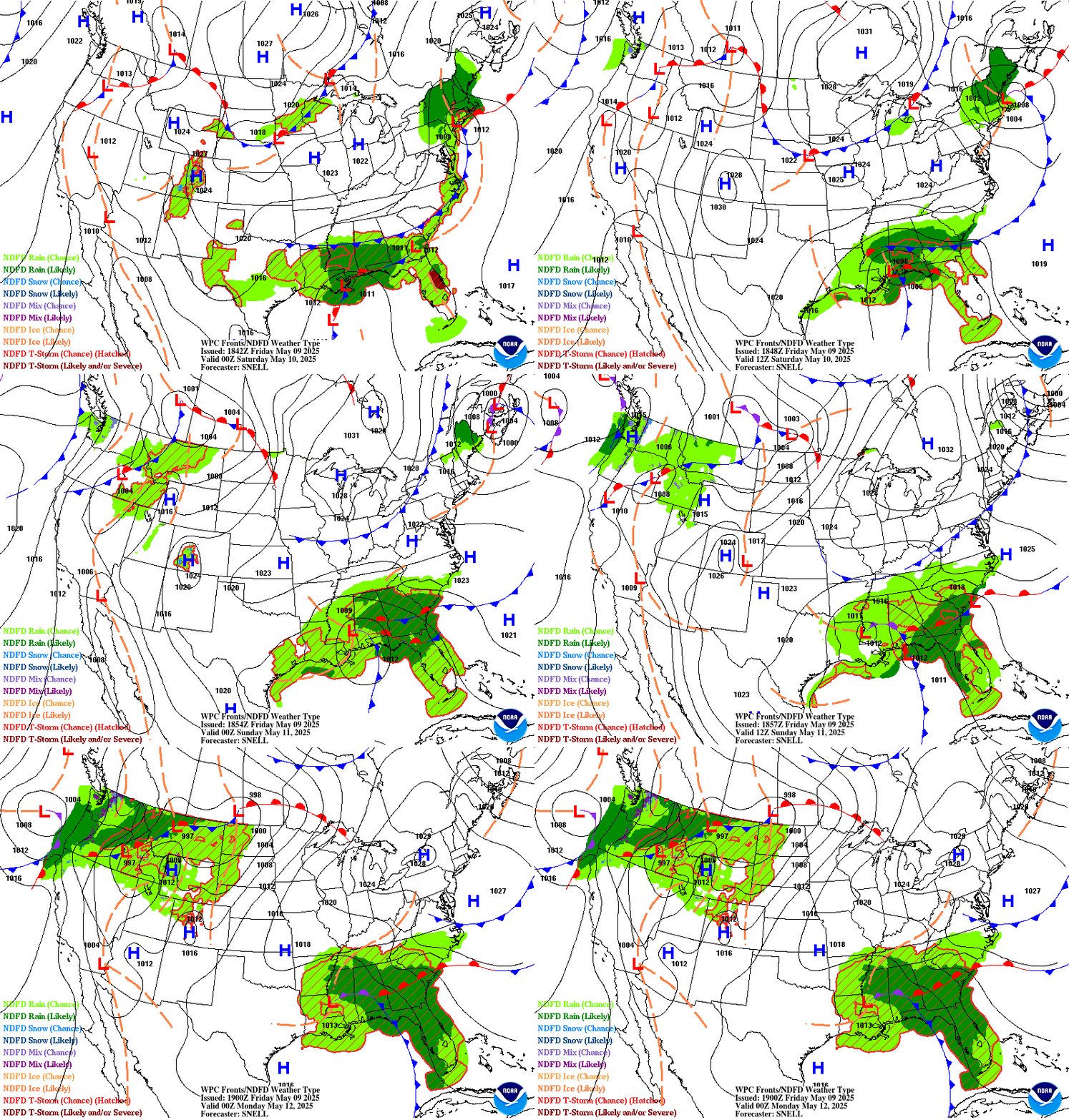
The explanation for the coding used in these maps, i.e. the full legend, can be found here although it includes some symbols that are no longer shown in the graphic because they are implemented by color coding.
This graphic provides a good indication of where the moisture is. It is a bit different than just moisture imagery as it is quantitative.

Image credit:Center for Western Weather and Water Extremes, Scripps/UCSD. More explanation can be found at Atmospheric Rivers (Click to read full Weather Underground Dr. Bob Henson article)
Click Here for a World Precipitation Forecast produced by the Australian Bureau of Meteorology. Unfortunately I do not know how to extract the map only so to see it you have to click where I said “click here”. You can adjust the settings to show Temperature or many other things for THE WORLD. It can forecast out for a week. Pretty cool!
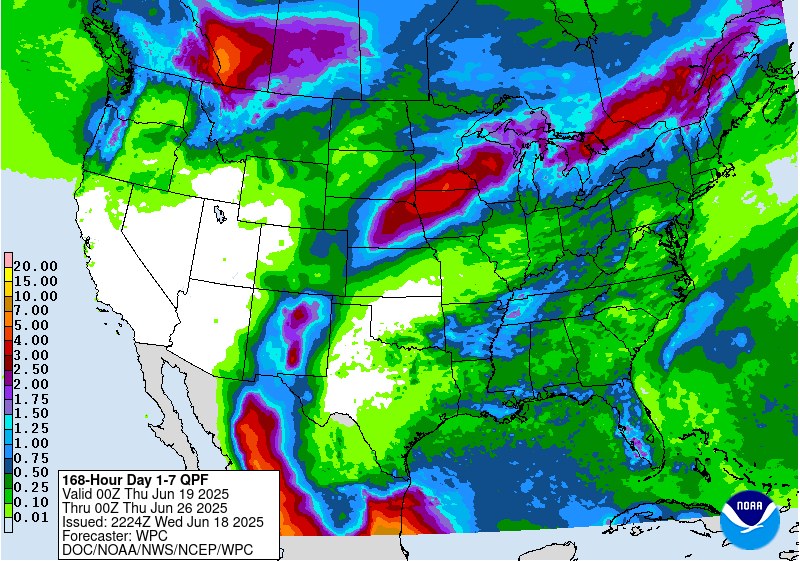
Here is the seven day precipitation forecast. More information is available here.
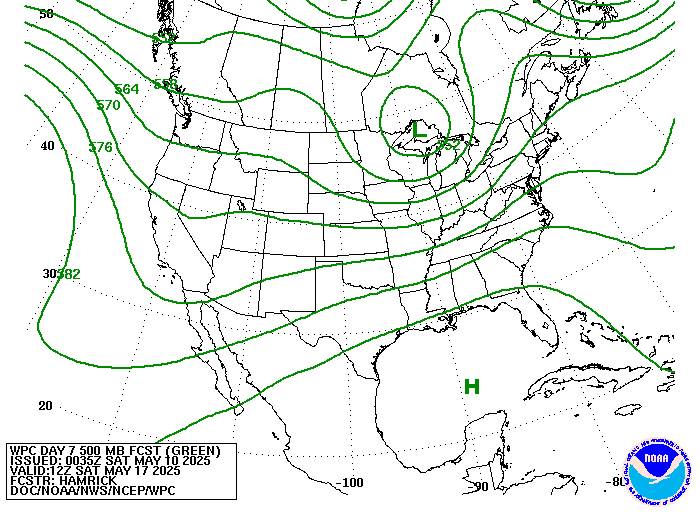
The map below is the mid-atmosphere 7-Day chart rather than the surface highs and lows and weather features. In some cases it provides a clearer less confusing picture as it shows only the major pressure gradients.This graphic auto-updates so when you look at it you will see NOAA’s latest thinking. The speed at which these troughs and ridges travel across the nation will determine the timing of weather impacts. This graphic auto-updates I think every six hours and it changes a lot. Because “Thickness Lines” are shown by those green lines on this graphic, it is a good place to define “Thickness” and its uses. The 540 Level general signifies equal chances for snow at sea level locations. I am leaving this explanation in the report but it may not be very significant until next October or so which now is less than two months away. .
The MJO has had significant impacts this prior winter during the development of the El Nino but the impact on this September is not likely to be very noticeable other than alternatively accelerating and decelerating the development of the La Nina. It is forecast to be more significant in October. The forecasts of the MJO are all over the place and not suggesting a strong Active or Inactive Phase of the MJO any time soon. Thus it may be October or November before it really is able to be factored in.
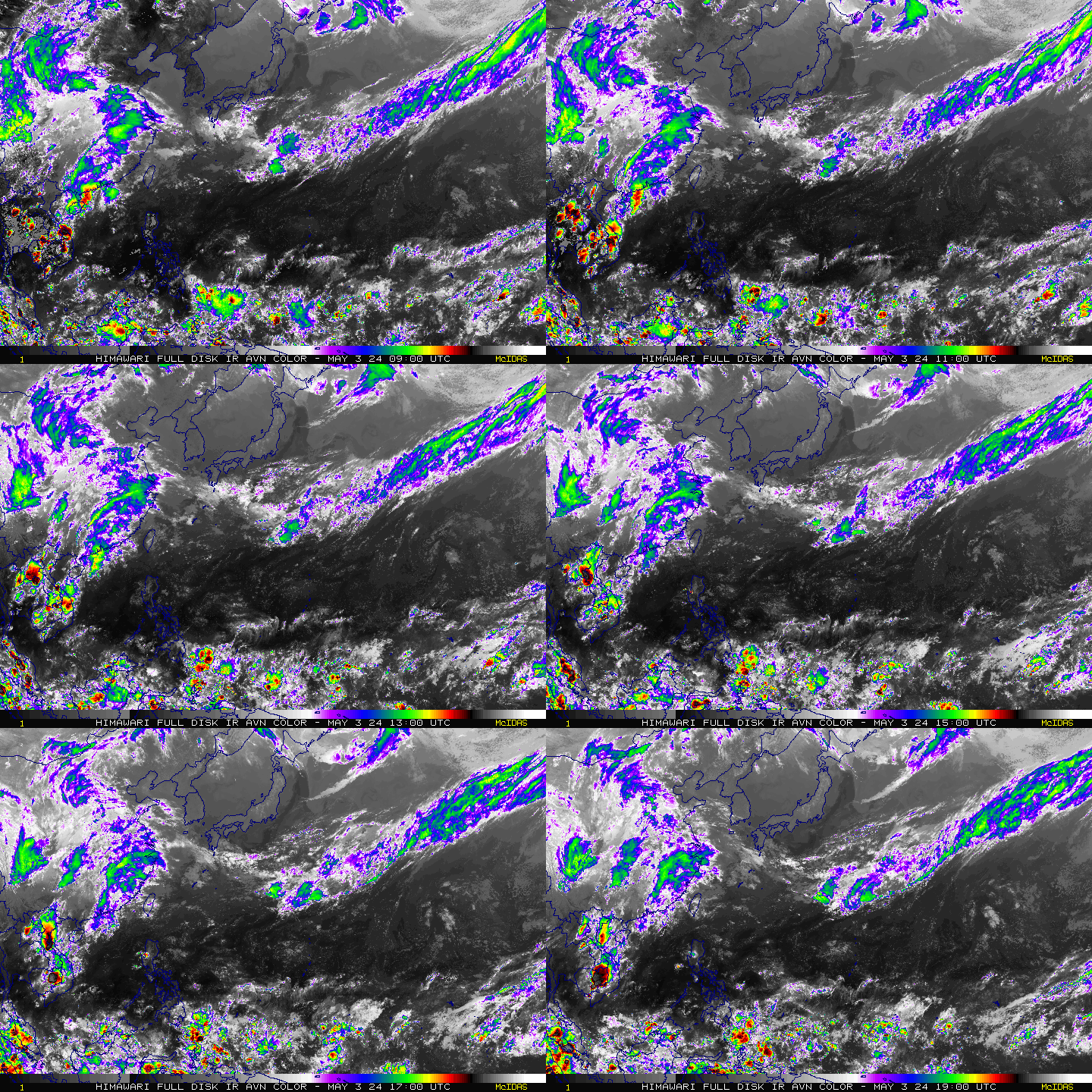


This graphic updates automatically so it most likely will look different by the time you look at it as the weather patterns, except for the Southwest Monsoon, are moving from west to east .
Below is an analysis of projected tropical hazards and benefits over an approximately two-week period. This graphic is scheduled to update on Tuesday and I am reading the August 30, 2016 Version and looking at Week 2 of that forecast.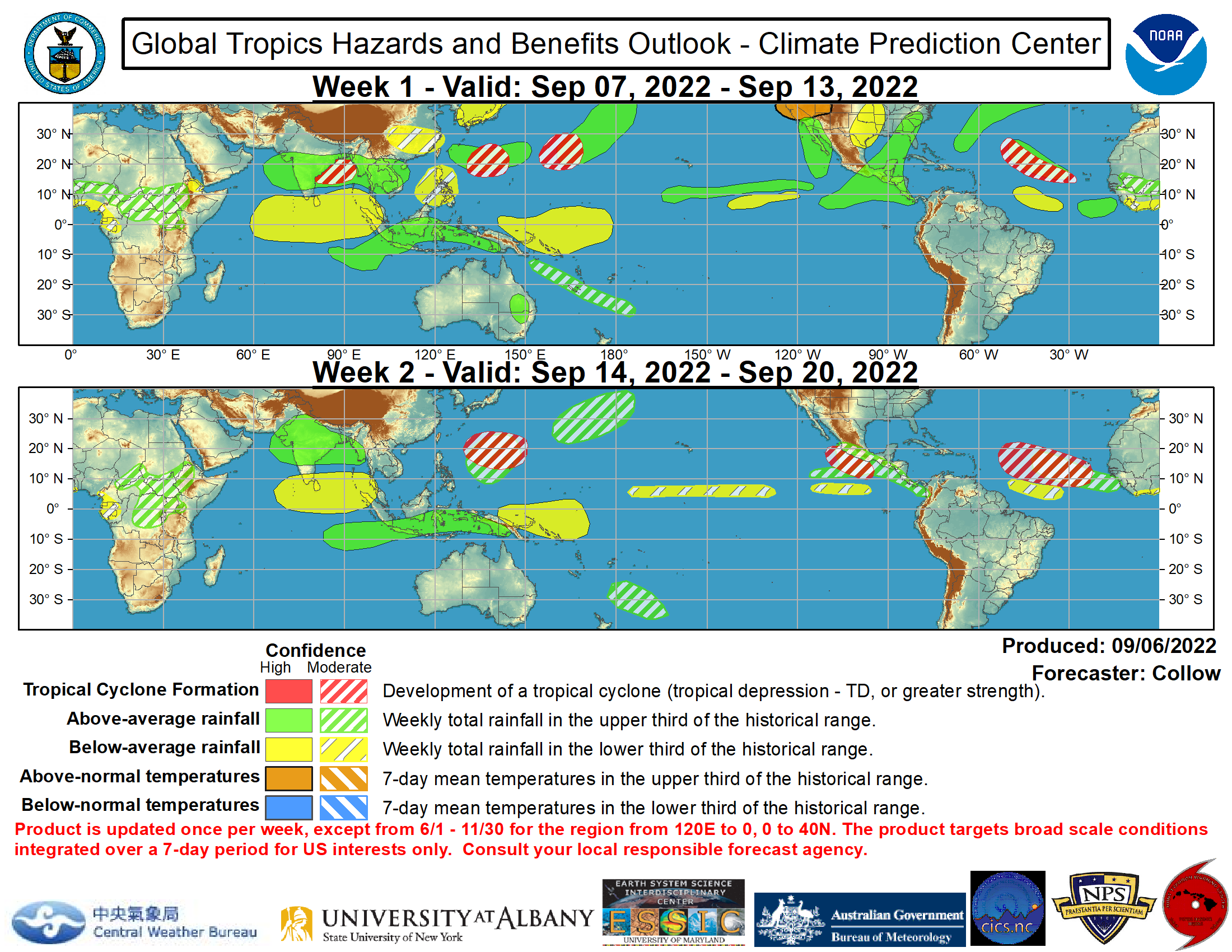

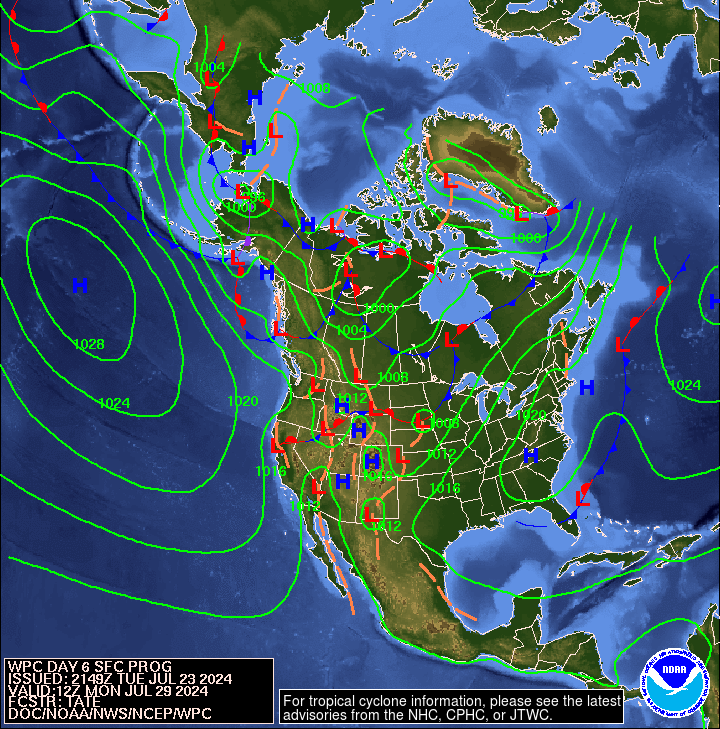
Below is a graphic which highlights the forecasted surface Highs and the Lows re air pressure on Day 6 (the Day 3 forecast is available on Page II of this Report). This graphic also auto-updates.
Looking at the current activity of the Jet Stream.


Below is the forecast out five days.

To see how the pattern is projected to evolve, please click here. In addition to the shaded areas which show an interpretation of the Jet Stream, one can also see the wind vectors (arrows) at the 300 Mb level.
This longer animation shows how the jet stream is crossing the Pacific and when it reaches the U.S. West Coast is going every which way.
Click here to gain access to a very flexible computer graphic. You can adjust what is being displayed by clicking on “earth” adjusting the parameters and then clicking again on “earth” to remove the menu. Right now it is set up to show the 500 hPa wind patterns which is the main way of looking at synoptic weather patterns.
And when we look at Sea Surface anomalies below, we see a lot of them not just along the Equator related to ENSO.
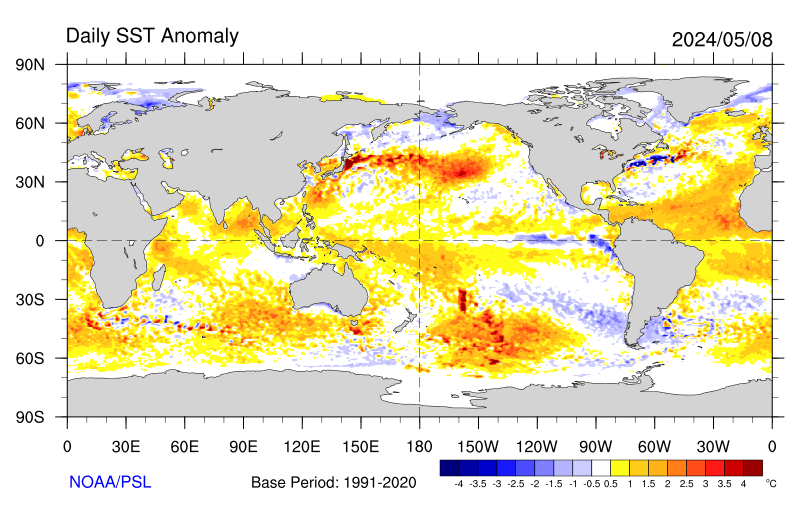
Below I show the changes over the last month in the Sea Surface Temperature (SST) anomalies.

Four- Week Outlook
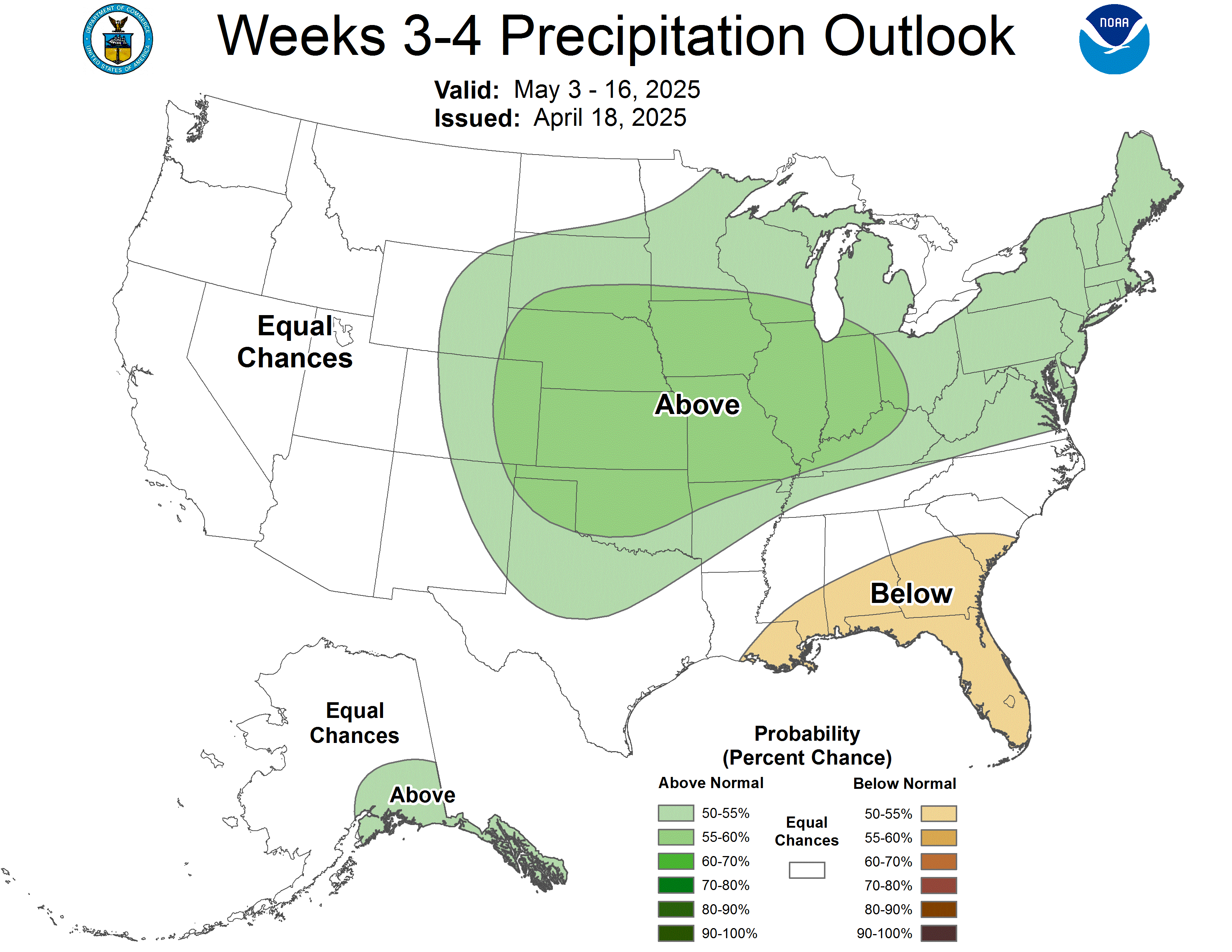
I am going to show the three-month SON Outlook (for reference purposes), the Early Outlook for the single month of September, the 6 – 10 Day and 8 – 14 Day Maps and the Week 3 – 4 Experimental Outlook.
First – Temperature
Here is the Three-Month SON Temperature Outlook issued on August 18, 2016:

Here is the Temperature Outlook for September which was updated on August 31, 2016
6 – 10 Day Temperature Outlook
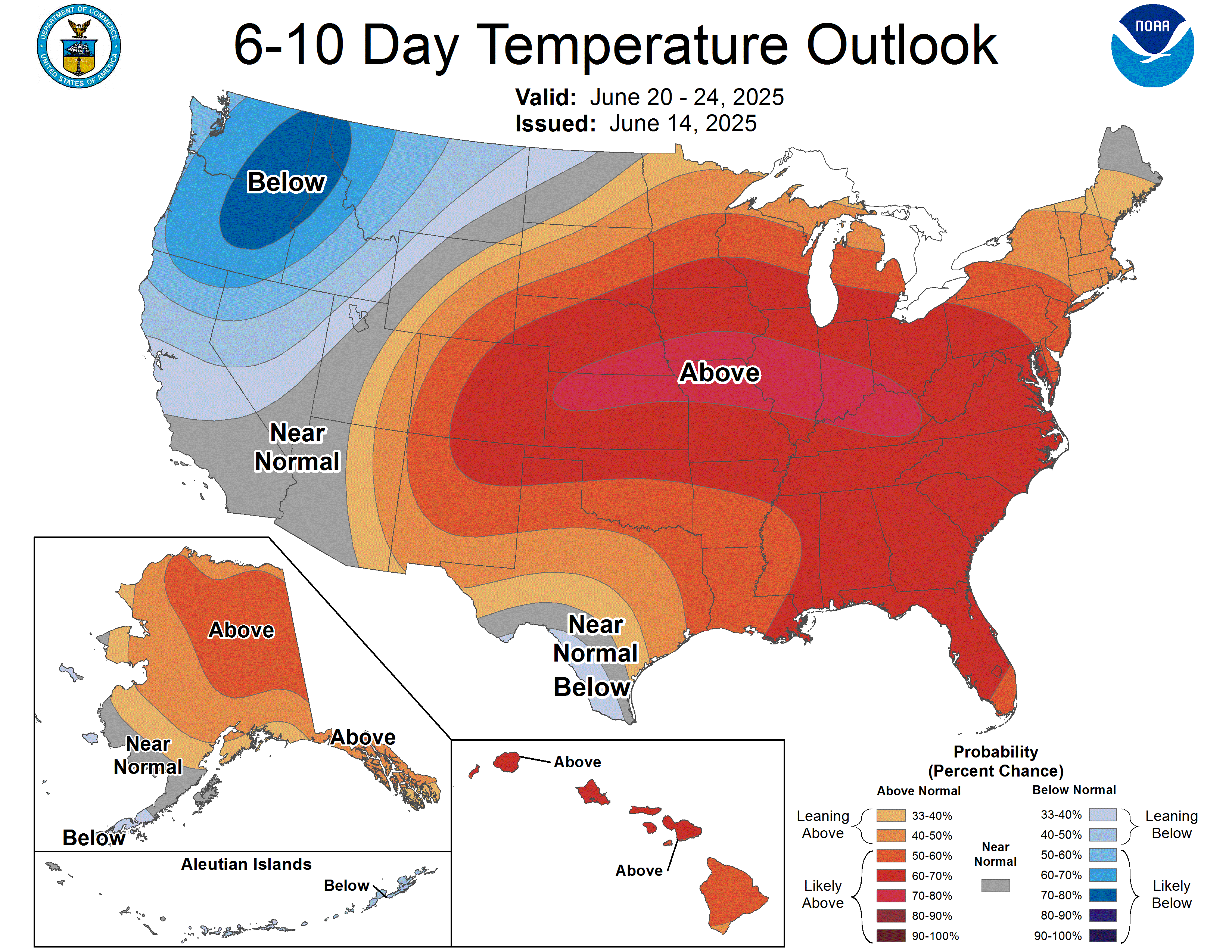
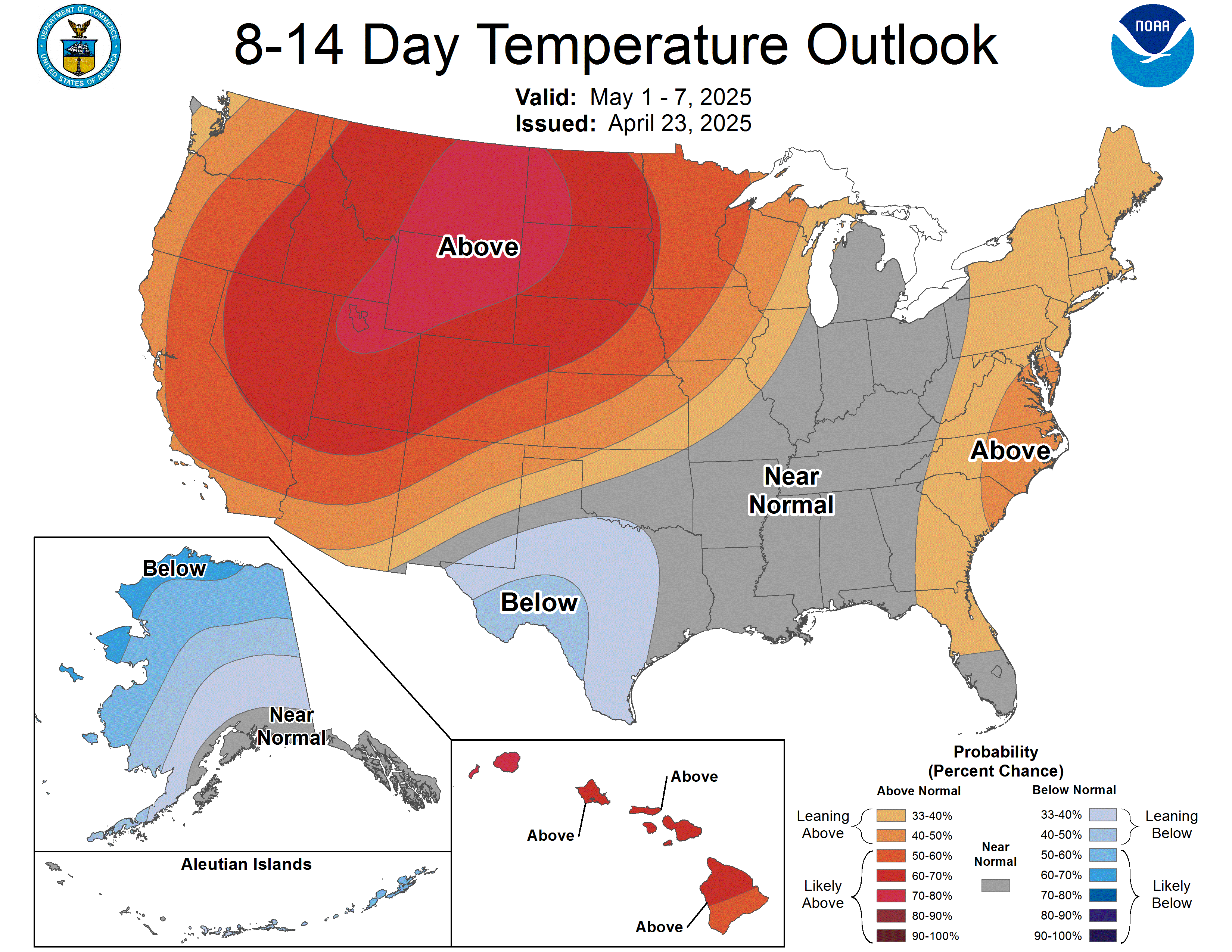
8 – 14 Day Temperature Outlook
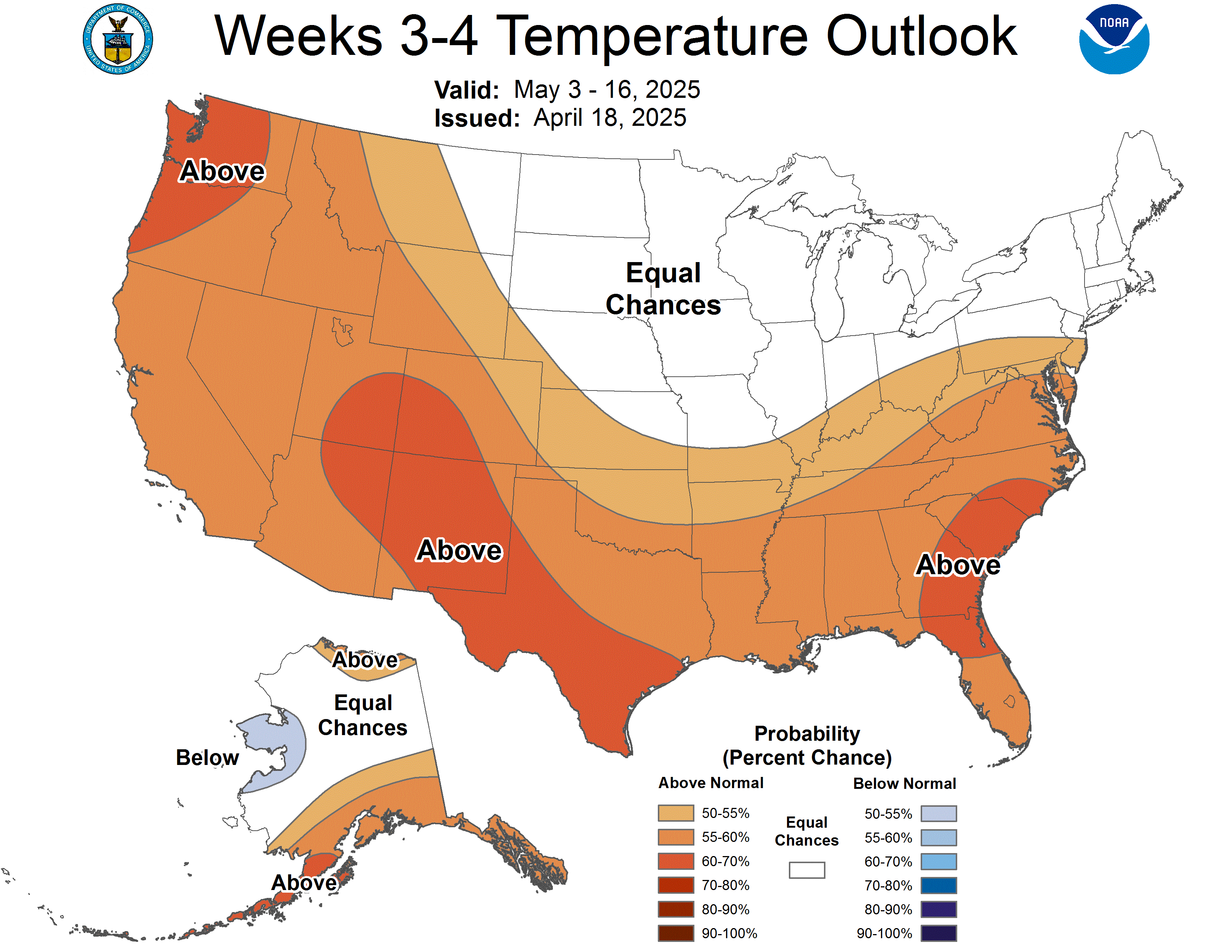
Looking further out.
Now – Precipitation
Here is the three-month SON Precipitation Outlook issued on August 18, 2016 21, 2016:

And here is the Updated Outlook for September Precipitation Issued on August 31, 2016
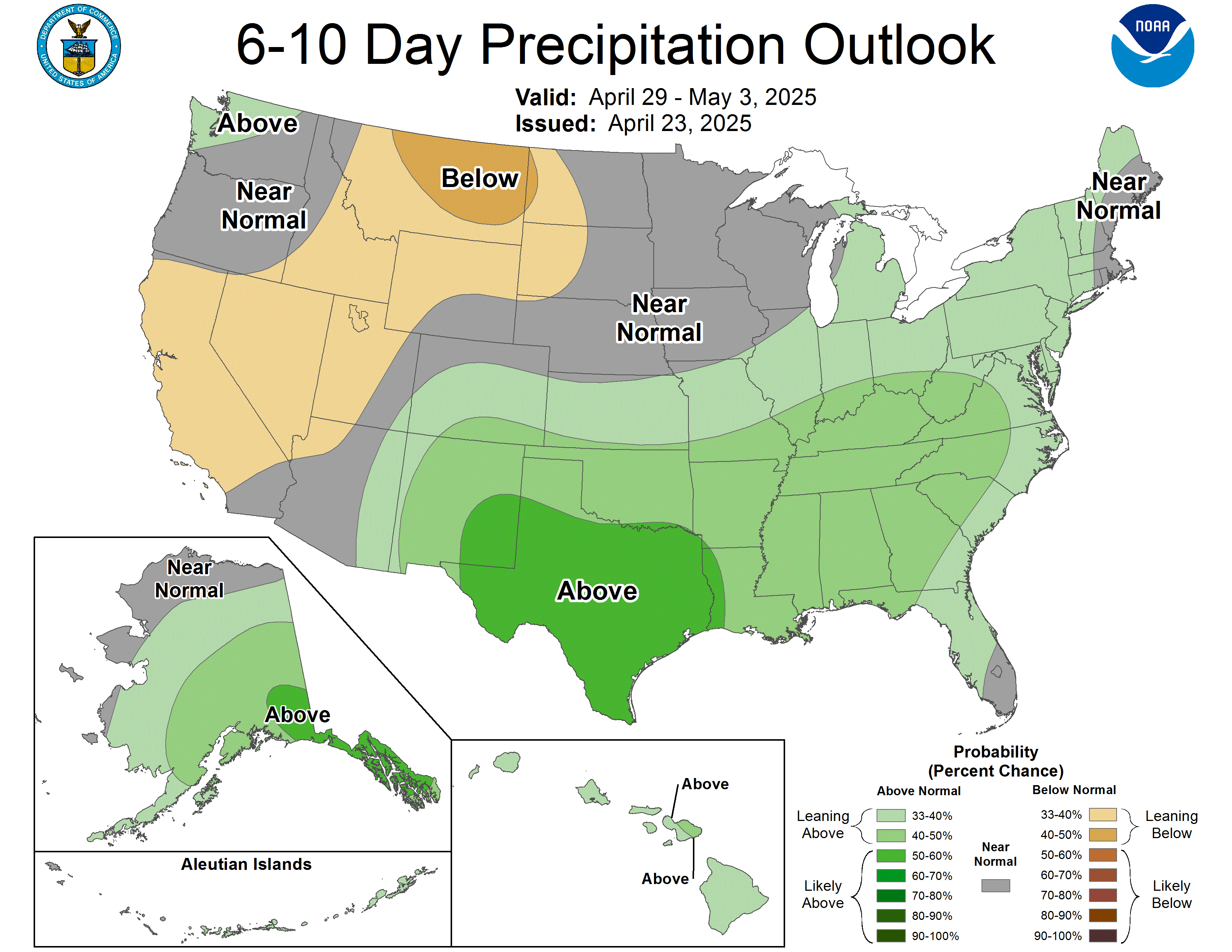
6 – 10 Day Precipitation Outlook
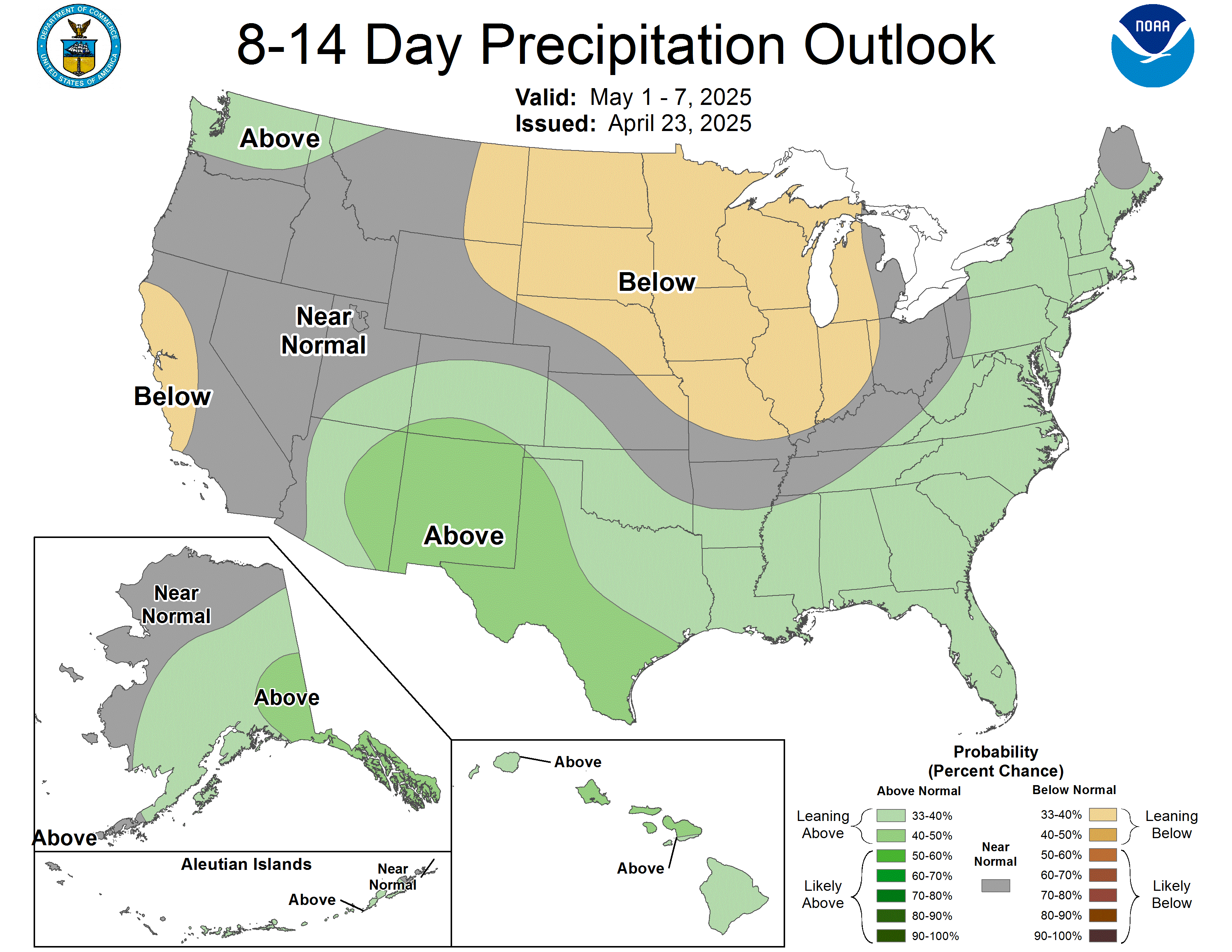
8 – 14 Day Precipitation Outlook
 .
.
As I view these maps on September 5 (two of the five update each day and one (the Week 3 – 4 Outlook) updates every Friday), it looks like precipitation leading up to September 30 is tending for the first half of September to be a dry Northwest with most of the rest of CONUS being impacted by either tropical inflows or easterly inflows from the Atlantic. In the second half of the month the wet anomaly west of the Great Lakes becomes prominent while the Northwest dry anomaly is there but with less geographical coverage and there there remain some small suggestions of continued tropical activity impacting the Central Gulf Coast and the southern part of Arizona and New Mexico.
Here is the NOAA discussion released today September 5, 2016.
6-10 DAY OUTLOOK FOR SEP 11 – 15 2016
TODAY’S 500-HPA MODEL SOLUTIONS ARE IN GOOD AGREEMENT IN DEPICTING A FAIRLY AMPLIFIED PATTERN OVER MUCH OF THE FORECAST DOMAIN. ANOMALOUS RIDGING IS FORECAST OVER THE GULF OF ALASKA AND WESTERN CANADA, WHILE AN ANOMALOUS TROUGH IS DEPICTED OVER THE WESTERN CONUS. DOWNSTREAM THERE IS AN ANOMALOUS RIDGE OVER THE NORTHEASTERN CONUS. THE VARIOUS ENSEMBLE MEAN SOLUTIONS FROM THE GFS, CANADIAN AND ECMWF SYSTEMS ARE IN GOOD AGREEMENT ON THE FORECAST PATTERN WITH MINOR VARIATIONS.
ABOVE-NORMAL TEMPERATURES ARE MOST LIKELY OVER THE EASTERN CONUS, WITH THE HIGHEST PROBABILITIES INDICATED NEAR THE ANOMALOUS RIDGE AXIS OVER THE NORTHEASTERN CONUS. THERE ARE ENHANCED PROBABILITIES FOR BELOW NORMAL TEMPERATURES FOR MUCH OF THE CENTRAL CONUS IN ASSOCIATION WITH A PREDICTED TROUGH. ABOVE NORMAL TEMPERATURES ARE MOST LIKELY FAVORED FOR THE NORTHWEST COAST IN ASSOCIATION WITH THE RIDGE MOVING INLAND. BELOW NORMAL TEMPERATURES ARE ALSO FAVORED FOR PARTS OF NORTHERN ALASKA UNDER AN ANOMALOUS NORTHERLY MID-LEVEL CIRCULATION AND BELOW NORMAL HEIGHTS. ABOVE-NORMAL TEMPERATURES ARE MOST LIKELY FOR SOUTHERN ALASKA, ALASKA PANHANDLE, AND THE ALEUTIANS DUE IN PART TO ABOVE NORMAL SEA SURFACE TEMPERATURES IN ADJACENT WATERS.
THERE ARE ENHANCED PROBABILITIES FOR ABOVE MEDIAN PRECIPITATION FOR PARTS OF THE NORTHERN ROCKIES AND SOUTH-CENTRAL CONUS IN ASSOCIATION WITH A MEAN TROUGH FORECAST NEAR THE WESTERN CONUS. BELOW AND NEAR MEDIAN PRECIPITATION IS MOST LIKELY FOR PARTS OF THE WESTERN CONUS BEHIND THE PREDICTED TROUGH OVER THE WESTERN CONUS. ABOVE MEDIAN PRECIPITATION IS FAVORED FOR THE SOUTHEASTERN CONUS DUE TO THE POTENTIAL FOR LOW-LEVEL MOIST EASTERLY FLOW. MODEL FORECASTS INDICATE BELOW MEDIAN PRECIPITATION IS MOST LIKELY FARTHER TO THE NORTH FOR PARTS OF THE UPPER MISSOURI VALLEY AND THE GREAT LAKES. THERE ARE ENHANCED PROBABILITIES FOR ABOVE MEDIAN PRECIPITATION FOR ALASKA RELATED TO A LOW-LEVEL CYCLONIC SYSTEM THERE.
FORECAST CONFIDENCE FOR THE 6-10 DAY PERIOD: ABOVE AVERAGE, 4 OUT OF 5, DUE TO GOOD AGREEMENT AMONG THE VARIOUS MODELS.
8-14 DAY OUTLOOK FOR SEP 13 – 19 2016
TODAY’S WEEK-2 500-HPA HEIGHT SOLUTIONS FROM THE ENSEMBLE MEANS ARE SIMILAR TO THAT FORECAST FOR THE 6-10 DAY PERIOD OVER MUCH OF THE FORECAST DOMAIN, BUT WITH SOME EASTWARD PROGRESSION OF THE PREDICTED TROUGH OVER THE CENTRAL CONUS AND DE-AMPLIFICATION OF ENSEMBLE MEAN ANOMALIES WITH INCREASING ENSEMBLE SPREAD. THE RECENT DETERMINISTIC RUNS OF THE GFS ARE IN FAIRLY GOOD AGREEMENT WITH ENSEMBLE MEANS.
ABOVE NORMAL TEMPERATURES ARE LIKELY ACROSS MUCH OF THE EASTERN CONUS UNDER POSITIVE 500-HPA HEIGHT ANOMALIES. BELOW NORMAL TEMPERATURES ARE MOST LIKELY OVER THE CENTRAL CONUS, IN ASSOCIATION WITH A PREDICTED TROUGH. ABOVE NORMAL TEMPERATURES ARE MOST LIKELY FOR PARTS OF PACIFIC COASTAL STATES UNDER ABOVE NORMAL MID-LEVEL HEIGHTS. ABOVE NORMAL TEMPERATURES ARE MOST LIKELY FOR MUCH OF SOUTHERN ALASKA IN ASSOCIATION WITH ABOVE NORMAL 500-HPA HEIGHTS AND RELATIVELY WARM SSTS.
THE WEEK-2 PRECIPITATION OUTLOOK IS DERIVED PRIMARILY FROM CALIBRATED MODEL FORECASTS FROM THE GEFS AND ECMWF ENSEMBLES, WITH ABOVE MEDIAN PRECIPITATION FAVORED OVER MUCH OF THE EASTERN CONUS AND MOST LIKELY OVER THE CENTRAL AND SOUTHERN GREAT PLAINS, UNDERNEATH OF ANOMALOUS TROUGHING FORECAST. BELOW MEDIAN PRECIPITATION IS MOST LIKELY EAST OF THE ANOMALOUS RIDGE AXIS OVER THE NORTHWESTERN CONUS. THERE ARE ENHANCED PROBABILITIES FOR ABOVE NORMAL PRECIPITATION FOR ALASKA UNDER LOW-LEVEL CYCLONIC FLOW.
FORECAST CONFIDENCE FOR THE 8-14 DAY PERIOD IS: ABOUT AVERAGE, 3 OUT OF 5, DUE TO FAIRLY GOOD AGREEMENT AMONG THE VARIOUS MODELS, OFFSET BY UNCERTAINTIES SURROUNDING THE PRECIPITATION FORECAST OVER THE EASTERN CONUS.
THE NEXT SET OF LONG-LEAD MONTHLY AND SEASONAL OUTLOOKS WILL BE RELEASED ON SEPTEMBER 15
Some might find this analysis interesting as the organization which prepares it looks at things from a very detailed perspective and their analysis provides a lot of information on the history and evolution of ENSO events.
Analogs to the Outlook.
Now let us take a detailed look at the “Analogs” which NOAA provides related to the 5 day period centered on 3 days ago and the 7 day period centered on 4 days ago. “Analog” means that the weather pattern then resembles the recent weather pattern and was used in some way to predict the 6 – 14 day Outlook.
Here are today’s analogs in chronological order although this information is also available with the analog dates listed by the level of correlation. I find the chronological order easier for me to work with. There is a second set of analogs associated with the Outlook but I have not been regularly analyzing this second set of information. The first set which is what I am using today applies to the 5 and 7 day observed pattern prior to today. The second set, which I am not using, relates to the correlation of the forecasted outlook 6 – 10 days out with similar patterns that have occurred in the past during the dates covered by the 6 – 10 Day Outlook. The second set of analogs may also be useful information but they put the first set of analogs in the discussion with the second set available by a link so I am assuming that the first set of analogs is the most meaningful and I find it so.
Day | ENSO Phase | PDO | AMO | Other Comments |
| Aug 27, 1952 | Neutral | – | + | |
| Sept 14, 1963 | Neutral | – | – | |
| Aug 26, 1980 | Neutral | + | + | |
| Aug 22, 1990 | Neutral | + | N (t) | |
| Sept 3, 1996 | Neutral | + | N (t) | Following a La Nina |
| Sept 4, 1996 | Neutral | + | N (t) | Following a La Nina |
| Aug 24, 2004 | El Nino | + | + | Modoki Type II |
| Sept 9, 2005 | Neutral | + | + | |
| Sept 11, 2005 | Neutral | + | + |
(t) = a month where the Ocean Cycle Index has just changed or does change the following month.
One thing that jumped out at me right away was the spread among the analogs from August 22 to September 14 which is just two days over three weeks which is a small spread. I have not calculated the centroid of this distribution which would be the better way to look at things but the midpoint, which is a lot easier to calculate, is about September 2. These analogs are centered on 3 days and 4 days ago (September 1 or 2). So the analogs could be considered pretty much in sync with the calendar with a small spread which to me adds some confidence in the forecast in the sense only that it is consistent with the time of the year and the analogs if correctly selected (a big assumption) are also consistent with this time of the year.
There is this time one El Nino Analog (why are there any?), zero La Nina Analogs (why are there none?), and eight ENSO Neutral Analogs. The phases of the ocean cycles in the analogs are suggestive of McCabe Condition C which kind of agrees with the forecasts which is a good sign.
The seminal work on the impact of the PDO and AMO on U.S. climate can be found here. Water Planners might usefully pay attention to the low-frequency cycles such as the AMO and the PDO as the media tends to focus on the current and short-term forecasts to the exclusion of what we can reasonably anticipate over multi-decadal periods of time. One of the major reasons that I write this weather and climate column is to encourage a more long-term and World view of weather.

You may have to squint but the drought probabilities are shown on the map and also indicated by the color coding with shades of red indicating higher than 25% of the years are drought years (25% or less of average precipitation for that area) and shades of blue indicating less than 25% of the years are drought years. Thus drought is defined as the condition that occurs 25% of the time and this ties in nicely with each of the four pairs of two phases of the AMO and PDO.
Historical Anomaly Analysis
When I see the same dates showing up often I find it interesting to consult this list.
With respect to relating analog dates to ENSO Events, the following table might be useful. In most cases this table will allow the reader to draw appropriate conclusions from NOAA supplied analogs. If the analogs are not associated with an El Nino or La Nina they probably are not as easily interpreted. Remember, an analog is indicating a similarity to a weather pattern in the past. So if the analogs are not associated with a prior El Nino or prior La Nina the computer models are not likely to generate a forecast that is consistent with an El Nino or a La Nina.
| El Ninos | La Ninas | |||||||||
|---|---|---|---|---|---|---|---|---|---|---|
| Start | Finish | Max ONI | PDO | AMO | Start | Finish | Max ONI | PDO | AMO | |
| DJF 1950 | J FM 1951 | -1.4 | – | N | ||||||
| T | JJA 1951 | DJF 1952 | 0.9 | – | + | |||||
| DJF 1953 | DJF 1954 | 0.8 | – | + | AMJ 1954 | AMJ 1956 | -1.6 | – | + | |
| M | MAM 1957 | JJA 1958 | 1.7 | + | – | |||||
| M | SON 1958 | JFM 1959 | 0.6 | + | – | |||||
| M | JJA 1963 | JFM 1964 | 1.2 | – | – | AMJ 1964 | DJF 1965 | -0.8 | – | – |
| M | MJJ 1965 | MAM 1966 | 1.8 | – | – | NDJ 1967 | MAM 1968 | -0.8 | – | – |
| M | OND 1968 | MJJ 1969 | 1.0 | – | – | |||||
| T | JAS 1969 | DJF 1970 | 0.8 | N | – | JJA 1970 | DJF 1972 | -1.3 | – | – |
| T | AMJ 1972 | FMA 1973 | 2.0 | – | – | MJJ 1973 | JJA 1974 | -1.9 | – | – |
| SON 1974 | FMA 1976 | -1.6 | – | – | ||||||
| T | ASO 1976 | JFM 1977 | 0.8 | + | – | |||||
| M | ASO 1977 | DJF 1978 | 0.8 | N | – | |||||
| M | SON 1979 | JFM 1980 | 0.6 | + | – | |||||
| T | MAM 1982 | MJJ 1983 | 2.1 | + | – | SON 1984 | MJJ 1985 | -1.1 | + | – |
| M | ASO 1986 | JFM 1988 | 1.6 | + | – | AMJ 1988 | AMJ 1989 | -1.8 | – | – |
| M | MJJ 1991 | JJA 1992 | 1.6 | + | – | |||||
| M | SON 1994 | FMA 1995 | 1.0 | – | – | JAS 1995 | FMA 1996 | -1.0 | + | + |
| T | AMJ 1997 | AMJ 1998 | 2.3 | + | + | JJA 1998 | FMA 2001 | -1.6 | – | + |
| M | MJJ 2002 | JFM 2003 | 1.3 | + | N | |||||
| M | JJA 2004 | MAM 2005 | 0.7 | + | + | |||||
| T | ASO 2006 | DJF 2007 | 1.0 | – | + | JAS 2007 | MJJ 2008 | -1.4 | – | + |
| M | JJA 2009 | MAM 2010 | 1.3 | N | + | JJA 2010 | MAM 2011 | -1.4 | + | + |
| JAS 2011 | FMA 2012 | -0.9 | – | + | ||||||
| T | MAM 2015 | NA | 1.0 | + | N | |||||
Progress of the Cool ENSO Event
Let us start with the SOI.
Below is the Southern Oscillation Index (SOI) reported by Queensland, Australia. The first column is the tentative daily reading, the second is the 30 day moving/running average and the third is the 90 day moving/running average.
| Date | Current Reading | 30-Day Average | 90 Day Average |
| Aug 30 | +15.29 | +4.42 | +3.95 |
| Aug 31 | +12.32 | +4.43 | +4.09 |
| Sept 1 | +8.20 | +4.60 | +4.22 |
| Sept 2 | +12.24 | +5.14 | +4.37 |
| Sept 3 | +17.47 | +6.00 | +4.54 |
| Sept 4 | +13.55 | +6.76 | +4.90 |
| Sept 5 | +2.62 | +7.08 | +5.25 |
The 30-day average, which is the most widely used measure, as of September 5 is reported at +7.08 which is up considerably from last week and is a La Nina level. The 90-day average at +5.25 is also up substantially from last week and and is now borderline but clearly trending towards La Nina. These may be the high water marks for the SOI re this cycle. Usually but not always the 90 day average changes more slowly than the 30 day average but it depends on what values drop out. The disparity between the two is one reason why we look at both. Different agencies use a different range to classify the SOI as being El Nino or La Nina. The tightest range (I have referred to that as “strictest” but that may not be a clear way of putting it) is -5 for El Nino and +5 for La Nina. Some meteorological agencies sometimes use -8 or +8. So the range +5 to -5 is clearly neutral and above +8 is clearly La Nina and below -8 is clearly El Nino and between -8 and -5 and +5 to + 8 is somewhat marginal but suggestive of El Nino if negative and La Nina if positive. For many purposes the trend is more important than the absolute level.
The MJO or Madden Julian Oscillation is an important factor in regulating the SOI and Kelvin Waves and other tropical weather characteristics. More information on the MJO can be found here. Here is another good resource. August has not been particularly favorable for La Nina development and neither will be September in terms of the MJO. The MJO being Inactive is more favorable for La Nina than the MJO being Active. It is complicated in that some models predict a strong active MJO for September which normally means westerlies which is negative for the development of the La Nina. But the MJO goes back and forth from being Active, Inactive, strong and weak so in has mostly a short-term impact. Right now the impact is fairly muted. It tends to be more important when the situation is ENSO Neutral and the MJO can start the process of an El Nino getting started.
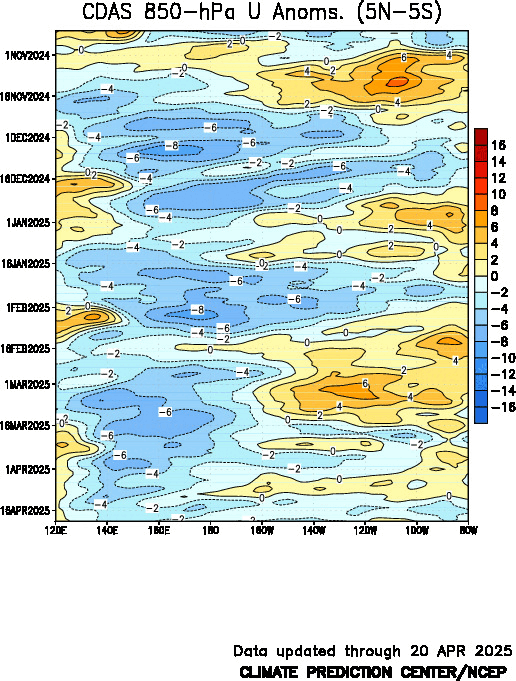
Low-Level Wind Anomalies
Here are the low-level wind anomalies.
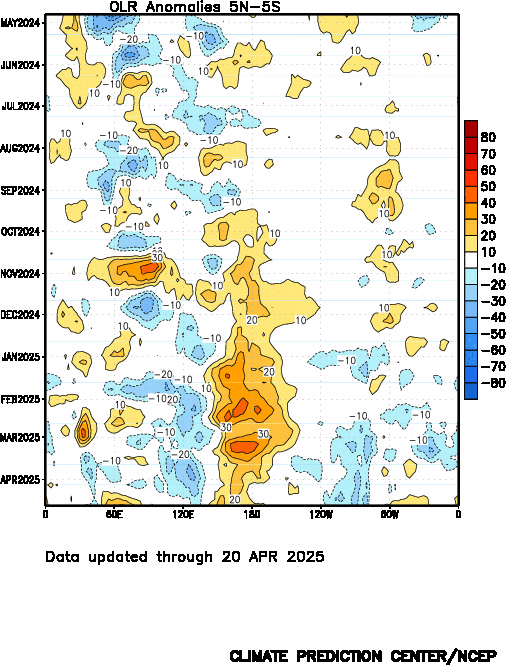
And now the Outgoing Longwave Anomalies which tells us where convection has been taking place.
Equatorial Subsurface Analysis
We are now going to change the way we look at a three dimensional view of the Equator and move from the surface view to the view from the surface down.
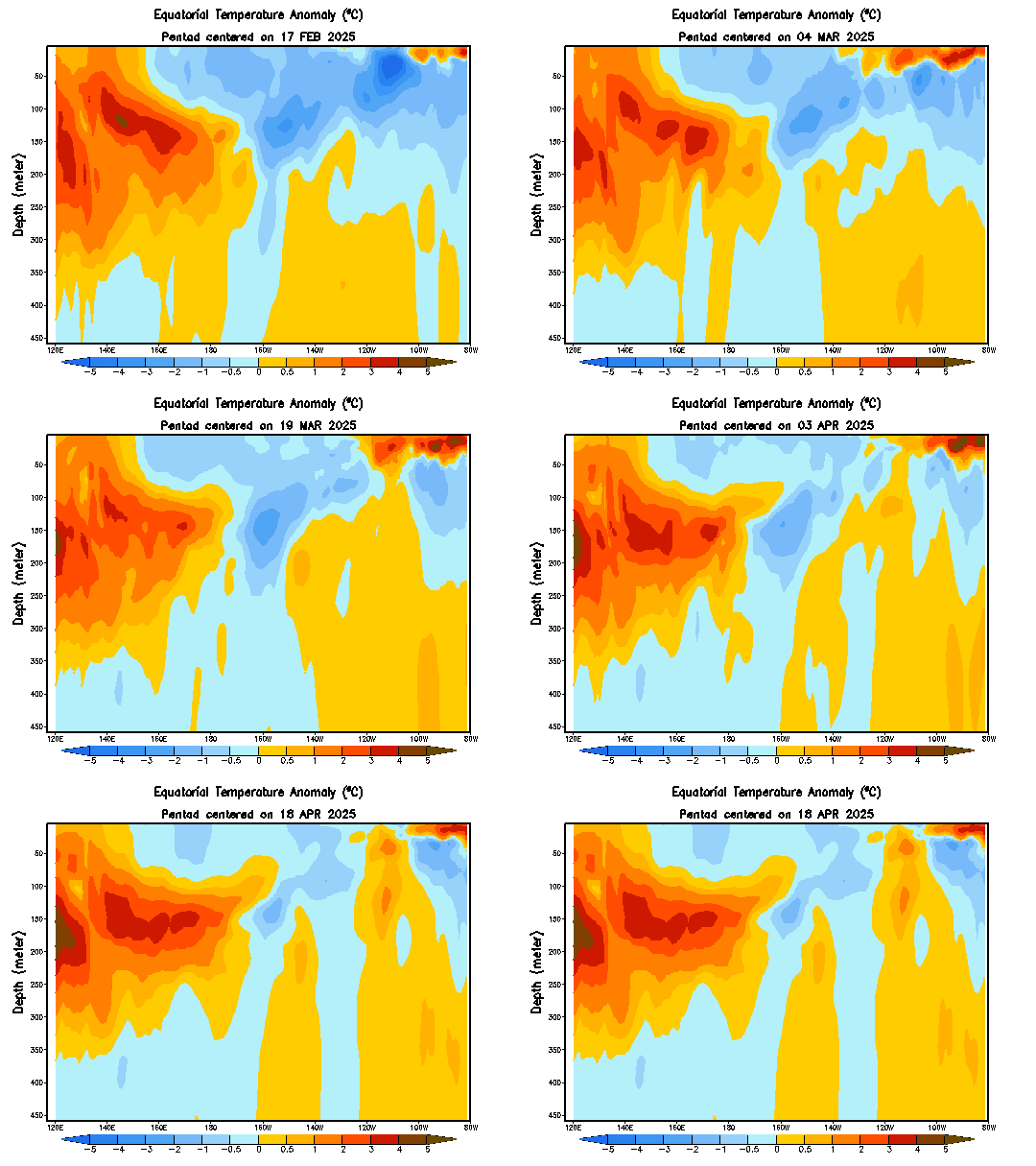
Current Sub-Surface Conditions. Notice the lag in getting this information posted so the current situation may be a bit different than shown.
And now the pair of graphics that I regularly provide and which as I publish are currently able to be accessed from the NOAA website. There was a period of time when that website was up and down but it appears to be functioning well recently. :
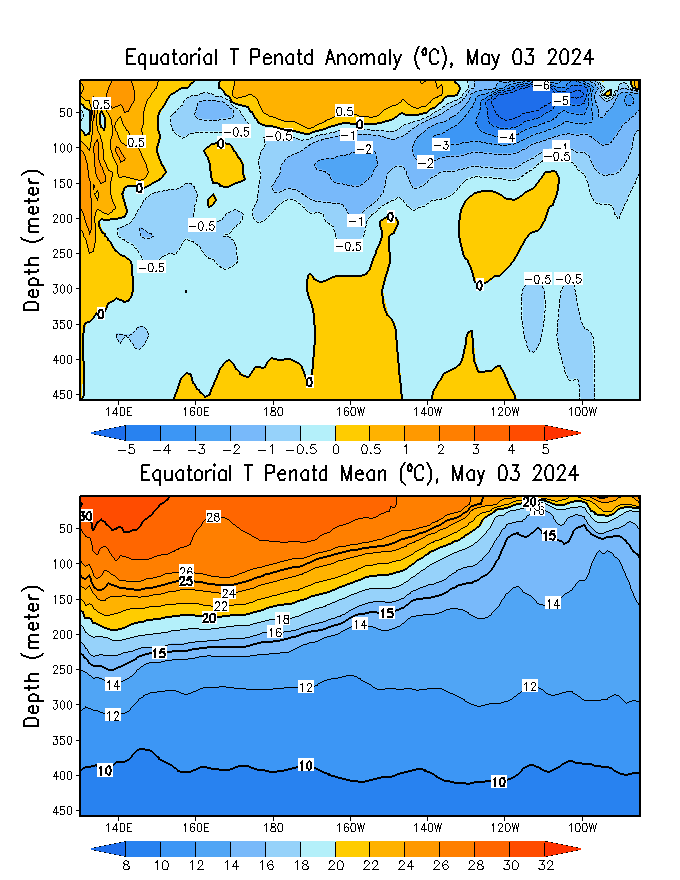
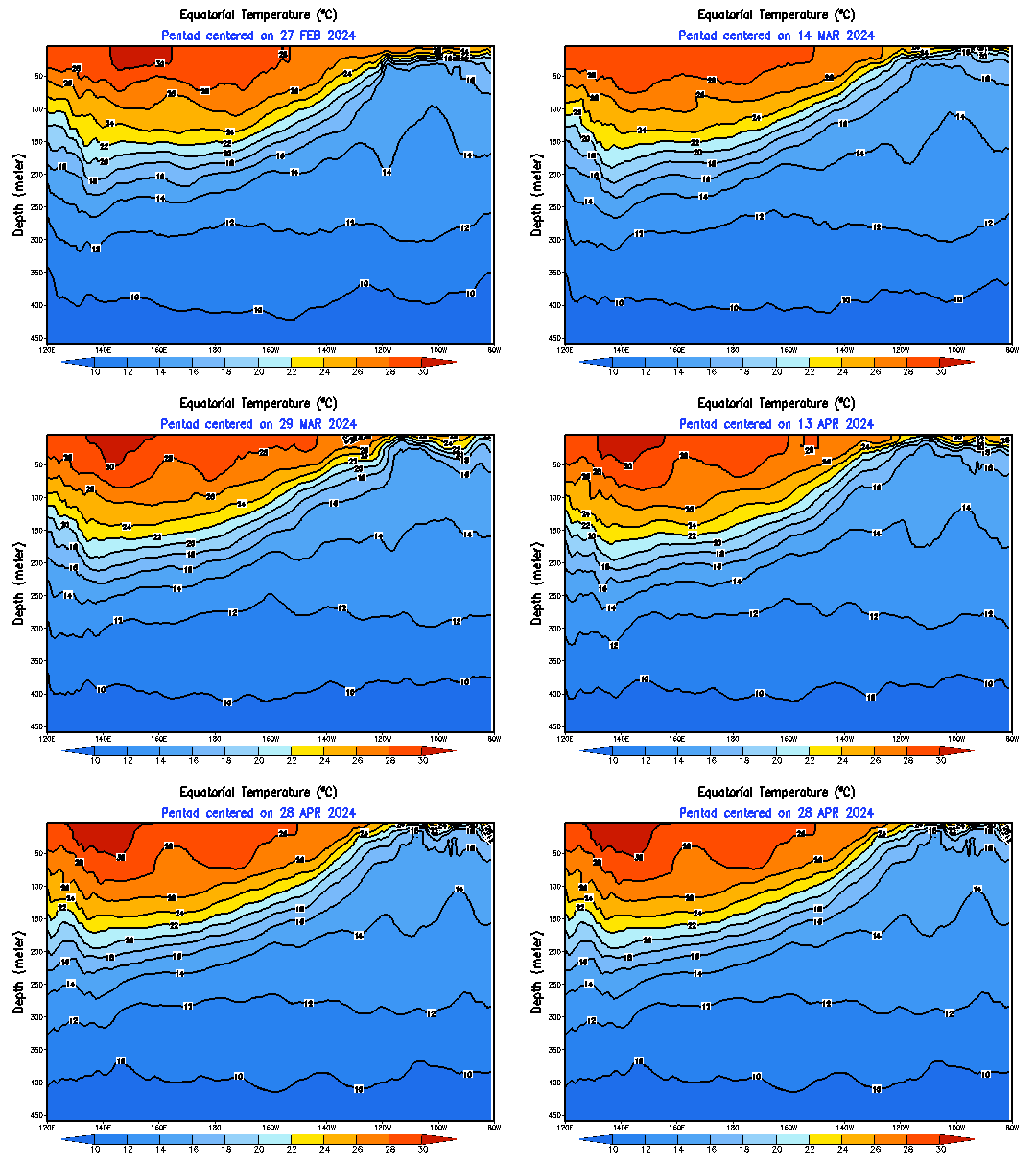
The above pair of graphics showing the current situation has an upper and lower graphic. The bottom graphic shows the absolute values, the upper graphic shows anomalies compared to what one might expect at this time of the year in the various areas both 130E to 90W Longitude and from the surface down to 450 meters.
The bottom half of the graphic (Absolute Values which highlights the Thermocline) is now more useful as we track the progress of this new Cool Event.
It shows the thermocline between warm and cool water. The 28C Isotherm is now located at 175W which is further east than last week.This graphic does not show a 27.5C anomaly which might more precisely indicate where convection is likely to occur. The 27C isotherm is now at 170W so we do not have ideal conditions for significant convection along the Equator east of the Dateline. The 25C isotherm is at about 150W. The 20C Isotherm has moved close to the surface but is not reaching the surface. But the amount of warm water just west of the Dateline is also not real impressive either but growing but staying fairly far east. It is clearly a transition state and all of this is important not just for tracking this cool event but thinking about when the next El Nino might be triggered. This graphic helps understand the logic behind some of the forecasts of the ONI. For the past six weeks we pretty much had weak La Nina conditions both in terms of water temperatures and the SOI but it appears to be transitory in the sense off the SST’s moving back towards Neutral this week with the SOI flashing La Nina. So it is still a battle going on but .
Here are the above graphics as a time sequence animation. You may have to click on them to get the animation going.
TAO/TRITON GRAPHIC

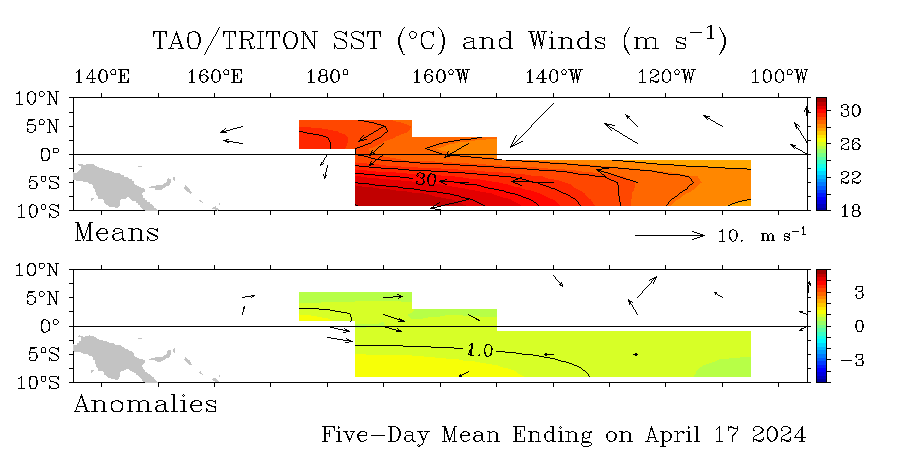
And here is the current version of the TAO/TRITON Graphic.
| ———————————————— | A | B | C | D | E | —————– |
The below table which only looks at the Equator shows the extent of anomalies along the Equator. I had split the table to show warm, neutral, and cool anomalies. The top rows showed El Nino anomalies. When there were no more El Nino anomalies along the Equator, I eliminated those rows. The two rows just below that break point contribute to ENSO Neutral and after another break the rows are associated with La Nina conditions. I have changed the reference date to May 23, 1016.
Subareas of the Anomaly | Westward Extension | Eastward Extension | Degrees of Coverage | ||||
As of Today | May 23, 2016 | As of Today | May 23 2016 | As of Today | In Nino 3.4 | May 23, 2016 | |
| These Rows Show the Extent of ENSO Neutral Impacts on the Equator | |||||||
| 0.5C or cooler Anomaly* | 170E | 155E | Land | 155W | 95 | 50 | 50 |
| 0C or cooler Anomaly | Dateline | 155W | Land | Land | 85 | 50 | 60 |
| These Rows Show the Extent of the La Nina Impacts on the Equator | |||||||
| -0.5C or cooler Anomaly | 165W | 145W | LAND | Land | 70 | 45 | 55 |
| -1C or cooler Anomaly | 160W | 140W | 140W | 105W | 40 | 30 | 35 |
| -1.5C or cooler Anomaly | LAND | 135W | LAND | 120W | 0 | 0 | 0 |
I calculate the ONI each week using a method that I have devised. To refine my calculation, I have divided the 170W to 120W ONI measuring area into five subregions (which I have designated from west to east as A through E) with a location bar shown under the TAO/TRITON Graphic). I use a rough estimation approach to integrate what I see below and record that in the table I have constructed. Then I take the average of the anomalies I estimated for each of the five subregions. So as of Monday September 5, in the afternoon working from the September 4 TAO/TRITON report, this is what I calculated.
| Anomaly Segment | Estimated Anomaly | |
| Last Week | This Week | |
| A. 170W to 160W | -0.2 | -0.3 |
| B. 160W to 150W | -0.5 | -0.6 |
| C. 150W to 140W | -0.6 | -0.5 |
| D. 140W to 130W | -0.6 | -0.6 |
| E. 130W to 120W | -0.5 | -0.5 |
| Total | -2.4 | -2.5 |
| Total divided by five subregions i.e. the ONI | (-2.4)/5 = -05 | (-2.5)/5 = -0.5 |
My estimate of the daily Nino 3.4 ONI remains at -0.5 which is a borderline La Nina value. NOAA has reported the weekly ONI to be lower at -0.7 which is a La Nina value but I question the accuracy of their calculation.It is entirely possible that the TAO/TRITON system is not reporting accurately or that I have made an error in my estimation of the value for Nino 3.4 from the TAO/TRITON graphic but the difference between -0.5 and -0.7 is fairly substantial. I am skeptical about the validity of the report this week from NOAA via their Weekly ENSO Report. We need to recognize that NOAA has many data sources and this is just one of their sources. But it is the one that is reported on on Mondays. I have made comments at different points in this report about what appears to be conflicting information. But we have to recognize that the tools for making these estimates each have a confidence interval and that is one reason that data over a period of time is required to draw conclusions. But I would be remiss not to say that I had the same estimate for Nino 3.4 this week and NOAA was lower than my estimate last week and much lower this week.Nino 4.0 is reported as being the same as last week at -0.1. Nino 3 is being reported as less cool at -0.3 Nino 1 + 2 which extends from the Equator south rather than being centered on the Equator is being reported quite a bit warmer at +0.3 up from 0.2. ACCORDING TO NOAA WE REMAIN IN ENSO Neutral BUT WE HAVE HAD OUR eighth LA NINA value of the ONI reported in the NOAA WEEKLY REPORT. But I again question the accuracy of the calculation this week. Quite frankly I think the NOAA ONI calculation have been incorrect for three weeks and it is getting to be quite ridiculous. The Australian Bureau of Meteorology has just announced that their estimate of the ONI for August was -0.4. IT IS THE SAME OCEAN. Someone is wrong. I believe my rough estimation approach is providing a more realistic ONI value right now.There are other NOAA graphics in this report that suggest that the NOAA Nino 3.4 value reported today is incorrect. I comment on them as I present them.Eight weeks are not definitive (the NOAA criteria for declaring an El Nino or La Nina includes five overlapping three-month periods with the appropriate conditions) especially without confirmation from the SOI which we may have now finally. These index measurements are not definitive but they suggest the direction things are headed but other information strongly suggests the ONI readings will soon (NOAA) or after September (Australia BOM) be less negative than they are this week. I am only showing the currently issued version of the NINO SST Index Table as the prior values are shown in the small graphics on the right with this graphic. The same data in graphical form but going back a couple of more years can be found here. NINO 1+ 2 stubbornly remains positive and determines the weather of Ecuador and Peru.

ONI Recent History

The official reading for Jun/Jul/Aug is now reported as -0.3. As you can see this recent El Nino peaked in NDJ and has now ended and depending on what system you use it is either the 2nd or 3rd strongest El Nino since modern records were kept which is considered to be 1950. You could argue for it being #1 based on a week of readings but few are buying that argument. Still #2 or #3 means it is one of the strongest ever based on the way these events are measured. I will be writing more about that soon in a separate article. I believe the measurement system is inadequate re being useful in forecasting Worldwide weather impacts. The JJA is not a La Nina Value. So there would need for there to be five periods of -0.5 or colder starting with JAS. It is not even clear that JAS will record as -0.5 or less. So the chances of this event being an official La Nina are very low.
The full history of the ONI readings can be found here. The MEI index readings can be found here.
Although I did not discuss the Kelvin Waves earlier, now seems to be the best place to show the evolution of the subsurface temperatures which remains relevant. What we have is only the upwelling phase of the series of Kelvin waves last winter.

Ecuador and Peru. The western part is plenty potent but is not being reinforced by more cool water arriving from the west. So it is simply a matter of the cooler subsurface water mixing out. So this cool event would appear to be self-limiting.
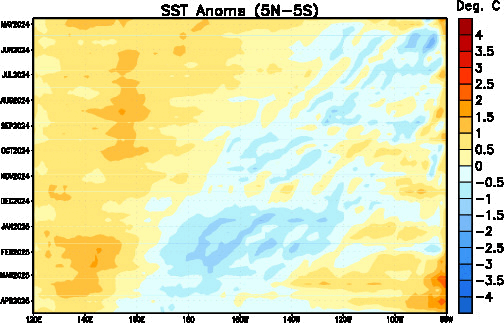
SST Surface Anomaly Hovmoeller
Here is another way of looking at it: Unlike the Upper Ocean Heat Anomaly Hovmoeller (I call it the Kelvin Wave Hovmoeller) which takes an average down to 300 meters, this just measures the surface temperature anomaly. It is the surface that interacts with the atmosphere and causes convection and also the warming and cooling of the atmosphere. A major advantage of the Hovmoeller method of displaying information is that it shows the history so I do not need to show a sequence of snap shots of the conditions at different points in time. This Hovmoeller provides a good way to visually see the evolution of this ENSO event.
Recent CONUS Weather
Since it is now mid-Summer not Spring, I have decided to no longer show May.
Here is the 30 day period through July 3. It completes the month of June.

And now we track July. First we will take a look at the three-month history or at least a 90 day history which is basically May through July.

Now let’s look at the temperature and precipitation anomalies for the 30 days ending July 30, 2016

And now we start looking at August. Here are the 30 Days ending August 27.

And now the 30 days ending September 3, 2016.

Weather Research in the News
Nothing to report
Weather in the News
Hermine Lingers and now other tropical events are of more concern.
Global Warming in the News
Not new news. New York Times may be planning to move printing operations from its College Point Queens location.
Putting it all Together.
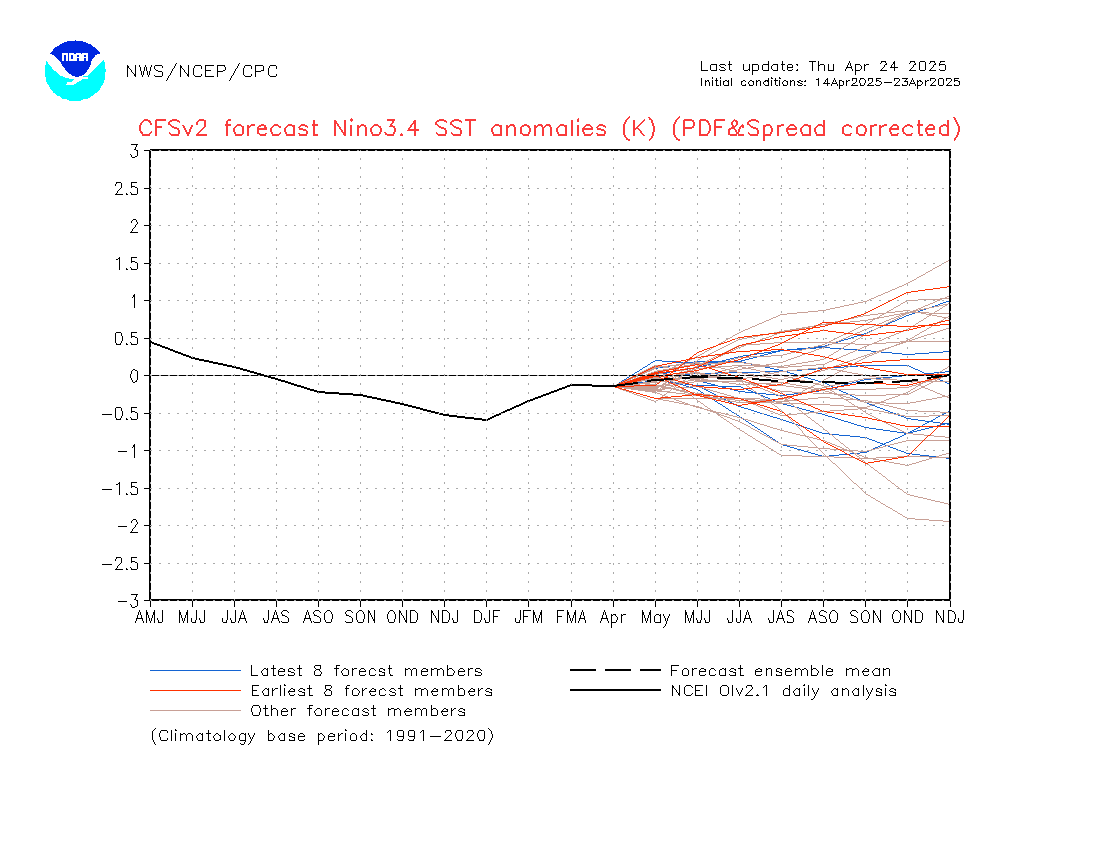
This El Nino has ended in terms of currently satisfying the criteria. We are now speculating on the winter of 2016/2017 which now according to some of the models seems likely to be a La Nina or Neutral with a La Nina bias. But Australia and Japan do not see it that way and are not calling for a La Nina at this point in time. So NOAA is a bit the Odd Man Out but it is mostly a question of degree. NOAA is calling for a borderline La Nina and the others are forecasting a La Nina-ish event that does not quite meet the criteria for being labeled a La Nina and does not last long enough to meet the criteria.
The below is first the CPC/IRI (Early Month) forecast issued on August 11, 2016 followed by the (Late Month) forecast issued on August 18, 2016. It is important to remember that the first report in each month is based on a survey of meteorologists and the second report later in the month is based on the analysis of the forecast models. It is a minor difference but a difference.
First the Meteorologist Consensus Based Analysis. I assume they do it this way as to avoid forcing meteorologists to have to run their computers twice a month (some sarcasm expressed there).

And then the more recent Model-Based Forecast.

We have suggested that it is possible that some of the models and in particular NOAA’s model will be wrong about how fast the Eastern Pacific Warm Pool moves back towards its La Nina location and it may well be that next winter will be more of a Neutral year or even have some characteristics of an El Nino Modoki and thus be wetter than a typical year as the Warm Pool may still be more in the Central Pacific than shifted all the way west to its La Nina position.
I am trying to reconcile the reported value above to the reported values in the NOAA Weekly ENSO Report.
NINO……………. 1 + 2………….3……………3.4………..4.0
03AUG2016 21.5 0.5 24.7-0.5 26.4-0.5 28.8 0.1
10AUG2016 21.0 0.1 24.5-0.7 26.3-0.6 28.6-0.1
17AUG2016 21.1 0.5 24.5-0.5 26.3-0.5 28.7 0.0
24AUG2016 20.8 0.2 24.4-0.5 26.2-0.6 28.6-0.1
31AUG2016 20.9 0.3 24.6-0.3 26.0-0.7 28.5-0.1
The full list can be found here.
We now have the JAMSTEC August 1 ENSO forecast.

Aug. 17, 2016 Prediction from 1st Aug., 2016
ENSO forecast:
The SINTEX-F model initialized with the SST condition observed on July 31st predicts a weak La Niña/La Niña Modoki state in coming months. [Editor’s Note: This article is already running too long so we will not discuss La Nina Modoki tonight but here is a good article to read for those with an interest in the topic]. Although the NCEP GODAS shows an anomalously cold subsurface condition almost all the way from central Pacific to eastern Pacific along the equator in July, the prediction has not picked the strong La Niña/La Niña Modoki signal yet. This might be a model bias due to the simple SST data assimilation scheme used in the initialization. However, we have noted similar prediction results in several other climate models.
Indian Ocean forecast:
As predicted earlier, the negative Indian Ocean Dipole (IOD) has actually emerged in the June-July SST anomalies of the NCEP GODAS data. The model continues predicting the negative IOD for the boreal fall; this will bring a wetter-than-normal (drier-than-normal) condition over the eastern (western) side of the Indian Ocean. There is high possibility of floods in the region near Sumatra and Java, and drought in East Africa. The negative IOD seems to have brought temporary relief to a hot summer over East Japan normally expected in an evolving La Niña year.
Regional forecast:
In boreal fall, as a seasonally averaged view, most part of the globe will experience a warmer-than-normal condition, while northern Brazil will experience a colder-than-normal condition.
According to the seasonally averaged rainfall prediction, U.S., Korea, eastern China, Indo-China and East Africa will experience a drier condition during boreal fall, while most parts of Indonesia and northwestern South America (including Colombia, Ecuador, and western Brazil) will experience a wetter-than-normal condition; this may be mostly due to the negative IOD and the evolving weak La Niña. Also, because of those climate conditions in Indian and Pacific Oceans, Australia is expected to receive above normal rainfall during austral spring and summer. The active South Pacific Convergence Zone (SPCZ) may play a role in this, too However, we expect a weak dry condition in the southwestern coastal region of Western Australia because of the evolution of weak Ningaloo Niña. [ Editor’s Note: Click for Explanation and even more detail on the Ningaloo Niña]
Most part of Japan will experience above normal temperature from summer through winter. We expect above normal precipitation in most part of Japan in September-October. However, it may be noted that the forecast skills in those mid- and high-latitudes on regional scales are still limited.
Forecasting Beyond Five Years.
So in terms of long-term forecasting, none of this is very difficult to figure out actually if you are looking at say a five-year or longer forecast. The research on Ocean Cycles is fairly conclusive and widely available to those who seek it out. I have provided a lot of information on this in prior weeks and all of that information is preserved in Part II of my report in the Section on Low Frequency Cycles 3. Low Frequency Cycles such as PDO, AMO, IOBD, EATS. It includes decade by decade predictions through 2050. Predicting a particular year is far harder.
TABLE OF CONTENTS FOR PART II OF THIS REPORT The links below may take you directly to the set of information that you have selected but in some Internet Browsers it may first take you to the top of Page II where there is a TABLE OF CONTENTS and take a few extra seconds to get you to the specific section selected. If you do not feel like waiting, you can click a second time within the TABLE OF CONTENTS to get to the specific part of the webpage that interests you.
A. Worldwide Weather: Current and Three-Month Outlooks: 15 Month Outlooks (Usefully bookmarked as it provides automatically updated current weather conditions and forecasts at all times. It does not replace local forecasts but does provide U.S. national and regional forecasts and, with less detail, international forecasts)
B. Factors Impacting the Outlook
1. Very High Frequency (short-term) Cycles PNA, AO,NAO (but the AO and NAO may also have a low frequency component.)
2. Medium Frequency Cycles such as ENSO and IOD
3. Low Frequency Cycles such as PDO, AMO, IOBD, EATS.
C. Computer Models and Methodologies
D. Reserved for a Future Topic (Possibly Predictable Economic Impacts)
TABLE OF CONTENTS FOR PART III OF THIS REPORT – GLOBAL WARMING WHICH SOME CALL CLIMATE CHANGE. The links below may take you directly to the set of information that you have selected but in some Internet Browsers it may first take you to the top of Page III where there is a TABLE OF CONTENTS and take a few extra seconds to get you to the specific section selected. If you do not feel like waiting, you can click a second time within the TABLE OF CONTENTS to get to the specific part of the webpage that interests you.
D2. Climate Impacts of Global Warming
D3. Economic Impacts of Global Warming
D4. Reports from Around the World on Impacts of Glob


