


Biden administration will require nursing homes get staff vaccinated or lose federal funds
Written by Steven Hansen
The U.S. new cases 7-day rolling average are 18.5 % HIGHER than the 7-day rolling average one week ago and U.S. deaths due to coronavirus are now 14.5 % HIGHER than the rolling average one week ago. Today’s posts include:
- U.S. Coronavirus New Cases are 144,297
- U.S. Coronavirus deaths are at 993
- A new point of care coronavirus test produces faster and more sensitive results than conventional PCR tests
- Biden Poised to Repeat Mistakes that Led to COVID Pandemic, Biosecurity Experts Say
- Third COVID Vaccine Dose (Booster) Could Be the Last
- Early COVID data in a number of states hint at a rise in breakthrough infections
- Troubling CDC vaccine data convinced Biden team to back booster shots
- NIH director says new Israeli Covid data is building case for booster shots in the U.S.
- Vaccines remain 92% to 95% effective at preventing hospitalizations, New York state data shows
- Americans are spending $765 more a month than they did in 2020, survey finds
- California Sees Slowdown in New COVID Cases Three Weeks After New Restrictions
- Plus Many More Headlines …

include($_SERVER[‘DOCUMENT_ROOT’].’/pages/coronavirus1.htm’); ?>
Hospitalizations Are The Only Accurate Gauge
Hospitalizations historically appear to be little affected by weekends or holidays. The hospitalization growth rate trend continues to improve.

source: https://gis.cdc.gov/grasp/covidnet/COVID19_3.html
Historically, hospitalization growth follows new case growth by one to two weeks.
As an analyst, I use the rate of growth to determine the trend. But, the size of the pandemic is growing in terms of real numbers – and if the rate of growth does not become negative – the pandemic will overwhelm all resources.
The graph below shows the rate of growth relative to the growth a week earlier updated through today [note that negative numbers mean the rolling averages are LOWER than the rolling averages one week ago]. As one can see, the rate of growth for new cases peaked in early December 2020 for Thanksgiving, and early January 2021 for end-of-year holidays – and it now shows that the coronavirus effect is improving.

In the scheme of things, new cases decline first, followed by hospitalizations, and then deaths. The potential fourth wave did not materialize likely due to immunizations.
Coronavirus and Recovery News You May Have Missed
Vaccines remain 92% to 95% effective at preventing hospitalizations, New York state data shows – CNN
The New York State Department of Health found that vaccines remained 92% to 95% effective at preventing hospitalizations among the vaccinated, according to its data and analysis on vaccine efficacy.
The study examined rates of cases and hospitalizations among vaccinated New Yorkers older than 18, compared to unvaccinated people from early May to late July, a release from the office said.
Noting that with the emergence of the Delta variant and reduction of certain Covid protocols, such as mask-wearing and social distancing, both populations experienced an increase in cases.
“However, it is important to stress that researchers found vaccines remained about 92% to 95% effective at preventing hospitalizations among the vaccinated,” the press release said.
Unvaccinated New Yorkers “were eleven times more likely to be hospitalized and eight times more likely to be diagnosed with COVID-19 than those who were fully vaccinated,” the release stated.
[editor’s note: Since the beginning of the pandemic, 93 % of all people who were infected with COVID were not hospitalized. I believe this post is trying to say that if one is vaccinated, you have a better than 99 % chance of not being hospitalized.]
Biden Poised to Repeat Mistakes that Led to COVID Pandemic, Biosecurity Experts Say – Newsweek
The COVID-19 pandemic may have made a future pandemic more likely. In a terrible irony, nations eager to get a handle on the virus and its variants are building high-containment laboratories at a brisk pace, ensuring that more scientists continue to experiment on dangerous pathogens even after the current threat fades—increasing the likelihood of future lab accidents that could release dangerous pathogens. Regardless of whether the current pandemic got its start in a laboratory in Wuhan or in animals—a mystery that may never be resolved—the mere fact that it’s possible is reason enough to take precautions against any future occurrence, biosecurity experts say.
“Without a doubt, COVID-19 has changed the threat landscape,” says Peggy Hamburg, former FDA commissioner and now vice president of the Nuclear Threat Initiative, a nonpartisan think tank on global security.
Yet despite the rising risk of a new, future pandemic caused by a lab leak—or one that emerges from a bioterrorist attack or even natural causes, for that matter—the U.S. government, under the leadership of Joe Biden and Congress, seems on course to repeat the mistake made by nearly every one of its predecessors for the past several decades: failing to take all possible steps to strengthen America’s response to a future pandemic or prevent one from happening in the first place.
… The White House’s plan hits the right notes. It would improve response time to develop therapeutics and vaccines, beef up the national stockpile and tighten regulations on risky lab research. But just because Biden proposed it doesn’t mean Washington politicians are tripping over themselves to implement it. The bipartisan infrastructure package did not include funding for the plan, and it’s not clear the $3.5 trillion spending bill that Democrats hope to pass without Republican support will include that money, either—Democrats are reportedly considering paring down funding to 20 percent of the original proposal. On this omission, Biden has so far been silent.
Having resources to regulate hazardous research may be critical. “The discussions about the Wuhan lab underscore that this is a theoretically plausible risk—that there could be a global pandemic that emerges because of work going on in a laboratory,” says Dr. Hamburg. “We may never know the origins of this particular virus, but it shines a very bright light on the need to address some broader, very critical biosecurity concerns.”
[editor’s note: interesting article which deserves a full read]
Study suggests Harmony COVID-19 assay is superior to laboratory-based tests – News-Medical
A new study suggests a new coronavirus test developed by scientists from the University of Washington and the Brotman Baty Institute for Precision Medicine produces faster and more sensitive results than conventional PCR tests to measure severe acute respiratory syndrome coronavirus 2 (SARS-CoV-2) viral RNA.
The RT-LAMP test kit known as “Harmony COVID-19” is a point-of-care test designed to be inexpensive and straightforward to use with the ability to examine up to four samples at once. The device is intended to better help healthcare workers in identifying SARS-CoV-2 in patients.
The researchers also hope to extend Harmony COVID-19 for rapid testing of other respiratory infections, including seasonal SARS-CoV-2, influenza, and RSV.
The team writes:
“Tests such as Harmony will become a common practice for confirming the presence of viral infections that can be treated with antiviral therapies or that demand infection control, as well as helping to reduce inappropriate use of antibiotics. Further, test platforms developed for this pandemic could be more readily adapted to detect new diseases to increase readiness for future pandemics.”
The study “Harmony COVID-19: a ready-to-use kit, low-cost detector, and smartphone app for point-of-care SARS-CoV-2 RNA detection” is published on the preprint medRxiv* server.
What Do We Know About B.1.621? – Medpage
It doesn’t yet have a Greek letter to represent it, but the B.1.621 variant of COVID-19 is being eyed closely after its role in a deadly nursing home outbreak in Belgium.
Originally detected in Colombia in January, B.1.621 was recently named a “variant of interest” by the European Centre for Disease Prevention and Control — though neither the World Health Organization nor the CDC has elevated it to this status just yet.
B.1.621 has been detected in the U.S., though it (along with version B.1.621.1) currently accounts for just about 1% of all cases nationally. In Florida, however, recent data from the University of Miami showed that B.1.621 accounted for 9% of cases in the Jackson Memorial Health System as of the second week of July.
Last week, Reuters reported that seven residents in a Belgian nursing home died after being infected with B.1.621, despite the fact that all of them had been vaccinated, though which vaccines they’d received was not disclosed.
All of the deceased were in their 80s or 90s, and some were already in poor physical condition, according to virologist Marc Van Ranst, who conducted tests on the virus found in the nursing home, according to Reuters.
A total of 21 residents had been infected with the variant, along with several staff members. Infected staff only had mild symptoms, Reuters reported.
Public Health England — which classifies B.1.621 as a “variant under investigation,” just below “variant of concern” — said that as of August 2, there have been 3,854 sequences of B.1.621 reported to GISAID and 32 cases in England, with the majority (19%) being detected in London.
The new variant has mutations in E484K and K417N, making it similar to the Beta variant (B.1.351), so there is concern that B.1.621 could have similar immune escape properties, the agency noted.
In a risk assessment from August 6, Public Health England said that there’s lab evidence of a reduction in pseudovirus neutralization in the serum of people who have either been vaccinated or previously infected with the Delta variant.
However, the agency noted that the variant’s trajectory depends on its growth and expansion, and at the present time there is no indication that it’s outcompeting Delta and it appears unlikely that it’s more transmissible. Still, its immune escape properties could contribute to future changes in growth, they warned, and other epidemiological events could influence whether it becomes established in the U.K.
A recent paper in Lancet Infectious Diseases that assessed rapid genetic sequencing in hospitals found two cases of B.1.621 involving community transmission, at a time when 99% of cases were due to the Delta variant. Both of these cases occurred among unvaccinated individuals.
Delta’s dominance appears to be keeping other variants at bay, at least for now. Last month, concerns were raised about the Lambda variant (C.37) first detected in Peru, but this variant has yet to show up on CDC’s variant tracker, though it has been detected in California and Texas.
Troubling CDC vaccine data convinced Biden team to back booster shots – Politico
… The evidence, compiled by federal scientists over the past several months, showed a decline in the initial round of protection against Covid-19 infection that’s coincided with a resurgence in cases driven by the more contagious Delta variant. The data looked at vaccine effectiveness in individuals across age groups, with varying medical conditions and who received the shot at different times. It was presented to White House Covid-19 task force officials at a meeting Sunday.
“This is what moved the needle,” one senior administration official said, describing the CDC data and the decision to urge boosters.
That data — which is set to be made public later this week — brought a swift end to a debate over when to administer boosters that has raged within the administration for months, and spurred the buildout of a plan for distributing the additional shots in a matter of weeks.
The Biden administration is now expected to formally announce its strategy within days, following a series of meetings throughout the weekend focused on concerns that Americans’ immunity against Covid-19 was not only fading, but dropping faster than anticipated in the face of the Delta variant.
… The plan for now doesn’t call for boosters for recipients of the single-dose Johnson & Johnson vaccine. Federal officials are awaiting results of a study by the drugmaker on the effectiveness of administering two J&J doses.
… Still, the decision to forge ahead with third shots of Pfizer and Moderna is likely to invite backlash both at home and abroad. The World Health Organization has urged developed countries to hold off on booster shots over fears that a new round of mass vaccinations will make it even more difficult for lower-income countries to get access to initial supplies of the vaccines.
NIH director says new Israeli Covid data is building case for booster shots in the U.S. – CNBC
New data from Israel on the effectiveness of Covid-19 vaccines over time is causing U.S. health leaders to rethink their position on vaccine booster shots in the U.S., National Institutes of Health Director Dr. Francis Collins said Tuesday.
“The people who got immunized in January are the ones that are now having more breakthrough cases,” Collins said during an interview on “The Hugh Hewitt Show,” referring to Covid infections in fully vaccinated individuals. Israel released new data Monday showing a reduction in the effectiveness of Pfizer’s Covid vaccine against severe illness among people 65 and older who were fully vaccinated in January or February.
Collins said the rise in so-called breakthrough cases in Israel is likely due to a combination of the highly contagious delta variant and Covid vaccine protection waning over time.
“Mostly, of course, these are symptomatic, but not serious,” he said. “But you’re starting to see a little bit of a trend toward some of those requiring hospitalization.”
Americans are spending $765 more a month than they did in 2020, survey finds – CNBC
As the economy recovers and the market notches new highs, most people are ready to live it up.
Between dining out and taking trips, Americans are now spending an average of $765 more a month compared with last year when much of the country was shut down due to the coronavirus pandemic, according to the MassMutual Consumer Spending & Saving Index.
Young adults, in particular, are determined to make up for lost time. Millennials and Gen Z, who reported feeling the financial impact from the rise in reopenings and social gatherings, said they are shelling out $1,016 more a month, on average, than they did during summer of 2020. MassMutual polled 1,000 U.S. adults from July 21 to 28.
“Spending that extra money is sometimes making a short-term decision,” said Paul LaPiana, a certified financial planner and senior executive at MassMutual in Park City, Utah.
Younger generations “seem to be rushing to the door to get out and start living their lives again instead of making more disciplined decisions, including putting some away, just because they’ve been missing out for the last year and a half,” he observed.
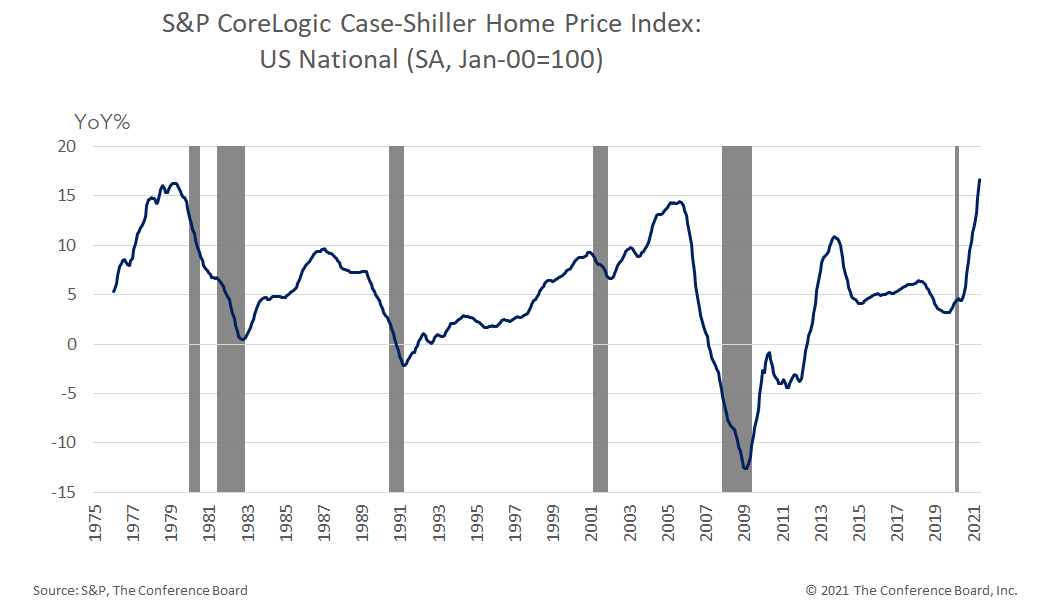
Hot Market: Pandemic- and Demographic-Induced Froth Fuel Home Price Spike – The Conference Board
According to the S&P CoreLogic Case-Shiller Home Price Index (HPI), existing single-family home prices rose by 16.6 percent from a year ago, exceeding the mid-2000s’ housing bubble peak. The home price run-up reflects a confluence of pandemic-induced factors, and also structural demographic events. These drivers caused a surge in demand for homes, following more than 15 years of housing underinvestment. The combined forces of rock-bottom interest rates, remote work, and millennial families drove household formations (e.g., moving to a new home or apartment away from parents or roommates) to an all-time high, according to the Census Bureau. Stimulus checks from the federal government probably also helped provide funds for making down payments.
Rising housing demand has driven home prices to historic highs last seen in the mid-1970s and mid-2000s, ahead of major recessions. However, while home price rises may be peaking, it is unlikely that cooling housing activity would trigger another Great Recession-type event. Financially fit home buyers and mortgage-market guardrails should help prevent another full-blown housing crisis. Unlike the 2005-07 housing boom and bust, most new mortgages are fixed-rate mortgages, as opposed to adjustable-rate mortgages, which were more prevalent 15 years ago. Most new home buyers have higher credit scores and more income compared to the subprime borrowers of the 2005-07 housing bubble. Underwriting standards are also significantly stricter now compared to the mid-2000s’ bubble.
To read more about ” US Housing: Boom-Bust Redux? – Why the US Will Avoid Another Housing Crisis” in our recent report please visit our website.
In a handful of states, early COVID data hint at a rise in breakthrough infections – Seattle Times
Since Americans first began rolling up their sleeves for coronavirus vaccines, health officials have said that those who are immunized are very unlikely to become infected, or to suffer serious illness or death. But preliminary data from seven states hint that the arrival of the delta variant in July may have altered the calculus.
Breakthrough infections in vaccinated people accounted for at least 1 in 5 newly diagnosed cases in six of these states and higher percentages of total hospitalizations and deaths than had been previously observed in all of them, according to figures gathered by The New York Times.
The absolute numbers remain very low, however, and there is little doubt that the vaccines remain powerfully protective. This continues to be “a pandemic of the unvaccinated,” as federal health officials have often said.
Still, the rise indicates a change in how vaccinated Americans might regard their risks.
“Remember when the early vaccine studies came out, it was like nobody gets hospitalized, nobody dies,” said Dr. Robert Wachter, chairman of the department of medicine at the University of California, San Francisco. “That clearly is not true.”
Third COVID Vaccine Dose Could Be the Last – MedPage
As the Biden administration prepares to recommend booster shots for the majority of Americans, some experts are saying the third dose could be the final one.
But what evidence leads them to believe that COVID-19 can be defeated by a three-dose series?
For starters, a longer duration between the second and third dose may provide stronger and longer-lasting immunity, experts said.
Peter Hotez, MD, PhD, of Baylor College of Medicine in Houston, said on CNN Monday night that a 3-week interval between the first and second doses of Pfizer’s mRNA vaccine, for instance, may not have been enough time to spur an extended immune response, with the initial shots acting only as a primary immunization.
An 8-month lag, on the other hand, could boost immunity significantly, Hotez said, with the potential to yield high levels of virus-neutralizing antibody and an immune response that is “really robust.”
“That may be it for a while, we may not need annual boosters,” Hotez said. “This could be the third and done.”
Since it’s typical for antibodies to wane over time, it’s common for vaccines to be administered in multiple doses over a longer time period. People get three shots over a 6-month period for hepatitis B, for instance, and a four-dose regimen is recommended for polio.
“In fact, it is unusual to give a one-dose, give-and-go vaccine,” John Moore, PhD, professor of microbiology and immunology at Weill Cornell Medicine in New York, told MedPage Today. “Most vaccines require at least two shots.”
In a multi-dose vaccine regimen, a longer interval between doses gives the immune system time to mature, Moore said. During this time period, a process called affinity maturation takes place, which causes antibodies to improve in quality while dwindling in number, he said.
[editor’s note: this article is worth a full read]
California Sees Slowdown in New COVID Cases Three Weeks After New Restrictions – Newsweek
On July 28, California reimposed mask mandates for some indoor activities and in the weeks since, the state has seen its daily COVID-19 numbers begin to flatten.
Three weeks ago, California announced that it was following guidance from the U.S. Centers for Disease Control and Prevention (CDC) and was recommending mask wearing when indoors for all individuals, regardless of their vaccination status.
California now requires masks for all people regardless of vaccination status on all public transit, indoors at K-12 schools and in emergency shelters. Additionally, masks are also required for all people in healthcare facilities and correctional facilities. Masks are required for unvaccinated people in all indoor public spaces and businesses.
“With the emergence of the more contagious Delta variant in California which now accounts for over 80 percent of cases sequenced, cases and hospitalizations of COVID-19 are rising throughout the state, especially amongst those that remain unvaccinated,” the California Department of Health said in a statement announcing the new guidelines.
In the week leading up to the announcement, California was experiencing an increase in daily COVID-19 cases. According to data from the CDC, from July 24 to July 28, the state saw its seven-day moving average number of daily cases increase from 7,317 to 8,533.
In the week after the masking guidance was announced, the daily number of cases continued to increase and the state was reporting an average of above 10,000 new daily cases until early August.
However, the number of new daily cases started to decline after August 13 and as of Sunday, CDC data showed that California had a seven-day average of 7,707 new COVID-19 cases.
According to an analysis by the Los Angeles Times, over the past week, California has seen a seven percent rise in cases compared to the previous week. In comparison, the analysis found that over the previous two week period, the state saw a 30 percent rise in new cases.
[editor’s note: although this post could be correct, there is no scientific proof that the new restrictions were the cause of the slowdown of new cases.]
Shoppers spend less as U.S. cases of the delta Covid variant surge – CNBC
Shoppers in the U.S. cut back their purchases in July even more than expected as worries over the delta variant of Covid-19 dampened activity and government stimulus dried up.
Retail sales for the month fell 1.1%, worse than the Dow Jones estimate of a 0.3% decline and below the upwardly revised 0.7% increase in June.
Excluding automobiles, sales declined 0.4%, according to Commerce Department figures released Tuesday.
Markets showed little initial reaction to the news, with futures tied to the Dow Jones Industrial Average off more than 200 points and government bond yields lower across the board.
“Although retail sales fell in July, the outlook for consumer spending remains positive,” said Gus Faucher, chief U.S. economist at PNC. “However, spending growth will shift from goods to services over the next couple of years, limiting growth in most categories of retail sales.”
Biden administration will require nursing homes get staff vaccinated or lose federal funds – CNN
The federal government will direct all nursing homes to require their staff be vaccinated against Covid-19 in order to continue receiving Medicare and Medicaid funds, Biden administration officials tell CNN.
President Biden will announce Wednesday afternoon that he is directing the Department of Health and Human Services to draw up new regulations making employee vaccination a condition for nursing homes to participate in Medicare and Medicaid, the officials said.
The move represents a significant escalation in Biden’s campaign to get Americans vaccinated and the tools he is willing to use, marking the first time he has threatened to withhold federal funds in order to get people vaccinated.
“As we see the spread of Delta and the threat of Covid cases, it is really especially important that we ensure that those caring for our most vulnerable are vaccinated,” Carole Johnson, a senior official on the White House’s Covid-19 response team, told CNN in an interview.
The move comes as the more transmissible Delta variant now accounts for 99% of Covid-19 cases in the United States and as data shows a link between low vaccination rates in certain nursing homes and rising coronavirus cases among residents.
The new regulations could go into effect as early as next month, but Johnson said the Centers for Medicare & Medicaid Services (CMS) will work with nursing homes, employees and their unions to ramp up staff vaccinations before the regulations go into effect.
About 1.3 million people are employed by the more than 15,000 nursing homes that participate in Medicare and Medicaid. About 40% of those workers are not vaccinated, according to CMS data.
The following are foreign headlines with hyperlinks to the posts
Roche warned of a global tocilizumab (Actemra) shortage if COVID cases continue to climb.
The Taliban urged Afghans not to leave the country, promising an “inclusive government” without “prejudice” against women. In the city of Jalalabad, however, their fighters responded to public dissent by firing into a crowd and beating protesters.
U.S. intelligence agencies warned over the summer that Afghan forces could rapidly collapse, even as President Biden publicly said a total Taliban takeover was unlikely.
Taliban Warning: US Must Fully Withdraw American Troops by Sept. 11
Amazon eclipsed Walmart to become the largest retail seller outside China, highlighting the shift to online shopping.
UK: Moderna COVID-19 vaccine approved by MHRA in 12-17 year olds
Chinese ports choke over ‘zero tolerance’ COVID-19 policy
U.S. Reaffirms Commitment to Taiwan After Leaving Afghanistan
New Zealand, which went into nationwide lockdown over one confirmed case on Tuesday, now has six more positive COVID cases.
Israel, once the model for beating Covid, faces a new surge of infections.
The following additional national and state headlines with hyperlinks to the posts
TSA extends to January mask rule for airline passengers
Pope appears in video promoting vaccination
Gov. Greg Abbott of Texas said he had tested positive for Covid.
Cargo ships stacked up off Southern California ports, straining supply chains
Raiders requiring fans to be vaccinated in first for NFL team
Biden Admin Recommends COVID-19 Booster Shots, Will Start Wide Distribution on Sept. 20 [note: The White House’s plan to offer coronavirus booster shots to vaccinated adults starting Sept. 20 still depends on whether the US Food and Drug Administration authorizes boosters and whether the US Centers for Disease Control and Prevention’s Advisory Committee on Immunization Practices (ACIP) recommends those boosters, US Surgeon General Dr. Vivek Murthy said Wednesday.]
Biden risks global backlash on COVID-19 booster shots
The health services department of Texas — a state seeing a surge in COVID hospitalizations — requested five mortuary trailers.
Twitter is testing a new feature that lets users flag tweets with misleading data, including COVID-specific misinformation.
TSA will extend the public transportation mask mandate through January 2022.
Airborne exposure deposited SARS-CoV-2 deep into lungs and transmitted the virus more efficiently than fomite exposure in a hamster model.
Science shows mask-wearing is largely safe for children
SARS-CoV-2 Delta variant: A gloomy forecast for the United States
NM Gov Launches Mask Mandate as Hospitalizations Rise Nearly 90 Percent
Nearly 20,000 Mississippi Students Under COVID Quarantine Across State
Restaurant owners sue New York City, hoping to block its ‘ridiculous’ vaccine mandate.
Today’s Posts On Econintersect Showing Impact Of The Pandemic and Recovery With Hyperlinks
July 2021 Residential Building Growth Rate Continues To Slow
July 2021 Import Sea Container Growth Continues At A Record Pace
What Makes A Disease Eradicable?
The U.S. States Hit Hardest By The New COVID Wave
UK COVID Cases Have Fallen Dramatically But Another Wave Is Likely
Warning to Readers
The amount of politically biased articles on the internet continues. And studies and opinions of the experts continue to contradict other studies and expert opinions. Honestly, it is difficult to believe anything anymore.

I assemble this update daily – sifting through the posts on the internet. I try to avoid politically slanted posts. This daily blog is not an echo chamber for any party line – and will publish controversial topics unless there are clear reasons why the topic is false. And I usually publish conflicting topics. It is my job to provide information so that you have the facts necessary – and then it is up to readers to draw conclusions. It is not my job to sell any point of view.
Analyst Opinion of Coronavirus Data
There are several takeaways that need to be understood when viewing coronavirus statistical data:
- The global counts are suspect for a variety of reasons including political. Even the U.S. count has issues as it is possible that as much as half the population has had coronavirus and was asymptomatic. It would be a far better metric using a random sampling of the population weekly. In short, we do not understand the size of the error in the tracking numbers.
- Just because some of the methodology used in aggregating the data in the U.S. is flawed – as long as the flaw is uniformly applied – you establish a baseline. This is why it is dangerous to compare two countries as they likely use different methodologies to determine who has (and who died) from coronavirus.
- Older population countries will have a significantly higher death rate as there is relatively few hospitalizations and deaths in younger age groups..
What we do or do not know about the coronavirus [actually there is little scientifically proven information]. Most of our knowledge is anecdotal, from studies with limited subjects, or from studies without peer review.
- How many people have been infected as many do not show symptoms?
- Masks do work. Unfortunately, early in the pandemic, many health experts — in the U.S. and around the world — decided that the public could not be trusted to hear the truth about masks. Instead, the experts spread a misleading message, discouraging the use of masks.
- Current thinking is that we develop at least 12 months of immunity from further COVID infection.
- The Moderna and Pfizer vaccines have an effectiveness rate of about 95 percent after two doses. That is on par with the vaccines for chickenpox and measles. The 95 percent number understates the effectiveness as it counts anyone who came down with a mild case of Covid-19 as a failure.
- To what degree do people who never develop symptoms contribute to transmission? Research early in the pandemic suggested that the rate of asymptomatic infections could be as high as 81%. But a meta-analysis, which included 13 studies involving 21,708 people, calculated the rate of asymptomatic presentation to be 17%.
- The accuracy of rapid testing is questioned – and the more accurate test results are not being given in a timely manner.
- Can children widely spread coronavirus? [current thinking remains that they are a minor source of the pandemic spread]
- Why have some places avoided big coronavirus outbreaks – and others hit hard?
- Air conditioning contributes to the pandemic spread.
- It appears that there is increased risk of infection and mortality for those living in larger occupancy households.
include(“/home/aleta/public_html/files/ad_openx.htm”); ?>


