


Written by Steven Hansen
The U.S. new cases 7-day rolling average are 45.0 % HIGHER than the 7-day rolling average one week ago and U.S. deaths due to coronavirus are now 62.2 % HIGHER than the rolling average one week ago.
Today’s posts include:
- U.S. Coronavirus New Cases are 235,099
- U.S. Coronavirus deaths are at 720
- Why the U.S. Delta Wave Could Be Far Less Deadly
- Study shows impaired SARS-CoV-2 mRNA vaccine antibody response in individuals with chronic conditions
- They worry the Johnson & Johnson shot isn’t enough. A new study offers answers
- Companies Now Deducting $50 From Unvaccinated Workers’ Monthly Paychecks: Consultancy Firm
- Roche, Abbott COVID Antigen Tests Just So-So in Real-World Data
- Vaccine side effects remain rare and are outweighed by benefits of vaccination, the C.D.C. reported.
- SARS-CoV-2 Iota variant increases mortality risk among older adults
- Charts show that Covid is hitting parts of Asia harder now than when the pandemic began
- “Things Are Just Getting Worse”: Global Demand Isn’t Booming, So Why Are Shipping Rates This High
- Plus Many More Headlines …

include($_SERVER[‘DOCUMENT_ROOT’].’/pages/coronavirus1.htm’); ?>
Hospitalizations Are The Only Accurate Gauge
Hospitalizations historically appear to be little affected by weekends or holidays. The hospitalization growth rate trend continues to improve.

source: https://gis.cdc.gov/grasp/covidnet/COVID19_3.html
Historically, hospitalization growth follows new case growth by one to two weeks.
As an analyst, I use the rate of growth to determine the trend. But, the size of the pandemic is growing in terms of real numbers – and if the rate of growth does not become negative – the pandemic will overwhelm all resources.
The graph below shows the rate of growth relative to the growth a week earlier updated through today [note that negative numbers mean the rolling averages are LOWER than the rolling averages one week ago]. As one can see, the rate of growth for new cases peaked in early December 2020 for Thanksgiving, and early January 2021 for end-of-year holidays – and it now shows that the coronavirus effect is improving.

In the scheme of things, new cases decline first, followed by hospitalizations, and then deaths. The potential fourth wave did not materialize likely due to immunizations.
Coronavirus and Recovery News You May Have Missed
Why the U.S. Delta Wave Could Be Far Less Deadly – MedPage
The rise of the Delta variant in the U.S. has led to outbreaks of COVID-19 across the country. But as more people get vaccinated, the death toll in the fourth wave of the pandemic may not spike as high as it did in previous surges, according to experts.
Increasing vaccination rates among Americans may result in a decoupling between infections and deaths — meaning that new cases might rise more steeply than fatalities.
This trend was evident across the pond: At the peak of the U.K.’s most recent spike in mid-July, the 7-day average of new daily infections was around 47,000 cases (approaching its 60,000 peak from January). But so far this month, the country has seen around 80 deaths per day.
“In the past with that level of infection, we would have seen over 1,000 deaths a day,” said Graham Medley, PhD, professor of infectious disease modeling at the London School of Hygiene & Tropical Medicine.
Before vaccines, Medley said that the number of deaths was the clearest metric to assess the severity of the pandemic. But since the U.K. has fully vaccinated the majority of high-risk individuals — more than 90% of its oldest and most vulnerable populations, according to government data — “deaths are no longer the most obvious outcome of infection to the public.”
There are lower vaccination rates in younger age groups, and as a result more young people are being hospitalized this time around, Medley noted.
“The Delta variant is able to overcome the vaccine, especially one dose, in terms of its ability to infect, but the vaccine is still very effective against Delta when it comes to death,” Medley said. “Vaccination has changed this pandemic for the better.”
A similar trend may follow in the U.S., according to experts. However, in areas with low vaccination rates, death tolls may mirror earlier pandemic waves.
“We will see an uptake in infections, but I don’t think that we’ll see a significant drive in hospitalization and death in the areas that have very high vaccination rates,” said Syra Madad, DHSc, MSc, an infectious disease epidemiologist based in New York City. Communities with a 50% to 60% vaccination rate will likely be protected from the most severe outcomes, she added.
Companies Now Deducting $50 From Unvaccinated Workers’ Monthly Paychecks: Consultancy Firm – Epoch Times
Some employers are starting to tack on a $20 to $50 monthly surcharge to their unvaccinated workers, according to a health benefits consultant group.
“Employers have tried encouraging employees to get vaccinated through offering incentives like paid time off and cash, but with the Delta variant driving up infections and hospitalizations throughout the country—at the same time that vaccination rates have stalled—we have received inquiries from at least 20 employers over the past few weeks who are giving consideration to adding health coverage surcharges for the unvaccinated as a way to drive up vaccination rates in their workforce,” Wade Symons, with consultancy group Mercer, told Forbes magazine on Aug. 8.
Symons didn’t disclose the names of the firms that are working to add surcharges to workers who haven’t received COVID-19 vaccines.
Several large companies, including Google, Facebook, and Walmart, as well as hospital systems and others, have mandated that their employees get vaccinated. And on Aug. 9, the Department of Defense stated that all military members will have to get the vaccine, coming more than a week after President Joe Biden announced that federal employees would have to either get the vaccine or be subject to routine testing.
Symons separately wrote in a column that some employers have held off on vaccine mandates “because of potential employee relations issues that such a move might provoke,” but he added that with the Delta COVID-19 variant and a stall in vaccinations, “health coverage surcharges for the unvaccinated are a tactic employers are reviewing as an alternative to a mandate.”
“The rationale for adding a surcharge to health insurance contributions for unvaccinated employees is seen as similar to that for a tobacco-use surcharge,” he wrote. “If an employee is unvaccinated and contracts a COVID-19 infection, that creates higher claims costs, which can impact the employer’s bottom line, and mean higher future contributions for other employees. Beyond plan costs, there are the public health benefits of greater vaccination rates, in addition to workplace safety considerations.”
They worry the Johnson & Johnson shot isn’t enough. A new study offers answers — and questions. – Washington Post
… more than 13 million Americans who have received the Johnson & Johnson vaccine, some of whom now question how well it will protect them against the delta variant. She and others who fret about their one dose have reasonable concerns given previous data and a rocky rollout. New research offers encouraging evidence about how the Johnson & Johnson vaccine stacks up against its competitors — and the delta variant, according to infectious-disease specialists. However, there are still lingering questions about booster shots.
Earlier clinical trials showed the Johnson & Johnson vaccine was 66 percent effective overall in preventing moderate to severe disease four weeks after the shot, with effectiveness varying depending on location. Its competitors, on the other hand, recorded 90 percent-plus effectiveness against the coronavirus. Anthony S. Fauci, the nation’s leading infectious-disease expert, has said all three vaccines are effective.
Vaccine experts cautioned recipients against comparing vaccines, saying the numbers didn’t tell the full scope of what was measured, but the memory of that lower number still lingers in the minds of Johnson & Johnson vaccine recipients such as Riley.
… A trial out of South Africa has caught the attention of people, particularly infectious-disease experts, with regard to the effectiveness of Johnson & Johnson’s vaccine against the delta variant.
The Sisonke trial looked at the effectiveness of the single-dose shot in South Africa’s front-line health-care workers.
Linda Gail-Bekker, one of the researchers for the trial, said the vaccine was found to be to be up to 95 percent effective in preventing delta variant-caused death and up to 71 percent effective in averting hospitalizations.
The results, which have not been peer reviewed or published in a scientific journal, show that the vaccine is not only safe but also effective in fighting the delta variant, she said.
Johnson & Johnson said in a statement that the preliminary results add to the body of evidence that confirms its efficacy in averting death and severe illness.
“A single-shot vaccine that provides protection and prevents hospitalization and death is an important tool in the global fight against covid-19,” the company said. “Evidence from our Phase 3 ENSEMBLE study demonstrates the efficacy of the J&J single-shot [coronavirus] vaccine, including against viral variants that are highly prevalent. Regardless of race and ethnicity, age, geographic location and comorbidities, these results remain consistent.”
90% Of Patients Treated With Experimental Israeli COVID Drug Discharged Within 5 Days – ZeroHedge
Finally, it looks like the world might be on the verge of obtaining a therapeutic drug that’s actually effective at helping patients infected with COVID. But you probably won’t hear anything about this latest breakthrough from the American media, which covered the race for a vaccine with breathless enthusiasm.
According to a report in the Jerusalem Post, some 93% of 90 seriously ill coronavirus patients treated in several Greek hospitals with a new drug developed by a team at Tel Aviv’s Sourasky Medical Center were discharged in five days or fewer during the Phase II trial of the new therapeutic.
The Phase II trial confirmed the results of Phase I, which was conducted in Israel last winter. That trial found that 29 out of 30 patients in moderate to serious condition recover within days, while no cases of serious side effects have yet been detected.
“The main goal of this study was to verify that the drug is safe,” Prof. Nadir Arber said. “To this day we have not registered any significant side effect in any patient from both groups.”
The trial was conducted in Athens because Israel didn’t have enough sick patients. The principal investigator was identified as Greece’s coronavirus commissioner, Prof. Sotiris Tsiodras.
Arber and his team developed the drug around amolecule that the professor has been studying for 25 years called CD24, which is naturally present in the body.
“It is important to remember that 19 out of 20 COVID-19 patients do not need any therapy,” Arber said. “After a window of five to 12 days, some 5% of the patients start to deteriorate.”
By now, even lay people may understand that the reason COVID patients deteriorate is due to a natural bodily reaction to something called the cytokine storm. The cytokine storm occurs because the body’s immune system goes ballistic. In many cases, the reaction actually contributes to the death or serious illness of the patient. The new therapeutic works by suppressing this reaction using the CD24 protein.
“This is precision medicine,” he said. “We are very happy that we have found a tool to tackle the physiology of the disease.”
“Steroids for example shut down the entire immune system,” he further explained. “We are balancing the part responsible for the cytokine storms using the endogenous mechanism of the body, meaning tools offered by the body itself.”
The scientists are preparing to begin the Phase 3 trial, which they hope to complete by the end of the year. That probably couldn’t happen quickly enough, since the world is already waking up to the fact that the vaccines originally marketed as more than 90% effective are actually helping the virus to mutate into more virulent strains.
SARS-CoV-2 Iota variant increases mortality risk among older adults – News-Medical
A study conducted at the New York City Department of Health and Mental Hygiene, USA, and the Mailman School of Public Health, Columbia University, USA, has determined the transmission rate, immune escape ability, and infection fatality rate of the B.1.526 variant of severe acute respiratory syndrome coronavirus 2 (SARS-CoV-2).
The findings reveal that the variant has considerably higher transmissibility and immune escape potential than previously circulating variants and that it can increase the infection fatality rate by 62% – 82% among older adults. The study is currently available on the medRxiv* preprint server.
Vaccine side effects remain rare and are outweighed by benefits of vaccination, the C.D.C. reported. – New York Times
For adults, the benefits of the three coronavirus vaccines authorized in the United States outweigh the risks of serious side effects, which remain rare, according to a new report from the Centers for Disease Control and Prevention.
The Pfizer-BioNTech and Moderna vaccines have been linked to inflammation of the heart muscle, known as myocarditis, and the Johnson & Johnson vaccine may increase the risk of a rare blood-clotting disorder and a neurological condition known as Guillain-Barré syndrome. All of the conditions can be serious, but remain uncommon.
These small risks are exceeded by the benefits of the vaccines, which provide powerful protection against disease and death, experts concluded. For instance, every million doses of the Johnson & Johnson vaccine that are administered are likely to prevent roughly 1,800 hospitalizations and 140 deaths, while causing 14 to 17 cases of Guillain-Barré and 1 to 2 cases of the blood clotting disorder, according to the paper, which was published on Tuesday.
The paper is based on data reported to the federal Vaccine Adverse Events Reporting System. The database contains unverified reports, but researchers confirmed many of the cases used in their calculations, which were initially presented at a July meeting of the C.D.C.’s vaccine advisory group.
As of June 30, roughly 12.6 million doses of the Johnson & Johnson vaccine had been given to American adults. As of that date, there had been 100 reports of Guillain-Barré, which can cause muscle weakness and paralysis, a rate of 7.8 cases per million doses. The risk was highest for men between 50 and 64, who developed the side effect at a rate of 15.6 per million doses.
As of July 8, there had also been 38 reports of the clotting disorder following the Johnson & Johnson vaccine. The disorder, which is known as thrombosis with thrombocytopenic syndrome, causes an unusual combination of blood clots, often in the brain, with abnormal bleeding. The overall rate of the clotting disorder is 3 cases per million doses, though women between 30 and 49 get it at a higher rate of 8.8 cases per million.
By the end of June, there had also been 497 reports of myocarditis after the second dose of either the Pfizer or the Moderna vaccines, a rate of 3.5 cases per million doses. That increased to 24.3 cases per million for men between 18 and 29, among whom myocarditis was most common.
Information about all three possible side effects have been added to the vaccine fact sheets given to patients and clinicians. The C.D.C. and the Food and Drug Administration will continue to monitor reports of adverse events, the report noted.
Charts show that Covid is hitting parts of Asia harder now than when the pandemic began – CNBC
Southeast Asia experienced a major surge in Covid-19 cases last month that has shown little signs of slowing, and the situation is expected to delay most of the region’s economic recovery.
Major economies in this part of the world including Indonesia, Malaysia, Singapore, Thailand, Vietnam and the Philippines saw a sharp rise in daily reported cases and deaths from the disease in July.
Information compiled by online publication Our World In Data showed, based on a seven-day moving average basis, Malaysia recorded 515.88 confirmed Covid infections per million people on July 31. That number steadily increased since June 30, when it was around 180.85.
Behind Malaysia was Thailand with 236.02 new cases per million people on July 31, followed by Indonesia with 147.20 cases even as it imposed a partial lockdown and ramped up contact tracing and quarantine efforts

Roche, Abbott COVID Antigen Tests Just So-So in Real-World Data – MedPage
Two widely used rapid screening tests for COVID-19, which check for SARS-CoV-2 antigens, missed a significant fraction of infected individuals when used in a real-world setting, researchers reported.
Among 2,215 “all-comers” tested at a German diagnostics lab, with 338 ultimately showing positive results with PCR testing, Roche’s SD Biosensor and Abbott’s Panbio rapid antigen tests showed overall sensitivities of 60.4% and 56.8%, respectively, reported Christoph Wertenauer, of Synlab GmbH in Augsburg and the University of Heidelberg in Mannheim, and colleagues.
“The sensitivities of the two [rapid diagnostic tests] are unsatisfactory. This calls into question whether their widespread use is effective in the ongoing SARS-CoV-2 pandemic,” the group wrote in a manuscript posted to the medRxiv preprint server.
They estimated that if 10,000 asymptomatic people were tested in a population with a 5% true positivity rate, these products would yield 124 false negatives. Testing 10,000 asymptomatic individuals from a population with less COVID-19 prevalence — 0.5% — would give 34 false negatives, but a higher rate of false positives (18 in all, or more than one-quarter of all positive results).
“Policy and health care providers should account for substantial limitations of [rapid tests] for SARS-CoV-2,” Wertenauer and colleagues noted, especially “in asymptomatic persons. Research into alternative approaches to the screening for SARS-CoV-2 should be intensified.”
In contrast, the Synlab study analyzed results for individuals presenting for routine testing, and sample collection for both the antigen tests and PCR was performed by trained lab workers.
Most of those tested were referred by physicians (32%) or government health agencies (43%), but the other 25% appeared to seek testing on their own initiative.
Not surprisingly, Wertenauer’s group found that positivity rates, both with antigen tests and PCR, were higher in those referred by professionals, presumably because of symptoms or exposure. However, over half the patients tested had no symptoms.
“Things Are Just Getting Worse”: Global Demand Isn’t Booming, So Why Are Shipping Rates This High – ZeroHedge
There is no COVID-era surge in global cargo demand. There’s a lengthy albeit temporary spike in congestion compounded by a localized, stimulus-and-savings-driven demand boom in America.
That explanation for skyrocketing rates gained more traction Friday when liner giant Maersk released details of its quarterly performance.
Maersk — which pre-reported record Q2 2021 results on Monday — estimated that global container shipping demand was up only 2.7% in the second quarter versus the same period two years ago, prior to the pandemic. And yet, Maersk’s average freight rate (including both contract and spot business) was $3,038 per forty-foot equivalent unit, up 63% from $1,868 per FEU in Q2 2019. The Drewry World Container Index of spot rates rose to $9,371 per FEU this week, 6.7 times what it was two years ago.
Ocean freight capacity is being heavily curtailed by congestion, with equipment tied up both on land and at sea. Maersk sent out a customer advisory on Wednesday titled, “Critical help needed — congestion increasing.” The advisory pleaded with U.S. customers to return equipment more quickly, stating: “We do not anticipate the congestion decreasing any time soon. On the contrary, the industry overall is forecasting higher [U.S.] volumes into early 2022 and beyond.”
Alphaliner reported this week: “Carriers need much more tonnage as ships get stuck in congested ports in both the U.S. and Asia. Some carriers reported that they needed at least 20-25% more fleet capacity [in the trans-Pacific] to continue carrying the same amount of cargo.”
Study shows impaired SARS-CoV-2 mRNA vaccine antibody response in individuals with chronic conditions – News-Medical
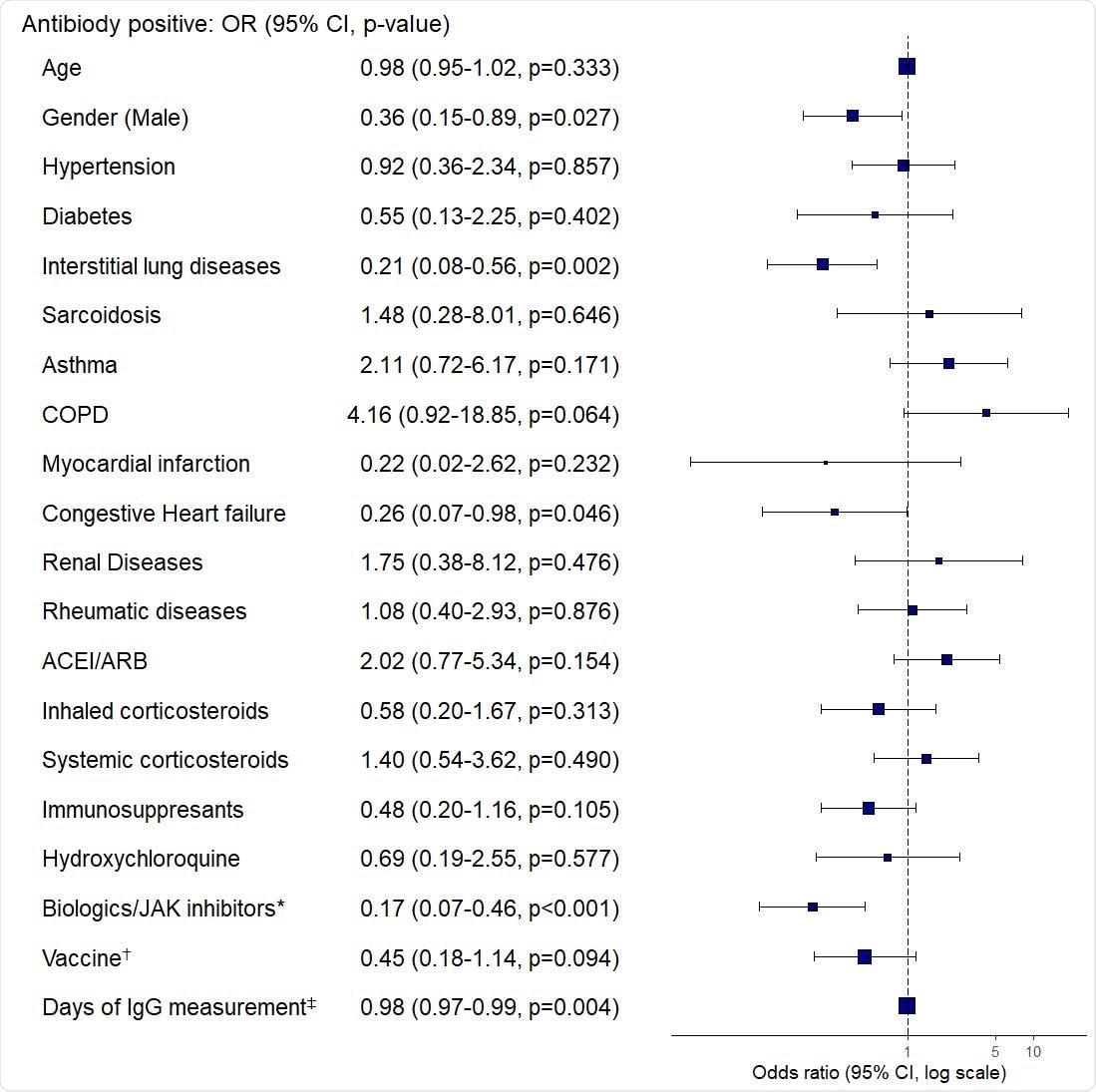
COVID-19 vaccines have led to drastic decreases in the number of severe acute respiratory syndrome coronavirus 2 (SARS-CoV-2) cases and mortality in the US; however, most of the patients in the vaccine trials did not have chronic underlying comorbidities, which is a major risk factor for COVID-19 morbidity and mortality. In addition, host factors in such high-risk patients may cause reduced responsiveness to COVID-19 vaccines and lead to “breakthrough” COVID cases.
A recent study in Colorado used real-world data to evaluate if individuals with chronic conditions have reduced antibody response to COVID-19 mRNA vaccines. The study investigated whether some medical conditions may impact antibody response to the mRNA vaccines. This work is available on the medRxiv* preprint server. The study participants were from patients in National Jewish Health, Colorado – a pulmonary specialty outpatient clinic.
Multivariate logistic regression of the association between antibody response and clinical characteristics. OR: odds ratio; CI: confidence interval; COPD: chronic obstructive pulmonary disease; ACE/ARB: angiotensin-converting enzyme inhibitors/angiotensin-receptor blockers. *Biologics: Anti- IL-5, -IL-6, -IL-12/23, -IL-17, -IgE, -CD20, and -TNF-α inhibitors †BNT162b2 (Pfizer-BioNTech) compared to mRNA-1273 (Moderna) ‡Days after 2nd vaccine dose.
The following are foreign headlines with hyperlinks to the posts
Ravaged by delta outbreak, Southeast Asia shifts away from China’s vaccines
Covid is surging and vaccinations are lagging in Mexico.
Europe has reopened to Americans. The U.S. hasn’t reciprocated.
Could The Delta Variant End The Chinese Communist Party?
Anti-vaccine demonstrators in the U.K. tried to storm what they thought was BBC News‘ headquarters, protesting vaccine passports, immunizations for children, and media bias.
US to send additional vaccine doses to Mexico
Saudi Arabia lifts a ban on foreign pilgrims heading to Mecca
Non-EU visitors to France can get a health pass to enter social venues
Virus outbreaks worsen in French overseas territories.
Modern plans to open vaccine factories around the world, starting in Canada
The following additional national and state headlines with hyperlinks to the posts
US Faces Intense Heat Wave as Wildfires Ravage West Coast
COVID Antibody Responses After Infection Lower in Some MS Patients
Delta variant is derailing plans for normalcy as schools open doors for new year
For the first time since February, the U.S. is averaging more than 100,000 new cases a day. See the latest charts.
The Biden administration said it would disclose long-classified documents that some Sept. 11 victims’ families believe could link the Saudi government to the attacks.
Other politicians’ scandals propelled career of NY’s next governor, ex-Rep. Kathy Hochul
Arkansas had its largest single-day increase in hospitalizations on Monday, leaving just eight ICU beds available across the state, and Texas Gov. Greg Abbott (R) asked hospitals to postpone elective procedures due to an increase in admissions for COVID-19.
In Washington state, Gov. Jay Inslee (D) issued an order mandating COVID-19 vaccinations for state employees and healthcare workers.
Gilead joined Pfizer in requiring the vaccine for company employees.
Local health departments in California have detected this year’s first cases of West Nile virus in Los Angeles and Orange Counties.
A quarter of US hospitals, and counting, demand workers get vaccinated.
Florida requesting hundreds of ventilators from federal government
Florida’s COVID Death Rate is More Than 32 States Combined
Former surgeon general: ‘Unconscionable’ for states to ban mask mandates
Google employees could lose money by working at home: report
Fauci supports mandates for teacher vaccinations
New COVID-19 infections hit six-month high
Florida Nurses Offered $500 Bonuses for Each Extra Shift During COVID Surge
George Washington Ordered the First Mass Vaccination of U.S. Troops
Hawaiian Airlines is the latest carrier to mandate Covid vaccinations for staff
White House’s message to Florida governor over masks in schools: “Get out of the way”
Schools reopening without masks “is a formula for disaster,” says Louisiana doctor
Florida governor says masking is “about parental choice, not government mandate”
Nearly all Americans live in areas with “high” or “substantial” levels of Covid-19 spread
Today’s Posts On Econintersect Showing Impact Of The Pandemic and Recovery With Hyperlinks
2Q2021 Preliminary Headline Productivity Rate Of Growth Slows Relative To Last Quarter
May 2021 Loan Performance: Serious Delinquency Rate Fell to Lowest Level Since June 2020
July 2021 Survey Of Consumer Expectations: Year-Ahead Inflation Expectations Hold Steady
COVID: What Happens If A Far More Lethal Coronavirus Emerges In Pets?
Warning to Readers
The amount of politically biased articles on the internet continues. And studies and opinions of the experts continue to contradict other studies and expert opinions. Honestly, it is difficult to believe anything anymore.

I assemble this update daily – sifting through the posts on the internet. I try to avoid politically slanted posts. This daily blog is not an echo chamber for any party line – and will publish controversial topics unless there are clear reasons why the topic is false. And I usually publish conflicting topics. It is my job to provide information so that you have the facts necessary – and then it is up to readers to draw conclusions. It is not my job to sell any point of view.
Analyst Opinion of Coronavirus Data
There are several takeaways that need to be understood when viewing coronavirus statistical data:
- The global counts are suspect for a variety of reasons including political. Even the U.S. count has issues as it is possible that as much as half the population has had coronavirus and was asymptomatic. It would be a far better metric using a random sampling of the population weekly. In short, we do not understand the size of the error in the tracking numbers.
- Just because some of the methodology used in aggregating the data in the U.S. is flawed – as long as the flaw is uniformly applied – you establish a baseline. This is why it is dangerous to compare two countries as they likely use different methodologies to determine who has (and who died) from coronavirus.
- Older population countries will have a significantly higher death rate as there is relatively few hospitalizations and deaths in younger age groups..
What we do or do not know about the coronavirus [actually there is little scientifically proven information]. Most of our knowledge is anecdotal, from studies with limited subjects, or from studies without peer review.
- How many people have been infected as many do not show symptoms?
- Masks do work. Unfortunately, early in the pandemic, many health experts — in the U.S. and around the world — decided that the public could not be trusted to hear the truth about masks. Instead, the experts spread a misleading message, discouraging the use of masks.
- Current thinking is that we develop at least 12 months of immunity from further COVID infection.
- The Moderna and Pfizer vaccines have an effectiveness rate of about 95 percent after two doses. That is on par with the vaccines for chickenpox and measles. The 95 percent number understates the effectiveness as it counts anyone who came down with a mild case of Covid-19 as a failure.
- To what degree do people who never develop symptoms contribute to transmission? Research early in the pandemic suggested that the rate of asymptomatic infections could be as high as 81%. But a meta-analysis, which included 13 studies involving 21,708 people, calculated the rate of asymptomatic presentation to be 17%.
- The accuracy of rapid testing is questioned – and the more accurate test results are not being given in a timely manner.
- Can children widely spread coronavirus? [current thinking remains that they are a minor source of the pandemic spread]
- Why have some places avoided big coronavirus outbreaks – and others hit hard?
- Air conditioning contributes to the pandemic spread.
- It appears that there is increased risk of infection and mortality for those living in larger occupancy households.
include(“/home/aleta/public_html/files/ad_openx.htm”); ?>


