


Written by Steven Hansen
The U.S. new cases 7-day rolling average are 33.1 % HIGHER than the 7-day rolling average one week ago and U.S. deaths due to coronavirus are now 28.9 % LOWER than the rolling average one week ago. Today’s posts include:
- U.S. Coronavirus New Cases are 32,447
- U.S. Coronavirus deaths are at 317
- Should We Be Concerned About the Lambda Variant?
- Growing concern over SARS-CoV-2 Lambda variant
- New study shows the need for full vaccination to protect against delta variant
- Here are four reasons the West is headed for a ‘very drastic crisis,’ according to a veteran economist
- Surging inflation could derail economic recovery from a pandemic, IMF warns
- Climbing the Pandemic Failures Chart: Research on Masking Kids
- Judge denies CDC request to keep COVID-19 cruise rules in place during the appeal
- Repurposed drugs present a new strategy for treating COVID-19
- Yes, COVID Vaccines Work in People With Obesity
- Plus many more headlines …

include($_SERVER[‘DOCUMENT_ROOT’].’/pages/coronavirus1.htm’); ?>
Hospitalizations Are The Only Accurate Gauge
Hospitalizations historically appear to be little affected by weekends or holidays. The hospitalization growth rate trend continues to improve.

source: https://gis.cdc.gov/grasp/covidnet/COVID19_3.html
Historically, hospitalization growth follows new case growth by one to two weeks.
As an analyst, I use the rate of growth to determine the trend. But, the size of the pandemic is growing in terms of real numbers – and if the rate of growth does not become negative – the pandemic will overwhelm all resources.
The graph below shows the rate of growth relative to the growth a week earlier updated through today [note that negative numbers mean the rolling averages are LOWER than the rolling averages one week ago]. As one can see, the rate of growth for new cases peaked in early December 2020 for Thanksgiving, and early January 2021 for end-of-year holidays – and it now shows that the coronavirus effect is improving.

In the scheme of things, new cases decline first, followed by hospitalizations, and then deaths. The potential fourth wave did not materialize likely due to immunizations.
Coronavirus and Recovery News You May Have Missed
Should We Be Concerned About the Lambda Variant? – MedPage
Yet another SARS-CoV-2 variant is making headlines, but experts reassure that early evidence suggests it can’t substantially evade vaccines — though it does have potential to become a variant of concern, one expert said.
The Lambda (C.37) variant, first identified in Peru in December 2020, now accounts for the majority of infections there, and is on the rise in other South American countries, including Argentina, Ecuador, Chile, and Brazil.
The World Health Organization named it a “variant of interest” — not yet the more severe “variant of concern” — on June 14, “based on evidence of continued emergence and suspected phenotypic implications.” The U.K. followed suit on June 23, “based on global spread and a novel combination of mutations.” (Lambda is not currently listed at all on the CDC’s variant tracker.)
Peru has been struggling with a high rate of COVID-19 infections, with a current 7-day average of 4,000 cases per day. That’s raised eyebrows among experts who’ve discovered that Lambda has an unusual combination of mutations that may make it more transmissible.
Nathaniel Landau, PhD, a virologist at NYU Grossman School of Medicine, and colleagues reported the novel mutations in a preprint in BioRxiv, highlighting two in the receptor binding domain of the spike protein (L452Q and F490S), as well as a novel deletion (del246-252) and novel mutations (G75V and T76I) in the N-terminal domain of spike. It also has other known spike mutations, D614G and T859N.
The novel mutations in spike may contribute to increased transmissibility, and could result in greater reinfection rates or reduced vaccine efficacy, the researchers reported. Their analysis showed that Pfizer serum samples were about 3-fold more resistant to neutralization, and Moderna samples were about 2.3-fold more resistant. Convalescent plasma was about 3.3-fold more resistant, while Regeneron’s monoclonal antibody combination had no loss of antibody titer, the group said.
“The typical titer for someone who is vaccinated is 1:2,000,” Landau told MedPage Today. “You can take that down to 1:500 and it will still kill the virus. … Natural infection titers tend to be 1:200, on average, and that’s still protective.”
“We’ve done this for Alpha, Beta, Gamma, Delta, and now Lambda,” Landau added. “The results we see are very similar for all these variants. We’re primarily looking at the mRNA vaccines, and vaccine-elicited antibodies do a good job of neutralizing all the variants.”
Growing concern over SARS-CoV-2 Lambda variant – News-Medical
A new report from Chile – currently available on the medRxiv* preprint server – reveals how mutations in the spike glycoprotein of the severe acute respiratory syndrome coronavirus 2 (SARS-CoV-2) Lambda variant can confer protection from neutralizing antibodies and increase viral infectivity rates, which means massive vaccination campaigns should be accompanied by strict genomic surveillance.
A new report from Chile – currently available on the medRxiv* preprint server – reveals how mutations in the spike glycoprotein of the severe acute respiratory syndrome coronavirus 2 (SARS-CoV-2) Lambda variant can confer protection from neutralizing antibodies and increase viral infectivity rates, which means massive vaccination campaigns should be accompanied by strict genomic surveillance.
… In a nutshell, these results indicate that mutations present in the spike glycoprotein of the Lambda variant of interest give rise to increased infectivity and enable the immune escape of this specific lineage from neutralizing antibodies elicited by CoronaVac.
“These data reinforce the idea that massive vaccination campaigns in countries with high SARS-CoV-2 circulation must be accompanied by strict genomic surveillance allowing the identification of new isolates carrying spike mutations and immunology studies aimed to determine the impact of these mutations in immune escape and vaccines breakthrough”, caution study authors in this medRxiv paper.
Such propensity of variants to escape from vaccine-induced immunity means there is still a need for next-generation vaccines that would provide broader neutralizing activity against present and potential future SARS-CoV-2 variants.
Here are four reasons the West is headed for a ‘very drastic crisis,’ according to a veteran economist – MarketWatch
Markets seem to be in cruise-control mode, at least until the Jackson Hole gathering of central bankers at which the Federal Reserve may finally announce it will slow the rate of bond purchases. The S&P 500 SPX, +0.34% ended Tuesday at its second highest closing level on record, after a slight decline ended a seven-session winning run.
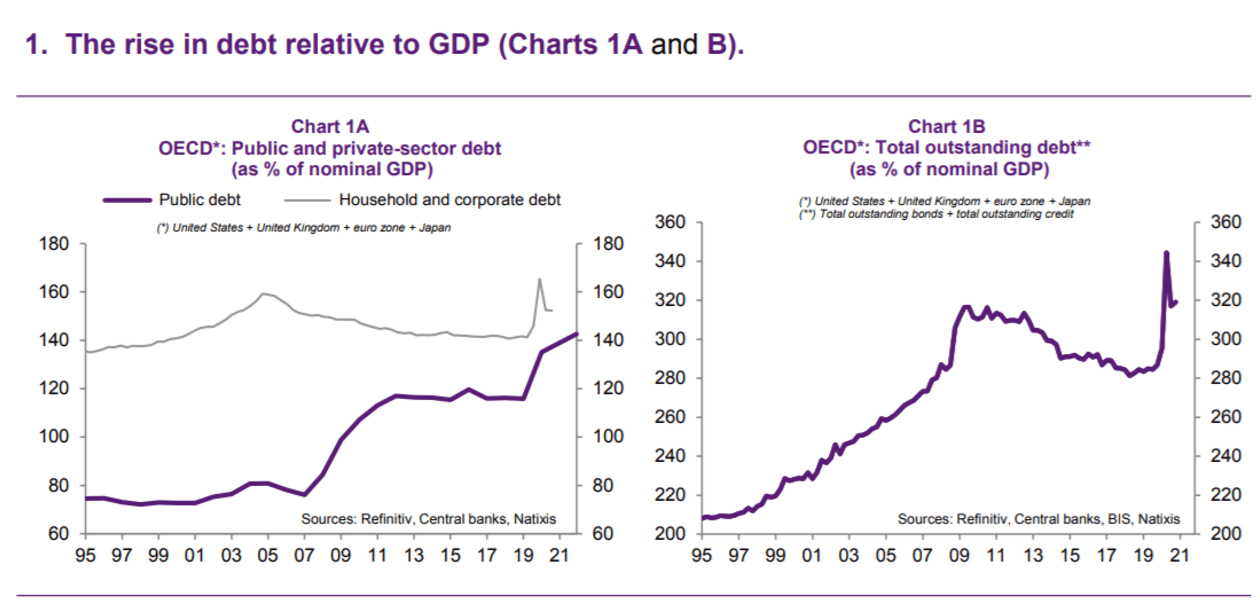
Patrick Artus, a senior economics adviser at French bank Natixis and a professor at the Paris School of Economics, isn’t sharing in the joy. In a very blunt memo to clients, Artus says a crisis is “inevitable.”
The total outstanding debt of the U.S., the U.K., the eurozone and Japan relative to gross domestic product has come off the highest levels of the pandemic as economies have reopened but still is at elevated levels. “Borrower solvency cannot be ensured if debt-to-income ratios increase continuously,” he says.
The money supply also is at records. “The money supply cannot be increased continuously relative to income, as soon or later demand for money, which is linked to savings and income, can no longer increase,” said Artus, whose résumé includes stints at the Organization for Economic Cooperation and Development and the Banque de France.
Also zooming higher is wealth, with both stock and housing prices surging. “Rising relative asset prices cannot be extrapolated: If they become too high, the savings of asset buyers will no longer suffice to buy then, leading inevitably to a downward correction in prices,” he says. Finally, he notes a skewing of income distribution against wage earners: “If wage earnings do not receive productivity gains over a long period, demand for goods and services will become too weak to absorb production, which grows rapidly when earnings are invested.”
So how will this unwind? Artus says a correction in income distribution will lead to faster wage growth and higher inflation. That, in turn, will need to more restrictive monetary policy and higher inflation-adjusted interest rates. The more restrictive monetary policy will then stabilize asset prices and wealth, forcing deleveraging. And that deleveraging will lead to a recession due to the necessary fall in demand among households, companies and governments.
[editor’s note: this post deserves a full read Also read Wells Unexpectedly Shuts All Existing Personal Lines Of Credit, Hinting US Economy On The Edge]
Surging inflation could derail economic recovery from pandemic, IMF warns – Fox
Surging inflation, particularly in the United States, has emerged as a new threat to the global economy as it faces a “worsening two-track recovery” from the coronavirus pandemic, the International Monetary Fund warned on Wednesday.
“There is a risk of a more sustained rise in inflation or inflation expectations, which could potentially require an earlier-than-expected tightening of U.S. monetary policy,” Kristalina Georgieva, the managing director of the Washington-based IMF, wrote in a blog post.
The IMF projected the U.S. economy will grow 7% this year – the highest since 1984 – boosted by a combination of an accelerated vaccine rollout and strong fiscal and monetary policy. And while the speedy rebound in the U.S. may benefit lower-income countries through increased trade, a sustained spike in inflation could pose major challenges to nations with high debt levels.
That’s because, if inflation continues to rise, it may lead to a “sharp tightening” of financial conditions around the world and “significant capital outflows” from emerging and developing economies.
“It would pose major challenges especially to countries with large external financing needs or elevated debt levels,” she wrote.
Judge denies CDC request to keep COVID-19 cruise rules in place during appeal – Miami Herald
A federal judge denied a request Wednesday from the U.S. Centers for Disease Control and Prevention to keep its COVID-19 safety regulations for Florida cruises in effect, clearing the path for them to turn into simply recommendations on July 18.
The CDC asked U.S. District Judge Steven Merryday of the Middle District of Florida to lift the deadline — part of a preliminary injunction he put in place last month after Gov. Ron DeSantis sued the CDC in April — while the case goes through the appeal process. The CDC argues that without its regulations, cruise ships could exacerbate the spread of COVID-19 in the U.S.
Merryday said in his ruling Wednesday that the CDC’s argument ignores state and local oversight and the improvements cruise companies have made to their operations since COVID-19 outbreaks caused deaths on several ships last year.
“CDC fails to demonstrate that denial of the stay will injure materially CDC or the United States, any third party, or the public,” Merryday wrote. “…This action is about the use and misuse of governmental power.”
Repurposed drugs present new strategy for treating COVID-19 – EurekAlert
A joint research group from KAIST and Institut Pasteur Korea has identified repurposed drugs for COVID-19 treatment through virtual screening and cell-based assays. The research team suggested the strategy for virtual screening with greatly reduced false positives by incorporating pre-docking filtering based on shape similarity and post-docking filtering based on interaction similarity. This strategy will help develop therapeutic medications for COVID-19 and other antiviral diseases more rapidly. This study was reported at the Proceedings of the National Academy of Sciences of the United States of America (PNAS).
Researchers screened 6,218 drugs from a collection of FDA-approved drugs or those under clinical trial and identified 38 potential repurposed drugs for COVID-19 with this strategy. Among them, seven compounds inhibited SARS-CoV-2 replication in Vero cells. Three of these drugs, emodin, omipalisib, and tipifarnib, showed anti-SARS-CoV-2 activity in human lung cells, Calu-3.
Yes, COVID Vaccines Work in People With Obesity – MedPage
All COVID-19 vaccines authorized for emergency use in the U.S. are effective in people with obesity, according to a new position statement issued by the Obesity Society.
In a review of data available on the Pfizer-BioNTech, Moderna, and Johnson & Johnson vaccines, efficacy was not significantly different between people with obesity versus those without obesity, reported W. Scott Butsch, MD, MSc, of the Cleveland Clinic in Ohio, and colleagues in the journal Obesity.
Therefore, the Obesity Society recommended that all people with obesity — a BMI of 30 or higher — get vaccinated with any of the current options.
“At present, there is no definitive way to determine which COVID vaccine is ‘best’ for patients overall or for specific patient subgroups, including those with obesity,” they stated. “Current FDA-approved COVID-19 vaccines from Pfizer-BioNTech, Moderna and Johnson & Johnson were all highly efficacious against COVID-19-associated hospitalization and death in trials, and were found to be equally efficacious in persons with obesity compared to normal weight individuals.”
New study shows need for full vaccination to protect against delta variant – The Hill
A study released Thursday found that one dose of the Pfizer-BioNTech or AstraZeneca vaccines “barely” offers any protection against the delta variant of COVID-19.
The peer-reviewed study published by the journal Nature found that only 10 percent of blood samples from people who had received one dose of either vaccine were able to neutralize the delta strain, which is now the dominant form of the coronavirus in the U.S.
That number, however, rose to 95 percent when a second vaccine dose was added.
“A single dose of Pfizer or AstraZeneca was either poorly or not at all efficient against Beta and Delta variants. Both vaccines generated a neutralizing response that efficiently targeted variant Delta only after the second dose,” the researchers wrote.
The French researchers looked at how well antibodies produced by natural infection and vaccines can neutralize the alpha, beta and delta variants, in addition to a variant that is comparable to the original version of the virus, The New York Times reported.
Americans will need masks indoors as U.S. heads for ‘dangerous fall’ with surge in delta Covid cases – CNBC
As the highly transmissible delta Covid variant continues to spread rapidly across the United States and elsewhere around the world, scientists and other health experts are warning that indoor mask mandates and other public health measures will likely make a return in the U.S. this fall.
- Already the dominant variant in the U.S., delta will hit the states with the lowest vaccination rates the hardest this fall.
- Authorities in Australia, South Africa and Asia have recently reintroduced curfews or other measures to curb rising delta outbreaks.
- High vaccination rates in the U.S. and the warm summer months have bought the country some extra time, but outbreaks across the world are giving Americans a preview of what may come this fall.
Climbing the Pandemic Failures Chart: Research on Masking Kids – MedPage
Last week, a study in JAMA Pediatrics created consternation. The study took 45 kids (ages 6 to 17) and asked them to wear a mask. It measured rates of CO2 inside the mask. The rates were high, and inversely related to age: the youngest kids appeared to have the highest CO2 concentration.
Criticism came immediately. One thoughtful observer pointed out that as children draw breath in, only a tiny fraction is from inside the mask (where it may be at a higher CO2 level). The rest of the air is pulled through the mask, and the CO2 will be diluted with room air in the lungs. There were many more objections raised (some legitimate), and the usual calls for retraction.
However, both the paper and the critics miss the point: Should kids be required to wear a mask and, if so, when?
It is a simple question, but it divides public health authorities. The World Health Organization (WHO) advises against masking kids under the age of 5, and only masking 6- to 11-year-olds under some circumstances. The CDC advises masks be worn by any unvaccinated individual over 2 years old in indoor public spaces. This means the WHO and CDC are in diametric opposition on the decision to mask kids ages 2 to 4 in daycare or other public settings. Who is right?
The truth is there are potential benefits to masking kids, and potential risks. The biggest potential benefit is the possibility of reduced SARS-CoV-2 acquisition and transmission. The potential risks include concerns about normal language acquisition, speaking, and development. At very young ages (<2 years old) or while sleeping, there may be risks of suffocation, which both the CDC and WHO acknowledge.
The following are foreign headlines with hyperlinks to the posts
Japan will ban all spectators from Olympic venues in and around Tokyo
Olympics Could Have Fans Attend Events Held Outside of Tokyo, Minister Says
Japan to declare virus emergency lasting through Olympics
Panic-buying as Vietnam announces broad COVID-19 curbs in biggest city
Sky News Shows Taliban Seizing Abandoned US Bases & “Treasure Trove” Of Weapons, Ammo
The global death toll from COVID-19 surpassed the 4 million mark on Wednesday.
Three patients with vaccine-induced immune thrombotic thrombocytopenia after receiving the AstraZeneca coronavirus shot improved with therapeutic plasma exchange after initial treatment failed.
The U.S. is shipping COVID vaccines to Latin America this week as part of an earlier pledge to share tens of millions of doses with the world.
Germany is giving away all of its remaining AstraZeneca vaccine stock — at least half a million doses.
Sinovac’s inactivated SARS-CoV-2 vaccine showed 65.9% vaccine effectiveness for the prevention of COVID-19 — 86.3% for preventing COVID mortality — when used during Chile’s mass vaccination campaign of more than 10 million people.
COVID Delta Variant Could Ruin Summer, French Government Warns
Lead Sinovac Vaccine Scientist in Indonesia Dies of Suspected COVID-19, Media Say
Vaccinated UK residents returning to England will be allowed to bypass quarantine
Germany Reports Delta Variant Cases Have Doubled in 1 Week
Africa suffers worst surge in Covid cases as delta variant spurs third wave
The following additional national and state headlines with hyperlinks to the posts
Delta Variant Makes Up 80 Percent of Cases in the Midwest
Study: Northwest heat wave impossible without climate change
Myocarditis Guidelines for Kids Have Answers for COVID Cases Too
The official Covid death toll in U.S. prisons is over 2,700 people. The real number is probably higher, as some facilities released very ill inmates before they died.
Donald Trump sued Facebook, Twitter and Google to restore his accounts. His political operation immediately began fund-raising off it.
Experts say Trump’s social media lawsuits are likely doomeed
Dozens of states sued Google, claiming its mobile app store abuses its market power. It’s the fourth state or federal antitrust suit against Google since October.
Moderna says it has started testing its mRNA vaccine against seasonal flu in people
Delta variant surges in Colorado as the bands play on
Regular rapid testing detects COVID-19 soon enough to stop transmission in schools
Minneapolis Fed requiring employees to be vaccinated
White House Urges Community Leaders to Visit Homes, Encourage Vaccinations
Boebert Calls COVID-19 Door-to-Door Vaccinators Biden’s ‘Needle Nazis’
Arkansas, Nevada Among the States With Rising COVID, Delta Variant Cases
Today’s Posts On Econintersect Showing Impact Of The Pandemic and Recovery With Hyperlinks
May 2021 Consumer Credit Continues To Expand
03 July 2021 New York Fed Weekly Economic Index (WEI): Index Declined
03 July 2021 Initial Unemployment Claims Rolling Average Continues To Modestly Decline
Why U.S. Corporate Bankruptcies Could Skyrocket
Warning to Readers
The amount of politically biased articles on the internet continues. And studies and opinions of the experts continue to contradict other studies and expert opinions. Honestly, it is difficult to believe anything anymore.

I assemble this update daily – sifting through the posts on the internet. I try to avoid politically slanted posts. This daily blog is not an echo chamber for any party line – and will publish controversial topics unless there are clear reasons why the topic is false. And I usually publish conflicting topics. It is my job to provide information so that you have the facts necessary – and then it is up to readers to draw conclusions. It is not my job to sell any point of view.
Analyst Opinion of Coronavirus Data
There are several takeaways that need to be understood when viewing coronavirus statistical data:
- The global counts are suspect for a variety of reasons including political. Even the U.S. count has issues as it is possible that as much as half the population has had coronavirus and was asymptomatic. It would be a far better metric using a random sampling of the population weekly. In short, we do not understand the size of the error in the tracking numbers.
- Just because some of the methodology used in aggregating the data in the U.S. is flawed – as long as the flaw is uniformly applied – you establish a baseline. This is why it is dangerous to compare two countries as they likely use different methodologies to determine who has (and who died) from coronavirus.
- Older population countries will have a significantly higher death rate as there is relatively few hospitalizations and deaths in younger age groups..
What we do or do not know about the coronavirus [actually there is little scientifically proven information]. Most of our knowledge is anecdotal, from studies with limited subjects, or from studies without peer review.
- How many people have been infected as many do not show symptoms?
- Masks do work. Unfortunately, early in the pandemic, many health experts — in the U.S. and around the world — decided that the public could not be trusted to hear the truth about masks. Instead, the experts spread a misleading message, discouraging the use of masks.
- Current thinking is that we develop at least 12 months of immunity from further COVID infection.
- The Moderna and Pfizer vaccines have an effectiveness rate of about 95 percent after two doses. That is on par with the vaccines for chickenpox and measles. The 95 percent number understates the effectiveness as it counts anyone who came down with a mild case of Covid-19 as a failure.
- To what degree do people who never develop symptoms contribute to transmission? Research early in the pandemic suggested that the rate of asymptomatic infections could be as high as 81%. But a meta-analysis, which included 13 studies involving 21,708 people, calculated the rate of asymptomatic presentation to be 17%.
- The accuracy of rapid testing is questioned – and the more accurate test results are not being given in a timely manner.
- Can children widely spread coronavirus? [current thinking remains that they are a minor source of the pandemic spread]
- Why have some places avoided big coronavirus outbreaks – and others hit hard?
- Air conditioning contributes to the pandemic spread.
- It appears that there is increased risk of infection and mortality for those living in larger occupancy households.
include(“/home/aleta/public_html/files/ad_openx.htm”); ?>


