


Written by Steven Hansen
The non-seasonally adjusted S and P CoreLogic Case-Shiller home price index (20 cities) year-over-year rate of home price growth is now 13.3 %. The index authors stated, “The March gain is the largest since December 2005 and is also one of the largest in the index’s 30-year history..”.

Analyst Opinion of Case-Shiller HPI
All home price indices are now showing home price growth is continuing year-over-year. At this point, the pandemic has little affected home prices (or sales for that matter).
- 20 city unadjusted home price rate of growth accelerated by 0.8 % month-over-month. [Econintersect uses the change in year-over-year growth from month-to-month to calculate the change in the rate of growth]
- Note that the Case-Shiller index is an average of the last three months of data.
- The market expected from Econoday:
| Consensus Range | Consensus | Actual | |
| 20-city, SA – M/M | 0.9 % to 1.6 % | +1.3 % | +1.6 % |
| 20-city, NSA – M/M | +2.2 % | ||
| 20-city, NSA – Yr/Yr | 11.3 % to 12.1 % | +11.8 % | +13.3 % |
S&P/Case-Shiller Home Price Indices Year-over-Year Change
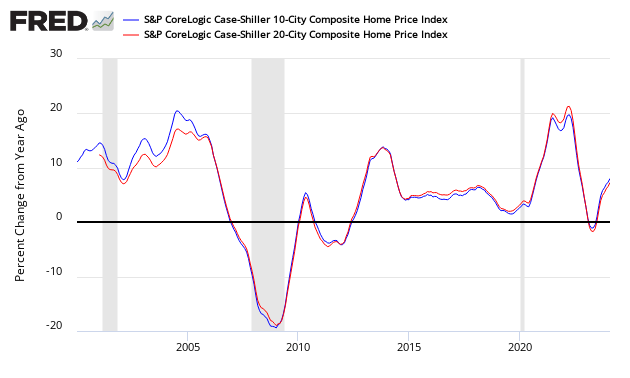
Comparing the NAR and Case-Shiller home price indices, it needs to be understood each of the indices uses a unique methodology in compiling their index – and no index is perfect.

The way to understand the dynamics of home prices is to watch the direction of the rate of change. Here home price growth is now accelerating.

There are some differences between the indices on the rate of “recovery” of home prices.
A synopsis of Authors of the Leading Indices:
Case Shiller’s Craig J. Lazzara, Managing Director and Global Head of Index Investment Strategy at S&P Dow Jones Indices stated:
Housing prices continued to rise robustly in March 2021,. The National Composite Index marked its tenth consecutive month of accelerating prices with a 13.2% gain from year-ago levels, up from 12.0% in February. This acceleration is also reflected in the 10- and 20-City Composites (up 12.8% and 13.3%, respectively). The market’s strength is broadly-based: all 20 cities rose, and all 20 gained more in the 12 months ended in March than they had gained in the 12 months ended in February.
More than 30 years of S&P CoreLogic Case-Shiller data put these results into historical context. The National Composite’s 13.2% gain was last exceeded more than 15 years ago in December 2005, and lies very comfortably in the top decile of historical performance. The unusual strength is reflected across all 20 cities; March’s price gains in every city are above that city’s median level, and rank in the top quartile of all reports in 19 cities. “These data are consistent with the hypothesis that COVID has encouraged potential buyers to move from urban apartments to suburban homes. This demand may represent buyers who accelerated purchases that would have happened anyway over the next several years. Alternatively, there may have been a secular change in preferences, leading to a permanent shift in the demand curve for housing. More time and data will be required to analyze this question.
Phoenix’s 20.0% increase led all cities for the 22nd consecutive month, with San Diego (+19.1%) and Seattle (+18.3%) close behind. Although prices were strongest in the West (+15.1%) and Southwest (+14.8%), every region logged double-digit gains.”
CoreLogic believes home demand will remain firm moving forward (March 2021 Data). Per Dr. Frank Nothaft, chief economist at CoreLogic and Frank Martell, president and CEO of CoreLogic stated:
Lower-priced homes are in big demand and short supply, driving up prices faster compared to their more expensive counterparts. First-time buyers seeking a starter home priced 25% or more below the local-area median saw prices jump 15.1% during the past year, compared with the overall 11.3% gain in our national index.for a down payment, closing costs and cash reserves, all of which are much higher as home prices go up. Add to that a rise in mortgage rates and the affordability challenge for first-time buyers becomes even greater.
Despite the severe slowdown last year, the 2021 spring homebuying season is trending strong – reflecting the many positive signs of economic recovery. With prospective buyers continuing to be motivated by historically low mortgage rates, we anticipate sustained demand in the summer and early fall.
From the National Association of Realtors (April 2021 data):
Home sales were down again in April from the prior month, as housing supply continues to fall short of demand. We’ll see more inventory come to the market later this year as further COVID-19 vaccinations are administered and potential home sellers become more comfortable listing and showing their homes. The falling number of homeowners in mortgage forbearance will also bring about more inventory.
Despite the decline, housing demand is still strong compared to one year ago, evidenced by home sales from this January to April, which are up 20% compared to 2020. The additional supply projected for the market should cool down the torrid pace of price appreciation later in the year.
First-time buyers in particular are having trouble securing that first home for a multitude of reasons, including not enough affordable properties, competition with cash buyers and properties leaving the market at such a rapid pace.
The U.S. Federal Housing Finance Agency produces an All-Transactions House Price Index for the United States:

Econintersect publishes knowledgeable views of the housing market.
Caveats on the Use of Home Price Indices
The housing price decline seen since 2005 varies by zip code – and seems to have ended somewhere around the beginning of the 2Q2012. Every area of the country has differing characteristics. Since January 2006, the housing declines in Charlotte and Denver are well less than 10%, while Las Vegas home prices had declined by almost 60%.
Each home price index uses a different methodology – and this creates slightly different answers.
The most broadly based index is the US Federal Housing Finance Agency’s House Price Index (HPI) – a quarterly broad measure of the movement of single-family house prices. This index is a weighted, repeat-sales index on the same properties in 363 metro centers, compared to the 20 cities Case-Shiller.
The US Federal Housing Finance Agency also has an index (HPIPONM226S) based on 6,000,000 same home sales – a much broader index than Case-Shiller. Also, there is a big difference between home prices and owner’s equity (OEHRENWBSHNO) which has been included in the graph below.
Comparing Various Home Price Indices to Owner’s Equity (blue line)


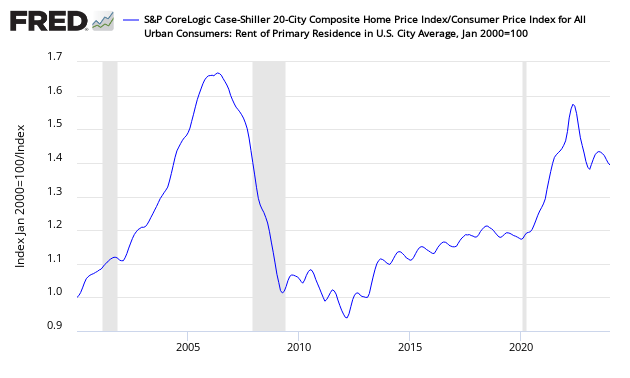
The affordability factor favors rental vs owning.
Price to Rent Ratio – Indexed on January 2000 – Based on Case-Shiller 20 cities index ratio to CPI Rent Index
include(“/home/aleta/public_html/files/ad_openx.htm”); ?>


