



Of the five regional Federal Reserve manufacturing surveys released to date, all are in expansion.
Analyst Opinion of Richmond Manufacturing
The important Richmond Fed subcategories (new orders and unfilled orders) are in expansion and both improved this month. We consider this survey better than last month.
Market expectations from Econoday were 17 to 22 (consensus 20). The actual survey value was 17 [note that values above zero represent expansion].
Fifth District manufacturing activity improved in April, according to the most recent survey from the Richmond Fed. The composite index held steady at 17, indicating continued growth, as all three component indexes — shipments, new orders, and employment — remained positive. Survey responses indicated supply constraints, with the backlog of orders and vendor lead time indexes registering historic highs. Meanwhile, inventories shrank as the indexes for inventories of finished goods and raw materials reached their lowest values on record. Manufacturers were optimistic that conditions would continue to improve in the coming months.
Survey results suggested that many manufacturing firms increased employment and wages in April. However, finding workers with the necessary skills remained difficult. Survey participants expected these trends to continue in the next six months.
The average growth rates of both prices paid and prices received by survey participants increased in April, as growth of prices paid continued to outpace that of prices received. Respondents expected price growth to slow in the near future.

z richmond_man1.PNG
Richmond Fed (hyperlink to reports):

z richmond_man.PNG
Summary of all Federal Reserve Districts Manufacturing:
Kansas Fed (hyperlink to reports):

z kansas_man.PNG
Dallas Fed (hyperlink to reports):

z dallas_man.PNG
Philly Fed (hyperlink to reports):

z philly fed1.PNG
New York Fed (hyperlink to reports):

z empire1.PNG
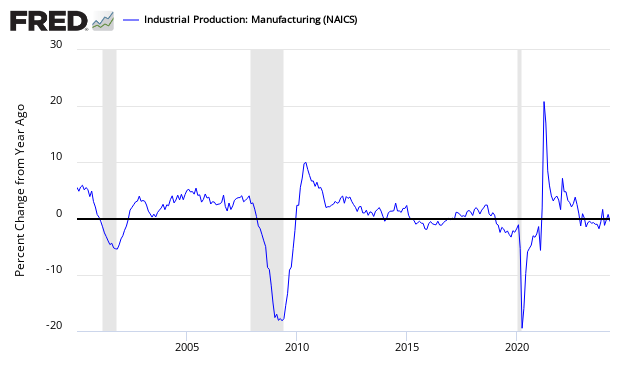
Federal Reserve Industrial Production – Actual Data (hyperlink to report):
Holding this and other survey’s Econintersect follows accountable for their predictions, the following graph compares the hard data from Industrial Products manufacturing subindex (dark blue bar) and US Census manufacturing shipments (red bar) to the Richmond Fed survey (darkest bar).

In the above graphic, hard data is the long bars, and surveys are the short bars. The arrows on the left side are the key to growth or contraction.
include(“/home/aleta/public_html/files/ad_openx.htm”); ?>


