


Written by Steven Hansen
The U.S. new cases 7-day rolling average are 1.8 % LOWER than the 7-day rolling average one week ago and U.S. deaths due to coronavirus are now 21.4 % LOWER than the rolling average one week ago. Today’s posts include:
- U.S. Coronavirus New Cases are 62,004
- U.S. Coronavirus deaths are at 907
- U.S. Coronavirus immunizations have been administered to 50.4 % of the population
- The 7-day rolling average rate of growth of the pandemic shows new cases improved and deaths improved
- Scientists Race To Develop Next Generation Of COVID Vaccines
- Carbon dioxide levels reflect COVID-19 risk
- South African and Brazilian SARS-CoV-2 variants can evade antibodies from therapies, vaccines, and infection
- One third of Covid-19 patients experience psychological or neurological diagnoses over 6 months, study shows
- EU medicines regulator finds possible link between AstraZeneca Covid vaccine and blood clots
- Even as schools reopen, many students learn remotely
- World’s Biggest Vaccine Maker ‘Very Stressed’ As India Sees Record Spike In COVID-19
- Vaccine shopping can be surprisingly easy
- ‘A moment of peril’: Biden sees infections climb on his watch
- How COVID-19 pulled US consumers toward new extremes of splurging and saving
- The Future of Face Masks

include($_SERVER[‘DOCUMENT_ROOT’].’/pages/coronavirus1.htm’); ?>
Hospitalizations Are The Only Accurate Gauge
Hospitalizations historically appear to be little affected by weekends or holidays. The hospitalization growth rate trend is improving.

source: https://gis.cdc.gov/grasp/covidnet/COVID19_3.html
Historically, hospitalization growth follows new case growth by one to two weeks.
As an analyst, I use the rate of growth to determine the trend. But, the size of the pandemic is growing in terms of real numbers – and if the rate of growth does not become negative – the pandemic will overwhelm all resources.
The graph below shows the rate of growth relative to the growth a week earlier updated through today [note that negative numbers mean the rolling averages are LOWER than the rolling averages one week ago]. As one can see, the rate of growth for new cases peaked in early December 2020 for Thanksgiving, and early January 2021 for end-of-year holidays – and it now shows that the coronavirus effect is now shrinking.

In the scheme of things, new cases decline first, followed by hospitalizations, and then deaths.
The New Variants Are The Primary Cause Of This Fourth Wave
Even with vaccinations picking up, the fourth wave is now underway.
- the more people that are vaccinated reduces the pool of people that can be infected. Today we have removed over 50 % of the population from being infected which theoretically should reduce the infection rate by 50 % [it is unproven whether the vaccines prevent a vaccinated person from being a carrier of the virus even though showing no signs]. If the vaccines are shown to stop transmission, then in theory it would reduce the infection rate by double the percent vaccinated [in this case you prevent your own infection and do not pass it along to another].
- it is also unknown what the effective rate of the current vaccines is against mutations that seem to appear almost daily. As an example, if the effective rate drops to 60%, it means the 50 % reduction in the infection rate discussed above is almost cut in half. The South African and Brazilian variant is reported somewhat immune to the current vaccines.
- The pandemic should be over immediately if everyone could be vaccinated today. The problem is that every day brings a new mutation (which would not appear if the pandemic was stopped). The longer the immunization process takes – the more ineffective the vaccine will become.
- It is not clear whether the vaccine prevents those vaccinated from spreading the virus. It seems to be well documented that it normally stops the virus from taking hold and when it does not – the infection is mild.
The real question is whether the vaccines will be mitigating this surge – and to what extent.
Coronavirus News You May Have Missed
Researchers identify novel SARS-CoV-2 variant unregistered on genomic sequence databases – News-Medical
A team of scientists from the University of California Santa Cruz, USA, recently identified a novel variant (B.1.x) of severe acute respiratory syndrome coronavirus 2 (SARS-CoV-2) that might be circulating in at least 20 US states and six countries globally. The mutations found in this variant are also present in other known variants of concern (VOCs). Crucially, because of the presence of a large deletion mutation, the sequence of B.1.x has been rejected by automated sequence checking tools used in publicly available genomic sequence databases. The study is currently available on the bioRxiv* preprint server.
Survey: Even as schools reopen, many students learn remotely – AP
Large numbers of students are not returning to the classroom even as more schools reopen for full-time, in-person learning, according to a survey released Wednesday by the Biden administration.
The findings reflect a nation that has been locked in debate over the safety of reopening schools during the coronavirus pandemic. Even as national COVID-19 rates continued to ebb in February, key measures around reopening schools barely budged.
Nearly 46% of public schools offered five days a week of in-person to all students in February, according to the survey, but just 34% of students were learning full-time in the classroom. The gap was most pronounced among older K-12 students, with just 29% of eighth graders getting five days a week of learning at school.
There were early signs of a shift, however, with more eighth grade students moving from fully remote to hybrid learning.
With the new findings, President Joe Biden came no closer to meeting his goal of having most elementary schools open five days a week in his first 100 days. Just shy of half the nation’s schools offered full-time learning in February, roughly the same share as the previous month.
Vaccine shopping can be surprisingly easy – Axios
By the numbers: Johnson & Johnson’s one-shot vaccine is particularly popular with people who say they want to wait and see how the vaccine is working for others before getting it, according to recent KFF polling.
- Among Americans open to getting vaccinated, only 28% said they had a strong preference of which shot they want, and nearly half said they didn’t have a preference.
- Similar shares said they would “definitely” get each of the three vaccines authorized for use in the U.S., although J&J had a slight edge over Pfizer and Moderna’s two-dose vaccines.
- Among those with a brand preference, about a quarter said they prefer a single-dose vaccine.

EU medicines regulator finds possible link between AstraZeneca Covid vaccine and blood clots – CNBC
Europe’s medicines regulator found a possible link between the coronavirus vaccine developed by AstraZeneca and the University of Oxford and rare blood clotting issues — though it said the benefits of getting the shot still outweigh its risks.
Unusual blood clotting with low blood platelets will be added as a “very rare” side effect to the vaccine’s product information, along with a slew of other possible adverse reactions, Emer Cooke, executive director of the European Medicines Agency, said in a televised press conference Wednesday.
The warning comes after the regulator’s safety committee reviewed extremely rare cases of unusual blood clots in some people vaccinated with the Oxford-AstraZeneca shot. Most of the cases occurred in women under 60 within two weeks of the shot, officials said. The EMA hasn’t yet identified specific risk factors that contributed to the phenomenon.
Researchers also don’t know what’s specifically causing the blood clots, but one plausible explanation is that the vaccine causes an immune response in some people that’s similar to one seen in patients treated with heparin, which is called heparin-induced thrombocytopenia, Cooke said.
“This case clearly demonstrates one of the challenges posed with large-scale vaccination campaigns,” she said. “When millions of people receive these vaccines, very rare events can occur that were not identified in the clinical trials.”
Separately, the U.K.’s medicine regulator said on Wednesday that it also identified a possible link between the shot and the rare blood clots. The Medicines and Healthcare products Regulatory Agency, or MHRA, similarly said the benefits of the Oxford-AstraZeneca vaccine outweighed the risks for most people.
Britain’s Joint Committee on Vaccination and Immunisation said people under 30 who don’t have any underlying health conditions should get a different vaccine if possible.
Other side effects
The EMA, which flagged other possible side effects, adding that it was of “great importance” that health care professionals and people receiving the Oxford-AstraZeneca vaccine were aware of the risks and to watch for possible symptoms that typically occur in the first two weeks following inoculation.
“These include, for example, shortness of breath, chest pain, swelling in the leg, persistent abdominal pain, neurological symptoms including severe or persistent headache or blurred vision and skin bruising beyond the site of injection,” Dr. Sabine Straus, chair of EMA’s safety committee, said in the same press conference. Those side effects will be listed as possible adverse drug reactions on the vaccine’s product information, she said.
[editor’s note: also Oxford University has stopped a trial of AstraZeneca’s COVID-19 vaccine in teenagers and children due to concerns over blood clotting and also read U.K. says under-30s should get a non-AstraZeneca option.]
‘A moment of peril’: Biden sees infections climb on his watch – Washington Post
For the first two months, all the coronavirus numbers broke in the Biden administration’s favor.
More than 100 million Americans have gotten at least one shot of vaccine and more than 200 million doses have been sent to states, a dramatic acceleration of the bumpy vaccine operation it inherited. Virus-related cases and deaths, which peaked in January, have fallen by about two-thirds since President Biden’s inauguration.
But the Biden White House is seeing new infections climb on its own watch — a potential crisis that could erase many of the hard-won gains of the president’s first 75 days, should the numbers keep rising. After railing for a year about the last administration’s response and vowing a more muscular strategy, Biden is encountering the limits of his own authority. The president can help secure and distribute supplies and medicines, issue guidance and urge caution — but like Donald Trump before him, he has few tools when governors decide to lift coronavirus protections at the wrong moment, manufacturers botch vaccine production, or Americans refuse to wear masks or get vaccinated.
“We need you to spread the word,” Biden told faith leaders last week, saying he was worried about Americans becoming “cavalier” about the virus. “They’re going to listen to your words more than they are me as president of the United States.”
Pelotons and Penny-Pinching: How COVID-19 pulled US consumers toward new extremes of splurging and saving – The Conference Board
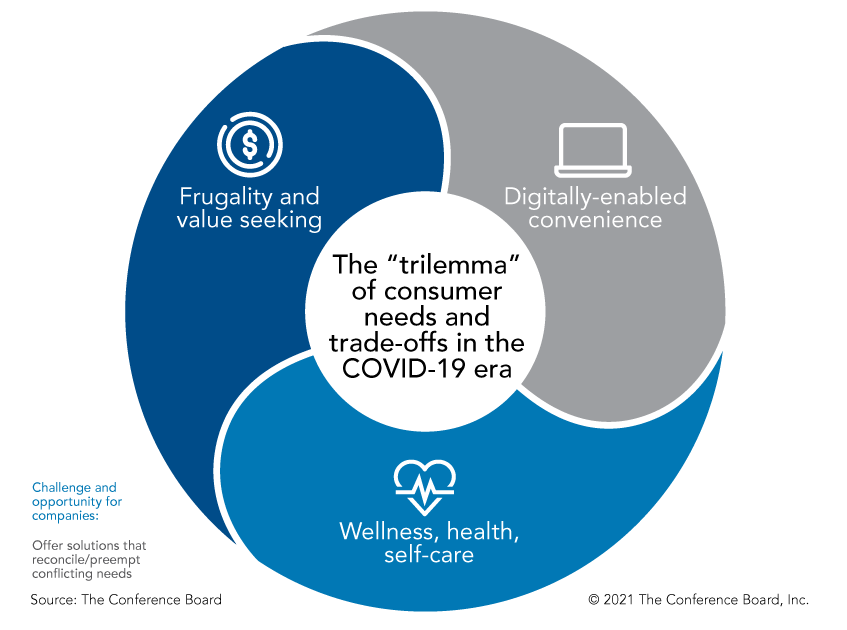
Of all the new, changed, or reinforced consumer behaviors COVID-19 has fostered, three stand out as major trends companies should consider in their marketing and innovation strategies:
- Digitally enabled convenience;
- Frugality and value seeking; and
- Focus on health, well-being, and self-care.
Some of these preferences may conflict. For example, the digital convenience of online shopping may be more expensive due to delivery costs and conflict with frugality goals. Pursuing a healthy lifestyle—including diet, gym membership, exercise equipment, and more—can also be prohibitively costly.
The challenge and opportunity for companies is to innovate with novel solutions that address the full constellation of consumers’ needs, while preempting conflicts between priorities. This is true for telehealth, which addresses all three needs—digital convenience, self-care, and frugality—while walk-in clinics, another less expensive alternative to traditional health care, address the latter two.
Even as vaccines usher in the return to a more normal life, companies are likely to see consumer behaviors and priorities continue to adjust for a while until a new equilibrium establishes itself. For example, during the pandemic, shoppers may have been more willing to pay for online shopping. They also spent more time at home, which made receiving deliveries easy, preempting theft and storage issues. Spending more time at home has changed eating habits to more snacking.
Looking ahead, people may become more cautious about spending. And once they spend more time outside the home, commuting to work and school, they may alter their habits yet again. Among other behaviors, this may affect the online ordering of groceries, take-out meals, and other items, as well as eating, workout, and dressing habits.
246 “Fully Vaccinated” Michigan Residents Catch COVID-19, 3 Die – ZeroHedge
So much for the COVID jabs being “100% effective” at preventing “serious illness.”
Michigan, now the epicenter of the American COVID outbreak, is desperately begging the federal government for more vaccines. But reports about a rash of infections in “fully vaccinated” patients might provoke a rethink.
The Detroit News reported that as many as 246 vaccinated Michigan residents later tested positive for the deadly bug, including three who have died. The cases were reported between Jan. 1 and March 31, and the 246 had a positive test 14 or more days after the last dose in the vaccine series, said Lynn Sutfin, a spokeswoman for the Michigan Department of Health and Human Services.
“Some of these individuals may ultimately be excluded from this list due to continuing to test positive from a recent infection prior to being fully vaccinated,” she said.
“These cases are undergoing further review to determine if they meet other CDC criteria for determination of potential breakthrough, including the absence of a positive antigen or PCR test less than 45 days prior to the post-vaccination positive test. In general, these persons have been more likely to be asymptomatic or mildly symptomatic compared with vaccinated persons.”
The department had hospitalization data for 117 of the cases, but 129 were incomplete, Sutfin added. The three deaths were all “persons 65 years or older,” and two of them died within three weeks of completion of vaccination, she said. “While the majority of the population develops full immunity within 14 days of completion of their vaccine series, a small proportion appear to take onger to mount a full antibody response.” Of the 117 with data available, 11 were hospitalized, 103 were not hospitalized, and 3 are reported as unknown, Sutfin said.
Is This the Future of Face Masks? – New York Times
Called Xupermask and made of silicon with athletic mesh fabric on the sides, it is a joint venture between Will.i.am and Honeywell. It fits snugly around the bottom half of the face and comes with three dual-speed fans, a Honeywell HEPA filtration system (which the company is careful to say is not medical quality), as well as noise-canceling headphones, LED lights for nighttime, a rechargeable battery and Bluetooth capability. It allows you to play music and take calls, has a seal over the nose to keep glasses from fogging and makes the wearer look sort of like a sci-fi rhino warrior.
The mask costs $299, which is very expensive for a simple face mask but the average top-end price for noise-canceling headphones (less than Sony and Bose, more than Apple). It was designed by Jose Fernandez, the Hollywood costume designer who created the SpaceX suits for Elon Musk and worked on “Black Panther,” “The Avengers” and “X-Men 2.” And it is going to be sold in direct-to-consumer, Supreme-style drops.

Scientists Race To Develop Next Generation Of COVID Vaccines – NPR
… researchers are racing to develop the next generation of COVID-19 vaccines, utilizing a variety of innovative technologies to produce more convenient and more potent options. Some of the new vaccines are already being tested in volunteers and could even be available for distribution in the next year or so.
Scientists are exploring one set of changes that should be popular with people who don’t like needles.
“We wanted to develop a platform technology where we could easily give a vaccine, and obviously the easiest format to give would be a tablet,” says Sean Tucker, chief scientific officer at Vaxart.
The COVID-19 vaccine that Vaxart is developing is similar to Johnson & Johnson’s in that it uses a harmless virus to deliver instructions to cells to make proteins that will prompt an immune response to the coronavirus.
But instead of putting the delivery virus in a liquid, Vaxart freeze-dries it, turning into a powder that can be formulated into a pill that can be stored at room temperature.
Another vaccine that could be self-administered is a nasal spray vaccine. Frances Lund, chair of the microbiology department at the University of Alabama at Birmingham, is working on that kind of vaccine with the biotech company Altimmune. She says that when you give people a vaccine by injection, the protection is systemic — that is, it works throughout the body.
By contrast, an intranasal vaccine induces two kinds of immunity, Lund says. You still get the systemic protection, she says, “but you will also get immunity directly at the site where you put that vaccine.”
Carbon dioxide levels reflect COVID-19 risk – EurekAlert
Tracking carbon dioxide levels indoors is an inexpensive and powerful way to monitor the risk of people getting COVID-19, according to new research from the Cooperative Institute for Research in Environmental Sciences (CIRES) and the University of Colorado Boulder. In any given indoor environment, when excess CO2 levels double, the risk of transmission also roughly doubles, two scientists reported this week in Environmental Science & Technology Letters.
The chemists relied on a simple fact already put to use by other researchers more than a decade ago: Infectious people exhale airborne viruses at the same time as they exhale carbon dioxide. That means CO2 can serve as a “proxy” for the number of viruses in the air.
“You’re never safe indoors sharing air with others, but you can reduce the risk,” said Jose-Luis Jimenez, co-author of the new assessment, a CIRES Fellow and professor of chemistry at the University of Colorado Boulder.
South African and Brazilian SARS-CoV-2 variants can evade antibodies from therapies, vaccines, and infection – News-Medical
In a new study, published in the journal Cell, researchers in Germany found that the variants B.1.1.7 (or United Kingdom) variant, the B.1.351 (or South African) variant, and the P.1 (or Brazilian) variant do not show augmented host cell entry.
The team also found that the B.1.351 and P.1 variants have the potential to evade therapeutic antibodies or antibodies induced by natural infection or vaccination.
World’s Biggest Vaccine Maker ‘Very Stressed’ As India Sees Record Spike In COVID-19 – NPR
India confirmed another record jump in COVID-19 cases Wednesday, as the world’s biggest vaccine maker said it was “very stressed” and needs help from the Indian government to boost production.
India is struggling to speed up vaccinations amid its sharpest spike in coronavirus infections since the pandemic began. Authorities are also trying to balance stricter curbs on movement while also ensuring fair voting in five regions holding state elections throughout the month.
Despite bans on large gatherings in other parts of India, Prime Minister Narendra Modi appeared in person at several political rallies Tuesday in West Bengal, one of the jurisdictions voting this month. Modi’s Bharatiya Janata Party hopes to make inroads in West Bengal — one of the last bastions of opposition rule.
India has administered nearly 90 million vaccine doses so far. But that’s still less than 6% of the population of nearly 1.4 billion. Modi got his first dose of a coronavirus vaccine on March 1.
In an interview with local TV, the CEO of the Serum Institute of India, Adar Poonawalla, said late Tuesday that his company’s production of the Oxford-AstraZeneca vaccine, the injection most used in India, is “very stressed, to put it frankly.”
“We are prioritizing the needs of India, but we are still short of being able to supply to every Indian,” Poonawalla said.
As many as one in three people infected with Covid-19 have longer term mental health or neurological symptoms, researchers reported Tuesday.
They found 34% of Covid-19 survivors received a diagnosis for a neurological or psychological condition within six months of their infection, according to the study published Tuesday in the journal Lancet Psychiatry.
The most common diagnosis was anxiety, found in 17% of those treated for Covid-19, followed by mood disorders, found in 14% of patients.
And while the neurological effects are more severe in hospitalized patients, they are still common in those who were only treated as outpatients, the researchers note.
“That rate increased progressively as the severity of the Covid-19 illness increased. If we look at patients who were hospitalized that rate increased to 39%,” said Maxime Taquet, an academic clinical fellow in psychiatry at the University of Oxford, and a co-author of the new study.
“Our results indicate that brain diseases and psychiatric disorders are more common after COVID-19 than after flu or other respiratory infections, even when patients are matched for other risk factors. We now need to see what happens beyond six months. The study cannot reveal the mechanisms involved, but does point to the need for urgent research to identify these, with a view to preventing or treating them,” Taquet added.
The following are foreign headlines with hyperlinks to the posts
Brazil Tops 4,000 Daily COVID-19 Deaths, Nears U.S. Peak
Toronto Suspends In-Person Classes As Cases Surge In Canada’s Most-Populous Province
Life expectancy drops in EU nations amid struggles with COVID-19
North Korea Again Claims That Country Has No COVID Cases
Japanese Governor Says Region’s Hospitals Are ‘on the Verge of Collapse’
Nepal resumes vaccinations thanks to a gift from China
Merkel wants a short lockdown in Germany. Not all local governors are convinced.
With the virus’s origins still murky, the W.H.O. and its critics look to next steps.
German state of Bavaria will buy Sputnik vaccine
Hungary to ease restrictions after recording deadliest day of pandemic last week
India’s Maharashtra state faces vaccine shortage
India reports more than 115,000 new Covid-19 cases in highest daily total
Russia to supply 150,000 doses of Sputnik V vaccine to Pakistan
Chile postpones elections due to surge in Covid-19 cases
Mexico authorizes emergency use of India’s Covid-19 vaccine
The following additional national and state headlines with hyperlinks to the posts
Dr. Fauci Can’t Explain Why Texas COVID Cases Keep Dropping Despite Reopening
Biden said that all adults in the U.S. would be eligible for a vaccine by April 19, accelerating the timeline he announced last month.
Nearly 80 percent of teachers and school employees in the U.S. have received at least one vaccine dose, the C.D.C. said.
31 U.S. States Averaged Fewer Than 1,000 COVID Cases Per Day in Last Week
The FDA announced that it had granted an emergency use authorization for the Symbiotica COVID-19 Self-Collected Antibody Test System, the first antibody test authorized for use with home-collected dried blood spot samples.
Brown University will require all students to be vaccinated against COVID-19 beginning in Fall 2021.
Moderna’s COVID Vax Produces Antibody Responses 6 Months Later
Mobility tracking using cell phone data showing greater movement of people is a strong predictor of increased rates of COVID-19, according to new data in CMAJ (Canadian Medical Association Journal).
NIH begins study of allergic reactions to Moderna, Pfizer-BioNTech COVID-19 vaccines
UK Variant Now the Dominant COVID-19 Strain In US
Nearly Half of New COVID-19 Cases Reported in Five States
One in three COVID-19 survivors diagnosed with psychological, neurological conditions: study
53% of Americans Support Requiring Vaccinated People to Carry Proof: Poll
FEMA will offer more financial aid for Covid funeral expenses starting next week.
Hospitals are seeing more young adults with severe Covid symptoms, CDC says
Pandemic stay-at-home orders caused increased well-being risk to US Black and Hispanic communities
Today’s Posts On Econintersect Showing Impact Of The Pandemic With Hyperlinks
17 March 2021 FOMC Meeting Minutes: Pandemic Continues To Weigh On Monetary Policy
February 2021 Trade Data Slows
Warning to Readers
The amount of politically biased articles on the internet continues to increase. And studies and opinions of the experts continue to contradict other studies and expert opinions. Honestly, it is difficult to believe anything anymore.

I assemble this coronavirus update daily – sifting through the posts on the internet. I try to avoid politically slanted posts (mostly from CNN, New York Times, and the Washington Post) and can usually find unslanted posts on that subject from other sources on the internet. I wait to publish posts on subjects that I cannot validate across several sources. But after all this extra work, I do not know if I have conveyed the REAL facts. It is my job to provide information so that you have the facts necessary – and then it is up to readers to draw conclusions.
Analyst Opinion of Coronavirus Data
There are several takeaways that need to be understood when viewing coronavirus statistical data:
- The global counts are suspect for a variety of reasons including political. Even the U.S. count has issues as it is possible that as much as half the population has had coronavirus and was asymptomatic. It would be a far better metric using a random sampling of the population weekly. In short, we do not understand the size of the error in the tracking numbers.
- Just because some of the methodology used in aggregating the data in the U.S. is flawed – as long as the flaw is uniformly applied – you establish a baseline. This is why it is dangerous to compare two countries as they likely use different methodologies to determine who has (and who died) from coronavirus.
- COVID-19 and the flu are different but can have similar symptoms. For sure, COVID-19 so far is much more deadly than the flu. [click here to compare symptoms]
- From an industrial engineering point of view, one can argue that it is best to flatten the curve only to the point that the health care system is barely able to cope. This solution only works if-and-only-if one can catch this coronavirus once and develops immunity. In the case of COVID-19, herd immunity may need to be in the 80% to 85% range. WHO warns that few have developed antibodies to COVID-19 when recovering from COVID-19. Herd immunity does not look like an option without immunization although there is now a discussion of whether T-Cells play a part in immunity [which means one might have immunity without antibodies]
- Older population countries will have a significantly higher death rate as there is relatively few hospitalizations and deaths in younger age groups..
- There are at least 8 strains of the coronavirus. California and New York may have a deadlier strain imported from Europe, compared to less deadly viruses elsewhere in the United States.
- Each publication uses different cutoff times for its coronavirus statistics. Our data uses 11:00 am London time. Also, there is an unexplained variation in the total numbers both globally and in the U.S.
What we do or do not know about the coronavirus [actually there is little scientifically proven information]. Most of our knowledge is anecdotal, from studies with limited subjects, or from studies without peer review.
- How many people have been infected as many do not show symptoms?
- Masks do work. Unfortunately, early in the pandemic, many health experts — in the U.S. and around the world — decided that the public could not be trusted to hear the truth about masks. Instead, the experts spread a misleading message, discouraging the use of masks.
- Current thinking is that we develop at least 5 months of immunity from further COVID infection.
- The Moderna and Pfizer vaccines have an effectiveness rate of about 95 percent after two doses. That is on par with the vaccines for chickenpox and measles. The 95 percent number understates the effectivenessas it counts anyone who came down with a mild case of Covid-19 as a failure. But turning Covid into a typical flu — as the vaccines evidently did for most of the remaining 5 percent — is actually a success. Of the 32,000 people who received the Moderna or Pfizer vaccine in a research trial, only one contracted a severe Covid case.
- To what degree do people who never develop symptoms contribute to transmission? Research early in the pandemic suggested that the rate of asymptomatic infections could be as high as 81%. But a meta-analysis, which included 13 studies involving 21,708 people, calculated the rate of asymptomatic presentation to be 17%.
- The accuracy of rapid testing is questioned – and the more accurate test results are not being given in a timely manner.
- Can children widely spread coronavirus? [current thinking is that they are a minor source of the pandemic spread]
- Why have some places avoided big coronavirus outbreaks – and others hit hard?
- Air conditioning contributes to the pandemic spread.
- It appears that there is increased risk of infection and mortality for those living in larger occupancy households.
- Male patients have almost three times the odds of requiring intensive treatment unit (ITU) admission compared to females.
- Outdoor activities seem to be a lower risk than indoor activities.
Treatments with solid scientific support:
- Dexamethasone
- Proning, or turning someone on their stomach
- Remdesivir
- Baricitinib
Treatments with potential but limited evidence:
- ECMO, or extracorporeal membrane oxygenation
- fluvoxamine
- Cyclosporine
- Famotidine
- Intravenous immunoglobulin
- Ivermectin
- Interferons
Drugs shown to be ineffective:
- The combination of lopinavir-ritonavir
- Hydroxychloroquine
- Insulin
- High dose zinc and vitamin C
- Convalescent plasma
- Monoclonal antibodies
- Tocilizumab
- Anti-coagulants
- A current scientific understanding of the way the coronavirus works can be found [here].
There is now a vaccine available – the questions remain:
- will there be any permanent side effects that will appear months from now,
- how long immunity will last [we can currently say we do not know if it will last more than 4 months],
- there is no solid evidence yet the vaccine will block transmission
Heavy breakouts of coronavirus have hit farmworkers. Farmworkers are essential to the food supply. They cannot shelter at home. Consider:
- they have high rates of respiratory disease [occupational hazard]
- they travel on crowded buses chartered by their employers
- few have health insurance
- they cannot social distance and live two to four to a room – and they eat together
- some reports say half are undocumented
- they are low paid and cannot afford not to work – so they will go to work sick
- they do not have access to sanitation when working
- a coronavirus outbreak among farmworkers can potentially shutter entire farm
The bottom line is that COVID-19 so far has been shown to be much more deadly than the data on the flu. Using CDC data, the flu has a mortality rate between 0.06 % and 0.11 % Vs. the coronavirus which to date has a mortality rate of 4 % [the 4% is the average of overall statistics – however in the last few months it has been hovering around 1.0%] – which makes it between 10 and 80 times more deadly. The reason for ranges:
Because influenza surveillance does not capture all cases of flu that occur in the U.S., CDC provides these estimated ranges to better reflect the larger burden of influenza.
There will be a commission set up after this pandemic ends to find fault [it is easy to find fault when a once-in-a-lifetime event occurs] and to produce recommendations for the next time a pandemic happens. Those that hate President Trump will conclude the virus is his fault.
Resources:
- Get the latest public health information from CDC: https://www.coronavirus.gov .
- Get the latest research from NIH: https://www.nih.gov/coronavirus.
- Find NCBI SARS-CoV-2 literature, sequence, and clinical content: https://www.ncbi.nlm.nih.gov/sars-cov-2/.
- List of studies: https://icite.od.nih.gov/covid19/search/#search:searchId=5ee124ed70bb967c49672dad
include(“/home/aleta/public_html/files/ad_openx.htm”); ?>


