


Written by Steven Hansen
The U.S. new cases 7-day rolling average are 25.5 % LOWER than the 7-day rolling average one week ago. U.S. hospitalizations due to COVID-19 are now 15.2 % LOWER than the rolling average one week ago. U.S. deaths due to coronavirus are now 6.6 % LOWER than the rolling average one week ago. Today’s posts include:
- U.S. Coronavirus New Cases are 62,398
- U.S. Coronavirus hospitalizations are at 64,533
- U.S. Coronavirus deaths are at 1,756
- U.S. Coronavirus immunizations have been administered to 16.5 % of the population
- The 7-day rolling average rate of growth of the pandemic shows new cases improved, hospitalizations improved, and deaths improved
- Hopefully, these current improving COVID trends will remain in play even with the new strains
- A next-generation coronavirus vaccine is in the works, but initial funding was denied
- The administration says it will spend $650 million to expand testing for K-8 schools and settings where people congregate such as homeless shelters
- HHS and DOD will also spend $815 million to increase domestic production of testing supplies and materials.
- The Centers for Disease Control and Prevention will spend $200 million to expand genomic sequencing of the virus — an effort to prepare for the spread of variants of the coronavirus.
- Scientists Paying People $6,000 to Catch COVID for Research
- Johnson and Johnson has only a few million Covid vaccine doses ready as it nears U.S. launch
- Going by train vs. plane: Is taking Amtrak safer than flying during COVID-19?
- Virologist: WHO Team Found No ‘Credible Link’ Between Wuhan Labs, COVID-19
- Russia and China seek to advance their interests abroad via vaccine diplomacy
- Fauci says a Covid-19 vaccine could be needed annually

The recent worsening of the trendlines for new cases is behind us which was attributed to going back to college/university, cooler weather causing more indoor activities, mutation of the virus, fatigue from wearing masks / social distancing, holiday activities, and some loosening of regulations designed to slow the coronavirus spread.
My continuing advice is to continue to wash your hands (especially after using the toilet as COVID first sheds in your stool), putting down the toilet seat (as flushing the toilet releases a plume), wear masks, avoid crowds, and maintain social distancing. No handwashing, mask, or social distancing will guarantee you do not get infected – but it sure as hell lowers the risk in all situations – and the evidence to-date shows a lower severity of COVID-19. In addition, certain activities are believed to carry higher risk – like being inside in air conditioning and removing your mask (such as restaurants, around your children/grandchildren, bars, and gyms). It is all about viral load – and outdoor activities are generally safe if you can maintain social distance. Finally, studies show eating right (making sure you are supporting your immune system) and adequate sleep increase your ability to fight off COVID.
include($_SERVER[‘DOCUMENT_ROOT’].’/pages/coronavirus1.htm’); ?>
Hospitalizations Are The Only Accurate Gauge As Reporting Is Not Affected By Holidays
The 4 day Thanksgiving holiday period put the first wobble in the trends. Over weekends and holidays, the number of new cases and deaths decline. Over weekends, this is not a problem for week-over-week rolling averages as weekends are compared against the previous weekend. But when a holiday falls within a working week, a non-working day is compared to a working day which causes havok in the trends.
However, hospitalizations historically appear to be little affected by weekends or holidays – the daily counts do not vary significantly from day-to-day.
The hospitalization growth rate trend is improving.

For the Thanksgiving and the end of the year holiday period – roughly, it seems each appears to have added around 5 % to the rate of growth of new cases, hospitalizations, and deaths.
Historically, hospitalization growth follows new case growth by one to two weeks.
As an analyst, I use the rate of growth to determine the trend. But, the size of the pandemic is growing in terms of real numbers – and if the rate of growth does not become negative – the pandemic will overwhelm all resources.
The graph below shows the rate of growth relative to the growth a week earlier updated through today [note that negative numbers mean the rolling averages are LOWER than the rolling averages one week ago]. As one can see, the rate of growth for new cases peaked in early December 2020 for Thanksgiving, and early January 2021 for end of year holidays – and the rate of growth is now contracting.

In the scheme of things, new cases decline first, followed by hospitalizations, and then deaths.
It is up to each of our readers to protect themselves and others by washing your hands, wearing a mask, avoiding crowds, and maintaining social distancing.
Will The New Variants Cause The Next Spike?
Maybe and maybe not. It all depends on vaccinations:
- the more people that are vaccinated reduces the pool of people that can be infected. Today we have removed over 16 % of the population from being infected which theoretically should reduce the infection rate by 16 % [it is unstudied whether the vaccines prevent a vaccinated person from being a carrier of the virus even though showing no signs]. If the vaccines are shown to stop transmission, then in theory it would reduce the infection rate by double the percent vaccinated [in this case you prevent your own infection and do not pass it along to another].
- it is also unknown what the effective rate of the current vaccines is against mutations that seem to appear almost daily. As an example, if the effective rate drops to 60%, it means the 16 % reduction in the infection rate discussed above is almost cut in half. The South African and Brazilian variant is somewhat immune to the current vaccines.
- The pandemic should be over immediately if everyone could be vaccinated today. The problem is that every day brings a new mutation (which would not appear if the pandemic was stopped). The longer the immunization process takes – the more ineffective the vaccine will become.
- It is not clear whether the vaccine prevents those vaccinated from spreading the virus. It seems to be well documented that it normally stops the virus from taking hold and when it does not – the infection is mild.
Coronavirus News You May Have Missed
A next-generation coronavirus vaccine is in the works, but initial funding was denied – USA Today
Drew Weissman realized a year ago that even if the COVID-19 vaccines then in progress were eventually approved, it might not be enough. The world might need a next-generation vaccine to rid itself of this pandemic.
Recent outbreaks of more resilient variants suggest he could be right. And yet, when Weissman – discoverer of the mRNA science behind two of the current vaccines – and a team of fellow scientists took a proposal for a more versatile COVID-19 vaccine to the National Institutes of Health for funding last May, they left empty-handed.
The group had proposed research on vaccines to protect against any variant of the virus, known as a universal or pan vaccine.
Weissman doesn’t blame NIH staff for the denial; the agency turns down about 80% of its grant applications. Weissman said staff initially wanted to put the grant on a fast-track for approval in September, less than half the time it normally takes. Then, Weissman says, their hands were tied by negative scores from the independent scientists asked to review the grant proposal.
Some of the reviewers, according to Weissman, “said, ‘We don’t need a pan coronavirus vaccine,’ which is crazy.”
Luck, foresight and science:How an unheralded team developed a COVID-19 vaccine in record time
The NIH says it doesn’t comment on grant applications, and Weissman said the written reviews, as well as the grant application and amount requested, are confidential.
Weissman, however, has some particularly impressive credentials with respect to COVID-19 vaccines. He’s one of two scientists at the University of Pennsylvania behind the scientific breakthrough that enabled Moderna and Pfizer to make mRNA vaccines. He also was a consultant to Pfizer on its vaccine.
The NIH grant would have allowed his group to dive into a new approach to vaccinating against coronaviruses, one that would go beyond replicating spike proteins on the virus – the way current vaccines generate antibodies.
In the short run, that could lead to a vaccine to protect against coronavirus variants not yet discovered. Eventually it also could lead to a vaccine to protect against future coronavirus outbreaks if other strains leap from bats to humans.
[editor’s note: this post deserves a full read]
White House Announces Expanded COVID-19 Testing, Manufacturing And Virus Sequencing – NPR
The White House plans to increase testing capacity in the U.S. through multiple channels, officials said in a media briefing on Wednesday.
The administration says it will spend $650 million to expand testing for K-8 schools and settings where people congregate such as homeless shelters, via new “hubs” created by the Department of Health and Human Services and the Department of Defense. Regional coordinating centers will work to increase testing capacity, partnering with labs and universities to collect specimens, perform tests and report results to public health agencies.
The plan could mean an additional 25 million tests per month, and it’s intended to aid President Biden’s effort to open schools for in-person learning.
HHS and DOD will also spend $815 million to increase domestic production of testing supplies and materials. That funding will go toward manufacturing of supplies including filter pipette tips, polymers used in antigen tests, and injected molded plastics to house testing reagents.
And in a third avenue, the Centers for Disease Control and Prevention will spend $200 million to expand genomic sequencing of the virus — an effort to prepare for the spread of variants of the coronavirus.
On the vaccine front, weekly vaccine allocations increased to 13.5 million from 11 million last week, said Jeffrey Zients, the White House COVID-19 response coordinator. Allocations to pharmacies would double to 2 million this week, compared to 1 million last week.
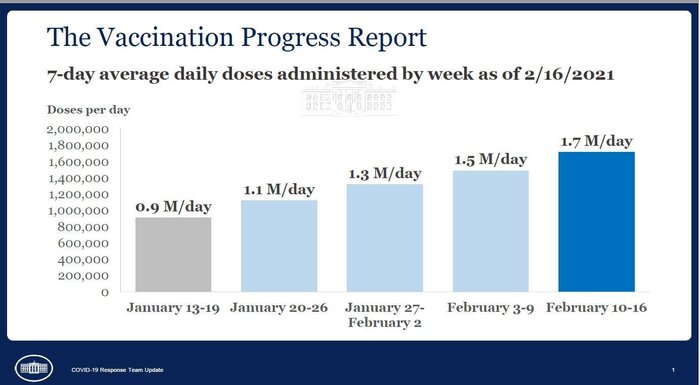
A chart from the White House shows steady increases in the average number of vaccine doses administered each day.
Scientists Paying People $6,000 to Catch COVID for Research – Newsweek
The U.K. has become the first country in the world to approve a so-called “human challenge trial” that will expose healthy young adults to COVID on purpose.
Planning for the first-of-its-kind trial has been ongoing for months, with details revealed in October last year. The U.K. government has now confirmed ethical approval has been granted by the country’s clinical trials ethics body.
As part of the study, participants will be exposed to “the smallest amount of virus needed to cause infection.” They will then be monitored in a controlled environment at London’s Royal Free hospital so that doctors can observe how the virus affects them.
Up to 90 participants will be selected for the study, with an age limit set between 18 and 30 years old as adults in this age group tend to be at the lowest risk of developing COVID complications.
The U.K.’s Evening Standard newspaper reported participants will be paid $6,000 to participate in the study. Newsweek has independently verified that claim.
J&J has only a few million Covid vaccine doses ready as it nears U.S. launch, Biden official says – CNBC
Johnson & Johnson will not have “a big inventory” of its Covid-19 vaccine ready ahead of its regulatory clearance expected this month, President Joe Biden’s Covid czar said Wednesday.
Jeff Zients said the administration has learned in the last couple of weeks that J&J will have only “a few million” doses manufactured when its single-shot vaccine is likely authorized by the Food and Drug Administration.
Federal and state health officials were expecting vaccine supply to rapidly increase after the emergency use authorization of J&J’s vaccine. The FDA has scheduled a meeting of its Vaccines and Related Biological Products Advisory Committee on Feb. 26 to discuss the vaccine, and the U.S. could authorize the vaccine as early as the next day.
J&J currently has a deal with the U.S. government to supply 100 million doses of its vaccine by the end of June, said Zients, the president’s Covid-19 response coordinator. Assuming the vaccine is authorized, the Biden administration will work with J&J to ramp up supply as quickly as possible, he said, adding U.S. officials hope many of those doses will be available in the early months of its rollout.
“We’re doing everything we can working with the company to accelerate the delivery schedule,” Zients told reporters during a White House news briefing on the pandemic.
The news comes as the Biden administration works to ramp up the supply of doses after states complained that demand for the shots was rapidly outpacing supply. Roughly 39.7 million out of some 331 million Americans have received at least their first dose of Pfizer’s or Moderna’s two-dose vaccines, according to data compiled by the Centers for Disease Control and Prevention. And 15 million of those people have already gotten their second shot.
New CDC reports warn that variants could lead to “rapid rise” in Covid-19 cases – CNN
Two new reports from the US Centers for Disease Control and Prevention warn that new coronavirus variants could lead to a rapid rise in the numbers of Covid-19 cases.
In one report released Wednesday, researchers from the CDC and Minnesota health department detailed cases of the B.1.1.7 variant, first identified in the United Kingdom. Earlier modeling data suggested this variant, which may be more transmissible, could become the predominant variant in the United States in March, and the CDC has urged people to take action to reduce spread.
The CDC’s Morbidity and Mortality Weekly Report described identified B.1.1.7 cases in specimens collected from eight Minnesota residents, ages 15 to 41, from mid-December through mid-January. Five reported Covid-19-like symptoms and three were asymptomatic.
Three of the people had a history of international travel in the two weeks before they became ill, including two who traveled in West Africa and one who traveled to the Dominican Republic, and three others had traveled to California, including one who received a positive test while in California and isolated before returning to Minnesota. None had a history of travel to the UK.
Identification of these variants in Minnesota “highlights the importance of mitigation measures such as mask use, physical distancing, avoiding crowds and poorly ventilated indoor spaces, isolation of persons with diagnosed COVID-19, quarantine of close contacts of persons with COVID-19, and adherence to CDC travel guidance,” the report says.
On Tuesday, the CDC reported at least 1,299 cases of coronavirus strains first spotted in the UK, South Africa and Brazil have been reported in the United States. The vast majority of these cases — 1,277 — are the B.1.1.7 variant originally detected in the UK. This variant has been found in 41 states and Washington, DC. Roughly a third are in Florida. Nineteen of those 1,299 are the B.1.351 variant first identified in South Africa.
These numbers do not represent the total number of such cases circulating in the United States, but rather, only those found by analyzing positive samples.
In a separate report released by the CDC on Wednesday, researchers from Zambia described how the detection of the B.1.351 variant first identified in South Africa coincided with a rapid rise of cases in Zambia – and this variant might have become the dominant strain there.
The B.1.351 variant might be circulating elsewhere in southern Africa, where many countries are reported rapid increases in Covid-19 case numbers in December and January, the report said.
“Spread of the B.1.351 variant is of public health concern because of the potential for increased transmissibility and, thus, increases in cases, hospitalizations, and deaths,” researchers wrote.
Going by train vs. plane: Is taking Amtrak safer than flying during COVID-19? – USA Today
As segments of society reopen and the world rushes to get vaccinated, more Americans may lose their fear of flying and once again crowd airports and airplanes.
Those still wary of catching COVID-19 may wonder: Is taking a train safer?
Amtrak doesn’t directly make that claim on its website, but the rail system’s officials posted videos that agree with experts on viral transmission: Amtrak trains are probably safer than planes for avoiding the virus.
Amtrak rider Erin Silverman of Bloomfield Hills, Michigan, got off the train on the night of Feb. 5 in Troy, after riding the rails all the way to and from Denver. Silverman, a travel agent who operates a Cruise Planners franchise from her home, said she was impressed with Amtrak’s COVID-19 precautions.
“They were very serious about having people wear masks. They announced several times, you must wear the mask over your nose and mouth, or we can kick you off,” she said.
Another safety factor? Airline seating is much more confined than the seating on Amtrak cars, Silverman said.
“Delta is the only airline that is still blocking the middle seat. All the others have people right next to you,” she said. In contrast, Amtrak conductors “were very strict about keeping everyone socially distanced.” Silverman called her trip “a relaxing way to travel.”
Virologist: WHO Team Found No ‘Credible Link’ Between Wuhan Labs, COVID-19 – NPR
After traveling to Wuhan, China, a team of researchers from the World Health Organization is readying a preliminary report on the origins of the coronavirus.
Wuhan is where the virus was first reported in December 2019.
The WHO team’s main public conclusion so far is that it’s “extremely unlikely” that the virus originated in a lab in Wuhan. The scientists think the virus most likely started in bats, then jumped to other animals, then to humans.
Dutch virologist Marion Koopmans was part of that team that “reconstructed every step in that initial outbreak” in two weeks of investigation.
The team said the pandemic did not start at the city’s Huanan Seafood Market, which was a location of an early coronavirus outbreak, because the virus was already circulating beforehand.
… So if there’s a lot of evidence pointing to the market, but maybe not all the evidence necessarily pointing to the market, is there any other location that’s a suspect in your mind?
Other markets, that’s clearly there. And what we have recommended is really to [trace] back from those markets, follow the supply chains, go to the farms, see where they are. And that’s already done. That will be in the report. Those supply chains do lead to regions where there’s also the hotspot for the bat coronavirus. So that’s a line to follow.
You probably also are hinting at the laboratory hypothesis.
I’ll just raise it because people raised it. Is there any evidence or can you rule it out?
So from everything that we’ve looked at and we’ve also visited three labs involved and also three labs that work on these viruses. From that, we have not been able to find any credible link there.
How open and transparent were the Chinese once they let you in?
This is a topic and a mission. There are sensitivities around it … big political tensions that are around it. And that’s something you cannot completely avoid in a situation like this. But once we got out of our quarantine, got into the face-to-face meetings, I think we’ve managed to get into real good scientific exchange with stiff discussions here and there, because [people] start from different backgrounds and different views. But I tell everyone, wait and read the report and let’s discuss then. But I think we managed to get a good outcome of this meeting. I think it was in that sense quite successful.
Russia and China seek to advance their interests abroad via vaccine diplomacy – CNBC
International diplomacy is likely to determine who gets access to coronavirus vaccines over the coming months, analysts have told CNBC, with countries such as Russia and China seen using one of the world’s most in-demand commodities to advance their own interests abroad.
It is hoped the rollout of Covid-19 vaccines could help to bring an end to the pandemic. While many countries have not yet started vaccination programs, even high-income nations are facing a shortfall in supplies as manufacturers struggle to ramp up production.
Russia and China had made distributing face masks and protective equipment to hard-hit countries a central tenet of diplomatic relations last year. Now, both countries are seen adopting a transactional approach to the delivery of vaccines.
Agathe Demarais, global forecasting director at the Economist Intelligence Unit, told CNBC via telephone that Russia, China and to a lesser extent India, are betting on providing Covid vaccines to emerging or low-income countries to advance their interests.
“Russia and China have been doing this for a long, long time … especially in emerging countries because they feel traditional Western powers have been withdrawing from these countries,” Demarais said.
Fauci says a Covid-19 vaccine could be needed annually – CNN
Dr. Anthony Fauci, director of the National Institute of Allergy and Infectious Diseases, said it’s “possible” that the Covid-19 vaccine could become a yearly vaccine, like the flu shot.
“We hope we can contain this particular outbreak and all of its ramifications throughout the world in a way that doesn’t have the … cycling of various versions of the virus so that you have to address it differently each year,” Fauci said in an interview with Spectrum News’ Lisa McRee on Tuesday.
Fauci also said that it’s “entirely conceivable” that scientists are already working on a universal coronavirus vaccine that would address all the variants.
There are a number of new variants that have emerged recently. Here are the top four that are most worrying:
- B.1.1.7 was first seen in the UK. It appears to be transmitted the same way — but is more contagious and easily spread, experts say.
- B.1.351 was first seen in South Africa and has since been reported in more than 30 other countries, according to the World Health Organization.
- P.1 is suspected of fueling a resurgence of viral spread in Brazil. It has since been reported in the US and Japan, carried by travelers from Brazil.
- L452R was seen in California as well as a dozen other states. Experts are still investigating the significance of this strain.
The following are foreign headlines with hyperlinks to the posts
Pandemic response adds $24T to global debt, IIF says
Months after other major world economies, Japan has belatedly begun giving its first coronavirus vaccines to front-line health workers today. Many are wondering if the campaign will reach enough people in time to save a Summer Olympics already delayed a year by the worst pandemic in a century
US to deliver $200 million to WHO, fulfilling contributions
Gaza’s First Shipment of COVID Vaccine Enough for Just 0.05% of Population
Beijing May Have Scuppered Taiwan’s Vaccine Roll-Out, Hints Health Minister
U.K. Prime Minister Boris Johnson is among several officials proposing a global “pandemic treaty” to ensure more transparency about future pandemics. The call comes amid unease over China’s reluctance to share information about the coronavirus outbreak.
British Covid-19 variant is worrying and doubling every week, German health minister says
BioNTech to supply additional 200 million vaccine doses to the EU
The following additional national and state headlines with hyperlinks to the posts
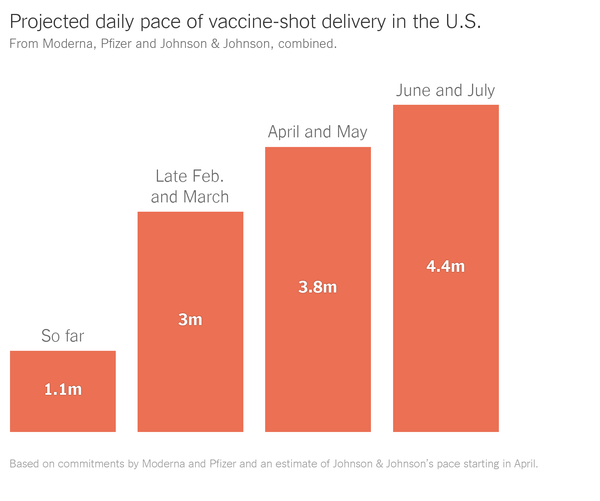
But over the next month and a half, Moderna and Pfizer companies have promised to deliver at least three million shots per day — and to accelerate the pace to about 3.3 million per day starting in April. Johnson & Johnson is likely to add to that total if, as expected, it receives the go-ahead to start distributing shots in coming weeks.
US consumer sentiment takes a hit despite promises of more stimulus
New York sues Amazon over workers’ protection during pandemic
Biden resets his own Covid goalposts at CNN town hall
President Joe Biden has promised that a majority of U.S. elementary schools will be open five days a week by the end of his first 100 days in office. Biden was restating a pandemic goal after his administration came under fire when aides said schools would be considered open if they held in-person learning just one day a week,
Latinos Vaccinations: Latinos face daunting barriers to getting vaccine shots in the U.S., creating a risk for public health as the coronavirus mutates and spreads. Many are struggling with a lack of knowledge about the shots, state vaccine websites that don’t have Spanish instructions and fears they could be targeted for immigration enforcement.
Native Americans Vaccinations: Tribes across the U.S. are bucking a trend of minority populations who harbor doubts about the vaccines. Native Americans are embracing inoculations and are adopting virus containment measures.
It’s Ash Wednesday, and Catholic priests have been advised by the Vatican to skip making the traditional sign-of-the cross with ashes on worshipers’ foreheads and sprinkle the ashes upon their heads instead. Some churches are offering drive-thru ashes and do-it-yourself, bagged ashes.
President Joe Biden made clear Tuesday his goal is for the majority of K-8 public schools to be open “five days a week” by the end of his first 100 days after the White House received criticism for scaling back that goal last week.
COVID-19 likely to become ‘endemic,’ experts say
Americans stream more TV, movies amid COVID-19
Pennsylvania physicians pushed back against state health department plans that favor big hospitals over small practices and clinics to administer COVID-19 vaccines
The first FEMA mass vaccination sites opened in Los Angeles and Oakland as the federal government rolled out plans to establish 100 vaccination sites nationwide in 100 days.
The White House said it will raise the number of coronavirus vaccines sent to states to 13.5 million doses a week and boost shipments to pharmacies to 2 million doses.
“It’s turning into a military campaign, in terms of how we have to treat the opposition,” said an anesthesiologist who helped organize #ThisIsOurShot, a grassroots social media campaign created by doctors and nurses to drown out anti-vaxxers.
COVID-19 was linked to potentially dangerous eye abnormalities in a small study.
Multisystem inflammatory syndrome in children (MIS-C) remains rare, but reports of the COVID-linked condition are increasing and cases are more severe
Fauci: ‘Non-workable’ to get every teacher vaccinated to reopen schools
New York sues Amazon over worker pandemic safety issues
Kamala Harris Dodges Questions About Teachers Going Back Into Schools
Ron DeSantis [Florida Governor] Won’t Use CDC Reopening Guidelines in Florida Schools
MGM Resorts will be resuming 24/7 operations in three of its resorts — Mandalay Bay, Park MGM and The Mirage — starting March 3, the company announced Wednesday in a statement.
More than a dozen top scientists are pushing the Biden administration to require N95 air filtration masks for employees in risky workplaces and issue air safety standards.
White House says teacher vaccinations are “not a requirement to reopen”
United States could be back to normal by Christmas, Biden says
Today’s Posts On Econintersect Showing Impact Of The Pandemic With Hyperlinks
4Q2020 Household Debt Shows Climbs to $14.56 Trillion in Fourth Quarter
December 2020 Business Inventories Up
January 2021 Headline Industrial Production Improves But Remains In Contraction
January 2021 Producer Price Final Demand Increased
Headline Retail Sales Improve in January 2021
Average Gasoline Prices for Week Ending 15 February 2021 Up 7 Cents From A Year Ago
Warning to Readers
The amount of politically biased articles on the internet continues to increase. And studies and opinions of the experts continue to contradict other studies and expert opinions. Honestly, it is difficult to believe anything anymore.

I assemble this coronavirus update daily – sifting through the posts on the internet. I try to avoid politically slanted posts (mostly from CNN, New York Times, and the Washington Post) and can usually find unslanted posts on that subject from other sources on the internet. I wait to publish posts on subjects that I cannot validate across several sources. But after all this extra work, I do not know if I have conveyed the REAL facts. It is my job to provide information so that you have the facts necessary – and then it is up to readers to draw conclusions.
Analyst Opinion of Coronavirus Data
There are several takeaways that need to be understood when viewing coronavirus statistical data:
- The global counts are suspect for a variety of reasons including political. Even the U.S. count has issues as it is possible that as much as half the population has had coronavirus and was asymptomatic. It would be a far better metric using a random sampling of the population weekly. In short, we do not understand the size of the error in the tracking numbers.
- Just because some of the methodology used in aggregating the data in the U.S. is flawed – as long as the flaw is uniformly applied – you establish a baseline. This is why it is dangerous to compare two countries as they likely use different methodologies to determine who has (and who died) from coronavirus.
- COVID-19 and the flu are different but can have similar symptoms. For sure, COVID-19 so far is much more deadly than the flu. [click here to compare symptoms]
- From an industrial engineering point of view, one can argue that it is best to flatten the curve only to the point that the health care system is barely able to cope. This solution only works if-and-only-if one can catch this coronavirus once and develops immunity. In the case of COVID-19, herd immunity may need to be in the 80% to 85% range. WHO warns that few have developed antibodies to COVID-19 when recovering from COVID-19. Herd immunity does not look like an option without immunization although there is now a discussion of whether T-Cells play a part in immunity [which means one might have immunity without antibodies]
- Older population countries will have a significantly higher death rate as there is relatively few hospitalizations and deaths in younger age groups..
- There are at least 8 strains of the coronavirus. New York may have a deadlier strain imported from Europe, compared to less deadly viruses elsewhere in the United States.
- Each publication uses different cutoff times for its coronavirus statistics. Our data uses 11:00 am London time. Also, there is an unexplained variation in the total numbers both globally and in the U.S.
What we do or do not know about the coronavirus [actually there is little scientifically proven information]. Most of our knowledge is anecdotal, from studies with limited subjects, or from studies without peer review.
- How many people have been infected as many do not show symptoms?
- Masks do work. Unfortunately, early in the pandemic, many health experts — in the U.S. and around the world — decided that the public could not be trusted to hear the truth about masks. Instead, the experts spread a misleading message, discouraging the use of masks.
- Current thinking is that we develop 5 months of immunity from further COVID infection.
- The Moderna and Pfizer vaccines have an effectiveness rate of about 95 percent after two doses. That is on par with the vaccines for chickenpox and measles. The 95 percent number understates the effectivenessas it counts anyone who came down with a mild case of Covid-19 as a failure. But turning Covid into a typical flu — as the vaccines evidently did for most of the remaining 5 percent — is actually a success. Of the 32,000 people who received the Moderna or Pfizer vaccine in a research trial, only one contracted a severe Covid case.
- To what degree do people who never develop symptoms contribute to transmission? Research early in the pandemic suggested that the rate of asymptomatic infections could be as high as 81%. But a meta-analysis, which included 13 studies involving 21,708 people, calculated the rate of asymptomatic presentation to be 17%.
- The accuracy of rapid testing is questioned – and the more accurate test results are not being given in a timely manner.
- Can children widely spread coronavirus? [current thinking is that they are a minor source of the pandemic spread]
- Why have some places avoided big coronavirus outbreaks – and others hit hard?
- Air conditioning contributes to the pandemic spread.
- It appears that there is increased risk of infection and mortality for those living in larger occupancy households.
- Male patients have almost three times the odds of requiring intensive treatment unit (ITU) admission compared to females.
- Outdoor activities seem to be a lower risk than indoor activities.
- Will other medical treatments for Covid-19 ease symptoms and reduce deaths? So far only remdesivir, Bamlanivimab,
and Regeneron) are approved for treatment. What drugs work?
Arthritis drugs tocilizumab and sarilumab could cut relative risk of death of those in intensive care by 24%
- A current scientific understanding of the way the coronavirus works can be found [here].
There is now a vaccine available – the questions remain:
- how effective it will be in the general population,
- will there be any permanent side effects that will appear months from now,
- how long immunity will last [we can currently say we do not know if it will last more than 4 months],
- there is no evidence the vaccine will block transmission
Heavy breakouts of coronavirus have hit farmworkers. Farmworkers are essential to the food supply. They cannot shelter at home. Consider:
- they have high rates of respiratory disease [occupational hazard]
- they travel on crowded buses chartered by their employers
- few have health insurance
- they cannot social distance and live two to four to a room – and they eat together
- some reports say half are undocumented
- they are low paid and cannot afford not to work – so they will go to work sick
- they do not have access to sanitation when working
- a coronavirus outbreak among farmworkers can potentially shutter entire farm
The bottom line is that COVID-19 so far has been shown to be much more deadly than the data on the flu. Using CDC data, the flu has a mortality rate between 0.06 % and 0.11 % Vs. the coronavirus which to date has a mortality rate of 4 % [the 4% is the average of overall statistics – however in the last few months it has been hovering around 1.0%] – which makes it between 10 and 80 times more deadly. The reason for ranges:
Because influenza surveillance does not capture all cases of flu that occur in the U.S., CDC provides these estimated ranges to better reflect the larger burden of influenza.
There will be a commission set up after this pandemic ends to find fault [it is easy to find fault when a once-in-a-lifetime event occurs] and to produce recommendations for the next time a pandemic happens. Those that hate President Trump will conclude the virus is his fault.
Resources:
- Get the latest public health information from CDC: https://www.coronavirus.gov .
- Get the latest research from NIH: https://www.nih.gov/coronavirus.
- Find NCBI SARS-CoV-2 literature, sequence, and clinical content: https://www.ncbi.nlm.nih.gov/sars-cov-2/.
- List of studies: https://icite.od.nih.gov/covid19/search/#search:searchId=5ee124ed70bb967c49672dad
include(“/home/aleta/public_html/files/ad_openx.htm”); ?>


