


Written by Steven Hansen
The U.S. new cases 7-day rolling average are 23.5 % LOWER than the 7-day rolling average one week ago. U.S. hospitalizations due to COVID-19 are now 12.5 % LOWER than the rolling average one week ago. U.S. deaths due to coronavirus are now 1.3 % LOWER than the rolling average one week ago. Today’s posts include:
- U.S. Coronavirus New Cases are 89,727
- U.S. Coronavirus hospitalizations are at 79,179
- U.S. Coronavirus deaths are 3,131 [are the new variants more deadly or are vaccinations increasing deaths – as deaths are no longer correlating with new cases or hospitalizations?>
- U.S. Coronavirus immunizations have been administered to 12.9 % of the population
- The 7-day rolling average rate of growth of the pandemic shows new cases marginally worsened, hospitalizations little changed, and deaths also marginally worsened
- Hopefully, these current improving COVID trends will remain in play even with the new strains
- Somewhere between 1-4% of reported COVID-19 cases in the U.S. are due to the B.1.1.7 variant first identified in the United Kingdom
- COVID-19 tests can spot variants, lab companies insist
- CDC Says Double-Masking Offers More Protection Against The Coronavirus
- Lilly Covid Antibody Combo Gets U.S. Emergency Authorization
- Markedly reduced hospitalizations with inhaled Asthma Tx steroid in small, open-label trial
- Decreased SARS-CoV-2 viral load following vaccination hints at lower infectiousness, further contributing to vaccine impact on virus spread.
- Putin’s Once-Scorned Vaccine Now Favorite in Pandemic Fight
- Coronavirus vaccination may be cause of rare blood disorder in at least 36 people
- Could a Single Vaccine Work Against All Coronaviruses?
- How Did U.S. Consumers Use Their Stimulus Payments?
- No wait for Covid-19 tests, Indian Army’s desi hounds sniff it out in seconds
- 9 million U.S. small businesses fear they won’t survive pandemic
- COVID-19 Cases Have Been ‘Severely Undercounted,’ Study Says

The recent worsening of the trendlines for new cases is behind us which was attributed to going back to college/university, cooler weather causing more indoor activities, mutation of the virus, fatigue from wearing masks / social distancing, holiday activities, and some loosening of regulations designed to slow the coronavirus spread.
My continuing advice is to continue to wash your hands (especially after using the toilet as COVID first sheds in your stool), putting down the toilet seat (as flushing the toilet releases a plume), wear masks, avoid crowds, and maintain social distancing. No handwashing, mask, or social distancing will guarantee you do not get infected – but it sure as hell lowers the risk in all situations – and the evidence to-date shows a lower severity of COVID-19. In addition, certain activities are believed to carry a higher risk – like being inside in air conditioning and removing your mask (such as restaurants, around your children/grandchildren, bars, and gyms). It is all about viral load – and outdoor activities are generally safe if you can maintain social distance. Finally, studies show eating right (making sure you are supporting your immune system) and adequate sleep increase your ability to fight off COVID.
include($_SERVER[‘DOCUMENT_ROOT’].’/pages/coronavirus1.htm’); ?>
Hospitalizations (grey line) and Mortality (green line)
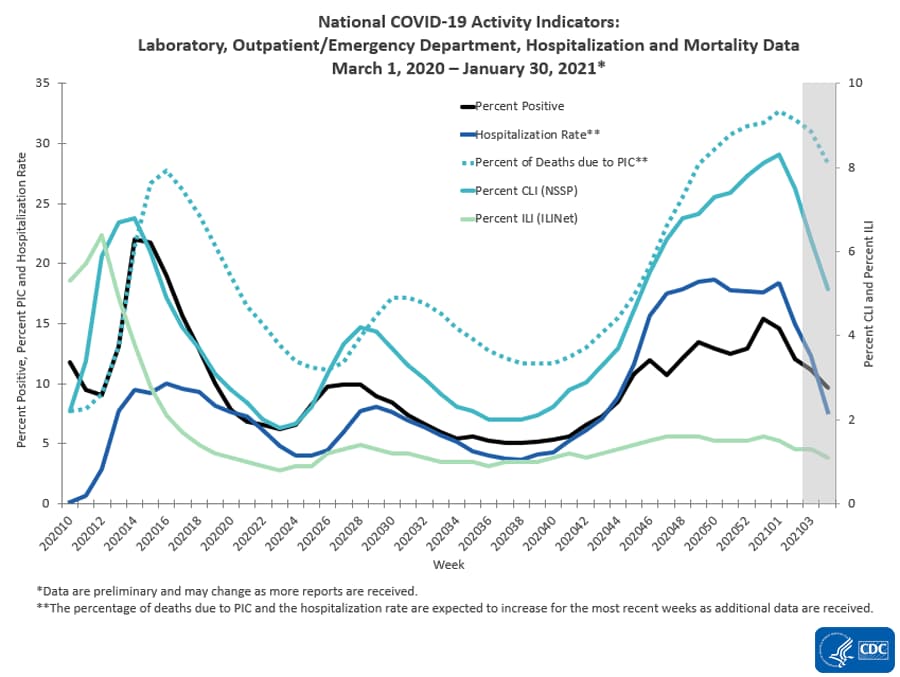
source: https://www.cdc.gov/coronavirus/2019-ncov/covid-data/covidview/index.html
Hospitalizations Are The Only Accurate Gauge As Reporting Is Not Affected By Holidays
The 4 day Thanksgiving holiday period put the first wobble in the trends. Over weekends and holidays, the number of new cases and deaths decline. Over weekends, this is not a problem for week-over-week rolling averages as weekends are compared against the previous weekend. But when a holiday falls within a working week, a non-working day is compared to a working day which causes havok in the trends.
However, hospitalizations historically appear to be little affected by weekends or holidays – the daily counts do not vary significantly from day-to-day.
The hospitalization growth rate trend is improving.

For the Thanksgiving and the end of the year holiday period – roughly, it seems each appears to have added around 5 % to the rate of growth of new cases, hospitalizations, and deaths.
Historically, hospitalization growth follows new case growth by one to two weeks.
As an analyst, I use the rate of growth to determine the trend. But, the size of the pandemic is growing in terms of real numbers – and if the rate of growth does not become negative – the pandemic will overwhelm all resources.
The graph below shows the rate of growth relative to the growth a week earlier updated through today [note that negative numbers mean the rolling averages are LOWER than the rolling averages one week ago]. As one can see, the rate of growth for new cases peaked in early December 2020 for Thanksgiving, and early January 2021 for end of year holidays – and the rate of growth is now contracting.

In the scheme of things, new cases decline first, followed by hospitalizations, and then deaths.
It is up to each of our readers to protect themselves and others by washing your hands, wearing a mask, avoiding crowds, and maintaining social distancing.
Will The New Variants Cause The Next Spike?
Maybe and maybe not. It all depends on vaccinations:
- the more people that are vaccinated reduces the pool of people that can be infected. Today we have removed over 12 % of the population from being infected which theoretically should reduce the infection rate by 12 % [it is unstudied whether the vaccines prevent a vaccinated person from being a carrier of the virus even though showing no signs]. If the vaccines are shown to stop transmission, then in theory it would reduce the infection rate by double the percent vaccinated [in this case you prevent your own infection and do not pass it along to another].
- it is also unknown what the effective rate of the current vaccines is against mutations that seem to appear almost daily. As an example, if the effective rate drops to 60%, it means the 12 % reduction in the infection rate discussed above is almost cut in half. The South African and Brazilian variant is somewhat immune to the current vaccines.
- The pandemic should be over immediately if everyone could be vaccinated today. The problem is that every day brings a new mutation (which would not appear if the pandemic was stopped). The longer the immunization process takes – the more ineffective the vaccine will become.
- It is not clear whether the vaccine prevents those vaccinated from spreading the virus. It seems to be well documented that it normally stops the virus from taking hold and when it does not – the infection is mild.
Coronavirus News You May Have Missed
CDC Says Double-Masking Offers More Protection Against The Coronavirus – NPR
The Centers for Disease Control and Prevention released new research on Wednesday that found wearing a cloth mask over a surgical mask offers more protection against the coronavirus, as does tying knots on the ear loops of surgical masks. Those findings prompted new guidance on how to improve mask fit at a time of concern over fast-spreading variants of the virus.
For optimal protection, the CDC says to make sure the mask fits snugly against your face, and choose a mask with at least two layers.
In laboratory testing, researchers simulated coughs and breathing and tested how well different masks worked to block aerosol particles — comparing no mask, a cloth mask, or a surgical mask. They also tested two methods to optimize the fit of cloth and medical masks: wearing a cloth mask over a surgical mask, and tying knots on the ear loops of surgical masks and then tucking in and flattening the extra material against the face.
Both methods produced substantially improved protection against transmission of and exposure to infectious aerosols.
“In the study, wearing any type of mask performed significantly better than not wearing a mask,” said CDC Director Rochelle Walensky in a briefing from the White House COVID-19 Response Team on Wednesday.
“And well-fitting masks provided the greatest performance at both blocking emitted aerosols and exposure of aerosols to the receiver. In the breathing experiment, having both the source and the receiver wear masks modified to fit better reduced the receiver’s exposure by more than 95%, compared to no mask at all,” she said.
[editor’s note: also read White House not recommending double masking at this time, considering a “range of options” to get masks to Americans]
“The B.1.1.7 (variant) is becoming widespread in the U.S.,” Dr. Anthony Fauci said, reiterating that the strain may become dominant in the U.S. by the end of March. Vaccines do well against the variant in test tube studies, Fauci said.
A variant from South Africa has been identified in a few U.S. states, but “it is very likely more prevalent than that,” Fauci said. Vaccine-induced immunity “stays within the realm of protection” from the virus, Fauci said.
“Bottom line is that we have vaccines that work well against it, and obviously we’re going to be planning, if necessary, to upgrade vaccines in the future if we ever have to do that.”
How Did U.S. Consumers Use Their Stimulus Payments? – NBER
Using a large-scale survey of U.S. consumers, we study how the large one-time transfers to individuals from the CARES Act affected their consumption, saving and labor-supply decisions. Most respondents report that they primarily saved or paid down debts with their transfers, with only about 15 percent reporting that they mostly spent it. When providing a detailed breakdown of how they used their checks, individuals report having spent or planning to spend only around 40 percent of the total transfer on average. This relatively low rate of spending out of a one-time transfer is higher for those facing liquidity constraints, who are out of the labor force, who live in larger households, who are less educated and those who received smaller amounts. We find no meaningful effect on labor-supply decisions from these transfer payments, except for twenty percent of the unemployed who report that the stimulus payment made them search harder for a job.
Putin’s Once-Scorned Vaccine Now Favorite in Pandemic Fight – Bloomberg
President Vladimir Putin’s announcement in August that Russia had cleared the world’s first Covid-19 vaccine for use before it even completed safety trials sparked skepticism worldwide. Now he may reap diplomatic dividends as Russia basks in arguably its biggest scientific breakthrough since the Soviet era.
Countries are lining up for supplies of Sputnik V after peer-reviewed results published in The Lancet medical journal this week showed the Russian vaccine protects against the deadly virus about as well as U.S. and European shots, and far more effectively than Chinese rivals.
At least 20 countries have approved the inoculation for use, including European Union member-state Hungary, while key markets such as Brazil and India are close to authorizing it. Now Russia is setting its sights on the prized EU market as the bloc struggles with its vaccination program amid supply shortages.
In the global battle to defeat a pandemic that’s claimed 2.3 million lives in little more than a year, the race to obtain vaccines has assumed geopolitical significance as governments seek to emerge from the huge social and economic damage caused by lockdowns imposed to limit the spread of the virus. That’s giving Russia an edge as one of a handful of countries where scientists have produced an effective defense.
Its decision to name Sputnik V after the world’s first satellite whose 1957 launch gave the Soviet Union a stunning triumph against the U.S. to start the space race only underlined the scale of the significance Moscow attached to the achievement. Results from the late-stage trials of 20,000 participants reviewed in The Lancet showed that the vaccine has a 91.6% success rate.
“This is a watershed moment for us,” Kirill Dmitriev, chief executive officer of the state-run Russian Direct Investment Fund, which backed Sputnik V’s development and is in charge of its international roll-out, said in an interview.

Decreased SARS-CoV-2 viral load following vaccination – Pfizer
Beyond their substantial protection of individual vaccinees, it is hoped that the COVID-19 vaccines would reduce viral load in breakthrough infections thereby further suppress onward transmission. Here, analyzing positive SARS-CoV-2 test results following inoculation with the BNT162b2 mRNA vaccine, we find that the viral load is reduced 4-fold for infections occurring 12-28 days after the first dose of vaccine. These reduced viral loads hint to lower infectiousness, further contributing to vaccine impact on virus spread.
Coronavirus vaccination may be cause of rare blood disorder in at least 36 people – Fox
At least 36 people may have developed a rare blood disorder, known as immune thrombocytopenia (ITP), after taking either Pfizer and BioNTech or Moderna’s COVID-19 vaccines, according to a report.
The condition develops when the immune system attacks platelets, a blood component essential for clotting, or the cells that create them, for unknown reasons.
According to The New York Times, the cases were reported to VAERS, the government’s Vaccine Adverse Event Reporting System, as of the end of January. However, the system relies on individuals to send in reports of their experiences to the CDC and FDA, and does not indicate whether vaccines actually caused the problems.
Over 43 million COVID-19 vaccine doses have been administered in the United States, with over 32 million Americans receiving at least one dose, according to the latest data Tuesday from the Centers for Disease Control and Prevention. No cases of thrombocytopenia were reported during the trials of either Moderna’s or Pfizer’s vaccines.
A Pfizer spokesperson told FOX News it is “aware of cases of thrombocytopenia in recipients of our COVID-19 vaccine” and takes reports of adverse events “very seriously.”
“We are collecting relevant information to share with the FDA. However, at this time, we have not been able to establish a causal association with our vaccine,” the spokesperson added. “To date, millions of people have been vaccinated and we are closely monitoring all adverse events in individuals receiving our vaccine. Serious adverse events, including deaths that are unrelated to the vaccine, are unfortunately likely to occur at a similar rate as they would in the general population.”
Pfizer noted that the 36 reports does not necessarily mean 36 separate and individual patients got thrombocytopenia after getting the vaccine, citing the possibility of duplicate entries submitted to the VAERS system.
Lilly Covid Antibody Combo Gets U.S. Emergency Authorization – Bloomberg
Eli Lilly & Co.‘s combination antibody drug for Covid-19 was cleared for emergency use by U.S. regulators, providing doctors with a treatment option that is expected to be better able to combat new coronavirus mutations.
The Food and Drug Administration authorized the treatment for use in Covid-positive adults and children 12 and older who are at high risk of developing severe forms of the disease or progressing to the hospital, according to a fact sheet posted Tuesday by the agency.
The combo treatment is the second antibody therapy from the Indianapolis-based drugmaker to gain an emergency authorization from the FDA. In November, the agency cleared bamlanivimab, one of the two antibodies used in the cocktail, for use in non-hospitalized, high-risk patients with mild-to-moderate symptoms of Covid-19.
Bamlanivimab, developed with AbCellera Biologics Inc., mimics the immune system’s virus-fighting powers. Regeneron Pharmaceuticals Inc. also gained FDA authorization for a product combining two antibodies last year. Former President Donald Trump received Regeneron’s drug after contracting Covid-19.
No wait for Covid-19 tests, Indian Army’s desi hounds sniff it out in seconds – India Today
The two Army dogs have till date tested 3,800 samples, of which 22 were found positive. Within seconds, the dog identifies the positive sample. The signal to his instructor is simple — he just sits next to the box, indicating it’s a positive case.
Two-year-old Casper, a cocker spaniel dog of the Indian Army, goes about sniffing little boxes. These are not explosives that such dogs can detect but urine samples for Covid-19 testing. Casper along with Jaya, a one-year-old Indian ‘chippiparai’, a hunting hound with extraordinary sniffing capabilities, is also quick in going about her business.
The two dogs have till date tested 3,800 samples, of which 22 were found positive. Within seconds, the dog identifies the positive sample. The signal to his instructor is simple — he just sits next to the box, indicating it’s a positive case.
The Indian Army has trained dogs for detecting Covid-19 cases by smelling urine and sweat samples since September last year after a surge in Covid cases in the Army.
By September 2020, there were nearly 20,000 Covid cases in the armed forces with over 16,000 infected in the Indian Army according to data presented in Parliament then.
Mani, another Indian ‘chippiparai’ hound, is still being trained to join the two during a demonstration, but is already quick enough to sniff and detect the samples in a matter of few seconds, giving confidence to his trainer that he is ready for the job.
The dogs are being used to augment the testing capabilities to identify the positive cases early and isolate them before the usual RT-PCR test results come.
Could a Single Vaccine Work Against All Coronaviruses? – New York Times
Scientists are working on a shot that could protect against Covid-19, its variants, certain seasonal colds — and the next coronavirus pandemic.
Now researchers are starting to develop prototypes of a so-called pancoronavirus vaccine, with some promising, if early, results from experiments on animals. Dr. Eric Topol, a professor of molecular medicine at the Scripps Research Institute in San Diego, thinks scientists should join together in another large-scale vaccine-creation project immediately.
“We have to get a real work force to accelerate this, so we can have it this year,” he said. Dr. Topol and Dennis Burton, a Scripps immunologist, called for this project on broad coronavirus vaccines on Monday in the journal Nature.
After coronaviruses were first identified in the 1960s, they did not become a high priority for vaccine makers. For decades it seemed as if they only caused mild colds. But in 2002, a new coronavirus called SARS-CoV emerged, causing a deadly pneumonia called severe acute respiratory syndrome, or SARS. Scientists scrambled to make a vaccine for it.
Since no one had made a coronavirus vaccine for humans before, there was a huge amount to learn about its biology. Eventually, researchers chose a target for immunity: a protein on the surface of the virus, called spike. Antibodies that stick to the spike can prevent the coronavirus from entering cells and stop an infection.
… In 2016, Maria Elena Bottazzi, a virologist at Baylor College of Medicine, and her colleagues applied for support from the American government to develop a pancoronavirus vaccine, but did not receive it. “They said there’s no interest in pancorona,” Dr. Bottazzi recalled.
Her team even lost funding for developing a SARS vaccine after they showed that it worked in mice, was not toxic to human cells and could be manufactured at scale. A coronavirus that had disappeared from view simply wasn’t a top priority.
Without enough money to start clinical trials, the scientists stored their SARS vaccine in a freezer and moved on to other research. “It’s been a struggle,” Dr. Bottazzi said.
[editor’s note: also read Scientists ramp up work on vaccine that would address every type of coronavirus: report]
COVID-19 tests can spot variants, lab companies insist – ABC
Quest Diagnostics and LabCorp., two of the biggest test processing labs in the U.S., say they haven’t reported any changes to the accuracy of their testing data with false negatives from the new U.K. coronavirus variant.
Abbott, a U.S. medical device and health care company that produced rapid tests purchased in large numbers by the federal government, said its BinaxNOW tests are still working as promised.
“We’ve continued to track these new variants as they emerge,” Dr. Mary Rodgers, principal scientist and head of infectious disease research at Abbott, told ABC News. “We’ve been bringing in samples to confirm our prediction based on the sequences, which indicate that there’s no cause for concern for any of our Abbott tests.”
The insistence by testing companies that their products are still working as hoped comes amid reports that the virus has mutated in countries where it spread widely. Three variants originating in the U.K., South Africa and Brazil have been documented in the U.S. and raised concerns that as the virus continues to mutate, that the nation’s current arsenal of tests to detect the virus might become less effective.
9 million U.S. small businesses fear they won’t survive pandemic – CBS
Three out of every 10 small businesses in the U.S. say they likely won’t survive 2021 without additional government assistance during the coronavirus pandemic, a survey from the Federal Reserve Bank shows. Considering there are roughly 30 million small businesses in the U.S., that means 9 million small firms are at risk of closing for good this year.
The outlook is even worse for minority-owned businesses: 8 in 10 said their company is in poor financial condition, according to the Fed survey, even after receiving limited help from Paycheck Protection Program (PPP) loans and other small business relief efforts during the pandemic.
Sam Myers, operations manager for Black-owned moving company Dillard Movers of St. Paul, Minnesota, described 2020 as a difficult year for the business and said that 2021 is shaping up to be the same.
Markedly reduced hospitalizations with inhaled Asthma Tx steroid in small, open-label trial – MedPage
Inhaled budesonide (Pulmicort), a steroid generally used to treat asthma, dramatically reduced the need for hospitalization in COVID-19 patients within a week of symptom onset, a small randomized trial in the U.K. found.
Among 139 patients with mild COVID-19 symptoms, 10 in the control group required either a COVID-19-related urgent care or emergency department (ED) visit or hospitalization compared to one in the intervention group by day 28 of follow-up, reported Mona Bafadhel, PhD, of the University of Oxford in England, and colleagues.
This resulted in a number needed to treat of eight to prevent COVID-19 deterioration in one patient, they reported in a medRxiv preprint that had not undergone peer review.
Bafadhel and colleagues said they stopped the trial early when it was determined further enrollment would not change the study outcome.
“There have been important breakthroughs in [hospitalized] COVID-19 patients, but equally important is treating early disease to prevent clinical deterioration … especially to the billions of people worldwide who have limited access to hospital care,” Bafadhel said in a statement. “I am heartened that a relatively safe, widely available and well studied medicine such as an inhaled steroid could have an impact on the pressures we are experiencing during the pandemic.”
Vaccine doses may be needed annually for several years – The Hill
Johnson & Johnson CEO Alex Gorsky said people may be getting COVID-19 vaccines annually for the next several years.
Gorsky made the comment at a CNBC event on Tuesday after he was asked if he felt that post-pandemic vaccines would be needed, specifically if people would require updated COVID-19 vaccines every year, similar to the flu.
Gorsky said that a lot would depend on how the virus mutates.
“Every time it mutates, it’s almost like another click of the dial, so to speak, where we can see another variant, another mutation that can have an impact on its ability, for example, to fend off antibodies or to have a different kind of response not only to a therapeutic but also to a vaccine,” Gorsky said.
“I think most people feel that this will be something, where, likely for the next several years, we’ll be getting a COVID-19 shot, just like we would a flu shot. Exactly what that shot is going to be comprised of, I don’t think we know, today. But, I think we can all imagine a future where we’re living with this, but we can keep the science at pace with the virus so we can keep on living our lives,” he added.
COVID-19 Cases Have Been ‘Severely Undercounted,’ Study Says – Medscape
Large numbers of COVID-19 cases have been undetected and unreported, which has resulted in severe undercounting of the total number of people who have been infected during the pandemic, according to a new study published Monday in the journal PLoS One.
In the U.S., the number of COVID-19 cases is likely 3 times that of reported cases. According to the study, more than 71 million Americans have contracted the virus during the pandemic, and 7 million were infected or potentially contagious last week.
Public health officials rely on case counts to guide decisions, so the undercounting should be considered while trying to end the pandemic.
“The estimates of actual infections reveal for the first time the true severity of COVID-19 across the U.S. and in countries worldwide,” Jungsik Noh, a bioinformatics professor at the University of Texas Southwestern Medical Center, said in a statement.
Noh and colleague Gaudenz Danuser created a computational model that uses machine-learning strategies to estimate the actual number of daily cases in the U.S. and the 50 most-infected countries.
The model pulls data from the Johns Hopkins University database and the COVID Tracking Project, as well as large-scale surveys conducted by the CDC and several states. The algorithm uses the number of reported deaths, which is thought to be more accurate than the number of lab-confirmed cases, as the basis for calculations.
In 25 of the 50 countries, the “actual” cumulative cases were estimated to be 5 to 20 times greater than the confirmed cases. In the U.S., Belgium, and Brazil, about 10% of the population has contracted the coronavirus, according to the model. At the beginning of February, about 11% of the population in Pennsylvania had current infections, which was the highest rate of any state. About 0.15% of residents in Minnesota had infections, and about 2.5% of residents in New York and Texas had infections.
“Knowing the true severity in different regions will help us effectively fight against the virus spreading,” Noh said. “The currently infected population is the cause of future infections and deaths. Its actual size in a region is a crucial variable required when determining the severity of COVID-19 and building strategies against regional outbreaks.”
COVID-19 Could Increase Dementia, Other Brain Disorders for Decades to Come – Newsweek
Loss of smell, emotional detachment and other cognitive disorders among COVID-19 survivors has in recent weeks become an urgent medical issue. Some patients experience psychotic breaks. Others report strange neurological symptoms—tremors, extreme fatigue, phantom smells, dizziness and bouts of profound confusion, a condition known as “brain fog.” In one early study of more than 200 patients in Wuhan, neurological complications were identified in 36 percent of all cases and in 45 percent of severe cases. Another study in France in the New England Journal of Medicine reported neurological symptoms in 67 percent of patients.
Although it’s too early to tell what the long-term effects of COVID-19 will be on the cognitive health of survivors, scientists now fear the disease could feed a spike in dementia and other neurodegenerative diseases in the decades ahead. In addition, a growing number of COVID long-haulers already meet the clinical criteria for Chronic Fatigue Syndrome (CFS), a mysterious condition, also called myalgic encephalomyelitis, characterized by extreme fatigue, exercise intolerance and a whole host of other strange and debilitating neurological symptoms. Prior to COVID-19, CFS afflicted 2 million Americans.
If COVID long-haulers follow the trajectory of those who suffer from CFS, anywhere from 10-to-30 percent of those infected by SARS-CoV-2 may eventually experience long-term symptoms—a vast pool of additional millions with the condition who will place a new strain our healthcare burden, says Avindra Nath, clinical director of the National Institute of Neurological Disorders and Stroke (NINDS).
In recent months, the medical establishment has belatedly begun to respond to the crisis. Whereas COVID-19 was in early months considered mainly a respiratory virus, there’s now a growing appreciation for its effect on other organs, including the brain. In addition, the media has increasingly begun to draw attention to the plight of long-haulers and their cognitive symptoms.
“The realization that there’s a neurological effect has been really recent,” says Nath. “I’ve been trying to beat that drum for quite some time. Patients have been complaining about it for months, but the scientists were not doing anything about it.”
[editor’s note: also read Rare Blood Disorder Thrombocytopenia Reported After COVID Vaccines]
Electronic Health Records May Be Delaying COVID-19 Vaccinations – NPR
Why has it been so hard to get a COVID-19 vaccination? One reason may be the software that almost all medical records in the U.S. are built on.
It makes up the systems nurses and doctors type patients’ vital signs and prescriptions into — whether they’re getting a routine physical or going to the emergency room with a broken arm.
And it’s the same type of program used to log patient data when COVID-19 shots are given. But those electronic health records often aren’t connected and don’t share information easily.
That’s making it difficult to line up a vaccine appointment, keep track of side effects and make sure vaccines are being distributed equitably and efficiently, says Dr. Bob Kocher, who advised the state of California on COVID-19 testing.
“Electronic health records are the tools that doctors use to take notes on patient care, to share information with other doctors, to track your lab results, to order prescriptions,” he says. “They’re really the workflow software that health care providers use.”
But this sharing is “not done very often and it’s only done really when a patient requests for it to happen,” says Kocher, who helped shape the Affordable Care Act under the Obama administration. He’s also a partner at the venture capital firm Venrock.
Disconnected systems require patients to formally request that their medical information be sent from one doctor’s office to another. And even then, Kocher says, “that information doesn’t flow” to all of a patient’s caregivers.
“In reality, hospitals are a lot more like banks or retail stores,” he says. “They don’t want to share information because they’re worried that patients might actually go to another location and get their care.”
There are over 1,000 different electronic health record systems in the U.S., and almost every hospital and clinic has a slightly different system tailored to its own needs, Kocher says.
How to avoid buying counterfeit N95 masks – USA Today
The most important thing to look for in an N95 mask is that the respirator has been tested and certified by the National Institute for Occupational Safety and Health (NIOSH). Both the mask and its packaging should be labeled “NIOSH-approved,” Dr. Stella Hines, Associate Professor at the University of Maryland School of Medicine, says. “These masks must meet a specific set of criteria to guarantee that they provide the expected level of protection and performance,” Dr. Hines explains. “A formal fit-testing procedure ensures that there is an adequate seal to the face.”
Legitimate N95 masks do not have ear loops—they have straps or a headband instead—and no other decorative accents. There should be an approval number on the filtering respirator and NIOSH must be spelled correctly. The CDC also cautions that any mask that claims to be approved for children is fake as NIOSH does not approve any respiratory protection for children.
Churchman also recommends keeping an eye out for any N95 masks that are significantly more expensive than the average respirator or ones that are available in suspiciously large quantities. He says that both of these are strong indicators of potential fraud, given that demand is high and that legitimate manufacturers won’t charge a premium during a pandemic.
The following are foreign headlines with hyperlinks to the posts
Israel’s ultra-Orthodox community has come under heavy criticism for holding large funerals and weddings in clear and dangerous violations of coronavirus restrictions. The gatherings have brought clashes with police and unprecedented public anger toward the religious community.
South Africa Vaccines: The country will begin administering the unapproved Johnson & Johnson vaccine to its front-line health care workers next week. It will also study them to see what protection the J&J shot provides from COVID-19, particularly against the variant dominant in the country.
WHO in Wuhan: A team of international and Chinese scientists looking for the origins of the virus have said it most likely first appeared in humans after jumping from an animal. The team dismissed as unlikely a theory that the virus leaked from a Chinese lab.
France Island Inequality: It’s the poorest corner of the European Union and was the last to receive any coronavirus vaccines. Welcome to the French Indian Ocean territory of Mayotte, where virus cases are spiking to their highest levels since the pandemic began, and demand for ICU beds is more than triple the supply.
U.K. residents may not be allowed to travel abroad until all adults are vaccinated.
WHO panel recommends AstraZeneca vaccine for emergency use
South Africa giving unapproved Johnson & Johnson vaccine to health care workers
Hong Kong plans to reopen restaurants, ease social distancing restrictions
Norway extends border closures to the end of February
EU drug regulator says it has not received an application for Russia’s Sputnik V vaccine
Spain’s patients recovering from Covid-19 must wait six months for vaccine
Bahrain becomes latest country to approve Russian vaccine
Ghana shuts down parliament for three weeks because of Covid-19 outbreak
South Korea grants conditional approval for AstraZeneca Covid-19 vaccine
UK coronavirus variant has been reported in 86 countries, WHO says
The following additional national and state headlines with hyperlinks to the posts
Oxford Covid vaccine has 10% efficacy against South African variant, study suggests
Although 72 senators have received one or more doses of the coronavirus vaccine, gathering indoors for former President Trump’s impeachment trial may still be risky
Roughly 15.2 million people age 65 or older have received at least one dose of the vaccine, out of an estimated 56 million in that age cohort.
Had it with constantly refreshing a dozen websites to get yourself — or an elderly relative — a vaccine? Tech-savvy people in New York and other states are building local workarounds.
Major League Baseball players and personnel must wear electronic tracing wristbands from the start of spring training, and will be disciplined for violations.
Uber is giving people in underserved areas free rides to Walgreens for their COVID-19 vaccine appointments.
The FDA issued guidance on the use of ventilator splitters during the pandemic.
Only about half of Americans under 65 said they were “absolutely likely” or “very certain” to get the COVID-19 vaccine in a new CDC poll.
Over 30 percent of Americans say they won’t get COVID-19 vaccine: poll
71% of Americans are now willing to get Covid-19 vaccines, Gallup poll finds
COVID-19 in Children: New Cases Down for Third Straight Week
FDA Authorizes Monoclonal Antibody Treatment to Lessen Severity of COVID-19
Nursing homes with more minority residents reported more than three times as many Covid deaths as those that had more White residents, a large study published Wednesday found.
Target will offer extra pay and free transportation to encourage hourly workers to get Covid vaccines.
Coca-Cola’s fourth-quarter revenue fell 5% to $8.6 billion as demand for its drinks waned amid the worldwide resurgence of Covid in December and January.
White House announces new mass vaccination centers in Texas
About 20,000 pregnant women have received Covid-19 vaccines so far, ‘with no red flags,’ Fauci says
Today’s Posts On Econintersect Showing Impact Of The Pandemic With Hyperlinks
December 2020 Headline Wholesale Sales Improved and Inventories Marginally Up
January 2021 CPI: Year-over-Year Inflation Rate Unchanged
Infographic Of The Day: Visualizing Global Attitudes Towards The COVID-19 Vaccines
No Recovery For The Bottom Half
Warning to Readers
The amount of politically biased articles on the internet continues to increase. And studies and opinions of the experts continue to contradict other studies and expert opinions. Honestly, it is difficult to believe anything anymore. A studymers Expect Higher Spending and Home Prices Improvement
January 2021 Small Business Optimism Drops Further Below Historical Index Average in January
Infographic Of The usually cannot establish cause and effect – but only correlation. Be very careful what you believe about this pandemic.

I assemble this coronavirus update daily – sifting through the posts on the internet. I try to avoid politically slanted posts (mostly from CNN, New York Times, and the Washington Post) and can usually find unslanted posts on that subject from other sources on the internet. I wait to publish posts on subjects that I cannot validate across several sources. But after all this extra work, I do not know if I have conveyed the REAL facts. It is my job to provide information so that you have the facts necessary – and then it is up to readers to draw conclusions.
Analyst Opinion of Coronavirus Data
There are several takeaways that need to be understood when viewing coronavirus statistical data:
- The global counts are suspect for a variety of reasons including political. Even the U.S. count has issues as it is possible that as much as half the population has had coronavirus and was asymptomatic. It would be a far better metric using a random sampling of the population weekly. In short, we do not understand the size of the error in the tracking numbers.
- Just because some of the methodology used in aggregating the data in the U.S. is flawed – as long as the flaw is uniformly applied – you establish a baseline. This is why it is dangerous to compare two countries as they likely use different methodologies to determine who has (and who died) from coronavirus.
- COVID-19 and the flu are different but can have similar symptoms. For sure, COVID-19 so far is much more deadly than the flu. [click here to compare symptoms]
- From an industrial engineering point of view, one can argue that it is best to flatten the curve only to the point that the health care system is barely able to cope. This solution only works if-and-only-if one can catch this coronavirus once and develops immunity. In the case of COVID-19, herd immunity may need to be in the 80% to 85% range. WHO warns that few have developed antibodies to COVID-19 when recovering from COVID-19. Herd immunity does not look like an option without immunization although there is now a discussion of whether T-Cells play a part in immunity [which means one might have immunity without antibodies]
- Older population countries will have a significantly higher death rate as there is relatively few hospitalizations and deaths in younger age groups..
- There are at least 8 strains of the coronavirus. New York may have a deadlier strain imported from Europe, compared to less deadly viruses elsewhere in the United States.
- Each publication uses different cutoff times for its coronavirus statistics. Our data uses 11:00 am London time. Also, there is an unexplained variation in the total numbers both globally and in the U.S.
What we do or do not know about the coronavirus [actually there is little scientifically proven information]. Most of our knowledge is anecdotal, from studies with limited subjects, or from studies without peer review.
- How many people have been infected as many do not show symptoms?
- Masks do work. Unfortunately, early in the pandemic, many health experts — in the U.S. and around the world — decided that the public could not be trusted to hear the truth about masks. Instead, the experts spread a misleading message, discouraging the use of masks.
- Current thinking is that we develop 5 months of immunity from further COVID infection.
- The Moderna and Pfizer vaccines have an effectiveness rate of about 95 percent after two doses. That is on par with the vaccines for chickenpox and measles. The 95 percent number understates the effectivenessas it counts anyone who came down with a mild case of Covid-19 as a failure. But turning Covid into a typical flu — as the vaccines evidently did for most of the remaining 5 percent — is actually a success. Of the 32,000 people who received the Moderna or Pfizer vaccine in a research trial, only one contracted a severe Covid case.
- To what degree do people who never develop symptoms contribute to transmission? Research early in the pandemic suggested that the rate of asymptomatic infections could be as high as 81%. But a meta-analysis, which included 13 studies involving 21,708 people, calculated the rate of asymptomatic presentation to be 17%.
- The accuracy of rapid testing is questioned – and the more accurate test results are not being given in a timely manner.
- Can children widely spread coronavirus? [current thinking is that they are a minor source of the pandemic spread]
- Why have some places avoided big coronavirus outbreaks – and others hit hard?
- Air conditioning contributes to the pandemic spread.
- It appears that there is increased risk of infection and mortality for those living in larger occupancy households.
- Male patients have almost three times the odds of requiring intensive treatment unit (ITU) admission compared to females.
- Outdoor activities seem to be a lower risk than indoor activities.
- Will other medical treatments for Covid-19 ease symptoms and reduce deaths? So far only remdesivir, Bamlanivimab,
and Regeneron) are approved for treatment. What drugs work?
Arthritis drugs tocilizumab and sarilumab could cut relative risk of death of those in intensive care by 24%
- A current scientific understanding of the way the coronavirus works can be found [here].
There is now a vaccine available – the questions remain:
- how effective it will be in the general population,
- will there be any permanent side effects that will appear months from now,
- how long immunity will last [we can currently say we do not know if it will last more than 4 months],
- there is no evidence the vaccine will block transmission
Heavy breakouts of coronavirus have hit farmworkers. Farmworkers are essential to the food supply. They cannot shelter at home. Consider:
- they have high rates of respiratory disease [occupational hazard]
- they travel on crowded buses chartered by their employers
- few have health insurance
- they cannot social distance and live two to four to a room – and they eat together
- some reports say half are undocumented
- they are low paid and cannot afford not to work – so they will go to work sick
- they do not have access to sanitation when working
- a coronavirus outbreak among farmworkers can potentially shutter entire farm
The bottom line is that COVID-19 so far has been shown to be much more deadly than the data on the flu. Using CDC data, the flu has a mortality rate between 0.06 % and 0.11 % Vs. the coronavirus which to date has a mortality rate of 4 % [the 4% is the average of overall statistics – however in the last few months it has been hovering around 1.0%] – which makes it between 10 and 80 times more deadly. The reason for ranges:
Because influenza surveillance does not capture all cases of flu that occur in the U.S., CDC provides these estimated ranges to better reflect the larger burden of influenza.
There will be a commission set up after this pandemic ends to find fault [it is easy to find fault when a once-in-a-lifetime event occurs] and to produce recommendations for the next time a pandemic happens. Those that hate President Trump will conclude the virus is his fault.
Resources:
- Get the latest public health information from CDC: https://www.coronavirus.gov .
- Get the latest research from NIH: https://www.nih.gov/coronavirus.
- Find NCBI SARS-CoV-2 literature, sequence, and clinical content: https://www.ncbi.nlm.nih.gov/sars-cov-2/.
- List of studies: https://icite.od.nih.gov/covid19/search/#search:searchId=5ee124ed70bb967c49672dad
include(“/home/aleta/public_html/files/ad_openx.htm”); ?>


