


Written by Steven Hansen
The U.S. new cases 7-day rolling average are 21.2 % LOWER than the 7-day rolling average one week ago. U.S. hospitalizations due to COVID-19 are now 12.6 % LOWER than the rolling average one week ago. U.S. deaths due to coronavirus are now 0.5 % HIGHER than the rolling average one week ago. Today’s posts include:
- U.S. Coronavirus New Cases are 88,044 [lowest number since 02 November 2021]
- U.S. Coronavirus hospitalizations are at 81,439 [lowest number since 19 November 2021]
- U.S. Coronavirus deaths are 1,276 [are the new variants more deadly or are vaccinations increasing deaths – as deaths are no longer correlating with new cases or hospitalizations?>
- U.S. Coronavirus immunizations have been administered to 12.3 % of the population
- The 7-day rolling average rate of growth of the pandemic shows new cases improved, hospitalizations little changed, and deaths improved
- Hopefully, these current improving COVID trends will remain in play even with the new strains
- Analysis suggests vaccinations are helping decline of Covid-19 in nursing homes
- UK strain doubling every 10 days in US
- US FDA Gearing Up for Rapid Review of Potential COVID-19 Booster Shots
- Pfizer expects to cut COVID-19 vaccine production time by close to 50% as production ramps up, efficiencies increase
- Why the US Is Underestimating COVID Reinfection
- Historical data indicates that physical training undertaken around the time of vaccination could improve efficacy
- The pandemic pushes millions from the labor force. That’s bad news
- Decreased SARS-CoV-2 viral load following vaccination

The recent worsening of the trendlines for new cases is behind us which was attributed to going back to college/university, cooler weather causing more indoor activities, mutation of the virus, fatigue from wearing masks / social distancing, holiday activities, and some loosening of regulations designed to slow the coronavirus spread.
My continuing advice is to continue to wash your hands (especially after using the toilet as COVID first sheds in your stool), putting down the toilet seat (as flushing the toilet releases a plume), wear masks, avoid crowds, and maintain social distancing. No handwashing, mask, or social distancing will guarantee you do not get infected – but it sure as hell lowers the risk in all situations – and the evidence to-date shows a lower severity of COVID-19. In addition, certain activities are believed to carry a higher risk – like being inside in air conditioning and removing your mask (such as restaurants, around your children/grandchildren, bars, and gyms). It is all about viral load – and outdoor activities are generally safe if you can maintain social distance. Finally, studies show eating right (making sure you are supporting your immune system) and adequate sleep increase your ability to fight off COVID.
include($_SERVER[‘DOCUMENT_ROOT’].’/pages/coronavirus1.htm’); ?>
Hospitalizations (grey line) and Mortality (green line)
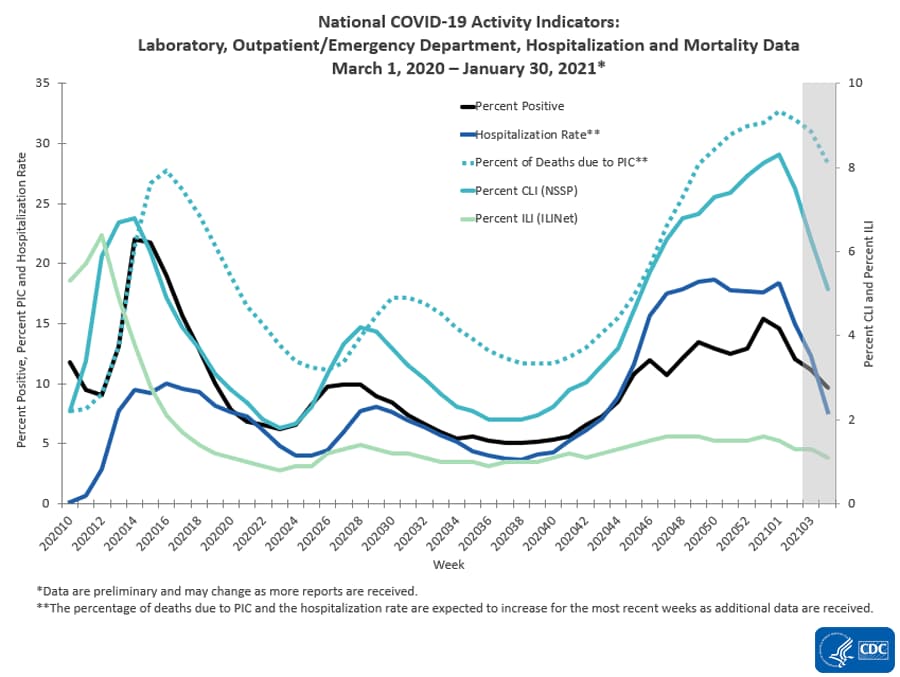
source: https://www.cdc.gov/coronavirus/2019-ncov/covid-data/covidview/index.html
Hospitalizations Are The Only Accurate Gauge As Reporting Is Not Affected By Holidays
The 4 day Thanksgiving holiday period put the first wobble in the trends. Over weekends and holidays, the number of new cases and deaths decline. Over weekends, this is not a problem for week-over-week rolling averages as weekends are compared against the previous weekend. But when a holiday falls within a working week, a non-working day is compared to a working day which causes havok in the trends.
However, hospitalizations historically appear to be little affected by weekends or holidays – the daily counts do not vary significantly from day-to-day.
The hospitalization growth rate trend is improving.

For the Thanksgiving and the end of the year holiday period – roughly, it seems each appears to have added around 5 % to the rate of growth of new cases, hospitalizations, and deaths.
Historically, hospitalization growth follows new case growth by one to two weeks.
As an analyst, I use the rate of growth to determine the trend. But, the size of the pandemic is growing in terms of real numbers – and if the rate of growth does not become negative – the pandemic will overwhelm all resources.
The graph below shows the rate of growth relative to the growth a week earlier updated through today [note that negative numbers mean the rolling averages are LOWER than the rolling averages one week ago]. As one can see, the rate of growth for new cases peaked in early December 2020 for Thanksgiving, and early January 2021 for end of year holidays – and the rate of growth is now contracting.

In the scheme of things, new cases decline first, followed by hospitalizations, and then deaths.
It is up to each of our readers to protect themselves and others by washing your hands, wearing a mask, avoiding crowds, and maintaining social distancing.
Will The New Variants Cause The Next Spike?
Maybe and maybe not. It all depends on vaccinations:
- the more people that are vaccinated reduces the pool of people that can be infected. Today we have removed over 12 % of the population from being infected which theoretically should reduce the infection rate by 12 % [it is unstudied whether the vaccines prevent a vaccinated person from being a carrier of the virus even though showing no signs]. If the vaccines are shown to stop transmission, then in theory it would reduce the infection rate by double the percent vaccinated [in this case you prevent your own infection and do not pass it along to another].
- it is also unknown what the effective rate of the current vaccines is against mutations that seem to appear almost daily. As an example, if the effective rate drops to 60%, it means the 12 % reduction in the infection rate discussed above is almost cut in half. The South African and Brazilian variant is somewhat immune to the current vaccines.
- The pandemic should be over immediately if everyone could be vaccinated today. The problem is that every day brings a new mutation (which would not appear if the pandemic was stopped). The longer the immunization process takes – the more ineffective the vaccine will become.
- It is not clear whether the vaccine prevents those vaccinated from spreading the virus. It seems to be well documented that it normally stops the virus from taking hold and when it does not – the infection is mild.
Coronavirus News You May Have Missed
Analysis suggests vaccinations are helping decline of Covid-19 in nursing homes – CNN
New Covid-19 cases among nursing home residents and staff have dropped more than 50% in about four weeks, according to a CNN analysis of the latest data published by the US Centers for Medicare and Medicaid Services. The data captured cases reported between the week ending Dec. 20 and the week ending Jan. 24.
A separate analysis by the American Health Care Association and National Center for Assisted Living found that new Covid-19 cases have dropped twice as fast in those nursing homes that held early vaccination clinics.
Last week, CMS said it was too soon to link the ongoing decreases in nursing home cases to vaccination efforts. [editor’s note: Dr. Fauci also stated that the vaccines were not responsible for the dropping new cases.]
… The AHCA/NCAL analysis, published last week, only assessed those nursing homes that enrolled in the Federal Partnership for Long-Term Care Program, including 797 facilities that held vaccination clinics in the first week and 1,709 facilities in the same set of counties that did not.
“The decline in new cases three weeks after the first dose, compared to facilities having vaccine clinics later, is encouraging and signals that the vaccine may decrease the spread of COVID, a finding not shown in the trials. If verified with additional data, this could expedite the reopening of long term care facilities to visitors, which is vital to residents’ health and wellbeing,” said Dr. David Gifford, chief medical officer for AHCA/NCAL. “Given the disproportionate impact COVID-19 has on long term care residents, we must continue to prioritize vaccinating the elderly in these settings.”
Pfizer expects to nearly cut in half the amount of time it takes to produce a batch of COVID-19 vaccine from 110 days to an average of 60 as it makes the process more efficient and production is built out, the company told USA TODAY.
As the nation revs up its vaccination programs, the increase could help relieve bottlenecks caused by vaccine shortages.
“We call this ‘Project Light Speed,’ and it’s called that for a reason,” said Chaz Calitri, Pfizer’s vice president for operations for sterile injectables, who runs the company’s plant in Kalamazoo, Michigan. “Just in the last month we’ve doubled output.”
The increased speed and capacity is not unexpected, said Robert Van Exan, president of Immunization Policy and Knowledge Translation, a vaccine production consulting firm.
“Nobody’s ever produced mRNA vaccines at this scale, so you can bet your bottom dollar the manufacturers are learning as they go. I bet you every day they run into some vaccine challenge and every day they solve it, and that goes into their playbook,” he said.
Pfizer’s COVID-19 vaccine is made at threePfizer plants: starting in Chesterfield, Missouri, moving to Andover, Massachusetts, and finishing in Kalamazoo, Michigan. As of Saturday, about 20.6 million doses of the Pfizer vaccine had been administered nationwide.
Herd Immunity Is Farther Away [Due To The UK Variant] – Tomas Pueyo – Substack
B117, the English Variant Grows 50% to 70% Faster
We just increased the herd immunity threshold from ~60% of the population (through vaccines or recoveries) to ~75-80%.
If in a country 20% of the population is immune after getting infected at some point, with the previous variant it would only have had to vaccinate an additional ~40% of the population to reach the 60% herd immunity threshold.
Now, with a threshold of 75%, instead of an additional 40% of the population to vaccinate, it’s 55%. That’s 35% more vaccines (55% is 35% more than 40%), at a time when vaccines are scarce.
That’s not just harder. It also takes more time. If a country can vaccinate on average 5% of its population per month, it would take 8 months to get to herd immunity with the previous variant (so it would be done by August of 2021). But with the new variant, it would take 3 more months, all the way to November.
And that assumes those who were infected in the past are still immune. As they learned in Manaus, Brazil, this might not be true: They thought they had reached herd immunity with up to 75% of people having been infected. Then they had a second wave, probably with the new Brazilian variant, they ran out of oxygen, and people died like flies.
It’s Deadlier
When B117 first appeared, most people said: “We shouldn’t worry, normally when viruses mutate they become less virulent.“
I was one of the few who alerted that it was, unfortunately, probably deadlier.
This was the common thinking: “If a virus kills more quickly, it has fewer opportunities to spread. It’s the transmission-virulence tradeoff.” Unfortunately, that was too simplistic.
The evidence of the transmission-virulence tradeoff theory is not that clear. This fantastic paper explains it well.


Decreased SARS-CoV-2 viral load following vaccination – MedRxiv
Beyond their substantial protection of individual vaccinees, it is hoped that the COVID-19 vaccines would reduce viral load in breakthrough infections thereby further suppress onward transmission. Here, analyzing positive SARS-CoV-2 test results following inoculation with the BNT162b2 mRNA vaccine, we find that the viral load is reduced 4-fold for infections occurring 12-28 days after the first dose of vaccine. These reduced viral loads hint to lower infectiousness, further contributing to vaccine impact on virus spread.
COVID-19 vaccination in athletes: ready, set, go… – Lancet
A study analysing the effects of regular physical training by a group of elite athletes on vaccine-induced cellular and humoral immunity showed that although both groups had a marked increase in vaccine-reactive CD4 T-cell levels, which peaked 1 week after vaccination, this increase was more pronounced in athletes when compared with healthy controls. Similarly, the increase in neutralising antibodies was stronger in athletes, suggesting that regular high frequency and intensity of training might enhance vaccine response. Another study in athletes, analysing the impact of the timing of influenza vaccination on antigen-specific T cell responses, showed no appreciable difference between administration 2 and 24 h post training. Overall, the historical data does not appear to indicate that physical training undertaken around the time of vaccination will reduce efficacy, and could in fact improve vaccination response. Studies will be needed to evaluate these outcomes in the context of the novel formulations of COVID-19 vaccination.
A logical concern in the context of COVID-19 vaccination relates to the impact of vaccine-related side effects. Detail on COVID-19 vaccination tolerability in the general population is still emerging (ie, the post-licensing data is still awaited) and will likely differ based on type and formulation of vaccine. In the meantime, preliminary trial data provides reassurance regarding an overall low serious adverse event rate, and that severe systemic effects were reported in only 1-3% of individuals.
A broad range of local and systemic side effects following COVID-19 vaccination have, however, been reported in late-phase trial data. Although these side effects are generally mild (ie, they do not typically impact routine activities), they are more prevalent in younger individuals (ie, those younger than 55 years) and more pronounced following the second dose with some vaccines, within sequential staged vaccine administration. Specifically, in one of the most widely used COVID-19 vaccines to date, the Pfizer/BioNTech vaccine (BNT162b2 mRNA Covid-19), local reactogenicity was encountered in 83% of younger individuals and systemic reactogenicity, with fatigue and headache, was reported in about 50% of all individuals, with around 25% requiring anti-pyretic or analgesic medication. Pertinent to athletes, myalgia was reported in 21% of younger individuals following the first vaccine, rising to 37% following the second vaccine. Notably, there are no published data on the duration (days) of side effects and their impact on ability to perform physical activity; clearly this information will be an important consideration.
Safety analysis from the other main class and widely available vaccine, the Oxford-AstraZeneca vaccine (ChAdOx1 nCoV-19), revealed that around 50% of recipients had localised pain and tenderness at the vaccination site, of mild to moderate severity, which on occasion lasted 4-5 days post first-dose administration despite paracetamol administration. Fatigue and headache were also reported in about 70% of recipients post first-dose with muscle ache and fever present in 60%, although these effects were less frequently reported following the second dose.
UK strain doubling every 10 days in US – The Hill
The COVID-19 strain first discovered in the U.K. is doubling in the U.S. every 10 days, presenting a potential risk of increased cases and deaths in the country, according to a study released Sunday.
A group of researchers estimated that the U.K. variant, called B.1.1.7, spreads at an increased transmission rate of 35 to 45 percent and is expected to become the predominant strain in the U.S. by March. The study, released on server medRxiv, has not yet been peer-reviewed or published in a medical journal.
“Our study shows that the U.S. is on a similar trajectory as other countries where B.1.1.7 rapidly became the dominant SARS-CoV-2 variant, requiring immediate and decisive action to minimize COVID-19 morbidity and mortality,” the study reads.
Scientists determined from half a million COVID-19 tests and 212 genomes that the Centers for Disease Control and Prevention’s (CDC) prediction that the U.K. strain would become the most prevalent coronavirus variant in the U.S. by March.
Kristian Andersen, a co-author of the study and virologist at the Scripps Research Institute in La Jolla, Calif., told The New York Times that “nothing in this paper is surprising, but people need to see it.”
Why the US Is Underestimating COVID Reinfection – Kaiser Health
As millions of Americans struggle to recover from covid and millions more scramble for the protection offered by vaccines, U.S. health officials may be overlooking an unsettling subgroup of survivors: those who get infected more than once. Identifying how common reinfection is among people who contracted covid — as well as how quickly they become vulnerable and why — carries important implications for our understanding of immunity and the nation’s efforts to devise an effective vaccination program.
Scientists have confirmed that reinfections after initial illness caused by the SARS-CoV-2 virus are possible, but so far have characterized them as rare. Fewer than 50 cases have been substantiated worldwide, according to a global reinfection tracker. Just five have been substantiated in the U.S., including two detected in California in late January.
That sounds like a rather insignificant number. But scientists’ understanding of reinfection has been constrained by the limited number of U.S. labs that retain covid testing samples or perform genetic sequencing. A KHN review of surveillance efforts finds that many U.S. states aren’t rigorously tracking or investigating suspected cases of reinfection.
KHN sent queries about reinfection surveillance to all 50 states and the District of Columbia. Of 24 responses, fewer than half provided details about suspected or confirmed reinfection cases. Where officials said they’re actively monitoring for reinfection, they have found far more potential cases than previously anticipated.
US FDA Gearing Up for Rapid Review of Potential COVID-19 Booster Shots – Reuters
The U.S. Food and Drug Administration is planning a rapid review process for quick turnaround of new COVID-19 booster shots if variants of the coronavirus emerge against which the vaccines do not provide protection, the agency’s top official said on Thursday.
Dr. Janet Woodcock, acting commissioner of the FDA, said that if new variants of the coronavirus emerge that require booster shots or changes to vaccines, the agency will not require the type of large trials that were required for emergency use authorization or approval.
The agency plans to issue a proposal on the process for public comment in a few weeks, she said during a press briefing. That process will likely require safety information as well as, if possible, the convening of an outside committee of experts to review the booster shot.
Both Pfizer Inc and German partner BioNTech SE as well as Moderna Inc, whose vaccines have been authorized for emergency use in the United States, have said they are preparing for the possibility that variants will emerge that could require a booster shot.
The current vaccines still provide adequate protection against existing variants of concern, Woodcock said. A variant in the U.K. has been found to be more transmissible while some vaccines have been found to be less effective against variants that emerged in South Africa and Brazil.
Settling on a regulatory process will help the FDA move quickly if needed, she said.
The pandemic pushes millions from the labor force. That’s bad news – CNBC
- Around 406,000 people left the labor force last month, according to the January jobs report issued Friday by the Bureau of Labor Statistics. More than 4 million have left since the pandemic started.
- This dynamic may be due to childcare duties, fear of getting Covid in the workplace and other reasons.
- These workers aren’t counted as unemployed because they’re not actively looking for work.
- Households may experience a drop in income, which may reverberate across the economy and dampen a recovery.
The following are foreign headlines with hyperlinks to the posts
EU chief calls on member states to donate Covid-19 vaccines to Ukraine
South Africa halted use of the AstraZeneca-Oxford vaccine, because of evidence that it didn’t stop mild or moderate illness from the virus variant first found there. Scientists said it might still protect against severe symptoms.
South Africa Vaccine: The country has suspended plans to inoculate its front-line health care workers with the AstraZeneca vaccine after a small clinical trial suggested that it isn’t effective in preventing mild to moderate illness from the variant dominant in the country.
AstraZeneca races to adapt Covid vaccine as South Africa suspends rollout
France will change its labor code to let workers eat at their desks. That’s “a catastrophe,” one woman said. “You need a pause to refresh the mind.”
Giving one’s citizens “the peace of mind” offered by the COVID-19 vaccine, as a Honduran business leader succinctly put it, has become a focal effort for some poorer countries who have gotten tired of waiting to get doses through a United Nations program. Countries including Honduras, Serbia and Mexico are actively striking out on their own, cutting their own private deals
Burkina Faso Hospitals: The West African country, which at first managed to avoid a catastrophic surge of the coronavirus, is now trying to cope with a much deadlier resurgence.
Global Initiative To Start Shipping Vaccines To Africa, Where Supplies Are Low
Indonesia begins inoculating people 60 and older, after initially excluding them.
Italy starts vaccinating people over 80
South Africa Covid-19 variant does not appear to be more transmissible, British health expert says
Iran reports more than new 7,300 Covid-19 cases as vaccination program set to begin
Seoul announces plan to test pets for Covid-19
Peru just received its first 300,000 doses of China’s Sinopharm vaccine
China reports no new local Covid-19 cases for first time since December
The following additional national and state headlines with hyperlinks to the posts
Fauci: Too late to study effectiveness of late 2nd dose
How a vaccine is made: Pfizer’s step-by-step journey
Coronavirus cases falling, but not yet from vaccine
Inside Bidenworld’s plan to punish the GOP for opposing Covid relief
Inside the lack of strategy and planning that plagued the Trump administration’s ballyhooed “Operation Warp Speed” and its vaccine rollout.
It’s not that some healthcare workers don’t want the COVID-19 vaccine, they just don’t want it right now.
Georgia public health department officials seized vaccines at a rural clinic administering the vaccine to teachers, who are not currently in the state’s allocated distribution group.
NFL commissioner Roger Goodell told President Biden that all 32 NFL owners want to pack their stadiums … with people getting a COVID-19 vaccine, that is.
Biden expects to take NFL up on offer to use stadiums as vaccination sites
Florida, on the same day it hosted the game, became the first state to report 200 cases of U.K. variant B.1.1.7
Thousands of people, many without masks, celebrated in the streets of Tampa after the Buccaneers won.
U.S. Rep. Ron Wright, R-Texas, died Sunday at 67, weeks after testing positive for COVID-19. Wright, who had also been undergoing treatment for lung cancer, is the first sitting member of Congress to die after being infected with the virus.
House Democrats Renew Investigation Into Trump-Era COVID-19 Response
Two tigers test positive for COVID-19 at Indiana zoo
New COVID-19 cases nationally drop below 100K for first time in 2021
Chicago district, teachers reach tentative deal to return to in-person instruction in phases
AstraZeneca Expects US Trial Results in Next 4-6 Weeks, Research Chief Says
Rheumatologic Disease Activity Influences COVID-19 Death Risk
More Than 20 Million Americans Have Received COVID-19 Vaccine Since Jan. 20
What We Know about COVID Vaccine Effectiveness Against the New Variants
MyPillow CEO Mike Lindell Calls COVID-19 Vaccine ‘Mark of the Beast Stuff’
Yellen Expects Full Employment Recovery if Biden’s COVID Package Passes
Catholic schools in the U.S. see a major enrollment drop during the pandemic.
Facebook says it plans to remove posts with false vaccine claims.
CDC Director Dr. Rochelle Walensky said new, highly contagious variants of the coronavirus are a threat to the U.S. and could reverse the recent drop in Covid-19 cases and hospitalizations.
Testing travelers for Covid-19 would be “another mitigation measure,” CDC director says
Delta to block middle seats on flights through April
Today’s Posts On Econintersect Showing Impact Of The Pandemic With Hyperlinks
Can Government Spending Help To Escape Recessions?
An Overview Of The Economic Outlook: 2021 To 2031
Government Support Is Vital As Countries Race To Vaccinate
No COVID Discount For Super Bowl Advertisers
In 2010, A Virus Similar To SARS-CoV-2 Was Already Present In Cambodia
Warning to Readers
The amount of politically biased articles on the internet continues to increase. And studies and opinions of the experts continue to contradict other studies and expert opinions. Honestly, it is difficult to believe anything anymore. A study usually cannot establish cause and effect – but only correlation. Be very careful what you believe about this pandemic.

I assemble this coronavirus update daily – sifting through the posts on the internet. I try to avoid politically slanted posts (mostly from CNN, New York Times, and the Washington Post) and can usually find unslanted posts on that subject from other sources on the internet. I wait to publish posts on subjects that I cannot validate across several sources. But after all this extra work, I do not know if I have conveyed the REAL facts. It is my job to provide information so that you have the facts necessary – and then it is up to readers to draw conclusions.
Analyst Opinion of Coronavirus Data
There are several takeaways that need to be understood when viewing coronavirus statistical data:
- The global counts are suspect for a variety of reasons including political. Even the U.S. count has issues as it is possible that as much as half the population has had coronavirus and was asymptomatic. It would be a far better metric using a random sampling of the population weekly. In short, we do not understand the size of the error in the tracking numbers.
- Just because some of the methodology used in aggregating the data in the U.S. is flawed – as long as the flaw is uniformly applied – you establish a baseline. This is why it is dangerous to compare two countries as they likely use different methodologies to determine who has (and who died) from coronavirus.
- COVID-19 and the flu are different but can have similar symptoms. For sure, COVID-19 so far is much more deadly than the flu. [click here to compare symptoms]
- From an industrial engineering point of view, one can argue that it is best to flatten the curve only to the point that the health care system is barely able to cope. This solution only works if-and-only-if one can catch this coronavirus once and develops immunity. In the case of COVID-19, herd immunity may need to be in the 80% to 85% range. WHO warns that few have developed antibodies to COVID-19 when recovering from COVID-19. Herd immunity does not look like an option without immunization although there is now a discussion of whether T-Cells play a part in immunity [which means one might have immunity without antibodies]
- Older population countries will have a significantly higher death rate as there is relatively few hospitalizations and deaths in younger age groups..
- There are at least 8 strains of the coronavirus. New York may have a deadlier strain imported from Europe, compared to less deadly viruses elsewhere in the United States.
- Each publication uses different cutoff times for its coronavirus statistics. Our data uses 11:00 am London time. Also, there is an unexplained variation in the total numbers both globally and in the U.S.
What we do or do not know about the coronavirus [actually there is little scientifically proven information]. Most of our knowledge is anecdotal, from studies with limited subjects, or from studies without peer review.
- How many people have been infected as many do not show symptoms?
- Masks do work. Unfortunately, early in the pandemic, many health experts — in the U.S. and around the world — decided that the public could not be trusted to hear the truth about masks. Instead, the experts spread a misleading message, discouraging the use of masks.
- Current thinking is that we develop 5 months of immunity from further COVID infection.
- The Moderna and Pfizer vaccines have an effectiveness rate of about 95 percent after two doses. That is on par with the vaccines for chickenpox and measles. The 95 percent number understates the effectivenessas it counts anyone who came down with a mild case of Covid-19 as a failure. But turning Covid into a typical flu — as the vaccines evidently did for most of the remaining 5 percent — is actually a success. Of the 32,000 people who received the Moderna or Pfizer vaccine in a research trial, only one contracted a severe Covid case.
- To what degree do people who never develop symptoms contribute to transmission? Research early in the pandemic suggested that the rate of asymptomatic infections could be as high as 81%. But a meta-analysis, which included 13 studies involving 21,708 people, calculated the rate of asymptomatic presentation to be 17%.
- The accuracy of rapid testing is questioned – and the more accurate test results are not being given in a timely manner.
- Can children widely spread coronavirus? [current thinking is that they are a minor source of the pandemic spread]
- Why have some places avoided big coronavirus outbreaks – and others hit hard?
- Air conditioning contributes to the pandemic spread.
- It appears that there is increased risk of infection and mortality for those living in larger occupancy households.
- Male patients have almost three times the odds of requiring intensive treatment unit (ITU) admission compared to females.
- Outdoor activities seem to be a lower risk than indoor activities.
- Will other medical treatments for Covid-19 ease symptoms and reduce deaths? So far only remdesivir, Bamlanivimab,
and Regeneron) are approved for treatment. What drugs work?
Arthritis drugs tocilizumab and sarilumab could cut relative risk of death of those in intensive care by 24%
- A current scientific understanding of the way the coronavirus works can be found [here].
There is now a vaccine available – the questions remain:
- how effective it will be in the general population,
- will there be any permanent side effects that will appear months from now,
- how long immunity will last [we can currently say we do not know if it will last more than 4 months],
- there is no evidence the vaccine will block transmission
Heavy breakouts of coronavirus have hit farmworkers. Farmworkers are essential to the food supply. They cannot shelter at home. Consider:
- they have high rates of respiratory disease [occupational hazard]
- they travel on crowded buses chartered by their employers
- few have health insurance
- they cannot social distance and live two to four to a room – and they eat together
- some reports say half are undocumented
- they are low paid and cannot afford not to work – so they will go to work sick
- they do not have access to sanitation when working
- a coronavirus outbreak among farmworkers can potentially shutter entire farm
The bottom line is that COVID-19 so far has been shown to be much more deadly than the data on the flu. Using CDC data, the flu has a mortality rate between 0.06 % and 0.11 % Vs. the coronavirus which to date has a mortality rate of 4 % [the 4% is the average of overall statistics – however in the last few months it has been hovering around 1.0%] – which makes it between 10 and 80 times more deadly. The reason for ranges:
Because influenza surveillance does not capture all cases of flu that occur in the U.S., CDC provides these estimated ranges to better reflect the larger burden of influenza.
There will be a commission set up after this pandemic ends to find fault [it is easy to find fault when a once-in-a-lifetime event occurs] and to produce recommendations for the next time a pandemic happens. Those that hate President Trump will conclude the virus is his fault.
Resources:
- Get the latest public health information from CDC: https://www.coronavirus.gov .
- Get the latest research from NIH: https://www.nih.gov/coronavirus.
- Find NCBI SARS-CoV-2 literature, sequence, and clinical content: https://www.ncbi.nlm.nih.gov/sars-cov-2/.
- List of studies: https://icite.od.nih.gov/covid19/search/#search:searchId=5ee124ed70bb967c49672dad
include(“/home/aleta/public_html/files/ad_openx.htm”); ?>


