


Written by Steven Hansen
The U.S. new cases 7-day rolling average are 18.9 % LOWER than the 7-day rolling average one week ago. U.S. hospitalizations due to COVID-19 are now 12.8 % LOWER than the rolling average one week ago. U.S. deaths due to coronavirus are now 0.1 % HIGHER than the rolling average one week ago. Today’s posts include:
- U.S. Coronavirus New Cases are 133,558
- U.S. Coronavirus hospitalizations are at 86,373
- U.S. Coronavirus deaths are at an elevated 3,674 [are the new variants more deadly or are vaccinations impacting deaths – as hospitalizations have been contracting since mid-January?>
- U.S. Coronavirus immunizations have been administered to 11.0 % of the population
- The 7-day rolling average rate of growth of the pandemic shows new cases improved, hospitalizations improved, and deaths worsened
- Hopefully, these current improving COVID trends will remain in play even with the new strains
- The coronavirus is mutating—but what determines how quickly?
- ‘We need to be prepared’: FDA will draft guidance to work with vaccine, drug and testing companies on COVID-19 variants
- New studies show that coronaviruses often mix chunks of genetic code, adding to worries over variants
- Canada bans cruise ships into 2022 as COVID-19 pandemic continues
- Four COVID Vaccines Compared
- Slight decline in Covid-19 cases isn’t due to coronavirus vaccinations, Fauci explains
- The vaccine alternatives for people with compromised immune systems

The recent worsening of the trendlines for new cases is behind us which was attributed to going back to college/university, cooler weather causing more indoor activities, mutation of the virus, fatigue from wearing masks / social distancing, holiday activities, and some loosening of regulations designed to slow the coronavirus spread.
My continuing advice is to continue to wash your hands (especially after using the toilet as COVID first sheds in your stool), putting down the toilet seat (as flushing the toilet releases a plume), wear masks, avoid crowds, and maintain social distancing. No handwashing, mask, or social distancing will guarantee you do not get infected – but it sure as hell lowers the risk in all situations – and the evidence to-date shows a lower severity of COVID-19. In addition, certain activities are believed to carry a higher risk – like being inside in air conditioning and removing your mask (such as restaurants, around your children/grandchildren, bars, and gyms). It is all about viral load – and outdoor activities are generally safe if you can maintain social distance. Finally, studies show eating right (making sure you are supporting your immune system) and adequate sleep increase your ability to fight off COVID.
include($_SERVER[‘DOCUMENT_ROOT’].’/pages/coronavirus1.htm’); ?>
Hospitalizations (grey line) and Mortality (green line)
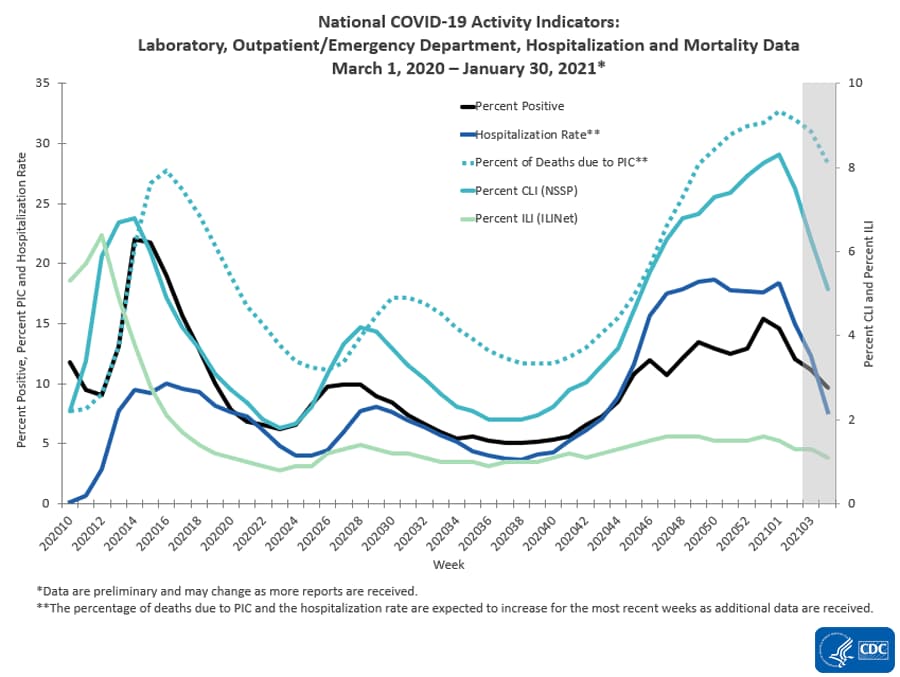
source: https://www.cdc.gov/coronavirus/2019-ncov/covid-data/covidview/index.html
Hospitalizations Are The Only Accurate Gauge As Reporting Is Not Affected By Holidays
The 4 day Thanksgiving holiday period put the first wobble in the trends. Over weekends and holidays, the number of new cases and deaths decline. Over weekends, this is not a problem for week-over-week rolling averages as weekends are compared against the previous weekend. But when a holiday falls within a working week, a non-working day is compared to a working day which causes havok in the trends.
However, hospitalizations historically appear to be little affected by weekends or holidays – the daily counts do not vary significantly from day-to-day.
The hospitalization growth rate trend is improving.

For the Thanksgiving and the end of the year holiday period – roughly, it seems each appears to have added around 5 % to the rate of growth of new cases, hospitalizations, and deaths.
Historically, hospitalization growth follows new case growth by one to two weeks.
As an analyst, I use the rate of growth to determine the trend. But, the size of the pandemic is growing in terms of real numbers – and if the rate of growth does not become negative – the pandemic will overwhelm all resources.
The graph below shows the rate of growth relative to the growth a week earlier updated through today [note that negative numbers mean the rolling averages are LOWER than the rolling averages one week ago]. As one can see, the rate of growth for new cases peaked in early December 2020 for Thanksgiving, and early January 2021 for end of year holidays – and the rate of growth is now contracting.

In the scheme of things, new cases decline first, followed by hospitalizations, and then deaths.
It is up to each of our readers to protect themselves and others by washing your hands, wearing a mask, avoiding crowds, and maintaining social distancing.
Will The New Variants Cause The Next Spike?
Maybe and maybe not. It all depends on vaccinations:
- the more people that are vaccinated reduces the pool of people that can be infected. Today we have removed over 11 % of the population from being infected which theoretically should reduce the infection rate by 11 % [it is unstudied whether the vaccines prevent a vaccinated person from being a carrier of the virus even though showing no signs]. If the vaccines are shown to stop transmission, then in theory it would reduce the infection rate by double the percent vaccinated [in this case you prevent your own infection and do not pass it along to another].
- it is also unknown what the effective rate of the current vaccines is against mutations that seem to appear almost daily. As an example, if the effective rate drops to 60%, it means the 11 % reduction in the infection rate discussed above is almost cut in half. The South African and Brazilian variant is somewhat immune to the current vaccines.
- The pandemic should be over immediately if everyone could be vaccinated today. The problem is that every day brings a new mutation (which would not appear if the pandemic was stopped). The longer the immunization process takes – the more ineffective the vaccine will become.
- It is not clear whether the vaccine prevents those vaccinated from spreading the virus. It seems to be well documented that it normally stops the virus from taking hold and when it does not – the infection is mild.
Coronavirus News You May Have Missed
The coronavirus is mutating—but what determines how quickly? – National Geographic
Amid a pandemic, however, the word “mutation” strikes a more ominous note. Viruses, though not technically alive, also mutate and evolve as they infect a hosts’ cells and replicate. The resulting tweaks to the virus’s genetic code could help it more readily hop between humans or evade the defenses of the immune system. Three such mutants of the virus SARS-CoV-2 have prompted experts to advocate for redoubled efforts to curb the coronavirus’s spread.
But these three versions of the virus are just a few among thousands of SARS-CoV-2 variants that have sprung up since the pandemic began. “We are creating variants like gangbusters right now because we have so many humans infected with SARS CoV-2,” says Siobain Duffy, a vial evolutionary biologist at Rutgers School of Environmental and Biological Sciences.
Many of these variants have since vanished. So why do some versions disappear, and why does the virus change in the first place? What mechanisms play puppet master for evolving viruses?
A successful virus is one that makes more of itself. But these tiny entities can’t do much on their own. Viruses are essentially coils of genetic material stuffed into a protein shell that’s sometimes blanketed in an outer envelope. In order to replicate, they must find a host. The virus binds to its target’s cells, injecting genetic material that hijacks the host’s cellular machinery to make a new generation of viral progeny.
But each time a new copy is made, there’s a chance that an error, or mutation, will occur. Mutations are like typos in the string of “letters” that make up a strand of DNA or RNA code.
The majority of mutations are harmful to a virus or cell, limiting the spread of an error through a population. For example, mutations can tweak the building blocks of proteins encoded in the DNA or RNA, which alters a protein’s final shape and prevents it from doing its intended job, Duffy explains.
“It doesn’t make the nice little curlicue alpha-helices it’s supposed to,” she says of a common structure found in proteins. “It doesn’t make the nice folded sheets it’s supposed to.”
Many other mutations are neutral, having no effect on how efficiently a virus or cell reproduces. Such mutations sometimes spread at random, when a virus carrying the mutation spreads to a population that hasn’t been exposed to any variants of the virus yet. “It’s the only kid on the block,” Anthony says.
However, a select few mutations prove useful to a virus or cell. For example, some changes could make a virus better at jumping from one host to the next, helping it outcompete other variants in the area. This was what happened with the SARS-CoV-2 variant B.1.1.7 that was first identified in the United Kingdom but has now spread to dozens of countries around the world. Scientists estimate the variant is roughly 50 percent more transmissible than past forms of the virus, giving it an evolutionary edge.
[editor’s note: a short article which deserves a full read]
Concerned about new variants of the virus that causes COVID-19, the U.S. Food and Drug Administration announced late Thursday that it is developing guidance to help vaccine, drug and testing manufacturers adapt.
Existing vaccines, treatments and tests still work well, emphasized the FDA’s acting commissioner Janet Woodcock. But now is the time to get ready for a future when they may not.
“We must prepare for all eventualities,” she said in a call with reporters.
Within the next few weeks, the FDA will provide draft guidance to manufacturers on how to adapt their products as needed, Woodcock said. Feedback from companies and others will help refine that guidance.
Concern has been growing in recent weeks over variants of the SARS-CoV-2 virus that causes COVID-19, some of which appear to be more infectious.
At least one, first identified in South Africa, rendered vaccines from Novavax and AstraZeneca-Oxford vaccines less effective in that country, although they still prevented severe disease and death.
Moderna and Pfizer-BioNTech’s vaccines also held up when tested in Petri dishes against a new variant first seen in the United Kingdom and now spreading quickly throughout the U.S. Moderna’s vaccine did not fare as well against the variant first seen in South Africa, though it likely still offered some protection.
New studies show that coronaviruses often mix chunks of genetic code, adding to worries over variants. – New York Times
Scientists have been sounding the alarm about new variants of the coronavirus that carry a handful of tiny mutations, some of which seem to make vaccines less effective.
But the novel coronavirus also has a propensity to mix large chunks of its genome when it makes copies of itself. Unlike the small mutations, which are like typos in the sequence, a phenomenon called recombination resembles a major copy-and-paste error in which the second half of a sentence is completely overwritten with a slightly different version.
A flurry of new studies suggests that recombination may allow the virus to shapeshift in dangerous ways.
The coronavirus mutations that most people have heard about, such as those in the B.1.351 variant first detected in South Africa, are changes in a single “letter” of the virus’s long genetic sequence, or RNA. Because the virus has a robust system for proofreading its RNA code, these small mutations are relatively rare.
Recombination, in contrast, is rife in coronaviruses.
Researchers at Vanderbilt University Medical Center recently studied how things go awry during replication in three coronaviruses, including SARS-CoV-2, which causes Covid. The team found that all three viruses showed “extensive” recombination in the laboratory.
Scientists worry that recombination might allow for different variants of the coronavirus to combine into more dangerous versions inside a person’s body. The B.1.1.7 variant first detected in Britain, for example, had more than a dozen mutations that seemed to appear suddenly.
Four COVID Vaccines Compared – Medscape
Two COVID vaccines have already been approved for use in the United States and two more could be approved within the next few months. Here’s what we know about each vaccine’s efficacy.
| Vaccine developer: | Pfizer | Moderna | AstraZeneca | Johnson & Johnson |
|---|---|---|---|---|
| When approved/expected approval | Dec. 11 | Dec. 18 | Could submit application for emergency use authorization in late March. | Submitted application for emergency use authorization on Feb. 5. |
| What percentage of people did it protect from getting infected in clinical studies? | 95% | 94.1% | 70% | 66% |
| How many shots do you need? | Two doses, 3 weeks apart | Two doses, 4 weeks apart | Two doses, a month apart | One dose |
| What are the side effects? | Fatigue, headache, chills, muscle pain, especially after the second dose. | Fever, muscle aches, headaches lasting a few days. Effects worse after second dose. | Injection site pain, fever, muscle aches, headache. | Not yet available. |
| How many doses will be available, and when? | 50 million, starting Dec. 18; 1.3 billion in 2021. | 20 million, starting Dec. 21; 80 million for U.S. in 2021. | 3 billion planned for 2021. | Not yet available. |
| Who is it recommended for? | People 16 years and older. | People 18 years and older. | Not yet available. | Not yet available. |
| What about pregnant women and nursing moms? | Pregnant women or nursing moms who want the COVID-19 vaccine should get one, experts say. The vaccine has not yet been studied in pregnant women. Read guidelines here. | There’s limited data. Studies in rats who were immunized before and during pregnancy found no safety concerns. The CDC says pregnant women may choose to receive the vaccine. | Not yet available. | Not yet available. |
| Is there anyone who shouldn’t get the vaccine? | People with a history of serious allergic reactions, anyone with a history of allergic reactions to vaccine ingredients including polyethylene glycol, and anyone with a history of allergic reactions to polysorbate. | People with a history of serious allergic reactions, anyone with a history of allergic reactions to vaccine ingredients including polyethylene glycol, and anyone with a history of allergic reactions to polysorbate. | Not yet available. | Not yet available. |
| Any significant side effects? | 50 cases of anaphylaxis in people who received the vaccine, mostly women. Four cases of Bell’s palsy, a type of temporary facial paralysis, reported in people who received the vaccine. This is not more than would be expected in the general population. | 21 cases of anaphylaxis in people who received the vaccine, all in women. Four cases of Bell’s palsy reported in the clinical trials including 3 in the vaccine group, and 1 in the placebo group. This is not more than would be expected in the general population. | Four total serious side effects, including two cases of transverse myelitis. | One person went to the hospital for fever associated with the vaccine. Four other serious cases were not related to the vaccine. |
| What about people with lowered immune function? | Ok for people whose immune function is lowered by HIV or immunosuppressing drugs if they have no other reasons to avoid it. There is limited safety data in this group. | Ok for people whose immune function is lowered by HIV or immunosuppressing drugs if they have no other reasons to avoid it. There is limited safety data in this group. | Not yet available. | Not yet available. |
| What about people with autoimmune diseases? | No data are available on the safety or effectiveness of mRNA vaccines in people with autoimmune disease. People with autoimmune conditions may still get the shots if they have no other reasons to avoid vaccination. | No data are available on the safety or effectiveness of mRNA vaccines in people with autoimmune disease. People with autoimmune conditions may still get the shots if they have no other reasons to avoid vaccination. | Not yet available. | Not yet available. |
| Is the vaccine safe for people with a history of Guillain-Barre Syndrome (GBS)? | To date, no cases of GBS have been seen in people vaccinated for COVID-19. The CDC says a history of GBS is not a reason to avoid vaccination. | To date, no cases of GBS have been seen in people vaccinated for COVID-19. The CDC says a history of GBS is not a reason to avoid vaccination. | Not yet available. | Not yet available. |
Slight decline in Covid-19 cases isn’t due to coronavirus vaccinations, Fauci explains – CNN
Covid-19 cases are showing a slight decline in the United States, but this doesn’t mean it’s because vaccinations have been taking place. Instead, it’s because the surge that came with holiday season activities is stabilizing, Dr. Anthony Fauci explained.
“I don’t think that the fact that we’re beginning to vaccinate people has yet contributed to that slight decline, because we haven’t vaccinated enough people yet,” Fauci, head of the National Institute of Allergy and Infectious Diseases, said on MSNBC’s “The Beat” Friday.
Here’s a quick rundown:
- In early January, the 7-day moving average reached 250,000 cases per day.
- This week, the 7-day moving average this week stayed below 150,000 cases per day.
- New cases of Covid-19 were down by 15% from last week.
“What I think is going on, a combination of the natural peaking, as well as people doubling down on the public health measure,” Fauci said. “I believe it’s entirely conceivable that a combination of continuing with that trend, as well as we get more and more people vaccinated, as we go from February, to March, to April, I think you’re going to see that [cases] continue to come way down.”
Fauci also said that right now “the only wild card” is that we have Covid-19 variants in the country.
[editor’s note: this Dr. Fauci statement appears incorrect. The spike in hospitalizations began in October well before the holiday season. The current decline may or may not be due to immunizations – but the concern now is why deaths have not correlated with the declines in hospitalizations.]
A new C.D.C. study adds to the evidence that masks can keep you out of the hospital. – New York Times
New research published by the Centers for Disease Control and Prevention on Friday shows that statewide mask-wearing mandates were associated with a decline in the growth rate of Covid-19 hospitalizations. The study provides additional evidence that wearing of masks can help minimize transmission of the coronavirus.
The research, published in the Morbidity and Mortality Weekly Report by the agency, found that in three weeks or more following a mask mandate, Covid-19 hospitalization growth rates fell by 5.5 percent in people aged 18 to 64.
The research focused on 10 states — California, Colorado, Connecticut, Maryland, Michigan, Minnesota, New Mexico, New York, Ohio and Oregon — that implemented mask mandates in the period from April to June of 2020. Hospitalization growth rates fell for adults 40 to 64 two weeks or more after the mandates were put into place, the research showed. There are currently 34 states with mask mandates.
Mask orders are “helping to protect people and helping the cases coming down,” said Dr. Rochelle Walensky, director for the C.D.C., in a briefing on Friday by the White House Covid-19 Response team. She added that the data remains somewhat open to interpretation in light of a multitude of changing factors taking place during the period these mandates were implemented.
The C.D.C.’s Morbidity and Mortality Weekly Report also published another study on Friday showing that college students appear to be doing an impressive job responding to the public health rallying cry to wear masks.
The vaccine alternatives for people with compromised immune systems – National Geographic
Drug makers are increasingly turning to monoclonal antibodies to protect the millions of people who can’t use vaccines. But questions swirl about their cost and long-term viability.
AS THE COVID-19 vaccine rollout gathers pace, a population is at risk of being left behind: the millions of people around the globe who lack fully functional immune systems.
While the exact number of the immunocompromised worldwide is unknown, estimates suggest that about 10 million live in the U.S. alone, or around 3 percent of the national population. The number encompasses a diverse range of vulnerabilities, including rare genetic immune deficiencies, chronic illnesses that impair the immune system such as rheumatoid arthritis, and cancer and organ-transplant patients who must take immune-suppressing medications.
For them, vaccines will not be effective, because they are incapable of making their own antibodies to neutralize the SARS-CoV-2 virus. Instead, pharmaceutical companies around the world are racing to develop alternative treatments that bypass the immune system altogether.
The most common option is called monoclonal antibody treatments. These artificially generated antibodies mimic the body’s natural immune response by binding to key sites on the virus’ spike protein, preventing it entering cells and reproducing. Companies including AstraZeneca, Regeneron, and Eli Lilly are currently testing whether monoclonal antibodies can protect immunocompromised people from SARS-CoV-2.
“You often find that patients who have had bone marrow transplants end up getting terrible flu and other infections, which they can’t clear without additional help,” says Nicky Longley, an infectious diseases consultant at University College London Hospitals. “It was these heavily immune-suppressed populations who did very badly during the first wave of COVID-19.”
In addition, preventing immunocompromised people from getting infected will be a key part of keeping the disease in check in the long run, says Andrew Ustianowski, an infectious disease specialist at the U.K.’s National Institute for Health Research.
“If we want to control this virus and get back into normal life, then being able to protect everybody, so we don’t have ongoing transmission in subgroups of the population, is important,” he says.
But while many scientists are excited about the potential of monoclonal antibodies to address gaps in the world’s vaccination programs, questions remain. The coming months will tell us whether these treatments are sufficiently cost-effective to be used on a large scale, if they can really provide adequate protection for months at a time, and whether using monoclonal antibodies may inadvertently do more harm than good.
[editor’s note: a good read for those with a compromised immune system]
Canada bans cruise ships into 2022 as COVID-19 pandemic continues – USA Today
Canada once again extended its ban on cruises – pushing back the possibility for large passenger vessels to sail in Canadian waters by an additional year after shutting them out last year amid the coronavirus pandemic.
No cruise ships will be able to sail in Canada until March 1, 2022.
“Today, I announced a 1-year ban on pleasure craft in Canadian Arctic waters and cruise vessels in all Canadian waters, these prohibitions will protect the most vulnerable among our communities and avoid overwhelming our health care systems,” Minister of Transport for Canada Omar Alghabra wrote on Twitter Thursday.
The prohibition on cruise ships had been scheduled to lift March 1 after extensions in May and October.
The order pertains to cruise ships carrying more than 100 people. Passenger vessels carrying more than 12 people are banned from entering Arctic coastal waters, including the Labrador Coast, Nunatsiavut and Nunavik, according to a news release from the Canadian government.
[editor’s note: also read Canada extends its cruise ship ban until 2022, and Alaska’s leaders aren’t happy.]
The following are foreign headlines with hyperlinks to the posts
With the virus spiking, Cuba imposes an overnight curfew.
Data from Britain’s rollout show that the vaccines in use are largely safe, a regulator says.
The following additional national and state headlines with hyperlinks to the posts
Evidence is growing that schools can safely reopen even without vaccinating teachers, said CDC Director Rochelle Walensky, MD, MPH, but teachers aren’t so thrilled.
Walensky also had a message for football fans this weekend: “Whichever team you’re rooting for and whichever commercial is your favorite, please watch the Super Bowl safely, gathering only virtually or with the people you live with,” she urged on Wednesday.
Fauci also warned that if new coronavirus variants become dominant, there’s a very good chance COVID survivors could get reinfected.
Johnson & Johnson sent paperwork to the FDA on Thursday requesting the agency to authorize the company’s one-dose vaccine for adults; the agency set a Feb. 26 advisory committee meeting to review it.
Biden’s pandemic response team has hit a serious roadblock: 20 million vaccine doses shipped to states by the Trump administration are missing from the tracking system.
The CDC’s pricey new Vaccine Administration Management System website intended to manage COVID-19 shots and inventory is so flawed that most states have deserted it.
An NIH panel found insufficient data to recommend for or against using IL-6 inhibitors tocilizumab (Actemra) or sarilumab (Kevzara) to treat COVID-19 in the ICU.
Going to a national park? Now you need a mask
NFL Offers All 30 Stadiums For Use As Coronavirus Vaccine Sites
Education Dept. Launches First Federal Effort To Track School Reopening
Should Schools Reopen If Teachers Aren’t Yet Vaccinated? CDC Will Soon Weigh In
White House Is Lining Up 6 More Contracts To Boost At-Home Coronavirus Tests
TSA to fine mask violators up to $1,500
FDA Curbs Use of COVID-19 Convalescent Plasma, Citing New Data
Kids in ICU for COVID Are Likely to Be Older, Black, Have Asthma
Indoor Singing Can Be Prohibited at Church Gatherings, Supreme Court Rules
Chicago and Philadelphia tell some teachers to return to classrooms or face discipline.
Today’s Posts On Econintersect Showing Impact Of The Pandemic With Hyperlinks
Global Initiative To Start Shipping Vaccines To Africa, Where Supplies Are Low
Warning to Readers
The amount of politically biased articles on the internet continues to increase. And studies and opinions of the experts continue to contradict other studies and expert opinions. Honestly, it is difficult to believe anything anymore. A study usually cannot establish cause and effect – but only correlation. Be very careful what you believe about this pandemic.

I assemble this coronavirus update daily – sifting through the posts on the internet. I try to avoid politically slanted posts (mostly from CNN, New York Times, and the Washington Post) and can usually find unslanted posts on that subject from other sources on the internet. I wait to publish posts on subjects that I cannot validate across several sources. But after all this extra work, I do not know if I have conveyed the REAL facts. It is my job to provide information so that you have the facts necessary – and then it is up to readers to draw conclusions.
Analyst Opinion of Coronavirus Data
There are several takeaways that need to be understood when viewing coronavirus statistical data:
- The global counts are suspect for a variety of reasons including political. Even the U.S. count has issues as it is possible that as much as half the population has had coronavirus and was asymptomatic. It would be a far better metric using a random sampling of the population weekly. In short, we do not understand the size of the error in the tracking numbers.
- Just because some of the methodology used in aggregating the data in the U.S. is flawed – as long as the flaw is uniformly applied – you establish a baseline. This is why it is dangerous to compare two countries as they likely use different methodologies to determine who has (and who died) from coronavirus.
- COVID-19 and the flu are different but can have similar symptoms. For sure, COVID-19 so far is much more deadly than the flu. [click here to compare symptoms]
- From an industrial engineering point of view, one can argue that it is best to flatten the curve only to the point that the health care system is barely able to cope. This solution only works if-and-only-if one can catch this coronavirus once and develops immunity. In the case of COVID-19, herd immunity may need to be in the 80% to 85% range. WHO warns that few have developed antibodies to COVID-19 when recovering from COVID-19. Herd immunity does not look like an option without immunization although there is now a discussion of whether T-Cells play a part in immunity [which means one might have immunity without antibodies]
- Older population countries will have a significantly higher death rate as there is relatively few hospitalizations and deaths in younger age groups..
- There are at least 8 strains of the coronavirus. New York may have a deadlier strain imported from Europe, compared to less deadly viruses elsewhere in the United States.
- Each publication uses different cutoff times for its coronavirus statistics. Our data uses 11:00 am London time. Also, there is an unexplained variation in the total numbers both globally and in the U.S.
What we do or do not know about the coronavirus [actually there is little scientifically proven information]. Most of our knowledge is anecdotal, from studies with limited subjects, or from studies without peer review.
- How many people have been infected as many do not show symptoms?
- Masks do work. Unfortunately, early in the pandemic, many health experts — in the U.S. and around the world — decided that the public could not be trusted to hear the truth about masks. Instead, the experts spread a misleading message, discouraging the use of masks.
- Current thinking is that we develop 5 months of immunity from further COVID infection.
- The Moderna and Pfizer vaccines have an effectiveness rate of about 95 percent after two doses. That is on par with the vaccines for chickenpox and measles. The 95 percent number understates the effectivenessas it counts anyone who came down with a mild case of Covid-19 as a failure. But turning Covid into a typical flu — as the vaccines evidently did for most of the remaining 5 percent — is actually a success. Of the 32,000 people who received the Moderna or Pfizer vaccine in a research trial, only one contracted a severe Covid case.
- To what degree do people who never develop symptoms contribute to transmission? Research early in the pandemic suggested that the rate of asymptomatic infections could be as high as 81%. But a meta-analysis, which included 13 studies involving 21,708 people, calculated the rate of asymptomatic presentation to be 17%.
- The accuracy of rapid testing is questioned – and the more accurate test results are not being given in a timely manner.
- Can children widely spread coronavirus? [current thinking is that they are a minor source of the pandemic spread]
- Why have some places avoided big coronavirus outbreaks – and others hit hard?
- Air conditioning contributes to the pandemic spread.
- It appears that there is increased risk of infection and mortality for those living in larger occupancy households.
- Male patients have almost three times the odds of requiring intensive treatment unit (ITU) admission compared to females.
- Outdoor activities seem to be a lower risk than indoor activities.
- Will other medical treatments for Covid-19 ease symptoms and reduce deaths? So far only remdesivir, Bamlanivimab,
and Regeneron) are approved for treatment. What drugs work?
Arthritis drugs tocilizumab and sarilumab could cut relative risk of death of those in intensive care by 24%
- A current scientific understanding of the way the coronavirus works can be found [here].
There is now a vaccine available – the questions remain:
- how effective it will be in the general population,
- will there be any permanent side effects that will appear months from now,
- how long immunity will last [we can currently say we do not know if it will last more than 4 months],
- there is no evidence the vaccine will block transmission
Heavy breakouts of coronavirus have hit farmworkers. Farmworkers are essential to the food supply. They cannot shelter at home. Consider:
- they have high rates of respiratory disease [occupational hazard]
- they travel on crowded buses chartered by their employers
- few have health insurance
- they cannot social distance and live two to four to a room – and they eat together
- some reports say half are undocumented
- they are low paid and cannot afford not to work – so they will go to work sick
- they do not have access to sanitation when working
- a coronavirus outbreak among farmworkers can potentially shutter entire farm
The bottom line is that COVID-19 so far has been shown to be much more deadly than the data on the flu. Using CDC data, the flu has a mortality rate between 0.06 % and 0.11 % Vs. the coronavirus which to date has a mortality rate of 4 % [the 4% is the average of overall statistics – however in the last few months it has been hovering around 1.0%] – which makes it between 10 and 80 times more deadly. The reason for ranges:
Because influenza surveillance does not capture all cases of flu that occur in the U.S., CDC provides these estimated ranges to better reflect the larger burden of influenza.
There will be a commission set up after this pandemic ends to find fault [it is easy to find fault when a once-in-a-lifetime event occurs] and to produce recommendations for the next time a pandemic happens. Those that hate President Trump will conclude the virus is his fault.
Resources:
- Get the latest public health information from CDC: https://www.coronavirus.gov .
- Get the latest research from NIH: https://www.nih.gov/coronavirus.
- Find NCBI SARS-CoV-2 literature, sequence, and clinical content: https://www.ncbi.nlm.nih.gov/sars-cov-2/.
- List of studies: https://icite.od.nih.gov/covid19/search/#search:searchId=5ee124ed70bb967c49672dad
include(“/home/aleta/public_html/files/ad_openx.htm”); ?>


