


Written by Steven Hansen
The U.S. new cases 7-day rolling average are 17.8 % LOWER than the 7-day rolling average one week ago. U.S. hospitalizations due to COVID-19 are now 12.7 % LOWER than the rolling average one week ago. U.S. deaths due to coronavirus are now 0.9 % LOWER than the rolling average one week ago. Today’s posts include:
- U.S. Coronavirus New Cases are 122,473
- U.S. Coronavirus hospitalizations are at 88,668
- U.S. Coronavirus deaths are at a RECORD 5,077 [are the new variants more deadly or are vaccinations impacting deaths – as hospitalizations have been contracting since mid-January?>
- U.S. Coronavirus immunizations have been administered to 10.5 % of the population
- The 7-day rolling average rate of growth of the pandemic shows new cases improved, hospitalizations improved, and deaths worsened
- Hopefully, these current improving COVID trends will remain in play even with the new strains
- Johnson & Johnson requests FDA authorization for its one-dose COVID-19 vaccine
- New studies show that coronaviruses often mix chunks of genetic code, adding to worries over variants
- Side effect of COVID-19 vaccine mirrors breast cancer symptom, doctors say
- Merck Warns Against Using Ivermectin to Treat COVID-19
- CDC study: Mask mandates reduce COVID-19 hospitalizations
- Senate passes $1.9 billion COVID relief resolution after all-night “vote-a-rama”
- COVID-19 Risk Not Equal for All Critical Care Staff
- White House Is Lining Up 6 More Contracts To Boost At-Home Coronavirus Tests
- Coming Soon: The ‘Vaccine Passport’

The recent worsening of the trendlines for new cases is behind us which was attributed to going back to college/university, cooler weather causing more indoor activities, mutation of the virus, fatigue from wearing masks / social distancing, holiday activities, and some loosening of regulations designed to slow the coronavirus spread.
My continuing advice is to continue to wash your hands (especially after using the toilet as COVID first sheds in your stool), putting down the toilet seat (as flushing the toilet releases a plume), wear masks, avoid crowds, and maintain social distancing. No handwashing, mask, or social distancing will guarantee you do not get infected – but it sure as hell lowers the risk in all situations – and the evidence to-date shows a lower severity of COVID-19. In addition, certain activities are believed to carry a higher risk – like being inside in air conditioning and removing your mask (such as restaurants, around your children/grandchildren, bars, and gyms). It is all about viral load – and outdoor activities are generally safe if you can maintain social distance. Finally, studies show eating right (making sure you are supporting your immune system) and adequate sleep increase your ability to fight off COVID.
include($_SERVER[‘DOCUMENT_ROOT’].’/pages/coronavirus1.htm’); ?>
Hospitalizations (grey line) and Mortality (green line)
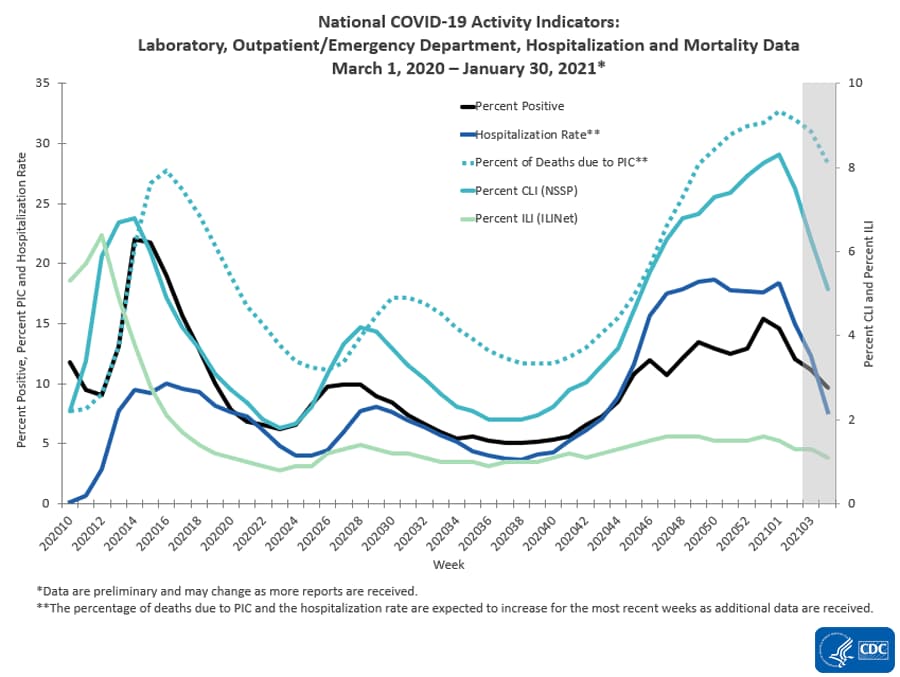
source: https://www.cdc.gov/coronavirus/2019-ncov/covid-data/covidview/index.html
Hospitalizations Are The Only Accurate Gauge As Reporting Is Not Affected By Holidays
The 4 day Thanksgiving holiday period put the first wobble in the trends. Over weekends and holidays, the number of new cases and deaths decline. Over weekends, this is not a problem for week-over-week rolling averages as weekends are compared against the previous weekend. But when a holiday falls within a working week, a non-working day is compared to a working day which causes havok in the trends.
However, hospitalizations historically appear to be little affected by weekends or holidays – the daily counts do not vary significantly from day-to-day.
The hospitalization growth rate trend is improving.

For the Thanksgiving and the end of the year holiday period – roughly, it seems each appears to have added around 5 % to the rate of growth of new cases, hospitalizations, and deaths.
Historically, hospitalization growth follows new case growth by one to two weeks.
As an analyst, I use the rate of growth to determine the trend. But, the size of the pandemic is growing in terms of real numbers – and if the rate of growth does not become negative – the pandemic will overwhelm all resources.
The graph below shows the rate of growth relative to the growth a week earlier updated through today [note that negative numbers mean the rolling averages are LOWER than the rolling averages one week ago]. As one can see, the rate of growth for new cases peaked in early December 2020 for Thanksgiving, and early January 2021 for end of year holidays – and the rate of growth is now contracting.

In the scheme of things, new cases decline first, followed by hospitalizations, and then deaths.
It is up to each of our readers to protect themselves and others by washing your hands, wearing a mask, avoiding crowds, and maintaining social distancing.
Will The New Variants Cause The Next Spike?
Maybe and maybe not. It all depends on vaccinations:
- the more people that are vaccinated reduces the pool of people that can be infected. Today we have removed over 10 % of the population from being infected which theoretically should reduce the infection rate by 10 % [it is unstudied whether the vaccines prevent a vaccinated person from being a carrier of the virus even though showing no signs]. If the vaccines are shown to stop transmission, then in theory it would reduce the infection rate by double the percent vaccinated [in this case you prevent your own infection and do not pass it along to another].
- it is also unknown what the effective rate of the current vaccines is against mutations that seem to appear almost daily. As an example, if the effective rate drops to 60%, it means the 10 % reduction in the infection rate discussed above is almost cut in half. The South African and Brazilian variant is somewhat immune to the current vaccines.
- The pandemic should be over immediately if everyone could be vaccinated today. The problem is that every day brings a new mutation (which would not appear if the pandemic was stopped). The longer the immunization process takes – the more ineffective the vaccine will become.
- It is not clear whether the vaccine prevents those vaccinated from spreading the virus. It seems to be well documented that it normally stops the virus from taking hold and when it does not – the infection is mild.
Coronavirus News You May Have Missed
Senate passes $1.9 billion COVID relief resolution after all-night “vote-a-rama” – CBS News
The Senate passed a budget resolution very early Friday that is an important step to getting President Biden’s $1.9 trillion COVID-19 relief proposal approved. The 51-50 vote, with Vice President Harris breaking the tie, came after an all-night marathon “vote-a-arama.”
It included 41 votes. The Senate adjourned at 5:39 a.m. and is scheduled to return Monday afternoon.
One vote rejected a major component of the Biden plan — raising the federal minimum wage to $15 an hour. In a voice vote, senators narrowly approved an amendment from Iowa Republican Joni Ernst that would ban the increase during a pandemic.
The increase could be restored when the final measure is hashed out.
The $1.9 trillion resolution is part of a budget process known as reconciliation, which allows legislation to pass with only a simple majority instead of the typical 60-vote threshold, meaning Democrats would be able to green-light it without any Republican votes.
But Republicans forced Democrats to go on the record with a series of votes on a slew of amendments in the politically painful “vote-a-rama.”
Once both houses of Congress pass the budget resolution, which serves as the vehicle for the legislation, committees begin formulating a reconciliation bill itself. The reconciliation bill will receive 20 hours of debate, and then another “vote-a-rama” before a final vote.
[editor’s note: also read House majority leader hopes to bring Covid relief bill for floor vote the week of Feb. 22]
Johnson & Johnson requests FDA authorization for its one-dose COVID-19 vaccine – USA Today
Johnson & Johnson submitted paperwork Thursday requesting that the U.S. Food and Drug Administration authorize its COVID-19 vaccine for use in adults.
The FDA announced later in the evening that its advisory committee will meet Feb. 26 to discuss the application. The agency is expected to authorize the vaccine within a few days of that meeting, making it the third available to the American public.
J&J announced last week that its vaccine was 72% effective in a U.S. trial, though it was less effective among people in Latin America and South Africa, bringing overall effectiveness down to 66%.
That compares to findings last year that vaccines from Pfizer-BioNTech and Moderna that their vaccines would be more than 94% effective.
Federal officials have said, however, that the trials are not directly comparable because they were conducted at different points in the COVID-19 pandemic.
It’s possible J&J’s vaccine would have shown equal effectiveness if its trial had been conducted last summer and fall as the other two were. Now, there are multiple different variants of the virus that causes COVID-19, which might weaken the vaccine’s effectiveness.
Still, NIH director Dr. Francis Collins and America’s top infectious disease expert Dr. Anthony Fauci, said last week that the J&J vaccine would provide a profound benefit to the fight against the pandemic.
The J&J vaccine is meant to be delivered as a single dose, though the company is running a separate trial to determine if a second dose is worthwhile.
The vaccine can also be stored at refrigerator temperatures, so it will be easier to distribute than the Pfizer-BioNTech and Moderna vaccines, both of which must be kept frozen much of the time.
All the vaccines appear to protect against severe disease and prevent deaths from COVID-19.
[editor’s note: also read Johnson & Johnson Announces Submission of Application to the U.S. FDA for Emergency Use Authorization of its Investigational Single-Shot Janssen COVID-19 Vaccine Candidate]
The left’s vaccine problem – New York Times
Early in the pandemic, countries with populist, right-wing governments were suffering some of the worst outbreaks. These countries had big differences from one another — the list included Brazil, Britain, Russia and the U.S. — but their problems all stemmed partly from leaders who rejected scientific expertise.
More progressive and technocratic countries — with both center-left and center-right leaders, like Australia, Canada, Denmark, Germany, Japan, New Zealand and South Korea — were doing a better job containing the pandemic. The pattern seemed to make sense: Politicians who believed in the ability of bureaucracies to accomplish complex jobs were succeeding at precisely that.
But over the last few weeks, as vaccination has become a top priority, the pattern has changed. Progressive leaders in much of the world are now struggling to distribute coronavirus vaccines quickly and efficiently:
[editor’s note: this article deserves a full read]
- Europe’s vaccination rollout “has descended into chaos,” as Sylvie Kauffmann of Le Monde, the French newspaper, has written. One of the worst performers is the Netherlands, which has given a shot to less than 2 percent of residents.
- Canada (at less than 3 percent) is far behind the U.S. (about 8.4 percent).
- Within the U.S., many Democratic states — like California, Illinois, Minnesota, New Jersey, New York and tiny Rhode Island — are below the national average. “The parts of the country that pride themselves on taking Covid seriously and believing in government are not covering themselves in glory,” The Times’s Ezra Klein has written.
White House Is Lining Up 6 More Contracts To Boost At-Home Coronavirus Tests – NPR
The Biden administration is finalizing contracts with six companies to increase the supply of at-home coronavirus tests – a plan that would bring more than 60 million tests to the U.S. market by the end of this summer, officials from the White House COVID-19 Response Team said on Friday.
The investment will “rapidly surge domestic testing capability,” said Tim Manning, supply coordinator for the COVID-19 Response Team, during an online briefing. The tests would not require a prescription.
“The country is well behind where we need to be in testing, particularly the rapid, at-home tests that will allow us all to get back to normal activities like work and school,” Manning said.
He added that the plan is being streamlined by invoking the Defense Production Act. The contracts will be finalized in the coming weeks, Manning said, declining to go into detail about which companies are involved and where they’re located.
The contracts call for the U.S. to help companies “construct new plants and build new production lines here in the United States,” Manning said.
The announcement follows news from earlier this week, when the administration said it signed a $231.8 million contract with the Australian company Ellume to boost production of its coronavirus test, which remains the only fully at-home test authorized so far by the Food and Drug Administration.
The Ellume test is not yet on the market in the U.S. or anywhere else. The first shipments of the tests are expected to arrive in the U.S. this month, a company representative told NPR.
CDC study: Mask mandates reduce COVID-19 hospitalizations – The Hill
States and counties that implemented mask mandates saw a substantial decline in the number of people admitted to the hospital to treat COVID019 symptoms in the weeks after the mandates took effect, according to a new study published Friday.
The study, published in the Centers for Disease Control and Prevention’s (CDC) Morbidity and Mortality Weekly Report, found hospitalization growth rates begin to drop slightly in the first three weeks after implementation. More than three weeks after a mask mandate took effect, hospitalization rates declined by almost 5 percent.
The study “demonstrates that statewide mask mandates were associated with a reduction in Covid-19-associated hospitalization growth rates,” the researchers wrote.
The study monitored hospitalization rates in 10 states — California, Colorado, Connecticut, Maryland, Michigan, Minnesota, New Mexico, New York, Ohio and Oregon — that implemented mask mandates between mid-April and mid-July.
Thirty-one states and the District of Columbia have implemented mask mandates.
Hospitalization rates dropped most significantly among those between the ages of 18 and 64. Hospitalization rates declined the least among those over 65, who are most susceptible to the worst outcomes of the coronavirus that causes COVID-19.
Drops in hospitalization rates are likely an indicator of fewer infections in the population as a whole. Only a small percentage of coronavirus infections lead to symptoms severe enough to require hospitalization.
Coming Soon: The ‘Vaccine Passport’ – New York Times
Among governments and those in the travel industry, a new term has entered the vocabulary: vaccine passport.
One of President Biden’s executive orders aimed at curbing the pandemic asks government agencies to “assess the feasibility” of linking coronavirus vaccine certificates with other vaccination documents, and producing digital versions of them.
Denmark’s government said on Wednesday that in the next three to four months, it will roll out a digital passport that will allow citizens to show they have been vaccinated.
It isn’t just governments that are suggesting vaccine passports. In a few weeks, Etihad Airways and Emirates will start using a digital travel pass, developed by the International Air Transport Association, to help passengers manage their travel plans and provide airlines and governments documentation that they have been vaccinated or tested for Covid-19.
A vaccination pass or passport is documentation proving that you have been vaccinated against Covid-19. Some versions will also allow people to show that they have tested negative for the virus, and therefore can more easily travel. The versions being worked on now by airlines, industry groups, nonprofits and technology companies will be something you can pull up on your mobile phone as an app or part of your digital wallet.
“It’s about trying to digitize a process that happens now and make it into something that allows for more harmony and ease, making it easier for people to travel between countries without having to pull out different papers for different countries and different documents at different checkpoints,” said Nick Careen, senior vice president for airport, passenger, cargo and security at I.A.T.A. Mr. Careen has been leading I.A.T.A.’s travel pass initiative.
… Dakota Gruener, executive director of ID2020, a global public-private partnership, said that there are three scenarios regarding digital credentialing for the coronavirus response. The first, which is largely off the table, is the creation of immunity certificates. These are documents that would show that people have developed some kind of immunity to the virus. The second scenario is being able to prove you’ve tested negative for the virus; the third is being able to show that you have been vaccinated. The last two scenarios, experts agree, are the most important for getting the travel industry going again.
“We’re seeing a lot of interest from airlines, airline industry groups, customs and border control agencies and travelers, all saying, ‘how do I safely get on a plane or as a condition of entry into a country, get on a train, whatever the case may be, and prove that I have been tested or vaccinated?'” Ms. Gruener said.
Side effect of COVID-19 vaccine mirrors breast cancer symptom, doctors say – FOX
Doctors are reporting a side effect of the COVID-19 vaccine that mirrors a symptom of breast cancer.
“We have been seeing swollen lymph nodes for a couple weeks now,” said Dr. Holly Marshall, with University Hospitals Cleveland Medical Center.
“It’s actually a normal response that the body has to the vaccine,” said Marshall. “It means that the body is making antibodies to fight the COVID-19 infection.”
Marshall said breast radiologists have encountered axillary adenopathy, also known as swollen lymph nodes, on screening mammograms of patients who have been vaccinated. It’s a side effect that could be mistaken for breast cancer.
Marshall said doctors made the discovery because the lymph nodes seen under the arm are included on a mammogram. Patients can also feel them.
Marshall said the swollen lymph nodes are on the same side as the placement of the vaccine.
“We also see swollen lymph nodes in patients with breast cancer, so that’s the concern there. So we are asking everybody who is having a mammogram if they had the COVID-19 vaccine, what dose, when, and what side,” said Marshall.
COVID-19 Risk Not Equal for All Critical Care Staff – MedPage
British clinicians who worked in different departments around the hospital were more likely to have been exposed to COVID-19 than those working exclusively on critical care units, a researcher said.
Those who worked in such fields as “diagnostics,” (echocardiographers and radiographers), “therapies” (physiotherapists and occupational therapists), and “general” (healthcare assistants and dietitians) were more likely to be SARS-CoV-2 antibody positive than other critical care staff, reported Kate El Bouzidi, MRCP, a PhD candidate at University College London.
Notably, housekeeping staff had the highest prevalence ratio, with all five surveyed staff members seropositive for SARS-CoV-2. All 10 administrators, meanwhile, were seronegative.
The late-breaking study was presented at the Society of Critical Care Medicine’s virtual Critical Care Congress, and published in Critical Care Medicine.
El Bouzidi said she wanted to determine SARS-CoV-2 seroprevalence in critical care staff, as well as look at the correlation between antibody status, prior swab testing, and COVID-19 symptoms. She added that the critical care department was a good choice for this study, since they had adequate availability of personal protective equipment (PPE) for staff in intensive care units and staff were tested via polymerase chain reaction (PCR) swabs if they became symptomatic.
All staff who worked in the critical care unit in Kings College Hospital in London participated. Serum samples were tested via six different assays to measure receptor-binding domain, nucleoprotein, and tri-spike, with one antibody result determined for each sample.
Merck Warns Against Using Ivermectin to Treat COVID-19 – Medscape
Drugmaker Merck & Co Inc on Thursday said its analysis of available data does not support the safety and efficacy of its anti-parasite drug, ivermectin, for the treatment of COVID-19.
Ivermectin, which is approved in the United States under the brand name Stromectol, is used mainly to treat roundworms, threadworms and other parasites.
Officials in the Bolivian city of Trinidad had launched a campaign in May last year to give out free doses of ivermectin to combat the novel coronavirus, although the South American country’s health ministry noted the lack of evidence for it as a treatment for COVID-19. (https://reut.rs/3oVnHsY)
In a statement (https://bit.ly/2Mz1NOW), the company said its analysis of existing and emerging studies of ivermectin to treat COVID-19 found no scientific basis for a potential therapeutic effect against the respiratory disease caused by the novel coronavirus.
Merck added that there was a concerning lack of safety data in the majority of studies testing ivermectin to treat COVID-19 and cautioned against the use of the drug beyond its use as an anti-parasitic.
New studies show that coronaviruses often mix chunks of genetic code, adding to worries over variants. – New York Times
Scientists have been sounding the alarm about new variants of the coronavirus that carry a handful of tiny mutations, some of which seem to make vaccines less effective.
But the novel coronavirus also has a propensity to mix large chunks of its genome when it makes copies of itself. Unlike the small mutations, which are like typos in the sequence, a phenomenon called recombination resembles a major copy-and-paste error in which the second half of a sentence is completely overwritten with a slightly different version.
A flurry of new studies suggests that recombination may allow the virus to shapeshift in dangerous ways.
The coronavirus mutations that most people have heard about, such as those in the B.1.351 variant first detected in South Africa, are changes in a single “letter” of the virus’s long genetic sequence, or RNA. Because the virus has a robust system for proofreading its RNA code, these small mutations are relatively rare.
Recombination, in contrast, is rife in coronaviruses.
Researchers at Vanderbilt University Medical Center recently studied how things go awry during replication in three coronaviruses, including SARS-CoV-2, which causes Covid. The team found that all three viruses showed “extensive” recombination in the laboratory.
Scientists worry that recombination might allow for different variants of the coronavirus to combine into more dangerous versions inside a person’s body. The B.1.1.7 variant first detected in Britain, for example, had more than a dozen mutations that seemed to appear suddenly.
The following are foreign headlines with hyperlinks to the posts
AstraZeneca vaccine works against UK coronavirus variant: study
Alcohol-related deaths hit record high in UK amid coronavirus
Data from Britain’s rollout show that the vaccines in use are largely safe, a regulator says.
Mass vaccination could blunt epidemic in U.K. in weeks.
UK “confident epidemic is shrinking” as R number reduces
UK to introduce hotel quarantine for travelers from mid-February
Liverpool banned from traveling to Germany for UEFA Champions League clash with RB Leipzig
Opposition legislators in Turkey are accusing Ankara’s leaders of secretly selling out Uighurs to China as a quid pro quo for vaccines. Tens of millions of vials of Chinese vaccines were promised to Turkey but many have not yet been delivered,
Israel Vaccine: Israel is discovering the limits of vaccines in the coronavirus fight. The country is home to the world’s speediest vaccination drive. It’s fueled from the top by national pride and a deep longing to start “getting back to life,” as Prime Minister Benjamin Netanyahu put it. But experts say reopening the country will still take months. It’s complicated by mutations that have spread from Britain and South Africa, a refusal among some sectors, like the ultra-Orthodox, to adhere to safety rules and wobbles in the pace of vaccinations,
Israel Says Vaccine Has Almost Halved COVID Cases Among Over-60s
Russian news outlets connected to election disinformation campaigns in the United States have set their sights on a new target: convincing Spanish-speaking countries that Russia’s Sputnik V coronavirus vaccine works better than its American competitors, according to researchers and State Department officials.
New Zealand will admit refugees again, nearly a year after closing its borders to noncitizens.
Pfizer withdraws an application for emergency authorization of its vaccine in India.
The following additional national and state headlines with hyperlinks to the posts
Sweden Joins Denmark, US In Issuing “Immunity Passports”
Coronavirus deaths in the U.S. have surpassed 450,000. The number of daily deaths remains alarmingly high at more than 3,000 a day, despite falling infections and the arrival of multiple vaccines. Infectious disease specialists expect deaths to start dropping soon, after new cases hit a peak right around the beginning of the year,
Vaccine Volunteers: A group of more than 100 volunteers in Florida is helping seniors navigate the technology-heavy process of getting a vaccine.
Stocks rise despite meager January jobs gain
One Emergency After Another: Wisconsin Governor And Legislators Battle Over COVID-19
Multiple national health organizations endorsed a statement that COVID-19 vaccine should be made available to any pregnant person who wants to be immunized.
Now playing out in an economy near you: Mask Wars, made in America versus made in China.
Bipartisan bill to provide $120B in coronavirus relief for restaurants reintroduced
Elderly New Yorkers Who Went to Connecticut for COVID Vaccine Turned Away
The Pentagon will deploy over a thousand active-duty troops to assist at vaccination sites.
Many people at long-term-care facilities are still waiting for a vaccine.
The N.F.L. had more than 700 coronavirus positives, but Seattle’s Seahawks had none.
Amazon’s Alexa voice assistant can now tell you the nearest spot to get a Covid test.
President Joe Biden signed an executive order directing the Federal Emergency Management Agency to cover all state and local government costs to partner with restaurants and nonprofits to prepare meals for those in need.
People who have had Covid and recovered can “afford to wait a little bit” to get the vaccine, but should ultimately get it,
Covid-19 vaccine doses administered in the US this week outnumbered new cases 10 to 1
It’s still safest to avoid indoor dining, even if more US states are allowing it
White House hopes to revive Trump plan to mail masks to Americans, chief of staff says
Virus variant first seen in UK “might become dominant” in US, Fauci says
San Quentin prison, linked to Covid-19 outbreak, fined more than $400,000 for violations
Today’s Posts On Econintersect Showing Impact Of The Pandemic With Hyperlinks
29 January 2021 ECRI’s WLI Growth Rate Continues To Improve
Can You Catch COVID-19 Variants From Surfaces?
January 2021 BLS Jobs Situation – Only A Small Employment Increase
Rail Week Ending 30 January 2021 – Rail Movements Up 5.3% In January
Warning to Readers
The amount of politically biased articles on the internet continues to increase. And studies and opinions of the experts continue to contradict other studies and expert opinions. Honestly, it is difficult to believe anything anymore. A study usually cannot establish cause and effect – but only correlation. Be very careful what you believe about this pandemic.

I assemble this coronavirus update daily – sifting through the posts on the internet. I try to avoid politically slanted posts (mostly from CNN, New York Times, and the Washington Post) and can usually find unslanted posts on that subject from other sources on the internet. I wait to publish posts on subjects that I cannot validate across several sources. But after all this extra work, I do not know if I have conveyed the REAL facts. It is my job to provide information so that you have the facts necessary – and then it is up to readers to draw conclusions.
Analyst Opinion of Coronavirus Data
There are several takeaways that need to be understood when viewing coronavirus statistical data:
- The global counts are suspect for a variety of reasons including political. Even the U.S. count has issues as it is possible that as much as half the population has had coronavirus and was asymptomatic. It would be a far better metric using a random sampling of the population weekly. In short, we do not understand the size of the error in the tracking numbers.
- Just because some of the methodology used in aggregating the data in the U.S. is flawed – as long as the flaw is uniformly applied – you establish a baseline. This is why it is dangerous to compare two countries as they likely use different methodologies to determine who has (and who died) from coronavirus.
- COVID-19 and the flu are different but can have similar symptoms. For sure, COVID-19 so far is much more deadly than the flu. [click here to compare symptoms]
- From an industrial engineering point of view, one can argue that it is best to flatten the curve only to the point that the health care system is barely able to cope. This solution only works if-and-only-if one can catch this coronavirus once and develops immunity. In the case of COVID-19, herd immunity may need to be in the 80% to 85% range. WHO warns that few have developed antibodies to COVID-19 when recovering from COVID-19. Herd immunity does not look like an option without immunization although there is now a discussion of whether T-Cells play a part in immunity [which means one might have immunity without antibodies]
- Older population countries will have a significantly higher death rate as there is relatively few hospitalizations and deaths in younger age groups..
- There are at least 8 strains of the coronavirus. New York may have a deadlier strain imported from Europe, compared to less deadly viruses elsewhere in the United States.
- Each publication uses different cutoff times for its coronavirus statistics. Our data uses 11:00 am London time. Also, there is an unexplained variation in the total numbers both globally and in the U.S.
What we do or do not know about the coronavirus [actually there is little scientifically proven information]. Most of our knowledge is anecdotal, from studies with limited subjects, or from studies without peer review.
- How many people have been infected as many do not show symptoms?
- Masks do work. Unfortunately, early in the pandemic, many health experts — in the U.S. and around the world — decided that the public could not be trusted to hear the truth about masks. Instead, the experts spread a misleading message, discouraging the use of masks.
- Current thinking is that we develop 5 months of immunity from further COVID infection.
- The Moderna and Pfizer vaccines have an effectiveness rate of about 95 percent after two doses. That is on par with the vaccines for chickenpox and measles. The 95 percent number understates the effectivenessas it counts anyone who came down with a mild case of Covid-19 as a failure. But turning Covid into a typical flu — as the vaccines evidently did for most of the remaining 5 percent — is actually a success. Of the 32,000 people who received the Moderna or Pfizer vaccine in a research trial, only one contracted a severe Covid case.
- To what degree do people who never develop symptoms contribute to transmission? Research early in the pandemic suggested that the rate of asymptomatic infections could be as high as 81%. But a meta-analysis, which included 13 studies involving 21,708 people, calculated the rate of asymptomatic presentation to be 17%.
- The accuracy of rapid testing is questioned – and the more accurate test results are not being given in a timely manner.
- Can children widely spread coronavirus? [current thinking is that they are a minor source of the pandemic spread]
- Why have some places avoided big coronavirus outbreaks – and others hit hard?
- Air conditioning contributes to the pandemic spread.
- It appears that there is increased risk of infection and mortality for those living in larger occupancy households.
- Male patients have almost three times the odds of requiring intensive treatment unit (ITU) admission compared to females.
- Outdoor activities seem to be a lower risk than indoor activities.
- Will other medical treatments for Covid-19 ease symptoms and reduce deaths? So far only remdesivir, Bamlanivimab,
and Regeneron) are approved for treatment. What drugs work?
Arthritis drugs tocilizumab and sarilumab could cut relative risk of death of those in intensive care by 24%
- A current scientific understanding of the way the coronavirus works can be found [here].
There is now a vaccine available – the questions remain:
- how effective it will be in the general population,
- will there be any permanent side effects that will appear months from now,
- how long immunity will last [we can currently say we do not know if it will last more than 4 months],
- there is no evidence the vaccine will block transmission
Heavy breakouts of coronavirus have hit farmworkers. Farmworkers are essential to the food supply. They cannot shelter at home. Consider:
- they have high rates of respiratory disease [occupational hazard]
- they travel on crowded buses chartered by their employers
- few have health insurance
- they cannot social distance and live two to four to a room – and they eat together
- some reports say half are undocumented
- they are low paid and cannot afford not to work – so they will go to work sick
- they do not have access to sanitation when working
- a coronavirus outbreak among farmworkers can potentially shutter entire farm
The bottom line is that COVID-19 so far has been shown to be much more deadly than the data on the flu. Using CDC data, the flu has a mortality rate between 0.06 % and 0.11 % Vs. the coronavirus which to date has a mortality rate of 4 % [the 4% is the average of overall statistics – however in the last few months it has been hovering around 1.0%] – which makes it between 10 and 80 times more deadly. The reason for ranges:
Because influenza surveillance does not capture all cases of flu that occur in the U.S., CDC provides these estimated ranges to better reflect the larger burden of influenza.
There will be a commission set up after this pandemic ends to find fault [it is easy to find fault when a once-in-a-lifetime event occurs] and to produce recommendations for the next time a pandemic happens. Those that hate President Trump will conclude the virus is his fault.
Resources:
- Get the latest public health information from CDC: https://www.coronavirus.gov .
- Get the latest research from NIH: https://www.nih.gov/coronavirus.
- Find NCBI SARS-CoV-2 literature, sequence, and clinical content: https://www.ncbi.nlm.nih.gov/sars-cov-2/.
- List of studies: https://icite.od.nih.gov/covid19/search/#search:searchId=5ee124ed70bb967c49672dad
include(“/home/aleta/public_html/files/ad_openx.htm”); ?>


