


Written by Steven Hansen
The U.S. new cases 7-day rolling average are 15.7 % LOWER than the 7-day rolling average one week ago. U.S. hospitalizations due to COVID-19 are now 10.0 % LOWER than the rolling average one week ago. U.S. deaths due to coronavirus are now 5.4 % HIGHER than the rolling average one week ago. Today’s posts include:
- U.S. Coronavirus New Cases are 168,620
- U.S. Coronavirus hospitalizations are at an elevated 104,303
- U.S. Coronavirus deaths are at an elevated 4,000
- U.S. Coronavirus immunizations have been administered to 7.9 % of the population
- The 7-day rolling average rate of growth of the pandemic shows new cases worsened, hospitalizations improved, and deaths improved
- Current charts are showing a “holiday” peak is behind us – hopefully, this improving trend will remain in play even with the new strains
- Experts warn not to take pain reliever before getting the COVID-19 vaccine
- J&J COVID-19 Vax Effective Against Severe Disease — But overall efficacy falls well short of competitors
- Novavax COVID Vaccine – Encouraging British data; but results from South Africa bring more questions than answers
- Asthma Patients Get Reassurance on COVID-19
- Racing the Virus: Why Tweaking the Vaccines Won’t Be Simple
- New COVID Mutations May Prolong Pandemic for Another Year, Despite Vaccines
- How Much Protection Do Babies Get From Mom’s COVID Antibodies?

The recent worsening of the trendlines for new cases is behind us which was attributed to going back to college/university, cooler weather causing more indoor activities, mutation of the virus, fatigue from wearing masks / social distancing, holiday activities, and some loosening of regulations designed to slow the coronavirus spread.
My continuing advice is to continue to wash your hands (especially after using the toilet as COVID first sheds in your stool), putting down the toilet seat (as flushing the toilet releases a plume), wear masks, avoid crowds, and maintain social distancing. No handwashing, mask, or social distancing will guarantee you do not get infected – but it sure as hell lowers the risk in all situations – and the evidence to-date shows a lower severity of COVID-19. In addition, certain activities are believed to carry a higher risk – like being inside in air conditioning and removing your mask (such as restaurants, around your children/grandchildren, bars, and gyms). It is all about viral load – and outdoor activities are generally safe if you can maintain social distance. Finally, studies show eating right (making sure you are supporting your immune system) and adequate sleep increase your ability to fight off COVID.
include($_SERVER[‘DOCUMENT_ROOT’].’/pages/coronavirus1.htm’); ?>
Hospitalizations (grey line) and Mortality (green line)
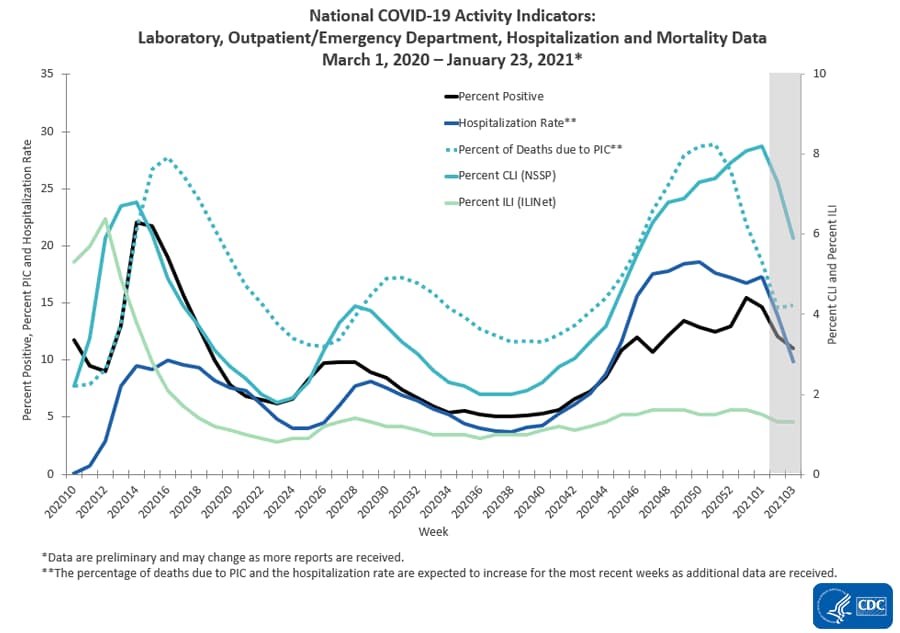
source: https://www.cdc.gov/coronavirus/2019-ncov/covid-data/covidview/index.html
Hospitalizations Are The Only Accurate Gauge As Reporting Is Not Affected By Holidays
The 4 day Thanksgiving holiday period put the first wobble in the trends. Over weekends and holidays, the number of new cases and deaths decline. Over weekends, this is not a problem for week-over-week rolling averages as weekends are compared against the previous weekend. But when a holiday falls within a working week, a non-working day is compared to a working day which causes havok in the trends.
However, hospitalizations historically appear to be little affected by weekends or holidays – the daily counts do not vary significantly from day-to-day.
The hospitalization growth rate trend is improving.

For the Thanksgiving and the end of the year holiday period – roughly, it seems each appears to have added around 5 % to the rate of growth of new cases, hospitalizations, and deaths.
Historically, hospitalization growth follows new case growth by one to two weeks.
As an analyst, I use the rate of growth to determine the trend. But, the size of the pandemic is growing in terms of real numbers – and if the rate of growth does not become negative – the pandemic will overwhelm all resources.
The graph below shows the rate of growth relative to the growth a week earlier updated through today [note that negative numbers mean the rolling averages are LOWER than the rolling averages one week ago]. As one can see, the rate of growth for new cases peaked in early December 2020 for Thanksgiving, and early January 2021 for end of year holidays – and the rate of growth is now contracting.

In the scheme of things, new cases decline first, followed by hospitalizations, and then deaths.
It is up to each of our readers to protect themselves and others by washing your hands, wearing a mask, avoiding crowds, and maintaining social distancing.
Will The New Variants Cause The Next Spike?
Maybe and maybe not. It all depends on vaccinations:
- the more people that are vaccinated reduces the pool of people that can be infected. Today we have removed over 7% of the population from being infected which theoretically should reduce the infection rate by 7% [it is unstudied whether the vaccines prevent a vaccinated person from being a carrier of the virus even though showing no signs]. If the vaccines are shown to stop transmission, then in theory it would reduce the infection rate by double the percent vaccinated [in this case you prevent your own infection and do not pass it along to another].
- it is also unknown what the effective rate of the current vaccines is against mutations that seem to appear almost daily. As an example, if the effective rate drops to 60%, it means the 7% reduction in the infection rate discussed above is almost cut in half. The South African and Brazilian variant is somewhat immune to the current vaccines.
- The pandemic should be over immediately if everyone could be vaccinated today. The problem is that every day brings a new mutation (which would not appear if the pandemic was stopped). The longer the immunization process takes – the more ineffective the vaccine will become.
- It is not clear whether the vaccine prevents those vaccinated from spreading the virus. It seems to be well documented that it normally stops the virus from taking hold and when it does not – the infection is mild.
Coronavirus News You May Have Missed
Experts warn not to take pain reliever before getting the COVID-19 vaccine – ABC
COVID-19 vaccines from Pfizer-BioNTech and Moderna are being offered to an increasing number of people. Vaccine recipients typically experience minimal side effects — the most common being temporary pain and swelling at the injection site, fevers, chills, tiredness, muscle aches and pains and headaches.
While these side effects are generally a minor nuisance to most people, some attempt to prevent them by taking common over-the-counter pain relievers like acetaminophen (Tylenol) or ibuprofen (e.g., Motrin, Advil) beforehand. However, experts said these medications might not just dull the pain, but they may dull the vaccine from fully working.
We do not recommend premedication with ibuprofen or Tylenol before COVID-19 vaccines due to the lack of data on how it impacts the vaccine-induced antibody responses,” Dr. Simone Wildes, an infectious disease specialist at South Shore Medical Center and a member of Massachusetts’ COVID-19 Vaccine Advisory Group, told ABC News.
The side effects from the vaccines are caused by activation of the immune system, meaning that the immune system is working and starting to build immunity to COVID-19 — this is what we want. These pain relievers may prevent parts of the immune system from working and slow down the immune response. There is a theory that taking these medications before immunization may reduce their effectiveness.
A study from Duke University found that children who took pain relievers before getting their childhood vaccines had fewer antibodies than those who did not take the medications, which could mean less protection. However, there were still protective antibody levels, despite the blunting.
Johnson & Johnson’s COVID-19 one-dose vaccine candidate was 66% effective overall against moderate to severe COVID-19 in a multinational phase III trial, and 72% effective in the U.S. cohort, the company said in a press release on Friday.
Interim data showed 468 symptomatic cases of COVID-19 from 43,783 adult volunteers in the U.S., Latin America and South Africa, who comprised the phase 3 ENSEMBLE trial. The one-dose vaccine met its co-primary endpoints, which was protection against symptomatic COVID-19 at day 14 and day 28 following vaccination.
Notably, however, the primary outcome did not count mild COVID-19 cases, whereas the vaccines now in distribution from Pfizer/BioNTech and Moderna did while achieving efficacy rates close to 95%. The new trial had co-primary endpoints of moderate-severe illness assessed at 14 days and 28 days after dosing.
Specifically, Ja∓J’s ENSEMBLE trial defined moderate COVID as a positive PCR test plus at least one of the following: evidence of pneumonia, deep vein thrombosis, shortness of breath or abnormal blood oxygen saturation above 93%, or respiratory rate ≥20); or two or more systemic symptoms suggestive of COVID-19. Moderna and Pfizer, on the other hand, defined cases more liberally; a cough plus positive PCR test was enough to count toward their primary endpoints.
Criteria for severe COVID-19 in ENSEMBLE included “signs consistent with severe systemic illness, admission to an intensive care unit, respiratory failure, shock, organ failure or death, among other factors,” as well as a positive PCR test, the company said.
There were no deaths in the vaccine group, and five deaths in the placebo group related to COVID-19, and 13 deaths in the placebo group and three deaths in the vaccine group overall.
The product, developed by Johnson & Johnson’s Janssen unit, uses an adenoviral vector to deliver genetic material encoding coronavirus spike protein elements. It is stable for months at refrigerator temperatures. The company is also conducting another phase III trial called ENSEMBLE 2 in which participants will receive two doses, about 2 months apart.
Anthony Fauci, MD, director of the National Institute of Allergy and Infectious Diseases, which partially funded the trial, said in a media briefing that if there had not been vaccine candidates showing 94% and 95% efficacy, “one would’ve said this [72% efficacy] was an absolutely spectacular result.”
For combined endpoints, protection in the U.S. was 72%, with 66% in Latin American countries and 57% in South Africa, where most cases were due to the South African variant.
… The U.S. government purchased 100 million doses of vaccine from Johnson & Johnson to be delivered by the end of June, which committed to producing up to one billion doses this year.
Matt Hepburn, MD, the COVID-19 Response Vaccine Team Lead, said the U.S. government would be looking at how best to use this single-dose vaccine to “augment the current vaccination roll-out that we see” in this country.
[editor’s note: By comparison, the seasonal flu vaccine ranges from an average high of about 60% effective to as low as about 20% depending on the year.] [editor’s note: Johnson & Johnson plans to submit an emergency use application to FDA next week, company official says]
Novavax’s protein-based COVID-19 vaccine candidate demonstrated nearly 90% efficacy against COVID-19, in a cohort where half the cases were due to the new U.K. variant, the company said in a press release on Thursday.
However, the news was less positive from a trial in South Africa, where overall vaccine efficacy was under 50% against cases largely due to the trickier South African variant.
Moreover, findings from that study suggested prior infection with the wild-type strain may not fully protect against new infection from the variant strain.
The vaccine is a recombinant version of the coronavirus spike protein, produced in insect cells, and thus represents a relatively conventional technology that also differs from the COVID-19 vaccines now in distribution.
In an interim analysis of a phase III trial conducted in Great Britain, 89.3% efficacy (95% CI 75.2%-95.4%) was achieved against PCR-confirmed symptomatic COVID-19. This was based on 62 COVID-19 cases among some 15,000 participants, with 56 observed in the placebo group and six in those receiving the active vaccine. Of these 62 cases, only one was classified as severe.
And Novavax touted a preliminary analysis indicating that 32 of the 62 cases were the so-called U.K. coronavirus variant. Based on PCR testing, vaccine efficacy was 95.6% against the original COVID-19 strain and 85.6% against the U.K. variant strain in the post-hoc analysis.
The phase III study enrolled adults ages 18-84, including 27% age 65 and older. The primary endpoint was PCR-confirmed symptomatic COVID-19 at least 7 days after the second of the two-dose regimen in serologically negative participants.
Preliminary safety data indicated that adverse events were infrequent and mostly comparable between groups. The manufacturer said it plans to share full results of the trial via pre-publication servers and submit them to a peer-reviewed journal.
Novavax also provided topline results from a phase IIb trial in South Africa of the vaccine in which about 6% of participants were HIV-positive. Here, the vaccine showed 60% efficacy (95% CI 19.9%-80.1%) in the HIV-negative population; it was much less effective in the HIV-infected participants, leading to overall vaccine efficacy of 49.4% (95% CI 6.1%-72.8%) for the entire study population.
There were 29 COVID-19 cases in the placebo group (one severe) and 15 in the vaccine group (none severe).
Most of these cases involved the so-called South African variant that includes multiple mutations in the coronavirus spike protein. Preliminary sequencing data indicated that the variant was responsible for 25 of 27 cases analyzed.
Asthma Patients Get Reassurance on COVID-19 – MedPage
Early in the COVID-19 pandemic, both the CDC and the World Health Organization identified asthma patients as being at high risk for severe disease and hospitalization, but it soon became evident that this may not be the case when study after study showed little or no support for that conclusion.
Now the largest research review published to date provides even stronger evidence that the risk for severe or fatal COVID-19 in asthma patients is similar to that of the general population — as long as the asthma remains well controlled.
The review of 150 studies conducted throughout the world should provide reassurance to asthma patients, said Rajiv Dhand, MD, of the University of Tennessee Medical Center in Knoxville, discussing his team’s study now online in the American Journal of Respiratory and Critical Care Medicine.
“The message to patients is, if they do get COVID there is no reason to believe their disease will be more severe than anyone else,” Dhand told MedPage Today. “But it is important that they stay on their asthma meds. It is especially important right now to not let asthma get out of control.”
CDC guidance on the subject, last updated Jan. 20, still warns that people with moderate-to-severe asthma may be “at higher risk of getting very sick from COVID-19.” Dhand said he would like to see federal health officials revisit that.
“I think the guidance should reflect the research, which has not shown firm evidence of increased risk,” he said. “That would be more straightforward and it would help reassure the public.”
The nation’s largest group of allergists and immunologists did recently weigh in, in an effort to ease the fears of asthma patients: A press release last month from the American Academy of Allergy, Asthma & Immunology noted that despite the CDC statement that asthma patients may have a greater risk for severe disease if they become sick with COVID-19, “there are no published data to support this determination at this time.”
How Much Protection Do Babies Get From Mom’s COVID Antibodies? – MedPage
Mothers with COVID-19 produced a robust antibody response, but transfer of antibodies across the placenta to their infants was less efficient than expected, researchers found.
In an analysis of pregnant women who had COVID-19, neutralizing activity — which measures the potency of antibody response — was detected in 94% of maternal blood samples and only 25% of cord blood, according to Naima Joseph, MD, MPH, of Emory University in Atlanta, and colleagues.
The overall cord-to-maternal anti-receptor binding (RBD) immunoglobulin (Ig)G ratio was 81%, Joseph reported at the Society for Maternal-Fetal Medicine annual meeting.
“There is a maternal antibody response that is robust following infection,” Joseph said in her presentation. But while she emphasized that anti-RBD domain IgG titers were detected in umbilical cord samples, she said it was unexpected that the efficiency of transfer was less than 1.
She told MedPage Today it was surprising to see inefficient transfer of SARS-C0V-2 antibodies to infants because rates are higher with other viral infections: “That gives us more clues that there’s something inherent to this virus that’s different from others, or maybe there is something about natural infection versus vaccine that will affect transplacental antibody transfer,” she said.
Joseph added that the study investigators have now expanded protocols to include vaccinated pregnant patients, in an attempt to assess how vaccination may affect passive immunity.
Racing the Virus: Why Tweaking the Vaccines Won’t Be Simple – Medscape
After developing and rolling out COVID-19 vaccines at record speed, drugmakers are already facing variants of the rapidly-evolving coronavirus that may render them ineffective, a challenge that will require months of research and a massive financial investment, according to disease experts.
Executives from Moderna Inc and Pfizer Inc and partner BioNTech SE are considering new versions of their vaccines to respond to the most concerning variants identified so far. That is just one piece of the work needed to stay ahead of the virus, nearly a dozen experts told Reuters.
A global surveillance network to assess emerging variants must be built. Scientists need to establish what level of antibodies will be required to protect people from COVID-19 and determine when vaccines need to be altered. And regulators must convey what is needed to demonstrate updated vaccines are still safe and effective.
“At this point, there is no evidence that these variants have changed the equation in terms of protection from the vaccine,” said Dr. Michael Osterholm, an infectious disease expert at the University of Minnesota. “But we have to be prepared for that.”
Johnson & Johnson told Reuters the concerning variant first identified in South African has got its attention and will tweak its vaccine accordingly if needed. Pfizer said it could produce a new vaccine relatively quickly, but a top vaccine executive said manufacturing it presents additional challenges.
The urgency of this effort is clear.
Moderna on Monday said lab studies showed antibodies made in response to its vaccine were six times less effective at neutralizing a lab-created version of a South African variant than prior versions of the virus. (https://bit.ly/3qMk8qf)
A study released on Wednesday ahead of peer review found the South African variant reduced neutralizing antibodies 8.6-fold for the Moderna vaccine and by 6.5-fold for the Pfizer/BioNTech shot (https://bit.ly/39stAcF), although a separate Pfizer-backed study released on Wednesday suggests its vaccine may be more hardy (https://bit.ly/3ck4v5l). Moderna said this week it is starting work on a potential booster shot.
New COVID Mutations May Prolong Pandemic for Another Year, Despite Vaccines – Newsweek
As more than 25 million Americans bask in the presumed protection of at least one dose of a COVID-19 vaccine, Dr. Anthony Fauci has hit the news shows with visions of herd immunity by the end of summer. That’s the rosy scenario we’re all desperate to believe in. An alternate scenario is starting to appear increasingly likely, though—one in which we could still be battling the pandemic well into 2022.
This view starts with our current, tenuous situation: case rates are frighteningly high, few people have immunity and the vaccine rollout is grindingly slow. The virus, meanwhile, is changing. It has already mutated into versions that spread more quickly, may kill more efficiently and threaten to undermine the effectiveness of vaccines.
The nightmare scenario: the virus mutates into a variant that renders current vaccines weakened or obsolete before the rollout reaches the 150 million or so people needed to achieve herd immunity, which would halt the virus in its tracks.
If we’re really unlucky, mutated versions of SARS-CoV-2 already circulating are enough to cause such a setback. That’s what some studies suggest—though these are preliminary, and it could take weeks or months of collecting patient data to clearly demonstrate what any particular variant is doing. “All indications are that these variants of the virus could be a significant challenge to the vaccine,” says Michael Osterholm, the straight-talking infectious disease expert at the University of Minnesota who was a key member of Joe Biden‘s pre-inauguration COVID advisory board. “Without a doubt that’s potentially the most overwhelming problem we face.”
Infectious disease expert: “These are really, in my mind, three almost equivalent vaccines” – CNN
After Johnson & Johnson announced its Covid-19 vaccine’s efficacy data, infectious disease expert Michael Osterholm says he assesses the vaccine to be equivalent to Moderna and Pfizer based on the study released.
“If I were in the general public right now, my first reaction would be, I want the one that protects me the most. You know, we haven’t really done a god job, I think, of explaining to the public that the immune response that occurs with the vaccine sometimes takes months to mature,” he told CNN, adding that the results from Johnson & Johnson “are really what happened in the two months after the last dose was administered.”
He highlighted that the vaccine’s study shows that the “protection got better the farther you got out from the vaccination. And that actually if we had followed this several more months, it might have been an equal, if not superior vaccine to what we’re seeing with Moderna and Pfizer.”
Johnson & Johnson’s single-shot Covid-19 vaccine was shown to be 66% effective in preventing moderate and severe disease in a global Phase 3 trial, but 85% effective against severe disease, the company announced Friday, adding that the vaccine was 72% effective against moderate and severe disease in the US.
Vaccines from Pfizer/BioNTech and Moderna that are already in the US market are about 95% effective overall against Covid-19.
“These are really, in my mind, three almost equivalent vaccines. The advantage here is that the Johnson & Johnson vaccine is much more stable. We can keep it in our refrigerators longer. We don’t have to worry about the extreme temperature issues. And for many clinics out there, this is going to be the ideal vaccine to have. One dose. Stable vaccine. Use it,” he said.
The following are foreign headlines with hyperlinks to the posts
Mexico’s death toll became the world’s third highest. Cases have surged in the country since December, and its hospitals are struggling.
Vietnam, which has been relatively successful in containing the virus, reported 82 new infections, the first local transmissions in nearly two months. Some cases may be connected to the variant that has been spreading in Britain.
The scale of Britain’s raging outbreak can seem overwhelming, with tens of thousands of new infections and more than 1,000 deaths added each day. But on hospitals’ COVID-19 wards, the pandemic feels both epic and intimate, as staff fight the virus one patient at a time, and with no end in sight
Dubai’s Woes: After opening itself for New Year’s revelers — and those escaping their own national lockdowns — Dubai now finds itself blamed by countries for spreading the coronavirus abroad. That’s as questions swirl about the city-state’s ability to handle reported cases spiking to record levels.
China WHO Mission: A World Health Organization team has visited a hospital where China says the first COVID-19 patients were treated more than a year ago.
Tanzania Virus Denial: The president of Tanzania says God has eliminated COVID-19 in his country. His own church now begs to differ. The local Catholic authority warned this week of a new wave of coronavirus infections, and government institutions now require staffers to take precautions.
Brazil’s Sao Paulo Spread: Just as Brazil has a glimpse of hope with the start of vaccination, it faces a dizzying resurgence that is straining facilities’ ability to treat patients. Intensive-care units in public hospitals have been overwhelmed in several states and municipalities across the country, including two state capitals in the remote Amazon and even some cities like Jau in Sao Paulo, the nation’s wealthiest state,
NZ Dangerous Liaison: New Zealand authorities say a woman returning to New Zealand who was placed in a 14-day mandatory hotel quarantine and a man working there were found in an inappropriate encounter.
Portugal set a new world record for the highest seven-day, per-capita average for new cases and deaths.
Trudeau announces new restrictions on international travel to Canada
Mexico surpasses India in coronavirus death toll
Deaths After Pfizer COVID Vaccines Not Linked to Shots: EU Medicine Agency
Scientist says UK coronavirus variant projected to dominate in Belgium by March
Israel’s health data suggests Pfizer and Moderna vaccines may be more effective than we thought
Maskless crowds pack Australian Open tennis exhibition in Covid-free Adelaide
The following additional national and state headlines with hyperlinks to the posts
Average rates of new cases have dropped 21% nationally in the past week, with at least 12 states seeing declines greater than 25%.
Novavax says its COVID-19 vaccine appears 89% effective, based on early findings from a British study. The shot also seems to work against the mutated versions of the virus identified in the U.K. and South Africa, though not as well.
Unionized nurses demonstrated across the country this week, seeking better protections from the virus. It’s a sign of the power that health care worker unions are seeking to build during the pandemic.
NY Nursing Homes: New York Gov. Andrew Cuomo’s administration confirmed that thousands more nursing home residents died of COVID-19 than the state’s official tallies had previously acknowledged.
Last year’s American economy shrank the most since 1946
Up to 10,000 US retail stores predicted to close this year: research firm
After vaccinating some teachers and other school staff — all falling outside of the phase 1a group — a Georgia medical center is now barred from the state’s vaccine program for six months.
Researchers at UC Irvine are working to develop a vaccine against all coronaviruses strains, such as those responsible for SARS and MERS as well as COVID-19.
The Miami Heat basketball team will use “coronavirus detection dogs” to screen fans for infection.
Andrew Brooks, creator of first saliva COVID test, dies
CDC: 16 states have used less than half of vaccines
Early Data Shows Striking Racial Disparities In Who’s Getting The COVID-19 Vaccine
Anchorage to ease restrictions after drop in coronavirus cases
Fact Check: Did the American Journal of Medicine Recommend Hydroxychloroquine For COVID?
Indoor dining will reopen on Valentine’s Day in N.Y.C., at 25 percent capacity, Cuomo says.
Columbia students go on tuition strike, saying online classes aren’t worth full price.
To help reassure skeptical Black Americans, Tyler Perry gets vaccinated as cameras roll.
Hundreds of Seattle residents lined up in pajamas at Seattle University and University of Washington clinics to receive a Covid-19 vaccine after a freezer failure left 1,650 Moderna vaccine doses at risk of expiring, KING 5 NBC reports.
The National Guard is supporting US vaccination efforts in 38 states
“We should be treating every case as if it’s a variant,” CDC director says
CDC director says US is ramping up surveillance and sequencing of Covid-19 variants
Today’s Posts On Econintersect Showing Impact Of The Pandemic With Hyperlinks
December 2020 Headline Pending Home Sales Decline Again
Final January 2021 Michigan Consumer Sentiment Declines
22 January 2021 ECRI’s WLI Growth Rate Continues To Improve
December 2020 Real Income Grew and Real Expenditures Declined
Rail Week Ending 16 January 2021 – Improvement This Week
Why The Next Major Hurdle To Ending The Pandemic Will Be About Persuading People To Get Vaccinated
GDP: The Fat Lady Ain’t Gonna Sing Anytime Soon
A Universal Influenza Vaccine May Be One Step Closer, Bringing Long-Lasting Protection Against Flu
Warning to Readers
The amount of politically biased articles on the internet continues to increase. And studies and opinions of the experts continue to contradict other studies and expert opinions. Honestly, it is difficult to believe anything anymore. A study usually cannot establish cause and effect – but only correlation. Be very careful what you believe about this pandemic.

I assemble this coronavirus update daily – sifting through the posts on the internet. I try to avoid politically slanted posts (mostly from CNN, New York Times, and the Washington Post) and can usually find unslanted posts on that subject from other sources on the internet. I wait to publish posts on subjects that I cannot validate across several sources. But after all this extra work, I do not know if I have conveyed the REAL facts. It is my job to provide information so that you have the facts necessary – and then it is up to readers to draw conclusions.
Analyst Opinion of Coronavirus Data
There are several takeaways that need to be understood when viewing coronavirus statistical data:
- The global counts are suspect for a variety of reasons including political. Even the U.S. count has issues as it is possible that as much as half the population has had coronavirus and was asymptomatic. It would be a far better metric using a random sampling of the population weekly. In short, we do not understand the size of the error in the tracking numbers.
- Just because some of the methodology used in aggregating the data in the U.S. is flawed – as long as the flaw is uniformly applied – you establish a baseline. This is why it is dangerous to compare two countries as they likely use different methodologies to determine who has (and who died) from coronavirus.
- COVID-19 and the flu are different but can have similar symptoms. For sure, COVID-19 so far is much more deadly than the flu. [click here to compare symptoms]
- From an industrial engineering point of view, one can argue that it is best to flatten the curve only to the point that the health care system is barely able to cope. This solution only works if-and-only-if one can catch this coronavirus once and develops immunity. In the case of COVID-19, herd immunity may need to be in the 80% to 85% range. WHO warns that few have developed antibodies to COVID-19 when recovering from COVID-19. Herd immunity does not look like an option without immunization although there is now a discussion of whether T-Cells play a part in immunity [which means one might have immunity without antibodies]
- Older population countries will have a significantly higher death rate as there is relatively few hospitalizations and deaths in younger age groups..
- There are at least 8 strains of the coronavirus. New York may have a deadlier strain imported from Europe, compared to less deadly viruses elsewhere in the United States.
- Each publication uses different cutoff times for its coronavirus statistics. Our data uses 11:00 am London time. Also, there is an unexplained variation in the total numbers both globally and in the U.S.
What we do or do not know about the coronavirus [actually there is little scientifically proven information]. Most of our knowledge is anecdotal, from studies with limited subjects, or from studies without peer review.
- How many people have been infected as many do not show symptoms?
- Masks do work. Unfortunately, early in the pandemic, many health experts — in the U.S. and around the world — decided that the public could not be trusted to hear the truth about masks. Instead, the experts spread a misleading message, discouraging the use of masks.
- Current thinking is that we develop 5 months of immunity from further COVID infection.
- The Moderna and Pfizer vaccines have an effectiveness rate of about 95 percent after two doses. That is on par with the vaccines for chickenpox and measles. The 95 percent number understates the effectivenessas it counts anyone who came down with a mild case of Covid-19 as a failure. But turning Covid into a typical flu — as the vaccines evidently did for most of the remaining 5 percent — is actually a success. Of the 32,000 people who received the Moderna or Pfizer vaccine in a research trial, only one contracted a severe Covid case.
- To what degree do people who never develop symptoms contribute to transmission? Research early in the pandemic suggested that the rate of asymptomatic infections could be as high as 81%. But a meta-analysis, which included 13 studies involving 21,708 people, calculated the rate of asymptomatic presentation to be 17%.
- The accuracy of rapid testing is questioned – and the more accurate test results are not being given in a timely manner.
- Can children widely spread coronavirus? [current thinking is that they are a minor source of the pandemic spread]
- Why have some places avoided big coronavirus outbreaks – and others hit hard?
- Air conditioning contributes to the pandemic spread.
- It appears that there is increased risk of infection and mortality for those living in larger occupancy households.
- Male patients have almost three times the odds of requiring intensive treatment unit (ITU) admission compared to females.
- Outdoor activities seem to be a lower risk than indoor activities.
- Will other medical treatments for Covid-19 ease symptoms and reduce deaths? So far only remdesivir, Bamlanivimab,
and Regeneron) are approved for treatment. What drugs work?
Arthritis drugs tocilizumab and sarilumab could cut relative risk of death of those in intensive care by 24%
- A current scientific understanding of the way the coronavirus works can be found [here].
There is now a vaccine available – the questions remain:
- how effective it will be in the general population,
- will there be any permanent side effects that will appear months from now,
- how long immunity will last [we can currently say we do not know if it will last more than 4 months],
- there is no evidence the vaccine will block transmission
Heavy breakouts of coronavirus have hit farmworkers. Farmworkers are essential to the food supply. They cannot shelter at home. Consider:
- they have high rates of respiratory disease [occupational hazard]
- they travel on crowded buses chartered by their employers
- few have health insurance
- they cannot social distance and live two to four to a room – and they eat together
- some reports say half are undocumented
- they are low paid and cannot afford not to work – so they will go to work sick
- they do not have access to sanitation when working
- a coronavirus outbreak among farmworkers can potentially shutter entire farm
The bottom line is that COVID-19 so far has been shown to be much more deadly than the data on the flu. Using CDC data, the flu has a mortality rate between 0.06 % and 0.11 % Vs. the coronavirus which to date has a mortality rate of 4 % [the 4% is the average of overall statistics – however in the last few months it has been hovering around 1.0%] – which makes it between 10 and 80 times more deadly. The reason for ranges:
Because influenza surveillance does not capture all cases of flu that occur in the U.S., CDC provides these estimated ranges to better reflect the larger burden of influenza.
There will be a commission set up after this pandemic ends to find fault [it is easy to find fault when a once-in-a-lifetime event occurs] and to produce recommendations for the next time a pandemic happens. Those that hate President Trump will conclude the virus is his fault.
Resources:
- Get the latest public health information from CDC: https://www.coronavirus.gov .
- Get the latest research from NIH: https://www.nih.gov/coronavirus.
- Find NCBI SARS-CoV-2 literature, sequence, and clinical content: https://www.ncbi.nlm.nih.gov/sars-cov-2/.
- List of studies: https://icite.od.nih.gov/covid19/search/#search:searchId=5ee124ed70bb967c49672dad
include(“/home/aleta/public_html/files/ad_openx.htm”); ?>


