


Written by Steven Hansen
The U.S. new cases 7-day rolling average are 16.6 % LOWER than the 7-day rolling average one week ago. U.S. hospitalizations due to COVID-19 are now 9.4 % LOWER than the rolling average one week ago. U.S. deaths due to coronavirus are now 7.7 % HIGHER than the rolling average one week ago. Today’s posts include:
- U.S. Coronavirus New Cases are 152,478
- U.S. Coronavirus hospitalizations are at an elevated 107,444
- U.S. Coronavirus deaths are at an elevated 3,943
- U.S. Coronavirus immunizations have been administered to 7.1 % of the population
- The 7-day rolling average rate of growth of the pandemic shows new cases worsened, hospitalizations improved, and deaths improved
- Current charts are showing a “holiday” peak is behind us – hopefully, this improving trend will remain in play even with the new strains
- Moderna’s and Pfizer’s vaccines Unsafe For People With Allergies.
- ‘COVID arm’ rash seen after Moderna vaccine annoying but harmless
- Officials Investigate Physician’s Death After COVID Vaccination
- FEMA asks Pentagon for help administering COVID-19 vaccines
- South Carolina Reports 1st Known U.S. Cases Of Variant From South Africa
- Despite dropping Covid-19 cases, 95% of US population lives in a “sustained hotspot”
- The first 22M Americans have been vaccinated for COVID-19, and initial safety data shows everything is going well, CDC says

The recent worsening of the trendlines for new cases is behind us which was attributed to going back to college/university, cooler weather causing more indoor activities, mutation of the virus, fatigue from wearing masks / social distancing, holiday activities, and some loosening of regulations designed to slow the coronavirus spread.
My continuing advice is to continue to wash your hands (especially after using the toilet as COVID first sheds in your stool), putting down the toilet seat (as flushing the toilet releases a plume), wear masks, avoid crowds, and maintain social distancing. No handwashing, mask, or social distancing will guarantee you do not get infected – but it sure as hell lowers the risk in all situations – and the evidence to-date shows a lower severity of COVID-19. In addition, certain activities are believed to carry a higher risk – like being inside in air conditioning and removing your mask (such as restaurants, around your children/grandchildren, bars, and gyms). It is all about viral load – and outdoor activities are generally safe if you can maintain social distance. Finally, studies show eating right (making sure you are supporting your immune system) and adequate sleep increase your ability to fight off COVID.
include($_SERVER[‘DOCUMENT_ROOT’].’/pages/coronavirus1.htm’); ?>
Hospitalizations (grey line) and Mortality (green line)
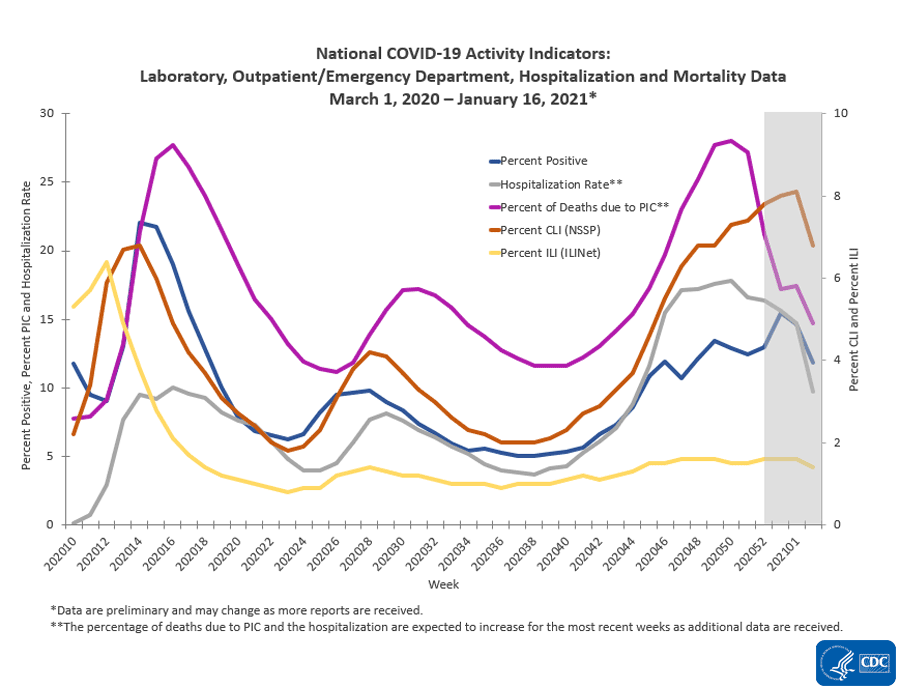
source: https://www.cdc.gov/coronavirus/2019-ncov/covid-data/covidview/index.html
Hospitalizations Are The Only Accurate Gauge As Reporting Is Not Affected By Holidays
The 4 day Thanksgiving holiday period put the first wobble in the trends. Over weekends and holidays, the number of new cases and deaths decline. Over weekends, this is not a problem for week-over-week rolling averages as weekends are compared against the previous weekend. But when a holiday falls within a working week, a non-working day is compared to a working day which causes havok in the trends.
However, hospitalizations historically appear to be little affected by weekends or holidays – the daily counts do not vary significantly from day-to-day.
The hospitalization growth rate trend is improving.

For the Thanksgiving and the end of the year holiday period – roughly, it seems each appears to have added around 5 % to the rate of growth of new cases, hospitalizations, and deaths.
Historically, hospitalization growth follows new case growth by one to two weeks.
As an analyst, I use the rate of growth to determine the trend. But, the size of the pandemic is growing in terms of real numbers – and if the rate of growth does not become negative – the pandemic will overwhelm all resources.
The graph below shows the rate of growth relative to the growth a week earlier updated through today [note that negative numbers mean the rolling averages are LOWER than the rolling averages one week ago]. As one can see, the rate of growth for new cases peaked in early December 2020 for Thanksgiving, and early January 2021 for end of year holidays – and the rate of growth is now contracting.

In the scheme of things, new cases decline first, followed by hospitalizations, and then deaths.
It is up to each of our readers to protect themselves and others by washing your hands, wearing a mask, avoiding crowds, and maintaining social distancing.
Will The New Variants Cause The Next Spike?
Maybe and maybe not. It all depends on vaccinations:
- the more people that are vaccinated reduces the pool of people that can be infected. Today we have removed over 7% of the population from being infected which theoretically should reduce the infection rate by 7% [it is unstudied whether the vaccines prevent a vaccinated person from being a carrier of the virus even though showing no signs]. If the vaccines are shown to stop transmission, then in theory it would reduce the infection rate by double the percent vaccinated [in this case you prevent your own infection and do not pass it along to another].
- it is also unknown what the effective rate of the current vaccines is against mutations that seem to appear almost daily. As an example, if the effective rate drops to 60%, it means the 7% reduction in the infection rate discussed above is almost cut in half. There continues to be worries that the South African and Brazilian variant is somewhat immune to the current vaccines.
- The pandemic should be over immediately if everyone could be vaccinated today. The problem is that every day brings a new mutation (which would not appear if the pandemic was stopped). The longer the immunization process takes – the more ineffective the vaccine will become.
- It is not clear whether the vaccine prevents those vaccinated from spreading the virus. It seems to be well documented that it normally stops the virus from taking hold and when it does not – the infection is mild.
Coronavirus News You May Have Missed
Moderna’s and Pfizer’s vaccines share the same problem: They’re unsafe for people with allergies – VaccineInjuryNews
The goal of mRNA vaccines, according to CDC, is to instruct cells to produce a harmless piece of a viral protein — in this case, the spike protein that the coronavirus uses to infect cells. This innocuous protein then triggers an immune response and allows the body to build a suitable defense against the COVID-19 virus. This, theoretically, would give whoever receives the vaccine protection against COVID-19 without having to risk getting sick with the viral disease. (Related: Moderna admits that some components of mRNA tech used in vaccines can cause “significant adverse events”.)
However, despite repeated assurances by both Pfizer and Moderna that their vaccines are safe, several experts have raised concerns about a particular ingredient used in mRNA vaccines. Polyethylene glycol (PEG) is a compound derived from petroleum and is used in various industrial products. In the form of tiny spheres, PEG is used to protect the mRNA in Pfizer and Moderna’s vaccines and help it penetrate cells. But according to Dr. Peter Marks, the director of the FDA’s Center for Biologics Evaluation and Research, this compound may be the culprit behind the anaphylactic reactions associated with the vaccines.
PEG has never been used before in any approved vaccine, mainly because there is no need for it. But there have been reports of certain drugs containing PEG occasionally causing anaphylaxis symptoms, such as rashes, shortness of breath, plummeting blood pressure and palpitations. Experts have also raised the possibility of people previously exposed to the compound having high levels of antibodies against it. This potentially puts them at great risk of a severe allergic reaction should they receive either one of the approved vaccines.
Why Scientists Are Very Worried About The Variant From Brazil – NPR
New coronavirus variants seem to be cropping up everywhere. There’s one from the U.K., which is more contagious and already circulating in the United States. There’s one from South Africa, which is forcing Moderna and Pfizer to reformulate their COVID-19 vaccines and create “booster” shots, just to make sure the vaccines maintain their efficacies.
But for some scientists, the most worrying variant might be the newest one. A variant called P.1, which emerged in early December in Manaus, Brazil, and by mid-January had already caused a massive resurgence in cases across the city of 2 million people.
On Monday, officials detected the first confirmed case of P.1 in the U.S., specifically in Minnesota. The state Department of Health picked up the case by randomly sequencing 50 nasal swabs from positive patients each week. The person infected with P.1. had previously traveled to Brazil.
“If you were to ask me right now, what’s most concerning of all the things that I’ve heard so far, it’s the fact that they are reporting a sudden increase in cases in Manaus, Brazil,” virus expert Jeremy Luban at the University of Massachusetts told NPR two weeks ago before the variant arrived in the United States. “Manaus already had 75% of people infected [in the spring of last year].”
The concern with P.1 is twofold: Scientists don’t understand why the variant has spread so explosively in Brazil, and the variant carries a particularly dangerous set of mutations.
While the variant from the U.K. took about three months to dominate the outbreak in England, P.1 took only about a month to dominate the outbreak in Manaus. In addition, Manaus had already been hit extremely hard by the virus in April. One study estimated that the population should have reached herd immunity and the virus shouldn’t be able to spread easily in the community. So why would the city see an even bigger surge 10 months later? Could P.1 be evading the antibodies made against the previous version of the virus, making reinfections easier? Could it just be significantly more contagious? Could both be true?
“While we don’t *know* exactly why this variant has been so apparently successful in Brazil, none of the explanations on the table are good,” epidemiologist Bill Hanage at Harvard University wrote on Twitter.
Reinfections are a serious concern for several reasons. First off, like the variant from South Africa, P.1 carries a cluster of mutations along the surface of the virus where antibodies — especially the potent antibodies — like to bind. “They are kind of the major targets of the immune system,” said virus expert Penny Moore at the National Institute for Communicable Diseases in South Africa and the University of KwaZulu-Natal. “So when we see a whole lot of mutations in [those surfaces], it raises the possibility that the mutations might be conferring immune escape.” That is, the mutations are helping the virus evade antibodies or escape recognition by them. In essence, the mutations are providing the virus with a type of invisibility cloak.
Officials Investigate Physician’s Death After COVID Vaccination – MedPage
After a Miami doctor died this month from an unusual blood disorder just 2 weeks after receiving the COVID-19 vaccine, state and federal officials are investigating the case further.
Gregory Michael, MD, a 56-year-old ob/gyn in private practice in Florida, died from complications of immune thrombocytopenia (ITP), according to a Facebook post written by his wife, Heidi Neckelmann.
Public health officials at the state and federal level are continuing to investigate Michael’s case in relation to the COVID-19 injection, but vaccine experts and hematologists have emphasized that this case is extremely rare, and the coincidental timing of ITP and vaccination doesn’t demonstrate causality.
Michael went to the hospital three days after getting his first dose of Pfizer’s mRNA injection after noticing petechiae on his hands and feet, Neckelmann wrote on Facebook. He was admitted to the emergency room, where his blood test showed his platelet count at zero, and he was diagnosed with ITP.
For 2 weeks, Michael’s care team tried to increase his platelets, but their attempts were unsuccessful, Neckelmann wrote. Doctors scheduled him for a last-resort splenectomy; then, two days before the procedure, Michael suffered a fatal hemorrhagic stroke, according to reports. He died in early January, 16 days after he was first immunized.
Neckelmann wrote that Michael was “very healthy,” stating that he delivered many babies during the pandemic and was loved by his community. She added that Michael was a “pro vaccine advocate,” which is why he got it himself.
Federal public health officials confirmed to MedPage Today their investigation into Michael’s death. CDC spokesperson Kristen Nordlund told MedPage Today in an email that officials will continue to evaluate the situation and provide timely updates. “Our thoughts are with the family during this heartbreaking time,” she said.
FEMA asks Pentagon for help administering COVID-19 vaccines – The Hill
The Federal Emergency Management Agency (FEMA) has asked the Pentagon to assist with President Biden’s goal to vaccinate 100 million people against the coronavirus in his first 100 days in office, the Department of Defense’s (DOD) top spokesman said Thursday.
“The Department of Defense has received a request from FEMA for assistance in administering COVID-19 vaccine at various locations across the country. The Department is evaluating the request, and what kinds of support it can provide,” Pentagon press secretary John Kirby said in a statement.
Kirby said that given the significance of the request, “it will be reviewed urgently but carefully” to determine what military assets can be made available to help safely.
“As [Defense Secretary Lloyd Austin] has said, DOD is committed to do as much as it possibly can to assist the whole-of-government effort against COVID-19.”
CNN was the first to report on the discussions between the Pentagon and the Department of Homeland Security, of which FEMA is a part, on how the military can assist the agency.
Among the possible solutions is sending up to 10,000 active-duty and National Guard forces to so-called vaccination megahubs.
Despite dropping Covid-19 cases, 95% of US population lives in a “sustained hotspot” – CNN
New Covid-19 cases continue to trend downward, with 16% fewer cases reported this week than last. But 95% of the US population lives in a county that the federal government considers to be a “sustained hotspot,” according to a report.
The interagency White House Covid-19 Team publishes a daily report tracking key indicators for regions, states, cities and counties across the country. Wednesday’s report showed that two-thirds of counties reported fewer Covid-19 cases in the past seven days than they had the week prior, and one-third of counties reported fewer deaths this week than last.
But more than 1,900 counties – home to 95% of the population – are still considered “sustained hotspots,” or places that maintain a high case burden and may be at risk for a strain on health care resources.
More than half of the US population lives in a county with a test positivity rate of 10% or higher, which could indicate an undercount in cases. About 5% of the population lives in a county where at least 1 in 5 people are testing positive for Covid-19, including five counties in the Atlanta metro region, along with four counties each in the Dallas, Cincinnati and Tulsa metro regions.
Early safety data from the first month of COVID-19 vaccination finds the shots are as safe as the studies suggested they’d be.
Everyone who experienced an allergic response has been treated successfully, and no other serious problems have turned up among the first 22 million people vaccinated, according to the Centers for Disease Control and Prevention.
The data was collected from several tracking systems, including a voluntary one in which people who are vaccinated report their symptoms via text. Another allows people who believe they have been harmed by a vaccine to contribute their information, and athird collects reports from medical records.
Although it’s never possible to prove something is completely safe, data from these tracking systems suggests the vaccines are not causing large numbers of unusual or dangerous results.
Wednesday, Dr. Tom Shimabukuro, deputy director of the CDC’s Immunization Safety Office, briefed a CDC advisory committee on the agency’s review of safety data collected on the two authorized vaccines.
Side effects remain a common result of both the Pfizer-BioNTech and Moderna vaccines – 70% of people who self-reported said they suffered pain.
Vaccinated people have suffered major health crises and even death within a few days of receiving a shot, but the rate of those events is no higher than would be expected in the general population and cannot be connected to the vaccine, the review found.
Shimabukuro did not address the several people reported to have died after receiving a vaccine, including a Florida doctor and a California X-ray technologist.
South Carolina Reports 1st Known U.S. Cases Of Variant From South Africa – NPR
Health officials have identified the first U.S. cases of the coronavirus variant that was initially detected in South Africa. The Centers for Disease Control and Prevention says the variant, known as B 1.351, has been found in South Carolina.
“CDC is early in its efforts to understand this variant and will continue to provide updates as we learn more,” the agency said. “At this time, we have no evidence that infections by this variant cause more severe disease. Like the U.K. and Brazilian variants, preliminary data suggests this variant may spread more easily and quickly than other variants.”
The two cases in South Carolina involve adults in the eastern part of the state, from the Lowcountry and Pee Dee regions, according to the state’s Department of Health and Environmental Control. It did not provide more details about the patients, citing privacy concerns.
“At this point in time, there is no known travel history and no connection between these two cases,” the agency said.
‘COVID arm’ rash seen after Moderna vaccine annoying but harmless, doctors say – USA Today
An angry red rash being called “COVID arm” is a harmless but annoying response in some people who get the Moderna vaccine. Aside from sometimes being itchy, it doesn’t appear to be dangerous, and people who get it should not hesitate to get their second dose of the vaccine, doctors say.
There is no indication the reaction is anything but a topical – and brief – response as the body’s immune system goes to work, said Dr. Esther Freeman, director of global health dermatology at Massachusetts General Hospital.
“We want to reassure people that this is a known phenomenon,” she said. “Having a big red splotch on your arm for a couple of days may not be fun but the reality is there’s no need to panic and no reason not to get your second shot.”
Freeman is the principal investigator in theglobal COVID-19 dermatological registry, which is collecting case reports from doctors of people experiencing COVID-19 responses. So far, there are only 14 examples in the registry, but she thinks there are more that haven’t been reported.
COVID-19 vaccine reactions can be reported on the CDC’s V-safe page.
Dermatologists and allergists are studying the side effect, which they’ve tentatively dubbed “delayed cutaneous hypersensitivity.” Laypeople are calling it “COVID arm.”
The rash is red, sometimes itchy and painful to the touch, and can be as much five or six inches across. It always occurs on the arm where the shot was given.
“It’s temporarily dramatic, but it will go away” within 24 hours to a week, Freeman said.
The specific reaction has occurred only in people who’ve gotten the Moderna vaccine, not the Pfizer vaccine, Freeman said. A small number of rash reactions were reported in Moderna’s clinical trials.
[editor’s note: also readUK COVID Variant Sufferers Cough More, but Smell Less Affected: Survey]
The following are foreign headlines with hyperlinks to the posts
The World Health Organization warned that the world is facing a “pandemic paradox” — vaccine availability brings sense that the pandemic is winding down, yet people must still follow restrictions as new virus mutations pose danger.
The World Health Organization said in a statement new coronavirus variants that are highly contagious are “fueling Africa’s second wave,” and the variant first identified in South Africa “is predominant and powering record case numbers in South Africa and the sub-region.”
Many of the richest countries in the world are part of the 27-nation European Union — most with a universal health care system to boot. But that seems to be counting for little in the global vaccination drive. The bloc is coming under searing criticism for the slow rollout of its vaccination campaign.
The European Union has suggested that drugmaker AstraZeneca divert supplies of its coronavirus vaccine from the U.K. to mainland Europe, as a battle over production delays and supply continues.
EU orders inspection of AstraZeneca’s Belgium site following vaccine delivery delays
Britain’s Lockdown: Prime Minister Boris Johnson has indicated that the lockdown in England will remain in place until at least March 8 as he ruled out any imminent return to school for most students.
A steady decrease in new coronavirus infections three weeks into Cyprus’ nationwide lockdown means authorities can start the gradual, targeted lifting of restrictions in February
Police in Thailand say they have arrested 89 foreigners for violating coronavirus regulations at a party on a popular resort island. The raid on the Three Sixty Bar on Koh Phangan also netted 22 Thais, including the bar’s owner and another who sold drinks there.
Efforts to dissuade Chinese from traveling for the Lunar New Year appear to be working. Beijing’s main train station was largely quiet and estimates of passenger totals were smaller than in past years.
As the variants continue to spread in many countries, Norway announced it will prohibit all non-essential visitors from crossing its borders.
Ireland’s deputy prime minister said that the country probably won’t reach herd immunity before autumn, making summer vacations overseas “very unlikely.”
COVID-19 Infections Surge In Europe As Vaccines Lag
China Using Anal Swabs for Some COVID Testing
Germany Recommends AstraZeneca COVID-19 Shot Only for Under 65s
Germany says vaccine shortages are likely to last another 10 weeks
‘Leftover’ COVID Vaccines Offered To Non-Priority Groups in England
Italian Doctor Charged With Murdering COVID Patients for Bed Space
Vietnam reports 82 cases, its first local transmissions in nearly two months.
The following additional national and state headlines with hyperlinks to the posts
When public health workers transporting vaccine doses in Oregon got stuck in a snowstorm, they improvised to ensure that the shots wouldn’t go to waste: They vaccinated other stranded drivers on the spot.
States Easing Restrictions: Several states are loosening their coronavirus restrictions on restaurants and other businesses because of improved infection and hospitalization numbers but are moving cautiously, in part because of the more contagious variant taking hold in the U.S
Fed holds rates at near-zero as it watches progress on vaccinations
Biden Signs Executive Order To Ban The Term ‘China Virus
A lab study showed that Pfizer/BioNTech’s COVID-19 vaccine produced antibodies that effectively neutralized the U.K. variant, but the vaccine appeared slightly less effective against the South Africa variant.
Regeneron announced that its antibody cocktail (casirivimab and imdevimab) is effective against both the U.K. (B.1.1.7) and South African variant (B.1.351).
The new administration has also begun the process of allowing retired doctors and nurses to administer vaccines.
COVID-19 deaths of nursing home residents in New York have been undercounted by about 50% as poor infection-control practices and understaffing fueled the coronavirus crisis, New York’s Attorney General reported Thursday.
Sinclair ends show after COVID-19 misinformation
Hall of Famer Michael Strahan has coronavirus
Sinclair cancels Eric Bolling’s show, host to launch podcast with Brett Favre
Arizona Nursing Home Scrutinized for Making COVID-Infected Employees Work
Biden COVID Adviser Criticizes Newsom for Reopening California
Stimulus Payments Arriving on Debit Cards Are Being Confused For Scams
Florida Wants Tokyo’s 2021 Olympics Despite Rising COVID Infections, Deaths
San Fran Mayor Criticizes School Board’s COVID Plan As They Rename Schools
Inside the White House, strict rules aim to slow the spread of the coronavirus

Lowe’s plans to hire 50,000 workers in the U.S. ahead of the spring season when Americans stuck at home are likely to turn to remodeling, Reuters reports.
Legislators from Arizona, Michigan, Ohio, Maryland, Kentucky, Indiana and Pennsylvania are moving to curb the authority of governors to impose emergency restrictions such as mask rules and business shutdowns, according to the Associated Press.
U.S. gross domestic product increased 4.0% in the fourth quarter, slightly below the 4.3% expectation from economists surveyed by Dow Jones
There’s a chance schools will be able to reopen in the fall, says incoming US surgeon general
Covid-19 outbreaks on college campuses put broader community at risk
Today’s Posts On Econintersect Showing Impact Of The Pandemic With Hyperlinks
Warning to Readers
The amount of politically biased articles on the internet continues to increase. And studies and opinions of the experts continue to contradict other studies and expert opinions. Honestly, it is difficult to believe anything anymore. A study usually cannot establish cause and effect – but only correlation. Be very careful what you believe about this pandemic.

I assemble this coronavirus update daily – sifting through the posts on the internet. I try to avoid politically slanted posts (mostly from CNN, New York Times, and the Washington Post) and can usually find unslanted posts on that subject from other sources on the internet. I wait to publish posts on subjects that I cannot validate across several sources. But after all this extra work, I do not know if I have conveyed the REAL facts. It is my job to provide information so that you have the facts necessary – and then it is up to readers to draw conclusions.
Analyst Opinion of Coronavirus Data
There are several takeaways that need to be understood when viewing coronavirus statistical data:
- The global counts are suspect for a variety of reasons including political. Even the U.S. count has issues as it is possible that as much as half the population has had coronavirus and was asymptomatic. It would be a far better metric using a random sampling of the population weekly. In short, we do not understand the size of the error in the tracking numbers.
- Just because some of the methodology used in aggregating the data in the U.S. is flawed – as long as the flaw is uniformly applied – you establish a baseline. This is why it is dangerous to compare two countries as they likely use different methodologies to determine who has (and who died) from coronavirus.
- COVID-19 and the flu are different but can have similar symptoms. For sure, COVID-19 so far is much more deadly than the flu. [click here to compare symptoms]
- From an industrial engineering point of view, one can argue that it is best to flatten the curve only to the point that the health care system is barely able to cope. This solution only works if-and-only-if one can catch this coronavirus once and develops immunity. In the case of COVID-19, herd immunity may need to be in the 80% to 85% range. WHO warns that few have developed antibodies to COVID-19 when recovering from COVID-19. Herd immunity does not look like an option without immunization although there is now a discussion of whether T-Cells play a part in immunity [which means one might have immunity without antibodies]
- Older population countries will have a significantly higher death rate as there is relatively few hospitalizations and deaths in younger age groups..
- There are at least 8 strains of the coronavirus. New York may have a deadlier strain imported from Europe, compared to less deadly viruses elsewhere in the United States.
- Each publication uses different cutoff times for its coronavirus statistics. Our data uses 11:00 am London time. Also, there is an unexplained variation in the total numbers both globally and in the U.S.
What we do or do not know about the coronavirus [actually there is little scientifically proven information]. Most of our knowledge is anecdotal, from studies with limited subjects, or from studies without peer review.
- How many people have been infected as many do not show symptoms?
- Masks do work. Unfortunately, early in the pandemic, many health experts — in the U.S. and around the world — decided that the public could not be trusted to hear the truth about masks. Instead, the experts spread a misleading message, discouraging the use of masks.
- Current thinking is that we develop 5 months of immunity from further COVID infection.
- The Moderna and Pfizer vaccines have an effectiveness rate of about 95 percent after two doses. That is on par with the vaccines for chickenpox and measles. The 95 percent number understates the effectivenessas it counts anyone who came down with a mild case of Covid-19 as a failure. But turning Covid into a typical flu — as the vaccines evidently did for most of the remaining 5 percent — is actually a success. Of the 32,000 people who received the Moderna or Pfizer vaccine in a research trial, only one contracted a severe Covid case.
- To what degree do people who never develop symptoms contribute to transmission? Research early in the pandemic suggested that the rate of asymptomatic infections could be as high as 81%. But a meta-analysis, which included 13 studies involving 21,708 people, calculated the rate of asymptomatic presentation to be 17%.
- The accuracy of rapid testing is questioned – and the more accurate test results are not being given in a timely manner.
- Can children widely spread coronavirus? [current thinking is that they are a minor source of the pandemic spread]
- Why have some places avoided big coronavirus outbreaks – and others hit hard?
- Air conditioning contributes to the pandemic spread.
- It appears that there is increased risk of infection and mortality for those living in larger occupancy households.
- Male patients have almost three times the odds of requiring intensive treatment unit (ITU) admission compared to females.
- Outdoor activities seem to be a lower risk than indoor activities.
- Will other medical treatments for Covid-19 ease symptoms and reduce deaths? So far only remdesivir, Bamlanivimab,
and Regeneron) are approved for treatment. What drugs work?
Arthritis drugs tocilizumab and sarilumab could cut relative risk of death of those in intensive care by 24%
- A current scientific understanding of the way the coronavirus works can be found [here].
There is now a vaccine available – the questions remain:
- how effective it will be in the general population,
- will there be any permanent side effects that will appear months from now,
- how long immunity will last [we can currently say we do not know if it will last more than 4 months],
- there is no evidence the vaccine will block transmission
Heavy breakouts of coronavirus have hit farmworkers. Farmworkers are essential to the food supply. They cannot shelter at home. Consider:
- they have high rates of respiratory disease [occupational hazard]
- they travel on crowded buses chartered by their employers
- few have health insurance
- they cannot social distance and live two to four to a room – and they eat together
- some reports say half are undocumented
- they are low paid and cannot afford not to work – so they will go to work sick
- they do not have access to sanitation when working
- a coronavirus outbreak among farmworkers can potentially shutter entire farm
The bottom line is that COVID-19 so far has been shown to be much more deadly than the data on the flu. Using CDC data, the flu has a mortality rate between 0.06 % and 0.11 % Vs. the coronavirus which to date has a mortality rate of 4 % [the 4% is the average of overall statistics – however in the last few months it has been hovering around 1.0%] – which makes it between 10 and 80 times more deadly. The reason for ranges:
Because influenza surveillance does not capture all cases of flu that occur in the U.S., CDC provides these estimated ranges to better reflect the larger burden of influenza.
There will be a commission set up after this pandemic ends to find fault [it is easy to find fault when a once-in-a-lifetime event occurs] and to produce recommendations for the next time a pandemic happens. Those that hate President Trump will conclude the virus is his fault.
Resources:
- Get the latest public health information from CDC: https://www.coronavirus.gov .
- Get the latest research from NIH: https://www.nih.gov/coronavirus.
- Find NCBI SARS-CoV-2 literature, sequence, and clinical content: https://www.ncbi.nlm.nih.gov/sars-cov-2/.
- List of studies: https://icite.od.nih.gov/covid19/search/#search:searchId=5ee124ed70bb967c49672dad
include(“/home/aleta/public_html/files/ad_openx.htm”); ?>


