



The four regional manufacturing surveys released to date for January are in expansion.
Analyst Opinion of Kansas City Fed Manufacturing
Kansas City Fed manufacturing has been one of the more stable districts. Note that the key internals were positive. This survey should be considered better than last month.
Both new orders insignificantly improved while the backlog was unchanged.
Market expectations from Econoday were ————- (consensus —-). The reported value was 17. Any value below zero is in contraction.

z kansas_man.PNG
The Federal Reserve Bank of Kansas City released the January Manufacturing Survey today. According to Chad Wilkerson, vice president and economist at the Federal Reserve Bank of Kansas City, the survey revealed that Tenth District manufacturing activity increased at a faster pace in January compared to a month ago and was similar to year ago levels. Expectations for future activity rose further. “Regional factories reported more growth in January,” said Wilkerson. “COVID-19 vaccination is a key factor in manufacturers’ overall business outlook for 2021, but with less impact on hiring and capital spending in the near-term.”
Tenth District manufacturing activity increased at a faster pace in January compared to a month ago and was similar to year ago levels (Chart 1, Tables 1 & 2). Expectations for future activity rose further. Prices paid for raw materials continued to rise rapidly, to the highest reading since 2011. Prices for finished goods also expanded from a month ago and a year ago. District firms expected prices for both raw materials and finished goods to increase further in the next six months.
The month-over-month composite index was 17 in January, up from 14 in December and 11 in November (Tables 1 & 2). The composite index is an average of the production, new orders, employment, supplier delivery time, and raw materials inventory indexes. Activity rose more at durable goods plants, driven by manufacturing of primary metals, machinery, electronics, and transportation equipment. Production, shipments, new orders, employment, employee workweeks, new orders for exports, and supplier delivery time increased further in January and order backlog expanded at a steady pace. Materials inventories remained positive while finished goods inventories were slightly negative. Year-over-year factory indexes were somewhat mixed in January, but the composite index was flat at 0. The future composite index expanded to the highest level in over a year at 24, up from 17 in December
Summary of all Federal Reserve Districts Manufacturing:
Richmond Fed (hyperlink to reports):

z richmond_man.PNGaeuro
Dallas Fed (hyperlink to reports):

z dallas_man.PNG
Philly Fed (hyperlink to reports):

z philly fed1.PNG
New York Fed (hyperlink to reports):

z empire1.PNG
Federal Reserve Industrial Production – Actual Data (hyperlink to report):
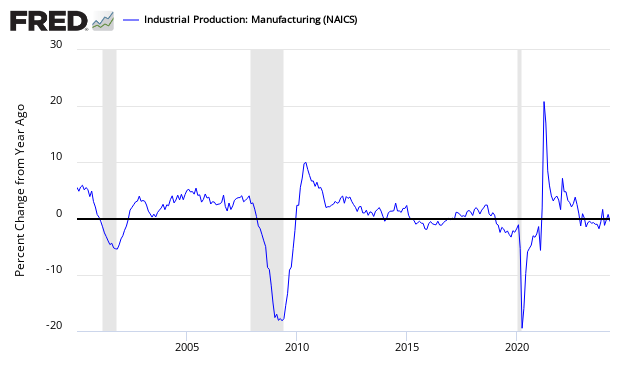
Holding this and other survey’s Econintersect follows accountable for their predictions, the following graph compares the hard data from Industrial Products manufacturing subindex (dark blue bar) and US Census manufacturing shipments (red bar) to the Kansas City Fed survey (light green bar).
Comparing Surveys to Hard Data:

z survey1.png
In the above graphic, hard data is the long bars, and surveys are the short bars. The arrows on the left side are the key to growth or contraction.
include(“/home/aleta/public_html/files/ad_openx.htm”); ?>


