


Written by Steven Hansen
The non-seasonally adjusted S and P CoreLogic Case-Shiller home price index (20 cities) year-over-year rate of home price growth continues to accelerate. The index authors stated, “Recent data are consistent with the view that COVID has encouraged potential buyers to move from urban apartments to suburban homes.”.

Analyst Opinion of Case-Shiller HPI
Please note from the authors:
Please note that transaction records for September 2020 for Wayne County, MI are now available. Due to delays at the local recording office caused by the COVID-19 lockdown, S&P Dow Jones Indices and CoreLogic were previously unable to generate a valid September 2020 update of the Detroit S&P CoreLogic Case-Shiller indices. However, there are not a sufficient number of records for October 2020 and November 2020 for Detroit. Since Wayne is the most populous county in the Detroit metro area, S&P Dow Jones Indices and CoreLogic are unable to generate a valid Detroit index value for the months of October and November. When the sale transactions data fully resume and sufficient data are collected, the Detroit index values for the month(s) with missing updates will be calculated.
All home price indices are now showing home price growth is accelerating year-over-year. At this point, it looks like the pandemic has little affected home prices (or sales for that matter).
- 20 city unadjusted home price rate of growth accelerated by 1.1 % month-over-month. [Econintersect uses the change in year-over-year growth from month-to-month to calculate the change in the rate of growth]
- Note that the Case-Shiller index is an average of the last three months of data.
- The market expected from Econoday:
| Consensus Range | Consensus | Actual | |
| 20-city, SA – M/M | 0.5 % to 1.0 % | +0.8 % | +1.4 % |
| 20-city, NSA – M/M | 0.4 % to 1.1 % | +0.8 % | +1.1 % |
| 20-city, NSA – Yr/Yr | 6.9 % to 9.2 % | +8.2 % | +9.1 % |
S&P/Case-Shiller Home Price Indices Year-over-Year Change
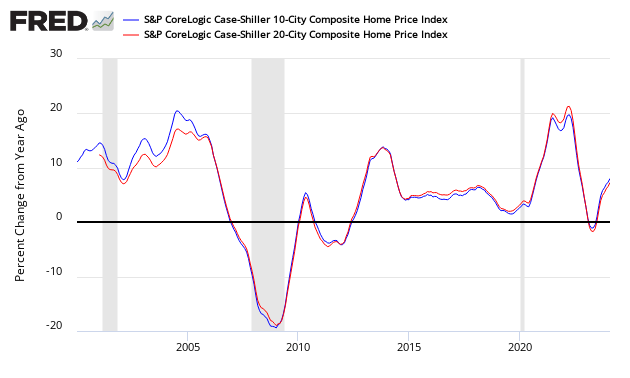
Comparing the NAR and Case-Shiller home price indices, it needs to be understood each of the indices uses a unique methodology in compiling their index – and no index is perfect.

The way to understand the dynamics of home prices is to watch the direction of the rate of change. Here home price growth is now accelerating.

There are some differences between the indices on the rate of “recovery” of home prices.
A synopsis of Authors of the Leading Indices:
Case Shiller’s Craig J. Lazzara, Managing Director and Global Head of Index Investment Strategy at S&P Dow Jones Indices stated:
“The trend of accelerating home prices that began in June 2020 has now reached its sixth month with November’s emphatic report,” says Craig J. Lazzara, Managing Director and Global Head of Index Investment Strategy at S&P Dow Jones Indices. “The National Composite Index gained 9.5% relative to its level a year ago, accelerating from October’s 8.4% increase. The 10- and 20-City Composites (up 8.8% and 9.1%, respectively) also rose more rapidly in November than they had done in October. The housing market’s strength was once again broadly-based: all 19 cities for which we have November data rose, and all 19 gained more in the 12 months ended in November than they had gained in the 12 months ended in October.
“As COVID-related restrictions began to grip the economy last spring, their effect on housing prices was unclear. Price growth decelerated in May and June before beginning a steady climb upward. November’s report continues that acceleration in a particularly impressive manner. The National Composite last matched this month’s 9.5% growth rate in February 2014, more than six and a half years ago. From the perspective of more than 30 years of S&P CoreLogic Case-Shiller data, November’s 9.5% year-over-year change ranks near the top decile of all monthly reports.
“Recent data are consistent with the view that COVID has encouraged potential buyers to move from urban apartments to suburban homes. This may represent a true secular shift in housing demand, or may simply represent an acceleration of moves that would have taken place over the next several years anyway. Future data will be required to address that question.
“Phoenix’s 13.8% increase led all cities for the 18 th consecutive month. Seattle (+12.7%) and San Diego (+12.3%) took the silver and bronze medals once again. Prices were strongest in the West (+10.1%) and Southwest (+9.7%) regions, with the historically lagging Northeast (+9.3%) also turning in an impressive month.”
CoreLogic believes home demand will remain firm moving forward (November 2020 Data). Per Dr. Frank Nothaft, chief economist at CoreLogic stated:
The demographic tailwind has arrived as Generation X and millennials drive housing demand,” said Dr. Frank Nothaft, chief economist at CoreLogic. “Lower-priced home values increased about one and a half times faster than higher-priced home values in November, as first-time buyers tend to seek out homes within the lower price ranges.
The housing market performed remarkably well in 2020 despite the volatile economic state. While we can expect to see lingering effects of COVID-19 resurgences and subsequent shutdowns in the early months of 2021, vaccine distributions and stimulus actions should revitalize economic activity and keep home purchase demand and home price growth strong.
From the National Association of Realtors (December 2020 data):
Home sales rose in December, and for 2020 as a whole, we saw sales perform at their highest levels since 2006, despite the pandemic. What’s even better is that this momentum is likely to carry into the new year, with more buyers expected to enter the market.
I predict a continuation of the strong activity that’s currently taking place in the housing market and in the overall economy.
Although mortgage rates are projected to increase, they will continue to hover near record lows at around 3%. Moreover, expect economic conditions to improve with additional stimulus forthcoming and vaccine distribution already underway.
To their credit, homebuilders and construction companies have increased efforts to build, with housing starts hitting an annual rate of near 1.7 million in December, with more focus on single-family homes. However, it will take vigorous new home construction in 2021 and in 2022 to adequately furnish the market to properly meet the demand.
The U.S. Federal Housing Finance Agency produces an All-Transactions House Price Index for the United States:

Econintersect publishes knowledgeable views of the housing market.
Caveats on the Use of Home Price Indices
The housing price decline seen since 2005 varies by zip code – and seems to have ended somewhere around the beginning of the 2Q2012. Every area of the country has differing characteristics. Since January 2006, the housing declines in Charlotte and Denver are well less than 10%, while Las Vegas home prices had declined by almost 60%.
Each home price index uses a different methodology – and this creates slightly different answers.
The most broadly based index is the US Federal Housing Finance Agency’s House Price Index (HPI) – a quarterly broad measure of the movement of single-family house prices. This index is a weighted, repeat-sales index on the same properties in 363 metro centers, compared to the 20 cities Case-Shiller.
The US Federal Housing Finance Agency also has an index (HPIPONM226S) based on 6,000,000 same home sales – a much broader index than Case-Shiller. Also, there is a big difference between home prices and owner’s equity (OEHRENWBSHNO) which has been included in the graph below.
Comparing Various Home Price Indices to Owner’s Equity (blue line)


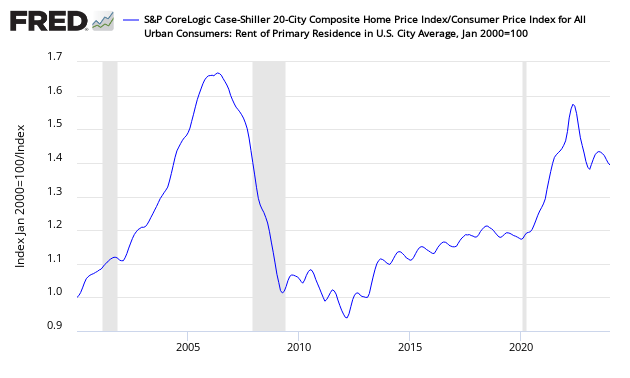
The affordability factor favors rental vs owning.
Price to Rent Ratio – Indexed on January 2000 – Based on Case-Shiller 20 cities index ratio to CPI Rent Index
include(“/home/aleta/public_html/files/ad_openx.htm”); ?>


